

Quick Summary: Meta ads transparency and competitor analysis tools help marketers decode what rivals are running on Facebook and Instagram by surfacing active campaigns, creative patterns, and messaging strategies. The best platforms combine Meta’s Ad Library data with deeper intelligence layers like creative fatigue signals, element-level breakdowns, and AI-powered variant generation to turn competitor insights into actionable campaign assets.
Knowing what competitors are running on Meta platforms gives teams a serious edge. Instead of guessing which creatives, copy, or offers will resonate, marketers can study what’s already working in their market and build on those insights.
The challenge? Meta’s Ad Library alone shows active ads without any performance context, creative longevity signals, or format patterns. That’s where specialized competitor analysis tools come in.
Here’s the thing though—not every tool tackles the same problem. Some focus purely on ad discovery and archival. Others add creative intelligence layers. A few go further with predictive fatigue tracking and AI-powered generation.
What Meta Ads Transparency Actually Means
Meta’s Ad Library is the baseline. Launched following regulatory scrutiny—including a $5 billion FTC penalty on Facebook in July 2019, alongside sweeping new privacy restrictions and significant requirements to boost accountability and transparency—the library makes all active ads searchable by advertiser name, topic, or region.
It’s free. It’s comprehensive. And it stops short of the signals media buyers actually need.
The Ad Library shows which ads are live, not how long they’ve been running, which variants got pulled early, or what creative elements correlate with staying power. There’s no historical depth beyond a rolling seven-year window for certain categories, no performance proxies, and no way to set alerts when a competitor launches a new campaign.
That’s where third-party transparency tools come in. They index the Ad Library continuously, layer on metadata like first-seen dates and format classification, and surface patterns the native interface hides.
Why Competitor Analysis Tools Matter in 2026
Competition for digital attention is fiercer than ever. Brands ship more creative variants, test more hooks, and cycle through messaging faster than in any prior year.
According to research published on arXiv.org, empirical studies reveal that approximately 20% of ad creatives succeed in delivering strong campaign performance. The other 80% miss the mark or plateau early.
Competitor analysis tools help teams avoid the 80%. By studying which creatives competitors keep live for weeks or months, marketers can infer what’s resonating—and reverse-engineer the strategic choices behind those ads.
The Andromeda Update, Meta’s AI-driven advertising framework introduced in 2025, reshaped the advertising ecosystem, making creative differentiation even more critical. Platforms that surface winning patterns quickly give teams a structural advantage.
Top Meta Ads Transparency and Competitor Analysis Tools
Here’s a breakdown of the platforms doing real work in this space. Each entry covers what the tool does, what it’s best for, and where it fits in the transparency-to-action spectrum.
1. Extuitive
Extuitive is a predictive AI platform focused on Meta and TikTok ads. It forecasts creative performance before launch by combining brand-specific historical data with a Polyintelligence engine powered by 150,000+ simulated AI consumer agents. Users connect a Shopify store or website, and the platform analyzes products, generates or refines ad assets (copy, images, videos), scores creatives for predicted CTR and ROAS (High/Medium/Low), and recommends winning directions.
The core value is eliminating wasted spend on live testing — it ranks and filters creatives in minutes instead of weeks, while continuously updating predictions as real campaigns run.
Best for: Shopify brands and e-commerce teams spending $10K+ per month on Meta ads who want to scale creative testing without burning budget on losers. Ideal for performance marketers who need data-driven creative decisions and faster iteration loops.
What it lacks: It is not a traditional ad spy or library tool — it does not index or show competitors’ live ads. Focus is almost entirely on your own creatives and brand data rather than broad competitor monitoring or visual inspiration boards. Pricing is premium (starts at $1,000/month).
Contact Information:
- Website: extuitive.com
- Email: [email protected]
- LinkedIn: www.linkedin.com/company/extuitive
- Twitter: x.com/Extuitive_Inc
- Instagram: www.instagram.com/extuitiveinc
2. Meta Ad Library (Free, Native)
Meta’s own Ad Library is the source of truth. Every active ad on Facebook, Instagram, Messenger, and Audience Network is searchable by advertiser, keyword, or region.
The interface is bare-bones: text search, a few dropdowns, and a grid of ad previews. There’s no historical depth visualization, no longevity filter, and no way to track when an ad first appeared beyond manually checking back.
Best for: one-off checks, verifying whether a specific advertiser is currently running ads, or accessing ads in regulated categories like housing or politics.
What it lacks: any intelligence layer. The Ad Library is a database, not an analysis tool.
3. AdStellar

AdStellar focuses on high-volume testing teams. The platform indexes Meta ads and adds creative intelligence signals like format classification, first-seen timestamps, and competitor campaign clustering.
The standout feature is creative production acceleration. After identifying a winning competitor hook, AdStellar’s AI layer generates on-brand variants, produces ad copy alternatives, and exports assets ready for upload.
Particularly strong for teams running high-volume testing who need to move from creative inspiration to launched ad sets without manual production bottlenecks.
Pricing information for AdStellar should be verified on the official website, as pricing may have changed.
4. Foreplay

Foreplay is built for creative teams. The platform combines ad discovery with a visual organization layer—think Pinterest for competitor ads, but with metadata and collaboration features.
Teams save ads to boards, tag them by theme or format, and share collections across departments. The search layer pulls from Meta, TikTok, and native ad networks, making it useful for cross-platform creative research.
Best for: agencies managing multiple clients, brand teams building seasonal creative briefs, or designers hunting for visual inspiration across channels.
What it doesn’t do: predictive fatigue tracking or automated alerts. Foreplay is a research and organization tool, not a monitoring system.
5. Minea

Minea targets e-commerce brands, especially dropshippers and D2C teams testing product ads. The platform indexes Meta and TikTok ads, then layers on product-specific filters like price point mentions, promotional language, and influencer collaboration detection.
The influencer collab detection automatically surfaces which creators a brand is partnering with and whether the same influencer runs ads for multiple brands.
Best for: product-focused advertisers who need to track competitor offers, pricing tests, and influencer partnerships in one place.
Pricing information varies—check Minea’s official website for current plans.
6. AdClarity by Semrush

AdClarity sits inside the Semrush ecosystem, which already covers SEO, PPC, and content analytics. The ad transparency layer adds display and social ad monitoring, including Meta placements.
The integration is the value proposition. Teams already using Semrush for keyword research or backlink tracking can pull competitor ad data into the same dashboard without switching platforms.
Best for: marketing teams that need cross-channel intelligence—SEO, Google Ads, and Meta ads—in a unified reporting layer.
What it’s not optimized for: creative-first teams. AdClarity focuses more on spend estimates and placement distribution than visual creative analysis.
7. BigSpy
BigSpy indexes over 100 million ads across Facebook, Instagram, YouTube, and other platforms. The search interface is straightforward: keyword, advertiser name, region, and date range.
The platform offers saved searches and limited daily searches on the free tier. Paid plans are available with tiered pricing for expanded search limits and export options.
Best for: teams on tight budgets who need basic ad discovery without the intelligence layers that premium platforms add.
Trade-off: no creative fatigue tracking, no AI generation, and minimal collaboration features.
8. PowerAdSpy
PowerAdSpy focuses on affiliate marketers and performance buyers. The platform indexes ads and adds engagement proxies—like counts, share counts, and comment sentiment—to help users infer which ads are gaining traction.
The engagement layer isn’t perfect (Meta doesn’t expose true engagement metrics in the Ad Library), but PowerAdSpy scrapes public post data where available and surfaces ads with high visible activity.
Best for: affiliate marketers hunting for offer angles, direct-response copywriters studying high-engagement hooks, or teams testing aggressive promotional messaging.
Pricing for PowerAdSpy is available on the official website, with tiered plans unlocking advanced filters and unlimited searches.
9. Pathmatics by Sensor Tower
Pathmatics is an enterprise-grade competitive intelligence platform. It tracks digital ad spending across display, video, social, and native channels, including detailed Meta campaign breakdowns.
The spend estimation layer uses proprietary algorithms to model competitor budgets, channel allocation, and seasonal pacing. This is valuable for brand strategy teams benchmarking against category leaders.
Best for: large brands, agencies managing Fortune 500 clients, or teams where budget allocation insights matter as much as creative analysis.
Pricing is custom—Pathmatics doesn’t publish standard tiers. Expect enterprise-level contracts.
10. MagicBrief
MagicBrief bridges ad discovery and creative production. The platform indexes competitor ads, lets teams organize them into mood boards, and then generates creative briefs pulling elements from saved references.
The brief generation feature auto-populates messaging themes, visual styles, and call-to-action patterns based on the ads a team has tagged. Designers and copywriters get a head start instead of interpreting raw ad screenshots.
Best for: creative agencies, in-house brand studios, or any team where the handoff from strategy to production tends to lose fidelity.
Pricing details are available on the official site—MagicBrief offers tiered plans based on team size and brief volume.
11. Hawky
Hawky operates at the deepest intelligence layer. The platform indexes Meta ads, tracks creative longevity, predicts fatigue, and adds element-level analysis—breaking down which visual components or copy patterns correlate with staying power.
The Copilot feature generates on-brand variants from competitor hooks, turning a single winning ad into multiple testable alternatives. The system also sends weekly competitor alerts, notifying teams when rivals launch new campaigns or shift messaging.
Best for: D2C brands and agencies running $50,000+ per month on Meta and Google, where creative velocity directly impacts ROAS.
Pricing is custom—Hawky tailors plans to ad spend volume and team size.
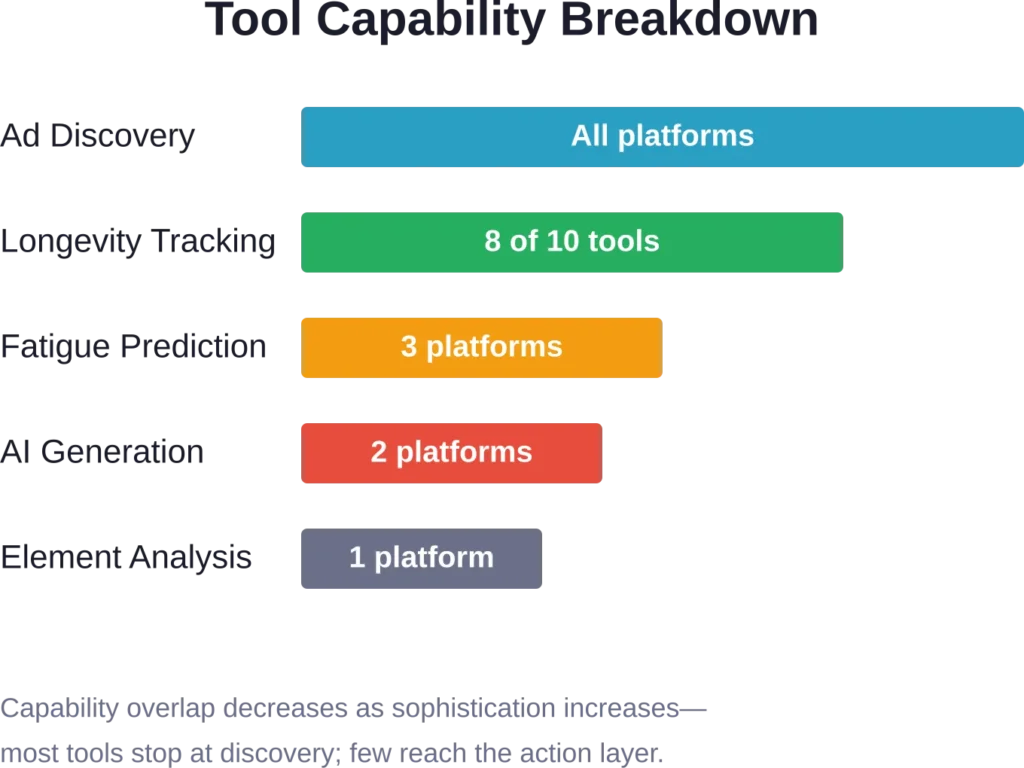
Feature Comparison: What to Prioritize
Not every team needs every feature. Here’s how to prioritize based on actual workflow needs.
| Feature | What It Does | Who Needs It |
|---|---|---|
| Ad Library Depth | Historical coverage, total indexed ads | Teams tracking long-term creative shifts |
| Creative Longevity | First-seen timestamps, run duration | Performance buyers inferring winner signals |
| Format Classification | Auto-tagging (carousel, video, static) | Teams analyzing format performance trends |
| Competitor Alerts | Notifications on new campaigns | Brand teams monitoring competitive launches |
| Fatigue Prediction | Signals when an ad is losing traction | High-volume testers cycling creative fast |
| AI Variant Generation | Produces on-brand alternatives from hooks | Creative teams with tight production timelines |
| Element-Level Analysis | Breaks down visual/copy components | Strategists optimizing specific ad elements |
Look for coverage of at least 100 million indexed ads across Facebook and Instagram, with historical data going back at least two years, not just current active campaigns.
Understanding Creative Element Impact
Research on ad layout performance indicates that visual elements, call-to-action buttons, and background design choices significantly impact click-through rates. These findings highlight why element-level analysis tools add real value. Knowing which components drive performance lets teams isolate variables instead of testing entire ad concepts blindly.
Research on ad layout performance uses composite scoring metrics to measure relative performance across different design elements and layout structures. The variance between layouts underscores how much structural choices influence outcomes.
How to Actually Use These Tools
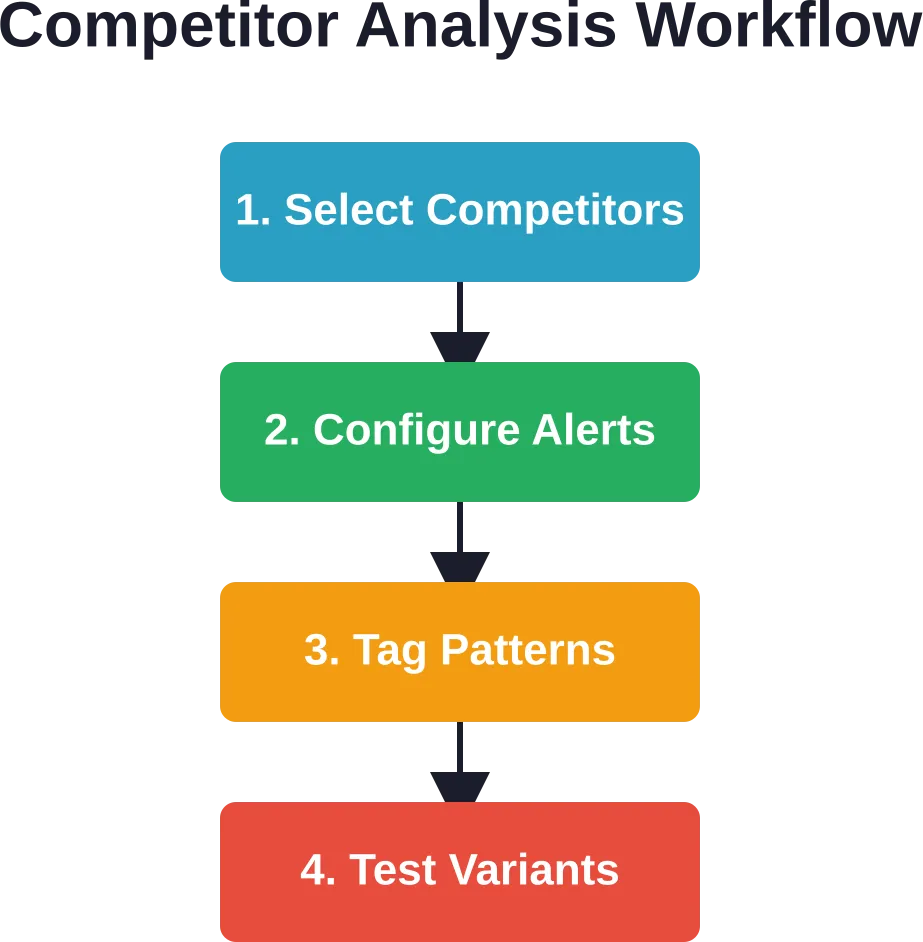
Competitor analysis is only valuable if it changes what gets shipped. Here’s a practical workflow that turns insights into action.
Step One: Identify Benchmark Competitors
Pick three to five direct competitors and two aspirational brands outside your vertical but targeting similar audiences. Don’t just monitor the biggest players—track brands one tier above your current position.
Step Two: Set Up Monitoring Streams
Configure weekly alerts for new campaign launches, messaging shifts, and promotional patterns. The goal is consistent passive monitoring, not daily manual checks.
Step Three: Tag and Categorize
As competitor ads surface, tag them by format, offer type, creative theme, and estimated audience. This structure makes pattern recognition easier when reviewing a month’s worth of data.
Step Four: Analyze for Patterns, Not Individual Ads
A single competitor ad is a data point. Five ads with the same hook structure running for 30+ days is a signal. Look for repetition—that’s where the insight lives.
Step Five: Test Variants, Not Copies
Never clone a competitor ad outright. Extract the structural choice—hook pattern, visual hierarchy, CTA framing—and adapt it to your brand voice and offer. The goal is inspiration with differentiation.
Step Six: Measure Impact
Track which competitor-inspired tests outperform baseline creative. If a pattern consistently wins, document it as a playbook principle and scale it across campaigns.
Regulatory Context: Why Transparency Tools Exist
Meta’s Ad Library wasn’t a voluntary product launch. It emerged from regulatory pressure following years of criticism around political advertising, data misuse, and platform accountability.
The FTC imposed a $5 billion penalty on Facebook in July 2019, alongside sweeping new privacy restrictions and significant requirements to boost accountability and transparency. That settlement pushed Meta to expand public ad disclosures across all categories, not just political or issue-based campaigns.
The result is an advertising environment where transparency is table stakes. Any advertiser running campaigns on Meta platforms contributes to a publicly searchable archive—and third-party tools capitalize on that mandated openness.
Emerging Trends: GenAI and Explainability
Recent academic work explores how generative AI is reshaping marketing strategy co-creation. Systems like MindFuse aim to make AI-driven creative recommendations explainable, addressing a core challenge: black-box optimization that produces winning ads without revealing why they work.
Explainable content optimization systems score ad components and surface which elements drive performance. This bridges the gap between raw competitor data and actionable creative principles.
As platforms adopt these capabilities, the next generation of competitor analysis tools won’t just show what rivals are running—they’ll explain the structural reasons those ads succeed and generate optimized alternatives automatically.
Choosing the Right Tool for Your Team
The best platform depends on workflow, budget, and strategic goals. Here’s how to narrow the field.
For Budget-Conscious Teams
Start with Meta’s native Ad Library combined with BigSpy’s free tier. This covers basic discovery without subscription costs. Upgrade to paid plans only when manual research becomes a bottleneck.
For Creative-First Agencies
Foreplay and MagicBrief excel at organizing visual research and translating competitor ads into creative briefs. The collaboration features make cross-team handoffs smoother.
For Performance Buyers at Scale
Hawky and AdStellar add the intelligence and action layers that matter when creative velocity drives ROAS. Predictive fatigue tracking and AI generation justify the premium pricing for teams spending five figures monthly.
For Enterprise Brand Strategy
Pathmatics and AdClarity integrate competitive ad intelligence into broader market analysis. Spend estimation and cross-channel reporting support strategic planning beyond tactical creative decisions.
Common Pitfalls to Avoid
Even with the right tools, teams make predictable mistakes. Here’s what to watch for.
Pitfall One: Chasing Tactics Without Understanding Strategy
Seeing a competitor run carousel ads doesn’t mean carousels are the answer. Dig into why that format fits their offer structure, audience, and funnel stage before testing the same approach.
Pitfall Two: Over-Indexing on Ad Longevity
An ad running for 60 days might signal success—or a slow internal approval process. Longevity is a useful proxy, not a definitive performance metric. Cross-check with format diversity and campaign volume.
Pitfall Three: Ignoring Audience Differences
Competitor ads target their audience, not yours. An aggressive direct-response hook might work for their cold-traffic offer but alienate a warm retargeting segment. Context matters.
Pitfall Four: Analysis Paralysis
Competitor research should inform decisions, not replace them. Set a time limit for discovery—two hours weekly, max—and ship tests based on patterns, not perfect information.
Integration with Broader Marketing Intelligence
Competitor ad analysis sits inside a larger intelligence ecosystem. The most effective teams connect ad insights with SEO data, content performance, and email strategy.
For example, if a competitor launches a Meta campaign around a specific product benefit, check whether that messaging appears in their organic content, landing pages, and email flows. Consistent themes across channels signal high-confidence bets worth testing.
Platforms like Semrush unify these layers, letting teams spot cross-channel patterns without switching dashboards. That integration saves time and surfaces strategic shifts faster than siloed tools.
The Role of Fair Advertising Policies
Research from Auburn University’s Harbert College suggests that digital platforms benefit financially and in effectiveness when they implement fair advertising policies. Ensuring ad fairness on platforms like Google, Facebook, and YouTube not only supports user trust but also improves overall advertising outcomes.
For competitor analysis, this means monitoring not just creative and messaging but also adherence to platform policies. Ads that push boundaries on claims, targeting, or disclosure often get pulled—tracking which competitors’ ads disappear early can reveal compliance risks to avoid.
Looking Ahead: What Changes in 2026 and Beyond
Meta continues evolving its ad platform. The Andromeda Update, Meta’s AI-driven advertising framework introduced in 2025, shifted algorithmic prioritization toward creative quality signals, making differentiation more critical than budget alone.
Competitor analysis tools are adapting by adding deeper creative scoring, predictive performance modeling, and tighter integration with asset production workflows. The line between research platform and creative studio is blurring.
Expect more platforms to add generative capabilities, automated A/B testing suggestions, and real-time fatigue alerts. The tools that win will be the ones that close the loop from insight to launched campaign in minutes, not days.
Frequently Asked Questions
Meta Ad Library is a free, searchable archive of all active ads. It shows which ads are running but lacks historical depth, longevity tracking, fatigue signals, or organizational features. Third-party tools index the Ad Library continuously, add metadata like first-seen dates and format tags, and layer on intelligence features like predictive fatigue and AI-powered generation. The native library is great for one-off checks; specialized platforms scale ongoing monitoring and analysis.
These platforms index Meta’s Ad Library at regular intervals—often multiple times daily. By comparing snapshots over time, they determine when an ad first appeared and how long it remains active. This first-seen timestamp lets teams infer which ads are performing well enough to keep running, a signal the native Ad Library doesn’t expose directly.
No. Meta doesn’t expose true performance data like click-through rates, conversion rates, or spend amounts in the Ad Library. Third-party tools use proxies—ad longevity, format diversity, visible engagement on organic posts—to infer performance, but these are educated guesses, not hard metrics. Spend estimates from enterprise platforms like Pathmatics use proprietary modeling and should be treated as directional, not exact.
Yes. Meta’s Ad Library is free and comprehensive for basic discovery. BigSpy offers a free tier with limited daily searches. These work well for occasional research or building swipe files. However, free tools lack the intelligence layers—longevity tracking, alerts, AI generation—that make ongoing competitor monitoring scalable. Teams running serious ad budgets typically need paid platforms to avoid manual bottlenecks.
Prioritize based on workflow needs. If your team ships high-volume creative tests, look for fatigue prediction and AI variant generation. If you’re managing multiple clients, prioritize collaboration features and visual organization. For strategic planning, focus on historical depth and cross-channel integration. Check that the platform indexes at least 100 million ads with two-plus years of history, offers saved searches and alerts, and fits your budget. Most importantly, confirm the tool closes the gap between research and action—insights matter only if they change what gets launched.
Set up weekly automated alerts rather than manual daily checks. Reviewing competitor activity once a week is enough to catch new campaigns, messaging shifts, and seasonal promotions without consuming excessive time. Save deep-dive analysis for monthly strategy sessions where patterns across multiple weeks become visible. The goal is consistent passive monitoring, not reactive ad-by-ad tracking.
Yes. These tools access publicly available data that Meta is required to disclose under regulatory transparency mandates. The Ad Library exists specifically to make advertising visible and searchable. Third-party platforms simply organize and enrich that public data. Where legal lines matter is in how insights are used—never clone competitor ads outright, respect trademark and copyright, and ensure your own campaigns comply with platform policies.
Conclusion
Meta ads transparency and competitor analysis tools turn public ad data into strategic advantage. The platforms that matter go beyond simple ad discovery, adding intelligence layers like creative longevity, fatigue prediction, and element-level breakdowns that surface what actually works.
The right tool depends on team workflow and budget. Budget-conscious teams can start with the native Ad Library and free tiers. Creative agencies benefit from visual organization and brief generation. Performance buyers at scale need predictive signals and AI-powered variant creation.
But here’s the thing—tools only matter if they change what gets shipped. The teams winning in 2026 aren’t just monitoring competitors. They’re extracting structural patterns, testing differentiated variants, and iterating faster than the market average.
Pick a platform that fits your workflow, set up consistent monitoring, and ship tests based on patterns, not guesses. That’s how competitor intelligence becomes competitive advantage.