

Quick Summary: AI tools for marketing automation combine artificial intelligence with automated workflows to streamline campaign management, personalize customer experiences, and optimize marketing performance at scale. Leading platforms like Extuitive, HubSpot, Zapier, and specialized AI solutions help marketing teams automate repetitive tasks, predict customer behavior, and create personalized content. According to Forrester research, 67% of AI decision-makers plan to increase investment in generative AI within the next year, signaling the critical role these tools play in modern marketing strategies.
Marketing automation has crossed a threshold. What began as simple email schedulers and drip campaigns has transformed into intelligent systems that predict customer behavior, personalize content dynamically, and orchestrate multi-channel campaigns with minimal human intervention.
The integration of artificial intelligence into marketing automation platforms represents more than incremental improvement—it fundamentally changes what’s possible. AI-powered tools analyze customer data at scales impossible for human teams, identify patterns that inform strategic decisions, and execute personalized campaigns across thousands or millions of contacts simultaneously.
But here’s the thing though—not all AI marketing automation tools deliver on their promises. Some add superficial AI features to justify premium pricing. Others offer genuine innovation that transforms marketing operations.
This guide examines the AI marketing automation tools that actually matter in 2026, based on verified user ratings, authoritative research, and documented capabilities. The focus remains on platforms that combine proven automation functionality with meaningful AI enhancements.
What Makes AI Marketing Automation Different
Traditional marketing automation follows predetermined rules. If a contact opens an email, send a follow-up. If they visit a pricing page, alert sales. These if-then workflows powered marketing automation for years.
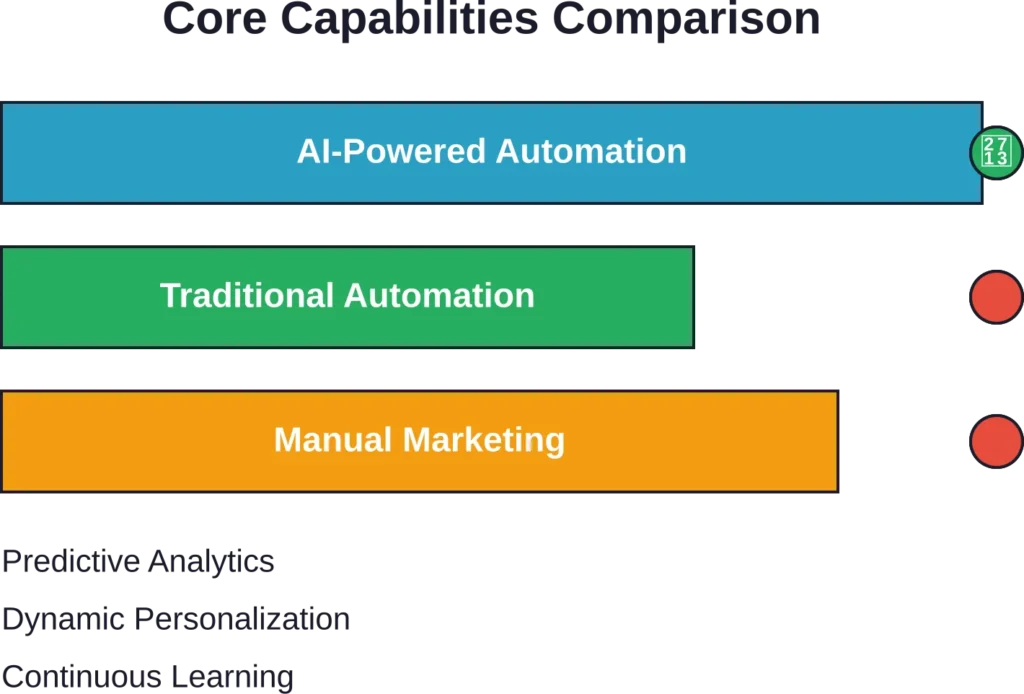
AI-powered marketing automation operates differently. Instead of following static rules, these systems learn from data, adapt to changing patterns, and make predictions about future behavior. The difference shows up in several key capabilities.
Predictive analytics identify which contacts are most likely to convert, allowing teams to prioritize high-value opportunities. According to academic research on AI-powered digital marketing, machine learning technologies not only facilitate automation of marketing processes but also enable creation of personalized content, increasing accuracy of predicting consumer decisions.
Content personalization extends beyond inserting a contact’s name in an email. AI systems analyze behavioral data, purchase history, and engagement patterns to determine what content resonates with specific audience segments. Then they generate or select content tailored to individual preferences at scale.
Send-time optimization uses historical engagement data to predict when specific contacts are most likely to open emails or engage with content. Rather than sending all contacts at the same time, AI determines optimal delivery windows for each recipient.
Natural language processing enables chatbots and email assistants that understand context and intent, not just keywords. These systems handle customer inquiries, qualify leads, and route conversations appropriately without human intervention.
The Trust Challenge
Despite growing adoption, trust remains the biggest barrier to AI implementation in marketing. Forrester research found that 61% of AI decision-makers are concerned about privacy and data protection that might violate laws like GDPR.
Marketing teams implementing AI automation tools must address data privacy, algorithmic transparency, and compliance with evolving regulations. The most effective platforms build trust through clear data handling policies, explainable AI decisions, and robust security measures.
Top AI Marketing Automation Platforms for 2026
The marketing automation landscape includes dozens of platforms claiming AI capabilities. These stand out based on verified user ratings, documented features, and proven results.
Extuitive
Extuitive positions itself as a predictive advertising intelligence platform that forecasts ad performance before any budget is spent. It combines AI creative generation with consumer simulation to help e-commerce brands launch winning ads with minimal waste.
AI capabilities include pre-launch performance prediction for CTR and ROAS, AI ad creation and optimization (copy, images, videos, pricing), intelligent audience targeting, and validation through 150,000+ simulated AI consumers modeled on real buyer behavior. The system also analyzes trends and generates creative briefs automatically.
The platform excels at connecting directly to Shopify stores for automated product and audience analysis, then generating, scoring, and ranking creatives at scale. This creates a fast feedback loop that replaces weeks of live testing with minutes of AI simulation, delivering higher engagement and stronger returns on Meta and TikTok campaigns.
Extuitive offers tiered pricing starting at $1,000/month (Starter plan) for brands spending over $10K/month on ads, with Professional at $2,500/month and Enterprise custom. Higher tiers unlock more ad scoring, creations, and support.
Best for: Shopify/D2C brands and e-commerce teams looking for predictive, AI-powered marketing automation focused on creative validation and paid ad efficiency rather than traditional all-in-one campaign management.
Contact Information:
- Website: extuitive.com
- Email: [email protected]
- LinkedIn: www.linkedin.com/company/extuitive
- Twitter: x.com/Extuitive_Inc
- Instagram: www.instagram.com/extuitiveinc
HubSpot Marketing Hub
HubSpot maintains its position as one of the most comprehensive marketing automation platforms, combining extensive features with user-friendly interfaces. The platform maintains a position as a leading solution based on extensive user adoption.
AI capabilities in HubSpot include content assistant tools for generating email copy and social media posts, predictive lead scoring that identifies high-value contacts, and conversation intelligence that analyzes customer interactions for insights.
The platform excels at all-in-one functionality, integrating email marketing, social media management, landing pages, forms, and analytics in a unified system. Marketing teams can manage entire campaigns without switching between tools.
HubSpot’s pricing structure varies based on features and tier level, with a free plan offering limited automation suitable for small businesses testing marketing automation.
Best for: Mid-sized businesses and enterprises seeking comprehensive marketing automation with strong CRM integration and growing AI features.
Zapier

Zapier approaches marketing automation differently. Rather than providing marketing-specific features, it connects more than 8,000 applications through automated workflows called Zaps.
The AI orchestration capabilities allow marketers to build custom automation connecting their specific tool stack. For example, automatically adding email subscribers to a CRM, posting social media updates when blog content publishes, or triggering follow-up sequences based on website behavior.
Recent AI additions include built-in AI tools for data transformation, content generation within workflows, and intelligent routing based on content analysis. These enhance automation beyond simple if-then logic.
Zapier offers a free plan; paid plans start at $19.99/month for increased task volumes and premium features.
Best for: Teams with established marketing tools that need powerful integration and custom workflow automation rather than an all-in-one platform.
Brevo

Formerly Sendinblue, Brevo focuses on affordable all-in-one marketing automation for small and medium businesses.
AI features include send-time optimization that determines optimal delivery windows for each contact, predictive analytics for campaign performance, and intelligent segmentation that identifies audience clusters based on behavior patterns.
Email marketing, SMS campaigns, chat, and basic CRM functionality combine in a single platform. The interface emphasizes simplicity without sacrificing capability.
Pricing remains competitive compared to enterprise platforms, making Brevo accessible for smaller teams exploring marketing automation.
Best for: Small to medium businesses seeking affordable, user-friendly marketing automation with essential AI features.
ActiveCampaign

ActiveCampaign built its reputation on powerful automation workflows and strong email marketing capabilities.
AI enhancements focus on predictive sending, which determines optimal email delivery times, and machine learning-powered segmentation that continuously refines audience targeting based on engagement patterns.
The visual automation builder allows marketers to create complex, branching workflows without coding. Conditional logic, wait periods, and multi-channel actions combine to deliver sophisticated customer journeys.
Integration capabilities connect ActiveCampaign with hundreds of tools including CRMs, e-commerce platforms, and analytics systems.
Best for: Marketing teams prioritizing advanced automation workflows and detailed customer journey mapping with AI-enhanced optimization.
Insider

Insider specializes in cross-channel personalization for enterprise marketing teams.
The AI engine powers product recommendations, dynamic content personalization across channels, and predictive customer segmentation. Real-time behavioral analysis triggers personalized experiences across web, mobile, email, and SMS.
E-commerce brands particularly benefit from Insider’s product recommendation algorithms, abandoned cart recovery, and personalized shopping experiences.
The platform targets enterprise customers with corresponding pricing and implementation complexity.
Best for: Enterprise e-commerce and retail brands requiring sophisticated cross-channel personalization and AI-driven recommendations.
| Platform | Key Strength | Starting Price | Best For | Key AI Feature |
|---|---|---|---|---|
| HubSpot Marketing Hub | All-in-one platform | Free tier available | All-in-one platform | Predictive lead scoring |
| Zapier | App integration | $19.99/month | App integration | AI orchestration |
| Brevo | Affordable pricing | Check official site | SMB affordability | Send-time optimization |
| ActiveCampaign | Advanced workflows | Check official site | Advanced workflows | Predictive sending |
| Insider | Enterprise personalization | Enterprise pricing | Cross-channel personalization | Real-time behavioral AI |
| Intuit Mailchimp | Email focus | Free tier available | Email-first automation | Content optimizer |
Additional Notable Platforms
Several other platforms deserve consideration based on specific use cases:
CleverTap focuses on mobile-first marketing automation with AI-powered engagement optimization and retention campaigns.
Iterable emphasizes growth marketing with AI-enhanced journey orchestration and experimentation capabilities.
WebEngage specializes in customer data platform capabilities combined with multi-channel campaign automation.
MoEngage delivers customer engagement platform features with AI-driven insights and personalization.
Thryv targets small businesses with simplified marketing automation and CRM tools.
Intuit Mailchimp remains popular for email-focused marketing automation with AI content optimization and predictive demographics.
AI Features That Actually Matter
Marketing automation vendors tout various AI capabilities. Some deliver measurable value while others amount to marketing buzzwords. Here’s what actually moves the needle.
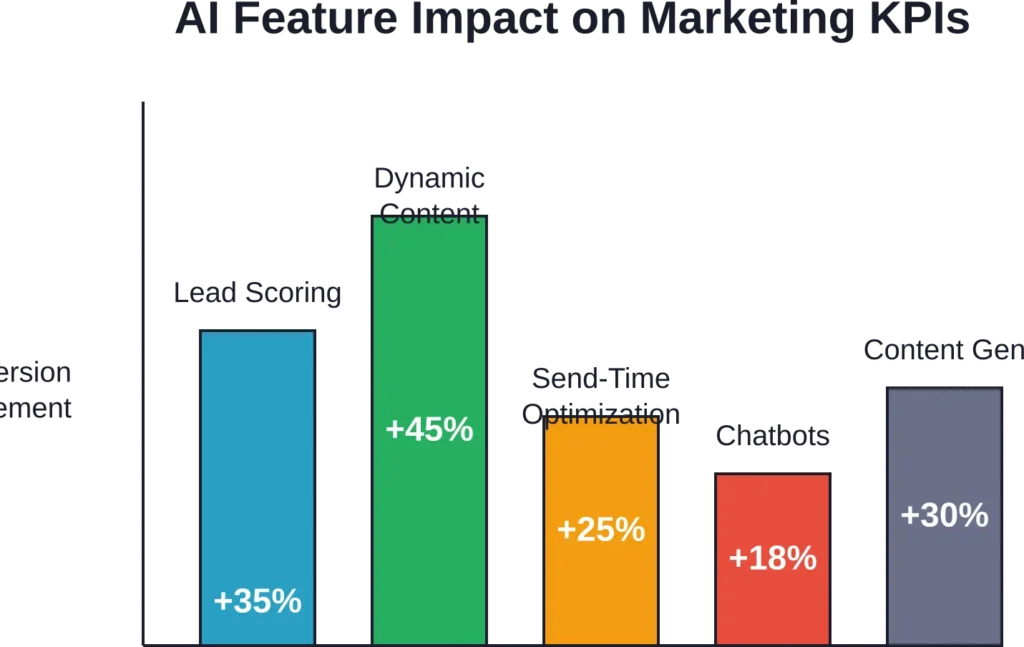
Predictive Analytics and Lead Scoring
The ability to predict which contacts are most likely to convert transforms marketing efficiency. Instead of treating all leads equally, teams focus energy on high-probability opportunities.
Effective predictive lead scoring analyzes dozens or hundreds of variables—email engagement, website behavior, demographic data, social media activity, and more. Machine learning models identify patterns correlating with conversion, continuously refining predictions as new data accumulates.
Real talk: this only works with sufficient historical data. Platforms need hundreds or thousands of contacts and conversion events to train accurate models. Businesses just starting with marketing automation won’t see immediate benefits from predictive features.
Dynamic Content Personalization
Generic broadcast messages convert poorly compared to personalized content. But manual personalization doesn’t scale beyond simple name insertion.
AI-powered dynamic content systems select or generate personalized content elements based on individual characteristics and behavior. Product recommendations, blog article suggestions, case study selections, and even email copy adapt to each recipient.
The most sophisticated systems personalize across channels—website content, email, mobile apps, and advertising adjust simultaneously based on unified customer profiles.
Send-Time Optimization
When marketing messages arrive matters as much as what they contain. Send-time optimization analyzes historical engagement patterns to predict when individual contacts are most likely to open emails or engage with content.
Rather than sending all contacts at the same time (typically mid-morning on Tuesday), AI systems deliver messages at individually optimized times—perhaps 7 AM for early risers, 8 PM for evening email checkers, or Saturday afternoon for weekend readers.
Conversational AI and Chatbots
Natural language processing enables chatbots that understand context and intent, not just keyword matching. These systems handle customer inquiries, qualify leads, book meetings, and route conversations appropriately.
The key distinction between basic chatbots and AI-powered conversational systems lies in understanding. Simple chatbots follow decision trees and look for specific keywords. AI chatbots comprehend intent even with varied phrasing and maintain context across multi-turn conversations.
Implementation success depends on proper training, clear escalation paths to humans, and realistic scope. Chatbots excel at frequently asked questions and data collection but struggle with complex, nuanced inquiries.
Content Generation and Optimization
Generative AI tools produce marketing content at unprecedented speed. Email subject lines, social media posts, blog outlines, ad copy, and product descriptions can be generated in seconds rather than hours.
Quality varies significantly. AI-generated content requires human review and editing to ensure accuracy, brand voice consistency, and strategic alignment. The technology works best as an assistant that accelerates human creativity rather than a replacement for creative teams.
Content optimization features analyze existing content and suggest improvements for engagement, conversion, or SEO performance based on historical data and testing.
Implementation Challenges and Solutions
Adopting AI marketing automation involves more than selecting software. Several common challenges trip up implementation efforts.
Data Quality and Quantity Requirements
AI models require substantial, clean data to function effectively. Predictive analytics needs historical conversion data. Personalization engines need behavioral tracking. Content optimization requires engagement metrics.
Organizations with fragmented data across disconnected systems struggle to feed AI tools properly. Customer records with incomplete information, inconsistent formatting, or duplicate entries degrade model accuracy.
The solution starts with data consolidation and cleanup before implementing AI features. Establishing data governance policies, standardizing collection methods, and investing in data quality maintenance pays dividends across all AI applications.
Privacy and Compliance Concerns
The same data collection that powers AI personalization raises privacy concerns. Forrester research shows 61% of AI decision-makers worry about violating regulations like GDPR.
Marketing teams must balance personalization benefits with privacy obligations. This requires understanding applicable regulations, implementing proper consent mechanisms, providing transparency about data usage, and offering opt-out options.
The best practice involves privacy-by-design approaches—building compliance into systems from the start rather than retrofitting protection later.
Integration Complexity
Marketing technology stacks typically include numerous tools—CRM systems, email platforms, analytics software, content management systems, advertising platforms, and more. AI marketing automation platforms must integrate with existing infrastructure.
Integration challenges arise from incompatible data formats, API limitations, synchronization delays, and authentication complexities. Each additional integration point creates potential failure modes.
Platforms like Zapier address integration challenges through pre-built connectors and standardized workflow capabilities. When evaluating marketing automation tools, integration capabilities deserve scrutiny equal to feature sets.
Skills Gap and Training Needs
AI marketing automation tools introduce new concepts and interfaces. Marketing teams accustomed to traditional campaign management face learning curves around predictive models, algorithm training, and AI-assisted workflows.
Organizations implementing these tools need training programs covering both technical operation and strategic application. Understanding when to trust AI recommendations versus applying human judgment requires experience.
The most successful implementations pair AI tools with ongoing education, experimentation periods, and clear success metrics.
Measuring ROI from AI Marketing Automation
Justifying investment in AI marketing automation requires demonstrating return. Several metrics help quantify value.
Time Savings and Efficiency Gains
Automation reduces manual work. Track hours saved on repetitive tasks like email deployment, list management, social media posting, and report generation.
Convert time savings to dollar value based on labor costs. If automation saves 20 hours weekly at $50 per hour, that’s $52,000 annually in labor cost avoidance.
Conversion Rate Improvements
AI features like predictive lead scoring, dynamic personalization, and send-time optimization aim to improve conversion rates. Compare conversion metrics before and after implementation.
Even modest improvements compound significantly. A 10% increase in email conversion rate can add substantial annual revenue in typical scenarios with large contact volumes and order values.
Revenue Attribution
Multi-touch attribution models track how marketing automation contributes to revenue. AI-enhanced platforms often include sophisticated attribution analytics showing which automated campaigns influenced purchases.
Compare revenue attributed to automated campaigns against platform costs and labor investment to calculate ROI.
Customer Lifetime Value Impact
Effective marketing automation nurtures customer relationships beyond initial purchase. Track how automated retention campaigns, personalized recommendations, and re-engagement sequences affect customer lifetime value.
Improvements in customer retention can significantly increase lifetime value depending on purchase frequency and industry.
The Future of AI Marketing Automation
Current AI marketing automation capabilities represent early stages of technology development. Several trends will shape the next evolution.
Increased Investment and Adoption
According to Forrester, 67% of AI decision-makers plan to increase generative AI investment within the next year. This sustained investment will accelerate capability development and broaden access to sophisticated tools.
As platforms mature, AI features will move from premium add-ons to standard capabilities. Smaller businesses will gain access to automation previously available only to enterprises.
More Sophisticated Personalization
Current personalization focuses mainly on demographic segmentation and basic behavioral triggers. Future systems will understand individual preferences, communication styles, and decision-making patterns at granular levels.
Brand language models—AI systems trained specifically on a company’s content, voice, and messaging—will generate highly authentic communications at scale. Forrester’s 2024 predictions identified this as a key agency trend.
Autonomous Campaign Management
Today’s AI marketing automation requires human supervision and decision-making. Future systems will operate more autonomously—designing campaigns, executing tests, analyzing results, and optimizing performance with minimal human intervention.
Marketing teams will shift from campaign execution to strategy development and creative direction while AI handles tactical implementation.
Job Market Evolution
Automation inevitably affects employment. However, Forrester research provides nuanced perspective: while AI and automation will impact 6.1% of US jobs (10.4 million total) by 2030, with generative AI responsible for 50% of that impact, the effect on specific roles varies significantly.
The research notes 20% of US jobs will be strongly influenced by generative AI by 2030, but influenced doesn’t mean eliminated. Many roles will evolve rather than disappear, with workers using AI to enhance productivity rather than being replaced.
Mayo Clinic’s radiology staff has grown by 55% since 2016 as AI tools increased productivity and service capacity—an example of how automation increases capability rather than reducing headcount.
Marketing roles will similarly evolve. Repetitive execution tasks decrease while strategic planning, creative thinking, and relationship building become more valuable.

Selecting the Right Platform for Your Business
With dozens of AI marketing automation platforms available, selection requires matching capabilities to specific needs.
Business Size Considerations
Small businesses (under 50 employees) typically need affordable, user-friendly platforms with core automation features. Extensive AI capabilities matter less than ease of use and quick implementation. Platforms like Brevo, Mailchimp, or basic HubSpot plans fit these requirements.
Mid-sized businesses (50-500 employees) benefit from more sophisticated automation with growing AI features. Integration capabilities become important as technology stacks expand. HubSpot, ActiveCampaign, and similar platforms balance functionality with accessibility.
Enterprises (500+ employees) require advanced AI capabilities, extensive customization, and robust integration. Platforms like Insider, enterprise HubSpot, or specialized solutions handle complex requirements and large contact databases.
Industry-Specific Requirements
E-commerce businesses need product recommendation engines, abandoned cart recovery, and integration with shopping platforms. Insider, CleverTap, and e-commerce-focused platforms prioritize these capabilities.
B2B companies emphasize lead scoring, account-based marketing features, and CRM integration. HubSpot, ActiveCampaign, and B2B-oriented platforms excel here.
Content publishers focus on subscriber engagement, content recommendation, and audience segmentation. Platforms with strong email marketing and content distribution fit best.
Technical Capability Assessment
Teams with strong technical resources can leverage more complex platforms offering extensive customization and advanced features. Organizations with limited technical staff need platforms emphasizing user-friendly interfaces and strong customer support.
Integration requirements depend on existing technology investments. Audit current tools and prioritize platforms offering seamless connections.
Budget Reality Check
Platform costs vary dramatically from free tiers to six-figure enterprise licenses. Beyond software costs, factor in implementation expenses, training time, and ongoing management labor.
Calculate total cost of ownership including:
- Platform subscription fees
- Implementation and setup costs
- Training expenses
- Integration development
- Ongoing management time
- Additional tools or add-ons required
Compare total costs against expected benefits to ensure positive ROI.
Implementation Best Practices
Successful AI marketing automation implementation follows proven patterns.
Start with Foundation Before AI
Basic automation must work before adding AI complexity. Begin with essential workflows—welcome sequences, abandoned cart emails, lead nurturing campaigns. Ensure data flows correctly and integrations function reliably.
Only after mastering fundamental automation should teams layer on AI features like predictive scoring or dynamic personalization.
Define Clear Success Metrics
Establish baseline measurements before implementation. Track key metrics like conversion rates, email engagement, lead quality, and revenue attribution.
Set specific, measurable goals for AI automation—improve email conversion by 15%, reduce lead qualification time by 30%, increase customer retention by 10%. Clear targets enable objective evaluation.
Adopt Phased Rollout Approach
Implementing all features simultaneously overwhelms teams and complicates troubleshooting. Instead, roll out capabilities in phases:
Phase 1: Core automation workflows and basic segmentation
Phase 2: Email marketing optimization and testing
Phase 3: Predictive lead scoring
Phase 4: Dynamic content personalization
Phase 5: Cross-channel orchestration
Each phase builds on previous capabilities while allowing teams to learn and adapt.
Invest in Training and Change Management
Technology succeeds only when teams use it effectively. Allocate budget and time for comprehensive training covering both technical operation and strategic application.
Address change management proactively. Some team members resist automation, fearing job displacement or loss of creative control. Communication about how AI enhances rather than replaces human work helps build buy-in.
Monitor, Test, and Iterate
AI models improve through feedback. Regularly review performance, test variations, and refine approaches based on results.
Establish review cycles—weekly for active campaigns, monthly for strategy assessment, quarterly for comprehensive platform evaluation. Use insights to continuously optimize automation effectiveness.
Common Mistakes to Avoid
Learning from others’ errors accelerates success. These mistakes appear frequently in AI marketing automation implementations.
Over-Automation
Automating everything isn’t the goal. Some interactions benefit from human touch—complex customer inquiries, high-value sales conversations, relationship building with key accounts.
The best implementations automate repetitive, high-volume tasks while preserving human involvement where it adds disproportionate value.
Neglecting Data Quality
AI quality depends entirely on data quality. Incomplete records, duplicate contacts, outdated information, and inconsistent formatting degrade performance.
Regular data cleaning and validation must accompany automation. Garbage in, garbage out applies especially to AI systems.
Ignoring Privacy and Compliance
Data collection enthusiasm must balance against privacy obligations. Organizations violating GDPR, CCPA, or other regulations face serious consequences—financial penalties, legal liability, and reputation damage.
Build privacy considerations into automation from the start. Obtain proper consent, provide transparency, honor opt-outs, and secure data appropriately.
Setting Unrealistic Expectations
AI marketing automation delivers significant benefits but not magic. Platforms won’t transform failing marketing strategies into success overnight. Implementation takes time, optimization requires iteration, and results build gradually.
Set realistic timelines and expectations. Most organizations see meaningful results 3-6 months after implementation once systems are properly configured and optimized.
Choosing Features Over Fit
The platform with the longest feature list isn’t necessarily the best choice. Features matter only if they address actual business needs and match team capabilities.
Prioritize platforms that excel at core requirements over those offering extensive features mostly irrelevant to specific use cases.
Frequently Asked Questions
Traditional marketing automation follows predetermined rules and workflows—if a contact takes action X, trigger response Y. AI marketing automation adds predictive capabilities, machine learning, and adaptive behavior. AI systems analyze data to predict outcomes, personalize content dynamically, optimize timing automatically, and continuously improve performance based on results. Think of traditional automation as following a recipe exactly, while AI automation adjusts ingredients and techniques based on feedback.
Pricing varies dramatically based on platform, features, and business size. Entry-level platforms like Mailchimp offer free tiers with limited features. Mid-tier solutions like HubSpot start at various price points but increase substantially for AI features and larger contact databases. Enterprise platforms require custom pricing often reaching thousands monthly. Beyond software costs, budget for implementation, training, and ongoing management. Total cost of ownership typically runs 1.5-2x the platform subscription price when including all expenses.
Modern AI marketing automation platforms are designed for marketing teams without data science expertise. Vendors build AI capabilities into user-friendly interfaces with pre-configured models and automated optimization. Basic implementation requires only marketing knowledge and platform training. However, advanced customization, complex integrations, or building custom AI models may benefit from technical expertise. Start with out-of-the-box capabilities before investing in specialized resources.
Timeline depends on implementation scope and existing marketing maturity. Basic automation workflows can show results within weeks—automated welcome sequences and abandoned cart recovery often deliver immediate value. AI features like predictive lead scoring require 2-3 months to gather sufficient data and train accurate models. Comprehensive implementations typically demonstrate meaningful ROI within 3-6 months once systems are optimized. Quick wins are possible but sustainable transformation takes quarters, not weeks.
Forrester research provides data-based perspective: AI and automation will impact 6.1% of US jobs by 2030, with 20% of jobs strongly influenced by generative AI. However, influenced doesn’t mean eliminated. Mayo Clinic’s radiology staff has grown by 55% since 2016 despite AI predictions of job elimination—AI increased productivity and service capacity rather than replacing workers. Marketing roles will similarly evolve with automation handling repetitive execution while humans focus on strategy, creativity, and relationship building. The skills required shift but demand for marketing expertise continues.
According to Forrester research, trust represents the biggest barrier—61% of AI decision-makers worry about privacy violations like GDPR breaches. Beyond trust, data quality challenges, integration complexity, and skills gaps create implementation friction. Organizations succeed by addressing these systematically: establishing data governance, building privacy compliance into design, investing in integration infrastructure, and providing comprehensive training. Technical challenges are solvable; building organizational confidence and capability takes sustained effort.
Absolutely. Modern platforms offer accessible entry points for small businesses through free tiers, affordable pricing, and user-friendly interfaces. Small businesses benefit especially from time savings—automation handles repetitive tasks that would otherwise consume limited staff hours. Start with basic automation before advancing to AI features. As contact databases and historical data grow, predictive capabilities become more valuable. Platforms like Mailchimp, Brevo, and entry-level HubSpot provide sophisticated automation at small business budgets.
Taking Action
AI marketing automation represents a fundamental shift in how organizations engage customers, nurture leads, and drive revenue. The technology has matured beyond experimental novelty into practical tools delivering measurable results.
But adoption requires more than selecting software. Success demands strategic planning, thoughtful implementation, ongoing optimization, and organizational commitment to transformation.
Organizations just beginning this journey should start by assessing current marketing processes and identifying high-value automation opportunities. Which repetitive tasks consume disproportionate time? Where does personalization lag due to manual limitations? What customer insights remain hidden in data?
These questions reveal automation priorities and guide platform selection. Match tool capabilities to specific needs rather than choosing based on features or popularity.
For teams already using marketing automation, the path forward involves evaluating AI enhancement opportunities. Review current platforms for available AI features. Test predictive scoring with historical data. Experiment with content personalization on small segments. Measure results rigorously.
The competitive advantage flows not from having AI marketing automation tools but from using them effectively. Thoughtful implementation, continuous testing, and data-driven optimization separate organizations that extract real value from those that accumulate expensive underutilized software.
Start small, measure carefully, and scale what works. The technology enables unprecedented marketing capability for organizations willing to invest in proper implementation.
The question isn’t whether AI will transform marketing—that transformation is already underway. The question is whether an organization will lead that transformation or scramble to catch up.