

Quick Summary: AI tools for scaling paid ads in ecommerce leverage machine learning to automate campaign optimization, creative generation, audience targeting, and performance analysis. The best platforms for 2026 include Extuitive, AdAmigo.ai for Meta automation, AdCreative.ai for creative generation, Optmyzr for Google Ads automation, and Smartly.io for enterprise-level multi-platform campaigns. These tools help ecommerce brands reduce manual work, improve ROAS, and scale ad spend efficiently.
Ecommerce advertising has reached a point where manual campaign management can’t keep pace with scale. Brands spending thousands—sometimes hundreds of thousands—on paid ads need intelligent systems that optimize faster than any human team could.
That’s where AI-powered advertising tools come in. They analyze performance data in real time, generate creative variations, adjust bids automatically, and identify audience segments that convert. The difference between a brand stuck at $50,000 monthly ad spend and one scaling to $500,000 often comes down to the automation stack.
But here’s the thing: not all AI advertising tools deliver on their promises. Some are glorified rule engines with an “AI” label slapped on. Others work brilliantly for one channel but fail when you expand to multiple platforms.
This guide covers the AI tools actually moving the needle for ecommerce brands in 2026—the platforms that automate the tedious stuff while improving performance metrics that matter.
Why AI Tools Matter for Ecommerce Paid Advertising
According to the SBS Journal of Applied Business Research, AI in digital marketing enables personalized customer experiences through predictive analytics and natural language processing. For ecommerce specifically, this translates to advertising systems that adapt to consumer behavior faster than traditional manual optimization.
Research from Harvard’s Professional & Executive Development indicates that AI presents marketers with opportunities to personalize customer experiences at scale, ultimately driving business growth through more relevant advertising.
The practical benefits break down into a few categories:
Speed. AI systems process performance data and make optimization decisions in minutes, not days. When an ad set starts burning budget with poor performance, automated systems catch it before you lose thousands.
Scale. Managing 50 ad sets manually is feasible. Managing 500 requires automation. AI tools handle the complexity of multi-product catalogs, dozens of audience segments, and continuous creative testing without expanding headcount.
Pattern Recognition. Machine learning identifies profitable patterns humans miss—like which product combinations work best for specific audience segments, or which creative elements drive conversion rates up by 20% or more.
Research documented in academic publications shows that AI-driven consumer behavior analysis revolutionizes digital marketing strategies through enhanced predictive capabilities and natural language processing.
Top AI Tools for Meta Ads (Facebook & Instagram)
Meta advertising accounts for a massive chunk of ecommerce ad spend. The platform’s native AI has improved, but third-party tools add layers of automation and optimization Meta doesn’t provide out of the box.
Extuitive
Extuitive is an AI-powered predictive advertising platform that forecasts ad performance before launch using advanced consumer simulation. The system deploys over 150,000 AI agents modeled after real buyers to test and score creatives across Meta, Google, and TikTok.
The standout feature is pre-launch prediction and creative validation. It analyzes your product feed, historical campaign data, and new creatives to predict CTR, ROAS, CPA, and conversion rates with high accuracy. This allows marketers to kill weak ideas early and scale only the highest-potential creatives.
Pricing: Plans start at $149/month (billed annually) according to available plan data.
Best for: Shopify/D2C ecommerce brands that want to scale paid ads efficiently by reducing wasted test budget and launching only high-performing creatives.
Limitations: Still relatively new platform with limited third-party case studies. Best results require decent historical ad data; newer brands with low data volume may see less accurate predictions.
Contact Information:
- Website: extuitive.com
- Email: [email protected]
- LinkedIn: www.linkedin.com/company/extuitive
- Twitter: x.com/Extuitive_Inc
- Instagram: www.instagram.com/extuitiveinc
AdAmigo.ai

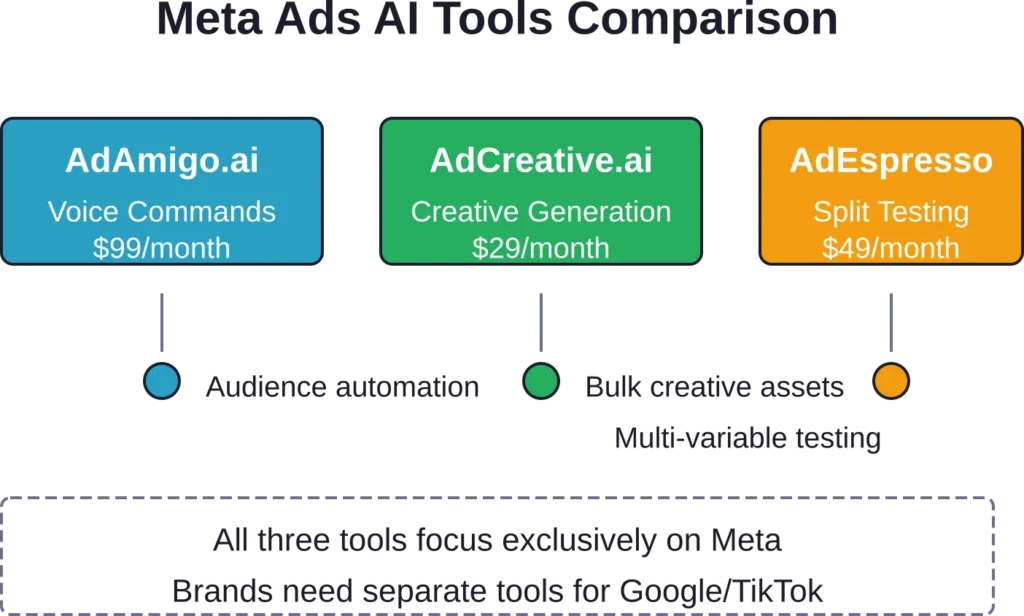
AdAmigo.ai focuses exclusively on Meta advertising with a conversational interface that lets marketers manage campaigns through text or voice commands. The platform’s AI continuously refines audience parameters based on performance data, making it particularly useful for teams that want optimization on autopilot.
The standout feature is lookalike audience creation through natural language. Instead of navigating multiple menus in Ads Manager, marketers describe the audience they want and the AI builds it. The system monitors performance and adjusts targeting parameters automatically.
Pricing: Plans start at $99/month according to multiple sources.
Best for: Ecommerce brands focused primarily on Meta advertising who want conversational campaign management and automated audience optimization.
Limitations: Only works with Meta ads. Brands running multi-platform campaigns need additional tools for Google, TikTok, and other channels.
AdCreative.ai

AdCreative.ai specializes in generating ad creative variations using machine learning. The platform analyzes top-performing ads across industries and creates new creative assets optimized for conversion.
The tool generates hundreds of creative variations from a single product image and description. It handles ad copy, headline variations, and visual layouts. For ecommerce brands running dynamic product ads, this dramatically reduces the creative production bottleneck.
Testing shows the AI tends to favor proven patterns, which means higher consistency but occasionally less breakthrough creativity. Still, for brands that need volume over novelty, it solves a real problem.
Pricing: Plans start at $29/month for small businesses, according to corroborated source data.
Best for: Small to mid-sized ecommerce businesses that need to generate large volumes of ad creative without hiring a full creative team.
Limitations: Creative output sometimes lacks the standout originality that separates breakout campaigns from incremental improvements.
AdEspresso by Hootsuite
AdEspresso entered the market before “AI” became a buzzword, but the platform has evolved to include machine learning for split testing and campaign optimization. It’s particularly strong at managing complex A/B tests across multiple variables—creative, copy, audience, placement.
The interface simplifies campaign creation and makes split testing accessible to marketers who aren’t data scientists. The AI analyzes test results and surfaces winning combinations faster than manual analysis.
Pricing: Plans start at $49/month according to multiple corroborated sources.
Best for: Beginners and small-to-medium businesses that want simplified split testing without the complexity of enterprise platforms.
Limitations: The cost structure becomes expensive for brands with large ad budgets. Advanced features trail behind newer platforms built from the ground up with AI.
AI Tools for Google Ads Automation
Google Ads complexity has grown exponentially. Performance Max campaigns, responsive search ads, and audience signals all require constant optimization. AI tools help manage this complexity at scale.
Optmyzr

Optmyzr provides automation and optimization across Google Ads, Microsoft Ads, and Amazon Advertising. The platform’s strength lies in rule-based automation combined with machine learning insights that surface opportunities human analysts might overlook.
The One-Click Optimizations feature presents high-impact changes with supporting data. Instead of digging through campaign reports, marketers review curated optimization suggestions and apply them with a single click.
The tool excels at bid management, quality score improvement, and budget allocation across campaigns. For ecommerce brands managing hundreds of products, Optmyzr’s automated shopping campaign optimization saves hours of manual work weekly.
Best for: Mid-to-large ecommerce brands running complex Google Ads campaigns across multiple product categories.
Limitations: The learning curve is steeper than simpler tools. Smaller brands might find they’re not using enough of the platform’s capabilities to justify the investment.
Albert AI

Albert AI (now part of the Zoomd suite) positions itself as an autonomous digital marketer. The platform doesn’t just optimize existing campaigns—it creates, manages, and scales campaigns across Google, Facebook, and Instagram without human intervention.
The AI analyzes creative assets, audience data, and performance metrics to build and test campaigns autonomously. It allocates budget dynamically based on performance and continuously experiments with new audience segments and creative combinations.
Albert AI positions itself toward brands with substantial ad budgets, as the platform requires significant data volume to train its models effectively.
Best for: Large ecommerce brands with substantial ad budgets that want hands-off campaign management.
Limitations: The platform requires high monthly ad spend to be cost-effective. Smaller brands won’t see proportional value. Pricing is custom and based on ad spend, making it inaccessible for many businesses.
Multi-Platform AI Advertising Tools
Brands running campaigns across Meta, Google, TikTok, and other channels need tools that optimize holistically rather than treating each platform in isolation.
Smartly.io

Smartly.io handles creative production, campaign management, and optimization across Meta, Snapchat, TikTok, Pinterest, and Google. The platform shines for brands with large product catalogs that need dynamic creative optimization at scale.
The Creative Intelligence feature analyzes creative performance and automatically generates new variations based on winning patterns. For ecommerce, this means product feeds automatically generate thousands of personalized ad variations optimized for different audience segments.
Smartly.io’s Predictive Budget Allocation uses machine learning to shift spend toward top-performing campaigns in real time. Instead of setting fixed budgets per platform, the system allocates dynamically based on performance.
Best for: Enterprise ecommerce brands running large-scale campaigns across multiple advertising platforms with extensive product catalogs.
Limitations: Pricing is enterprise-level and requires significant ad spend to justify. Not practical for small to mid-sized businesses.
Madgicx

Madgicx focuses on ecommerce brands advertising on Meta and Google, with AI-powered audience targeting, creative analysis, and automated ad buying. The platform’s Audience Launcher uses machine learning to identify and target high-value customer segments automatically.
The Creative Intelligence module analyzes which creative elements (colors, layouts, copy patterns) drive conversions and provides actionable recommendations. Madgicx also offers autonomous bid management that adjusts based on real-time performance signals.
Madgicx is positioned as a tool that balances automation and control for ecommerce brands.
Best for: Ecommerce brands spending $10,000–$100,000 monthly on ads who want multi-platform optimization without enterprise-level complexity or pricing.
Limitations: Some features overlap with native platform tools. Advanced users might find certain automation capabilities redundant.
AI Tools for Creative Production and Testing
Creative is the variable most advertisers underinvest in. Testing shows creative accounts for the majority of performance variance, yet most brands don’t systematically test and optimize it.
Jasper (formerly Jarvis)
Jasper generates ad copy, product descriptions, email content, and landing page text using large language models. For ecommerce advertising, it speeds up copywriting for ads, especially when testing multiple messaging angles.
The platform includes templates specifically for ad copy—Facebook primary text, Google responsive search ads, product descriptions—that generate on-brand variations in seconds. The Boss Mode allows longer-form content generation with more control over output.
Best for: Brands that need high volumes of ad copy variations for testing but lack in-house copywriters or agencies.
Limitations: Output quality varies. The AI generates decent first drafts but typically requires editing for brand voice and precision. It’s a productivity tool, not a replacement for strategic copywriting.
Pencil
Pencil combines creative generation with performance prediction. The platform uses machine learning trained on thousands of ad campaigns to predict which creative variations will perform best before spending a dollar on media.
Brands upload creative assets, and Pencil generates hundreds of ad variations. The AI scores each variation based on predicted performance, allowing teams to prioritize high-probability winners for testing.
Pencil is positioned as helping creative teams ground decisions in data-backed creative strategies.
Best for: Ecommerce brands with in-house creative teams that want to augment human creativity with AI-powered performance prediction.
Limitations: The platform requires a learning period. Initial predictions improve as it learns from your brand’s specific performance data.
AI Tools for Performance Analysis and Reporting
Optimization requires understanding what’s actually driving results. AI analytics tools surface insights buried in campaign data.
Cometly

Cometly focuses on attribution and conversion tracking for ecommerce brands running multi-channel campaigns. The platform uses machine learning to connect ad interactions across devices and platforms to actual conversions, solving the attribution challenge that plagues cross-platform advertising.
The AI-powered attribution model accounts for the full customer journey—first touch, mid-funnel interactions, and final conversion—giving marketers accurate data on which channels and campaigns actually drive sales.
For brands spending across Meta, Google, TikTok, and other platforms, Cometly provides a unified view of performance with attribution that goes beyond last-click models.
Best for: Ecommerce brands with complex customer journeys across multiple advertising platforms that need accurate attribution data to optimize budget allocation.
Limitations: Requires proper tracking setup. Brands with attribution gaps or tracking issues need to clean up data infrastructure first.
Claude (Anthropic)

Claude isn’t an advertising tool per se, but it has become invaluable for performance analysis, creative briefs, and strategic decision-making. The AI assistant analyzes campaign data, generates hypotheses for underperformance, and suggests optimization strategies.
Marketers use Claude to interpret complex analytics reports, generate creative brief variations for testing, and even draft SOPs for campaign management. According to source data, paid plans start from $20/month with a free tier available.
Claude can be used for tasks ranging from analyzing creative performance to drafting client reports.
Best for: Literally any advertiser who needs help with creative briefs, performance analysis, or strategic decisions.
Limitations: Requires human oversight. The AI provides analysis and suggestions but doesn’t integrate directly with ad platforms or take action autonomously.
Specialized AI Tools for Specific Use Cases
Beyond the major platforms, specialized tools solve specific pain points in the ecommerce advertising workflow.
Zapier with AI Features

Zapier now incorporates AI into its automation platform, allowing marketers to build custom workflows that connect advertising platforms with CRMs, email systems, inventory management, and analytics tools.
For ecommerce, this enables automations like: pausing ad sets when product inventory runs low, triggering email sequences when specific ads drive conversions, or updating customer segments in Meta based on purchase behavior tracked in Shopify.
The AI helps build these workflows through natural language descriptions of what needs to happen, making complex automation accessible to non-technical marketers.
Pricing: Free for basic automations, paid plans from $19.99/month according to source data.
Best for: Brands that need custom automation connecting advertising platforms to other business systems.
Limitations: Requires understanding of workflow logic. More complex automations have a learning curve.
Anyword

Anyword generates and scores marketing copy using predictive performance algorithms. The platform analyzes copy variations and predicts conversion rates before running actual campaigns.
For paid advertising, Anyword generates headline and body text variations optimized for specific platforms and objectives. The AI scoring helps prioritize which copy variations to test first.
Best for: Brands that test extensively and need data-backed copy variations beyond human intuition.
Limitations: Like most AI copywriting tools, output requires editing. The predictions improve with campaign data but aren’t perfect initially.
How to Choose the Right AI Advertising Tools
Not every tool makes sense for every business. The right stack depends on several factors.
Match Tools to Your Ad Spend
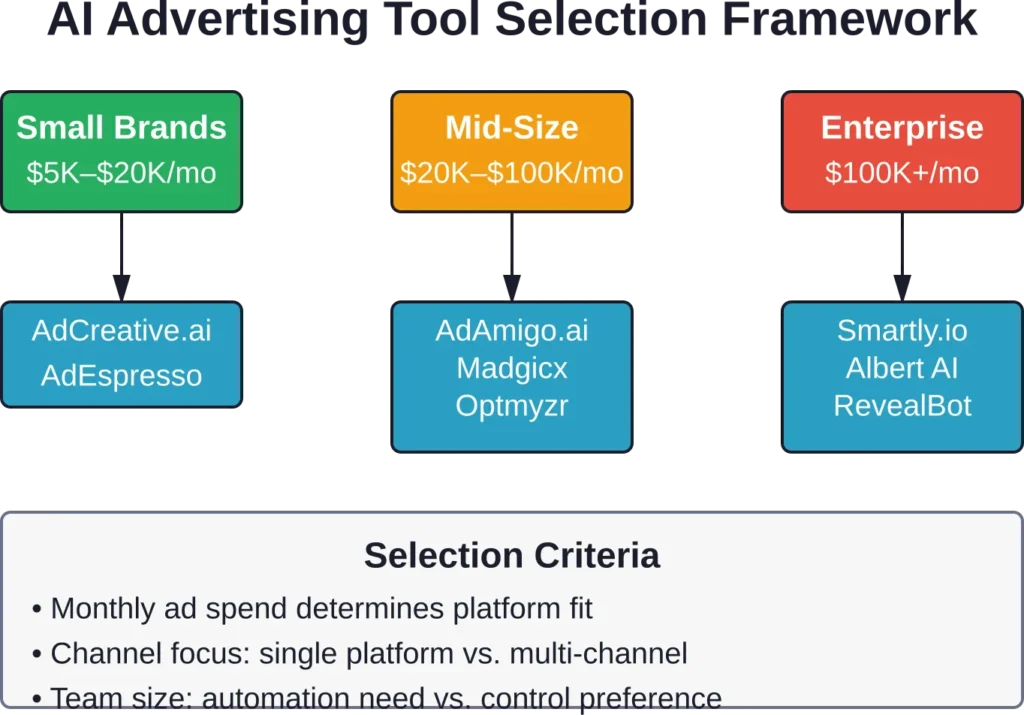
Budget determines which tools deliver positive ROI. Spending $5,000 monthly on ads doesn’t justify enterprise platforms designed for brands spending $100,000+.
Small brands (under $20,000/month) should focus on single-platform tools with low monthly fees. Mid-sized brands ($20,000–$100,000/month) can justify multi-platform tools and more sophisticated automation. Large brands ($100,000+/month) need enterprise solutions that handle complexity at scale.
Prioritize Your Bottlenecks
Where does your team spend the most time? Where do mistakes happen most frequently? That’s where AI tools deliver the most value.
If creative production is the bottleneck, invest in tools like AdCreative.ai or Jasper. If campaign optimization takes too long, focus on platforms like Optmyzr or Madgicx. If attribution is unclear, start with Cometly.
Start Single-Platform, Then Expand
Most ecommerce brands get 60–80% of their paid advertising results from one or two platforms. Master AI tools for your primary channel before adding complexity.
If Meta drives most revenue, start with Meta-specific tools. Once those workflows are dialed in, expand to Google Ads automation. Trying to optimize everywhere at once usually means optimizing nowhere effectively.
Consider Integration Requirements
Tools need to connect with your existing stack. Check whether AI platforms integrate with your ecommerce platform, analytics system, and CRM before committing.
Some tools offer native Shopify or WooCommerce integrations. Others require middleware like Zapier. Integration friction slows down implementation and reduces actual usage.
| Tool | Starting Price | Best For | Primary Strength |
|---|---|---|---|
| AdAmigo.ai | $99/month | Meta campaigns | Voice-controlled automation |
| AdCreative.ai | $29/month | Small businesses | Creative generation at scale |
| AdEspresso | $49/month | Beginners, SMBs | Simplified split testing |
| Optmyzr | Custom pricing | Google Ads complexity | Rule-based automation with ML |
| Smartly.io | Enterprise pricing | Multi-platform, large catalogs | Dynamic creative optimization |
| Madgicx | Custom pricing | Mid-sized brands | Audience targeting automation |
| Claude | $20/month (paid) | Analysis & strategy | Performance interpretation |
Implementation Best Practices
Buying tools doesn’t automatically improve performance. Implementation determines whether AI delivers results or becomes shelfware.
Set Clear Success Metrics Before Implementation
Define what improvement looks like. Is it reduced cost per acquisition? Higher return on ad spend? Less time spent on manual optimization? Without clear metrics, there’s no way to assess whether the tool is working.
Baseline current performance before implementing new tools. Track the same metrics before and after to measure actual impact.
Start with One Tool, One Channel
Implementing five AI tools simultaneously across three advertising platforms creates chaos. Start with one high-impact tool on your primary advertising channel.
Get that working smoothly, train the team, optimize workflows, and document processes. Then add the next tool.
Give AI Systems Time to Learn
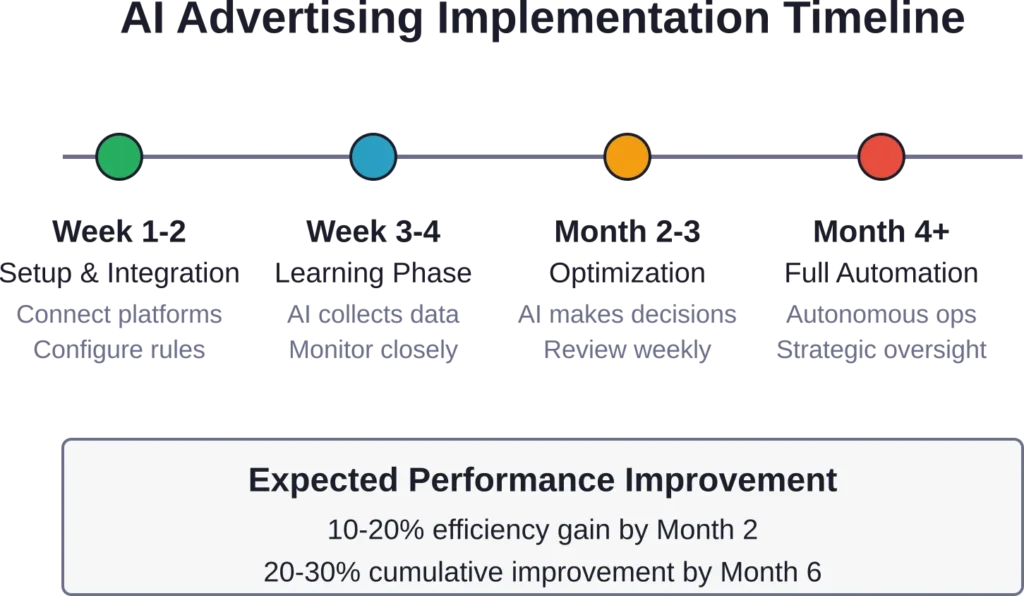
Machine learning requires data. Most AI advertising tools need 2-4 weeks of performance data before optimization algorithms work effectively.
Don’t judge a tool’s performance in the first week. Let the system collect data, train models, and refine recommendations. Evaluate after 30 days minimum.
Maintain Human Oversight
Automation doesn’t mean abandoning campaigns. AI makes recommendations and executes optimizations, but humans need to review decisions and maintain strategic direction.
Set up regular review cycles—weekly for actively scaling campaigns, bi-weekly for stable accounts. Check for anomalies, review major budget shifts, and validate that automated decisions align with business goals.
Document Workflows and Decision Rules
As AI tools take over more optimization tasks, document what they’re doing and why. When performance changes, teams need to understand which automated rules or AI decisions caused the shift.
Create documentation showing which tools handle which tasks, what rules are active, and how different systems interact. This prevents confusion and makes troubleshooting easier.
Common Pitfalls and How to Avoid Them
Implementation fails often follow predictable patterns. Here’s what to watch for.
Over-Automation Too Quickly
Handing complete control to AI before understanding how it makes decisions leads to budget waste. Automate incrementally, starting with low-risk optimizations like dayparting or device bid adjustments.
Reserve high-impact decisions—major budget shifts, audience expansion, campaign pausing—for human review until the AI proves reliable.
Ignoring Data Quality
AI tools amplify whatever data they receive. If conversion tracking is broken or attribution is inaccurate, AI optimization will optimize for the wrong signals and make performance worse.
Audit tracking implementation, verify conversion data accuracy, and fix attribution gaps before implementing AI optimization. Garbage data in means garbage decisions out.
Not Integrating Tools Properly
Many tools offer API connections and webhooks for deeper integration. Using basic features without proper integration limits effectiveness.
Invest time in setup. Connect ad platforms to CRMs, link inventory systems to pause ads when stock runs out, integrate analytics for unified reporting. Proper integration makes AI tools 10x more valuable.
Expecting Miracles Immediately
AI advertising tools improve performance incrementally, not magically. Expecting a 300% improvement in week one leads to disappointment.
Realistic expectations: 10–30% improvement in efficiency metrics (CPA, ROAS) over 3–6 months as AI systems learn and optimize. The value compounds over time.
The Future of AI in Ecommerce Advertising
AI advertising technology continues evolving rapidly. Several trends are reshaping what’s possible.
Fully Autonomous Campaign Management
Tools like Albert AI represent the direction advertising is heading: AI systems that create, launch, optimize, and scale campaigns without human intervention. Marketers set strategic objectives and budgets; AI handles execution.
This isn’t science fiction—it’s available now for brands with sufficient ad spend. Over the next few years, expect autonomous campaign management to become accessible to smaller businesses as technology costs decrease.
Real-Time Creative Optimization
Static ads are giving way to dynamically generated creative that adapts in real time based on viewer behavior, time of day, device, and dozens of other signals.
AI systems will generate personalized creative for individual users, not just audience segments. The ad someone sees at 9 AM on mobile will differ from what they see at 7 PM on desktop—same product, optimized creative for context.
Predictive Performance Modeling
Current AI tools optimize based on historical data. Next-generation platforms will predict performance before campaigns launch, using simulation and synthetic data to identify winning strategies without burning test budget.
Brands will test campaign strategies in AI simulation environments, launch only the highest-probability winners, and achieve better results with less wasted spend.
Voice and Conversational Interfaces
Tools like AdAmigo.ai demonstrate how natural language interfaces simplify campaign management. Expect this trend to accelerate—marketers will manage campaigns through conversation rather than clicking through dashboards.
Voice commands, chat interfaces, and AI assistants will replace traditional campaign management UIs for routine tasks, making advertising automation accessible to non-technical users.
Key Takeaways for Ecommerce Brands
AI advertising tools have moved from experimental to essential for ecommerce brands looking to scale profitably. Here’s what matters most:
Match tools to business size. Small brands need different tools than enterprises. Spending $99/month on specialized automation makes sense at $20,000 monthly ad spend. It’s overkill at $2,000 and insufficient at $200,000.
Solve your biggest bottleneck first. Don’t implement tools because they’re trendy. Identify where your team wastes the most time or makes the most errors, and solve that problem with AI.
Implementation matters more than features. The best tool poorly implemented delivers worse results than a basic tool properly integrated into workflows. Invest time in setup, training, and optimization.
AI augments human strategy; it doesn’t replace it. Automation handles tactical execution and optimization. Humans still own strategy, creative direction, and business judgment. The winning combination is strategic humans + fast-executing AI.
Start now, not later. Competitors are already using these tools. The learning curve and data accumulation required for AI optimization mean starting today gives advantages that compound monthly.
According to Ground’s positioning, the platform helps ecommerce businesses grow by uncovering and unlocking revenue opportunities. While this illustrates the potential impact of AI tools, success depends on proper implementation tailored to your specific business needs.
Frequently Asked Questions
Most AI tools become cost-effective around $5,000–$10,000 monthly ad spend. Below that threshold, the tool costs represent too high a percentage of media spend. There are exceptions—tools like AdCreative.ai at $29/month work for smaller budgets focused on creative production. But comprehensive automation platforms typically need $10,000+ monthly spend to justify their cost and deliver measurable ROI improvements.
Not entirely. AI tools handle tactical execution—bid adjustments, budget allocation, audience refinement, creative testing—faster and more accurately than humans. But they don’t replace strategic thinking, creative concepting, or business judgment. The most effective approach combines AI automation with human expertise. Small brands might replace junior media buyers with AI tools plus strategic oversight. Larger brands use AI to make their existing teams more efficient rather than replacing people entirely.
Expect 2–4 weeks for AI systems to collect sufficient data and begin meaningful optimization. Measurable performance improvements typically appear around 30–45 days after implementation. Significant results—20–30% efficiency gains—usually take 3–6 months as AI systems refine their models. The timeline depends on ad spend volume (more spend generates more data faster) and campaign complexity. Don’t judge performance in week one; give systems time to learn.
It depends on ad spend distribution. If 80% of budget goes to one platform, a specialized tool for that platform often outperforms multi-platform tools. If spend is distributed across Meta, Google, TikTok, and others, multi-platform tools like Smartly.io or Madgicx make more sense. Many brands start with platform-specific tools for their primary channel, then add multi-platform solutions as they scale. There’s no single right answer—match the tool stack to where revenue comes from.
Over-automation before understanding baseline performance. Brands hand full control to AI without auditing tracking accuracy, documenting current workflows, or establishing clear success metrics. When performance changes (up or down), they don’t know why. Start with limited automation on low-risk tasks, maintain human oversight on major decisions, and only expand automation after validating that AI decisions align with business goals. The second biggest mistake is implementing too many tools simultaneously, creating complexity that overwhelms teams and prevents any single tool from being properly optimized.
The data shows mixed results. AI-generated creative excels at producing high volumes of on-brand variations for testing—quantity and consistency are strengths. But breakthrough creative that significantly outperforms benchmarks typically still comes from human creativity. The winning approach combines both: use AI to generate testing variations and handle routine creative production, while humans focus on big-idea creative and strategic campaigns. Tools like AdCreative.ai work well for steady-state performance, but major product launches and brand campaigns still benefit from human creative direction.
AI optimization requires data. New accounts or products with limited conversion history won’t benefit much from AI tools initially—the systems don’t have enough signal to optimize effectively. In these situations, focus on tracking implementation and basic campaign structure first. Run campaigns manually until there are at least 50–100 conversions per month, then implement AI optimization. Some tools offer synthetic data or industry benchmarks to help cold-start scenarios, but results improve dramatically once real conversion data accumulates.
Conclusion
AI advertising tools have fundamentally changed what’s possible for ecommerce brands. Tasks that required hours of manual work—audience segmentation, creative testing, bid optimization, performance analysis—now happen automatically and often more effectively than human execution.
But tools are just tools. Results come from strategic implementation: choosing platforms that match business size and objectives, integrating them properly with existing systems, giving AI time to learn, and maintaining human oversight on strategy and creative direction.
The brands scaling profitably in 2026 aren’t necessarily the ones with the biggest budgets. They’re the ones combining smart AI automation with strong strategic thinking. They’re testing systematically, optimizing continuously, and letting technology handle tactical execution while humans focus on differentiation and positioning.
Start with one tool that solves your biggest bottleneck. Implement it properly. Measure results. Then expand from there. The ecommerce brands that treat AI as a competitive advantage rather than a buzzword are the ones winning market share while competitors manually optimize campaigns like it’s 2015.