

Quick Summary: Facebook ad optimization tools automate campaign management, audience targeting, creative testing, and performance analysis to improve ROAS and reduce wasted spend. The best solutions for 2026 include AI-powered platforms like Extuitive, AdStellar AI and Meta’s native Advantage suite, bulk launch tools like AdAmigo.ai and Kitchn.io, and analytics platforms like Madgicx and Motion that unify cross-channel reporting.
Managing Facebook ads manually in 2026 is a recipe for wasted budget. The platform’s auction dynamics shift constantly, audience behaviors evolve daily, and creative fatigue sets in faster than most marketers can react.
The right optimization tools make the difference between campaigns that drain budgets and campaigns that scale profitably. They handle the repetitive tasks, process performance signals in real time, and surface insights that would take hours to find manually.
This guide breaks down the top Facebook ad optimization tools across four core categories: AI-powered automation platforms, bulk ad launch solutions, reporting and analytics tools, and Meta’s own native features. Each category solves different problems for different team sizes and budgets.
Why Facebook Ad Optimization Tools Matter in 2026
Facebook’s advertising ecosystem has grown exponentially more complex. With millions of advertisers competing for attention, relying on manual campaign adjustments leaves performance on the table.
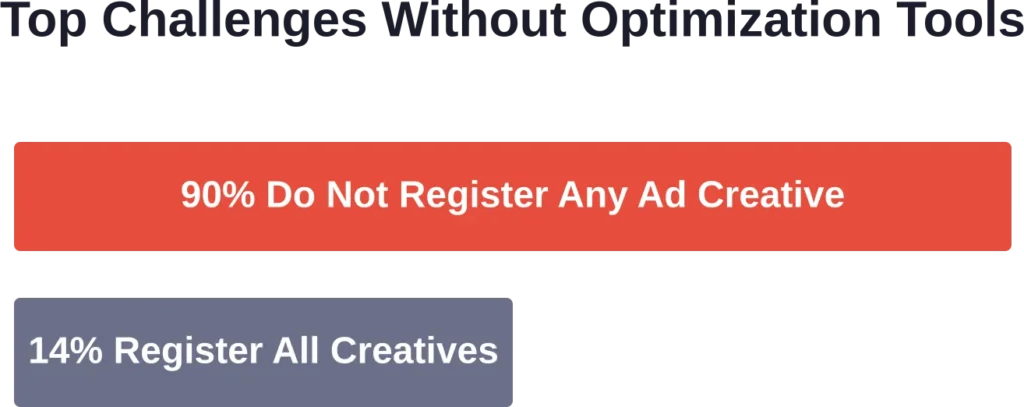
According to the 2024 IAB Digital Video Ad Spend & Strategy Report, nearly 90% of TV/video buyers do not register any ad creative.
The problem isn’t effort—it’s the scale of data. Modern campaigns generate thousands of performance signals daily. Tools automate pattern recognition, identify winning combinations before they’re obvious, and scale what works while cutting what doesn’t.
What Optimization Tools Actually Do
Facebook optimization tools fall into four functional categories. Most platforms focus on one or two, though some attempt to cover everything.
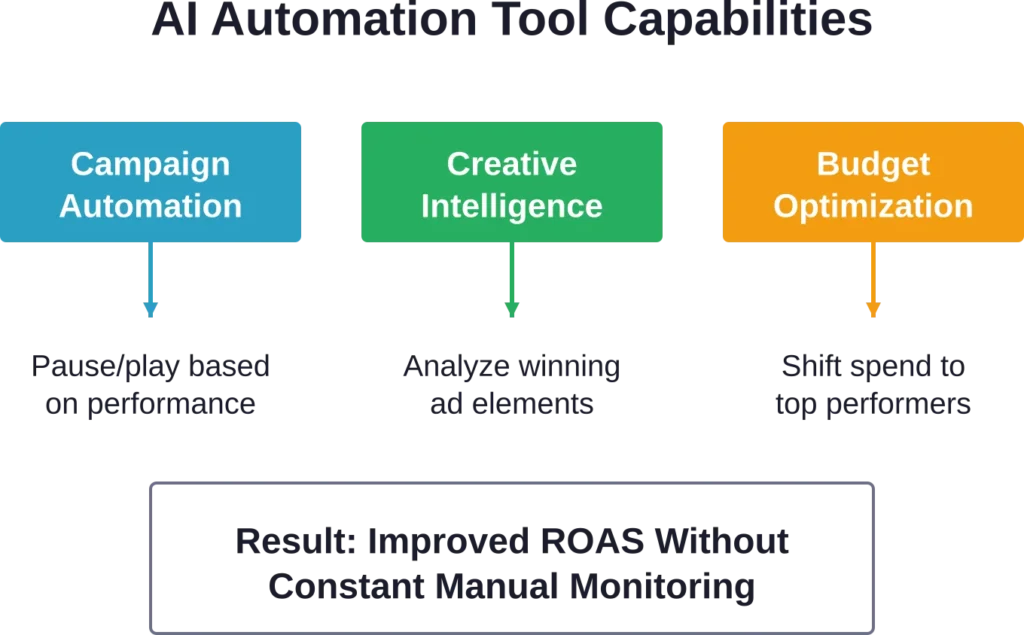
Campaign automation: These tools monitor performance metrics continuously and make bid adjustments, budget reallocation, and pause/play decisions based on predefined rules or AI models. They react faster than human analysts can.
Bulk creative management: Launching hundreds of ad variations manually through Ads Manager takes hours. Bulk tools import creative assets, audience combinations, and targeting parameters to generate campaigns at scale.
Performance analytics: Native Facebook reporting shows basic metrics, but multi-channel analytics platforms aggregate data from Facebook, Google, TikTok, and other sources into unified dashboards with cross-platform attribution.
Creative intelligence: These systems analyze which visual elements, copy formulas, and format types drive results. They identify patterns across winning ads and suggest improvements for underperformers.
Top AI-Powered Facebook Ad Automation Platforms
AI automation tools represent the cutting edge of Facebook optimization. They process millions of data points to make real-time decisions about budget allocation, audience targeting, and creative rotation.
Extuitive
Extuitive specializes in pre-launch predictive intelligence for Facebook (Meta) and TikTok ads. The platform uses a network of 150,000+ AI consumer agents to simulate real buyer behavior, score creatives for predicted CTR and ROAS, and classify them as High/Medium/Low potential before any budget is spent. It connects directly to Shopify stores for automated product analysis, creative generation (copy, images, videos), validation, and launch.
The tool combines brand-specific historical data with its Polyintelligence engine to deliver highly accurate forecasts, significantly reducing wasted spend on underperforming ads while accelerating creative testing and scaling.
Best for: Shopify/D2C e-commerce brands and performance teams that want to eliminate trial-and-error ad testing. Ideal for companies spending $10K+ per month on Meta/TikTok ads who prioritize predictive validation and high-volume creative iteration over rule-based post-launch automation.
Contact Information:
- Website: extuitive.com
- Email: [email protected]
- LinkedIn: www.linkedin.com/company/extuitive
- Twitter: x.com/Extuitive_Inc
- Instagram: www.instagram.com/extuitiveinc
AdStellar AI
AdStellar AI specializes in goal-driven campaign management with AI recommendations that adapt to specific KPIs like ROAS, CPA, or CPL. The platform handles bulk ad launch for high-volume creative testing while automatically scaling winning combinations.
The tool offers a 7-day free trial to test its full capabilities. Pricing isn’t publicly listed, but AdStellar provides a founding offer of 20% off the annual plan for new users.
Best for: E-commerce brands and agencies running high-volume creative tests across multiple client accounts. Teams that need fast campaign setup combined with automated scaling logic.
Madgicx
Madgicx combines AI-powered automation with creative intelligence and cross-channel reporting. The platform analyzes ad performance across Facebook, Instagram, and Google to identify winning patterns and suggest budget shifts.
Its creative intelligence module breaks down which visual elements and messaging angles drive conversions. That analysis feeds back into campaign creation to improve future launches.
Best for: Performance marketers managing six-figure monthly ad spends who need unified reporting across multiple channels plus AI-driven optimization suggestions.
Revealbot (Now Bïrch)

Revealbot rebranded as Bïrch but maintains its core strength: rule-based automation that executes complex if-then logic across campaigns. Users build custom automation workflows that pause underperforming ads, increase budgets on winners, and duplicate successful ad sets to new audiences.
The platform supports Facebook, Instagram, Google, TikTok, and Snapchat from a single interface.
Best for: Growth teams that want granular control over automation rules rather than black-box AI. Works well for advertisers who know exactly which metrics and thresholds matter for their business.
Bulk Ad Launch Tools for High-Volume Testing
Creative testing at scale requires launching dozens or hundreds of ad variations quickly. Bulk launch tools eliminate the repetitive clicking and form-filling that makes manual campaign creation so time-consuming.
AdAmigo.ai

AdAmigo.ai combines bulk ad launching with AI optimization and built-in error detection. The platform works directly with Meta ad accounts, eliminating the need for CSV exports or third-party connectors.
The error detection feature catches common setup mistakes—mismatched tracking pixels, broken links, incorrect audience selections—before campaigns go live.
Best for: Agencies managing multiple client accounts who need speed, quality control, and AI-powered optimization in one platform.
Kitchn.io
Kitchn.io claims to make bulk ad launching 90% faster than Meta’s native Ads Manager. The platform focuses purely on speed and scale, eliminating manual tasks without adding complex optimization layers.
The interface streamlines repetitive setup steps, making it faster to launch campaigns but offering limited AI-driven decision-making compared to full automation platforms.
Best for: Teams that already have strong manual optimization processes and simply need to launch campaigns faster. Works well when internal strategists handle optimization decisions.
AdManage.ai

AdManage.ai provides bulk launching capabilities with limited AI optimization features. The platform sits between pure bulk tools and full automation suites, offering faster setup than Ads Manager with basic performance-based rules.
Best for: Small to mid-size businesses that need bulk launching occasionally but don’t require enterprise-level automation or cross-channel analytics.
| Feature | AdAmigo.ai | Kitchn.io | AdManage.ai | Revealbot |
|---|---|---|---|---|
| Bulk Ad Launching | Yes | Yes | Yes | Limited |
| AI Optimization | Yes | No | Limited | Yes |
| Error Detection | Yes | Limited | No | No |
| Cross-Channel Support | Facebook/Instagram | Facebook/Instagram | Facebook/Instagram | Multi-platform |
| Best For | Agencies | Speed-focused teams | Small businesses | Advanced automation |
Facebook Ads Reporting and Analytics Tools
Native Facebook reporting provides basic performance data, but it doesn’t aggregate cross-channel insights or track customer journeys beyond Meta’s ecosystem. Third-party reporting tools fill that gap.
Motion

Motion specializes in multi-channel reporting for agencies. The platform aggregates data from Facebook, Google, TikTok, LinkedIn, and other ad platforms into unified client dashboards.
Motion’s strength lies in client retention—agencies use it to provide branded, automated reports that showcase results without manual data pulling each month.
Best for: Digital marketing agencies managing multiple clients across several advertising platforms. Teams that prioritize client communication and retention through professional reporting.
Wicked Reports
Wicked Reports focuses on multi-touch attribution, tracking customer journeys from first click through final purchase across multiple channels. The platform shows which touchpoints contribute to conversions, not just last-click attribution.
For e-commerce brands running Facebook ads alongside email marketing, Google Ads, and influencer campaigns, Wicked Reports clarifies which channels actually drive revenue.
Best for: E-commerce businesses with complex customer journeys and multiple marketing channels. Companies that need to understand true attribution beyond Facebook’s native reporting.
Supermetrics
Supermetrics doesn’t provide its own dashboard—instead, it pipes advertising data directly into Google Sheets, Excel, Data Studio, Tableau, or other business intelligence tools.
This approach works well for teams that already have preferred visualization tools and simply need clean data feeds.
Best for: Data analysts and marketing operations teams that build custom reports in existing BI platforms. Companies with technical resources to handle data transformation and visualization internally.
Meta’s Native Optimization Features
Before investing in third-party tools, it’s worth understanding what Meta provides natively. The company has invested heavily in AI-powered optimization, particularly through its Advantage suite.
Meta Advantage+
Meta Advantage+ represents the platform’s push toward AI-driven campaign management. The suite includes Advantage+ Shopping Campaigns, Advantage+ App Campaigns, and several Advantage optimization features.
Advantage+ Shopping Campaigns automate audience targeting, creative testing, and placements. Advertisers provide creative assets and conversion goals; Meta’s AI handles the rest. According to Harvard Business School case research (HBS Case Collection, October 2025, Revised February 2026), Meta has been making significant investments in AI since 2013, with many directed toward enhancing its digital advertising business.
According to a Santa Clara University blog post from October 30, 2025, Meta’s Andromeda Update introduced game-changing capabilities to its advertising platform, described as an AI-driven advertising framework that enhances targeting, automation, and cross-platform performance.
Best for: E-commerce brands willing to cede control to Meta’s algorithms in exchange for simplified management. Works best with strong creative assets and clear conversion tracking.
Advantage Detailed Targeting
This feature automatically expands audience reach beyond manually selected targeting parameters when Meta’s AI identifies additional high-performing audience segments.
Instead of restricting delivery to only users who match explicit interest or demographic criteria, Advantage Detailed Targeting tests adjacent audiences that show similar conversion patterns.
Best for: Advertisers who want modest audience expansion while maintaining some manual targeting control. Serves as a middle ground between fully manual and fully automated targeting.
Creative Optimization Tools in Ads Manager
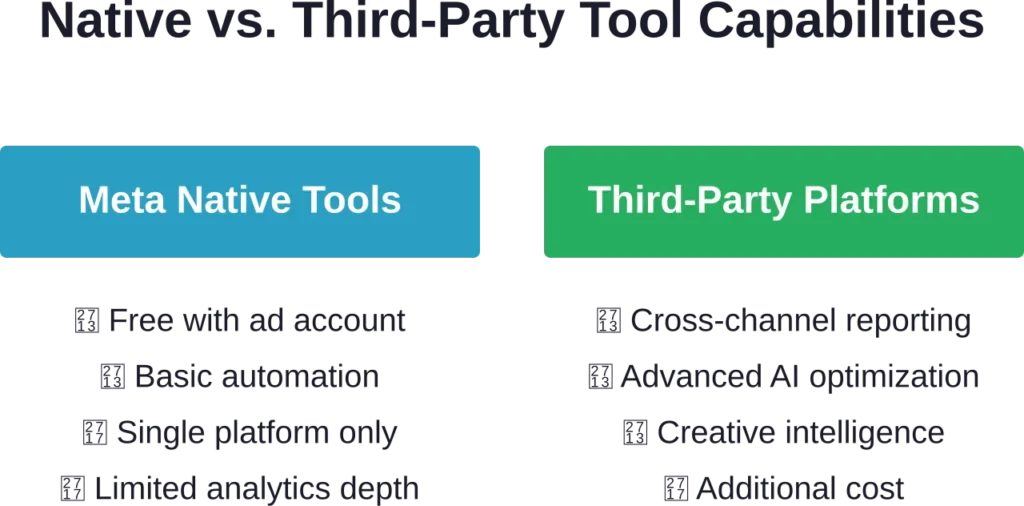
Meta’s native Ads Manager includes several creative optimization features: dynamic creative testing, which automatically combines headlines, images, descriptions, and CTAs to find top-performing combinations, and the Creative Hub for mockups and previews.
While useful, these tools lack the advanced creative intelligence that third-party platforms provide—they test combinations but don’t analyze why certain elements perform better or suggest improvements.
Best for: Small businesses and startups with limited budgets who need basic creative testing without additional software costs.
Choosing the Right Facebook Ad Optimization Tool
No single tool solves every problem. The right choice depends on team size, budget, technical capability, and specific pain points.
Start With Your Biggest Bottleneck
If campaign setup takes hours, bulk launch tools provide immediate relief. If performance analysis consumes days each month, reporting platforms deliver faster insights. If campaigns plateau after initial success, AI automation catches optimization opportunities manual management misses.
Identifying the specific bottleneck clarifies which tool category matters most. Many teams eventually use multiple tools—one for bulk launching, another for reporting, and perhaps Meta’s native features for baseline optimization.
Budget Considerations
Tool costs typically scale with ad spend. Most platforms charge monthly subscriptions ranging from $99 for basic plans to $2,000+ for enterprise features.
For teams spending less than $10,000 monthly on Facebook ads, Meta’s native tools plus one specialized solution—either bulk launching or basic reporting—often suffices. Above $50,000 monthly spend, the time savings and performance improvements from full automation platforms typically justify their cost.
Check each tool’s official website for current pricing, as rates and feature availability change frequently.
Integration Requirements
Most optimization tools connect directly to Facebook’s Marketing API, requiring account permissions but no complex technical setup. However, advanced features—particularly multi-touch attribution and cross-channel reporting—often require additional integrations with e-commerce platforms, CRM systems, and analytics tools.
Before committing, confirm which integrations the tool supports and whether implementation requires developer resources.
Trial Periods and Testing
Nearly every major Facebook optimization tool offers free trials, typically 7-14 days. Use trial periods to test with real campaigns rather than demo data.
Focus trials on the specific pain point the tool claims to solve. For bulk launch tools, measure time savings. For automation platforms, compare performance with and without AI recommendations. For reporting tools, evaluate whether insights actually change decisions.
Common Mistakes When Using Optimization Tools
Even powerful tools produce poor results when used incorrectly. Several patterns appear repeatedly across failed implementations.
Trusting Automation Without Oversight
AI automation works best with human oversight. Tools make recommendations based on data patterns, but they don’t understand business context, seasonal factors, or brand positioning.
Set review schedules—weekly for new campaigns, bi-weekly for established accounts—to verify automation decisions align with business goals.
Ignoring Creative Fatigue
Declining click-through rates and rising cost per 1,000 impressions signal creative fatigue. Even the best optimization tools can’t overcome stale creative.
Establishing creative refresh schedules prevents performance degradation. For most campaigns, new creative assets every 4-6 weeks maintain engagement without triggering learning phase resets.
Poor Data Quality
AI-powered tools rely on conversion data to optimize. If tracking pixels fire incorrectly, conversion values aren’t captured, or purchase events don’t register properly, automation produces flawed decisions.
Audit tracking implementation before launching optimization tools. Use Meta’s Test Events tool and verify conversions appear correctly in Events Manager.
Frequently Asked Questions
Meta Ads Manager provides basic campaign creation, targeting, and reporting features built into Facebook’s platform. Third-party optimization tools add AI-powered automation, bulk launching capabilities, cross-channel reporting, creative intelligence, and advanced analytics that Meta’s native interface doesn’t provide. Many advertisers use both—Ads Manager for core functionality and specialized tools for specific optimization needs.
At $5,000 monthly spend, the ROI from optimization tools depends on time constraints and growth goals. If campaign management consumes excessive time or performance has plateaued, tools provide clear value. Start with Meta’s native Advantage features and one specialized tool addressing the biggest bottleneck—either reporting or bulk launching. Full automation platforms typically deliver stronger ROI above $10,000 monthly spend.
Both. Optimization tools save time by automating repetitive tasks, but they also improve ROAS by processing performance signals faster than manual analysis allows. AI platforms identify winning audience segments, budget allocation opportunities, and creative combinations that manual management often misses. The performance improvement depends on current optimization sophistication—accounts with minimal manual optimization see larger gains than those already implementing systematic testing and analysis.
Initial setup typically takes 1-3 days, including account connections, permission grants, and configuration. Performance improvements appear within 7-14 days for automation tools as AI models learn campaign patterns. Bulk launch tools deliver immediate time savings. Reporting platforms provide value as soon as data aggregation completes, usually within 24 hours. Expect 30-45 days before optimization tools reach full effectiveness as algorithms accumulate sufficient performance data.
Many successful advertisers use multiple tools serving different functions—one for bulk launching, another for reporting, and Meta’s native features for baseline automation. This approach works well when each tool solves a distinct problem. However, avoid overlapping automation rules from multiple platforms, which can conflict and produce unpredictable results. If using multiple tools, ensure they operate on different campaign elements or designate one as the primary automation platform.
Campaigns continue running in Meta Ads Manager, but automated adjustments stop immediately. Budget reallocation, pause/play rules, and bid modifications no longer execute. Performance typically declines gradually without ongoing optimization, though the rate depends on previous manual optimization sophistication. Most tools allow exporting campaign structures and performance data before cancellation. Plan for increased manual management time when discontinuing automation platforms.
Local businesses with limited budgets often find better ROI from Meta’s native Advantage features plus one specialized tool—typically bulk launching for testing multiple creative variations quickly, or basic reporting for client updates if working with agencies. Full automation platforms deliver strongest value for local businesses spending $3,000+ monthly across multiple locations or service areas. Below that threshold, the learning curve and cost often exceed benefits unless time savings alone justify the investment.
Moving Forward With Facebook Ad Optimization
The Facebook advertising landscape continues evolving rapidly. Meta’s AI investments reshape what’s possible with native tools, while third-party platforms push boundaries in cross-channel attribution and creative intelligence.
The 2024 IAB research showing nearly 90% of TV/video buyers do not register any ad creative highlights how systematic optimization creates competitive advantages. But those same challenges create opportunities—systematic optimization, whether through Meta’s native tools or third-party platforms, delivers measurable competitive advantages.
Start by identifying the single biggest constraint in current Facebook ad management. Is it time spent on repetitive setup? Difficulty analyzing performance across multiple accounts? Inability to scale winning campaigns quickly enough?
That constraint determines which tool category delivers fastest ROI. Agencies drowning in manual campaign creation benefit from bulk launch tools. E-commerce brands struggling with attribution need cross-channel reporting. Performance marketers hitting optimization ceilings gain most from AI automation.
The right optimization tool doesn’t just save time—it fundamentally changes what’s achievable with the same advertising budget. Most platforms offer free trials. Test with real campaigns, measure specific outcomes, and scale what works.
Facebook advertising in 2026 rewards systematic, data-driven optimization. The tools exist. The question isn’t whether to optimize—it’s which tools fit specific needs best.