

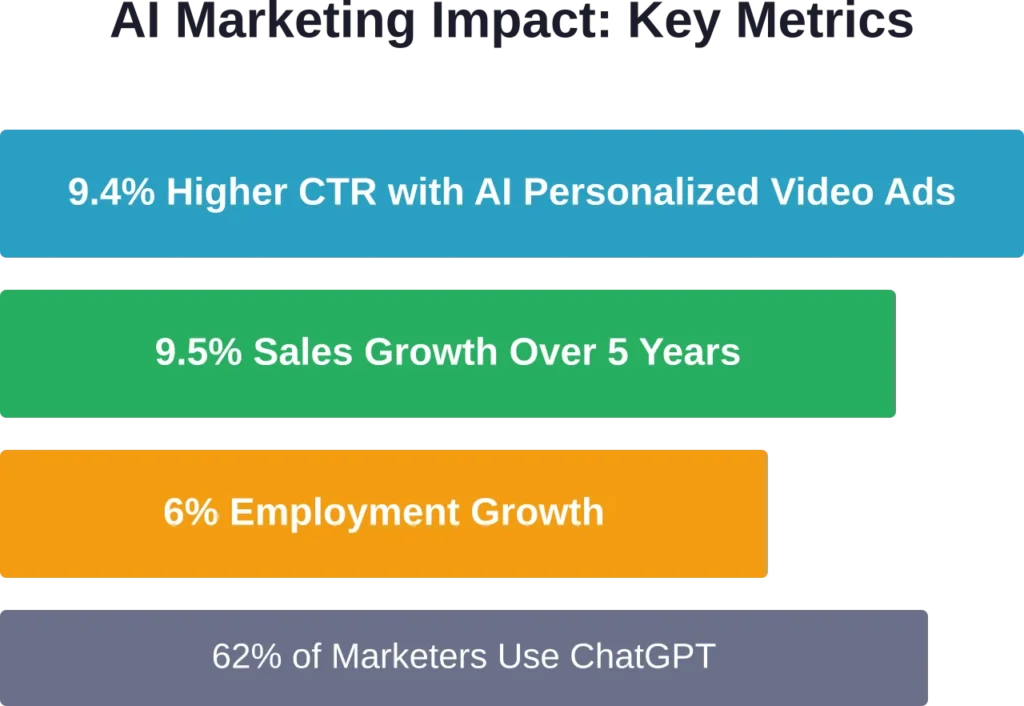
Quick Summary: AI marketing solutions are transforming how brands engage customers, with platforms like Salesforce Marketing Cloud, HubSpot, and specialized tools delivering measurable results. According to recent data, AI personalized video ads achieve 9.4% higher click-through rates than image ads, while companies that extensively adopt AI see 6% higher employment growth and 9.5% more sales growth over five years. This guide covers the top AI marketing platforms across automation, content creation, analytics, and customer engagement.
Marketing has fundamentally changed. The brands winning in 2026 aren’t just using AI as a buzzword—they’re deploying sophisticated platforms that automate workflows, personalize at scale, and generate content that actually converts.
But here’s the thing: the AI marketing landscape has become crowded. Forrester tracks hundreds of vendors across multiple categories, from B2B marketing automation platforms to consumer intelligence tools. Gartner’s Magic Quadrant evaluations now span numerous AI-powered marketing segments.
So which solutions actually deliver? This guide cuts through the noise to identify the platforms marketing teams rely on right now.
What AI Marketing Solutions Actually Do
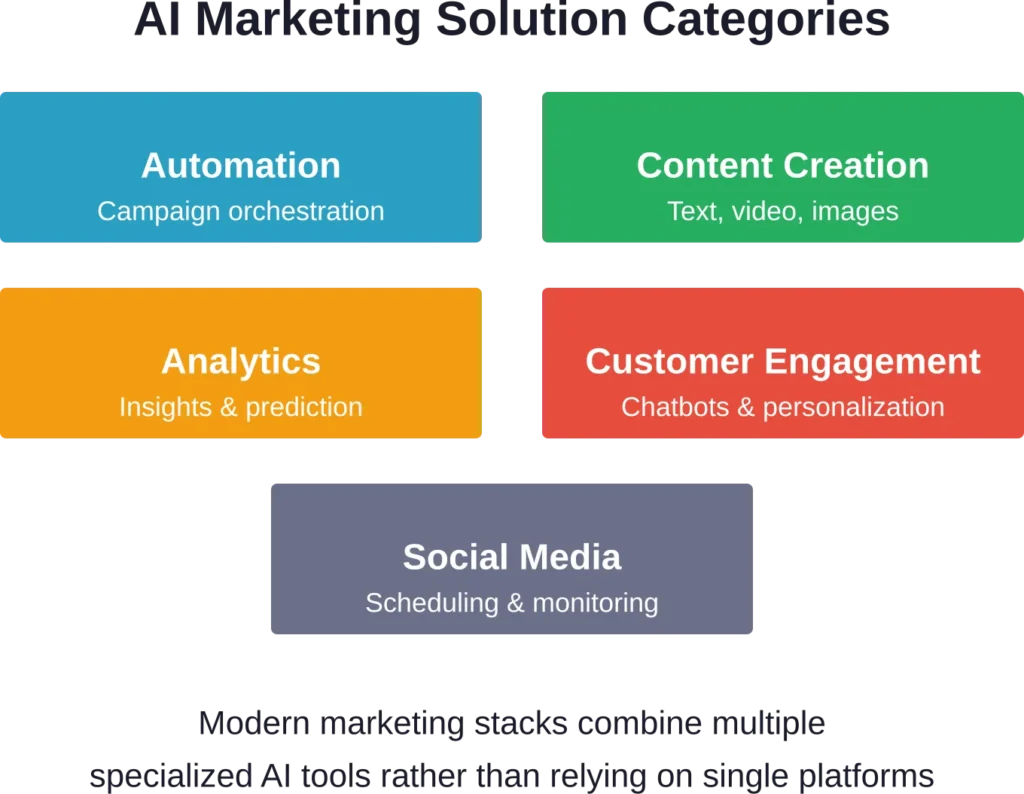
AI marketing solutions aren’t a single category. They span multiple functions that historically required separate tools and manual effort.
These platforms use machine learning, natural language processing, and generative AI to handle tasks like audience segmentation, content generation, campaign optimization, and customer service. The best solutions integrate across these functions rather than operating in isolation.
Marketing automation platforms represent the foundation. According to Gartner’s definition, B2B marketing automation platforms support demand generation processes at scale, helping marketers capture and qualify leads and accounts while orchestrating marketing-driven engagement across the full customer lifecycle.
But modern AI marketing extends beyond automation. Tools now generate video ads, write email copy, analyze customer sentiment across dozens of channels, and even identify customer needs from interview transcripts. Fine-tuned large language models performed as well as expert analysts at identifying and categorizing customer needs, according to MIT research.
The ROI Question
Do these tools actually work? The data says yes, but with nuance.
Companies that extensively adopt AI see 6% higher employment growth and 9.5% more sales growth over five years, MIT research shows. AI personalized video ads generated 9.4% higher click-through rates than personalized image ads and 6.5% higher than generic videos in a 21,000-consumer study.
Here’s the catch: AI adoption initially reduces productivity. The same MIT research found productivity can decline by 1.33 percentage points in the short term when controlling for company size, age, capital stock, and IT infrastructure. The paradox resolves over time as teams learn to work with the technology.
That said, 62% of marketers already use chatbots like ChatGPT for content generation, 58% use AI-powered tools like Grammarly, and 52% use embedded AI tools like Microsoft Co-Pilot or Canva, according to a September 2024 American Marketing Association survey.
AI-Powered Content Creation Platforms
Content remains the foundation of digital marketing. AI tools now generate everything from blog posts to video scripts, though quality varies wildly.
Extuitive
Extuitive has emerged as a specialized AI platform for predictive ad creative generation and testing, particularly for e-commerce brands. According to user reports and platform data, it helps Shopify stores significantly reduce wasted ad spend by forecasting creative performance before launch.
For marketing teams, Extuitive connects directly to Shopify, analyzes product catalogs, and generates complete advertising creatives including copy, images, and videos. It then tests these creatives against 150,000+ AI agents that simulate real consumer behavior to predict CTR, ROAS, and conversion rates with high accuracy.
But here’s what Extuitive doesn’t do as well: it is highly focused on performance advertising creatives and does not replace general-purpose content tools for blog posts, long-form articles, or non-ad content. The platform works best when used specifically for ad campaigns rather than broad marketing content needs.
Best for: DTC brands, Shopify merchants, and performance marketing teams that want to scale profitable ad creatives without expensive manual testing.
Contact Information:
- Website: extuitive.com
- Email: [email protected]
- LinkedIn: www.linkedin.com/company/extuitive
- Twitter: x.com/Extuitive_Inc
- Instagram: www.instagram.com/extuitiveinc
ChatGPT and OpenAI GPT Models

ChatGPT has become synonymous with AI content creation. According to a March 2025 survey, 28% of employed adults in the United States used ChatGPT to get work done.
For marketing teams, ChatGPT handles initial draft creation, brainstorming, content outlining, and even audience research. ChatGPT Plus at $20/month provides advanced features including access to GPT-4 and priority support.
But here’s what ChatGPT doesn’t do well: maintain brand voice consistency across campaigns, integrate with marketing workflows, or optimize for specific conversion goals. It’s a powerful general-purpose tool that requires human oversight and editing.
Jasper AI

Jasper focuses specifically on marketing content, offering templates for ads, emails, social posts, blog articles, and product descriptions. The platform maintains brand voice guidelines and can generate content variations for A/B testing.
Teams appreciate Jasper’s workflow integrations and collaboration features. Multiple users can work within brand-approved parameters, and the platform includes plagiarism checking and SEO optimization suggestions.
Pricing tiers scale with usage volume. Check Jasper’s official website for current plans—they’ve adjusted pricing models several times based on market conditions.
Copy.ai

Copy.ai targets sales and marketing teams needing high-volume content generation—email sequences, social media posts, ad copy, and website content. The platform emphasizes speed and variety over deep customization.
The strength is rapid iteration. Teams can generate dozens of variations in minutes, then refine the best options. The weakness is maintaining sophisticated brand voice and strategic messaging across long-form content.
B2B Marketing Automation Leaders
Marketing automation platforms handle the orchestration layer—managing campaigns, scoring leads, syncing with CRM systems, and automating multi-touch nurture sequences.
Salesforce Marketing Cloud Account Engagement
Salesforce Marketing Cloud Account Engagement (formerly Pardot) has been recognized as a Leader in the Gartner Magic Quadrant for B2B Marketing Automation Platforms for seven consecutive years as of October 2024.
The platform excels at aligning marketing and sales teams through tight Salesforce CRM integration. Marketing AI capabilities include Einstein features for predictive lead scoring, send-time optimization, and engagement frequency management.
Einstein Generative AI in Marketing Cloud Engagement adds content generation capabilities—drafting email subject lines, body copy, and even SMS messages based on brand guidelines and campaign objectives.
Real talk: Salesforce works best for organizations already invested in the Salesforce ecosystem. The learning curve is steep, and full deployment typically requires dedicated admin resources or consultant support.
HubSpot Marketing Hub
HubSpot earned Leader status in the inaugural Forrester Wave for B2B Revenue Marketing Platforms, Q3 2024. The platform combines marketing automation with CRM, content management, and customer service tools in a unified system.
HubSpot’s AI tools span content generation (blog posts, social media, email), conversation intelligence, and predictive lead scoring. The platform’s strength lies in its usability—teams can deploy sophisticated automation without extensive technical knowledge.
The freemium model lets small teams start without budget approval, then scale up as needs grow. That accessibility has made HubSpot popular with mid-market companies and fast-growing startups.
Oracle Eloqua

Oracle Eloqua targets enterprise B2B organizations with complex, multi-touch buying cycles. The platform handles advanced lead management, account-based marketing, and campaign orchestration across channels.
AI capabilities focus on adaptive campaign optimization, predictive content recommendations, and behavioral pattern recognition. Eloqua’s integration with Oracle’s broader cloud suite (sales, service, commerce) makes it compelling for large organizations standardizing on Oracle infrastructure.
The trade-off? Implementation complexity and cost. Eloqua makes sense for enterprises with dedicated marketing ops teams, not for companies seeking quick-start solutions.
Marketing Analytics and Intelligence Platforms
Understanding what customers want and how campaigns perform requires platforms that aggregate data from multiple sources and surface actionable insights.
Google Analytics 4 with AI Insights

Google Analytics 4 represents a complete rebuild focused on cross-platform measurement and predictive metrics. AI features include automatic anomaly detection, predictive audiences, and natural language query.
The platform predicts purchase probability, churn probability, and revenue potential for user segments without requiring manual model configuration. These predictions power automated remarketing and optimization.
GA4’s free tier provides substantial capability, though enterprise organizations may need Google Analytics 360 for unsampled reports, advanced attribution, and enhanced support.
Consumer Intelligence Platforms
Consumer intelligence platforms derive real-time insights from data sources outside companies—social media conversations, review sites, forums, and news coverage—using proprietary analysis methods.
These evolved from social listening platforms to encompass broader signal detection. Forrester’s upcoming Consumer Intelligence Platforms Landscape report reflects this transformation.
Platforms in this category help marketers identify emerging trends, track brand perception, understand competitive positioning, and discover unmet customer needs. The AI layer analyzes unstructured data at scale that human teams couldn’t manually process.
Julius AI for Data Visualization

Julius AI handles a specific but critical function: transforming raw data into clear visualizations. Marketing teams upload datasets and use natural language prompts to generate charts, graphs, and dashboards.
This bridges the gap between data availability and insight accessibility. Marketers without advanced analytics training can explore campaign performance, customer behavior, and market trends through conversational queries.
Customer Engagement and Conversational AI
Customer engagement platforms use AI to personalize interactions, automate responses, and scale one-to-one communication.
Drift Conversational Marketing

Drift pioneered conversational marketing—using chatbots and live chat to qualify leads, book meetings, and route prospects to the right sales representatives in real-time.
The AI layer handles initial qualification, answers common questions, and escalates complex inquiries to human agents. Drift integrates with marketing automation and CRM systems to provide context for every conversation.
Conversational marketing works particularly well for high-consideration B2B purchases where immediate engagement dramatically increases conversion rates compared to traditional form-fill workflows.
Intercom Customer Service Platform

Intercom combines customer messaging, chatbots, help desk functionality, and product tours in a unified platform. AI powers automated responses, conversation routing, and proactive messaging based on user behavior.
The Resolution Bot handles common support questions automatically, while human agents focus on complex issues. Intercom’s data shows automation can resolve 30-50% of incoming queries without human involvement.
For marketing teams, Intercom enables behavioral messaging—triggering personalized campaigns based on product usage, feature adoption, or engagement patterns.
Agentforce Marketing Capabilities

Agentforce represents Salesforce’s evolution toward agentic AI—autonomous agents that execute multi-step workflows with minimal human direction. Organizations are increasingly piloting agentic AI with growing numbers moving toward production deployment.
Agentforce differs from Einstein AI tools in scope and autonomy. Einstein provides recommendations and predictions that humans act on. Agentforce agents can execute complete workflows—analyzing campaign performance, adjusting budgets, generating content variants, and optimizing delivery schedules autonomously within defined parameters.
This represents the frontier of AI marketing. The technology is still maturing, and most organizations are moving cautiously given the complexity and risk of fully autonomous marketing decisions.
Social Media Management with AI
Social media demands constant content production, community management, and performance analysis across multiple platforms. AI tools help teams scale these operations.
Hootsuite with AI Composer

Hootsuite provides scheduling, publishing, monitoring, and analytics across major social platforms. The AI Composer generates post variations, suggests optimal posting times, and recommends hashtags based on content and audience.
Teams manage multiple brand accounts from a unified dashboard, collaborating on content calendars and responding to mentions. Analytics track performance across networks with unified reporting.
Sprout Social Intelligence

Sprout Social combines publishing, engagement, and analytics with robust social listening capabilities. AI features include sentiment analysis, competitive benchmarking, and trend detection.
The platform surfaces actionable insights from social conversations—identifying customer pain points, feature requests, and perception shifts. These insights inform broader marketing strategy beyond just social tactics.
Buffer’s AI Assistant

Buffer focuses on simplicity and ease of use for small teams. The AI Assistant helps generate post ideas, repurpose content across formats, and optimize posting schedules for maximum engagement.
Buffer works well for teams needing straightforward social media management without enterprise complexity. The tool integrates with other platforms through Zapier for workflow automation.
Video and Visual Content Creation
Video content delivers strong engagement, but production traditionally required significant time and budget. AI tools have democratized video creation.
Descript’s AI Underlord

Descript revolutionized video editing by letting users edit video through transcript editing. Delete words from the transcript, and Descript removes the corresponding video segments automatically.
AI features include automatic filler word removal, Studio Sound that improves audio quality, and AI voices for overdubbing corrections. The AI Underlord handles complex editing tasks through text commands.
This dramatically reduces the skill barrier for video content. Marketers without video editing experience can produce polished content by focusing on message rather than technical mechanics.
Synthesia AI Video Generation

Synthesia generates videos from text scripts using AI avatars and voices. Marketing teams create explainer videos, product demos, training content, and personalized messages without filming.
The platform supports 120+ languages and provides diverse avatar options. Teams can customize branding, add screen recordings, and incorporate graphics into generated videos.
Limitations exist around authenticity and emotional resonance—AI avatars lack the warmth of real people. The technology works best for informational content where consistency and scalability matter more than personal connection.
DALL-E and Midjourney for Visual Content


DALL-E (from OpenAI) and Midjourney generate images from text descriptions. Marketing teams use these tools for social media graphics, blog illustrations, ad concepts, and mood boards.
The technology excels at creating unique visuals quickly. A marketer can generate dozens of concept variations in the time it would take to brief a designer for a single option.
That said, generated images sometimes include subtle artifacts or inconsistencies. Many teams use AI for initial concepts, then refine promising directions with human designers.
| Platform Category | Primary Use Case | Best For | Integration Complexity |
|---|---|---|---|
| B2B Marketing Automation | Campaign orchestration, lead nurturing | Enterprise marketing teams | High |
| Content Generation | Text, video, image creation | Content marketers, agencies | Low to Medium |
| Analytics & Intelligence | Data analysis, trend identification | Data-driven marketers | Medium |
| Conversational AI | Customer engagement, chatbots | B2B companies with sales cycles | Medium |
| Social Media Management | Publishing, monitoring, scheduling | Social media managers | Low |
| Video Creation | Video editing, generation | Content teams needing scale | Low |
Email Marketing Optimization Tools
Email remains one of the highest-ROI marketing channels. AI tools now optimize every aspect—from subject lines to send times to content personalization.
Seventh Sense Send Time Optimization
Seventh Sense integrates with HubSpot and Marketo to optimize email send times at the individual recipient level. The AI analyzes engagement patterns to determine when each person is most likely to open and click.
Rather than sending all emails at 10 AM on Tuesday, Seventh Sense distributes sends across a window based on individual behavior patterns. This can significantly improve open and click rates for existing campaigns without changing content.
Phrasee Language Optimization
Phrasee uses AI to generate and test email subject lines, preview text, and body copy variations. The platform learns brand voice and optimizes for engagement metrics specific to each brand’s audience.
Major brands have used Phrasee to test thousands of language variations at scale, identifying patterns in what resonates that human copywriters might miss. The system gets smarter over time as it accumulates more data.
SEO and Search Marketing AI
Search engine optimization involves keyword research, content optimization, technical audits, and link building. AI tools accelerate each component.
Surfer SEO Content Optimization

Surfer SEO analyzes top-ranking pages for target keywords and provides specific optimization recommendations—word count ranges, keyword density, headings structure, and terms to include.
Writers use Surfer’s real-time content editor to optimize as they write, with a score indicating how well the content matches ranking patterns. The tool integrates with Google Docs and WordPress for seamless workflows.
Clearscope Content Intelligence

Clearscope provides similar content optimization with emphasis on semantic relevance rather than just keyword matching. The platform identifies related concepts and terms that signal comprehensive coverage to search engines.
Marketing teams use Clearscope for content briefs, optimization, and performance tracking. The tool helps maintain consistent quality across content teams by providing objective optimization metrics.
Alli AI for Technical SEO

Alli AI automates technical SEO optimization—fixing meta tags, adjusting internal linking, implementing schema markup, and optimizing page speed factors across entire websites.
The platform deploys changes through code injection rather than requiring manual edits to every page. This makes enterprise-scale SEO optimization feasible for teams without extensive development resources.
Project Management and Workflow Automation
AI increasingly handles routine project coordination, task management, and workflow orchestration.
Zapier AI Automation

Zapier connects thousands of apps and services through automated workflows called Zaps. AI features include natural language Zap creation, automatic error handling, and intelligent data mapping between apps.
Marketing teams use Zapier to sync data between platforms, trigger actions based on events, and eliminate manual data entry. Common workflows include adding form submissions to CRM systems, posting social media content across platforms, and generating reports from multiple data sources.
Monday.com Work OS

Monday.com provides visual project management with AI-powered automation for task assignment, deadline tracking, and status updates. The platform adapts to various workflows rather than enforcing rigid structures.
Marketing teams manage campaigns, content calendars, and launch plans with customizable boards and automations that reduce coordination overhead.
Notion AI Knowledge Management

Notion combines wiki, project management, and knowledge base functionality with AI writing assistance, content generation, and automatic summarization.
Teams use Notion for campaign planning, content calendars, meeting notes, and documentation. The AI layer helps maintain knowledge bases by generating summaries, filling in templates, and answering questions about stored information.
AI Platform Selection Considerations
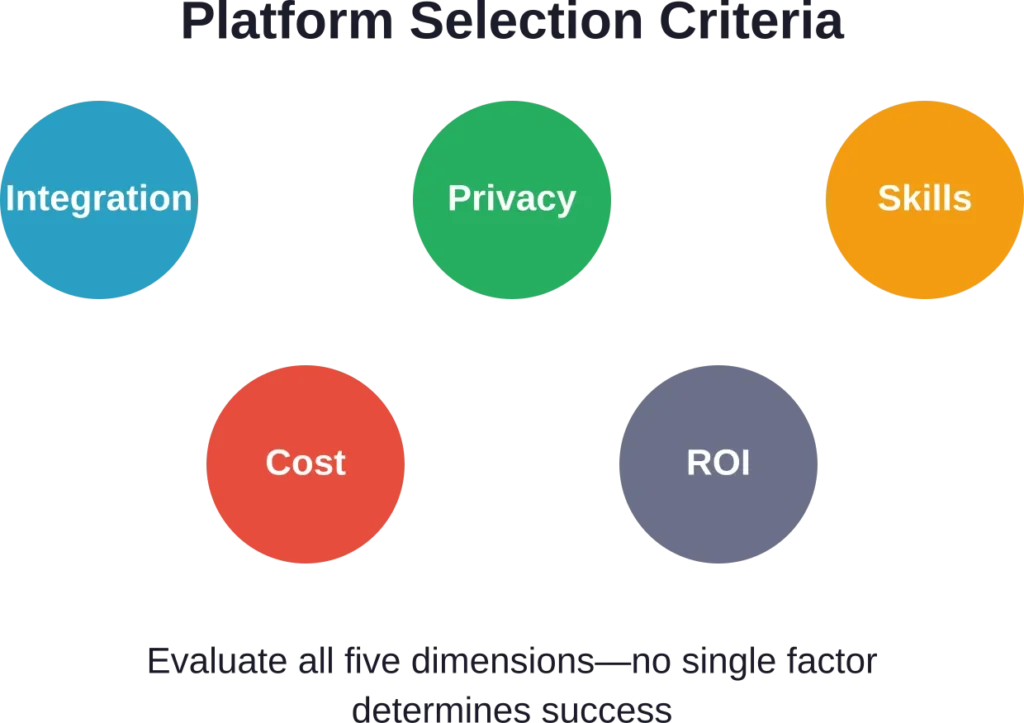
Choosing the right AI marketing solutions requires evaluating several dimensions beyond feature lists.
Integration Requirements
Marketing technology stacks typically include 10-30 different tools. Solutions must integrate smoothly with existing CRM, analytics, content management, and automation platforms.
Check native integrations, API availability, and whether platforms appear in integration marketplaces like Zapier. 95% of organizations struggle with disconnected or incomplete customer data, according to the American Marketing Association.
Data Privacy and Trust
45% of consumers say visibility and control over their data is a top priority when engaging with brands, according to the Adobe 2025 AI and Digital Trends report. That mandate extends to how brands use AI.
68% of customers say advances in AI make it more important for companies to be trustworthy, Salesforce research shows. Marketing leaders must ensure AI platforms maintain appropriate data security, provide transparency about AI usage, and comply with privacy regulations.
Look for platforms with clear data handling policies, SOC 2 compliance, GDPR readiness, and options to opt out of having data used for model training.
Skill Requirements and Learning Curve
Some AI platforms require minimal training—ChatGPT’s conversational interface needs little explanation. Others demand weeks of onboarding and ongoing admin support.
Assess honestly whether the team has bandwidth for complex implementations. Sometimes a simpler tool that ships quickly delivers more value than a sophisticated platform that sits unused because nobody completed the training.
Cost Structure and Scalability
AI marketing platform pricing varies dramatically—from $20/month for individual tools to six-figure enterprise contracts for full marketing clouds.
Watch for usage-based pricing that can spike unexpectedly. Some platforms charge per API call, per generated asset, or per contact in the database. These costs can escalate rapidly as usage grows.
Evaluate total cost of ownership including implementation, training, ongoing administration, and integration maintenance—not just subscription fees.
Implementation Best Practices
Successful AI marketing adoption follows patterns that reduce risk and accelerate value realization.
Start with High-Impact, Low-Complexity Use Cases
Don’t begin with the most complex automation. Identify tasks that consume significant time but follow predictable patterns—social media post generation, email subject line testing, basic customer service inquiries.
These use cases deliver quick wins that build momentum and demonstrate ROI. Success with simple implementations builds confidence for more sophisticated projects.
Expect the Productivity Paradox
Remember the MIT research showing short-term productivity declines during AI adoption. Teams need time to learn new tools, adjust workflows, and develop effective prompting techniques.
Budget for this learning period. Don’t kill promising initiatives because month-one results disappoint. The organizations seeing 6% employment growth and 9.5% sales growth from AI invested through the initial adjustment period.
Maintain Human Oversight
AI generates content at scale, but quality varies. Every AI-generated output needs human review—checking for accuracy, brand voice consistency, and strategic alignment.
Implement approval workflows that ensure AI serves as a productivity multiplier for skilled marketers rather than replacing judgment entirely. The best results come from human-AI collaboration, not full automation.
Measure and Iterate
Define success metrics before deploying AI tools. Are you optimizing for time savings, engagement improvement, conversion rate increases, or cost reduction?
Track these metrics consistently and adjust based on results. AI platforms improve with usage and feedback—the more data they process, the better recommendations they provide.
Future Trends in AI Marketing
The AI marketing landscape continues evolving rapidly. Several trends are shaping where the technology heads next.
Agentic AI Expansion
Agentic AI—autonomous agents that execute multi-step workflows—represents the next frontier. Organizations are increasingly piloting agentic AI with growing numbers moving toward production deployment.
These systems will increasingly handle complete campaign workflows—analyzing performance, adjusting targeting, generating creative variations, and optimizing budgets without human intervention for routine decisions.
Multimodal AI Integration
Early AI marketing tools focused on single modalities—text or images or video. Newer platforms seamlessly combine text, image, video, and audio generation in unified workflows.
This enables campaign creation that spans formats from a single brief. Describe a campaign concept, and the system generates social posts, email copy, landing page content, and video scripts together with consistent messaging.
Real-Time Personalization at Scale
The 9.4% CTR improvement from AI personalized video ads demonstrates the power of individualization. Advances in generative AI enable this personalization across more channels and at greater scale.
Expect systems that dynamically generate website content, email creative, and ad variations tailored to individual users in real-time based on behavior, preferences, and context.
Tighter Privacy and Governance
As 45% of consumers prioritize data control and 68% demand increased trustworthiness, regulatory pressure will intensify. Marketing AI platforms will incorporate more robust consent management, data minimization, and algorithmic transparency.
Organizations using AI must implement governance frameworks that address data usage, bias detection, transparency requirements, and auditability.
| Solution Type | Example Vendors | Primary Benefit | Typical Investment |
|---|---|---|---|
| Marketing Automation | Salesforce, HubSpot, Oracle Eloqua | Campaign orchestration, lead management | Enterprise-level |
| Content Generation | ChatGPT, Jasper, Copy.ai, Descript | Speed, scale, variety of content | Low to Medium |
| Analytics | Google Analytics 4, Julius AI | Insight generation, prediction | Low to Medium |
| Conversational AI | Drift, Intercom, Agentforce | Real-time engagement, qualification | Medium to High |
| Social Media | Hootsuite, Sprout Social, Buffer | Multi-platform management | Low to Medium |
| SEO Tools | Surfer SEO, Clearscope, Alli AI | Search visibility improvement | Low to Medium |
Common Implementation Challenges
Organizations encounter predictable obstacles when deploying AI marketing solutions. Understanding these helps avoid common pitfalls.
Data Quality Issues
AI systems are only as good as the data they process. 95% of organizations struggle with disconnected or incomplete customer data, according to the American Marketing Association.
Before implementing sophisticated AI, audit data quality across systems. Address duplicate records, incomplete profiles, and integration gaps. Clean data is the foundation for effective AI.
Skills Gaps
AI literacy varies widely across marketing teams. Some members embrace new tools enthusiastically while others resist change or struggle with technical concepts.
Invest in training and create internal advocates who can help colleagues learn. The American Marketing Association offers AI literacy programs specifically for marketing professionals navigating this transition.
Over-Automation
The temptation exists to automate everything possible. But some marketing activities benefit from human judgment, creativity, and relationship-building that AI can’t replicate.
Strategic decisions, relationship nurturing, crisis communications, and complex negotiation still require human involvement. Use AI to eliminate grunt work and enhance decision-making, not replace thinking.
Vendor Lock-In
Some platforms make it difficult to export data or switch providers. Before committing to a solution, understand data portability, export formats, and migration processes.
Favor platforms with standard APIs, documented data models, and active integration ecosystems. This provides flexibility if requirements change or better alternatives emerge.
Frequently Asked Questions
According to September 2024 American Marketing Association survey data, 62% of marketers use chatbots like ChatGPT for content generation, 58% use AI-powered tools like Grammarly, 52% use embedded AI tools like Microsoft Co-Pilot or Canva, and 45% use specialized image and video generators like Midjourney. Marketing automation platforms from Salesforce, HubSpot, and Oracle also see widespread enterprise adoption.
Pricing varies dramatically by platform type and organization size. Individual tools like ChatGPT Plus cost around $20/month. Specialized marketing tools range from $50-500/month for small teams. Enterprise marketing automation platforms from Salesforce, Oracle, and similar vendors typically involve five- to six-figure annual contracts depending on user count, feature requirements, and implementation complexity. Always check current pricing on official vendor websites as models frequently change.
MIT research shows companies that extensively adopt AI see 6% higher employment growth and 9.5% more sales growth over five years. AI personalized video ads achieve 9.4% higher click-through rates than personalized image ads according to a 21,000-consumer study. However, expect short-term productivity declines during initial adoption as teams learn new systems. ROI materializes over time rather than immediately.
Small businesses typically benefit most from low-complexity tools with minimal learning curves. ChatGPT Plus for content generation, Canva with AI features for design, Buffer for social media management, and HubSpot’s free CRM with marketing tools provide substantial capability without enterprise complexity or cost. Focus on tools that solve specific high-value problems rather than trying to implement comprehensive marketing clouds.
No. AI tools augment human marketers by handling routine tasks, accelerating content production, and surfacing insights from data. Strategic thinking, creative direction, relationship building, and complex decision-making still require human judgment. Research shows firms using AI extensively grow faster and hire more people—the technology creates leverage rather than replacement. However, the nature of marketing work is changing, with less time spent on execution and more on strategy and oversight.
Maintain brand voice by creating detailed guidelines that include tone, vocabulary, messaging principles, and example content. Use platforms like Jasper that allow uploading brand voice documentation. Always review and edit AI-generated content before publishing—AI provides first drafts, not finished work. Build a library of approved examples that establish quality standards. Over time, fine-tune prompts to consistently generate on-brand content, but never skip human review.
Marketing automation platforms execute predefined workflows—if X happens, do Y. These systems follow rules marketers configure but don’t make independent decisions. AI marketing tools use machine learning to make predictions, generate content, optimize decisions, and adapt behavior based on outcomes without explicit programming for every scenario. Modern platforms increasingly combine both—automation handles workflow orchestration while AI optimizes decisions within those workflows.
Conclusion
The AI marketing landscape in 2026 offers unprecedented capability. Platforms handle everything from campaign orchestration to content generation to predictive analytics with sophistication that seemed impossible just a few years ago.
But capability doesn’t automatically translate to results. The organizations winning with AI marketing share common patterns. They start with clear use cases rather than chasing shiny objects. They invest in data quality and integration. They maintain human oversight while letting AI handle routine work. And they measure results consistently to guide continuous improvement.
The numbers back this approach. Companies see 6% employment growth and 9.5% sales growth from extensive AI adoption. AI personalized video ads achieve 9.4% higher click-through rates. These aren’t marginal improvements—they’re competitive advantages that compound over time.
The key is matching solutions to actual problems. Don’t implement AI because everyone else is. Implement it because you’ve identified specific bottlenecks, inefficiencies, or opportunities where the technology delivers measurable value.
Start small. Test thoroughly. Scale what works. And remember that AI succeeds when it amplifies human creativity and judgment rather than replacing it.
Ready to transform your marketing with AI? Begin by auditing your current workflows, identifying time-intensive tasks that follow predictable patterns, and selecting one high-impact use case for initial implementation. The organizations building competitive advantages aren’t waiting for perfect solutions—they’re learning by doing.