

Quick Summary: AI marketing analytics tools use machine learning and automation to transform raw data into actionable insights, enabling faster decision-making and campaign optimization. The best platforms in 2026 combine cross-channel data integration, predictive analytics, natural language query interfaces, and automated reporting to help marketing teams measure ROI, identify trends, and allocate budgets more effectively.
Marketing teams today are drowning in data. Google Analytics, social platforms, email tools, CRM systems, advertising networks—each generates mountains of numbers. But raw data isn’t insight.
That’s where AI marketing analytics tools step in. These platforms don’t just aggregate metrics. They identify patterns humans would miss, predict outcomes before campaigns launch, and answer questions in plain English instead of forcing marketers to master SQL.
The shift is happening fast. According to Forrester research, 67% of AI decision-makers plan to increase investment in generative AI within the next year. The technology has moved beyond experimental.
This guide examines the AI marketing analytics tools reshaping how teams work with data. Not every platform claiming “AI-powered” genuinely transforms analytics work. The tools covered here demonstrate measurable improvements in speed, depth, and accessibility of marketing insights.
What Makes an AI Marketing Analytics Tool Different
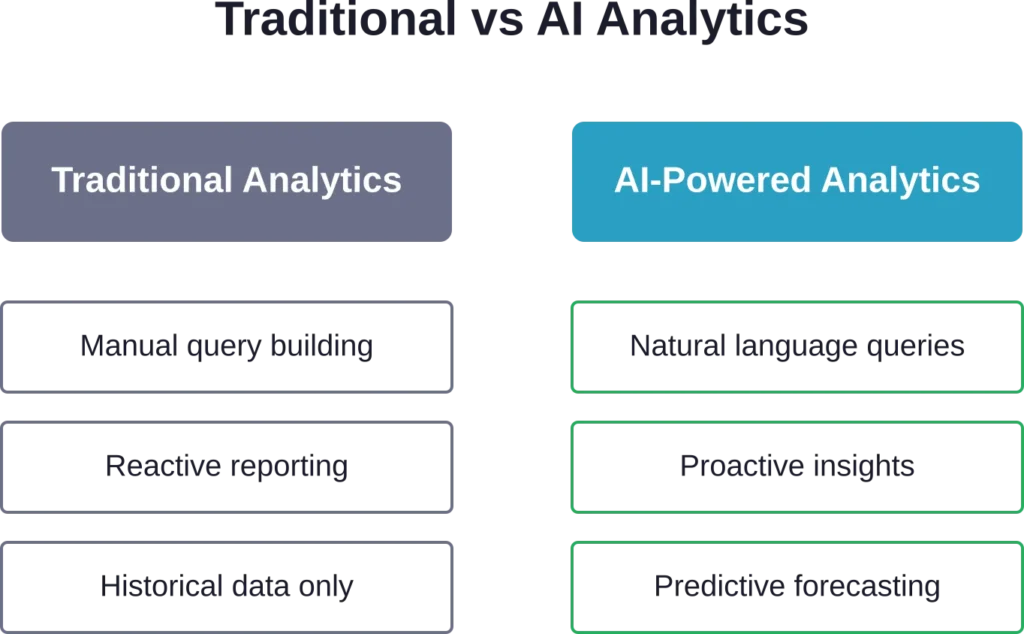
Traditional analytics platforms display data. AI-powered platforms interpret it.
The distinction matters. A standard dashboard might show that email open rates dropped 12% last quarter. An AI analytics tool identifies that the drop correlates with send times shifting two hours later, competing with inbox clutter, and affecting specifically the 25-34 age segment in Eastern time zones.
Here’s what separates genuine AI analytics from dashboards with a chatbot tacked on:
Natural Language Processing for Data Queries
Instead of building complex filters and segments, marketers ask questions: “Which campaigns drove the most qualified leads last month?” or “Why did conversion rates drop in the Northeast region?”
The tool parses the question, identifies relevant data sources, performs the analysis, and returns both an answer and the supporting visualizations. This eliminates the bottleneck where only data analysts can extract insights.
Predictive Analytics and Forecasting
AI models trained on historical performance can project future outcomes with increasing accuracy. These systems forecast campaign results, predict customer lifetime value, estimate budget requirements for target goals, and flag anomalies before they become crises.
Testing shows that synthetic personas and digital twins—AI-generated proxies that simulate consumer responses—can closely mirror human responses in certain domains, dramatically reducing the time and cost of traditional market research.
Automated Insight Generation
Rather than waiting for someone to notice a trend, AI analytics platforms proactively surface findings. They identify underperforming segments, detect unusual patterns, highlight opportunities, and prioritize issues by potential impact.
This shifts analytics from reactive reporting to proactive intelligence.
Cross-Channel Data Integration
Most marketing teams use 8-15 different tools. AI analytics platforms connect these fragmented data sources, resolve identity across channels, normalize metrics with different definitions, and create unified customer journey views.
The real power emerges when the tool understands how channels influence each other—not just individual performance.
Top AI Marketing Analytics Platforms in 2026
The market has consolidated around platforms that genuinely solve analytics bottlenecks. Here are the tools marketing teams are actually using—not just evaluating.
Extuitive: Pre-Launch Predictive Ad Analytics
Extuitive is an AI-powered platform that predicts ad creative performance before launching any campaigns. The platform connects to Shopify, analyzes products, auto-generates copy, images, and videos, then tests them against thousands of AI consumer agents modeled after 150,000+ real consumer behaviors.
The core strength lies in pre-launch forecasting. Instead of spending budget on test campaigns, Extuitive delivers accurate predictions for CTR, ROAS, conversion rates, and purchase intent, allowing teams to validate and rank creatives in minutes rather than weeks.
For D2C and Shopify brands, this dramatically reduces wasteful ad spend and increases winning creative hit rates. The platform also provides intelligent audience targeting recommendations and synthetic consumer validation.
The trade-off is that Extuitive focuses primarily on the pre-launch and creative validation stage rather than post-campaign multi-channel reporting or deep attribution analysis.
Pricing starts at approximately $1,000/month for the Starter plan, with Professional at $2,500/month and Enterprise on custom terms.
Contact Information:
- Website: extuitive.com
- Email: [email protected]
- LinkedIn: www.linkedin.com/company/extuitive
- Twitter: x.com/Extuitive_Inc
- Instagram: www.instagram.com/extuitiveinc
Whatagraph: Visual Reporting with AI Insights

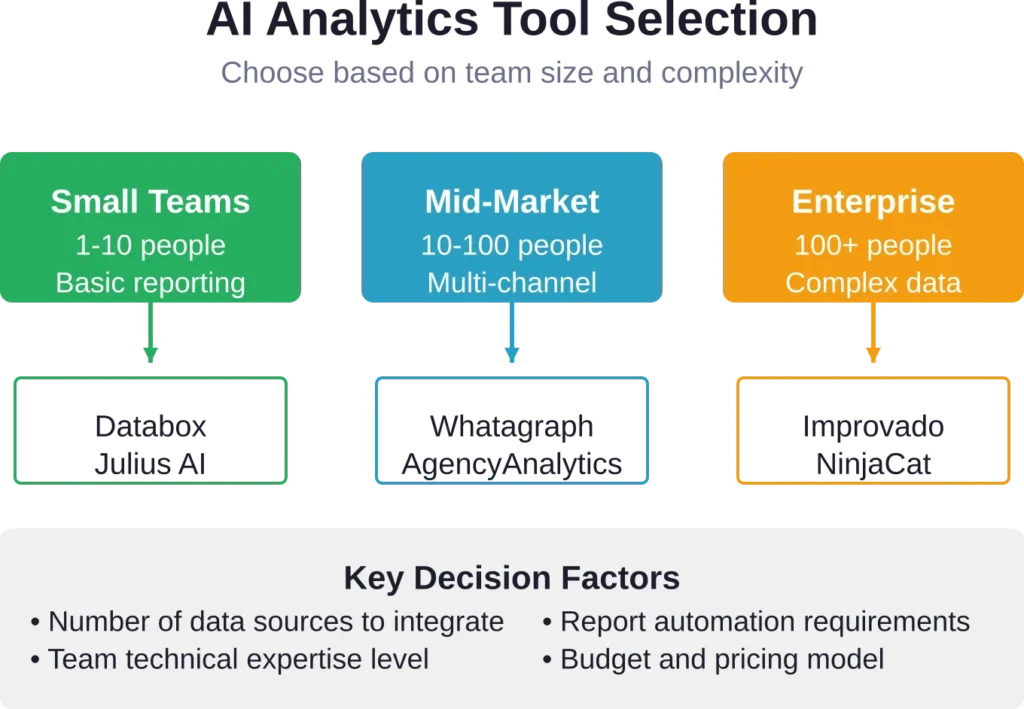
Whatagraph specializes in transforming multi-channel marketing data into visual reports that non-technical stakeholders can understand. The platform connects over 45 marketing data sources and uses AI to highlight performance anomalies and trends.
The core strength lies in automated report generation. Teams create template reports once, then Whatagraph refreshes them automatically with current data. The AI layer adds context—flagging when metrics deviate from expected ranges or identifying which channels are over- or under-performing relative to benchmarks.
For agencies managing multiple clients, the white-label reporting and client portal features eliminate hours of manual report compilation. The trade-off is that Whatagraph focuses primarily on reporting and visualization rather than deep predictive analytics.
According to the Whatagraph pricing table, the Start plan is $229/month (billed annually) and includes 20 source credits with essential integrations.
Improvado Agent: Conversational Analytics

Improvado has built what they call an AI agent specifically for marketing analytics—a natural language interface that queries data, generates insights, and creates visualizations on demand.
The system integrates with 500+ marketing and sales data sources, automatically normalizing metrics across platforms. Instead of building dashboards, analysts and marketers simply ask questions. The agent understands context, can compare time periods, break down results by segment, and even suggest follow-up analyses.
Early adoption shows significant time savings for mid-size and enterprise teams managing complex multi-channel programs. The platform particularly excels at cross-channel attribution analysis and marketing mix modeling.
The main limitation is price point—Improvado targets mid-market and enterprise clients rather than small teams or individual marketers.
Julius AI: Data Visualization Through Prompts

Julius AI takes a different approach. Rather than connecting directly to marketing platforms, it allows teams to upload data exports and then query them using natural language prompts.
The tool generates visualizations, performs statistical analysis, identifies correlations, and even creates predictive models—all through conversational prompts. For teams with data analysts who export campaign data from various sources, Julius provides a faster way to explore that data than traditional business intelligence tools.
The limitation is the upload requirement. There’s no real-time connection to live data sources, which means insights are only as current as the most recent data export.
AgencyAnalytics: Client Reporting at Scale

Built specifically for agencies, AgencyAnalytics focuses on client reporting across multiple accounts and channels. The AI features center on anomaly detection, automated insights, and report scheduling.
The platform shines when managing dozens or hundreds of client accounts. It monitors all campaigns continuously and flags issues that need attention—traffic drops, budget pacing problems, conversion rate changes—so account managers don’t have to manually check every client daily.
The SEO reporting tools are particularly comprehensive, integrating rank tracking, backlink monitoring, and technical SEO audits alongside standard marketing analytics.
Klipfolio: Customizable Metric Tracking

Klipfolio provides a flexible canvas for building custom dashboards that pull from virtually any data source with an API. The AI layer helps by suggesting relevant metrics based on data sources, auto-generating queries from natural language descriptions, and identifying unusual patterns in tracked metrics.
This works well for teams with specific KPI framework or unconventional data sources. The trade-off is complexity—Klipfolio offers more flexibility but requires more setup work than turn-key solutions.
Databox: Mobile-First Analytics

Databox emphasizes mobile accessibility, allowing marketing teams to monitor performance and receive insights on phones and tablets. The AI features include predictive goal tracking, automated performance summaries, and benchmarking against similar companies.
The Scorecard feature provides a simple daily summary of whether key metrics are trending positively or negatively, with AI-generated explanations of what’s driving changes. For distributed teams or leaders who need performance visibility without logging into multiple platforms, this approach reduces friction.
NinjaCat: Enterprise Marketing Analytics

NinjaCat targets larger marketing teams and agencies with complex reporting needs. The platform combines data integration, analytics, and reporting with workflow tools for campaign management.
The AI capabilities focus on automated insight generation across large data sets—particularly useful for enterprise teams managing hundreds of campaigns across multiple brands, regions, or business units. The system identifies patterns at scale that would be impossible to detect manually.
The platform’s strength is handling complexity, but that makes it overkill for smaller teams with straightforward analytics needs.
Specialized AI Analytics for Specific Marketing Channels
While comprehensive platforms handle cross-channel analytics, specialized tools deliver deeper capabilities for specific marketing functions.
Consumer Intelligence Platforms for Social Listening
As media consumption fragments across platforms and emerging formats gain traction, marketers face challenges tracking consumer feedback, opinions, and sentiment in real time. Consumer intelligence platforms address this by aggregating social conversations, reviews, forum discussions, and other unstructured data sources.
AI layers process this unstructured text to identify emerging trends, measure sentiment shifts, track brand perception, map competitive positioning, and detect potential PR issues early.
These tools have evolved beyond simple keyword tracking. Modern platforms understand context, sarcasm, and nuance—distinguishing between “This product is sick” (positive) and “This made me sick” (negative).
Email Marketing Analytics
Email-specific AI tools go beyond open and click rates to predict optimal send times per recipient, forecast which subject lines will perform best, identify subscribers at risk of churning, recommend content personalization, and optimize send frequency.
The predictive capabilities matter most. Instead of A/B testing subject lines and waiting hours for results, AI models trained on historical performance can forecast outcomes before sending.
SEO and Content Performance Analytics
AI-powered SEO tools analyze search rankings, predict content performance, identify topic gaps, recommend optimization priorities, and track competitive content strategies.
These platforms help content teams move from gut-feel editorial planning to data-driven content strategies—understanding which topics have traffic potential, what angle competitors are missing, and which existing content offers the best optimization ROI.
Advertising Analytics and Optimization
AI advertising tools automate bid management, predict audience performance, identify high-value lookalike segments, forecast budget requirements, and optimize creative performance.
The ROI impact shows most clearly here. AI bidding strategies consistently outperform manual optimization in head-to-head tests, particularly for campaigns with sufficient data volume for models to learn from.
Implementation Considerations and Common Challenges
Adopting AI analytics tools isn’t just a software purchase. Teams encounter predictable obstacles during implementation.
Data Quality and Integration Complexity
AI models are only as good as the data they analyze. Common issues include inconsistent naming conventions across platforms, duplicate records from multiple sources, missing or incomplete historical data, and tracking gaps in the customer journey.
Addressing these requires data hygiene work before or during implementation. Many teams underestimate the effort required to clean and normalize data across sources.
The Trust Barrier
Many AI decision-makers cite trust as a significant barrier to generative AI adoption. Marketing teams often struggle to trust AI-generated insights when they can’t see the underlying logic.
The solution involves transparency features—platforms that show their work, explain why they surfaced an insight, allow users to drill into underlying data, and provide confidence scores for predictions.
Building trust takes time. Teams typically start by validating AI insights against manual analysis, then gradually rely on automated insights as accuracy proves out.
Skills and Training Gaps
AI analytics tools promise to democratize data access, but teams still need training on how to ask good questions, interpret results correctly, distinguish correlation from causation, and understand model limitations.
Research indicates that a significant percentage of employees express concerns about job security related to AI adoption. This anxiety can create resistance to adoption. Change management matters—framing AI as augmenting analysts rather than replacing them.
Cost and ROI Justification
Enterprise AI analytics platforms aren’t cheap. Justifying budget requires quantifying the value of faster insights, better decisions, analyst time saved, and improved campaign performance.
Many teams start with limited pilots—implementing AI analytics for one channel or business unit, measuring impact, then expanding based on demonstrated results.
| Challenge | Impact | Mitigation Strategy |
|---|---|---|
| Data quality issues | Inaccurate insights and predictions | Audit and clean data before integration; establish governance standards |
| Trust and adoption resistance | Low usage despite investment | Start with transparent tools; validate accuracy; involve team in selection |
| Integration complexity | Extended implementation timelines | Prioritize critical data sources first; use platforms with pre-built connectors |
| Skills gaps | Underutilization of capabilities | Invest in training; hire data-literate marketers; partner analytics with marketing |
| Cost concerns | Budget approval delays | Start with pilots; measure and document time savings and performance lifts |
Emerging Trends Reshaping Marketing Analytics
The AI analytics space continues evolving rapidly. Several trends are reshaping what’s possible.
Conversational Analytics Interfaces
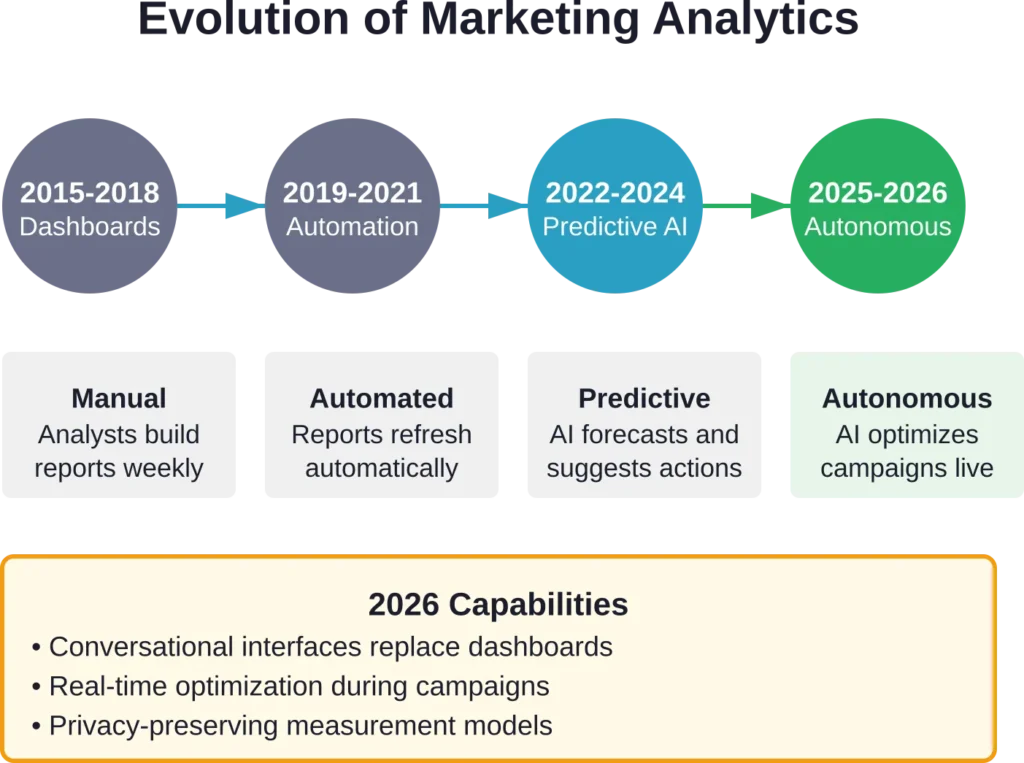
The shift from dashboards to chat is accelerating. Instead of learning where specific metrics live in a platform’s UI, marketers simply ask questions and receive answers with supporting visualizations.
This isn’t just convenience—it fundamentally changes who can extract insights. Non-technical team members no longer need to involve analysts for routine queries.
Look for this to expand beyond text queries to voice interfaces and even multimodal interactions where teams can sketch what they want to see.
Real-Time Predictive Optimization
Analytics is moving from post-campaign reporting to mid-campaign intervention. AI models now detect performance issues hours or days into a campaign and automatically adjust targeting, creative, or budget allocation.
This closes the gap between insight and action—systems don’t just report what happened, they automatically optimize to improve what happens next.
Privacy-Preserving Analytics
As tracking capabilities erode due to privacy regulations and platform restrictions, AI helps marketers extract insights from less granular data. Techniques like aggregated measurement, synthetic data generation, and statistical modeling fill gaps left by reduced tracking.
According to Forrester’s Predictions 2026 guide, display ad budgets are expected to drop 30% in 2026 as consumers leave the open web. AI analytics tools that adapt to privacy-first measurement will gain advantage.
Multi-Touch Attribution and Marketing Mix Modeling
AI is making sophisticated attribution modeling accessible to mid-market teams. Previously, only enterprises with data science teams could build models showing how different touchpoints contribute to conversion.
Modern platforms automate this analysis, helping teams understand the true value of each channel and optimize budget allocation accordingly. The models continuously learn and refine as more data accumulates.
Automated Experimentation Platforms
The next evolution combines analytics with automated testing—systems that continuously run experiments, measure results, and implement winning variations without manual intervention.
This transforms optimization from periodic projects into continuous improvement programs running in the background.
How to Choose the Right AI Analytics Tool
With dozens of platforms claiming AI capabilities, selection requires cutting through marketing claims to evaluate genuine fit.
Start with Use Cases, Not Features
Don’t begin by comparing feature lists. Instead, document the specific analytics problems that need solving. Common examples include reducing time to create client reports, identifying underperforming campaigns faster, understanding cross-channel attribution, forecasting budget needs accurately, and detecting anomalies before they impact results.
Rank these by impact and frequency. The tool that solves high-impact problems well beats the one with the longest feature list.
Evaluate Integration Capabilities
The best analytics platform is worthless if it can’t connect to data sources. Verify that candidates integrate with current marketing tools, support needed custom data sources, refresh data at required frequencies, and handle data volume without performance degradation.
Request proof-of-concept integrations for any unique or complex data sources before committing.
Test Natural Language Interfaces
Not all AI query interfaces are equally capable. Some handle only simple questions while others understand complex, multi-part queries. Test with real questions the team would actually ask. Evaluate whether the system correctly interprets intent, returns accurate results, explains its reasoning, and learns from corrections.
The interface should feel like talking to a knowledgeable analyst, not parsing instructions to a rigid system.
Assess Transparency and Explainability
Black-box AI undermines trust. Strong platforms show underlying data for every insight, explain the logic behind recommendations, provide confidence scores for predictions, and allow drilling down into details.
This matters particularly for teams in regulated industries or those requiring audit trails.
Consider Total Cost of Ownership
Platform subscription costs are just the beginning. Factor in implementation and integration time, required training for the team, ongoing maintenance and administration, and cost of premium features or add-ons.
Some platforms offer attractive base pricing but charge significantly for data connectors, user seats, or volume tiers. Map total costs across realistic usage scenarios.
Evaluate Vendor Stability and Roadmap
AI analytics is a hot space attracting both established players and venture-funded startups. Consider vendor financial stability, platform maturity and reliability, development velocity and innovation, customer base size and retention, and support quality and responsiveness.
Request customer references at similar company size and use cases.
Building an AI-Powered Analytics Practice
Tools alone don’t create analytics value. Organizations need supporting practices and culture.
Establish Data Governance Early
Before implementing AI analytics, define standards for naming conventions across platforms, data quality requirements, access controls and permissions, and documentation of metrics and definitions.
These foundations prevent the “garbage in, garbage out” problem where AI amplifies existing data problems.
Create a Center of Excellence
Centralize expertise rather than having every team independently figure out the platform. A small center of excellence develops best practices, creates template analyses, provides training and support, and shares insights across teams.
This accelerates adoption and ensures consistent methodology.
Balance Automation with Human Judgment
AI analytics platforms excel at processing data and identifying patterns, but human judgment remains essential for interpreting context, questioning assumptions, recognizing platform limitations, and making strategic decisions.
The goal is augmented intelligence—AI handling computational work so humans focus on strategic thinking.
Measure and Communicate Impact
Track how AI analytics changes outcomes. Common metrics include time saved on reporting and analysis, faster identification of issues or opportunities, improved campaign performance from insights, better budget allocation decisions, and increased adoption of data-driven practices.
Documenting value justifies continued investment and encourages broader adoption.
| Organization Size | Recommended Approach | Starting Budget Range | Primary Focus |
|---|---|---|---|
| 1-10 employees | Single integrated platform | $200-500/month | Automated reporting, basic predictions |
| 11-50 employees | Core platform plus 1-2 specialized tools | $500-2,000/month | Cross-channel analytics, attribution |
| 51-200 employees | Enterprise platform with department instances | $2,000-10,000/month | Advanced attribution, forecasting, optimization |
| 200+ employees | Integrated analytics stack with governance | $10,000+/month | Real-time optimization, custom models, data science |
The Future of AI Marketing Analytics
Where is this technology heading? Several directions seem clear.
From Assistive to Autonomous
Current AI analytics tools assist human decision-making. The evolution points toward systems that make and execute certain decisions autonomously—adjusting bids, reallocating budget, pausing underperforming creative, and shifting targeting based on real-time performance.
Humans will set guardrails and strategic direction while AI handles tactical optimization continuously.
Unified Customer Data Platforms
Analytics platforms are converging with customer data platforms and activation tools. The future system doesn’t just report what happened—it maintains unified customer profiles, predicts next actions, and automatically orchestrates personalized experiences across channels.
The boundary between analytics and marketing automation will blur.
Smaller Models, Better Results
Early AI analytics required massive data volumes to train models. Advances in transfer learning and few-shot learning allow effective models with less historical data. This democratizes advanced analytics for smaller companies and newer products.
Ethical AI and Bias Mitigation
As AI analytics influences significant business decisions, focus on fairness and bias mitigation will intensify. Platforms will need to demonstrate that models don’t amplify demographic biases, provide audit trails for significant decisions, and allow human override of automated actions.
Regulatory scrutiny of automated decision systems is increasing, particularly in finance, healthcare, and employment contexts.
Frequently Asked Questions
Traditional marketing analytics tools display historical data through dashboards and reports that users must manually interpret. AI marketing analytics platforms actively process data to identify patterns, predict future outcomes, answer natural language questions, and proactively surface insights without requiring manual analysis. The AI layer transforms raw data into actionable intelligence automatically rather than just presenting numbers for human interpretation.
AI analytics tools now serve all team sizes with appropriate platforms available at different price points. Small teams benefit significantly from automation that eliminates manual reporting work and provides insights that would otherwise require dedicated analysts. Entry-level platforms start around $200-300 monthly, making them accessible for small businesses. The key is selecting tools that match actual complexity needs rather than paying for enterprise features that won’t be used.
Prediction accuracy depends on data quality and volume. For well-tracked campaigns with sufficient historical data, AI models typically forecast performance within 10-15% accuracy ranges for metrics like conversion rates and revenue. Accuracy improves as models accumulate more data. However, predictions cannot account for unprecedented external factors like major market disruptions or competitive actions. AI forecasts work best for stable, data-rich scenarios and should be treated as informed estimates rather than guarantees.
AI analytics augments rather than replaces human analysts. These tools eliminate repetitive data processing and surface insights faster, but humans remain essential for interpreting context, questioning assumptions, designing experiments, and making strategic decisions. Research shows that some employees fear job loss to AI, but the reality is that analysts shift from manual reporting work to higher-value strategic analysis. Organizations still need people who understand both marketing strategy and data interpretation.
Leading platforms integrate 100-500+ data sources including advertising platforms like Google Ads, Facebook Ads, and LinkedIn Ads, analytics tools such as Google Analytics and Adobe Analytics, email marketing systems, CRM platforms, e-commerce platforms, social media channels, and SEO tools. Most platforms provide pre-built connectors for common tools plus API access for custom integrations. The specific integrations available vary significantly between platforms, so verifying that a tool connects to your current marketing stack is essential before purchase.
Implementation timelines range from days to months depending on complexity. Simple platforms with pre-built connectors for standard tools can be operational within 1-2 weeks. Enterprise implementations involving custom integrations, data cleaning, and complex attribution modeling typically require 2-4 months. The main time investments go to connecting and validating data sources, cleaning and normalizing historical data, configuring reports and alerts, and training team members. Organizations should plan for ongoing optimization even after initial launch as teams learn what insights deliver the most value.
Reputable platforms are designed to comply with major privacy regulations, but compliance responsibility ultimately rests with the organization using the tool. Key considerations include ensuring the platform supports data processing agreements, provides controls for data retention and deletion, allows user consent management, and processes data in approved geographic regions. Organizations must configure platforms correctly, implement proper consent mechanisms, and understand what data is being shared with third parties. Review each vendor’s privacy documentation and work with legal counsel to ensure compliant implementation.
Conclusion: Making AI Analytics Work for Your Team
AI marketing analytics has moved from experimental technology to practical necessity. The platforms available in 2026 genuinely transform how teams work with data—making insights faster, predictions more accurate, and analytics accessible to non-specialists.
But technology alone doesn’t create value. Success requires selecting tools that match actual needs rather than chasing features, investing in data quality and governance, training teams to ask better questions, and balancing automation with human judgment.
The organizations gaining the most from AI analytics share common characteristics. They start with clear use cases rather than tool shopping. They treat implementation as a change management project, not just software installation. They measure impact systematically and iterate based on results.
For teams still relying on manual reporting and intuition-based decisions, the gap is widening. Competitors using AI analytics spot opportunities faster, optimize campaigns more effectively, and allocate budgets more efficiently. The advantage compounds over time.
The good news? Entry barriers have dropped dramatically. Tools that required six-figure investments and data science teams five years ago are now accessible as cloud platforms at mid-market prices. Pre-built integrations eliminate months of custom development. Natural language interfaces let marketers query data without learning SQL.
Start by identifying the single biggest analytics bottleneck your team faces—maybe it’s manual client reporting, attribution confusion, or slow campaign optimization. Find the tool that solves that specific problem well. Measure the impact. Then expand.
The future of marketing belongs to teams that turn data into decisions faster than competitors. AI analytics platforms are the enabler. The question isn’t whether to adopt them, but how quickly your organization can build the capabilities to use them effectively.