

Quick Summary: Leading AI marketing tools in 2026 include platforms for content creation (Extuitive, ChatGPT, Jasper), SEO optimization (Surfer SEO), visual content (Canva, DALL·E 3), video production (Runway, Creatify AI), social media management (SOCi), and workflow automation (Zapier). These tools help marketers automate repetitive tasks, personalize customer experiences, analyze data faster, and scale campaigns efficiently, with 67% of AI decision-makers planning to increase their generative AI investment this year.
Artificial intelligence has stopped being a nice-to-have experiment. It’s now the backbone of how successful marketing teams operate.
Through all the market uncertainty, one constant persists: AI adoption and its potential to reshape B2C marketing as we know it. According to Forrester’s May 2024 survey, 67% of AI decision-makers plan to increase investment in generative AI within the next year. This reflects strategic commitment across organizations.
But here’s the thing—not every AI tool lives up to its promise. Some automate busywork. Others transform entire workflows. And with so many options flooding the market, finding the ones that actually deliver results feels overwhelming.
This guide aims to cut through the noise. It focuses on AI marketing tools that real marketing teams use today to grow faster, work smarter, and stay ahead of competitors. Tools in this guide are selected based on industry recognition and real-world usage, with evaluation of automation capability, integration flexibility, personalization features, and performance.
What Makes an AI Marketing Tool Worth Using
An AI marketing tool isn’t just software with a chatbot slapped on. The best platforms use machine learning, natural language processing, and predictive analytics to handle tasks that would otherwise consume hours of manual work.
Real AI marketing tools should deliver at least one of these core benefits:
- Automation of repetitive tasks — email sequences, social posts, ad copy, reporting
- Personalization at scale — dynamic content, segmentation, customer journey mapping
- Data analysis and insights — pattern recognition, predictive modeling, sentiment analysis
- Content creation and optimization — writing, design, video editing, SEO recommendations
The technology has evolved from being a tool for content and code creation to a critical resource for redefining operations, decision-making, customer experience, and revenue generation. Generative AI now powers everything from copywriting to complex marketing automation workflows.
That said, trust remains a barrier. According to Forrester, Trust remains a barrier to generative AI adoption among AI decision-makers. And with 68% of customers saying AI advances make company trustworthiness more important, marketers need to choose platforms that prioritize security, transparency, and ethical data use.
Best AI Tools for Content Creation and Copywriting
Content creation tools have become the most widely adopted AI marketing category. These platforms help marketers write blog posts, ad copy, email campaigns, and social media content faster.
Extuitive
Extuitive is an AI-powered platform designed for e-commerce brands, especially Shopify stores, that need fast, high-converting ad creatives with built-in performance prediction. It goes beyond basic text generation by combining content creation with pre-launch validation using AI consumer models trained on 150,000+ real-world data points.
Marketers and store owners use Extuitive to analyze their products automatically, generate or optimize ad copy, images, videos, and full creative briefs, then predict key metrics like CTR, ROAS, and purchase intent before spending a dollar on ads. It excels at turning product data into scroll-stopping campaigns while reducing wasted budget on underperforming ideas.
What sets Extuitive apart is its predictive validation engine — AI agents simulate real consumer behavior to score and rank creatives, helping teams launch only the strongest concepts. It integrates directly with Shopify for seamless product pulling, trend analysis, and audience targeting recommendations.
Users praise its speed and ability to deliver agency-quality results in minutes at a fraction of traditional costs, making it especially valuable for direct-to-consumer brands running paid campaigns on Meta and beyond.
Contact Information:
- Website: extuitive.com
- Email: [email protected]
- LinkedIn: www.linkedin.com/company/extuitive
- Twitter: x.com/Extuitive_Inc
- Instagram: www.instagram.com/extuitiveinc
ChatGPT (OpenAI)

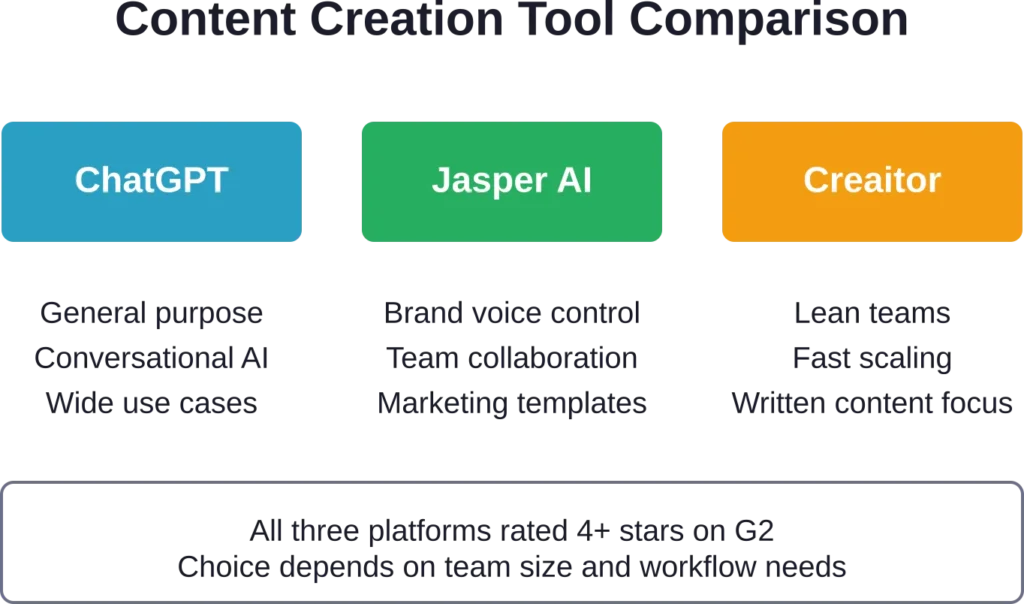
ChatGPT has become synonymous with AI content creation. A March 2025 survey found that 28% of employed adults in the U.S. used ChatGPT to get work done. The platform’s conversational interface makes it accessible even for non-technical users.
Marketers use ChatGPT for brainstorming campaigns, drafting long-form content, writing product descriptions, and even generating customer support scripts. The platform excels at understanding context and maintaining tone across different content types.
The free tier provides solid capability for occasional use. For heavier workloads, paid plans unlock faster response times, priority access during peak hours, and advanced features like image generation and web browsing.
Jasper AI

Jasper focuses specifically on marketing teams that need brand-safe AI writing with collaboration features. The platform offers pre-built templates for common marketing tasks: blog posts, email sequences, social media captions, ad copy, and landing pages.
What sets Jasper apart is its brand voice feature. Teams can train the AI to match specific tone guidelines, style preferences, and terminology—ensuring consistent output across campaigns. Multiple team members can work simultaneously, review drafts, and approve content without leaving the platform.
Users frequently praise Jasper’s ease of use and output quality, though some note learning curves exist for advanced customization.
Jasper for Team Collaboration
For larger marketing departments, Jasper offers workspace features that let teams organize projects by campaign, client, or content type. Version control and approval workflows prevent miscommunication and ensure everyone works from the latest draft.
Creaitor

Creaitor targets lean marketing teams that need to scale written content production quickly. The platform emphasizes speed and simplicity over advanced customization. Teams can generate blog outlines, expand bullet points into full paragraphs, and rewrite content for different audiences in seconds.
G2 reviewers praise Creaitor for its straightforward interface and fast output, making it ideal for agencies or startups that need volume without heavy setup time.
AI Tools for Visual Content and Design
Visual content drives engagement across every channel—social media, email, ads, landing pages. AI design tools help marketers create professional graphics, edit images, and produce video content without needing specialized design skills.
Canva

Canva has become the go-to platform for collaborative, all-in-one visual content creation. The AI-powered templates, brand kits, and real-time team collaboration features make it easy to design social posts, presentations, infographics, and videos.
Recent AI additions include Magic Write for generating captions, Magic Design for instant layout suggestions, and background removal with one click. Teams can maintain brand consistency by storing logos, color palettes, and fonts in shared workspaces.
Pricing starts at $15.00/month for individuals, with team plans offering additional collaboration features and storage.
DALL·E 3

DALL·E 3 is an AI image generator that creates custom visuals from text descriptions. Marketers use it for generating hero images, social media graphics, ad concepts, and unique product mockups.
The platform integrates with automation tools like Zapier, enabling workflows that automatically generate images from form submissions, CRM updates, or content management systems. This integration capability transforms DALL·E from a standalone tool into part of a larger marketing automation stack.
For teams that need original imagery without stock photo limitations or designer bottlenecks, DALL·E offers speed and creative flexibility.
Adobe Photoshop (AI Features)

Adobe Photoshop has integrated advanced AI photo editing capabilities, including Generative Fill, which uses AI to extend images, remove objects, or add elements based on text prompts. Marketers use these features to customize product images, create variations for A/B testing, and edit visuals without starting from scratch.
While Photoshop requires more technical skill than Canva, it offers unmatched control for marketers who need pixel-perfect precision or complex compositing work.
Best AI Video Creation Platforms
Video content drives higher engagement rates than static images or text, but production traditionally requires significant time, budget, and expertise. AI video tools democratize video creation by automating editing, generating scripts, and even creating realistic avatars.
Runway

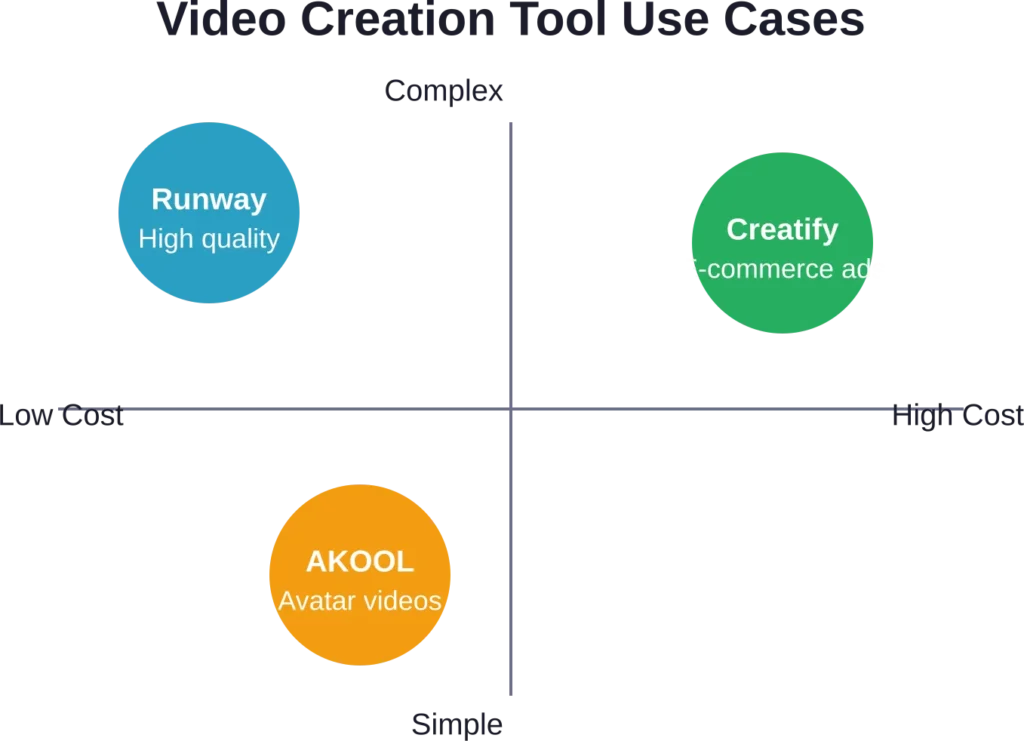
Runway specializes in high-quality AI video generation and editing. The platform offers tools for text-to-video generation, motion tracking, green screen removal, and automated color correction. Marketers use Runway to produce short-form content for social media, ad variations, and product demos.
The interface balances accessibility with professional-grade features, making it suitable for both novice video creators and experienced editors who want to speed up repetitive tasks.
Creatify AI

Creatify AI focuses on effortless video content creation, particularly for e-commerce and performance marketing. The platform generates video ads from product URLs, customizes caption options, and adapts everything to brand colors automatically.
Pricing starts at $19.00/month, making it cost-effective for agencies or brands that need consistent ad creative output. The platform enables rapid production of multiple ad variations.
AKOOL

AKOOL specializes in realistic AI avatar videos and creative storytelling. The platform lets marketers create spokesperson videos, product explainers, and personalized messages without filming. Users can choose from pre-built avatars or create custom ones based on real people.
Pricing for AKOOL begins at $21/month, positioning AKOOL as an affordable alternative to hiring actors or videographers for routine video content. The platform works well for teams that need consistent video output but lack in-house production resources.
SEO and Content Optimization Tools
Creating content is only half the battle. Getting it found requires optimization for search engines, readability, and user intent. AI SEO tools analyze top-ranking pages, suggest improvements, and automate technical optimizations.
Surfer SEO

Surfer SEO analyzes top-ranking pages for target keywords and provides specific recommendations for content structure, keyword usage, heading organization, and optimal word count. The platform’s Content Editor scores drafts in real-time, showing how well they match search intent compared to competitors.
Marketers use Surfer to brief writers with data-driven guidelines, optimize existing content for better rankings, and identify content gaps in their keyword strategy. The tool integrates with Google Docs and WordPress, allowing optimization without switching platforms.
G2 reviews consistently praise Surfer’s accuracy and actionable recommendations, though some mention the learning curve for interpreting all available data points.
Hypotenuse AI

Hypotenuse AI focuses on generating SEO-ready blog articles, product descriptions, and landing page content at scale. The platform analyzes search intent, incorporates relevant keywords naturally, and structures content to match ranking page patterns.
E-commerce teams particularly benefit from Hypotenuse’s ability to generate hundreds of unique product descriptions from basic specifications, maintaining SEO optimization and brand voice across the entire catalog.
Social Media Management and Automation
Social media demands consistent posting, community engagement, and performance tracking across multiple platforms. AI tools help marketers schedule content, generate captions, analyze sentiment, and respond to comments efficiently.
SOCi

SOCi specializes in multi-location social media management, making it ideal for franchises, retail chains, and businesses with distributed marketing teams. The platform uses AI to suggest optimal posting times, generate location-specific content variations, and monitor brand mentions across regions.
Pricing starts at $19.00/month, with features scaling based on the number of locations and users. SOCi offers centralized control combined with local customization flexibility—corporate teams can approve content while local managers adjust messaging for their specific markets.
Social Media Content Scheduling
Several AI tools integrate with social platforms to automate posting schedules based on audience activity patterns. These systems analyze when followers are most active, suggest optimal posting frequencies, and automatically adjust timing based on engagement data.
For teams managing multiple brands or clients, automation prevents the manual work of scheduling posts individually while ensuring consistent presence across all channels.
Marketing Automation and Workflow Tools
True marketing efficiency comes from connecting individual tools into seamless workflows. Automation platforms eliminate repetitive manual tasks by triggering actions based on customer behavior, form submissions, data updates, or scheduled events.
Zapier

Zapier connects over 5,000 apps, enabling marketers to build automated workflows (called Zaps) without coding. Common marketing use cases include automatically adding form submissions to CRM systems, generating images from database entries, posting new blog content to social media, and sending notification emails when specific events occur.
The platform supports multi-step workflows with conditional logic, allowing complex automation sequences. For example, a Zap could trigger when someone downloads a lead magnet, add them to an email sequence, create a task for sales follow-up, and log the interaction in a spreadsheet—all automatically.
Zapier essentially becomes the connective tissue between AI marketing tools, multiplying their value by eliminating manual data transfer and repetitive setup tasks.
HubSpot Marketing Hub

HubSpot offers an integrated marketing automation platform with AI features built throughout. The system handles email marketing, lead scoring, workflow automation, landing page creation, and analytics in one unified interface.
AI capabilities include predictive lead scoring, content optimization suggestions, automated campaign analysis, and chatbot functionality. For teams that want an all-in-one solution rather than connecting multiple specialized tools, HubSpot provides cohesive functionality with deep integration between components.
Customer Engagement and Conversational AI
Direct customer interaction represents one of AI’s most visible marketing applications. Chatbots, email personalization, and automated customer support help brands maintain 24/7 availability while reducing manual workload.
AI-Powered Chatbots
Modern marketing chatbots go beyond scripted responses. They understand natural language, maintain conversation context, route complex questions to human agents, and learn from interactions to improve over time.
Brands use conversational AI on websites to qualify leads, answer product questions, schedule demos, and collect customer information. Email and SMS chatbots handle customer service inquiries, send order updates, and provide personalized recommendations based on purchase history.
The key to effective chatbot implementation is balancing automation with human escalation—knowing when to let AI handle routine questions and when to transfer to a person for nuanced support.
Birdeye

Birdeye specializes in AI-powered brand communication, particularly for managing customer reviews, feedback collection, and reputation monitoring. The platform automates review requests after purchases, analyzes sentiment in customer feedback, and alerts teams to negative reviews requiring immediate response.
For businesses where online reviews directly impact purchasing decisions—restaurants, healthcare, professional services, retail—Birdeye helps maintain positive reputation while reducing manual monitoring effort.
Email Marketing with AI Personalization
Email remains one of the highest-ROI marketing channels. AI enhances email marketing through subject line optimization, send time prediction, content personalization, and automated segmentation.
Mailchimp

Mailchimp is frequently praised in G2 customer reviews for being one of the easiest ways to launch and measure email campaigns. Mailchimp offers an approachable editor, built-in automation, solid reporting capabilities, and wide range of integrations. that connect it to existing marketing stacks.
AI features include subject line optimization, send time optimization based on individual recipient behavior, and predictive segmentation that identifies which subscribers are most likely to engage. The platform’s template-led approach helps teams launch campaigns quickly, though advanced design customization requires more technical effort.
Email Personalization at Scale
AI enables true one-to-one email personalization beyond inserting first names. Advanced systems analyze customer behavior, purchase history, browsing patterns, and engagement data to dynamically customize email content for each recipient.
Product recommendations change based on individual preferences. Email copy adjusts tone for different segments. Send timing shifts to match when each subscriber typically opens messages. This level of personalization drives significantly higher engagement rates compared to generic batch-and-blast campaigns.
| Tool Category | Primary Use Case | Best For |
|---|---|---|
| Content Creation | Writing blog posts, ad copy, social captions | Marketing teams needing consistent content output |
| Visual Design | Creating graphics, editing images, brand assets | Non-designers who need professional visuals quickly |
| Video Production | Generating video ads, explainer videos, social clips | Brands requiring video content without production budget |
| SEO Optimization | Keyword research, content optimization, technical SEO | Content marketers focused on organic search growth |
| Social Media | Scheduling, caption generation, engagement tracking | Multi-channel brands maintaining consistent presence |
| Automation | Workflow integration, task automation, data sync | Teams connecting multiple tools into unified systems |
| Email Marketing | Campaign creation, personalization, send optimization | Businesses relying on email for customer communication |
Data Analysis and Marketing Intelligence
AI’s ability to process massive datasets and identify patterns makes it invaluable for marketing analytics. These tools surface insights that would take humans weeks to discover manually.
Marketing Analytics Platforms
AI-powered analytics platforms monitor campaign performance across channels, identify trends, predict outcomes, and recommend optimizations. They can detect which content formats drive conversions, which audience segments show highest lifetime value, and which touchpoints contribute most to the customer journey.
Rather than simply reporting what happened, predictive analytics forecast what’s likely to happen next—enabling proactive strategy adjustments instead of reactive damage control.
Customer Sentiment Analysis
AI tools analyze customer feedback from reviews, social media comments, support tickets, and survey responses to quantify sentiment and identify common themes. This analysis reveals how customers actually feel about products, features, and brand interactions—often surfacing issues before they become widespread problems.
Marketing teams use sentiment data to refine messaging, prioritize product improvements, and understand which aspects of their offering resonate most strongly with different customer segments.
Choosing the Right AI Marketing Tools
With so many options available, selection comes down to specific business needs, existing technology stack, team size, and budget constraints.
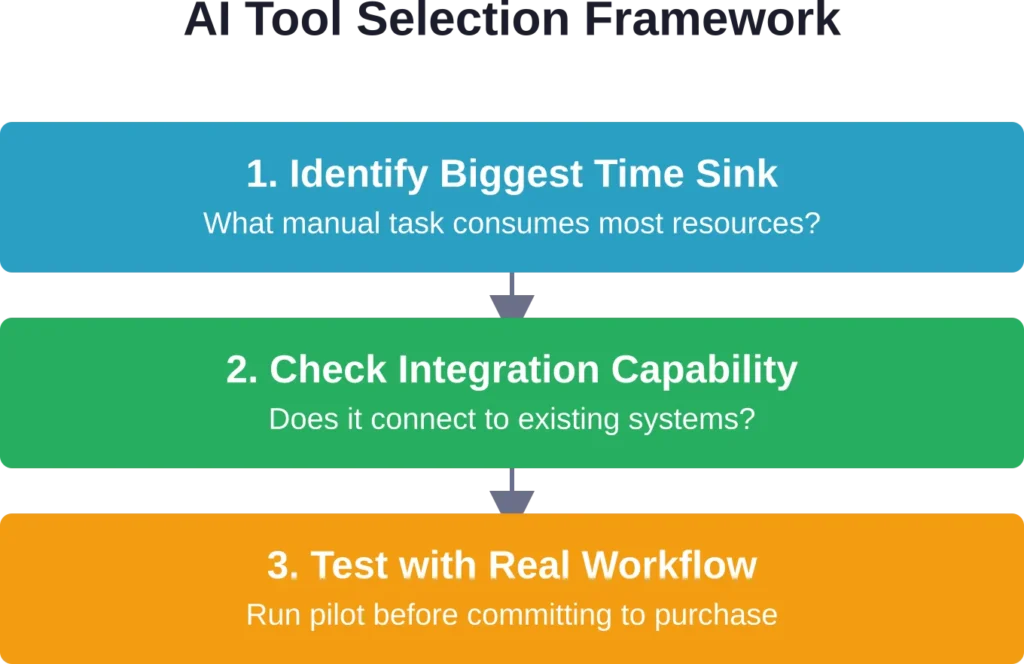
Start with Your Biggest Time Sink
Identify which marketing tasks consume the most manual effort with the lowest strategic value. That’s typically the best place to introduce AI automation. If content creation is the bottleneck, start with writing tools. If social media management drains resources, begin with scheduling and automation platforms.
Solve the most painful problem first rather than trying to implement AI across every function simultaneously.
Integration Capability Matters
Tools that don’t connect to existing systems create data silos and manual workarounds. Prioritize platforms that integrate with your CRM, content management system, email provider, and analytics tools. Automation platforms like Zapier can bridge gaps, but native integrations typically offer deeper functionality.
Consider Team Technical Skill
Some AI tools require significant setup, training, and ongoing optimization. Others offer plug-and-play simplicity. Match tool complexity to team capability. A sophisticated platform that nobody knows how to use properly delivers less value than a simpler tool that gets used consistently.
Evaluate Based on Real Needs, Not Features
Marketing technology vendors compete on feature lists, but more features don’t equal better results. Focus on whether a tool solves your specific problems effectively rather than checking off the longest list of capabilities.
Run pilot tests when possible. Most platforms offer free trials—use them to validate that tools work as expected in your actual workflow before committing to annual contracts.
Implementation Best Practices
Buying AI tools is easy. Getting value from them requires thoughtful implementation.
Set Clear Success Metrics
Define what success looks like before implementation. Is it time saved? Cost reduction? Revenue increase? Quality improvement? Without clear metrics, there’s no way to determine whether a tool delivers ROI or just creates busy work.
Track baseline performance before introducing AI tools, then measure impact after adoption. Real data beats subjective assessment.
Train Teams Thoroughly
Even intuitive tools require training. Invest time upfront to ensure everyone understands capabilities, limitations, and best practices. Teams that receive proper training extract significantly more value from AI tools than those who try to figure things out through trial and error.
Create internal documentation, run workshops, and designate power users who can help colleagues troubleshoot issues and discover advanced features.
Start Small and Scale
Don’t try to automate everything at once. Begin with one team, one process, or one campaign. Learn what works. Refine the approach. Then expand to additional use cases.
This incremental strategy reduces risk, builds organizational confidence, and allows course correction before problems become entrenched across multiple workflows.
Monitor Quality Consistently
AI tools improve efficiency, but they can also produce mediocre output at scale if not monitored. Establish quality control processes to review AI-generated content, check automated decisions, and ensure outputs meet brand standards.
Automation should augment human judgment, not replace it entirely. The best results come from combining AI efficiency with human creativity and strategic thinking.
Privacy, Security, and Ethical Considerations
As AI becomes more integrated into marketing operations, data privacy and ethical use become critical concerns.
Data Protection and Compliance
AI marketing tools process customer data—names, emails, behavior patterns, purchase history. Ensuring this data remains secure and is used in compliance with regulations like GDPR, CCPA, and industry-specific requirements is non-negotiable.
Vet vendors for security certifications, data handling policies, and compliance capabilities. Understand where data is stored, who has access, and how it’s protected. With 68% of customers saying AI advances make company trustworthiness more important, security lapses can cause significant brand damage.
Transparency in AI Use
Customers increasingly want to know when they’re interacting with AI versus humans. Best practices include clearly labeling chatbots, disclosing when content is AI-generated, and providing options to reach human support when needed.
Transparency builds trust. Deceptive AI use erodes it.
Avoiding Algorithmic Bias
AI systems learn from training data, which can contain historical biases. Marketing AI tools might inadvertently exclude certain demographics, reinforce stereotypes, or make unfair assumptions about customer preferences.
Regularly audit AI outputs for bias. Diversify training data. Test campaigns across different audience segments to ensure equitable treatment. Ethical AI use isn’t just the right thing to do—it protects brands from public relations disasters and legal liability.
The Future of AI Marketing Tools
Generative AI has shifted from being a technological novelty to a core enabler of innovation and efficiency across industries. The development of early marketing agentic AI use cases sustains marketers’ enthusiasm—According to Forrester’s Q1 2025 CMO Pulse Survey, ninety percent of B2C marketing executives plan to increase their investment in AI over the next year.
Agentic AI for Marketing
The next evolution involves AI agents that don’t just execute tasks but make autonomous decisions within defined parameters. These systems could manage entire campaign workflows—analyzing performance, reallocating budget across channels, adjusting creative elements, and optimizing targeting—with minimal human intervention.
Early use cases are already emerging in programmatic advertising, where AI agents make real-time bidding decisions and creative adjustments based on performance data.
Deeper Personalization
As AI systems access more behavioral data and processing power improves, personalization will move beyond content variation to truly individualized experiences. Every customer interaction—email, website visit, ad impression—could be uniquely tailored to that specific person’s preferences, history, and current context.
Cross-Channel Orchestration
Current marketing automation connects channels sequentially. Future AI systems will orchestrate experiences across channels simultaneously, ensuring consistent messaging while optimizing each touchpoint for its unique role in the customer journey.
A customer might see a brand mention in social media, receive a personalized email, and encounter a relevant ad—all coordinated by AI to reinforce a cohesive narrative rather than appearing as disconnected random contacts.
Common Challenges and How to Overcome Them
AI adoption isn’t without obstacles. Understanding common challenges helps teams prepare and respond effectively.
Change Resistance
Employees sometimes resist AI tools, fearing job displacement or doubting technology effectiveness. Research indicates employee concerns about AI displacement.
Address this through clear communication about how AI augments rather than replaces human work. Show concrete examples of AI handling repetitive tasks so people can focus on strategic, creative work that machines can’t do well. Involve teams early in tool selection and implementation to build ownership rather than imposing changes from above.
Data Quality Issues
AI tools are only as good as the data they process. Incomplete customer records, inconsistent naming conventions, duplicate entries, and outdated information degrade AI performance.
Before implementing AI tools, audit and clean existing data. Establish data governance processes to maintain quality going forward. Garbage in, garbage out remains true regardless of how sophisticated the AI system is.
Tool Overload
Marketing teams can accumulate too many tools, creating complexity instead of efficiency. Each additional platform adds learning curves, integration challenges, and subscription costs.
Regularly audit the marketing technology stack. Eliminate tools that aren’t delivering value. Look for opportunities to consolidate—choosing platforms that handle multiple functions rather than maintaining separate tools for each narrow task.
Measuring ROI
Quantifying AI tool value can be challenging when benefits include time savings, quality improvements, and opportunity costs of not adopting technology.
Track both hard metrics (revenue, conversions, cost per acquisition) and soft metrics (time saved, employee satisfaction, campaign quality scores). Calculate the monetary value of reclaimed time by considering what else teams can accomplish with freed resources.
Frequently Asked Questions
Traditional marketing software automates predefined tasks based on rules and workflows that humans configure. AI marketing tools use machine learning to analyze patterns, make predictions, and improve performance autonomously without explicit programming for every scenario. AI systems can adapt to new data, optimize themselves over time, and handle complex decisions that would require constant human input in traditional systems.
Most modern AI marketing tools are designed for non-technical users with intuitive interfaces and pre-built templates. Platforms like ChatGPT, Canva, and Jasper require minimal technical knowledge. Some advanced tools—particularly those involving workflow automation, API integrations, or custom model training—benefit from technical skills, but many teams successfully use AI marketing tools without dedicated technical staff.
Pricing varies widely based on tool category, feature set, and usage volume. Some tools offer free tiers with limited functionality. Paid plans typically range from $15-50/month for individual users to hundreds or thousands of dollars monthly for enterprise solutions with advanced features and higher usage limits. Most platforms use subscription pricing with tiered plans based on user count, features, or usage volume.
AI tools augment human marketers rather than replacing them. They excel at data analysis, repetitive tasks, pattern recognition, and execution at scale. Humans remain essential for strategic thinking, creative direction, emotional intelligence, ethical judgment, and complex decision-making that requires nuanced understanding of brand, culture, and business objectives. The most effective marketing combines AI efficiency with human creativity and judgment.
Start by identifying your biggest marketing challenges—where you spend excessive time on low-value tasks, where quality is inconsistent, or where you lack necessary capabilities. Evaluate tools that specifically address those problems. Consider integration with existing systems, team technical skill level, budget constraints, and scalability needs. Run free trials to test tools with real workflows before committing to purchases. Prioritize solving one problem well over trying to implement multiple tools simultaneously.
Security and compliance vary by vendor. Reputable AI marketing platforms implement encryption, access controls, regular security audits, and compliance certifications for regulations like GDPR and CCPA. Before adopting any tool, review its security documentation, data handling policies, and compliance certifications. Understand where customer data is stored, how it’s processed, who has access, and what happens if the vendor relationship ends. Work with legal and IT teams to vet vendors for enterprise deployments.
Timeline depends on tool type and use case. Content creation tools can deliver immediate value—generating first drafts in minutes instead of hours. Automation platforms might require weeks of setup before workflows run smoothly. AI systems that learn from data—like predictive analytics or personalization engines—need time to accumulate sufficient information before optimization becomes apparent, often 30-90 days. Set realistic expectations based on tool category and define success metrics before implementation to track progress accurately.
Conclusion: Making AI Marketing Tools Work for Your Business
AI has moved beyond experimental technology to become essential marketing infrastructure. The tools highlighted in this guide represent proven platforms that real marketing teams use to work faster, optimize campaigns, and scale operations that would be impossible manually.
But technology alone doesn’t create success. The value comes from strategic implementation—choosing tools that solve actual problems, integrating them thoughtfully into existing workflows, training teams thoroughly, and maintaining quality standards.
Start with the area where manual work creates the biggest bottleneck. Implement one tool well before expanding to others. Measure results against clear success metrics. Adjust based on real performance data rather than vendor promises.
The competitive advantage goes to marketing teams that combine AI efficiency with human creativity and strategic judgment. Technology handles repetitive tasks, data processing, and execution at scale. Humans provide strategic direction, creative insight, and ethical oversight.
The question isn’t whether to adopt AI marketing tools—it’s which ones to implement first and how to extract maximum value from them. With 67% of AI decision-makers planning to increase generative AI investment, the momentum is clear. Organizations that develop AI capabilities now position themselves to compete effectively as these technologies continue evolving.
Explore the tools that address your biggest challenges. Test them thoroughly. Implement thoughtfully. Measure relentlessly. That’s how marketing teams turn AI from buzzword to business advantage.