

Quick Summary: The best ROAS optimization tools for Instagram ads in 2026 combine Meta Ads Manager’s native features with specialized platforms for creative intelligence, automation, and attribution. Industry data shows accounts using the right tool stack see 3.8x higher ROAS compared to manual management. The optimal setup depends on monthly ad spend: businesses under $5K need Meta Ads Manager plus creative tools, while accounts over $50K benefit from enterprise automation and advanced attribution platforms.
Instagram advertising has evolved far beyond simple campaign setup and monitoring. The platform now demands sophisticated tooling to compete—especially when return on ad spend matters more than vanity metrics.
According to the 2025 Sprout Social Index, 65% of marketing leaders want a clear link between social campaigns and business outcomes. That pressure creates a direct need for tools that connect ad spend to revenue outcomes, not just impressions and clicks.
The landscape changed dramatically in 2025-2026. Creative effectiveness now drives 70-80% of campaign performance on Meta platforms, attribution models have grown more complex, and manual optimization simply can’t keep pace with algorithmic shifts.
This guide breaks down the essential ROAS optimization tools for Instagram ads—from the foundational platform every advertiser uses to specialized solutions that solve specific friction points in scaling campaigns profitably.
Understanding ROAS Optimization for Instagram Ads in 2026
ROAS measures revenue generated per dollar spent on advertising. Simple enough. But optimization means systematically improving that ratio through better targeting, creative, bidding, and attribution.
The challenge? Instagram ad performance depends on variables that shift constantly—audience fatigue, creative decay, competitive pressure, platform algorithm changes, and iOS privacy updates all impact what works this month versus last quarter.
Tools exist to close the gap between spending and knowing what’s actually working. The right stack should answer: which creative elements drive purchases, when campaigns hit fatigue, where budget should shift, and what competitors are testing.
Businesses should strive for a ROAS of 2:1 or higher to ensure advertising efforts produce positive returns, according to HubSpot. Most profitable DTC brands on Instagram operate between 3:1 and 6:1 depending on unit economics.
The Three Pillars of Instagram ROAS Optimization
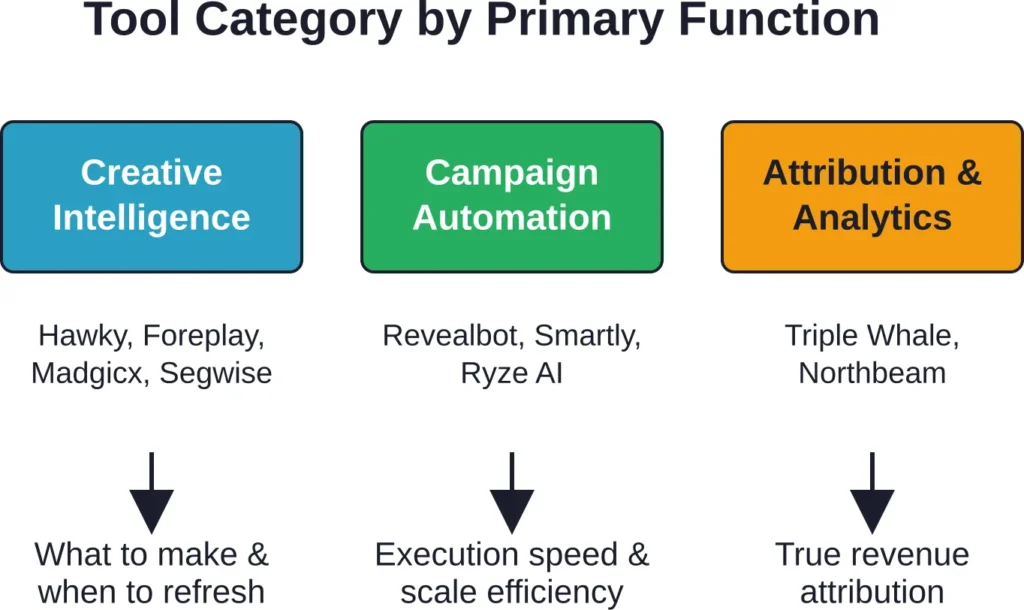
Every tool in this list addresses at least one of these core needs:
- Creative Intelligence: Connecting specific ad elements (hooks, CTAs, formats) to revenue outcomes and predicting fatigue before cost spikes
- Campaign Automation: Rules-based or AI-driven budget allocation, bid optimization, and audience management that reacts faster than manual checks
- Attribution and Analytics: Tracking customer journeys across touchpoints to understand which ads actually drove conversions beyond Meta’s last-click model
The mistake most advertisers make? Picking tools based on features instead of identifying where their actual bottleneck lives. More on that later.
Creative Intelligence and Analysis Tools
Creative performance drives the majority of ROAS variance on Instagram in 2026. Two ads with identical targeting and budgets can deliver 3-5x different returns based purely on the first three seconds, CTA placement, or color palette.
The tools in this category exist to answer: which specific creative elements correlate with revenue, when will this ad fatigue, and what angles are competitors testing right now?
Extuitive
Extuitive is an AI-powered predictive creative intelligence platform for Instagram and Meta Ads. It forecasts ad performance and expected ROAS before any budget is spent by combining brand historical data with simulation across 150,000+ AI-modeled consumers.
The platform analyzes products via Shopify integration, scores new creatives, copies, and audiences on predicted CTR and ROAS (High/Medium/Low), and validates them before launch. This shifts optimization from expensive trial-and-error to pre-launch intelligence.
The key differentiator? True pre-launch ROAS forecasting. Instead of waiting days or weeks to see what works, Extuitive tells you which creatives are likely to drive revenue and which ones to kill immediately — dramatically reducing wasted ad spend on underperformers.
It also supports AI-assisted creative generation and audience recommendations, giving teams both prediction and creation capabilities in one dashboard.
Best for Shopify DTC brands and teams spending $10K+ monthly who want to scale creative testing volume without burning budget on low-potential ads. Perfect for companies that produce high volumes of creative and need data-driven prioritization before pushing anything live.
Contact Information:
- Website: extuitive.com
- Email: [email protected]
- LinkedIn: www.linkedin.com/company/extuitive
- Twitter: x.com/Extuitive_Inc
- Instagram: www.instagram.com/extuitiveinc
Hawky AI
Hawky specializes in element-level creative analysis across Meta, Google, and TikTok. The platform automatically tags video hooks, CTAs, visual styles, audio choices, and emotional tones—then maps those elements directly to ROAS.
The differentiator? Fatigue prediction. Hawky’s algorithms detect performance degradation patterns before cost-per-acquisition spikes, giving teams time to swap creatives proactively rather than reactively.
Competitive intelligence sits inside the same dashboard. Advertisers see what angles, formats, and messaging competitors are currently running—not just that a competitor has an active campaign, but the actual creative strategy behind it.
Best for teams spending $10K+ monthly who need to scale creative production based on data rather than guesswork. The platform integrates directly with Meta Ads Manager for creative upload and testing.
Foreplay (Ad Library Tool)

Foreplay aggregates ads from Meta’s Ad Library and organizes them into searchable, saveable collections. The interface lets advertisers research competitor angles, save creative inspiration, and track how long specific ads have been running.
The core value? Competitive research before building campaigns. Teams can analyze what’s working in their vertical, identify emerging trends, and avoid testing angles that competitors already abandoned.
Foreplay offers pricing starting around $49/month and advanced search filters. The platform works best paired with creative production tools—Foreplay identifies what to make, other platforms help make it.
Madgicx Creative Intelligence
Madgicx offers AI-powered bid optimization combined with creative analytics. The platform tracks which ad variations drive conversions, automatically pauses underperformers, and reallocates budget to winners.
Creative scoring ranks ads based on predicted performance before spending significant budget on testing. The system analyzes historical data across accounts to identify patterns—certain hook styles, CTA placements, or visual compositions that typically outperform.
Madgicx offers competitive pricing in the mid-market range. The automation features work across Facebook and Instagram placements simultaneously.
Campaign Automation Platforms
Automation tools execute optimization decisions faster than manual management. Instead of checking campaigns daily and adjusting budgets by hand, these platforms apply rules or AI models to shift spend, pause ads, and scale winners in real-time.
Revealbot

Revealbot operates on if/then rule logic. Advertisers configure conditions—if ROAS drops below 2.5, pause the ad set; if cost-per-click exceeds $1.20, reduce budget by 20%—and the platform executes automatically.
The interface supports complex multi-condition rules, schedule-based automation, and bulk operations across hundreds of campaigns. For teams managing multiple clients or brands, the time savings compound quickly.
Revealbot pricing scales with ad spend volume. The platform integrates with Meta, Google, TikTok, and Snapchat, allowing unified automation across channels.
Best for agencies or brands spending $5K-$50K monthly who need consistent execution without constant manual oversight.
Smartly.io

Smartly combines automation with cross-platform optimization. The platform manages campaigns across Meta, TikTok, Pinterest, and Snapchat from a single interface, applying budget optimization algorithms that shift spend toward the highest-performing platform and placement combination.
Creative automation tools within Smartly generate hundreds of ad variations from templates, test them systematically, and scale winners. The platform’s AI models predict which creative-audience combinations will perform best before significant spend.
Smartly.io pricing operates on custom enterprise agreements. The platform suits brands spending $50K+ monthly across multiple platforms.
Ryze AI

Ryze AI positions itself as an autonomous platform for Google and Meta ads. The system handles bid optimization, budget allocation, and performance reporting without requiring daily manual management.
According to the platform, accounts using the right tool stack see 3.8x higher ROAS and 67% lower cost-per-acquisition compared to manual management. Ryze specifically targets that efficiency through algorithmic decision-making that adapts to performance shifts faster than human operators.
The platform is used by over 2,000 marketers across 23 countries managing more than $500M in ad spend. Best for teams that want to reduce time spent on routine optimization while maintaining performance.
Attribution and Analytics Platforms
Meta’s native attribution operates on last-click and short attribution windows. These tools provide multi-touch attribution, server-side tracking, and incrementality measurement to understand the full customer journey.
Triple Whale

Triple Whale specializes in e-commerce attribution for Shopify stores. The platform tracks customer touchpoints across Meta ads, Google ads, email, organic social, and influencer content—then assigns revenue credit based on multi-touch models.
The dashboard consolidates all marketing data into a single view. Instead of switching between Meta Ads Manager, Google Analytics, Shopify admin, and email platforms, teams see unified metrics in one place.
Server-side tracking through Triple Whale’s pixel helps recover conversion data lost to iOS privacy updates. The platform reports an average 20-30% lift in tracked conversions compared to Meta’s native pixel alone.
Triple Whale pricing scales with monthly revenue. Best for DTC brands that need accurate attribution to justify ad spend.
Northbeam

Northbeam provides enterprise-grade multi-touch attribution with custom modeling. The platform tracks every customer interaction across paid channels, organic content, email, SMS, and offline events—then builds attribution models tailored to specific business rules.
Incrementality testing sits inside the same platform. Advertisers can run geo-split tests or holdout groups to measure the true incremental impact of campaigns, not just correlated conversions.
The platform integrates with Meta Conversions API, Google Analytics 4, Shopify, and most major e-commerce platforms. Northbeam pricing operates on enterprise agreements.
Best for brands spending $100K+ monthly who need boardroom-ready attribution that survives CFO scrutiny.
Segwise

Segwise focuses on creative-to-ROAS mapping combined with advanced analytics. The platform’s AI automatically tags creative elements—hooks, CTAs, characters, visual styles, emotional tones, voiceover styles—eliminating manual tagging labor.
According to Segwise, AI automation can save teams up to 20 hours per week on creative tagging. The system then connects those tagged elements directly to revenue outcomes, showing which specific components drive purchases.
Analytics dashboards break down performance by creative element, audience segment, placement, and time of day. Analysis of creative elements can reveal performance differences between formats and styles for the 25-34 demographic specifically.
Best for performance teams that produce high volumes of creative and need granular data to guide production priorities.
Meta Ads Manager: The Foundation Platform
Every Instagram ad runs through Meta Ads Manager. It’s the native control center for campaign setup, audience configuration, creative upload, budget management, and baseline reporting.
The platform includes pixel tracking, Conversions API integration, Advantage+ shopping campaigns, and detailed breakdowns by placement, demographic, and creative asset. All free—Meta takes a percentage of spend regardless.
What Meta Ads Manager Does Well
Campaign control sits entirely in-platform. Advertisers configure objectives, test campaign structures, and access Meta’s native targeting and optimization algorithms. Advantage+ campaigns leverage machine learning for audience expansion and automatic creative testing.
The interface provides real-time performance data, A/B testing frameworks, and direct access to Instagram Reels, Stories, and Feed placements. For businesses spending under $5K monthly, this alone might suffice.
According to academic research from the University of Rhode Island, suggested starting budgets for Google Ads range from $10-$50 per day or $1,000-$2,000/month for local businesses for small businesses—a tier where Meta Ads Manager’s native tools handle most optimization needs without third-party platforms.
Where Meta Ads Manager Falls Short
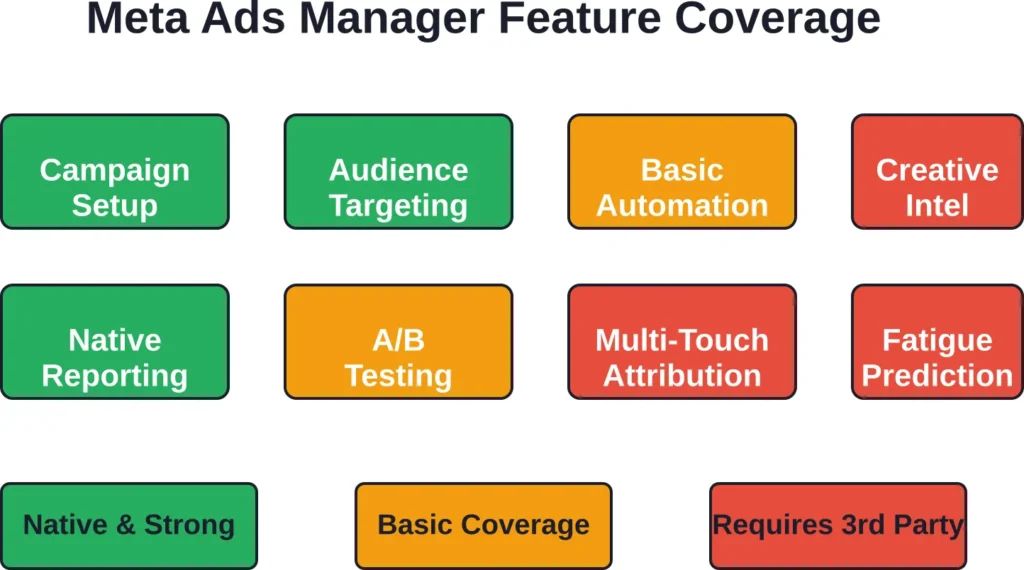
The platform doesn’t connect creative elements to outcomes. An advertiser might know “Video A” outperformed “Video B,” but not that the first three seconds of Video A’s hook drove 40% higher hold rates.
Reporting focuses on Meta’s attribution window. Multi-touch analysis, incrementality testing, and server-side attribution beyond CAPI require external tools. Automation exists but lacks the granularity of specialized platforms.
Creative fatigue prediction, competitive intelligence, and cross-platform budget optimization simply aren’t native features. That creates the market for everything else on this list.
How to Choose the Right Tool Stack for Your Budget
The correct combination depends on monthly ad spend, team size, and the specific bottleneck limiting current ROAS.
Under $5K Monthly Spend
Meta Ads Manager handles most needs. Add Foreplay ($49/month) for competitive research and creative inspiration. That’s the complete stack.
Testing multiple expensive platforms at this budget level creates tool overhead that outweighs benefits. Focus on creative quality and audience testing using native features.
$5K-$20K Monthly Spend
Add Revealbot ($99/month) for automation and Madgicx ($44/month) for creative intelligence. This stack provides rule-based optimization and basic creative scoring without enterprise pricing.
If attribution accuracy matters—particularly for e-commerce—consider Triple Whale to recover iOS-lost conversions. The investment pays for itself if the attribution lift captures even 10% more tracked revenue.
$20K-$50K Monthly Spend
Upgrade to Hawky or Segwise for advanced creative analysis. The granular element-level data becomes valuable at this spend tier because creative production volume justifies the investment in intelligence.
Automation should graduate to either Smartly (if running multi-platform campaigns) or stick with Revealbot plus custom rule sophistication. Attribution platforms like Northbeam make sense if leadership demands incrementality proof.
$50K+ Monthly Spend
Enterprise stacks typically include: Smartly for automation, Northbeam for attribution, Hawky for creative intelligence, and custom integrations. At this scale, the tools pay for themselves through percentage-point ROAS improvements on large base spends.
Teams should also consider platforms like Ryze AI that promise autonomous optimization—freeing internal resources to focus on strategy and creative direction rather than daily campaign management.
| Monthly Ad Spend | Recommended Stack | Priority Features | Approximate Tool Cost |
|---|---|---|---|
| < $5K | Meta Ads Manager + Foreplay | Competitive research, creative inspiration | ~$50/month |
| $5K – $20K | Meta + Revealbot + Madgicx | Automation rules, creative scoring | ~$150/month |
| $20K – $50K | Meta + Hawky + Revealbot + Triple Whale | Element-level creative analysis, attribution | ~$500/month |
| > $50K | Smartly + Northbeam + Hawky + Custom integrations | AI optimization, incrementality, multi-touch attribution | $5,000+/month |
Common Mistakes When Selecting ROAS Optimization Tools
The biggest error? Stacking tools based on features rather than identifying the actual bottleneck.
If creative fatigue drives cost spikes, attribution platforms won’t help. If iOS privacy tanked conversion tracking accuracy, automation tools just optimize bad data. If teams already produce winning creative consistently, creative intelligence delivers less marginal value than automation that scales those winners faster.
Over-Tooling at Low Spend
Advertisers spending $2K monthly don’t need five platforms. The subscription costs eat into ad budget, and the complexity creates analysis paralysis. One core tool beyond Meta Ads Manager suffices until spend justifies additional layers.
Ignoring Attribution Gaps
Many teams optimize ROAS based on Meta’s reported conversions, then wonder why the business bank account doesn’t match platform metrics. Attribution platforms cost money but prevent optimizing toward phantom conversions that never actually happened.
Choosing Tools Without Clear Success Metrics
Before adding a platform, define the measurable outcome it should improve. Creative intelligence should reduce cost-per-acquisition or extend campaign lifespan. Automation should save X hours weekly or improve reaction time to performance shifts. Attribution should increase tracked conversion accuracy by Y%.
Without defined metrics, tools become expensive dashboards that people check but don’t act on.
Integrating ROAS Optimization Tools Into Workflow
Tools only improve ROAS if teams actually use the data to make decisions. That requires process integration, not just software integration.
Effective workflows typically follow this pattern: creative intelligence platforms identify what’s working and what’s fatiguing, automation platforms execute budget shifts and pausing decisions based on rules or AI, attribution platforms validate that optimizations drove real revenue, and Meta Ads Manager remains the system of record for campaign configuration.
Teams should establish regular cadences—daily automated checks via Revealbot or Ryze, weekly creative performance reviews via Hawky or Segwise, monthly attribution analysis via Triple Whale or Northbeam. That rhythm prevents both constant over-reaction and dangerous under-reaction.
Data Hygiene Matters
Multiple platforms tracking the same conversions can create discrepancies. Establish a single source of truth for revenue data—usually the e-commerce platform or CRM—and use that to validate what attribution and ad platforms report.
Conversions API implementation should be clean, duplicate events should be deduplicated properly, and test purchases should be excluded from optimization algorithms. Messy data creates messy optimization regardless of tool sophistication.
The Role of AI in Instagram ROAS Optimization
AI adoption in marketing has proven beneficial—generative AI tools save users an average of 5.4% of work hours, according to research from Northwestern’s Medill School. That’s more than two hours per week for full-time professionals.
For Instagram ads specifically, AI manifests in three ways: predictive creative scoring, autonomous budget optimization, and automated creative generation.
Predictive Creative Scoring
Platforms like Madgicx and Hawky use historical data to predict which new creative variations will outperform before significant testing budget gets spent. The models analyze thousands of past campaigns to identify patterns—certain visual compositions, hooks, or CTAs that consistently drive better outcomes.
The value? Reduced testing waste. Instead of spending $500 to discover a creative underperforms, teams can deprioritize predicted losers and allocate that budget to predicted winners.
Autonomous Budget Optimization
Ryze AI and Smartly’s algorithms shift budgets between campaigns, ad sets, and even platforms based on real-time performance data. The systems react faster than human operators—detecting a ROAS decline at 2pm and reducing spend by 4pm instead of waiting until the next morning’s manual check.
Platform providers of AI automation highlight consistent time savings and reduced need for constant campaign monitoring. The trade-off? Less granular manual control in exchange for algorithmic efficiency.
Automated Creative Generation
Tools like Pencil (not detailed in this guide but mentioned in competitive research) generate ad variations from templates using AI. Advertisers input product images, brand guidelines, and messaging frameworks—the platform produces hundreds of variations for testing.
The effectiveness depends on creative quality standards. For brands where volume matters more than artistic polish, AI generation accelerates testing velocity. For brands where brand consistency and creative excellence drive performance, human-created assets typically still outperform.
Measuring Success: KPIs Beyond ROAS
ROAS is the primary metric, but it doesn’t tell the complete story. Effective optimization tracks several supporting indicators.
Cost-per-acquisition (CPA) shows efficiency—ROAS might stay flat while CPA improves if average order value dropped. Customer lifetime value (LTV) reveals whether acquired customers generate long-term profit beyond initial purchase. Creative lifespan indicates how long ads maintain performance before fatigue.
Attribution accuracy percentage shows what portion of conversions are being tracked reliably. Time saved through automation quantifies operational efficiency gains. Win rate on creative tests measures how often new variations outperform controls.
According to the 2025 Sprout Social Index, 65% of marketing leaders say they need to prove how social media supports business goals (implying 35% struggle)—meaning 56% still struggle. The gap often stems from tracking activity metrics instead of outcome metrics.
| Metric | What It Reveals | Tool That Tracks It | Target Benchmark |
|---|---|---|---|
| ROAS | Revenue per ad dollar | Meta Ads Manager, all platforms | 2:1 minimum, 4:1+ for profitability |
| CPA | Acquisition efficiency | Meta Ads Manager, attribution tools | Below 30% of customer LTV |
| Creative Lifespan | Days until fatigue | Hawky, Madgicx | 30+ days for static, 14+ for video |
| Attribution Accuracy | % conversions tracked | Triple Whale, Northbeam | 80%+ capture rate post-iOS updates |
| Time Saved | Hours freed from manual tasks | Revealbot, Ryze AI | 5+ hours weekly for automation tools |
Future Trends in Instagram ROAS Optimization
The platform continues shifting toward video—Reels now dominate reach and engagement. Tools that analyze video-specific elements (hooks, pacing, audio choices) deliver more value than those built for static image ads.
Privacy regulations keep tightening. Third-party cookies are dead, iOS privacy continues limiting tracking, and regulators in multiple jurisdictions are scrutinizing data practices. Attribution tools that rely on server-side tracking and first-party data will become mandatory, not optional.
Creative volume requirements are increasing. Brands that tested 10 creative variations monthly in 2023 now test 40+ to maintain performance. That volume demands automation in both production and analysis—manual creative management doesn’t scale.
Cross-platform optimization is merging. Advertisers don’t run “Instagram campaigns” in isolation anymore—they run integrated strategies across Instagram, TikTok, YouTube, and Google, optimizing budget allocation across all channels simultaneously. Tools like Smartly that unify multi-platform management have structural advantages.
AI will handle more decisions autonomously. The trajectory points toward platforms that operate with minimal human input—teams set strategy and creative direction, AI executes tactical optimization. That shift elevates the value of creative and strategic thinking while reducing the need for manual campaign management skills.
Frequently Asked Questions
Businesses should target a ROAS of 2:1 or higher to ensure positive return on investment, according to HubSpot. The actual profitability threshold depends on gross margins—a business with 60% margins needs 1.67:1 ROAS to break even, while a business with 30% margins needs 3.33:1. Most sustainable DTC brands operate between 3:1 and 6:1 ROAS on Instagram.
Yes, but tool selection matters. Academic research suggests starting budgets of $500-$1,500/month for small business Instagram advertising. At that scale, Meta Ads Manager plus one affordable tool like Foreplay ($49/month) or Madgicx ($44/month) provides sufficient optimization without overwhelming costs. Expensive enterprise platforms don’t make sense until monthly spend exceeds $20K.
Automation and attribution tools typically show impact within 2-4 weeks as algorithms collect data and optimize. Creative intelligence tools deliver value faster—often within days—because they analyze existing campaign data immediately. The compounding effect builds over 60-90 days as tools accumulate learning and teams adjust workflows based on insights.
No. Instagram and Facebook ads run through the same Meta Ads Manager platform, and all tools listed here work across both placements simultaneously. Some tools also extend to TikTok, Google, Pinterest, and Snapchat. The creative strategies differ between platforms, but the optimization tools handle multi-platform campaigns within single interfaces.
ROAS measures revenue generated per ad dollar spent (revenue divided by ad spend). ROI measures net profit per dollar invested (profit divided by total investment including ad spend, production costs, and overhead). A campaign might deliver 4:1 ROAS but 1.5:1 ROI after accounting for product costs and operational expenses. ROAS is the ad-specific metric; ROI is the business-level metric.
Identify the current bottleneck. If creative fatigue drives cost increases, prioritize creative intelligence tools. If manual management consumes excessive time, prioritize automation. If conversion tracking seems inaccurate post-iOS updates, prioritize attribution. Most teams discover their bottleneck by analyzing where campaigns fail—creative exhaustion, delayed optimization reactions, or mysterious discrepancies between platform metrics and actual revenue.
Start with Meta Ads Manager alone for the first 30-60 days and $2K-$5K in spend. That baseline establishes what manual management achieves and reveals specific friction points. Then add one tool that addresses the clearest problem. Stacking multiple platforms before understanding core campaign mechanics creates unnecessary complexity and expense.
Conclusion
Instagram ROAS optimization in 2026 requires more than native platform features. The combination of creative intelligence, campaign automation, and accurate attribution creates the performance advantage that separates profitable scaling from expensive guesswork.
The correct tool stack depends on monthly ad spend, team capacity, and specific bottlenecks. Small businesses under $5K monthly need Meta Ads Manager plus basic creative research. Mid-market advertisers between $5K-$50K benefit from adding automation and creative analysis. Enterprise accounts above $50K justify sophisticated multi-platform optimization and advanced attribution.
The mistake to avoid? Adding tools without clear metrics for success. Each platform should solve a defined problem—creative fatigue, optimization speed, attribution accuracy—and deliver measurable improvement within 60-90 days.
Start by auditing current campaign performance. Identify whether creative exhaustion, manual management limitations, or tracking inaccuracy represents the primary constraint. Then select the tool category that addresses that specific friction point.
The Instagram advertising landscape keeps evolving—privacy restrictions tighten, creative volume requirements increase, and AI takes on more optimization decisions. Tools that adapt to these shifts deliver compounding advantages. The brands that win long-term aren’t necessarily those with the biggest budgets, but those with the best intelligence on what’s working and the fastest execution on scaling it.