

Quick Summary: The ecommerce AI landscape in 2026 has matured beyond experimental tools into proven systems that drive measurable ROI. Leading solutions now focus on analytics and attribution platforms that unify fragmented data, AI-powered customer support agents that resolve tickets autonomously, personalization engines that adapt in real-time, and content generation tools built specifically for product catalogs. Selection should prioritize integration depth, data compatibility, and resolution metrics over feature counts.
AI tools have shifted from experimental add-ons to core infrastructure in ecommerce operations. The difference between brands that scale profitably and those that stall often comes down to which AI systems they deploy and how those systems connect.
According to Forrester research, 67% of AI decision-makers plan to increase investment in generative AI within the next year (based on a May 2024 survey). But here’s the thing—not all AI tools deliver equal returns.
Some generate impressive demos but fail when connected to real data. Others solve narrow problems while creating new integration headaches. The highest-impact solutions don’t just automate tasks; they operate across systems and deliver measurable improvements in resolution rates, conversion lift, or contribution margin.
How AI Functions in Ecommerce Operations Today
The landscape has moved past simple chatbots and basic product recommendations. Modern ecommerce AI operates in five distinct categories, each solving different operational challenges.
Customer-facing AI now resolves support tickets autonomously rather than just routing them. Analytics platforms use machine learning to unify fragmented data sources and calculate true profitability metrics. Content generation tools produce product descriptions, model imagery, and video at scale. Personalization engines adapt site experiences in real-time based on behavioral signals.
Real talk: the brands seeing the biggest wins focus on AI that connects to existing systems rather than requiring complete platform migrations.
The Shift From Features to Outcomes
Teams used to evaluate AI tools by counting features. How many integrations? How many templates? How many data points?
That approach breaks down when the tool can’t handle your specific data structure or requires manual exports. The new evaluation framework centers on three questions: What metric improves? By how much? At what cost?
A support AI that resolves 60% of tickets autonomously at $0.90 per resolution beats one with 50 integrations but only 30% resolution. An analytics platform that surfaces contribution margin accurately from messy data beats one with beautiful dashboards showing incorrect numbers.
Predict Ad Success Before Spending

Extuitive provides an AI-powered prediction engine that simulates consumer behavior to forecast the performance of digital ads before they go live. Instead of relying on expensive “test-and-learn” phases, the platform uses behavioral models validated against data from over 100,000 real consumers to identify winning creatives and audiences.
- Predicts CTR, ROAS, and conversion rates for ad assets before launch.
- Identifies high-intent audience segments based on store-specific product data.
- Generates and validates Meta ad creatives tailored to target demographics.
- Analyzes large volumes of content instantly to eliminate underperforming ads.
- Reduces customer acquisition costs by focusing budget on proven winners.
Book a demo to see how Extuitive can scale your ecommerce growth with predictive advertising.
AI Analytics and Attribution Platforms
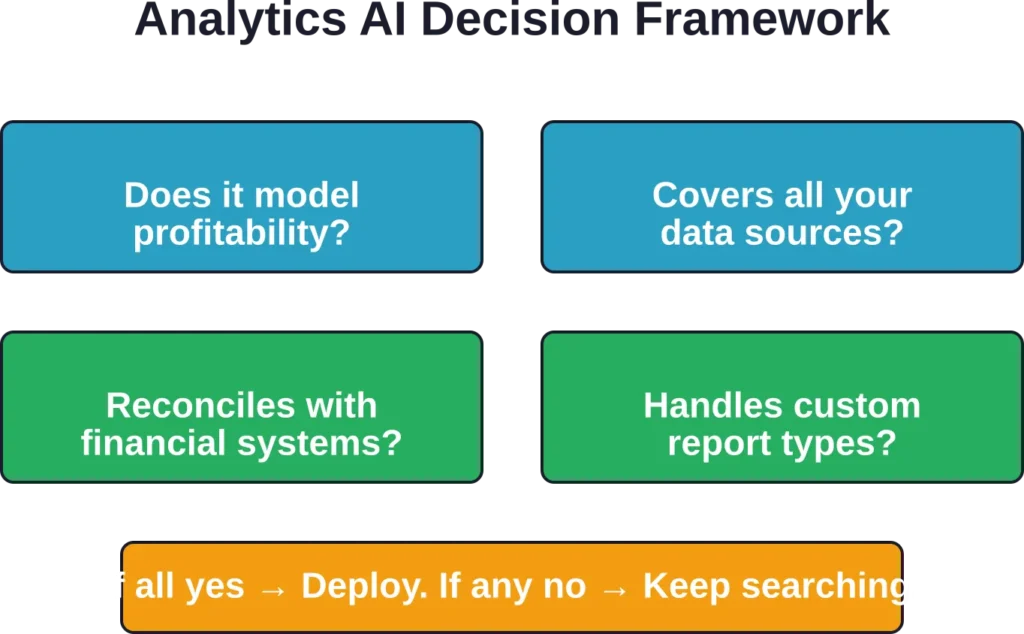
Data intelligence sits at the foundation of effective ecommerce AI deployment. Brands operate across dozens of platforms—Shopify or custom storefronts, multiple ad networks, email providers, 3PLs, ERPs, Amazon Seller Central.
Each system stores pieces of the profitability puzzle. Most analytics tools connect to major platforms but miss the long-tail data sources that matter: specific Amazon report types, regional 3PL APIs, niche affiliate networks.
Saras Analytics: Multi-Source Data Intelligence
Saras Analytics addresses the data fragmentation problem by connecting to over 200 data sources, including long-tail 3PLs, regional ERPs, and uncommon Amazon report types that standard connectors miss.
The platform models profitability rather than just revenue, calculating contribution margin by channel while reconciling discrepancies between ad platform reporting and actual warehouse costs. When a brand connects an LLM to their data warehouse and asks for contribution margin by channel, precision matters—getting numbers off by 14 percentage points destroys trust in the entire analytics stack.
Saras solves this by implementing data validation layers that catch mismatches between source systems before they corrupt downstream analysis. For brands running complex operations with multiple warehouses, international shipping, or hybrid D2C-plus-marketplace models, this depth of integration determines whether AI recommendations actually work.
| Capability | Saras Analytics | Triple Whale | Polar Analytics | Northbeam |
|---|---|---|---|---|
| Data Sources | 200+ including long-tail 3PLs and ERPs | Shopify-centric with major ad platforms | 45+ connectors, Shopify focus | 80+ sources, strong on ads |
| Profitability Modeling | Contribution margin with P&L reconciliation | Basic COGS and ad spend | Gross margin tracking | Revenue attribution focus |
| Custom Data Handling | Supports non-standard report types | Limited to pre-built connectors | Standard API connections | Pre-built integrations only |
| Best For | Complex operations, multi-channel, international | Shopify brands under $10M | D2C brands, straightforward ops | Brands focused on attribution |
Attribution Platforms for Multi-Touch Analysis
Attribution answers which marketing channels actually drive profitable customers. Cookie deprecation and iOS privacy changes broke traditional tracking, forcing platforms to use modeling instead.
Northbeam rebuilds customer journeys using first-party data combined with probabilistic modeling. The platform tracks 80-plus sources and provides multi-touch attribution that accounts for view-through and assist conversions, not just last-click.
Rockerbox takes a similar modeling approach but emphasizes transparency in how attribution windows and weighting rules affect results. Both platforms help brands reallocate budgets from channels that look good in Google Analytics but don’t actually contribute to margin.
AI-Powered Customer Support Solutions
Support costs scale linearly with order volume unless AI handles tier-one requests. The technology has reached the point where autonomous resolution is viable for common queries: order status, return initiation, product specs, shipping estimates.
The metric that matters is resolution rate—the percentage of conversations the AI closes without human handoff. Anything below 50% means the tool creates more work than it saves. The best platforms hit 60-70% resolution while maintaining customer satisfaction scores.
Gorgias: Ecommerce-Specific Support Automation

Gorgias built specifically for ecommerce support workflows. The platform integrates with Shopify, Magento, and BigCommerce to pull order data, inventory status, and shipping tracking directly into support conversations.
The AI Agent feature handles common requests autonomously—processing returns, updating addresses, answering product questions from catalog data.
According to NRF 2026 conference insights, Sephora’s chatbot tripled usage since launch. For clients who add products to their basket directly from chat, conversion rates increased and those who convert show 30% higher basket sizes.
Fin AI and Zendesk AI


Fin AI focuses on resolution accuracy by connecting to knowledge bases, help documentation, and historical ticket data. The system learns from resolved tickets to improve answer quality over time. Teams can set confidence thresholds—if the AI isn’t confident in its response, it escalates immediately rather than guessing.
Zendesk AI operates within the broader Zendesk ecosystem, making it the logical choice for brands already using Zendesk Support. The AI handles ticket routing, suggests responses to agents, and resolves straightforward requests. Integration with existing Zendesk workflows means faster deployment.
Content Generation for Product Catalogs
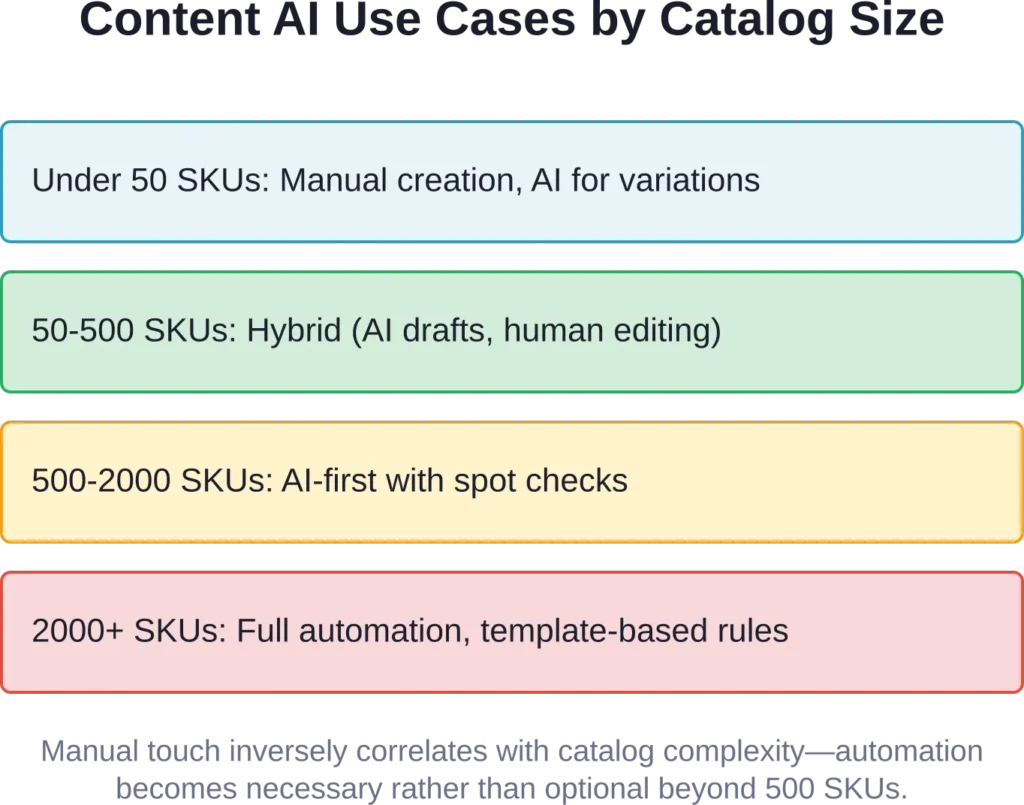
Brands with hundreds or thousands of SKUs face a scaling problem: every product needs descriptions, images, and eventually video. Writing unique, SEO-optimized descriptions for 500 products takes weeks. Shooting model photography for seasonal collections costs tens of thousands.
AI content tools built for ecommerce address these bottlenecks by generating text and visuals at catalog scale while maintaining brand consistency.
Shopify Magic: Built-In Content Suite

Shopify Magic ships free with any Shopify plan (which starts at $39 per month). The suite includes product description generation, image background removal, and email subject line optimization.
For brands already on Shopify, the tool requires zero additional integration. Merchants input basic product attributes and the AI generates descriptions optimized for both conversion and search visibility. Quality varies—simple products get solid results, while complex or technical items often need editing.
The tool’s strength is accessibility. Small brands without content budgets can launch with professional-looking copy immediately. Larger brands use it for first drafts that human writers refine.
WearView: Fashion AI for Imagery and Video

WearView specializes in fashion ecommerce, offering virtual try-on, AI model generation, and product video creation. Pricing starts at $29 per month.
The platform addresses a specific pain point: fashion brands need to show products on diverse models in different settings, but traditional photoshoots for every SKU-color-model combination become prohibitively expensive. WearView generates model imagery using AI, allowing brands to display products on different body types and in varied contexts without additional shoots.
The virtual try-on feature lets customers visualize how items look on them, reducing return rates by setting accurate expectations. Video generation creates short product clips suitable for social media or product pages, automating content creation for platforms that prioritize video.
Klaviyo: Email and Lifecycle Marketing AI

Klaviyo combines email marketing with AI-driven segmentation, predictive analytics, and content generation. The platform analyzes customer behavior to predict purchase timing, lifetime value, and churn risk.
AI features include subject line optimization, send-time prediction (delivering emails when individual recipients are most likely to open), and automated flow creation based on customer lifecycle stage. For brands focused on retention and repeat purchase, Klaviyo’s predictive capabilities help prioritize high-value segments.
The tool integrates with major ecommerce platforms to pull purchase history, browse behavior, and product catalog data. This allows for personalized product recommendations within email campaigns without manual segmentation.
Personalization and Search Optimization
Generic site experiences convert poorly because different visitors have different intent. First-time browsers need education. Repeat customers want quick reorder paths. High-value segments expect premium options surfaced immediately.
Personalization AI adapts site content, product sorting, and recommendations based on behavioral signals, purchase history, and segment characteristics.
Bloomreach: Commerce Experience Platform

Bloomreach combines search, merchandising, and personalization into one platform. The AI analyzes browsing patterns, purchase history, and real-time behavior to adjust product rankings, category pages, and homepage layouts.
For search specifically, the tool understands intent beyond keyword matching—searching “red shoes” surfaces different results for someone who previously bought running gear versus formal wear. The platform also handles merchandising rules, letting teams boost certain products during promotions while maintaining personalization.
Bloomreach works best for mid-to-large catalogs where generic sorting leaves money on the table. Smaller catalogs may not have enough SKUs for personalization to show measurable lift.
YesPlz AI: Fashion Search and Visual Discovery

YesPlz focuses specifically on fashion search, using visual AI to understand style attributes beyond text tags. Shoppers can filter by visual characteristics—neckline shape, pattern density, silhouette—that traditional filters miss.
The platform also offers virtual try-on and size recommendation features. For fashion brands struggling with high return rates due to fit issues, the size recommendation AI analyzes product measurements and customer data to suggest the most likely fit.
The Agentic AI Shift and Discovery
Search behavior is shifting. Instead of typing queries into Google and clicking through results, consumers increasingly ask AI agents—ChatGPT, Claude, Perplexity—to research products and provide recommendations.
According to Jason Goldberg at NRF 2026, certain AI platforms now rank as top-10 ecommerce sites globally based purely on commerce-related prompts, despite not actually selling products. They received significant traffic from a small percentage of commerce-related prompts.
This creates a new discovery problem: how do brands ensure their products surface in AI-generated recommendations?
Optimizing for AI Citations
Research from Yext indicates that 86% of AI citations come from brand-controlled sources such as websites, listings, and other brand-managed platforms. This means brands have more control than they might assume.
The tactics that improve AI visibility mirror traditional SEO but with adjustments. Structured data markup becomes critical because AI agents parse schema.org fields directly. Product specifications need to be comprehensive and machine-readable. Review aggregation matters because AI agents weight high-review-count products more heavily.
Brand websites should provide clear, factual product information that AI can extract without interpretation. Flowery marketing copy performs worse than straightforward specs and use cases.
Direct AI Agent Integrations
Some platforms now offer direct integrations with AI agents. Shopify has explored partnerships that let AI shopping assistants access real-time inventory and pricing. Brands on those platforms gain automatic visibility in AI-driven shopping experiences.
As agentic AI matures, expect more direct integration opportunities where brands can provide product feeds, availability data, and pricing directly to agent platforms rather than relying on web scraping.
Operations and Inventory Intelligence
Backend operations—demand forecasting, inventory allocation, pricing optimization—represent less visible but equally valuable AI applications. These tools don’t interact with customers directly but affect margin and fulfillment speed.
Demand Forecasting and Inventory Planning
AI forecasting platforms analyze historical sales, seasonality, promotional calendars, and external signals (weather, trends, events) to predict future demand. This helps brands avoid both stockouts and overstock situations.
Tools like Inventory Planner and Cogsy connect to ecommerce platforms and warehouses to recommend purchase orders and allocation across fulfillment centers. For brands operating multiple warehouses or international markets, AI allocation reduces shipping costs by positioning inventory closer to predicted demand.
Dynamic Pricing Optimization
Pricing AI adjusts prices based on demand signals, competitor pricing, inventory levels, and margin targets. The approach works best for brands with large catalogs and elastic demand—electronics, apparel, home goods.
Platforms like Prisync and Intelligence Node monitor competitor pricing in real-time and recommend price adjustments. Some integrate directly with ecommerce platforms to implement changes automatically within defined rules (minimum margin, maximum discount depth).
Dynamic pricing requires careful implementation. Customers notice frequent price changes and perceive them negatively if not handled transparently. The AI should optimize within guardrails that protect brand positioning.
Building an Integrated AI Stack
The biggest mistake brands make is treating AI tools as isolated point solutions. A support AI that can’t access order data forces customers to repeat information. An analytics platform that doesn’t connect to the content generator creates workflow gaps. A personalization engine that ignores inventory status recommends out-of-stock items.
The stack needs to function as a system, with data flowing between tools.
Integration Architecture Considerations
Start by mapping data dependencies. Which tools need access to which data sources? Support AI requires order management system access. Personalization needs behavioral data and inventory status. Analytics pulls from everything.
APIs and webhooks enable real-time data sharing. Tools that only offer CSV exports or batch imports create latency—the support AI makes decisions based on yesterday’s inventory levels, leading to poor customer experiences.
Consider middleware platforms like Segment or Zapier that route data between systems when direct integrations don’t exist. But be aware of data freshness—some middleware operates on scheduled syncs rather than real-time streams.
Evaluation Framework for New Tools
Before adding another AI tool, validate it against these criteria:
Data compatibility: Does it support your specific data sources, including edge cases? Can it handle your ERP’s export format? Does it connect to your specific Amazon marketplace?
Integration method: API, webhook, or manual export? Real-time or batch? What’s the data freshness guarantee?
Metric clarity: What specific KPI improves? By how much in benchmarks or case studies? What’s the expected timeline to see results?
Cost structure: Per-seat, per-resolution, percentage of revenue, flat fee? How does cost scale with volume? Are there usage caps or overage charges?
Vendor stability: How long has the company operated? What’s their funding status? Do they have enterprise customers you can reference?
Common Implementation Challenges
AI tools promise simple deployment but reality involves data cleaning, integration troubleshooting, and change management. Understanding common roadblocks helps teams prepare.
Data Quality Issues
AI models perform only as well as their input data. Product catalogs with inconsistent categorization, missing attributes, or outdated pricing break recommendation engines. Customer support AI trained on poorly resolved historical tickets learns bad habits.
Before deploying AI, audit data quality. Are product descriptions complete? Are categories consistent? Is inventory data accurate? Many brands discover data problems only after AI implementation fails.
Change Management and Team Adoption
Some employees resist AI implementation, fearing job displacement. Support teams resist AI agents that might replace them. Merchandisers distrust automated product ranking that overrides their expertise.
Successful rollouts position AI as augmentation rather than replacement. Support AI handles repetitive tier-one tickets so human agents focus on complex issues. Merchandising AI provides recommendations that human teams approve or override.
Training matters. Teams need to understand what the AI does, how it makes decisions, and when to intervene. Black-box systems that can’t explain their logic create distrust.
Trust and Transparency Barriers
Trust barriers represent a significant concern among AI decision-makers regarding generative AI adoption. When AI-generated content contains factual errors or AI analytics produce numbers that don’t reconcile with finance systems, trust erodes quickly.
The solution involves validation layers. Content AI should flag low-confidence outputs for review. Analytics AI should show calculation methodology and allow drill-down into source data. Support AI should provide confidence scores and escalate uncertain responses.
Transparency builds trust. Teams need visibility into how decisions are made, not just the final output.
Measuring AI ROI in Ecommerce
AI investments require justification like any technology spend. But measuring ROI correctly means tracking the right metrics and attributing improvement accurately.
Direct Cost Reduction Metrics
Support AI ROI calculates simply: (cost per ticket with human agents) minus (cost per ticket with AI) times (number of tickets resolved by AI). If human resolution costs $8 and AI resolution costs $0.90, each AI-resolved ticket saves $7.10.
Content generation AI compares content creation cost manually versus AI-assisted. If a copywriter produces 10 product descriptions per day at $25 per hour and AI enables 40 descriptions per day, the productivity multiplier is 4x.
Revenue Impact Metrics
Personalization and recommendation engines drive incremental revenue. Measure conversion rate lift (percentage increase in site-wide conversion), average order value change, and attach rate for recommended products.
Attribution gets tricky—was the conversion increase due to personalization, seasonal trends, or other concurrent changes? A/B testing provides cleaner attribution by comparing AI-enabled experiences against control groups.
Margin and Efficiency Gains
Analytics and attribution AI improve profitability by reallocating spend toward higher-margin channels. Track contribution margin by channel before and after optimization. Calculate how much wasted spend the AI eliminated.
Inventory AI reduces carrying costs and markdowns. Measure stockout frequency, overstock value, and markdown depth before and after implementation.
| AI Category | Primary Metric | Secondary Metrics | Typical Payback Period |
|---|---|---|---|
| Support Automation | Resolution rate | Cost per resolution, CSAT, escalation rate | 3-6 months |
| Analytics & Attribution | Contribution margin accuracy | Budget reallocation impact, forecast accuracy | 6-12 months |
| Content Generation | Content output per hour | Content quality scores, SEO ranking improvement | 6-9 months |
| Personalization | Conversion rate lift | AOV, revenue per session, engagement time | 9-18 months |
| Inventory Optimization | Stockout reduction | Markdown depth, carrying cost, forecast accuracy | 12-18 months |
Looking Ahead: What’s Next for Ecommerce AI
The pace of AI development means what works today might be outdated by next quarter. But certain trends are already visible.
Multimodal AI and Visual Commerce
AI increasingly processes multiple input types—text, images, video—simultaneously. Shoppers will upload photos of items they like and receive visually similar recommendations. Visual search will understand context beyond object recognition, identifying style, occasion, and aesthetic preferences.
Video commerce AI will generate shoppable videos from product images, automatically tagging items and creating purchase links. Live shopping experiences will incorporate AI moderation, translation, and real-time product suggestions.
Autonomous Commerce Agents
Current AI tools require human oversight. The next generation will operate more autonomously—negotiating with supplier APIs to optimize procurement, adjusting marketing spend across channels in real-time, managing inventory allocation without human approval.
This level of autonomy requires significantly better trust mechanisms and guardrails. Brands will define acceptable operating boundaries and let AI optimize within those constraints.
Predictive Customer Intelligence
AI will shift from reactive (responding to customer actions) to predictive (anticipating needs before explicit signals). Churn prediction models will identify at-risk customers weeks before they lapse. Upsell models will recognize lifecycle moments when customers are ready for premium products.
Privacy regulations will shape how predictive models operate. Brands must balance personalization benefits against customer data sensitivity and regulatory compliance.
Selecting Your Next AI Tool
With hundreds of ecommerce AI tools available, selection paralysis is real. Here’s a practical decision framework.
Identify Your Biggest Constraint
What’s currently limiting growth? Support costs scaling faster than revenue? Inability to launch products quickly due to content bottlenecks? Poor attribution leading to budget misallocation?
The constraint determines the AI category. Don’t implement personalization if the real problem is that analytics are unreliable. Don’t deploy content AI if support costs are crushing margin.
Validate Data Compatibility First
Before evaluating features, confirm the tool can actually connect to your systems. Request documentation on supported integrations. Ask specifically about edge cases relevant to your business—obscure ERPs, regional 3PLs, custom data schemas.
Request a technical integration call with their engineering team. Product demos often gloss over integration complexity.
Run Proof-of-Concept Tests
Most enterprise AI tools offer POC periods. Define success metrics upfront—specific percentage improvement in specific KPIs within specific timeframes. Test with real data on a subset of products, categories, or customer segments.
Evaluate not just whether the tool works but whether it integrates smoothly with existing workflows. Does it require so much manual configuration that it negates efficiency gains?
Calculate Total Cost of Ownership
Pricing isn’t just the subscription fee. Factor in integration costs (development time, API costs), training time for team members, ongoing maintenance, and potential costs of switching away if the tool doesn’t work out.
Some tools advertise low base prices but charge per transaction, per user, or per resolution in ways that make actual costs 3-5x the marketed price at scale.
Frequently Asked Questions
Ecommerce AI tools integrate specifically with ecommerce platforms, shopping carts, and retail data sources. They understand product catalogs, order flows, inventory systems, and customer purchase behavior. General AI tools like ChatGPT or Jasper can generate content but don’t connect to Shopify, access order data, or understand ecommerce metrics like contribution margin or return rates. The integration depth and domain-specific optimization make ecommerce AI more effective for retail use cases.
Small brands actually gain disproportionate benefits from certain AI categories. Shopify Magic provides free content generation for any Shopify merchant. Support AI like Gorgias starts at $10 per month and scales with volume. Content tools let small teams compete with larger catalogs without proportional headcount. The key is choosing tools with pricing that scales gradually rather than requiring large upfront commitments. Analytics and personalization AI show clearer ROI at higher volumes, but support and content AI deliver value regardless of size.
Check the vendor’s integration documentation for explicit platform support. Ask for case studies or references from brands on the same platform. Request a technical integration review call where your development team can ask specific questions about APIs, webhooks, data formats, and authentication methods. Many tools advertise broad compatibility but only offer full feature sets on major platforms like Shopify. If running custom or less common platforms, verify integration depth rather than assuming compatibility from marketing materials.
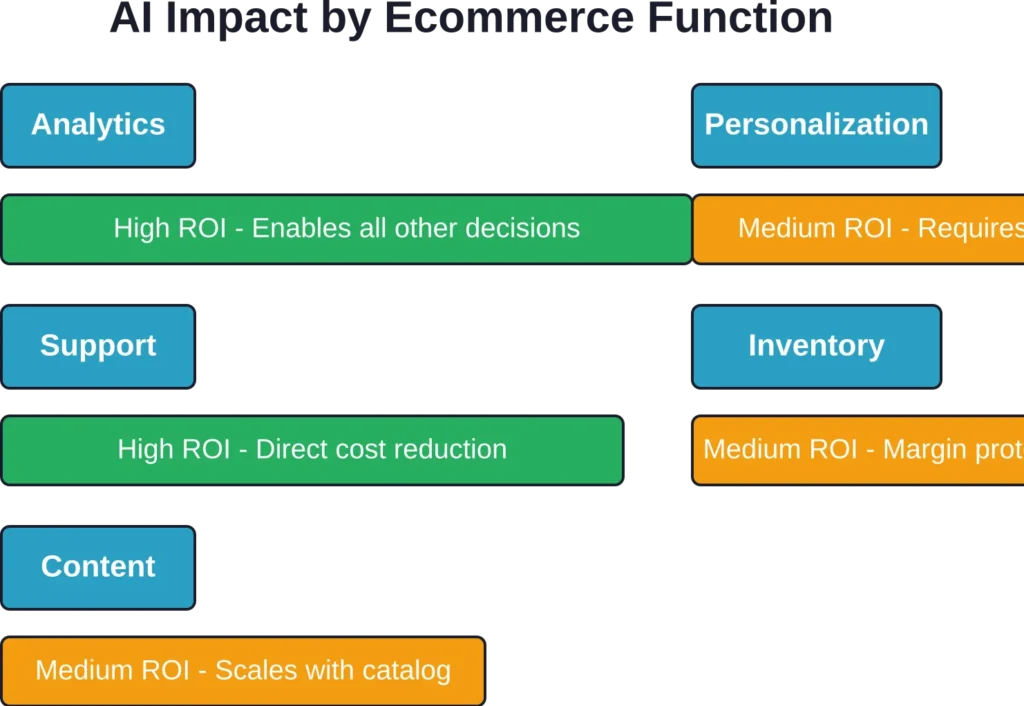
Support AI typically shows ROI fastest—3 to 6 months—because cost savings are direct and measurable. Content generation follows at 6 to 9 months. Analytics and attribution take 6 to 12 months since improvement requires acting on insights, not just accessing them. Personalization requires 9 to 18 months because it needs sufficient traffic volume for statistical significance. Inventory optimization shows returns at 12 to 18 months across full seasonal cycles. Tools promising immediate ROI usually measure vanity metrics rather than actual profit impact.
Customer-facing AI generally delivers faster measurable ROI. Support automation produces immediate cost reduction. Personalization drives conversion lift within months. Back-office AI—inventory forecasting, pricing optimization—protects margin and prevents losses but shows benefits over longer timeframes. The exception is analytics AI, which sits between categories and enables better decision-making across both customer-facing and operational functions. Start with analytics if data is unreliable, then support automation, then personalization or content depending on constraints.
Implement confidence thresholds and human escalation. Support AI should escalate conversations when confidence drops below a defined level rather than guessing. Content AI should flag generated text for review when product complexity exceeds its training. Analytics AI should expose calculation methodology so teams can validate outputs against known benchmarks. Start with AI-assisted workflows where humans review outputs before publishing or acting. Gradually increase automation as the system proves reliable. Always maintain override capabilities so teams can intervene when AI recommendations conflict with business judgment or brand values.
Best-of-breed tools typically outperform all-in-one suites in specific functions, but integration complexity increases. An all-in-one platform offers simpler data flow and unified reporting but often sacrifices depth in individual capabilities. The optimal approach depends on team technical capacity and business complexity. Brands with strong technical teams benefit from integrated stacks of specialized tools. Brands with limited development resources or simpler operations gain more from consolidated platforms despite feature trade-offs. Regardless of approach, ensure tools can share data—isolated point solutions that don’t communicate create workflow gaps.
Moving Forward with AI in Ecommerce
The ecommerce AI landscape in 2026 rewards strategic implementation over rushed adoption. Tools that connect to real data, operate across systems, and deliver measurable outcomes separate themselves from impressive demos that fail in production.
Forrester’s prediction that display ad budgets will drop 30% in 2026 signals the broader shift—customers are leaving the open web for AI-mediated experiences. Brands that optimize for AI discovery, deploy autonomous support, unify fragmented data, and personalize at scale will capture disproportionate growth.
But success requires moving past feature checklists to outcome validation. What metric improves? By how much? At what cost? The answers determine which tools belong in the stack.
Start with data. Analytics and attribution platforms create the foundation for every other AI decision. Add support automation to reduce costs while improving customer experience. Layer in content generation as catalogs scale. Deploy personalization when traffic volume justifies the investment.
And remember—AI tools evolve rapidly. What’s cutting-edge today becomes table stakes in months. Build flexibility into your stack, evaluate new tools continuously, and optimize for outcomes rather than features.
The brands winning with AI in 2026 aren’t the ones using the most tools. They’re the ones using the right tools, integrated properly, measured rigorously, and optimized constantly.