

Quick Summary: AI solutions for ecommerce have evolved from experimental chatbots to mission-critical infrastructure that drives revenue, retention, and operational efficiency. The best tools in 2026 span customer support automation, personalized recommendations, predictive analytics, agentic commerce, and sentiment analysis—with leading platforms delivering measurable ROI through improved conversion rates, reduced support costs, and smarter inventory management.
Walk into any ecommerce operations meeting in 2026, and the conversation isn’t about whether to use AI. It’s about which AI solutions actually move the needle.
The AI landscape for ecommerce has matured. According to Forrester research, 67% of AI decision-makers plan to increase generative AI investment within the next year. That’s a massive vote of confidence—but it also creates a new problem.
With hundreds of tools claiming to revolutionize ecommerce, how do teams separate genuine value from marketing hype?
The answer lies in understanding what today’s AI solutions actually do—and matching capabilities to specific business outcomes. This guide cuts through the noise to examine 15 AI solutions that deliver measurable results across customer experience, operations, and revenue growth.
Why AI Has Become Core Infrastructure for Ecommerce
AI in ecommerce isn’t new. Recommendation engines and basic chatbots have existed for years. What’s different now?
Scale and sophistication. Modern AI solutions handle complex, multi-step workflows that previously required human intervention. They analyze sentiment across millions of customer interactions, predict inventory needs months in advance, and complete transactions without ever redirecting shoppers to a checkout page.
According to Salesforce data, 73% of customers expect better personalization as technology advances. That expectation isn’t just about seeing their name in an email—it’s about relevant product suggestions, contextual support, and shopping experiences that adapt in real time.
The shift from AI-assisted to AI-driven commerce is accelerating. Research from Forrester shows that 33% of US online adults now use AI agents to find and compare products. Even more striking: 10% of US online adults had used OpenAI’s Instant Checkout or Perplexity’s Buy With Pro as of October 2025.
These aren’t experimental features anymore. They’re becoming standard expectations.
How AI Delivers Value Across the Ecommerce Stack
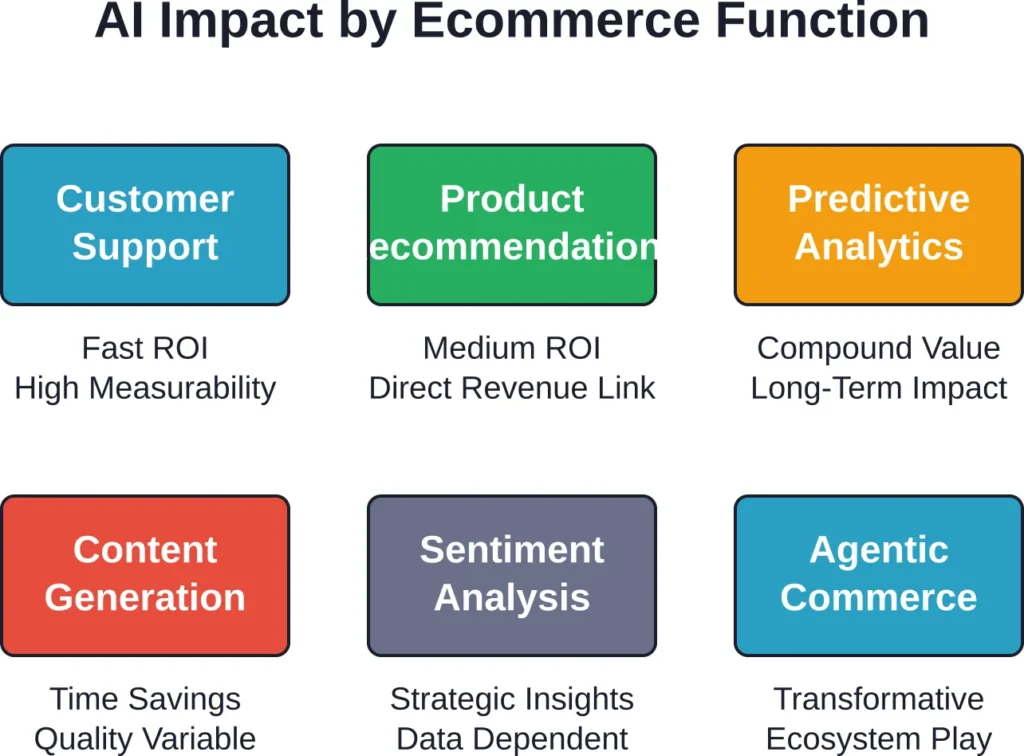
Before diving into specific tools, it helps to understand where AI creates the most impact. Not all AI solutions are created equal—some deliver quick wins, while others require months of integration before showing ROI.
Customer-Facing AI: Immediate ROI
The fastest path to measurable results? Customer-facing AI that automates support, personalizes recommendations, and guides purchase decisions.
Support automation stands out. According to industry analyses, a single “Where Is My Order?” request can cost a business several dollars in agent time. Multiply that across thousands of monthly inquiries, and the cost savings become substantial.
But the real value isn’t just cost reduction—it’s availability and consistency. AI support agents work 24/7, handle multiple languages simultaneously, and never have a bad day that affects service quality.
Back-Office AI: Compound Value Over Time
Inventory forecasting, demand prediction, and pricing optimization don’t generate instant wins. They compound over time by reducing stockouts, minimizing overstock costs, and optimizing margins across thousands of SKUs.
These tools require clean data pipelines and integration with existing systems. The payoff comes months later—but it’s substantial.
Agentic Commerce: The Emerging Frontier
Here’s where things get interesting. Agentic commerce—AI systems that complete entire shopping journeys from discovery to checkout—represents a fundamental shift in how transactions happen online.
According to research from CEIBS, when Walmart partnered with OpenAI to bring shopping directly into ChatGPT, they reframed the customer journey from “search, redirect, order” to “conversation, confirmation, transaction.” Shoppers never leave the ChatGPT interface.
The implications? Massive. Forrester data shows that 92% of US B2C marketing executives are developing agentic commerce strategies as of Q3 2025. This isn’t experimental—it’s strategic priority.
The 15 Best AI Solutions for Ecommerce in 2026
Now for the tools themselves. These solutions span customer support, recommendations, analytics, content, and commerce automation—chosen based on real-world adoption, measurable outcomes, and strategic fit for modern ecommerce operations.
Predictive Analytics and Business Intelligence
1. Extuitive

Extuitive is an AI-powered platform designed for ecommerce brands (especially Shopify stores) that focuses on end-to-end ad creation, validation, and launch. It connects directly to your store, analyzes product data, and uses AI agents to generate high-converting creatives — including copy, images, videos, pricing variants, and targeting suggestions.
The core strength lies in pre-launch performance forecasting: ads are tested against AI consumer models trained on hundreds of thousands of real buyer profiles and behaviors. This predicts engagement, purchase intent, CTR, and ROAS before any budget is spent, replacing slow and expensive traditional testing with instant, data-driven validation.
This approach dramatically reduces wasted ad spend, accelerates campaign cycles, and helps merchandising and marketing teams launch stronger creatives with higher conversion potential.
Contact Information:
- Website: extuitive.com
- Email: [email protected]
- LinkedIn: www.linkedin.com/company/extuitive
- Twitter: x.com/Extuitive_Inc
- Instagram: www.instagram.com/extuitiveinc
2. Algopix

Algopix focuses on product-level analytics—demand forecasting, competitive pricing analysis, and market opportunity identification. The platform helps merchandising teams decide which products to stock, how to price them, and where to sell them.
This level of granular prediction reduces overstock costs and minimizes missed revenue from stockouts.
3. SAP Commerce Cloud with AI

SAP’s enterprise-grade platform combines transactional data with external signals—seasonality, economic indicators, competitor pricing—to forecast demand across complex SKU hierarchies.
For large-scale operations managing thousands of products, SAP’s AI delivers the infrastructure needed to optimize inventory and pricing at scale.
Product Recommendations and Personalization
4. Dynamic Yield (Mastercard)

Dynamic Yield personalizes every touchpoint—from homepage layouts to email campaigns—based on real-time behavioral data. The platform uses machine learning to test hundreds of variations simultaneously, optimizing for conversion rather than clicks.
According to research published on arXiv, persona-enhanced recommendation models improve NDCG@K and F1-Score@K metrics by approximately 12%. That translates to more relevant suggestions and higher cart values.
5. Nosto

Nosto specializes in real-time product recommendations across the shopping journey. The system analyzes browsing patterns, purchase history, and category affinity to surface relevant products at critical decision points.
The platform integrates with major ecommerce platforms and updates recommendations instantly as customer behavior shifts—no batch processing delays.
6. Bloomreach

Bloomreach combines product discovery with content personalization, ensuring search results and merchandising align with individual customer preferences. The platform’s AI learns from 13 million user-item interactions across real-world ecommerce datasets, according to arXiv research testing recommendation system performance.
Customer Support and Service Automation
7. Agentforce Guided Shopping (Salesforce)

Salesforce’s Agentforce turns conversations into conversions by integrating visual product search directly into chat interfaces. Shoppers can upload images to find similar products, ask questions about inventory and shipping, and complete purchases via Apple Pay or Google Pay without leaving the conversation.
The platform addresses the biggest pain point in AI support: actually resolving issues end-to-end rather than just answering questions.
8. Fin AI

Built specifically for ecommerce support, Fin AI focuses on resolution rate rather than just response time. The system can automate up to 60% of customer inquiries while maintaining context across multiple interactions.
What separates Fin from generic chatbots? Deep integration with order management systems, enabling the AI to update shipping addresses, process returns, and handle order modifications without human escalation.
9. Zendesk AI Agents

Zendesk’s AI agent platform excels at handling high-volume, repetitive inquiries across email, chat, and social channels. The system learns from historical ticket data to improve response accuracy over time.
For ecommerce teams managing seasonal spikes, Zendesk AI provides elastic capacity—scaling support coverage during peak periods without hiring temporary staff.
Content Generation and Optimization
10. Jasper AI

Jasper generates product descriptions, ad copy, email campaigns, and blog content trained on ecommerce-specific templates. Teams can maintain brand voice consistency while scaling content production across thousands of SKUs.
Pricing for Jasper AI starts at $39 per month with a free 7-day trial, making it accessible for small to mid-sized operations.
11. Copy.ai

Copy.ai focuses on short-form content—social media posts, ad headlines, product taglines—with built-in A/B testing suggestions. The platform helps marketing teams generate variations quickly, then test to find what resonates.
For teams running high-velocity campaigns across multiple channels, Copy.ai accelerates creative iteration.
12. Phrasee
Phrasee specializes in email subject lines and push notification copy, using natural language generation trained on conversion data. The platform doesn’t just generate copy—it predicts performance before sending.
That predictive capability reduces the risk of underperforming campaigns and improves average open rates over time.
Sentiment Analysis and Customer Insights
13. MonkeyLearn

MonkeyLearn analyzes customer reviews, support tickets, and social media mentions to extract sentiment, identify common complaints, and surface feature requests. The platform categorizes feedback automatically, turning unstructured text into actionable insights.
According to arXiv research on AI-driven sentiment analytics, these tools unlock business value by identifying patterns invisible in aggregate metrics—specific pain points affecting small but vocal customer segments.
14. Lexalytics

Lexalytics goes deeper than basic positive/negative sentiment, extracting entity-level opinions—what customers think about specific product features, shipping speed, packaging quality, or customer service.
This granularity helps product teams prioritize improvements based on what actually matters to customers.
Agentic Commerce and Transaction Automation
15. OpenAI Instant Checkout

OpenAI’s Instant Checkout enables conversational shopping from curiosity to completed purchase without ever leaving ChatGPT. Shoppers can browse Etsy products, ask questions, compare options, and check out—all via natural language.
This isn’t a link to a merchant site. It’s a complete transaction inside an AI interface. According to Forrester research, this type of agentic commerce represents a fundamental shift in how transactions occur online.
The challenge? As CEIBS research notes, even if each step in a multi-step process has 95% success, overall success across 20 steps drops to roughly 36%. AI alone can’t solve that—ecosystem partnerships and infrastructure matter.
| Solution | Primary Function | Best For | Key Differentiator |
|---|---|---|---|
| Agentforce (Salesforce) | Customer Support | High-volume stores | End-to-end issue resolution |
| Fin AI | Support Automation | Order-heavy operations | OMS integration depth |
| Dynamic Yield | Personalization | Enterprise retail | Real-time optimization |
| Klaviyo AI | Predictive Analytics | DTC brands | Churn prediction accuracy |
| Jasper AI | Content Generation | Content-heavy catalogs | Brand voice consistency |
| MonkeyLearn | Sentiment Analysis | Feedback-rich brands | Automated categorization |
Evaluating AI Solutions: What Actually Matters
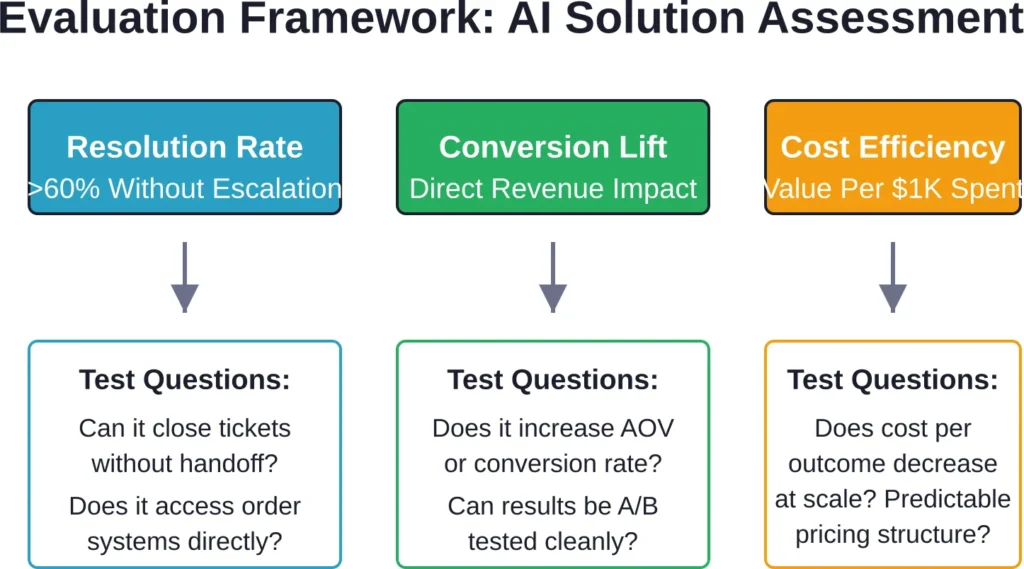
With dozens of AI tools claiming to transform ecommerce, how should teams evaluate them? Three criteria rise above the noise.
Resolution Rate Over Response Time
For customer-facing AI, resolution rate matters more than speed. A chatbot that responds in seconds but escalates 80% of conversations creates more work, not less.
The best AI support tools resolve issues end-to-end—updating orders, processing returns, answering complex questions—without human intervention.
Conversion Lift, Not Just Engagement
Recommendation engines often tout engagement metrics—clicks, views, time on page. But engagement doesn’t pay the bills. Conversion does.
Evaluate personalization tools based on measurable revenue impact: average order value, conversion rate, repeat purchase frequency. If a tool increases clicks but not purchases, it’s creating noise, not value.
Cost Efficiency at Scale
AI solutions should become more efficient as usage grows, not more expensive. Watch for pricing models that penalize success—per-interaction fees, usage-based tiers without volume discounts, or platform fees that scale linearly with revenue.
The best tools deliver compound value: each additional customer interaction improves the model, making future interactions more valuable.
The Risks Nobody Talks About
AI solutions promise efficiency and growth, but they introduce risks that often surface only after implementation.
Trust Barriers and Customer Skepticism
According to research, trust is cited as a significant barrier to generative AI adoption to generative AI adoption. That skepticism isn’t limited to internal teams—customers notice when they’re talking to AI, and some react negatively.
The solution isn’t hiding AI involvement. It’s ensuring AI interactions deliver value. When support is faster and more accurate, customers don’t care whether they’re talking to a human or a bot.
Data Quality Dependencies
Machine learning models are only as good as their training data. Garbage in, garbage out isn’t just a saying—it’s the reason many AI implementations underperform.
According to arXiv research on pretrained embeddings for ecommerce machine learning, poor data quality causes recommendation systems to fail in predictable ways—suggesting irrelevant products, ignoring category constraints, and making pricing errors.
Before deploying AI, audit data quality. Clean product catalogs, accurate customer records, and consistent tagging matter more than algorithm sophistication.
Employee Displacement Fears
Forrester research shows that 36% of employees fear job displacement due to AI. That anxiety affects adoption rates, training effectiveness, and long-term success.
The most successful AI implementations reframe the conversation: AI handles repetitive tasks so humans can focus on complex problem-solving, relationship-building, and strategic work that actually requires judgment.
Building an AI Strategy That Scales
Individual tools deliver value. An integrated AI strategy delivers transformation.
The difference? Strategy connects tools to workflows, ensures data flows between systems, and aligns AI capabilities with business priorities.
Start With High-Impact, Low-Complexity Wins
Customer support automation and product recommendations deliver fast, measurable ROI with relatively simple integration. Start there.
Build confidence, demonstrate value, and use those wins to fund more complex initiatives like predictive analytics and agentic commerce.
Prioritize Integration Over Features
A tool with fewer features but deeper integration often outperforms a feature-rich solution that operates in isolation.
For example, a recommendation engine that can’t access real-time inventory data will suggest out-of-stock products. That’s worse than no recommendation at all.
Measure What Matters
According to According to research, generative AI tools have increased the efficiency of buyer research processes. That’s efficiency. But here’s what matters more: Research indicates that AI tools help buyers discover vendors and options they might otherwise miss.
That’s market expansion. Measure both efficiency gains and new opportunities created—not just cost savings.
What’s Coming Next in Ecommerce AI
The pace of AI development makes prediction risky, but several trends are accelerating fast enough to warrant attention.
Agentic commerce will move from experimentation to mainstream. As infrastructure improves and success rates climb, more retailers will enable transactions inside AI interfaces. Forrester data shows that 92% of US B2C marketing executives are developing agentic commerce strategies suggests this shift is imminent.
Sentiment analysis will become more granular. Instead of broad positive/negative classifications, next-generation tools will extract feature-level opinions and prioritize improvements based on customer impact.
And predictive models will incorporate external signals—economic indicators, social trends, competitor actions—making forecasts more accurate and actionable.
Frequently Asked Questions
Small businesses should prioritize customer support automation and content generation tools that deliver immediate value without complex integration. Fin AI, Jasper AI, and Zendesk AI Agents offer accessible entry points with pricing models that scale affordably.
Pricing varies widely based on features and scale. Entry-level tools like Jasper AI start at $49 per month, while enterprise platforms like SAP Commerce Cloud and Salesforce Agentforce require custom pricing based on transaction volume and integration complexity. Check official websites for current pricing, as tiers and features change frequently.
AI can automate up to 60% of routine inquiries, but complete replacement isn’t realistic for complex issues requiring empathy, negotiation, or judgment. The most effective approach combines AI automation for repetitive tasks with human agents for escalations and relationship-critical interactions.
AI recommendation systems analyze browsing behavior, purchase history, and category affinity to surface relevant products at critical decision points. According to arXiv research, persona-enhanced models improve recommendation accuracy by approximately 12%, translating to higher average order values and increased conversion rates.
Traditional AI chatbots answer questions but redirect customers to complete transactions elsewhere. Agentic commerce enables end-to-end purchasing within the AI interface—discovery, comparison, payment, and confirmation—without ever leaving the conversation. OpenAI’s Instant Checkout exemplifies this shift.
Customer-facing AI like support automation and product recommendations can demonstrate ROI within weeks through measurable improvements in resolution rates and conversion. Back-office AI like predictive analytics typically requires 3-6 months as models learn from historical data and optimize over multiple cycles.
Yes. Data quality issues can cause AI to make poor recommendations or pricing errors. Customer skepticism can harm brand perception if AI interactions feel impersonal or unhelpful. And employee displacement fears can undermine adoption. Successful implementations balance automation with human oversight and maintain data hygiene rigorously.
Moving From Tools to Transformation
The AI solutions outlined here represent proven technology delivering measurable results across customer experience, operations, and revenue growth.
But technology alone doesn’t create competitive advantage. Strategy does.
The ecommerce leaders pulling ahead in 2026 aren’t just adopting AI tools—they’re integrating them into coherent systems that compound value over time. They’re measuring outcomes that matter, investing in data quality, and ensuring teams understand how AI amplifies their capabilities rather than replaces them.
That’s the shift from experimentation to infrastructure. From interesting features to business-critical capabilities.
If your ecommerce operation hasn’t yet built an AI strategy, the time to start is now. Not because competitors are doing it—though they are. But because the gap between AI-enabled operations and traditional ones is widening fast.
Start with one high-impact tool. Measure results. Integrate deeply. Then expand systematically.
The best AI solutions for ecommerce aren’t the ones with the most features. They’re the ones that solve real problems, integrate seamlessly, and deliver measurable ROI.
Choose wisely. Implement deliberately. And let the results speak for themselves.