

Quick Summary: Free AI tools like ChatGPT, Canva, and Google Search Console are transforming digital marketing in 2026, offering capabilities from content creation to design and analytics without upfront costs. The global AI market grew from $233.46 billion in 2024 to a projected $1,771.62 billion by 2032, making these tools more accessible than ever. Selecting the right free AI tools depends on your marketing channel focus—whether content, social media, SEO, or automation.
The digital marketing landscape has shifted dramatically. What used to require expensive agency contracts or specialized software now fits inside free AI-powered platforms accessible to anyone with an internet connection.
But here’s the thing—not all free tools deliver real value. Some offer watered-down versions that create more frustration than results. Others hide essential features behind paywalls that make the “free” label misleading.
This guide cuts through the noise. The focus here is on tools that provide genuine marketing utility without requiring a credit card, based on real-world testing and verified performance data from 2026.
Why Free AI Marketing Tools Matter in 2026
The numbers tell a compelling story. The global AI market reached $233.46 billion in 2024 and is projected to hit $1,771.62 billion by 2032, representing a compound annual growth rate of 29.20%. That explosive growth has pushed AI capabilities down-market, making professional-grade tools available at zero cost.
According to WebIndia Inc industry data, traffic from generative AI to shopping sites surged nearly 700% during the 2025 holiday season. This shift reflects how AI has moved from experimental to essential in marketing workflows.
Free tiers now offer features that would have cost hundreds of dollars monthly just two years ago. Marketing automation, content generation, and analytics that once required enterprise budgets are now accessible to solopreneurs and small teams.
The barrier isn’t budget anymore—it’s knowing which tools actually work.
Visual Design Tools That Don’t Require Design Skills
Visual content drives engagement across every channel. These platforms make professional design accessible without training.
Extuitive: Predictive Ad Performance
Extuitive is transforming paid advertising by allowing marketers to predict real-world campaign results before launching any ads. The platform connects directly to your Shopify store, analyzes your products, and uses advanced AI models trained on real campaign data combined with simulations of over 150,000 consumer profiles to forecast CTR, ROAS, and conversion rates with high accuracy.
Key capabilities include AI generation of ad copy, images, videos, and full creative variations, predictive scoring of which creatives will perform best, consumer behavior simulation for pre-launch validation, and smart audience recommendations based on proven performance patterns.
Extuitive starts at approximately $1,000/month for the Starter plan. While it does not offer a free tier, it delivers strong ROI for growing e-commerce brands by significantly reducing wasted ad spend on underperforming creatives. The platform excels once you move beyond basic free tools and need data-driven confidence at scale.
Real talk: This is a premium tool built for brands with meaningful ad budgets. It works best when paired with free creative foundations like ChatGPT and Canva, turning good ideas into high-confidence winners.
Contact Information:
- Website: extuitive.com
- Email: [email protected]
- LinkedIn: www.linkedin.com/company/extuitive
- Twitter: x.com/Extuitive_Inc
- Instagram: www.instagram.com/extuitiveinc
Canva: Professional Design on a Free Plan
Canva transformed visual marketing by making design tools intuitive enough for non-designers. The free plan includes thousands of templates, fonts, and design assets—more than enough for consistent social media graphics, presentations, and basic brand materials.
AI features available on the free tier include Magic Write for copy generation and Magic Media for basic image creation, though with stricter limitations than paid plans. Testing confirms these tools produce usable results for social posts and blog graphics.
Canva Pro starts at $120/year and unlocks premium AI features, but the free version handles 80% of small business design needs. The drag-and-drop interface reduces design time dramatically compared to traditional tools.
Real talk: Canva’s template library means many designs look similar across users. Adding custom brand elements helps differentiation.
Top Free AI Tools for Content Creation
Content remains the foundation of digital marketing. These tools handle the heavy lifting of drafting, editing, and optimizing written material.
ChatGPT: The Swiss Army Knife for Marketing Copy

ChatGPT’s free tier provides access to GPT-3.5, which handles most content drafting tasks effectively. The tool generates blog outlines, social media captions, email subject lines, and ad copy in seconds.
According to Thryv’s research, ChatGPT can save 5–10 hours per week on writing and communication tasks for typical small businesses. The free version includes a generous context capacity of 32,000 tokens, enough to handle longer content pieces without losing thread.
Limitations worth noting: the free tier doesn’t include GPT-4 access, which offers better reasoning and nuance. Response quality varies with prompt specificity—vague requests produce generic output.
Best use case: drafting first versions of marketing content that human editors then refine and personalize.
Google Gemini: Content Generation With Search Integration

Google’s AI assistant offers 15GB of storage across Google Photos, Drive, and Gmail, making it useful for teams already embedded in Google Workspace.
What sets Gemini apart is its integration with Google Search, allowing it to pull recent information into responses. This makes it valuable for content that references current events, trends, or recent data.
The free plan is 100% free with no limits or paid tiers, unlike many competitors that upsell premium features. Output quality for marketing copy sits slightly below ChatGPT but remains serviceable for most use cases.
SEO and Search Marketing Tools

Organic search remains a primary traffic source for most businesses. These free tools provide the data needed to compete.
Google Search Console: Essential SEO Intelligence
Search Console delivers data directly from Google about how content performs in search results. No third-party tool offers more accurate information about search impressions, click-through rates, and keyword rankings.
The platform is 100% free with no limits or paid tiers. It shows exactly which queries drive traffic, which pages rank, and where technical SEO issues exist. Setting up takes minutes and provides ongoing value indefinitely.
When paired with AI assistants like ChatGPT for keyword research and content optimization recommendations, Search Console becomes a complete SEO workflow at zero cost.
AI-Powered Keyword Research
Combining free AI chat tools with Search Console data creates effective keyword research workflows. ChatGPT and similar platforms generate keyword ideas, variations, and semantic clusters when given a topic and target audience.
The output requires validation—AI-generated keywords need verification against actual search volume data. But for ideation and content planning, these free tools replace much of what used to require paid keyword research platforms.
Marketing Automation Platforms With Free Tiers
Automation tools save time and improve consistency. Several established platforms offer capable free versions.
Mailchimp: Email Marketing That Scales

Mailchimp’s free plan supports email marketing for small lists without cost. The platform includes email templates, basic automation, and audience segmentation—enough for early-stage email marketing programs.
According to the G2 source material, Mailchimp maintains a rating of 4.4 out of 5. The free plan is available with no time limits, making it viable for businesses that prioritize email as a channel.
Transaction fees of 0% apply to free tier users, unlike some competitors that charge per send. Limitations appear in advanced automation features and premium templates, which require paid plans.
HubSpot Marketing Hub: CRM-Integrated Marketing
HubSpot offers free CRM and basic marketing tools integrated into a single platform. The free tier includes email marketing, forms, landing pages, and contact management without time restrictions.
HubSpot’s G2 rating sits at 4.4 out of 5. Paid plans start at $45 per month for HubSpot’s premium features, with trial options available. The free version provides enough functionality for lead capture and basic nurture sequences.
The platform’s strength is integration—marketing, sales, and service tools share a unified database, reducing data silos.
| Tool | Best For | Key Free Feature | G2 Rating |
|---|---|---|---|
| HubSpot Marketing Hub | CRM-integrated email marketing | Unlimited contacts, basic automation | 4.4/5 |
| Mailchimp | Small business email campaigns | Email templates, audience segmentation | 4.4/5 |
| ActiveCampaign | Advanced automation workflows | 14-day trial of full platform | 4.5/5 |
| Braze | Multi-channel customer engagement | 14-day trial for testing | 4.5/5 |
Analytics and Performance Tracking
Data-driven decisions require accessible analytics. These tools provide the insights needed without requiring technical expertise.
Google Analytics 4: Complete Traffic Analysis

GA4 is free, comprehensive, and increasingly essential as third-party cookies disappear. The platform tracks user behavior across web and app properties, providing data on traffic sources, conversion paths, and audience demographics.
Setup requires adding tracking code to websites, but once configured, GA4 provides unlimited data collection and reporting at no cost. The learning curve is steeper than simpler analytics platforms, but the depth of data justifies the investment.
AI-powered insights within GA4 automatically surface trends and anomalies, reducing manual analysis time.
Social Media Native Analytics
Every major social platform provides free analytics for business accounts. Instagram Insights, Facebook Analytics, LinkedIn Analytics, and Twitter Analytics deliver data on post performance, audience demographics, and engagement patterns.
These native tools are often underutilized in favor of paid third-party platforms. But for businesses active on just one or two social channels, native analytics provide sufficient data for optimization.
When Free Tools Aren’t Enough
Free plans work well for testing, early-stage businesses, and specific use cases. But limitations eventually appear.
Volume Constraints
Many free tools cap monthly usage—number of emails sent, designs created, or API calls made. Growing marketing programs eventually hit these ceilings.
When usage caps become weekly roadblocks, paid plans deliver better value than workarounds.
Missing Advanced Features
Free tiers typically exclude advanced capabilities like A/B testing, detailed segmentation, custom integrations, or priority support. These features matter more as marketing sophistication increases.
Evaluate whether missing features actually block progress or just represent nice-to-haves. Many teams upgrade before truly needing paid features.
Data Ownership and Export
Some free platforms restrict data exports or require paid plans for full database access. This creates lock-in that complicates platform switches.
Check export capabilities before committing significant data to any free platform. The ability to leave cleanly matters.
Building Your Free AI Marketing Stack
Combining multiple free tools creates comprehensive marketing capabilities without subscriptions.
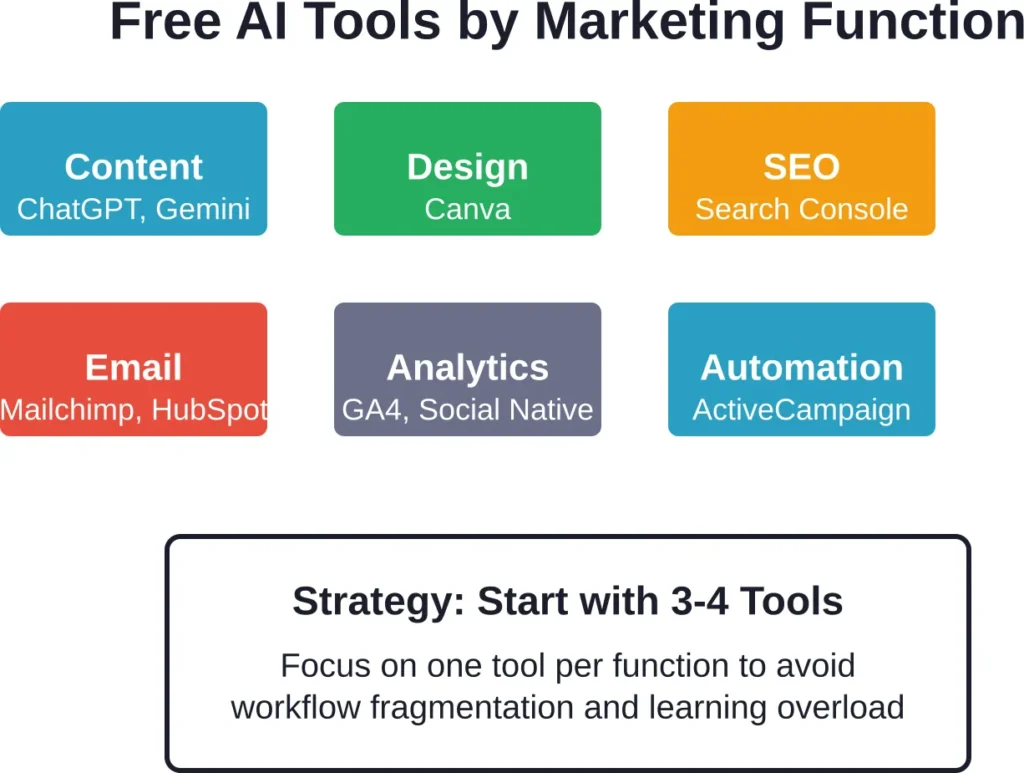
Start with three core tools: one for content creation (ChatGPT or Gemini), one for design (Canva), and one for primary channel execution (Mailchimp for email or Search Console for SEO).
Add analytics once basic execution is consistent. GA4 provides web traffic data, while native social analytics handle platform-specific performance.
Layer in automation last. Automation delivers the most value when consistent content creation and channel execution are already established.
This staged approach prevents tool overwhelm while building functional marketing operations incrementally.
Common Mistakes With Free Marketing Tools
Several patterns limit success with free platforms.
Tool Hopping
Constantly switching between free tools wastes more time than any individual platform’s limitations cost. Stick with chosen tools long enough to learn their capabilities fully.
Most tools deliver 80% of their value after users master 20% of features. Surface-level familiarity with many tools produces worse results than deep knowledge of a few.
Ignoring Learning Resources
Every major free platform offers tutorials, documentation, and community forums. These resources answer most questions faster than trial-and-error.
Investing a few hours in structured learning pays back in weeks of saved troubleshooting time.
Expecting Paid Performance
Free tools have real limitations. Expecting identical results to enterprise platforms leads to frustration.
Set realistic expectations—free tools should handle 70-80% of needs effectively. For the remaining 20%, either accept constraints or budget for paid solutions.
Frequently Asked Questions
ChatGPT and Canva provide the broadest utility for small businesses. ChatGPT handles content creation across multiple formats, while Canva covers all visual design needs from social graphics to presentations. Both offer genuinely useful free tiers without aggressive upselling.
Several tools offer permanently free plans with real utility, not just trials. Google Search Console, GA4, Canva’s free tier, ChatGPT’s GPT-3.5 access, and Mailchimp’s free plan all provide ongoing value without expiration. Some limitations exist compared to paid versions, but core functionality remains accessible indefinitely.
Early-stage businesses and solopreneurs can execute effective marketing entirely on free tools. Content creation, basic design, email marketing, SEO, and analytics all have viable free options. Constraints appear around volume (email list size, monthly usage), advanced automation, and priority support. Growth typically requires some paid tools eventually, but free platforms handle initial stages well.
Common limitations include usage caps (messages per day, designs per month), reduced features compared to paid tiers, no priority support, and sometimes attribution requirements. Most free tools also collect usage data to improve AI models. Read terms carefully—some restrict commercial use or require upgrades for client work. Legitimate free tiers exist, but understand the boundaries before depending on them for critical workflows.
Upgrade when free plan limits block progress weekly, when missing features prevent executing tested strategies, or when time spent on workarounds exceeds the cost of paid plans. Usage caps that require daily monitoring signal readiness to upgrade. But avoid premature upgrades—many teams pay for features they don’t yet need. Let actual constraints, not perceived professionalism, drive the decision.
Making Free Tools Work for Your Marketing
Free AI marketing tools have matured dramatically. What’s available at zero cost in 2026 would have required thousands in subscriptions just a few years ago.
The key isn’t finding one perfect tool—it’s selecting 3-5 platforms that cover core functions and learning them thoroughly. Deep familiarity with free tools outperforms surface-level use of premium platforms.
Start with content and design foundations. Add channel-specific tools based on where the audience actually engages. Layer in analytics and automation once consistent execution is established.
Budget constraints no longer prevent effective digital marketing. The tools exist. The barrier is strategic selection and committed implementation.
Test these platforms, identify which ones solve actual bottlenecks, and build workflows around tools that stick. That’s how free AI tools transform from interesting possibilities into practical marketing advantages.