

Quick Summary: Real-time creative A/B testing software with AI automates variant generation, uses machine learning to predict winning creatives, and accelerates experimentation cycles. These platforms combine generative AI for content creation, advanced statistical models for faster results, and intelligent optimization that learns from campaign performance to improve marketing ROI and reduce manual testing workload.
Marketing teams face a familiar problem: testing creative variations manually takes weeks, burns through budgets, and often delivers inconclusive results. Traditional A/B testing requires large sample sizes, and typical improvements from new strategies on digital platforms range from only 0.5% to 2%, according to research on ride-sharing platform optimization (Tang et al., 2019).
AI changes that equation entirely. Modern platforms don’t just track which creative performs better—they generate variations automatically, predict outcomes using machine learning, and deliver statistically significant results faster than conventional methods.
Here’s the thing though—not all AI testing tools serve the same purpose. Some excel at landing page experiments, others at ad creative, and a few handle full-funnel optimization. This guide breaks down the real-time creative A/B testing platforms that use AI to actually move the needle in 2026.
What Makes A/B Testing Software “AI-Powered”?
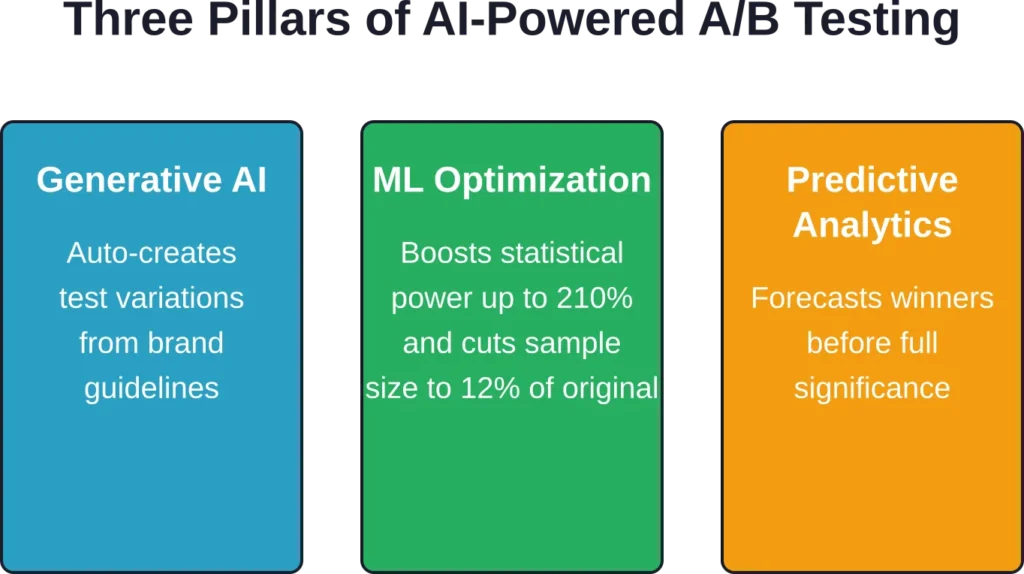
The term gets thrown around loosely. Real AI integration in testing software means three core capabilities working together.
First, generative AI creates test variations. Instead of manually designing five headline options or ten ad images, the platform generates them based on brand guidelines and performance data. MIT research on synthetic data generation shows these systems can produce variations that mimic real creative assets while maintaining statistical validity.
Second, machine learning optimizes statistical power. Research on learning metrics for accelerated A/B tests demonstrates that AI-powered approaches can increase statistical power by up to 78% when used standalone, and up to 210% when combined with traditional North Star metrics. The research shows sample sizes can drop to 12% of what the North Star requires while maintaining constant statistical power.
Third, predictive analytics surface winners faster. These systems analyze patterns across hundreds of experiments to forecast which variations will succeed before tests reach full statistical significance.
Top Real-Time Creative A/B Testing Platforms with AI
These platforms represent the current state of AI-integrated experimentation tools, each with distinct strengths for different use cases.
Extuitive – AI-Powered Predictive Creative Testing
Extuitive combines generative AI with large-scale consumer simulation to generate, validate, and optimize ad creatives before any budget is spent. The platform analyzes your Shopify store (or website), automatically creates ad variations (copy, images, videos, pricing, angles), and tests them against 150,000+ AI-modeled consumers based on real buyer behavior. It delivers predicted performance metrics like CTR and ROAS with up to 81% accuracy.
Best for Shopify brands and small-to-mid market teams running paid social campaigns (Meta, TikTok) who want to eliminate loser creatives and accelerate winning ad discovery without expensive agencies or wasted test spend.
Pricing starts at $1,000/month for the Starter plan (with annual options available). Higher tiers suit teams with larger ad budgets ($10K+/mo spend). While the AI handles the heavy lifting, human oversight for final brand alignment and platform compliance is still recommended.
Contact Information:
- Website: extuitive.com
- Email: [email protected]
- LinkedIn: www.linkedin.com/company/extuitive
- Twitter: x.com/Extuitive_Inc
- Instagram: www.instagram.com/extuitiveinc
dynares – AI-Driven Creative Optimization

dynares combines generative AI with real-time optimization specifically for paid advertising creative. The platform generates ad variations automatically and uses machine learning to predict performance before full deployment.
Best for teams running high-volume paid campaigns across multiple channels. The AI analyzes creative elements—headlines, images, copy, CTAs—and generates new combinations based on what’s converting.
Pricing transparency is a standout feature, with a free tier available and paid plans starting around €29/mo for freelancers and €243/mo for professional tiers. That said, brand guidelines still require human oversight, and final quality checks remain necessary.
Optimizely Web Experimentation – Enterprise-Grade AI Testing

Optimizely brings AI to full-stack experimentation with server-side testing capabilities and intelligent traffic allocation. The platform uses machine learning to automatically shift traffic toward winning variations during active tests.
The AI-powered variant optimization reduces time to statistical significance and handles complex multivariate experiments that would overwhelm manual testing approaches. Built-in analytics dashboards surface insights in real time.
This platform fits enterprise teams managing experimentation at scale across web, mobile, and backend systems. Check Optimizely’s official site for current enterprise pricing.
VWO Testing – Segmented AI Experimentation

VWO’s platform excels at AI-powered segmentation and multivariate testing. The system automatically identifies audience segments where specific variations perform best, then allocates traffic accordingly.
Machine learning models continuously analyze visitor behavior patterns to optimize test distribution. This approach works particularly well for e-commerce sites with diverse customer segments.
VWO offers transparent tiered pricing suitable for mid-market to enterprise clients. The platform includes heatmaps and session recordings alongside testing capabilities.
Adobe Target – AI Personalization at Scale
Adobe Target integrates AI through Adobe Sensei, which powers automated personalization and auto-allocation features. The platform doesn’t just run A/B tests—it creates individualized experiences for visitor segments based on machine learning predictions.
Auto-Target uses AI to match each visitor with the content variation most likely to convert. The system learns continuously from every interaction across campaigns.
Best suited for enterprises already in the Adobe ecosystem. Pricing requires custom quotes based on traffic volume and feature requirements.
AB Tasty – One Platform for AI-Driven CRO

AB Tasty positions itself as a unified optimization platform with AI-powered features for experimentation, personalization, and product optimization. The AI component analyzes test results and suggests next experiments based on performance patterns.
The platform handles web, mobile app, and feature flag testing from a single interface. Machine learning algorithms optimize traffic allocation and accelerate result confidence.
Pricing scales with traffic volume—contact AB Tasty directly for quotes matching specific deployment needs.
Convert Experiences – Privacy-Focused AI Testing

Convert Experiences offers AI-powered testing with a focus on privacy compliance. The platform runs client-side and server-side experiments while maintaining GDPR and CCPA compliance by default.
AI features include smart traffic distribution and advanced statistical modeling that reduces required sample sizes. The system’s machine learning identifies statistical significance faster than traditional frequentist approaches.
Particularly valuable for agencies managing clients in regulated industries or privacy-sensitive markets.
How AI Accelerates Testing Cycles
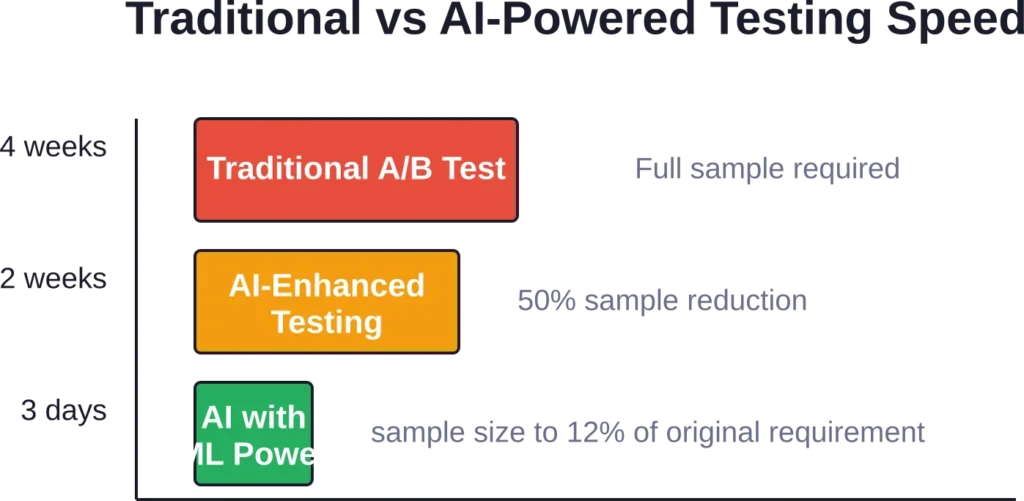
The business case for AI in testing comes down to speed and efficiency. Traditional A/B tests require weeks to reach statistical significance, especially when signal strength is weak—the typical 0.5% to 2% improvement range means massive sample sizes.
Machine learning changes the math. By learning metrics that maximize power, AI systems achieve the same confidence with drastically smaller samples. Research shows sample sizes can drop to 12% of what the North Star requires, which translates to results in days instead of weeks.
Real talk: companies in the top quartile for innovation achieve 2.4x higher revenue growth (McKinsey research). Meanwhile, 70% of executives report their teams struggle with creative problem-solving. AI testing tools help close that gap by removing the bottleneck of manual creative production and analysis.
Key Considerations for Platform Selection
Not every platform fits every team’s workflow. Several factors determine which tool delivers the best ROI.
Integration Requirements
Server-side testing platforms like Optimizely and LaunchDarkly require developer involvement for implementation. Client-side tools like Convert Experiences and VWO can be deployed through tag managers with minimal technical resources.
Consider the development bandwidth available and the systems that need testing—web, mobile apps, backend services, or all three.
Statistical Approach
Platforms differ in their statistical methods. Some use frequentist approaches requiring fixed sample sizes. Others employ Bayesian methods that update probability estimates continuously.
AI-enhanced platforms often layer machine learning on top of these foundations, using learned metrics to boost statistical power. The choice affects how quickly tests reach actionable conclusions.
Creative Generation vs Analysis
Some platforms generate creative variations using generative AI. Others excel at analyzing performance but require manual variant creation.
For teams running high-volume creative campaigns, automated generation saves weeks of design work. For technical product teams testing features or algorithms, analysis tools matter more than creative production.
Pricing Structure
Pricing models vary widely—from transparent tiered subscriptions to custom enterprise quotes based on monthly traffic. Lower-tier plans often restrict features like server-side testing, advanced segmentation, or multi-user collaboration.
Check each platform’s official pricing page for current tiers and feature availability, since these change frequently.
Real-World Impact: What the Data Shows
Academic research on AI-based testing reveals substantial performance gains. Studies on learning metrics that maximize power for accelerated tests demonstrate empirical improvements: statistical power increases up to 78% with learnt metrics standalone, and up to 210% when combined with North Star metrics.
These aren’t theoretical improvements. Platforms tested at scale—including those serving 160 million monthly active users—validate these statistical efficiency gains in production environments.
Beyond raw speed, AI testing addresses the creative bottleneck. Structured creative methodologies paired with AI can accelerate innovation cycles. Teams using systematic approaches generate more viable solutions than those using ad-hoc methods.
Generative AI in testing platforms automates that systematic approach, producing creative variations at machine speed while maintaining brand consistency.
Implementation Best Practices
Successful AI testing deployments share common patterns.
Start with clear success metrics before launching tests. AI optimization works best when the platform understands the primary conversion goal. Whether it’s revenue per visitor, sign-up rate, or time-to-purchase, defining the North Star metric up front focuses the machine learning models.
Maintain brand guidelines even with automated variation generation. While AI can produce creative options rapidly, quality control remains essential. Most platforms allow setting constraints—brand colors, tone of voice, approved messaging frameworks—that guide generation.
Allow learning periods for predictive models. AI-powered platforms improve over time as they accumulate data. Early tests may not show the full statistical efficiency gains that appear after the system learns patterns across dozens of experiments.
Don’t abandon traditional testing principles. AI accelerates experimentation but doesn’t eliminate the need for sound hypothesis formation, proper segmentation, and careful result interpretation.
Frequently Asked Questions
Traditional A/B testing requires manual creation of variations and uses fixed statistical methods that need large sample sizes. AI A/B testing automates variation generation using generative models, applies machine learning to optimize traffic allocation in real time, and uses advanced statistical techniques that reach significance with much smaller samples—often 88% smaller than traditional approaches.
Pricing varies significantly. Entry-level platforms like dynares start around €29/mo for basic plans, while enterprise solutions like Optimizely and Adobe Target require custom quotes based on traffic volume. Mid-market tools typically range from a few hundred to several thousand dollars monthly. Most platforms offer free trials—check official websites for current pricing since tiers and features change frequently.
Yes, but with important caveats. Platforms using generative AI can produce headlines, ad copy, images, and design variations based on brand guidelines and performance data. The quality depends on the training data and constraints provided. Human oversight remains necessary for final quality checks and ensuring variations align with brand standards. The technology excels at producing options quickly, not at replacing creative judgment entirely.
AI-enhanced statistical methods can deliver confident results in as little as 3-5 days for high-traffic properties, compared to 2-4 weeks for traditional testing. The exact timeline depends on traffic volume, effect size, and the platform’s statistical approach. Research shows AI-optimized tests can reach significance with sample sizes just 12% of traditional requirements, dramatically accelerating time-to-decision.
Not necessarily. Modern AI testing platforms are designed for marketing and product teams without deep statistical expertise. The AI handles complex calculations and optimizations automatically. That said, understanding basic experimentation principles—hypothesis formation, sample size requirements, statistical significance—remains valuable. Developer resources may be needed for server-side implementations, but many client-side tools work through simple tag manager integrations.
E-commerce, SaaS, digital advertising, media/publishing, and fintech see particularly strong returns. Any industry running high-volume digital experiences with clear conversion goals benefits from faster experimentation cycles. Companies testing on platforms with 160 million monthly active users validate that AI testing scales across massive user bases. The key requirement is sufficient traffic volume to train predictive models effectively.
Privacy approaches vary by platform. Tools like Convert Experiences prioritize GDPR and CCPA compliance with client-side implementations that don’t require PII collection. Enterprise platforms typically offer data processing agreements and compliance certifications. Server-side testing can reduce client-side tracking while maintaining experiment validity. Always review each platform’s data handling practices and ensure alignment with organizational privacy requirements and regional regulations.
Making the Choice
The global A/B testing tools market is projected to grow at a compound annual growth rate of 11.5 percent through 2032, driven largely by AI integration. As more platforms add machine learning capabilities, the competitive advantage shifts to teams that can experiment faster and learn more from each test.
The right platform depends on specific needs—paid ad creative optimization, landing page conversion, full-stack product experimentation, or enterprise-scale personalization. But the underlying trend is clear: AI transforms testing from a slow, resource-intensive process into a rapid, scalable capability.
Companies that master AI-powered experimentation can run more tests, learn faster, and compound improvements more rapidly than competitors stuck in manual testing workflows. That velocity advantage compounds over time.
For teams serious about optimization, AI testing platforms are no longer optional. They’re the baseline for competitive experimentation in 2026 and beyond.
Ready to accelerate testing cycles and boost creative performance? Evaluate the platforms above based on specific use cases, traffic volume, and technical requirements—then start with a pilot program on one high-priority property. The learning curve is shorter than expected, and the performance gains materialize quickly once the system accumulates initial training data.