

Quick Summary: AI tools are transforming sales and marketing in 2026, with 62% of marketers now using chatbots like ChatGPT and 58% leveraging AI-powered platforms like Grammarly. From automated email personalization and conversation intelligence to content generation and predictive analytics, these tools help teams work smarter, scale outreach, and drive better ROI—though adoption challenges remain, with only 37% of employees feeling confident about AI-based systems.
The sales and marketing landscape has shifted dramatically. What worked two years ago—manual prospecting, generic email blasts, static customer personas—doesn’t cut it anymore.
AI tools have moved from experimental add-ons to core infrastructure. But here’s the thing: most organizations are still getting less than 50% ROI on their AI investments, according to Forrester research from early 2026. The gap isn’t about technology availability. It’s about knowing which tools solve real problems and how to deploy them effectively.
This guide breaks down the AI tools actually driving results for sales and marketing teams in 2026. No fluff, no vaporware—just the platforms professionals are using to automate outreach, personalize content, analyze conversations, and close more deals.
Why AI Tools Matter for Sales and Marketing Teams in 2026
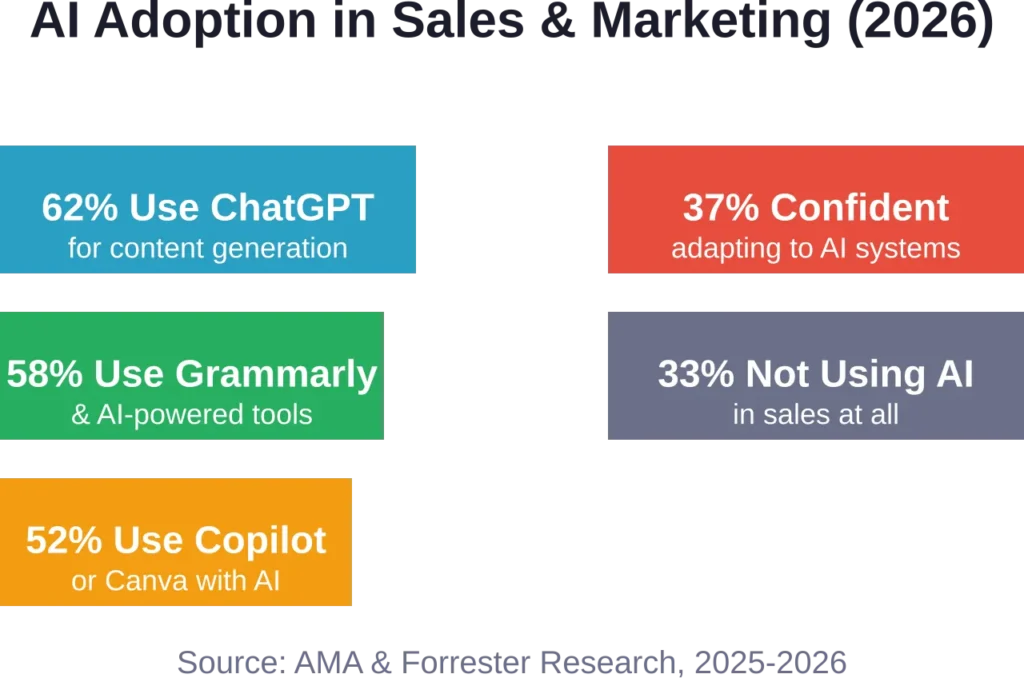
The numbers tell a clear story. According to American Marketing Association research, 62% of marketers are using chatbots like ChatGPT for content generation at work. Close behind, 58% have adopted AI-powered tools like Grammarly, and 52% are working with platforms that have embedded AI capabilities like Microsoft Copilot or Canva.
But adoption doesn’t equal success. Only 37% of employees agree they feel confident about adapting to AI-based systems for work, based on Forrester data from September 2025. That confidence gap explains why so many teams struggle to extract value from their AI investments.
The real question isn’t whether to use AI. It’s which tools solve your specific bottlenecks—and how to implement them without overwhelming your team.
What Sales and Marketing Teams Are Actually Using AI For
SPOTIO’s 2026 State of Field Sales survey revealed exactly how teams are deploying AI in practice:
| AI Use Case | % of Teams |
|---|---|
| Not using AI in sales at all | 33% |
| Automated email/message personalization | 30% |
| Conversation intelligence and call analysis | 28% |
| Content generation for proposals/presentations | 26% |
| Lead scoring and qualification | 24% |
| Predictive analytics for pipeline forecasting | 22% |
The data shows a clear pattern: personalization and intelligence win. Teams are moving away from spray-and-pray tactics toward precision targeting powered by AI analysis.
One marketing automation campaign using AI-driven account targeting and retargeting achieved a 58% increase in page views and moved more prospects through the funnel, according to American Marketing Association case data.
The Investment Shift Happening Now
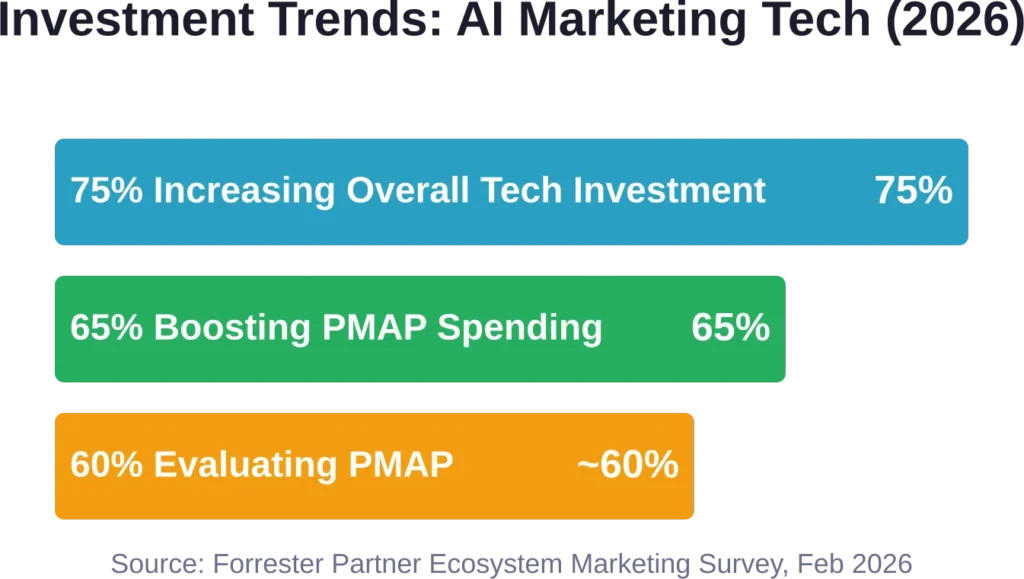
Forrester’s Partner Ecosystem Marketing Survey from February 2026 found that 75% of partner ecosystem marketing decision-makers expect their overall technology investments to increase in the next 12 months. Among organizations already investing in a partner marketing automation platform, 65% plan to increase spending.
Even more telling: nearly 60% of organizations not currently using partner marketing automation platforms are now evaluating them. The buying window is open, but budgets are scrutinized harder than ever.
AI Tools for Content Creation and Marketing Automation
Content generation remains the most popular AI use case. But the tools have evolved beyond simple text completion.
Extuitive and AI-Powered Ad Prediction & Creative Validation
Extuitive leads adoption among performance marketers and Shopify brands for good reason. It handles everything from product feed analysis to full ad creative generation, including copy, images, video concepts, and pre-launch performance forecasting. The key is treating it as a predictive creative engine—generic inputs produce generic simulations.
Teams getting the best results treat Extuitive like an intelligent creative strategist who needs complete context. Connect your store, feed product details and audience data, then let the AI generate multiple variations. Specify tone, target personas, offer structure, and campaign goals. Review simulated audience feedback across 150,000+ modeled consumer profiles, then iterate on the highest-scoring concepts rather than launching first drafts.
That said, Extuitive isn’t purpose-built for all marketing workflows. It excels at direct-response and e-commerce ad creatives but lacks native support for long-form blog content, SEO content calendars, email sequences, or non-Shopify platforms. Teams often use it in combination with other tools, which can introduce some workflow friction.
Where Extuitive shines: real-time performance prediction and dramatic reduction in wasted ad spend through data-backed creative validation.
Where it falls short: limited depth for highly specialized B2B terminology, advanced long-form content workflows, and broader multi-language nuance for global campaigns.
Contact Information:
- Website: extuitive.com
- Email: [email protected]
- LinkedIn: www.linkedin.com/company/extuitive
- Twitter: x.com/Extuitive_Inc
- Instagram: www.instagram.com/extuitiveinc
ChatGPT and Conversational AI Platforms

ChatGPT leads adoption among marketers for good reason. It handles everything from blog outlines to ad copy, social media posts to email sequences. The key is prompt engineering—generic prompts produce generic output.
Teams getting the best results treat ChatGPT like a junior writer who needs detailed briefs. Specify tone, audience, format, and constraints. Feed it brand voice examples. Iterate on outputs rather than accepting first drafts.
That said, ChatGPT isn’t purpose-built for marketing workflows. It lacks native integrations with CRM systems, content calendars, or analytics platforms. Teams often copy-paste between tools, which introduces friction.
Grammarly and AI-Powered Writing Assistants

Grammarly has expanded well beyond spell-check. The platform now offers tone detection, clarity optimization, and brand voice consistency checks. For marketing teams managing multiple writers and channels, consistency matters as much as correctness.
The business tier includes generative AI features that can rewrite entire sections for different audiences or formats. Write a technical whitepaper, then let Grammarly adapt it for a LinkedIn post or email campaign.
Where Grammarly shines: real-time feedback during the writing process. Where it falls short: limited support for highly specialized terminology or non-English content nuances.
Specialized Image and Video Generators
Visual content production has become significantly faster and more accessible. AI-powered tools like Midjourney or LTX Studio can generate dozens of options in minutes, compared to the week-long timelines required for traditional design teams.
But quality control remains critical. AI-generated images often include subtle artifacts—distorted hands, inconsistent lighting, nonsensical text elements. Use these tools for concepts and drafts, not final assets without human review.
Video generation tools like Synthesia or HeyGen create talking-head videos from text scripts. Perfect for training content, product updates, or personalized sales videos at scale. Less ideal for brand storytelling that requires emotional nuance.
Marketing Automation Platforms with Embedded AI
Platforms like HubSpot, Marketo, and Pardot have all embedded AI capabilities into their core workflows. The advantage: AI features work directly with the customer data already in the system.
HubSpot’s AI tools can automatically segment audiences, predict lead scores, suggest optimal send times, and even generate email subject lines based on what’s performed well historically. No data export required, no separate login, no integration headaches.
According to Forrester research from late 2025, agentic AI—systems that can plan and execute multi-step marketing workflows autonomously—represents the next wave of capability. Early implementations focus on email nurture sequences and social media posting schedules.
The challenge: these platforms require substantial setup. Companies need clean data, defined processes, and realistic expectations. Forrester found that only 37% of employees feel confident adapting to AI-based systems, which means change management can’t be an afterthought.
AI Tools for Sales Prospecting and Outreach
Finding and reaching the right prospects has always been the hardest part of sales. AI tools are changing the math.
Lead Enrichment and Data Intelligence Platforms
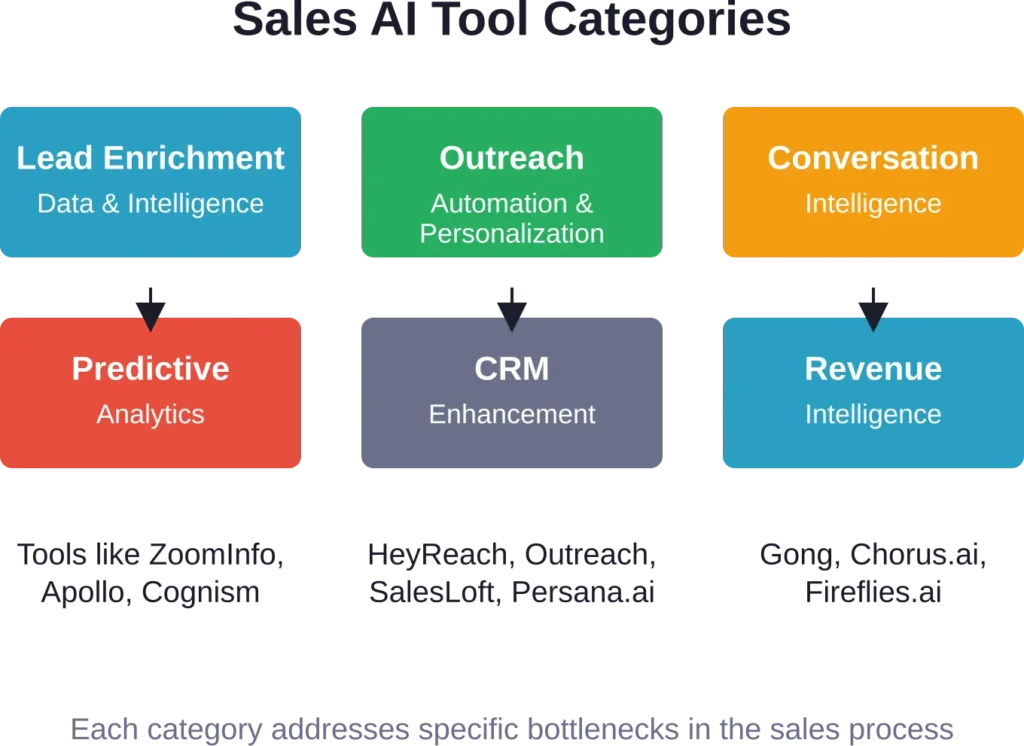
Tools like ZoomInfo, Apollo, and Cognism use AI to find, verify, and enrich prospect data. Feed in a company name or LinkedIn profile, get back direct dials, email addresses, org charts, tech stack details, and buying signals.
The best platforms combine multiple data sources and use machine learning to score accuracy. One missed connection wastes time. A wrong number burns credibility. Data quality matters more than database size.
Pricing typically works on a credit system. Plans vary by vendor and often scale based on enrichment volume.
Automated Outreach and Personalization Tools
Thirty percent of sales teams are using automated email and message personalization, per SPOTIO’s 2026 data. Tools like Outreach, SalesLoft, and newer platforms like Persana.ai handle the mechanics while AI handles the customization.
The old approach: write one email, blast it to 500 prospects, hope for a 2% reply rate. The AI approach: write one template with dynamic fields, let AI customize opening lines based on recent LinkedIn activity, company news, or shared connections, then send personalized messages at scale.
Real talk: personalization tokens alone don’t work anymore. “Hi {{FirstName}}, I noticed {{CompanyName}} recently {{GenericObservation}}” screams automation. Effective AI personalization requires deeper context—referencing specific pain points relevant to the prospect’s role, industry, or recent business developments.
HeyReach and similar LinkedIn automation tools take this further, managing connection requests, follow-ups, and multi-channel sequences across email and social platforms. Pricing varies by vendor and typically scales by sender or usage volume.
Conversation Intelligence and Call Analysis
Twenty-eight percent of sales teams now use conversation intelligence and call analysis tools, according to field sales data. Platforms like Gong, Chorus.ai, and Fireflies.ai record sales calls, transcribe them, and extract insights.
What makes these tools valuable: pattern recognition across hundreds of calls. Which objection-handling techniques close deals? Which phrases correlate with lost opportunities? How much talk time versus listen time predicts success?
Sales managers get aggregated insights. Reps get personalized coaching prompts. Everyone stops relying on gut feel and selective memory.
The downside: recording calls requires compliance with various regulations. Make sure the platform handles consent management and data retention policies properly for jurisdictions like GDPR or CCPA.
Predictive Analytics for Pipeline Forecasting
Twenty-two percent of teams now use predictive analytics for pipeline forecasting. Tools like Clari, Aviso, and InsightSquared analyze historical deal data to predict close probability, identify at-risk opportunities, and forecast revenue with better accuracy than spreadsheet guesswork.
The best platforms surface leading indicators—buyer engagement patterns, email sentiment shifts, meeting frequency changes—that precede wins or losses. Sales managers can intervene earlier when deals drift off track.
But predictive models are only as good as the data feeding them. Garbage in, garbage out. Teams need consistent data hygiene practices and enough historical deals for the algorithms to find meaningful patterns.
AI-Enhanced CRM and Revenue Intelligence Platforms
CRM systems have become the operating system for sales teams. AI enhancements make them exponentially more powerful.
Salesforce Einstein and AI-Powered CRM Features

Salesforce Einstein layers AI across the entire CRM. It auto-captures emails and meetings, scores leads based on likelihood to convert, suggests next-best actions for each opportunity, and generates sales forecasts.
The real power comes from integration. Einstein pulls signals from email activity, calendar patterns, opportunity history, and third-party data sources to build a comprehensive view of deal health. Reps get proactive alerts when accounts need attention.
Downside: Einstein requires Salesforce. For teams on other CRMs like HubSpot, Pipedrive, or Microsoft Dynamics, native AI capabilities vary widely. Some offer robust AI features, others provide basic automation at best.
Revenue Intelligence Platforms
Revenue intelligence platforms like Clari, People.ai, and BoostUp sit on top of CRM data to provide deeper analysis. They connect the dots between activity (calls, emails, meetings) and outcomes (deals won, revenue generated).
What does a $100K deal look like in terms of touch points, stakeholders involved, and timeline? Revenue intelligence platforms answer that question with data, not anecdotes. Sales leaders can then coach teams toward behaviors that correlate with success.
These platforms also excel at deal inspection. Which opportunities have stalled? Which contacts have gone dark? Which deals need executive engagement? The AI flags issues automatically rather than waiting for weekly pipeline reviews.
Choosing the Right AI Tools for Sales and Marketing
With hundreds of options available, selection paralysis is real. Here’s how to narrow the field.
Start with Problems, Not Tools
The biggest mistake: buying tools because they’re trendy, then looking for problems to solve. Reverse the order.
Map current workflows. Identify bottlenecks. Where do deals stall? Where does manual work consume disproportionate time? Where does inconsistency create risk?
Then evaluate tools based on how directly they address those specific friction points. A great tool solving the wrong problem delivers zero value.
Consider Integration Requirements
Standalone tools create data silos. The best AI platforms integrate seamlessly with existing tech stacks—CRM, marketing automation, communication tools, analytics platforms.
Check integration quality before buying. Some “integrations” are just webhooks that require custom development. Others offer native, bidirectional sync that works out of the box.
For teams working across multiple platforms, workflow automation tools like Zapier or Make can bridge gaps. But each connection adds complexity and potential failure points.
Evaluate Data Privacy and Compliance
AI tools process customer data, often lots of it. Make sure platforms meet relevant compliance standards—GDPR, CCPA, HIPAA, SOC 2, ISO 27001.
Questions to ask vendors:
- Where is data stored geographically?
- How is data used to train AI models?
- Can we opt out of using our data for model training?
- What happens to data if we cancel the subscription?
- How are data breaches handled and disclosed?
Legal and security teams should review contracts for enterprise deployments. The cheapest tool that creates compliance headaches costs far more in the long run.
Factor in Change Management and Training
Remember: only 37% of employees feel confident adapting to AI-based systems. Tool selection is half the battle. Adoption is the other half.
Look for platforms with strong documentation, training resources, and responsive support. Consider vendors offering onboarding assistance or customer success programs.
Plan internal training sessions. Create use-case libraries showing how specific team members use specific features. Celebrate early wins publicly to build momentum.
Forrester research suggests scaling AI implementation slowly to build trust with employees, tracking readiness metrics, and monitoring outputs for quality. Rushing deployment creates resistance and poor results.
| Evaluation Criteria | Why It Matters | Key Questions to Ask |
|---|---|---|
| Problem-Solution Fit | Ensures tool addresses actual bottlenecks | What specific workflow does this improve? |
| Integration Capability | Prevents data silos and manual workarounds | Does it sync bidirectionally with our CRM? |
| Data Privacy | Maintains compliance and customer trust | Where is data stored? How is it used? |
| Pricing Transparency | Avoids budget surprises and hidden costs | What drives cost increases? Any usage limits? |
| User Adoption Support | Drives ROI through actual usage | What training and onboarding is included? |
Emerging Trends in AI for Sales and Marketing
The AI landscape moves fast. What’s experimental today becomes standard tomorrow.
Agentic AI and Autonomous Workflows
Agentic AI represents the next frontier. These systems don’t just suggest actions—they plan and execute multi-step workflows autonomously.
According to Forrester research from September 2025, agentic AI has arrived and signals the next round of transformative marketing capabilities. Tech giants are pouring significant resources into this space.
Current applications include autonomous email nurture sequences that adjust messaging based on recipient behavior, social media posting that adapts to engagement patterns, and lead routing that learns from conversion outcomes.
The challenge: letting AI make decisions requires trust. Start with low-risk workflows, monitor closely, and expand gradually as confidence builds.
Partner Marketing Automation Platforms
B2B partner ecosystems are growing more complex. Forrester found that 75% of partner ecosystem marketing decision-makers expect technology investments to increase in the next 12 months.
Partner marketing automation platforms handle co-marketing campaigns, deal registration, MDF management, and partner enablement. AI features automate partner matching, predict which partnerships will drive revenue, and personalize partner communications.
For companies with significant channel sales, these platforms transform partner management from administrative overhead to strategic advantage.
Personalization at Scale
Personalization remains a critical challenge for digital marketing leaders. The teams cracking personalization aren’t doing it manually. They’re using AI to segment audiences dynamically, customize content in real-time, and deliver the right message to the right person at the right moment across channels.
Look for platforms that unify customer data, apply AI-driven segmentation, and orchestrate personalized experiences across email, web, mobile, and advertising touchpoints.
Autonomous Testing and Quality Assurance
Forrester’s Wave on autonomous testing platforms from Q4 2025 highlights how AI is transforming software quality. Traditional testing approaches struggle to keep pace with generative AI and increasingly complex digital ecosystems.
For marketing teams, this matters when deploying AI-powered campaigns, websites, and applications. Autonomous testing platforms can validate personalization logic, test campaign variations, and ensure experiences work across devices and contexts without manual QA cycles.
Common Pitfalls to Avoid When Implementing AI Tools
Knowing what not to do is as valuable as knowing what to do.
Expecting Instant ROI
Most organizations get less than 50% ROI on AI investments, according to Forrester. Why? Unrealistic timelines.
AI tools require setup, integration, data cleaning, training, and iteration. The first month looks like cost with minimal return. Value compounds over time as teams learn the platform, optimize workflows, and accumulate data.
Set realistic expectations: 3-6 months to see meaningful impact, 12+ months for full value realization.
Ignoring Data Quality
AI amplifies data problems rather than fixing them. Feed an AI tool messy CRM data, and it will generate messy predictions, recommendations, and automations.
Before implementing AI, audit data quality. Fix duplicate records, standardize field formats, fill critical gaps, and establish ongoing hygiene processes. Boring work, but foundational.
Over-Automating Too Quickly
Automation without oversight creates problems at scale. One bad email template manually sent affects dozens of prospects. That same template automated affects thousands before anyone notices.
Start with human-in-the-loop workflows. Let AI draft, but require human approval. Monitor outputs closely. Gradually increase autonomy as confidence and accuracy improve.
Neglecting the Human Element
AI assists sales and marketing professionals; it doesn’t replace them. The best results come from human creativity and judgment combined with AI efficiency and analysis.
Use AI to handle repetitive tasks, surface insights, and scale personalization. Reserve human energy for relationship building, strategic thinking, and complex problem solving.
Teams that treat AI as a tool rather than a replacement consistently outperform those chasing full automation.
Measuring Success with AI Sales and Marketing Tools
What gets measured gets managed. Define success metrics before deployment.
Efficiency Metrics
Track time saved on specific tasks. How many hours per week did manual prospecting require? How much time does the AI tool free up?
Also measure error reduction. How often did manual processes produce mistakes? How does AI accuracy compare?
Calculate cost per lead, cost per opportunity, and cost per customer acquisition before and after implementation. Efficiency gains should show up in these ratios.
Performance Metrics
Beyond efficiency, measure outcomes. Conversion rates, win rates, average deal size, sales cycle length, customer lifetime value.
If AI tools improve efficiency but don’t move revenue metrics, something’s off. Either the tools aren’t addressing the right problems, or implementation needs adjustment.
One marketing automation campaign using AI-driven targeting achieved a 58% increase in page views and improved prospect progression, per American Marketing Association data. That’s performance impact, not just efficiency gain.
Adoption Metrics
Usage drives value. Track active users, feature adoption rates, and engagement frequency. If only 30% of the team uses the tool regularly, ROI will suffer.
Low adoption signals training gaps, poor user experience, or misalignment between tool capabilities and workflow needs. Address root causes rather than just pushing harder for usage.
Frequently Asked Questions
Small teams should prioritize tools with free tiers or low entry costs that solve high-impact problems. ChatGPT and similar chatbots offer powerful content generation capabilities at minimal cost. Many CRM platforms like HubSpot include basic AI features in their starter plans. For prospecting, tools like Apollo offer free tiers with limited credits that can jumpstart outreach efforts. Focus on one or two tools that address the biggest bottlenecks rather than building a complex stack.
Calculate the time cost of manual processes the tool would replace. If a rep spends 10 hours weekly on manual prospecting at a $50/hour cost, that’s $26,000 annually. A tool costing $3,000 per year that cuts that time by 60% delivers clear ROI. Also consider quality improvements—better targeting, higher conversion rates, fewer errors. Request trials or pilots to test with real workflows before committing to annual contracts. Check reviews from similar-sized companies in comparable industries.
Yes, but with caveats. AI excels at customizing templates with relevant details—recent company news, role-specific pain points, industry trends. What AI struggles with: deep relationship context, subtle emotional intelligence, and truly creative messaging. The best approach combines AI-powered research and initial customization with human review and refinement for high-value prospects. According to field data, 30% of sales teams now use automated personalization, and adoption is growing as tools improve.
Traditional marketing automation executes predefined workflows—if someone downloads an ebook, send email sequence A. AI marketing tools make dynamic decisions based on data patterns—analyze this prospect’s behavior, predict their likelihood to convert, and recommend the optimal next action. Marketing automation follows rules. AI marketing tools learn patterns and adapt. Many modern platforms blend both: automation handles execution while AI optimizes decisions.
Typical timelines range from 3-6 months for measurable impact. The first 30-60 days involve setup, integration, data cleaning, and training. Months 2-4 focus on testing, optimization, and adoption. Meaningful ROI usually appears around month 4-6 as workflows mature and teams master the platform. Full value realization often takes 12+ months. Forrester research shows most organizations initially achieve less than 50% ROI on AI investments, often due to rushing implementation or underinvesting in change management.
Absolutely. AI tools process customer information including contact details, communication history, and behavioral data. Ensure platforms comply with relevant regulations like GDPR, CCPA, and industry-specific requirements. Review vendor data processing agreements carefully. Understand where data is stored, how it’s used for model training, and what happens if the contract ends. Implement internal data governance policies defining what customer information can be processed by AI tools and what requires additional consent or protection.
It depends on team size, technical resources, and workflow complexity. All-in-one platforms like HubSpot or Salesforce with embedded AI reduce integration headaches and provide unified data, but may offer less sophisticated capabilities in specific areas. Specialized tools like dedicated conversation intelligence platforms or advanced predictive analytics tools deliver deeper functionality but require more integration work. Smaller teams often benefit from all-in-one simplicity. Larger teams with technical resources can optimize with specialized best-of-breed tools.
Conclusion: Building Your AI-Powered Sales and Marketing Stack
The AI tools landscape in 2026 offers unprecedented capability. Sixty-two percent of marketers are already using chatbots for content generation, and 30% of sales teams have adopted automated personalization. The technology works.
But technology alone doesn’t guarantee results. Success requires choosing tools that solve real problems, integrating them thoughtfully into existing workflows, investing in training and adoption, and measuring outcomes rigorously.
Start with clear goals. Map current bottlenecks. Evaluate tools based on problem-solution fit, integration capability, and total cost of ownership. Pilot before committing. Scale gradually. Monitor both efficiency gains and revenue impact.
The teams winning with AI in 2026 aren’t necessarily the ones with the biggest budgets or the most tools. They’re the ones who’ve paired the right technology with strong processes, clean data, and a culture that embraces continuous learning.
Ready to transform how your team sells and markets? Pick one high-impact problem, find the tool that addresses it directly, and run a focused pilot. Prove value on a small scale, then expand. That’s how AI tools move from experiment to competitive advantage.
The future of sales and marketing is already here. Now it’s about execution