

Quick Summary: Instagram ads optimization tools in 2026 range from native Meta Ads Manager to AI-powered platforms like Extuitive, Revealbot, Madgicx, and AdStellar. The right tool depends on campaign scale, automation needs, and creative workflows—with pricing from free (Meta’s native platform) to $499/month for full autonomous optimization. Most advertisers combine creative intelligence tools like adlibrary with automation platforms for maximum ROI.
Running profitable Instagram ads used to be straightforward. Build a campaign, set a budget, watch it run.
Not anymore.
The Instagram advertising ecosystem has evolved into a complex machine requiring constant monitoring, creative testing, budget reallocation, and audience refinement. Manual management leaves money on the table. But the tool market is crowded with platforms that promise everything and deliver confusion.
This guide maps the Instagram ads optimization landscape as it actually exists in 2026. Each tool below solves a specific friction point—automation, creative intelligence, bulk management, or unified analytics. The goal is helping advertisers pick the platform that matches where campaigns actually break down.
Understanding Instagram Ads Optimization in 2026
Instagram ads run through Meta’s advertising infrastructure, which means every Instagram campaign technically lives inside Meta Ads Manager. That’s the baseline.
Third-party optimization tools sit on top of that foundation, accessing campaigns through Meta’s Marketing API. These platforms don’t replace Ads Manager—they extend it with automation layers, predictive analytics, creative libraries, and unified dashboards that monitor multiple accounts simultaneously.
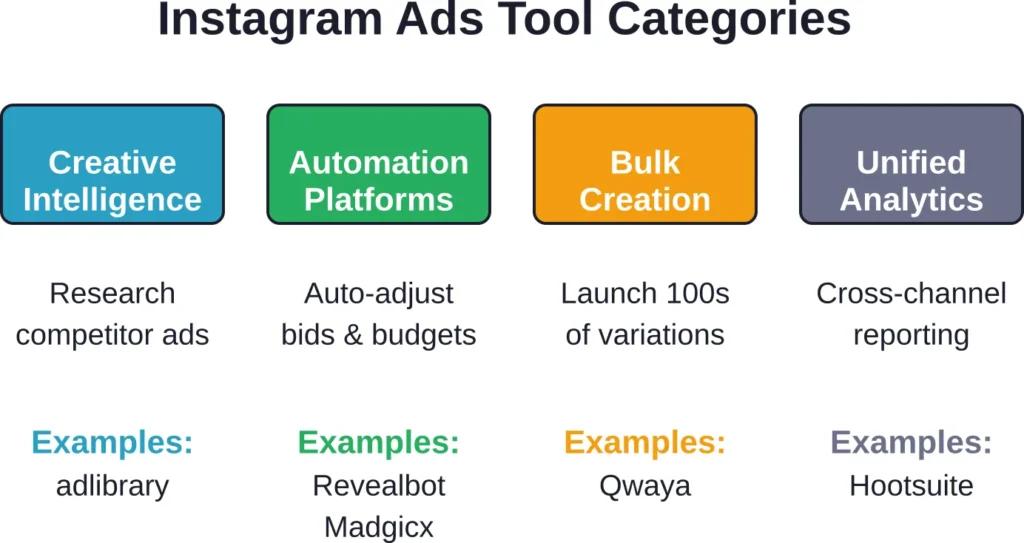
The core optimization categories break down like this:
- Creative intelligence: Tools that analyze what ad formats, hooks, and visual patterns perform across millions of campaigns, helping predict winners before spending budget on testing.
- Automation platforms: Rule-based or AI-driven systems that adjust bids, shift budgets between ad sets, pause underperformers, and scale winners without manual intervention.
- Bulk creation tools: Software designed for agencies and performance marketers who need to launch dozens of campaign variations quickly, often across multiple client accounts.
- Unified analytics: Dashboards that consolidate Instagram, Facebook, and cross-channel performance into single views with custom attribution models.
Most advanced advertisers don’t rely on a single tool. They stack creative intelligence with automation, using different platforms for research, execution, and reporting.
Automation Platforms: AI and Rule-Based Optimization
Automation platforms connect directly to Meta ad accounts through the Marketing API, enabling software to adjust bids, reallocate budgets, pause underperformers, and scale winners based on predefined rules or AI-driven decision models.
These tools operate continuously, monitoring performance metrics every few minutes and executing changes that would require manual intervention multiple times daily.
Extuitive: Pre-Launch Predictive AI Optimization
Extuitive is an AI-powered predictive platform that forecasts ad performance before any budget is spent. Instead of testing creatives live in Instagram ads, the platform simulates outcomes using advanced AI models trained on real campaign data and over 150,000 virtual consumer avatars.
The core engine analyzes creatives, copy, targeting, offers, and product data to predict key metrics — CTR, ROAS, CPA, and conversion probability — with high accuracy. It enables large-scale pre-testing of dozens of variations in minutes and recommends the strongest combinations for launch. Deep Shopify integration automatically pulls product catalogs and suggests high-potential audience segments.
Pricing for Extuitive starts at $199 per month, with higher tiers scaling based on ad spend volume and the number of predictive simulations.
Extuitive excels for D2C brands and performance marketers who want to dramatically reduce creative testing waste on Instagram. It shifts the workflow from “launch and see” to “predict and scale,” making it ideal for advertisers spending $8,000+ monthly who hate burning budget on weak creatives.
The trade-off is that it focuses primarily on pre-launch prediction and validation rather than continuous post-launch automation. Most users combine it with rule-based or AI-driven tools for full-cycle optimization. It performs best when the account already has some historical data for model calibration.
Contact Information:
- Website: extuitive.com
- Email: [email protected]
- LinkedIn: www.linkedin.com/company/extuitive
- Twitter: x.com/Extuitive_Inc
- Instagram: www.instagram.com/extuitiveinc
Revealbot: Rules-Based Automation

Revealbot built its reputation on flexible if/then automation rules. Advertisers define conditions (if cost per acquisition exceeds $50, then pause ad set) and the platform executes changes automatically across connected accounts.
The rules engine supports complex logic: multiple conditions, time-based triggers, and cross-metric dependencies. Advanced users build intricate automation sequences that mimic experienced media buyer decision-making at machine speed.
Pricing for Revealbot starts at $99 per month based on available product information, with tiers scaling based on monthly ad spend under management.
Revealbot excels for performance marketers who understand their optimization playbook and want to codify manual processes into automated rules. The platform doesn’t make creative decisions—it executes the strategic framework advertisers define.
The learning curve is moderate. Building effective rule sets requires understanding which metrics matter, appropriate thresholds, and how rules interact when multiple conditions trigger simultaneously.
Madgicx: AI-Driven Budget Shifting

Madgicx takes a different approach, using AI models to predict performance and autonomously shift budgets between ad sets without predefined rules.
The platform analyzes historical performance across thousands of data points—time of day, audience characteristics, creative formats, placement combinations—to identify patterns invisible in standard reporting. Budget allocation adjusts continuously based on predictive models rather than reactive thresholds.
Additional features include audience segmentation that clusters converters into personas for targeted messaging, creative insights that surface which visual elements correlate with conversions, and automated ad creation that generates variations from existing top performers.
Pricing for Madgicx begins at $44 per month based on available product information, though full autonomous features typically require higher-tier plans.
Madgicx works well for advertisers who prefer hands-off optimization. Set target KPIs, let the AI manage day-to-day decisions, and intervene only when performance deviates from goals.
The trade-off is control. Autonomous systems make thousands of micro-adjustments. Understanding why budgets shifted to specific ad sets requires trusting the AI’s decision logic, which some performance marketers find uncomfortable.
AdStellar: Predictive Performance for Instagram Ads

AdStellar positions itself as a predictive layer that analyzes campaign data to forecast performance before budgets scale. The platform ingests historical metrics, identifies success patterns, and recommends budget allocation across ad sets based on predicted ROI.
The tool also monitors competitor activity, surfacing market shifts that might impact campaign performance. For advertisers managing multiple clients or brands, the unified dashboard consolidates cross-account performance with custom KPI tracking.
The platform provides actionable insights that surface faster than manual analysis allows, supporting data-driven decision-making. Setup takes approximately five minutes according to competitor content, making onboarding relatively frictionless.
AdStellar fits advertisers who want data-driven recommendations without fully autonomous execution. The platform suggests optimizations; media buyers approve or reject changes manually.
Meta Ads Manager: The Foundation Layer
Meta Ads Manager offers full campaign control: audience targeting through Advantage+ detailed targeting expansion, conversion tracking via pixel and Conversions API, dynamic creative testing with multiple image and copy variations, and automated bidding strategies that optimize for lowest cost or highest value.
For advertisers spending under $10,000 monthly across Instagram and Facebook combined, Ads Manager alone often suffices. The native interface handles campaign structure, A/B testing frameworks, and real-time reporting without additional software costs.
The limitations surface at scale. Manual budget reallocation across dozens of ad sets becomes a full-time task. Creative performance patterns buried in data tables require hours of analysis to surface insights that should be instant. Cross-account management for agencies means constant browser tab switching and no unified view of client performance.
That’s where optimization tools enter. They don’t rebuild what Meta provides—they automate repetitive decisions, surface hidden patterns, and consolidate fragmented workflows.
Creative Intelligence Tools: Competitive Research and Format Benchmarks
Creative intelligence platforms analyze millions of active Instagram ads to identify format trends, successful hooks, and visual patterns that drive performance. Instead of launching campaigns blind, advertisers research what competitors are running, how long ads stay active (a proxy for profitability), and which creative angles dominate specific niches.
adlibrary: Competitive Intelligence and Creative Research
adlibrary provides access to over 1 billion in-market ads across Meta’s ad ecosystem, including Instagram placements. The platform indexes active campaigns, tracking creative lifespan, engagement patterns, and format distribution.
Key features include advanced search filters for niche, ad format, landing page technology, and launch date; creative lifespan tracking to identify which ads stay active longest (indicating profitability); and format benchmarking that shows whether video, carousel, or single-image ads dominate specific product categories.
Pricing for adlibrary starts at $49 per month based on available market data, positioning adlibrary as a research layer used before building campaigns rather than during active optimization.
The tool shines for media buyers launching new products or entering unfamiliar markets. Researching competitor creative strategies before spending testing budget reduces expensive false starts.
Limitations? adlibrary doesn’t integrate with campaign execution. Users research, export insights, then build campaigns manually in Meta Ads Manager or through automation platforms.
Bulk Creation and Testing Platforms
Agencies and performance marketers testing dozens of creative variations weekly need tools that streamline campaign duplication, variable substitution, and bulk uploads across multiple accounts.
Qwaya: Facebook and Instagram Campaign Bulk Creation
Qwaya specializes in launching high-volume campaign variations quickly. The platform’s bulk creation interface allows advertisers to define campaign templates with variable fields—headlines, images, audiences, budgets—then generate hundreds of combinations from a single spreadsheet upload.
Additional features include scheduled publishing for time-sensitive campaigns, collaborative workflows for team approvals before launch, and unified reporting that consolidates performance across all generated variations.
Pricing for Qwaya starts at $149 per month based on available product information, reflecting the platform’s focus on agencies and power users managing multiple client accounts.
Qwaya excels when testing volume matters. Launching 50 audience-creative combinations to identify winners fast justifies the higher price point compared to automation-focused tools.
The limitation is post-launch optimization. Qwaya handles creation and launch efficiently but offers fewer automation features than Revealbot or Madgicx for ongoing management.
AdCreative.ai: AI-Assisted Creative Generation

AdCreative.ai uses machine learning to generate Instagram ad creative variations automatically. Advertisers input product images and key messaging; the platform produces dozens of design layouts optimized for Instagram feed and Stories placements.
The tool analyzes which visual patterns drive engagement, applying those insights to generated creative. For advertisers lacking design resources, AdCreative.ai reduces dependence on external designers or time-intensive manual creation.
AdCreative.ai offers pricing starting at $29 per month for creative downloads based on available product information, with higher tiers offering more generation capacity and advanced features.
AdCreative.ai fits small teams that need creative volume without hiring designers. The trade-off is brand consistency—AI-generated designs follow performance templates, which can feel generic compared to custom brand work.
Unified Analytics and Cross-Channel Management
Advertisers running Instagram ads alongside Facebook, Google, TikTok, and other channels need consolidated dashboards that attribute conversions accurately across touchpoints and provide unified performance views.
Hootsuite: Unified Social Media Management

Hootsuite extends beyond Instagram ads into comprehensive social media management: content scheduling, community engagement, and cross-platform analytics in a single interface.
For Instagram specifically, Hootsuite consolidates organic post performance with paid ad metrics, helping brands understand how content and advertising strategies interact. The platform’s analytics layer tracks engagement, follower growth, and conversion attribution across Instagram, Facebook, Twitter, LinkedIn, and other connected channels.
Hootsuite pricing varies based on team size and features; official pricing tiers should be verified on the official website for current plans.
The platform works well for marketing teams managing both organic social presence and paid advertising. The unified dashboard reduces tool switching and provides holistic brand performance views.
However, Hootsuite’s ad optimization capabilities are less advanced than dedicated platforms like Revealbot or Madgicx. Teams prioritizing deep ad automation should consider Hootsuite for scheduling and reporting while using specialized tools for campaign optimization.
Sprout Social: Enterprise-Grade Analytics

Sprout Social targets enterprise brands with advanced reporting requirements, custom attribution models, and team collaboration workflows across large organizations.
The platform’s Instagram analytics track paid and organic performance with customizable dashboards, scheduled report generation for stakeholders, and integration with CRM systems to connect social engagement with sales pipeline data.
Sprout Social’s pricing reflects its enterprise positioning; smaller teams often find the cost prohibitive compared to lighter alternatives. For large organizations requiring robust governance, approval workflows, and detailed audit trails, the investment makes sense.
Creative Production Tools for Instagram Ads
While not strictly optimization platforms, creative production tools directly impact Instagram ad performance by improving design quality, video editing efficiency, and format adaptation for Stories versus feed placements.
Canva: Design for Non-Designers
Canva democratized graphic design through drag-and-drop templates optimized for Instagram ad formats. The platform provides pre-sized templates for feed posts, Stories, Reels, and carousel ads with brand kit functionality that maintains visual consistency.
For small businesses and solo advertisers without design skills, Canva eliminates the barrier of professional software like Adobe Creative Suite. Templates follow current design trends, and the content library includes stock photos, icons, and fonts.
Canva’s free tier covers basic needs; premium plans unlock additional templates, brand kit features, and team collaboration tools. Pricing should be verified on Canva’s official website for current subscription options.
Limitations appear when scaling creative production. High-volume advertisers testing dozens of variations weekly may find Canva’s manual workflow slower than bulk generation tools like AdCreative.ai.
Pencil: AI-Driven Video Ads for Instagram
Pencil focuses specifically on generating video ad variations using AI. The platform analyzes video performance patterns, then generates new cuts, hooks, and formats automatically from existing footage.
Video ads dominate Instagram engagement, but producing multiple variations traditionally requires video editing expertise. Pencil lowers that barrier by automating cut generation, text overlay positioning, and aspect ratio adaptation for different placements.
The platform suits brands with video assets who need to maximize testing volume. Upload source footage, define messaging variables, and Pencil generates dozens of video ad variations for testing.
Pricing and current feature availability should be confirmed on Pencil’s official website, as video AI tools evolve rapidly.
How to Choose the Right Instagram Ads Optimization Tool
The tool market is noisy. Every platform claims AI, automation, and optimization. Cutting through marketing copy requires asking specific questions about campaign structure and business goals.
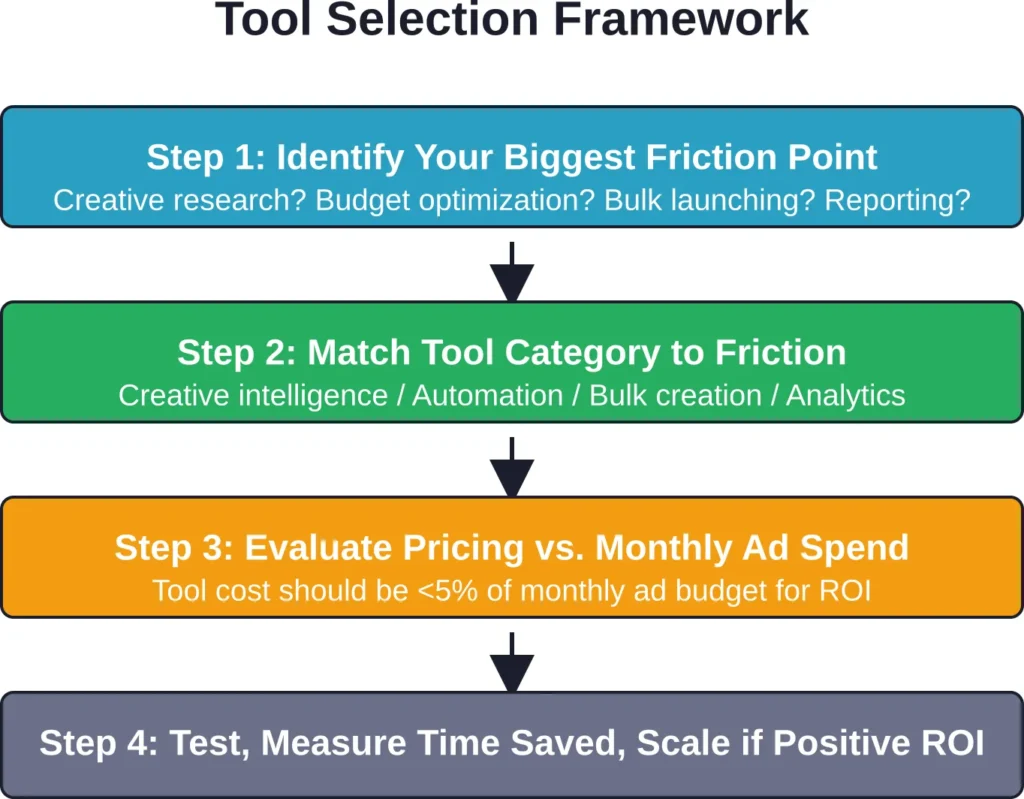
Start With the Bottleneck
Where does campaign management actually break down? If creative testing is the constraint—not enough variations, unclear which formats work—then creative intelligence and generation tools (adlibrary, AdCreative.ai, Canva) solve the right problem.
If manual budget reallocation consumes hours daily, automation platforms (Revealbot, Madgicx) deliver immediate time savings. If launching campaigns for multiple clients requires repetitive manual work, bulk creation tools (Qwaya) eliminate that friction.
Tools can’t fix structural problems. An automation platform won’t improve creative that doesn’t resonate. Creative intelligence won’t help if budget allocation is mismanaged. Match tool category to actual bottleneck.
Evaluate Pricing Against Monthly Ad Spend
A general rule: optimization tool costs should stay under 5% of monthly ad spend for positive ROI. Spending $99 monthly on Revealbot makes sense when managing $5,000+ in ad spend. At $500 monthly spend, the tool cost represents 20% overhead—too expensive unless time savings justify that ratio.
Free trials are standard across most platforms. Test tools with real campaigns for 7-14 days, measuring time saved and performance lift. If optimization doesn’t improve metrics or reduce workload measurably, cancel before the paid period starts.
Consider Stack Integration
Most advertisers use multiple tools. Creative research happens in adlibrary, campaign building in Meta Ads Manager, ongoing optimization in Revealbot, and reporting in Hootsuite. The tools don’t need to do everything—they need to integrate cleanly without duplicating costs.
Check whether platforms offer API connections or native integrations with existing workflow tools. Data exports, webhook support, and Zapier connections expand how tools fit into broader marketing stacks.
Match Control Preference to Tool Philosophy
Some platforms offer full autonomous control (Madgicx), others provide recommendations requiring manual approval (AdStellar), and some execute only predefined rules (Revealbot). Media buyers who want hands-on control should avoid fully autonomous systems. Teams preferring set-it-and-forget-it management should embrace AI-driven platforms.
There’s no universally correct approach—it’s about matching personal management style with tool philosophy.
| Tool Type | Primary Use Case | Typical Price Range | Best Ad Spend Tier |
|---|---|---|---|
| Creative Intelligence | Research competitor ads, format benchmarks | $49-99/month | All spend levels (research ROI compounds) |
| Automation Platforms | Budget shifting, bid optimization, auto-pausing | $44-499/month | $5,000+ monthly ad spend |
| Bulk Creation | Launching 20+ campaign variations quickly | $149+/month | Agencies, multi-client accounts |
| Unified Analytics | Cross-channel reporting, team collaboration | Varies widely | Enterprise, large teams |
Emerging Trends in Instagram Ads Optimization
The tool landscape continues evolving as Meta releases new ad formats, targeting capabilities, and API features. Several trends are reshaping how advertisers approach Instagram optimization heading deeper into 2026.
Predictive Performance Modeling
AI platforms increasingly predict campaign outcomes before budgets scale. Instead of testing with real spend to identify winners, predictive models analyze creative elements, audience characteristics, and historical patterns to forecast performance.
This shift reduces testing waste. Rather than splitting $1,000 across 10 ad sets to find 2 winners, predictive tools identify likely winners upfront, concentrating budget on high-probability performers.
According to a study published in the Journal of Interactive Marketing analyzing 961 Instagram posts from 71 fashion influencers, personality factors and authentic engagement patterns significantly impact ad performance—insights that newer AI tools attempt to quantify and predict.
Automated Creative Variation Generation
Manual creative production is the remaining bottleneck for many advertisers. Tools like AdCreative.ai and Pencil represent early attempts at automating design and video editing, but the next generation will integrate directly with automation platforms.
The workflow will become: define messaging strategy, let AI generate 50 creative variations, launch campaigns with automated budget optimization, and cycle out underperformers while generating new variations continuously—all without manual intervention beyond strategic oversight.
Conversions API and Server-Side Tracking
iOS privacy changes reduced pixel-based tracking accuracy, pushing advertisers toward Conversions API (CAPI) for server-side event tracking. Optimization tools are building deeper CAPI integrations, allowing platforms to access conversion data that bypasses browser restrictions.
Tools with robust CAPI support will optimize more accurately as third-party cookies disappear entirely. Advertisers should prioritize platforms that implement server-side tracking natively rather than relying solely on pixel data.
Common Mistakes When Using Instagram Ads Optimization Tools
Even powerful tools produce poor results when misused. Several patterns appear repeatedly across failed implementations.
Over-Automation Without Strategic Oversight
Setting automation rules or enabling AI optimization doesn’t eliminate the need for strategy. Tools execute tactics—advertisers still define target audiences, positioning, offers, and creative direction.
Campaigns fail when marketers assume tools replace strategic thinking. Automation amplifies good strategy and accelerates bad strategy equally.
Ignoring Creative Quality
Optimization tools can’t fix creative that doesn’t hook attention or communicate value clearly. Research examining Instagram marketing techniques found patterns in the effectiveness of different marketing approaches among college students, indicating that creative strategy matters more than optimization sophistication. Test fundamentally different creative approaches, not just minor variations of weak concepts.
Premature Scaling
Automation platforms make scaling easy—too easy. Doubling budgets before statistical significance is reached, or before understanding which audience segments actually convert profitably, burns money fast.
Establish clear performance benchmarks before enabling aggressive automation. Let campaigns run long enough to gather meaningful data, then scale winners systematically.
Tool Sprawl
Subscribing to five platforms that overlap 80% in functionality wastes budget and fragments data. Audit tool stacks regularly, cutting redundant subscriptions and consolidating around platforms that integrate cleanly.
Case Study: Stacking Tools for Maximum ROI
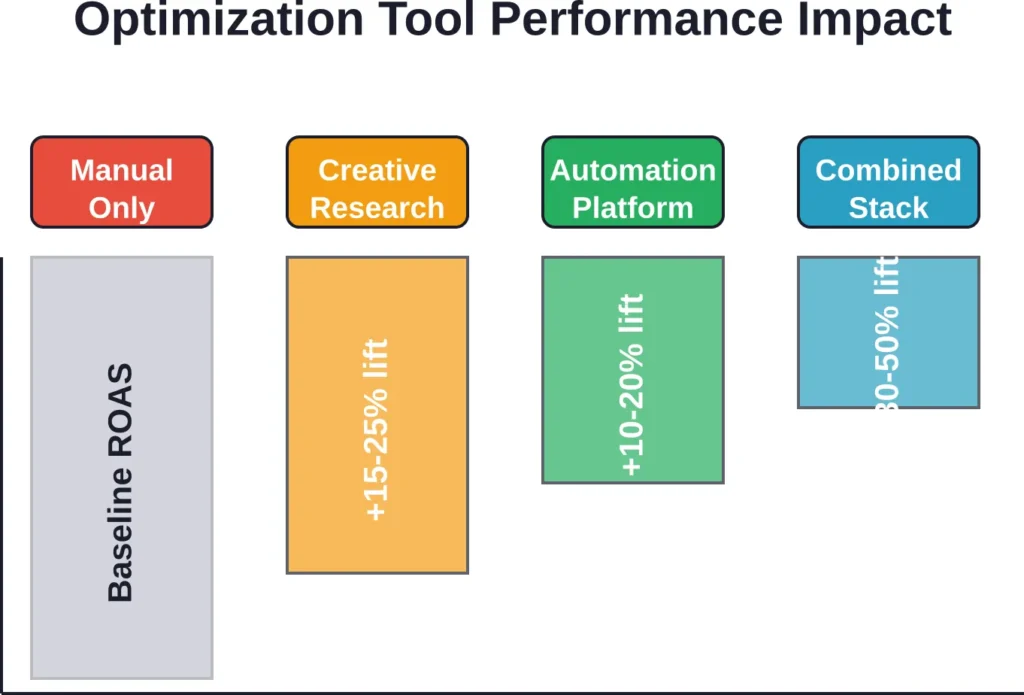
Consider a hypothetical e-commerce brand spending $15,000 monthly on Instagram ads. Manual management through Meta Ads Manager produces a baseline 3.2× ROAS. The team identifies two bottlenecks: creative testing is slow (launching only 3-4 variations monthly), and budget reallocation happens once weekly instead of continuously.
The solution stack:
- adlibrary subscription ($49/month): Research competitor creatives weekly, identifying winning formats and hooks before production.
- Canva Pro ($12.99/month): Rapid creative production using templates informed by adlibrary research, increasing testing volume to 12-15 variations monthly.
- Revealbot ($149/month tier): Automated rules pause underperformers when CPA exceeds target by 25%, scale winners when ROAS exceeds 4×, and reallocate budgets every 4 hours instead of weekly.
Total tool cost: $210.99 monthly (1.4% of ad spend).
Results after 60 days: ROAS improved to 4.1× through faster creative iteration and continuous budget optimization. The 28% ROAS increase on $15,000 monthly spend generated approximately $4,200 additional monthly revenue. Tool ROI: roughly 20× after accounting for subscription costs.
The key was stacking complementary tools rather than subscribing to a single platform claiming to do everything. Creative research informed production; production fed testing volume; automation maximized testing efficiency.
Frequently Asked Questions
Meta Ads Manager itself is the best starting point. Learn native features—Advantage+ campaigns, dynamic creative, automated rules—before adding third-party tools. Once monthly ad spend exceeds $3,000-5,000 and manual management becomes time-prohibitive, consider adding creative intelligence tools like adlibrary (for research) or automation platforms like Revealbot (for rule-based optimization). Start with one tool addressing the biggest bottleneck rather than multiple platforms simultaneously.
A general guideline: keep tool costs under 5% of monthly ad spend. At $2,000 monthly spend, a $100/month tool represents 5% overhead—justifiable if time savings or performance lift exceeds that cost. At $20,000 monthly spend, budgeting $500-1,000 for optimization tools (2.5-5%) allows stacking multiple platforms. If tool costs exceed 10% of ad spend, ROI becomes difficult unless performance improvements are dramatic.
No. Instagram ads run through Meta’s advertising infrastructure, meaning tools that optimize Facebook campaigns automatically work for Instagram. Platforms like Revealbot, Madgicx, and Qwaya manage both channels through the same Meta Marketing API connection. Creative intelligence tools like adlibrary index ads across Meta’s network, including both Instagram and Facebook placements. The tool selection should be based on feature needs, not platform separation.
Automation handles tactical execution—budget adjustments, bid optimization, performance monitoring—but doesn’t replace strategic decisions around positioning, offer development, audience research, and creative direction. Tools amplify good strategy and accelerate testing cycles, reducing manual workload by 50-70% for experienced media buyers. For beginners, tools can codify best practices through templates and recommended rules, but understanding foundational advertising principles remains essential for long-term success.
Rule-based platforms (like Revealbot) execute predefined if/then logic: if CPA exceeds $50, then pause ad set. Advertisers define conditions and actions explicitly. AI-driven platforms (like Madgicx) use machine learning to identify patterns and make autonomous decisions without predefined rules. Rule-based systems offer more control and transparency; AI-driven systems potentially discover optimization patterns humans miss but operate as black boxes. The best choice depends on management style—hands-on control versus hands-off delegation.
Yes. Creative intelligence tools like adlibrary don’t replace designers—they inform what to design. Researching which ad formats, hooks, and visual patterns perform in specific niches gives designers data-driven direction rather than starting from blank canvases. Designers create better work faster when informed by competitive intelligence. Think of creative research tools as strategic inputs that improve design briefs, not substitutes for creative talent.
Establish baseline metrics before implementing tools: current ROAS, CPA, time spent on manual management weekly, and creative testing velocity. Run the tool for 30-60 days, then compare: Did ROAS improve by more than the tool cost percentage? Did time saved justify subscription cost (calculate hours saved × hourly rate)? Did testing volume increase measurably? If at least two of three metrics improve significantly, the tool delivers positive ROI. If none improve after 60 days of proper implementation, cancel and try a different approach.
Bottom Line: Match Tools to Campaign Reality
Instagram ads optimization tools won’t fix broken fundamentals—weak offers, poor creative, or mismatched audiences. But for advertisers already running profitable campaigns, the right tools compound results by automating repetitive decisions, surfacing hidden patterns, and accelerating testing velocity.
The tool selection process starts with honest assessment: Where does campaign management actually break down? Creative research? Budget optimization? Bulk testing? Reporting? Match tool category to that friction point, evaluate pricing against monthly ad spend (aim for under 5% of budget), and test with free trials before committing to annual plans.
Most advanced advertisers stack multiple tools—creative intelligence for research, automation for execution, analytics for reporting—rather than expecting single platforms to excel at everything. Start with one tool addressing the biggest bottleneck, measure ROI after 60 days, then expand the stack incrementally as budgets scale.
The Instagram ads landscape becomes more competitive every quarter. Manual management leaves money on the table. Optimization tools level the playing field, giving smaller teams access to automation and intelligence previously available only to agencies with massive budgets.
Pick the tools that match where friction actually lives. Test systematically. Scale what works. That’s the path to sustainable Instagram ad performance in 2026.
Ready to optimize Instagram ad campaigns more efficiently? Start by auditing current bottlenecks, then trial one tool from the appropriate category. Track time saved and performance lift for 30 days. If ROI is positive, expand the stack. If not, pivot to a different tool or approach. Optimization is iterative—the first tool won’t always be the final stack.