

Quick Summary: Facebook Lead Ads testing tools help marketers validate creative, form design, and audience targeting before spending budget on live campaigns. The best tools in 2026 combine AI-powered predictive analytics with automated split testing to identify winning ad variations faster. Top platforms include Extuitive for AI validation, AdEspresso for automated A/B testing, and Motion for creative performance analysis, with pricing ranging from free tiers to enterprise solutions starting at $800/mo.
Facebook Lead Ads can drain budgets fast when campaigns launch with untested creative and unvalidated form designs. The difference between a 2% and a 12% conversion rate often comes down to one thing: testing before you spend.
But manual A/B testing inside Meta Ads Manager is slow and limited. It buries insights in spreadsheets and forces marketers to wait weeks for statistically significant results.
The right testing tool changes that equation. It automates validation, predicts winning creative, and scales high-performing campaigns faster.
Here’s a breakdown of the best Facebook Lead Ads testing tools available in 2026, ranked by use case, features, and pricing.
Why Testing Facebook Lead Ads Matters in 2026
Facebook generated nearly $40 billion in ad revenue during Q3 2024 alone. That massive scale means competition for attention is fierce.
Lead Ads work differently than standard traffic campaigns. They capture contact information directly inside Facebook without sending users to a landing page. Form design, headline copy, and creative quality all impact lead volume and quality simultaneously.
Testing helps identify which combinations drive the highest quality leads at the lowest cost per acquisition. According to Unbounce’s Conversion Benchmark Report, the median conversion rate across all industries is 6.6%. The best-performing campaigns often exceed that benchmark by 3-5x through rigorous testing.
Marketing leaders understand this. According to the 2025 Sprout Social Index™, 97% of marketing leaders say AI proficiency is vital for proper job performance.
What to Look for in a Lead Ads Testing Tool
Not all testing platforms are built for Lead Ads specifically. The best tools offer features tailored to the unique mechanics of lead generation campaigns.
Pre-Launch Creative Validation
The ability to predict performance before spending a dime separates modern tools from legacy A/B testing platforms. AI-powered systems analyze creative assets against historical performance data to forecast winners.
This cuts the time and budget wasted on low-performing variants.
Automated Split Testing
Manual split testing requires constant monitoring and manual adjustments. Automation handles variant rotation, budget allocation, and statistical significance calculations without human intervention.
Look for tools that support multivariate testing across headlines, images, form fields, and audience segments simultaneously.
Form Field Optimization
Lead quality depends heavily on form design. Tools that test different field combinations—name only vs. name + email + phone—reveal which configurations maximize both volume and quality.
Some platforms integrate directly with CRMs to track lead quality post-conversion, closing the loop between ad spend and revenue.
Audience Targeting Insights
Testing creative is only half the equation. The best tools also analyze audience performance, identifying which demographics, interests, and behaviors deliver the highest ROI.
Real-time data feeds show when audience fatigue sets in, signaling when to refresh creative or expand targeting.
Integration with Meta and CRM Platforms
Seamless integration with Meta Ads Manager, HubSpot, Salesforce, and other CRMs ensures data flows smoothly from lead capture to nurture to close.
Check integration documentation before committing to a platform.
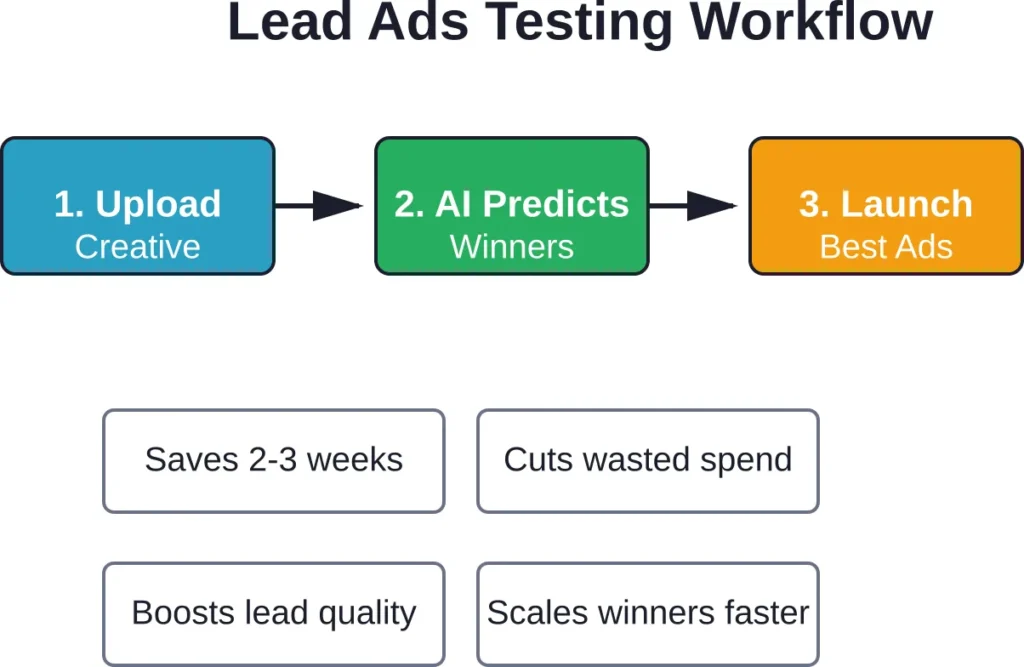
Modern lead ads testing workflow with AI-powered validation
Top Facebook Lead Ads Testing Tools in 2026
The tools below are ranked by specialization and use case. Some excel at creative testing, others at form optimization, and a few cover the full funnel.
1. Extuitive
Extuitive positions itself as a predictive AI platform specifically built for Facebook Lead Ads. It analyzes creative assets before launch and assigns each variant a probability score.
This tool shines for teams that want to eliminate guesswork entirely. Upload creative, get predictions, launch only the winners.
Key Features:
- AI-powered creative scoring and validation
- Pre-launch performance forecasting
- Automated winner selection and launch
- Integration with Meta Ads Manager
- Lead quality tracking post-conversion
Best For: Performance marketers managing high-volume lead gen campaigns who need fast validation without manual split testing.
Pricing: Contact for custom pricing based on ad spend and volume.
Contact Information:
- Website: extuitive.com
- Email: [email protected]
- LinkedIn: www.linkedin.com/company/extuitive
- Twitter: x.com/Extuitive_Inc
- Instagram: www.instagram.com/extuitiveinc
2. AdEspresso

AdEspresso has been a staple in Facebook ad testing for years. It automates split testing across creative, audiences, and placements with minimal setup.
The platform simplifies campaign management for teams without dedicated ad ops staff. Create variants, set rules, and let the tool optimize automatically.
Key Features:
- Automated A/B and multivariate testing
- Visual campaign builder with drag-and-drop interface
- Performance analytics and reporting dashboard
- Split testing for audiences, creative, and copy
- Integration with Facebook, Instagram, and Google Ads
Best For: Small to mid-sized teams that need automated testing without hiring a full ads team.
Pricing: Starts at $49/month.
3. Motion

Motion focuses on creative performance analysis and ad reporting. It aggregates data from Meta Ads Manager and presents insights in customizable dashboards.
This tool is built for teams that already run tests inside Meta but want better visibility into what’s working and why.
Key Features:
- Creative performance tracking and tagging
- Custom reporting dashboards
- Ad creative library and version control
- Performance alerts and anomaly detection
- Team collaboration and annotation tools
Best For: Marketing teams and agencies managing multiple clients or brands that need centralized reporting and creative performance insights.
Pricing: Check the official website for current pricing—plans vary by team size and feature access.
4. AdStellar AI

AdStellar combines creative testing with AI-driven optimization. It automates the heavy lifting of variant creation and performance monitoring.
The platform is particularly strong for teams without dedicated designers who still need high-volume creative testing.
Key Features:
- AI-generated creative variants
- Automated split testing and budget allocation
- Performance prediction algorithms
- Integration with major ad platforms
- Creative fatigue detection
Best For: Growth teams that want to test more creative faster without hiring designers or agencies.
Pricing: Hobby at $49/month, Pro at $129/month, and Ultra at $499/month. A 7-day free trial is available on all plans.
5. Madgicx
Madgicx offers end-to-end Facebook ad management with built-in AI optimization. It handles audience targeting, creative testing, and budget allocation autonomously.
This tool works well for teams that want a full-stack solution rather than a single-purpose testing platform.
Key Features:
- AI-powered audience targeting and segmentation
- Automated creative testing and optimization
- Budget management and bid optimization
- Cross-channel campaign tracking
- Performance forecasting and scenario modeling
Best For: E-commerce brands and agencies managing complex multi-channel campaigns that need full automation.
Pricing: Contact for pricing—tiers scale based on ad spend and feature requirements.
6. HubSpot Ads Software
HubSpot Ads Software integrates Facebook Lead Ads directly into HubSpot CRM, enabling closed-loop tracking from ad click to customer.
This tool is ideal for B2B marketers who need lead quality data, not just lead volume.
Key Features:
- Native Facebook Lead Ads integration
- CRM-based audience targeting and retargeting
- Lead quality tracking and attribution reporting
- Automated lead nurturing workflows
- ROI reporting tied to revenue
Best For: B2B marketing teams using HubSpot CRM who want to track lead quality and revenue attribution.
Pricing: Free plan available. Paid plans start at $45/mo for Starter, $800/mo for Professional, and $3,200/mo for Enterprise.
7. Creatopy

Creatopy specializes in ad creative design and testing. It offers templates, design automation, and variant generation for teams that need to produce high volumes of creative quickly.
This tool is particularly useful for teams testing different visual styles, formats, and messaging angles.
Key Features:
- Ad design templates for Facebook Lead Ads
- Automated creative variant generation
- Design collaboration and approval workflows
- Multivariate creative testing
- Integration with Meta Ads Manager
Best For: Teams without dedicated designers who need to create and test multiple ad variants fast.
Pricing: Check the official site for current plans—pricing varies by team size and design volume.
8. Qwaya
Qwaya is a Facebook ad management platform with built-in A/B testing and scheduling. It simplifies campaign creation and offers granular control over ad delivery.
The platform is best suited for teams that want more control than Meta Ads Manager offers but don’t need full AI automation.
Key Features:
- Advanced A/B testing for creative and audiences
- Bulk campaign creation and editing
- Scheduling and dayparting controls
- Custom reporting and analytics
- Collaboration tools for team workflows
Best For: Small agencies and in-house teams managing multiple Facebook campaigns who need better workflow tools.
Pricing: Starts at $149/mo as of 2025.
9. Meta’s Native Lead Ads Testing Tool
Facebook offers a native testing tool for Lead Ads directly through the Ads Manager interface. It allows marketers to preview forms and generate test leads without running live campaigns.
This tool is free and accessible to anyone with a Facebook Business account. Use it to validate form functionality before launch.
Key Features:
- Form preview and test lead generation
- Instant form functionality validation
- No cost—built into Ads Manager
- Basic A/B testing for creative and audiences
Best For: Marketers who want to test form functionality and basic creative variants without paying for third-party tools.
Pricing: Free.
Access the tool directly at https://developers.facebook.com/tools/lead-ads-testing to create sample leads and test form integrations.
10. Optimizely Data Platform (ODP)

Optimizely integrates Facebook Lead Ads into its customer data platform, enabling audience segmentation and omnichannel targeting.
This tool is built for enterprise marketers who need to sync Facebook leads with broader customer data and orchestrate multi-touch campaigns.
Key Features:
- Facebook Lead Ads integration with ODP
- Audience sync and segmentation
- Omnichannel campaign orchestration
- Lead scoring and quality tracking
- Integration with email, SMS, and other channels
Best For: Enterprise marketing teams running complex, multi-channel lead nurture programs.
Pricing: Contact Optimizely for custom enterprise pricing.
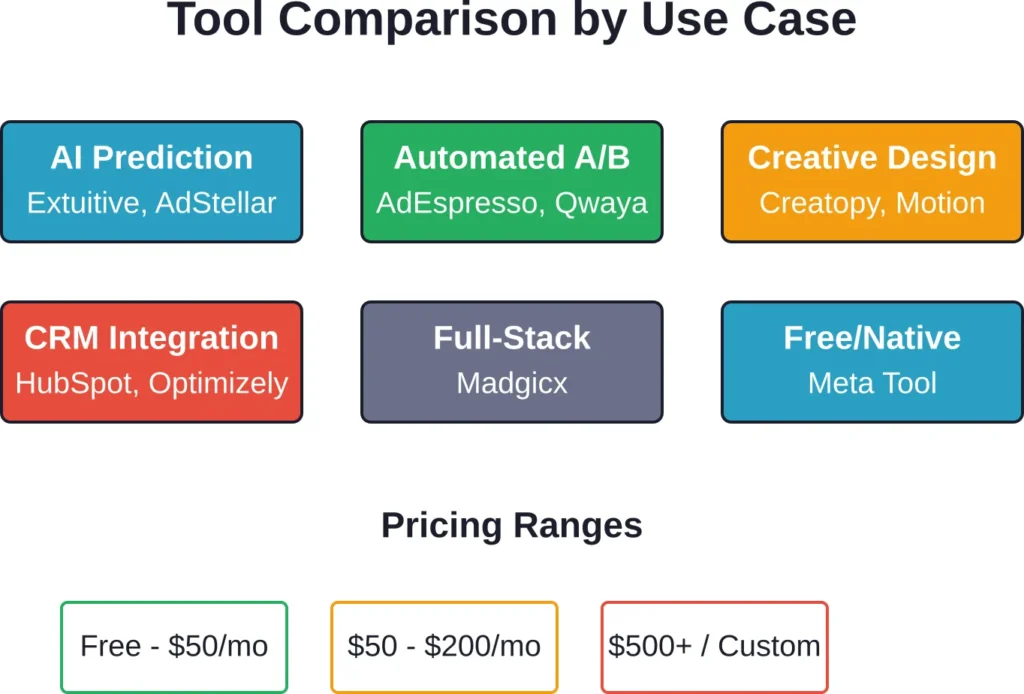
Tools categorized by primary use case and pricing tier
How to Choose the Right Testing Tool for Your Team
Selecting the right platform depends on team size, budget, technical capability, and campaign complexity.
For Small Teams with Limited Budgets
Start with Meta’s native testing tool and AdEspresso. Both offer low-cost or free options that cover the basics of creative and audience testing.
As campaigns scale, upgrade to tools with AI prediction or automated optimization.
For Mid-Sized Teams Scaling Lead Volume
Consider platforms like Extuitive or AdStellar that offer AI-powered validation. These tools cut weeks off the testing cycle and reduce wasted spend significantly.
Integration with CRMs becomes critical at this stage—choose tools that sync with HubSpot, Salesforce, or your existing marketing stack.
For Agencies Managing Multiple Clients
Motion and Qwaya shine here. Both offer multi-account management, custom reporting, and collaboration features that simplify client communication.
Look for platforms with white-label reporting and client-facing dashboards.
For Enterprise Teams with Complex Funnels
Enterprise teams benefit from full-stack solutions like Madgicx or Optimizely that integrate Lead Ads testing with broader customer data platforms and omnichannel orchestration.
Custom pricing and dedicated support become non-negotiable at this level.
Common Mistakes When Testing Facebook Lead Ads
Even with the best tools, poor testing methodology wastes budget and skews results.
Testing Too Many Variables at Once
Multivariate testing sounds appealing but requires massive sample sizes to reach statistical significance. Test one variable at a time—creative, then headline, then form fields—to isolate performance drivers.
Ignoring Lead Quality Metrics
High lead volume means nothing if leads don’t convert to customers. Track cost per qualified lead, not just cost per lead.
Integrate testing tools with CRMs to measure lead-to-customer conversion rates by ad variant.
Stopping Tests Too Early
Statistical significance requires adequate sample size. Stopping a test after 50 conversions may feel decisive but often leads to false positives.
Most platforms calculate significance automatically—trust the data, not gut instinct.
Neglecting Mobile Optimization
Most Facebook users access the platform on mobile devices. Creative and form fields that work on desktop often fail on small screens.
Preview every variant on mobile before launch.
Case Study: Real Results from Lead Ads Testing
Data from Sprout Social highlights the impact of strategic testing and optimization. One organization implementing AI-powered social media tools achieved a 101% growth in video views, a 79% increase in impressions, and a 63% boost in engagements on Facebook and Instagram.
Organizations implementing strategic testing and optimization report significant growth in audience reach and video performance.
Integrating Testing Tools into Your Workflow
The best tools deliver value only when integrated properly into existing workflows.
Step 1: Audit Current Performance
Before selecting a tool, analyze current campaign performance. Identify bottlenecks—low lead volume, high cost per lead, poor lead quality—and choose tools that address those specific gaps.
Step 2: Set Clear Testing Goals
Define what success looks like. Are you optimizing for lead volume, lead quality, cost per lead, or all three? Clear goals shape tool selection and testing methodology.
Step 3: Start Small and Scale
Test one campaign or ad set first. Validate that the tool integrates smoothly with Meta Ads Manager and your CRM before rolling it out across all campaigns.
Step 4: Track Results and Iterate
Monitor performance weekly. Identify which variants win consistently and why. Use those insights to inform future creative briefs and targeting strategies.
| Tool | Best Use Case | Starting Price | Key Strength |
|---|---|---|---|
| Extuitive | AI-powered prediction | Custom | Pre-launch winner validation |
| AdEspresso | Automated A/B testing | $49/mo | Easy setup, multi-platform |
| Motion | Creative performance tracking | Varies | Centralized reporting |
| AdStellar AI | AI creative generation | $49/mo | High-volume variant testing |
| HubSpot Ads | CRM integration | Free / $45/mo | Lead quality tracking |
| Meta Native Tool | Basic form testing | Free | No cost, built-in |
Trends Shaping Lead Ads Testing in 2026
AI adoption is accelerating. According to the 2025 Sprout Social Index™, 97% of marketing leaders say AI proficiency is vital for job performance.
This shift means testing tools are moving from manual split testing to predictive analytics and autonomous optimization. Platforms that fail to integrate AI risk obsolescence.
Privacy and Data Regulations
Data privacy laws continue to evolve. Tools that offer first-party data integration and respect user consent will gain market share as third-party tracking becomes less reliable.
Cross-Platform Testing
Marketers are testing Facebook Lead Ads alongside Instagram, LinkedIn, and TikTok lead gen formats. Tools that support cross-platform testing and unified reporting will dominate.
Real-Time Optimization
Static A/B tests are giving way to real-time dynamic optimization. AI-powered tools adjust creative, audiences, and bids automatically based on live performance data.
Frequently Asked Questions
Meta’s native Lead Ads Testing Tool is the best free option. It’s built into Ads Manager and allows marketers to preview forms and generate test leads without running live campaigns. Access it at https://developers.facebook.com/tools/lead-ads-testing to validate form functionality before launch.
Tests should run until they reach statistical significance, typically requiring at least 100-200 conversions per variant. Most testing tools calculate significance automatically. Stopping tests too early often leads to false conclusions. Let the data accumulate for at least 7-14 days for reliable results.
Yes. AI-powered tools like Extuitive and AdStellar predict creative performance before launch using historical data and machine learning models. These platforms assign probability scores to each variant, allowing marketers to launch only the highest-scoring creative. This approach cuts wasted spend on underperforming ads.
A/B testing compares two variants (e.g., two different images) while holding all other variables constant. Multivariate testing changes multiple variables simultaneously (image, headline, and form fields) to identify the best combination. Multivariate tests require larger sample sizes but reveal interactions between variables that A/B tests miss.
Integrate testing tools with CRM platforms like HubSpot, Salesforce, or Optimizely. Track metrics like lead-to-opportunity conversion rate, cost per qualified lead, and customer acquisition cost by ad variant. Tools like HubSpot Ads Software offer native Facebook Lead Ads integration with closed-loop reporting tied to revenue.
Meta Ads Manager offers basic A/B testing for creative and audiences, but lacks advanced features like AI prediction, automated optimization, and CRM integration. For simple tests, Ads Manager suffices. For high-volume campaigns or teams needing faster validation, dedicated tools like AdEspresso or Extuitive deliver better ROI.
Focus on cost per lead, lead quality score, form completion rate, and lead-to-customer conversion rate. Volume alone is misleading—high lead counts with low conversion rates waste budget. Track post-conversion metrics in your CRM to identify which ad variants deliver the highest lifetime value customers.
Final Thoughts
Facebook Lead Ads remain one of the most efficient ways to capture contact information at scale. But efficiency depends on testing.
The right tool accelerates the testing cycle, predicts winners before spending, and scales high-performing campaigns faster. Whether that’s Meta’s free native tool, AdEspresso’s automated split testing, or Extuitive’s AI-powered validation depends on team size, budget, and campaign complexity.
Start with clear goals, choose tools that address specific bottlenecks, and integrate them into existing workflows. Track lead quality, not just volume, and let statistical significance guide decisions.
Testing isn’t optional in 2026. It’s the difference between campaigns that drain budgets and campaigns that scale profitably.
Ready to cut wasted spend and launch winning Lead Ads faster? Evaluate the tools above, run a pilot test, and measure the impact. The data will speak for itself.