

Quick Summary: AI content marketing tools help businesses automate content creation, optimize SEO, and scale their marketing efforts efficiently. The best tools in 2026 include Extuitive, Semrush Content Toolkit for SEO optimization, ChatGPT for versatile writing tasks, Canva for visual content, and Jasper for brand-safe team collaboration. Selection depends on specific needs like content type, budget, team size, and integration requirements.
Content marketing teams are drowning in work. Blog posts, social media updates, video scripts, email campaigns—the list never ends. That’s where AI content marketing tools come in.
These tools don’t just speed things up. They fundamentally change how marketing teams operate. According to data from arxiv.org, ChatGPT infrastructure runs on more than 30,000 Nvidia A100 GPUs and handles 13 million independent visitors per day, showing just how massive the adoption of AI tools has become.
This guide breaks down the best AI content marketing tools available in 2026. Not every tool on the market—just the ones that actually move the needle for content teams.
What Are AI Content Marketing Tools?
AI content marketing tools use artificial intelligence to automate and enhance content creation, optimization, and distribution. They leverage machine learning models to generate text, images, videos, and other content formats.
The technology behind these tools has evolved rapidly. GPT-3, one of the foundational models, contains 175 billion parameters and required 3.2 million core hours for pre-training, according to research published on arxiv.org. The scale is staggering—the daily electricity charge is around $50,000.
But here’s what matters for marketing teams: these tools handle repetitive tasks, suggest improvements, and help scale content production without proportionally scaling headcount.
Categories of AI Marketing Tools
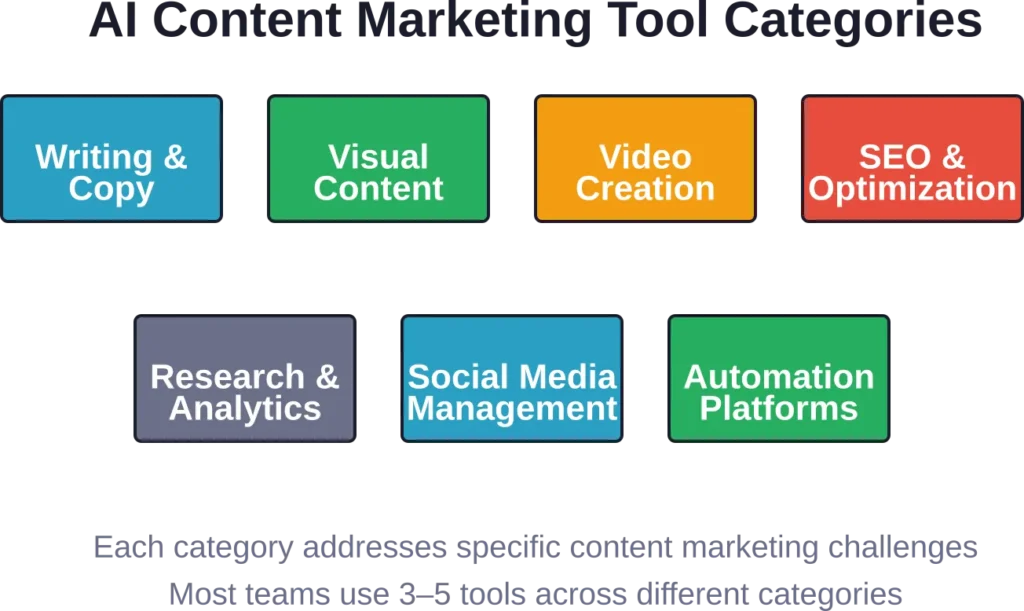
AI content marketing tools fall into several distinct categories:
- Writing and copywriting tools generate blog posts, ad copy, product descriptions, and social media content
- Visual content creators produce images, graphics, and design assets
- Video generation platforms create and edit video content with minimal manual work
- SEO optimization tools analyze search performance and optimize content for rankings
- Research and analytics platforms gather insights and track content performance
- Social media management tools schedule, create, and optimize social content
Each category solves specific problems. The right mix depends on team size, content volume, and marketing goals.
Best AI Content Writing and Copywriting Tools
Writing tools are the backbone of AI-powered content marketing. They handle everything from blog posts to email campaigns.
Extuitive
Extuitive is an AI-powered platform specializing in predictive creative generation and validation for e-commerce advertising, particularly for Shopify stores. It helps brands create, test, and launch high-converting ads before spending a single dollar on traffic.
The platform uses AI consumer agents that simulate the behavior of over 150,000 real consumers combined with its proprietary Polyintelligence engine. It accurately predicts CTR, ROAS, and overall creative performance.
Pricing is positioned for growing and scaling businesses: Starter plan starts at $1,000/month, Professional at $2,500/month, and Enterprise offers custom pricing with annual discounts available.
What makes Extuitive powerful is its predictive validation system. It automatically analyzes your store, generates copy, images, and video creatives, tests multiple angles and messaging on AI audiences, ranks them by predicted performance, and delivers clear recommendations on what to launch. This removes guesswork from advertising and dramatically reduces the cost of creative testing — especially valuable for Shopify merchants running Meta, TikTok, or Google ads.
Contact Information:
- Website: extuitive.com
- Email: [email protected]
- LinkedIn: www.linkedin.com/company/extuitive
- Twitter: x.com/Extuitive_Inc
- Instagram: www.instagram.com/extuitiveinc
ChatGPT

ChatGPT remains the most versatile AI writing tool available. OpenAI’s chatbot handles general-purpose writing tasks across virtually any format or topic.
The tool operates on multiple pricing tiers. The Plus plan costs $20/month, while the Pro plan runs $200/month. Business pricing starts at $30/user/month, with Enterprise options available at custom pricing.
What makes ChatGPT powerful is its flexibility. Marketing teams use it for brainstorming, drafting, editing, and repurposing content. The conversational interface means minimal learning curve.
That said, ChatGPT outputs often need refinement. Brand voice consistency requires careful prompting, and fact-checking remains essential.
Jasper

Jasper focuses specifically on marketing content. According to G2 research, Jasper is recognized as best for brand-safe AI writing and team collaboration.
The platform includes templates for common marketing formats: blog posts, social media captions, product descriptions, ad copy, and email campaigns. Teams can create custom brand profiles to maintain consistent voice and messaging.
Jasper integrates with content management systems and includes collaboration features for marketing teams. Pricing varies based on team size and usage—check Jasper’s official website for current plans.
Grammarly

Grammarly isn’t just a grammar checker anymore. The tool now includes AI writing assistance that helps produce clear, error-free content.
The Pro plan costs $30/member/month, with Enterprise options at custom pricing. Grammarly works across web browsers, desktop applications, and mobile devices.
Marketing teams use Grammarly to polish AI-generated content, ensure brand consistency, and catch errors before publication. The tone detector helps adjust writing for different audiences and contexts.
Semrush Content Toolkit

Semrush combines AI writing with SEO optimization. The Content Toolkit helps organizations publish search engine-optimized content.
Base pricing starts at $60/month, with options to purchase additional SEO-boosted articles for $30 per 10 articles. The platform analyzes top-ranking content and provides recommendations for improving search visibility.
Real talk: this is one of the few tools that directly connects content creation with search performance. Marketing teams focused on organic traffic should prioritize Semrush.
Creaitor

According to G2 research, Creaitor excels for lean teams scaling written content fast. The platform focuses on speed and efficiency.
Marketing teams can access higher-tier plans with additional features and capacity.
The tool generates multiple content variations quickly, making it useful for A/B testing and high-volume content production.
Visual Content Creation Tools
Visual content drives engagement. These AI tools help marketing teams create professional graphics without design expertise.
Canva
Canva dominates visual content creation. G2 identifies Canva as the best tool for collaborative, all-in-one visual content creation.
The platform costs $15.00/month (starting price) and includes AI-powered templates, brand kits, and real-time team collaboration. Teams can design social posts, presentations, infographics, and videos.
Canva’s AI features now include Magic Design, which generates complete design sets from simple prompts. Background removal, image enhancement, and smart resizing save hours of manual work.
The collaborative features matter more than most teams realize. Multiple team members can edit simultaneously, comment on designs, and maintain brand consistency through shared templates and assets.
DALL·E 3

DALL·E 3 generates images from text descriptions. Marketing teams use it for custom illustrations, concept art, and unique visual assets.
The tool integrates with ChatGPT Plus, making it accessible for teams already using OpenAI products. Automation possibilities exist too—DALL·E can connect to platforms like Zapier to automatically generate images from form submissions or database entries.
Image quality has improved significantly. DALL·E 3 produces more accurate, detailed visuals compared to earlier versions. But check usage rights carefully—commercial use has specific terms.
Adobe Photoshop (AI Features)

Adobe added extensive AI capabilities to Photoshop. The Generative Fill feature lets users add, remove, or modify image elements with text prompts.
This isn’t a replacement for traditional design skills—it’s a productivity multiplier. Professional designers use AI features to handle tedious tasks while focusing creative energy on concept and strategy.
Pricing follows Adobe’s Creative Cloud subscription model. Check Adobe’s official site for current plans and feature availability across different tiers.
Video Content Generation Tools
Video content takes time and resources. AI video tools dramatically reduce both.
Creatify AI

G2 data shows Creatify AI excels at effortless AI video content creation.
Marketing teams use Creatify to generate product videos, social media clips, and promotional content. The tool requires minimal video production knowledge.
AKOOL

AKOOL specializes in realistic AI avatar videos and creative storytelling.
The platform creates videos featuring AI-generated presenters. This works particularly well for explainer videos, product demonstrations, and educational content where on-camera talent would traditionally be required.
Runway

Runway offers high-quality AI video generation and editing. The platform includes text-to-video generation, background removal, motion tracking, and color grading.
Professional video creators use Runway alongside traditional editing software. The AI features handle specific tasks—removing objects from footage, extending clips, or generating transitions—while editors maintain creative control.
Pricing varies based on usage and plan tier. Check Runway’s official website for current subscription options.
Lumen5

Lumen5 transforms blog posts and text content into video format. Marketing teams use it to repurpose written content for social media platforms that prioritize video.
The tool analyzes text, suggests relevant stock footage, adds transitions, and generates captions. Teams can customize branding, music, and pacing.
This addresses a real problem: creating video versions of content without video production skills or budget.
SEO and Content Optimization Tools
Creating content is half the battle. Getting it found is the other half.
Semrush AI Visibility Toolkit
Semrush’s AI Visibility Toolkit is available as part of Semrush’s platform and monitors visibility across different AI platforms.
This matters because search behavior is shifting. ChatGPT and similar tools answer questions directly, changing how people discover content. The Visibility Toolkit helps marketers understand performance in this new landscape.
Hypotenuse AI

According to G2, Hypotenuse AI excels at creating SEO-ready blog articles. The platform generates content optimized for search engines while maintaining readability.
The tool analyzes top-ranking content, identifies optimization opportunities, and structures articles for both users and search algorithms.
Ranking Raccoon

Ranking Raccoon focuses on link building.
Link building remains critical for SEO success. Automating research and outreach saves time while maintaining personalization.
Social Media Management Tools
Social media content requires volume and consistency. AI tools help teams maintain both.
SOCi

SOCi specializes in multi-location social media management. G2 identifies it as best for this use case.
Businesses with multiple locations face unique challenges—maintaining brand consistency while allowing local customization. SOCi’s AI features generate location-specific content that aligns with brand guidelines.
Birdeye

Birdeye leverages AI for brand communication across channels. The platform manages reviews, social media, and customer messaging from a unified interface.
AI features include response suggestions, sentiment analysis, and automated follow-up. This helps marketing teams handle high volumes of customer interactions without sacrificing quality.
Research and Analytics Tools
Good content starts with good research. These tools accelerate the research process.
AI-Powered Competitive Analysis
Several platforms now offer AI-powered competitive analysis. These tools scan competitor content, identify gaps, and suggest topics worth covering.
The technology analyzes what competitors rank for, which keywords they target, and how their content performs. Marketing teams use this intelligence to find opportunities and avoid saturated topics.
Audience Intelligence Platforms
AI audience intelligence tools analyze customer data to identify preferences, behaviors, and trends. Marketing teams use these insights to create more relevant content.
The platforms aggregate data from multiple sources—social media, website analytics, customer feedback—and surface actionable patterns.
Marketing Automation and Workflow Tools
AI content marketing tools work better when connected. Automation platforms tie everything together.
Zapier for AI Marketing

Zapier connects different AI tools and automates workflows. Marketing teams use it to create multi-step processes without coding.
Examples include automatically generating images from form submissions, posting AI-generated content to social media on schedule, or triggering content creation based on customer actions.
The platform integrates with thousands of apps, making it possible to build custom marketing automation regardless of tech stack.
Gumloop

Gumloop specializes in AI-powered workflow automation for marketing tasks. The platform lets teams build custom automation flows using AI components.
Marketing teams can use Gumloop for sales, research, or admin tasks, and content workflows. The visual builder makes complex automation accessible to non-technical users.
How to Choose the Right AI Content Marketing Tools
Here’s the thing: not every tool fits every team. Selection depends on specific needs and constraints.
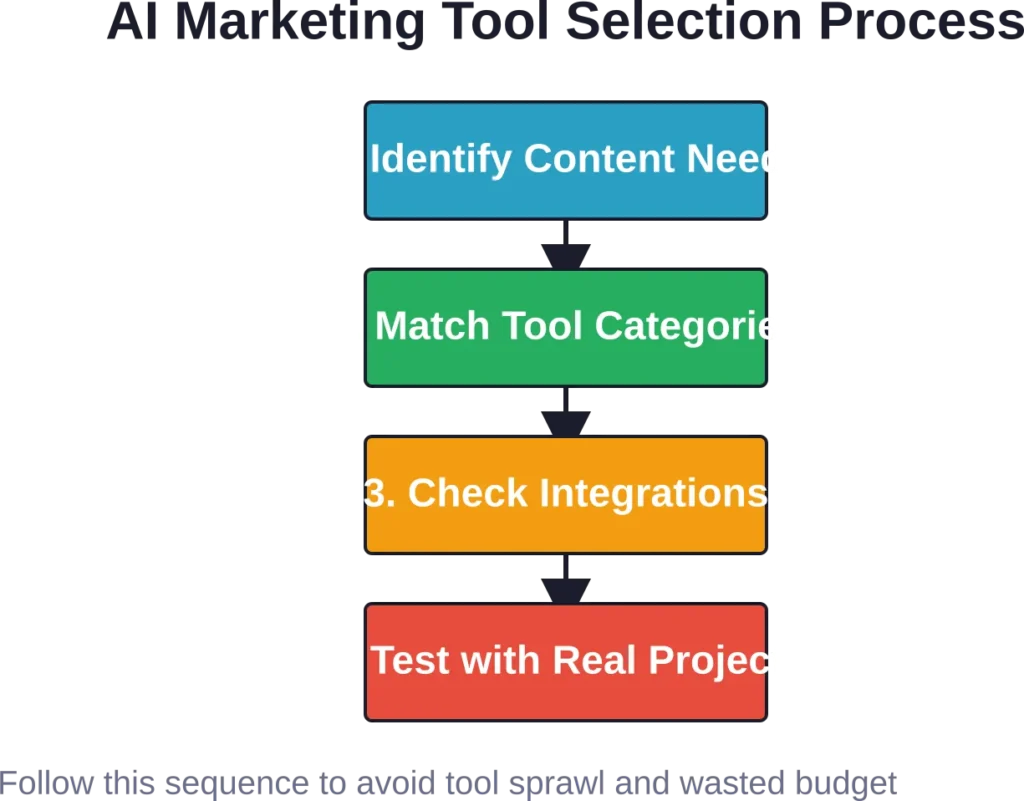
Assess Content Type Requirements
Start with what content the team produces most. A blog-focused team needs different tools than a video-first team.
| Content Type | Primary Tool Categories | Secondary Needs |
|---|---|---|
| Blog articles | Writing tools, SEO optimization | Research, visual assets |
| Social media | Visual creation, scheduling | Copywriting, analytics |
| Video content | Video generation, editing | Script writing, thumbnails |
| Email campaigns | Copywriting, personalization | Design, automation |
| Product content | Copywriting, image generation | SEO, batch processing |
Map current content production to these categories. Prioritize tools that address the highest-volume needs first.
Consider Team Size and Collaboration
Solo marketers need different features than enterprise teams. Small teams benefit from all-in-one platforms. Larger organizations often need specialized tools with robust collaboration features.
Look for features like shared workspaces, approval workflows, brand asset libraries, and user permissions when evaluating tools for teams.
Evaluate Integration Requirements
AI tools don’t exist in isolation. They need to connect with content management systems, social media platforms, analytics tools, and customer databases.
Check integration options before committing. Native integrations work better than workarounds. Platforms like Zapier help bridge gaps, but direct connections typically offer more functionality.
Budget Allocation Strategy
AI tool costs add up fast. A typical marketing team might spend $200-500 monthly on AI tools, with enterprise teams spending significantly more.
Prioritize spending on tools that directly impact revenue or efficiency. A $60/month SEO tool that drives organic traffic delivers better ROI than a $200/month tool that marginally improves workflow.
Trial Period Testing
Most platforms offer free trials. Use them strategically:
- Test with real projects, not hypothetical scenarios
- Involve the whole team in evaluation
- Measure specific metrics: time saved, content produced, quality improvements
- Document what works and what doesn’t
A two-week trial should reveal whether a tool fits the workflow or creates friction.
Common Pitfalls When Implementing AI Marketing Tools
Teams make predictable mistakes when adopting AI tools. Here’s what to avoid.
Tool Sprawl
The biggest mistake is accumulating too many tools. Each additional platform adds complexity, costs money, and requires training.
Aim for a focused toolkit. Three to five well-chosen tools typically cover most content marketing needs. More than that usually creates diminishing returns.
Skipping Training
AI tools require learning. Teams that skip training get mediocre results and blame the tools.
Invest time upfront. Learn prompting techniques, explore features, and establish best practices. The difference between basic and advanced usage is substantial.
Ignoring Brand Voice
AI-generated content defaults to generic. Without careful guidance, output lacks personality and doesn’t match brand voice.
Create clear brand guidelines. Document tone, vocabulary, style preferences, and examples. Train AI tools with this information—most platforms now support custom brand profiles.
Over-Automation
Automation is powerful. Too much automation removes human judgment and damages quality.
Keep humans in the loop for final review, strategic decisions, and quality control. AI should augment human creativity, not replace it entirely.
Neglecting Fact-Checking
AI models confidently generate incorrect information. Publishing unverified AI content creates accuracy problems and damages credibility.
Establish fact-checking workflows. Verify statistics, claims, and technical details before publication. This is non-negotiable for maintaining content quality.
AI Content Marketing in 2026: Current Trends
The AI marketing landscape continues evolving rapidly. Several trends are reshaping how teams use these tools.
Multimodal Content Generation
Tools increasingly handle multiple content formats from a single input. Describe an idea, and the platform generates text, images, video, and social media variants.
This reduces the friction between content formats and makes cross-channel campaigns more efficient.
Real-Time Personalization
AI tools now personalize content for individual users at scale. Email platforms generate unique subject lines for each recipient. Website tools adjust copy based on visitor behavior.
The technology analyzes user data and creates variants likely to resonate with specific segments or individuals.
AI-Native SEO
Search optimization is changing as AI-powered search engines gain market share. Tools adapt by optimizing content for traditional search engines and AI chatbots simultaneously.
This requires different approaches. AI search values conciseness and direct answers. Traditional SEO still rewards depth and comprehensiveness. Modern tools balance both.
Improved Brand Safety
Early AI tools struggled with brand safety. Content occasionally contained inappropriate language, incorrect facts, or off-brand messaging.
Newer platforms include better guardrails. They check outputs against brand guidelines, filter problematic content, and provide confidence scores for generated material.
Measuring ROI from AI Content Marketing Tools
Quantifying value from AI tools helps justify investment and identify underperforming platforms.
Time Savings Calculation
Track time spent on content tasks before and after AI implementation. Multiply saved hours by team member hourly rates to calculate direct cost savings.
Research suggests AI writing tools can reduce content creation time by 30-50% for routine formats. Visual tools show similar gains for design tasks.
Content Volume Metrics
Measure content output before and after tool adoption. AI should enable higher volume without proportionally increasing headcount.
But volume alone means nothing. Track quality metrics too—engagement rates, conversion rates, and audience feedback.
Revenue Attribution
Connect content performance to revenue. Track which AI-generated content drives conversions, leads, or sales.
This requires analytics integration. Tag AI-generated content differently in analytics platforms to isolate performance.
Quality Consistency
Monitor content quality over time. Good AI implementation should maintain or improve quality while increasing output.
Define quality metrics specific to content goals: readability scores, SEO metrics, engagement rates, conversion rates, or expert review scores.
| Metric Type | What to Measure | Target Improvement |
|---|---|---|
| Efficiency | Hours saved per content piece | 30-50% reduction |
| Volume | Content pieces published monthly | 50-100% increase |
| Quality | Engagement rate, conversion rate | Maintain or improve baseline |
| Revenue | Attributed conversions and sales | Positive ROI within 3-6 months |
| Cost | Tool costs vs. equivalent labor | 20-40% cost reduction |
Future Outlook for AI Content Marketing Tools
The technology continues advancing. Several developments will reshape AI content marketing in coming years.
Autonomous Content Campaigns
Tools are moving toward autonomous campaign management. Marketing teams will set objectives and guidelines while AI handles execution—topic selection, content creation, optimization, and distribution.
This doesn’t eliminate marketers. It shifts focus toward strategy, creative direction, and performance analysis.
Better Context Understanding
Current AI tools sometimes miss nuance and context. Next-generation models understand industry-specific terminology, cultural references, and subtle implications better.
This reduces editing time and increases the percentage of AI-generated content that’s publication-ready.
Tighter Integration Ecosystems
Expect more seamless integration between tools. Marketing platforms will embed AI capabilities directly rather than requiring separate tools.
This consolidation simplifies workflows but potentially reduces specialization. Teams will balance all-in-one convenience against best-of-breed specialized tools.
Regulatory Framework Development
According to NIST (National Institute of Standards and Technology), governments are developing AI risk management frameworks. These guidelines address transparency, accountability, and safety in AI systems.
Marketing tools will need to comply with emerging regulations around AI disclosure, data usage, and content attribution. Teams should monitor regulatory developments in their jurisdictions.
Building an Effective AI Content Marketing Stack
Here’s a practical approach to assembling a cohesive toolkit.
Core Foundation Tools
Start with these essential categories:
- One versatile writing tool (ChatGPT or similar) for general content generation
- One SEO platform (Semrush or equivalent) for optimization and research
- One visual tool (Canva or similar) for graphics and design
This foundation handles 70-80% of content marketing needs for most teams.
Specialized Additions
Add specialized tools based on specific needs:
- Video tool if video is a major content channel
- Social media management if running multi-platform campaigns
- Automation platform if integrating multiple systems
Only add tools that address clear gaps in current capabilities.
Integration Layer
Connect tools using automation platforms or native integrations. This creates workflows that span multiple tools without manual handoffs.
Example workflow: Keyword research tool identifies opportunity → Writing tool generates content → SEO tool optimizes → CMS publishes → Analytics tool tracks performance.
Regular Stack Audits
Review the toolkit quarterly. Remove underutilized tools, consolidate overlapping functions, and evaluate new options for significant gaps.
Tool needs change as teams grow and content strategies evolve. What worked for a five-person team might not fit a twenty-person team.
Frequently Asked Questions
No single tool fits every situation. For versatile writing, ChatGPT offers the best balance of capability and flexibility at $20/month. For SEO-focused content, Semrush Content Toolkit at $60/month directly connects creation with search performance. For visual content, Canva at $15.00/month (starting price) provides comprehensive design capabilities. The “best” tool depends on primary content type, team size, and specific needs.
Pricing varies significantly by tool and feature set. Individual tools range from $15-60/month for basic plans. ChatGPT Plus costs $20/month, Canva $15.00/month (starting price), and Semrush starts at $60/month. Video tools like Creatify AI and AKOOL fall in the $20-30 range. Enterprise teams typically spend $200-500+ monthly across multiple tools. Many platforms offer free trials to test before committing.
No. AI tools augment human creativity but don’t replace strategic thinking, brand expertise, or quality judgment. AI handles routine tasks, generates drafts, and accelerates production. Humans provide creative direction, ensure brand consistency, verify accuracy, and make strategic decisions. The most effective approach combines AI efficiency with human oversight and expertise. Teams that try to eliminate humans entirely produce lower-quality content that fails to resonate with audiences.
Create detailed brand guidelines documenting tone, vocabulary, style preferences, and examples. Many tools now support custom brand profiles—load these guidelines into the platform. Provide example content that exemplifies brand voice. Use consistent prompts that reinforce voice characteristics. Always review and edit AI outputs before publication. Over time, refine prompts based on which outputs best match brand voice. Tools like Jasper specifically focus on brand-safe content with team collaboration features for maintaining consistency.
Most teams see positive ROI within 3-6 months. Initial weeks involve learning and workflow adjustment—productivity may temporarily decrease. Month 2-3 typically shows efficiency gains as teams master tools. By month 3-6, increased content volume and reduced time investment deliver clear ROI. Calculate ROI by comparing tool costs against time saved (converted to labor cost) plus revenue from additional or improved content. Teams focusing on SEO may need 6-12 months to see full search traffic impact.
Absolutely. Small businesses often benefit most because AI tools provide capabilities previously requiring entire teams or agencies. A solo marketer can produce content volume comparable to a small team using AI writing, design, and video tools. Start with one or two core tools rather than a full stack. Focus on tools addressing the biggest time constraints. Many platforms offer affordable entry-level plans—ChatGPT at $20/month and Canva at $15.00/month (starting price) provide substantial capability for minimal investment.
Start by mapping current workflows step-by-step. Identify specific bottlenecks or time-intensive tasks. Select AI tools addressing those specific points. Implement gradually—introduce one tool at a time rather than overhauling everything simultaneously. Use automation platforms like Zapier to connect AI tools with existing systems. Train the team on new workflows before going fully live. Monitor metrics to ensure integration improves rather than disrupts efficiency. Adjust workflows based on real usage patterns, not theoretical ideal states.
Conclusion
AI content marketing tools have moved from experimental to essential. The technology delivers real efficiency gains, enables higher content volume, and frees marketing teams to focus on strategy and creativity.
But these aren’t magic solutions. Success requires thoughtful selection, proper training, and realistic expectations. AI augments human capabilities—it doesn’t replace strategic thinking or creative expertise.
Start with clear content goals. Choose tools addressing specific needs rather than chasing features. Implement gradually, measure results, and adjust based on actual performance.
The marketing teams seeing the best results combine AI efficiency with human judgment. They automate routine tasks while maintaining creative control over strategy and brand expression.
Ready to build your AI content marketing stack? Start with one core tool in your highest-volume content category. Master it. Measure results. Then expand strategically based on proven value.