

Quick Summary: Facebook Ads AI tools automate campaign management, optimize targeting, and scale ad performance using machine learning. These platforms range from Meta’s native Advantage+ suite to third-party automation tools like Extuitive, AdEspresso, and specialized creative generators that handle everything from audience segmentation to real-time bid adjustments.
Facebook advertising has hit a complexity ceiling that manual management can’t handle anymore.
Marketers juggle dozens of campaigns, hundreds of ad sets, and thousands of creative variations while Meta’s algorithm processes millions of signals per second. The gap between what humans can optimize and what the platform demands has never been wider.
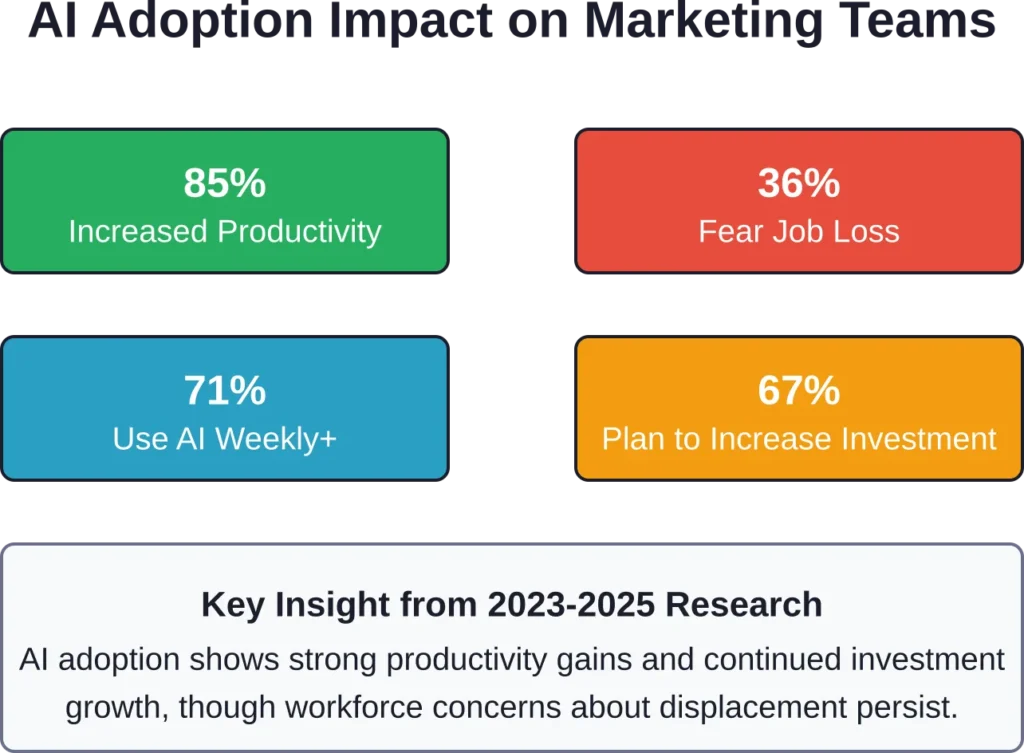
AI automation closes that gap. According to a March 2025 survey cited in Northwestern’s marketing resource, 28% of employed adults in the U.S. used ChatGPT to get work done. In marketing specifically, according to available research, 71% of marketers report using generative AI weekly or more. Even more telling: according to Northwestern’s research, generative AI tools for marketing save users an average of 5.4% of their work hours, which is more than two hours per week for full-time professionals, with 84% of companies investing in AI seeing positive ROI.
But here’s the thing—not all AI tools deliver equal results. Some excel at creative generation but fumble campaign logic. Others automate beautifully but lock you into rigid workflows. The market’s flooded with options, and sorting signal from noise takes serious time.
This guide breaks down the 15 most effective Facebook Ads AI tools available right now, organized by what they actually do best. Each entry includes core automation features, practical use cases, and honest assessments of where tools excel or fall short.
Why AI Automation Matters for Facebook Ads in 2026
Meta’s advertising platform processes real-time auction data faster than any human team can respond. Bid adjustments, audience expansions, creative rotations—these decisions happen in milliseconds. Manual optimization means reacting to yesterday’s data with today’s changes, always one step behind.
AI automation operates at platform speed. Machine learning models detect performance patterns, predict outcomes, and adjust campaigns before human analysts even spot the trend. The technology handles repetitive tasks like pausing underperforming ads, reallocating budgets toward winners, and testing creative variations at scale.
According to Forrester research, a May 2024 survey revealed that 67% of AI decision-makers plan to increase investment in generative AI within the next year. The adoption momentum reflects measurable returns—teams report reclaiming hours per week that previously went to manual bid adjustments and performance monitoring.
Real talk: AI doesn’t replace strategic thinking. It amplifies it. The technology excels at execution and optimization within parameters marketers define. Campaign strategy, brand positioning, offer development—those still require human judgment. AI handles the operational complexity so teams can focus on decisions that actually move revenue.
How Meta’s Native AI Works Inside Ads Manager
Before exploring third-party tools, understanding Meta’s built-in AI capabilities provides crucial context. The platform’s native machine learning powers every campaign, whether marketers actively engage with it or not.
Meta Advantage Suite Overview
Meta consolidated its AI-powered features under the Advantage brand. These tools include Advantage+ shopping campaigns, Advantage+ app campaigns, Advantage+ creative, and Advantage detailed targeting. Each automates specific aspects of campaign management.
Advantage+ shopping campaigns hand over nearly complete control to Meta’s algorithm. The system selects audiences, placements, and creative variations based on conversion probability. Advertisers provide assets and conversion events; Meta handles distribution decisions.
Advantage detailed targeting expands audience reach beyond manually selected parameters. The algorithm identifies users with similar conversion likelihood, even when they fall outside defined demographics or interests. This expansion frequently uncovers profitable audience segments advertisers wouldn’t manually target.
The Machine Learning Delivery System
Meta’s delivery system optimizes toward the conversion event advertisers specify. The algorithm analyzes historical performance data, user behavior signals, and contextual factors to predict which users will most likely complete the desired action.
Value-based bidding adds another layer. According to available data, the system distinguishes between conversion values—a critical capability when a $500 purchase and a $20 purchase both count as single conversions. Training the algorithm with quality conversion data that includes purchase values dramatically improves optimization accuracy.
The learning phase presents a common challenge. Campaign changes reset the algorithm’s accumulated knowledge, temporarily degrading performance. Minimizing edits during this phase—typically 50 conversion events—allows the system to stabilize faster.
Where Native Tools Fall Short
Meta’s native AI excels at in-platform optimization but lacks cross-channel visibility and advanced automation logic. The platform can’t automatically pause campaigns based on ROAS thresholds across multiple accounts, orchestrate complex testing sequences, or integrate external data sources for enriched targeting.
Third-party tools fill these gaps with rule-based automation, multi-account management, advanced reporting, and creative production workflows. They operate on top of Meta’s API, extending capabilities beyond what Ads Manager provides natively.
Top AI Tools for Facebook Ads Automation
The following tools represent the most effective solutions for different automation needs. Each excels in specific areas—campaign management, creative production, audience intelligence, or reporting.
1. Extuitive
Extuitive stands out in 2026 as a predictive AI platform that shifts Facebook Ads strategy from expensive live testing to pre-launch validation. Instead of launching dozens of creatives and waiting for performance data, it uses a network of over 150,000 AI consumer agents modeled on real behavioral patterns to simulate how audiences will react before any budget is spent.
The platform connects directly to Shopify stores, automatically analyzes products, and generates tailored ad concepts — including hooks, copy, images, videos, and reels. These concepts are then pressure-tested through evolutionary AI simulations that predict metrics like CTR, engagement, and purchase intent. Winners rise naturally while weak ideas are filtered out, dramatically reducing creative waste and improving day-one performance.
Extuitive excels at pre-campaign intelligence: forecasting which creatives are likely to succeed, identifying high-potential audience segments, and delivering performance predictions grounded in both brand history and broad consumer data. This makes it especially powerful for e-commerce brands that want to scale Facebook (and Instagram) ads with greater confidence and lower risk.
The tool is ideal for Shopify-focused businesses, DTC brands, and teams tired of burning budget on unproven creatives. It complements rule-based automation and creative generation tools by operating upstream — ensuring only strong concepts ever reach Ads Manager.
Check Extuitive’s official website for current pricing and demo availability, as the platform continues to evolve rapidly with new AI capabilities.
Contact Information:
- Website: extuitive.com
- Email: [email protected]
- LinkedIn: www.linkedin.com/company/extuitive
- Twitter: x.com/Extuitive_Inc
- Instagram: www.instagram.com/extuitiveinc
2. AdEspresso by Hootsuite

AdEspresso focuses on simplifying campaign creation and split testing. The platform’s guided workflows reduce the complexity of launching multi-variant tests, particularly for teams without deep advertising expertise.
Campaign duplication and variation testing form AdEspresso’s core value. Advertisers can test dozens of headline, image, and audience combinations simultaneously. The interface visualizes performance across variants, highlighting winners and losers faster than native Ads Manager reporting.
Integration with Hootsuite’s broader social media management suite provides consolidated reporting across organic and paid social efforts. Teams managing both sides benefit from unified dashboards, though this matters less for specialists focused exclusively on paid acquisition.
AdEspresso suits small to mid-sized businesses and agencies managing moderate campaign volumes. Enterprise-scale operations often outgrow the platform’s capabilities and migrate to more robust automation solutions.
3. Anyword

Anyword applies AI to the copywriting process specifically. The platform generates ad copy variations trained on performance data from thousands of campaigns. Predictive scoring estimates which headlines, descriptions, and calls-to-action will drive higher engagement and conversions.
The tool integrates directly into workflow, generating copy that fits character limits and platform requirements. Marketers input campaign objectives and brand guidelines; Anyword produces variations aligned with those parameters. The system learns from performance feedback, improving suggestions over time.
Copy optimization represents a specific but valuable automation niche. Creative fatigue degrades ad performance faster than most other factors. Anyword accelerates the production of fresh copy variations, extending creative lifespan and maintaining engagement rates.
Teams running high-volume campaigns across multiple products or audiences find particular value here. The ability to generate dozens of copy variations quickly surpasses manual brainstorming, especially when timelines compress.
4. Canva with Magic Write
Canva democratized design production; its AI features now extend to ad creative generation. Magic Write produces copy suggestions within design templates, while background removal, image enhancement, and template customization tools accelerate visual asset creation.
The platform’s template library includes thousands of ad formats optimized for Facebook specifications. Designers and non-designers alike can produce professional-looking creatives in minutes rather than hours. Brand kit features ensure consistency across campaigns and team members.
Canva’s AI capabilities lean more toward creative production than campaign optimization. The tool doesn’t automate bidding, audience targeting, or performance monitoring. But it removes creative production bottlenecks that often slow campaign launches.
Pricing remains accessible, with free and paid tiers supporting different team sizes and feature requirements. The platform’s widespread adoption means most marketing teams already have accounts, reducing onboarding friction.
5. Zalster

Zalster targets e-commerce advertisers specifically, with automation tailored to product catalog campaigns. The platform’s AI analyzes product performance, automatically allocating budget toward top sellers and pausing spend on low converters.
Dynamic creative optimization pulls product images, descriptions, and pricing directly from catalogs, generating ad variations without manual asset uploads. The system tests combinations and surfaces winning patterns, informing future creative decisions.
Zalster’s reporting emphasizes product-level metrics—ROAS by SKU, conversion rates by category, and inventory considerations. This granularity helps e-commerce teams make merchandising decisions alongside advertising optimizations.
The platform suits online retailers running catalog campaigns with significant product variety. Brands with limited SKUs won’t fully utilize the product-level intelligence, but those with hundreds or thousands of items gain actionable insights manual analysis would miss.
6. Trapica

Trapica applies machine learning to audience optimization. The platform’s algorithms analyze conversion patterns and automatically adjust targeting parameters to reach users with higher purchase probability.
Lookalike audience refinement represents a key capability. Rather than relying on Meta’s standard lookalike creation, Trapica’s models identify additional characteristics that separate converters from non-converters within lookalike segments, creating more precise targeting.
The platform integrates external data sources to enrich audience profiles. CRM data, website behavior, and offline conversion information feed into targeting models, improving prediction accuracy beyond what on-platform data alone provides.
Trapica fits advertisers with mature conversion tracking and sufficient historical data. The machine learning models require volume to identify meaningful patterns—campaigns with fewer than 50 conversions per week won’t provide enough signal for optimization.
7. AdStellar AI

AdStellar AI emphasizes speed and scale in campaign production. The platform can launch hundreds of ad variations in minutes. According to AdStellar AI’s pricing information, they provide a 7-day free trial for new users and offer a founding member discount of 20% off an annual plan.
Data-driven learning forms the core value proposition. The system analyzes performance across campaigns to identify patterns, then applies those insights to new campaign creation. Over time, the platform’s recommendations improve as it accumulates more account-specific performance data.
The tool focuses exclusively on Meta platforms—Facebook and Instagram. Advertisers running cross-channel campaigns on Google, TikTok, or other networks need separate tools. This specialization delivers depth within Meta’s ecosystem but lacks breadth across channels.
8. Pixis
Pixis positions itself as a comprehensive AI infrastructure for performance marketing. The platform handles targeting, creative optimization, budget allocation, and performance prediction across multiple advertising channels including Facebook.
The system processes millions of signals in real time, adjusting campaigns faster than human teams or simpler automation tools. Multi-armed bandit algorithms balance exploration of new audiences and creatives with exploitation of proven winners, optimizing the learning versus earning tradeoff.
Cross-channel budget allocation represents a standout feature. Pixis analyzes performance across Facebook, Google, TikTok, and other platforms, automatically shifting spend toward channels delivering stronger returns. This holistic optimization prevents channel-specific tools from operating in silos.
Enterprise-scale advertisers with substantial budgets across multiple platforms gain the most value. Smaller operations may find the platform’s capabilities exceed their current needs, though the technology scales down to support growing teams.
9. Madgicx

Madgicx combines automation, analytics, and creative intelligence in a unified platform. The tool segments audiences into tactical groups based on purchase stage and behavior, enabling more precise messaging and budget allocation.
The creative intelligence module analyzes ad performance by visual and copy elements. The system identifies which colors, layouts, emotional tones, and messaging angles drive results, informing future creative production beyond simple A/B test learnings.
Automated bidding strategies adapt to account-specific performance patterns rather than applying generic optimization logic. The platform learns which bid strategies work for particular products, audiences, and campaign objectives within each account.
Madgicx suits performance marketers comfortable with data-driven decision-making. The platform surfaces substantial insights, but extracting value requires engagement with analytics and willingness to implement recommendations.
10. Smartly.io

Smartly.io targets agencies and brands managing large-scale advertising operations. The platform’s workflow automation handles campaign production, trafficking, and optimization across thousands of campaigns and multiple accounts.
Template-based campaign creation standardizes production while allowing customization. Teams define campaign structures once, then replicate them across clients, products, or regions with automated adjustments for local requirements.
Creative automation pulls assets from digital asset management systems, applies brand guidelines, and generates platform-specific variations. The production pipeline reduces manual trafficking work that typically consumes substantial operational bandwidth.
Reporting consolidates performance across accounts and campaigns, with customizable dashboards serving different stakeholder needs. Client-facing reports, internal performance tracking, and executive summaries all pull from the same underlying data.
Pricing aligns with enterprise budgets—smaller advertisers typically find the platform’s costs exceed their scale. But agencies managing dozens of clients and brands coordinating global campaigns report substantial efficiency gains.
11. Pattern89
Pattern89 applies AI exclusively to creative optimization. The platform analyzes creative elements across thousands of ads to identify performance patterns, then predicts which new creatives will succeed before launch.
Image recognition technology tags visual components—colors, objects, faces, text density, composition. The system correlates these elements with performance metrics, revealing which creative choices drive engagement and conversions in specific contexts.
Predictive scoring estimates performance before ads go live. Creative teams can test concepts virtually, prioritizing production of high-probability winners and avoiding resource investment in likely underperformers.
The platform’s insights inform both immediate optimizations and longer-term creative strategy. Understanding which creative approaches work builds institutional knowledge that improves all future campaign development.
12. Pencil
Pencil generates unlimited ad creative variations using AI. The platform combines brand assets—logos, product images, brand colors—with AI-generated copy and design elements to produce platform-ready ads.
The tool addresses creative fatigue through volume. Rather than manually designing a handful of variations, teams can generate hundreds, maintaining fresh creative rotation that prevents audience burnout.
Learning algorithms analyze performance and adjust generation parameters. The system identifies which creative patterns work for specific accounts, applying those insights to subsequent generation batches.
Pencil suits direct-to-consumer brands and e-commerce operations running continuous campaigns that consume creative assets quickly. The ability to maintain creative freshness without expanding design teams provides clear operational value.
13. Hunch

Hunch focuses on audience intelligence and segmentation. The platform’s AI clusters users into behavioral segments based on engagement patterns, purchase history, and predicted lifetime value.
These segments enable more sophisticated targeting and messaging strategies. Rather than broad demographic targeting, advertisers can focus spend on high-value segments while adjusting messaging for different audience clusters.
The platform predicts customer lifetime value, allowing advertisers to adjust acquisition costs appropriately. Spending more to acquire high-LTV customers while reducing spend on low-value segments improves overall unit economics.
Hunch requires integration with customer data platforms or CRMs. The audience intelligence depends on rich behavioral data—advertisers without mature data infrastructure won’t fully leverage the platform’s capabilities.
14. Blueshift

Blueshift operates as a customer data platform with integrated advertising automation. The platform unifies customer data from multiple sources, then orchestrates personalized advertising based on individual behavior and predicted actions.
Cross-channel journey orchestration coordinates Facebook advertising with email, push notifications, SMS, and other channels. The system determines optimal timing, messaging, and channel for each customer interaction.
Predictive models identify churn risk, purchase propensity, and optimal next actions. Facebook campaigns can automatically target at-risk customers with retention offers or high-propensity prospects with conversion-focused messaging.
Enterprise marketing teams managing complex customer journeys across channels gain the most value. Smaller operations typically don’t need Blueshift’s full capabilities and may find simpler tools more appropriate.
15. Lately

Lately transforms long-form content into social media posts and ad copy using AI. The platform analyzes articles, videos, and podcasts, extracting key points and generating dozens of social-ready snippets.
The tool learns brand voice from existing content, generating copy that matches established tone and messaging style. This consistency maintains brand identity across the high volume of content social advertising demands.
Lately’s content multiplication addresses a specific bottleneck—turning authoritative long-form content into social assets. Teams producing blogs, webinars, or video content can extend that investment across paid social campaigns without manual adaptation work.
Content-driven brands and thought leadership organizations find particular value. The platform leverages existing content investments, maximizing reach and engagement from assets already produced.
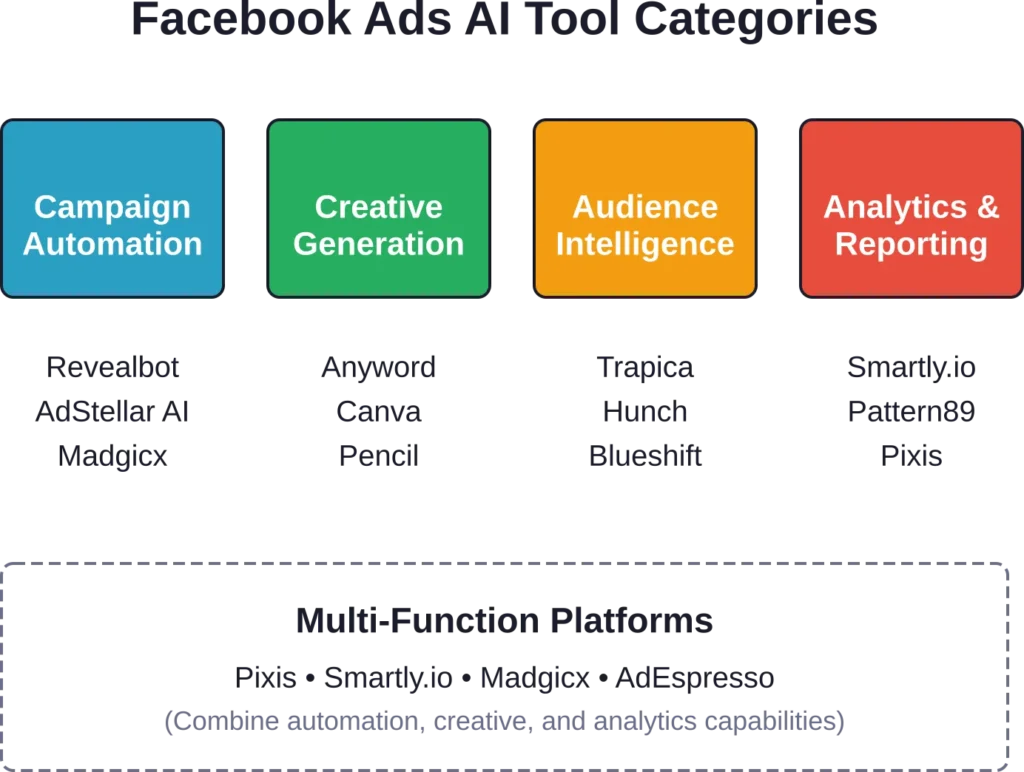
Choosing the Right Facebook Ads AI Tool
Selection depends on specific operational needs, team capabilities, and campaign complexity. No single tool dominates every use case; the right choice aligns with current bottlenecks and strategic priorities.
Assess Current Bottlenecks
Identifying the constraint that limits performance or efficiency focuses tool selection. Teams drowning in manual optimization work need campaign automation. Creative production bottlenecks call for generation tools. Audience targeting struggles point toward intelligence platforms.
Operational pain points reveal themselves through time allocation and performance gaps. Which tasks consume disproportionate hours? Where does performance degrade despite effort? The answers direct tool category selection before evaluating specific platforms.
Match Tool Complexity to Team Capability
Sophisticated platforms deliver advanced capabilities but demand corresponding expertise. Enterprise automation tools require technical implementation, data infrastructure, and analytical skills to extract value. Simpler tools sacrifice depth for accessibility.
Teams without dedicated technical resources benefit from platforms with guided workflows and minimal setup requirements. As capabilities mature, migration to more complex tools becomes viable. Starting with accessible options and graduating to advanced platforms matches tool adoption to organizational readiness.
Consider Budget and Scale
Pricing models vary dramatically across tools. Some charge flat monthly fees, others scale with ad spend, and enterprise platforms often require custom pricing negotiations. Total cost of ownership includes subscription fees, implementation time, and ongoing management requirements.
Ad spend volume influences tool ROI. Automation that saves 10 hours per week justifies higher costs for teams managing six-figure monthly budgets. The same tool might not pencil out for advertisers spending a few thousand monthly. Scale the tool investment to the operational complexity and budget it serves.
Evaluate Integration Requirements
Tools integrate with Meta’s advertising API, but they may also require connections to analytics platforms, CRMs, data warehouses, or creative management systems. Integration complexity affects implementation timelines and ongoing maintenance.
Standalone tools with minimal integration requirements launch faster but operate in isolation. Platforms requiring extensive data connections take longer to implement but enable more sophisticated optimization. Choose integration depth based on data maturity and technical resources available.
Test Before Committing
Most platforms offer free trials or limited-feature free tiers. Testing with actual campaigns reveals usability issues, performance impacts, and workflow fit that marketing materials obscure.
Run trials with representative campaigns, not just test accounts. Evaluate whether the tool actually addresses identified bottlenecks and whether the team adopts it naturally. A powerful platform that sits unused delivers zero value.
| Tool Category | Best For | Typical Pricing Model | Setup Complexity |
|---|---|---|---|
| Campaign Automation | Manual optimization bottlenecks | % of ad spend or flat monthly | Low to Medium |
| Creative Generation | Asset production bottlenecks | Flat monthly or per-asset | Low |
| Audience Intelligence | Targeting and segmentation | Flat monthly or custom | Medium to High |
| Analytics Platforms | Reporting and insights | Flat monthly or custom | Medium |
| All-in-One Platforms | Comprehensive management | Custom enterprise pricing | High |
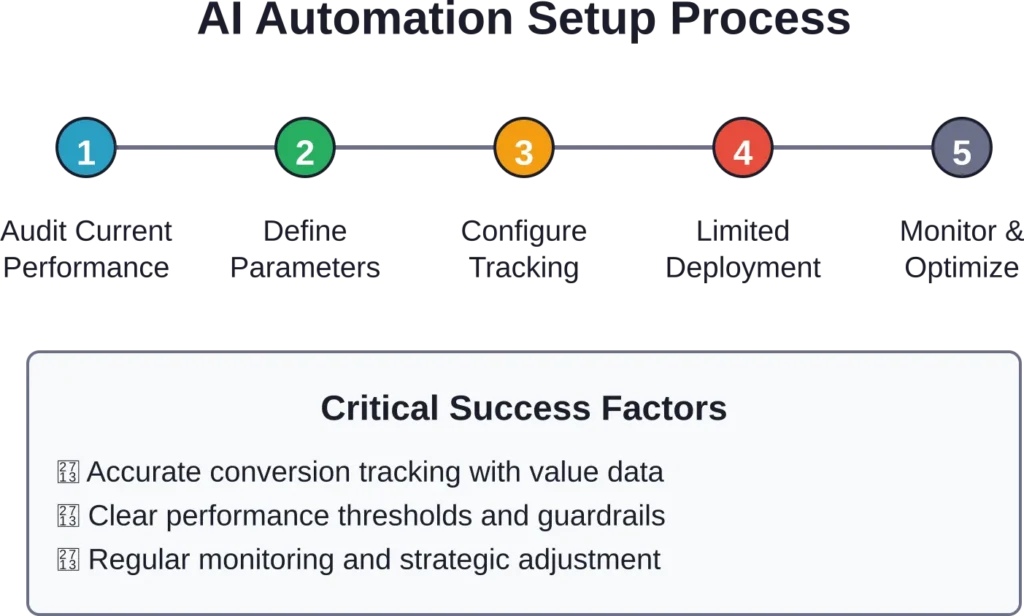
Setting Up AI Automation: Step-by-Step
Implementing AI automation successfully requires methodical setup and thoughtful configuration. Rushing deployment undermines performance and creates more problems than it solves.
Step 1: Audit Current Performance and Processes
Document baseline metrics before introducing automation. Conversion rates, CPA, ROAS, time spent on optimization—establish clear benchmarks that measure automation impact.
Map current workflows to identify handoff points, decision triggers, and time sinks. Understanding the manual process reveals which components automation should replace and which require human judgment.
Step 2: Define Clear Automation Parameters
AI operates within boundaries marketers establish. Defining these parameters prevents automation from making decisions that contradict strategy or brand standards.
Budget limits, CPA thresholds, audience exclusions, brand safety requirements—codify these constraints before enabling automation. The tighter the guardrails, the less risk of automation drift.
Step 3: Configure Conversion Tracking Properly
Accurate conversion data trains AI algorithms effectively. Implement Meta’s Conversions API alongside the pixel to capture events browser tracking misses. Tag conversion values when transaction sizes vary, enabling value-based optimization.
Test conversion tracking thoroughly before enabling AI optimization. Fire test events, verify they appear in Events Manager, and confirm values pass correctly. Poor conversion data produces poor AI decisions regardless of tool sophistication.
Step 4: Start with Limited Scope
Deploy automation on a subset of campaigns initially. Test with non-critical campaigns or allocate a limited budget to automated management. Monitor results closely and expand scope only after validating performance.
Gradual rollout reduces risk and enables learning. Early deployments reveal configuration issues, integration problems, or strategic misalignments when stakes remain low. Full-scale deployment happens after proving the approach works.
Step 5: Monitor and Adjust
AI automation isn’t set-and-forget. Performance monitoring remains essential, though the focus shifts from tactical optimization to strategic oversight.
Review automated decisions regularly. Are paused ads actually poor performers? Are budget reallocations directionally correct? Does the AI respond appropriately to performance changes? Identify patterns where automation falls short and adjust parameters accordingly.
Best Practices for Maintaining AI Ad Performance
AI automation performs best when marketers maintain data quality, provide fresh creative inputs, and exercise strategic oversight. These practices prevent common degradation patterns.
Maintain Conversion Data Quality
AI algorithms optimize toward conversion events marketers specify. Garbage in, garbage out applies ruthlessly. Broken tracking, duplicate events, or misattributed conversions train algorithms incorrectly.
Audit conversion tracking monthly. Verify event volumes match expectations, check for tracking gaps, and confirm values pass correctly. Address discrepancies immediately—AI compounds tracking errors into budget misallocations.
Refresh Creative Regularly
According to UC Berkeley research (California Management Review, November 2025), multiple specialized AI agents can collaborate in agentic workflows. For example, one agent might monitor campaign metrics and notice a 15% drop in sign-ups, then autonomously trigger a chain of analyses.
But even sophisticated AI can’t overcome creative fatigue. Audiences tire of repeated exposure to identical assets. Performance degrades as frequency increases, regardless of optimization sophistication.
Establish creative refresh cycles appropriate to campaign volume. High-impression campaigns require new assets weekly or biweekly. Lower-volume campaigns sustain longer creative lifespans. Monitor frequency metrics and proactively introduce new assets before fatigue tanks performance.
Balance Automation with Human Oversight
AI excels at execution within defined parameters but struggles with context shifts, strategic pivots, and edge cases. Human oversight catches situations where automated logic breaks down.
Review automated decisions at appropriate intervals. Daily checks for high-spend accounts, weekly reviews for moderate budgets. Look for patterns where automation consistently makes questionable calls and adjust parameters accordingly.
Don’t Over-Optimize the Learning Phase
Meta’s algorithm requires approximately 50 conversion events to exit the learning phase and stabilize performance. Campaign edits restart this process, temporarily degrading results.
Resist the urge to tweak campaigns showing poor initial performance. Allow sufficient time for learning completion before making optimization decisions. Premature changes reset progress and extend the period before AI optimization becomes effective.
Feed Quality Data to Value-Based Bidding
When conversion values vary substantially—as with e-commerce purchases or lead quality differences—value-based optimization dramatically improves results. But the approach requires passing accurate transaction values to Meta.
As noted in earlier data, treating a $500 purchase and a $20 purchase as equivalent conversions prevents AI from prioritizing high-value outcomes. Implement dynamic value passing that reflects true business impact, enabling the algorithm to optimize for revenue rather than conversion volume.
Common Pitfalls and How to Avoid Them
AI automation introduces new failure modes alongside its benefits. Awareness of common problems enables proactive prevention.
Over-Reliance Without Understanding
Blindly trusting automation without understanding underlying logic creates black-box systems that fail unpredictably. When performance degrades, teams lack the knowledge to diagnose issues or implement corrections.
Maintain working knowledge of automation rules and AI optimization approaches. Understand what triggers automated actions and why the system makes specific decisions. This knowledge enables informed oversight and faster troubleshooting when problems arise.
Insufficient Testing Before Full Deployment
Launching automation across entire campaign portfolios without testing risks widespread performance degradation. Configuration errors, logic flaws, or strategic misalignments affect all campaigns simultaneously.
Test new automation approaches with limited scope and budget. Validate performance improvements before expanding deployment. The time invested in careful testing prevents costly mistakes at scale.
Ignoring Platform-Specific Nuances
Facebook’s advertising platform operates differently than Google, TikTok, or LinkedIn. Automation strategies that work brilliantly on one platform may fail on another. Learning phases, attribution windows, audience behaviors—platform differences matter.
Customize automation approaches to Facebook’s specific characteristics. Understand how Meta’s algorithm learns, what signals it prioritizes, and how it responds to different inputs. Generic cross-platform strategies underperform platform-optimized approaches.
Neglecting Creative Quality for Volume
AI creative generators produce assets quickly, but volume doesn’t substitute for quality. Poor creative with perfect optimization still underperforms strong creative with basic optimization.
Maintain creative standards even when using generation tools. Review AI-produced assets before deployment, discard weak variations, and refine prompts based on output quality. Speed matters, but not at the expense of effectiveness.
Setting and Forgetting
The biggest automation pitfall remains treating it as completely hands-off. Market conditions change, competitive dynamics shift, and seasonal patterns emerge. Static automation fails when context evolves.
Schedule regular strategy reviews separate from tactical monitoring. Assess whether current automation parameters still align with business objectives, competitive realities, and market conditions. Adjust strategic direction even when tactical execution runs smoothly.
The Regulatory Landscape for AI Advertising
Government oversight of AI technologies continues evolving. Advertisers using AI tools should understand emerging compliance requirements.
The Federal Trade Commission has increased scrutiny of AI claims and implementations. On September 25, 2024, the FTC announced Operation AI Comply, a crackdown on deceptive AI claims and schemes, announcing five law enforcement actions against operations using AI hype or selling AI technology that can be used in deceptive and unfair ways.
According to FTC documentation, the agency settled a case involving AI-powered business opportunity schemes, banning further marketing of such business opportunities. In June 2024, the FTC filed suit against FBA Machine and Bratislav Rozenfeld (also known as Steven Rozenfeld and Steven Rozen) alleging that in a business opportunity scheme, they falsely guaranteed consumers could make money operating online storefronts using AI-powered software, defrauding consumers out of over $15 million.
The regulatory message emphasizes transparency and truthfulness. AI tools must deliver promised capabilities, not just marketing hype. Companies deploying AI advertising automation should verify tool claims, maintain documentation of performance, and avoid deceptive representations to customers.
Privacy considerations also matter. The FTC emphasized in January 2024 that data stands at the heart of AI development. AI companies must uphold privacy and confidentiality commitments, particularly when processing customer data for targeting and optimization.
Advertisers should review vendor data handling practices, understand what customer information flows to AI platforms, and ensure compliance with privacy regulations. Vendor contracts should specify data usage limitations and security requirements.
Looking Ahead: AI Trends Shaping Facebook Advertising
AI advertising technology continues advancing rapidly. Several trends will significantly impact Facebook advertising over the next few years.
Agentic AI Systems
According to Gartner research from January 2026, by 2028, 60% of brands will use agentic AI to facilitate streamlined one-to-one interactions. These systems employ multiple AI agents collaborating to accomplish complex tasks with minimal human direction.
In advertising contexts, agentic systems could autonomously identify performance issues, diagnose root causes, test solutions, and implement fixes—completing the entire optimization loop without human intervention. Early implementations show agents monitoring campaign metrics, triggering investigations when performance declines, and automatically adjusting parameters based on findings.
Deeper Creative Personalization
AI creative generation currently produces variations at scale. Next-generation systems will personalize creative elements to individual users or micro-segments, dynamically adjusting messaging, imagery, and offers based on behavioral signals and predicted preferences.
This capability extends beyond demographic targeting to true individualization. The same product advertised to 10,000 users could display 10,000 creative variations, each optimized for the recipient’s specific context and preferences.
Cross-Platform Intelligence Integration
AI tools increasingly operate across multiple advertising platforms, aggregating insights and optimizing budget allocation holistically rather than in platform silos. This cross-channel intelligence produces better overall returns than platform-specific optimization.
Facebook advertising decisions will increasingly consider performance across Google, TikTok, and other channels. Budget shifts between platforms will happen automatically based on comprehensive performance analysis, maximizing total return rather than per-platform metrics.
Enhanced Predictive Capabilities
Current AI primarily reacts to observed performance. Emerging predictive models anticipate performance before campaigns launch, seasonal trends before they manifest, and audience fatigue before metrics degrade.
This shift from reactive to proactive optimization prevents problems rather than fixing them. Advertisers will forecast campaign performance with increasing accuracy, adjust strategies preemptively, and avoid the performance dips that accompany reactive management.
Simplified Access for Smaller Advertisers
Early AI advertising tools required enterprise budgets and technical expertise. Democratization continues as platforms package sophisticated capabilities in accessible interfaces at lower price points.
Small businesses and individual entrepreneurs increasingly access AI automation previously available only to large advertisers. This democratization intensifies competition but also expands opportunities for advertisers willing to adopt new technologies quickly.
Frequently Asked Questions
Meta’s native AI handles in-platform optimization—audience selection, bid adjustments, and placement decisions. The system excels at leveraging Meta’s data and responding to real-time auction dynamics. Third-party tools extend beyond these capabilities with rule-based automation, cross-account management, creative production workflows, and advanced analytics. They operate through Meta’s API, adding functionality Ads Manager doesn’t provide natively. Most advertisers benefit from combining Meta’s native optimization with third-party tools that address specific operational needs.
Automation ROI depends more on operational complexity than absolute spend. Advertisers managing multiple campaigns, testing numerous variations, or overseeing several accounts benefit from automation at lower spend levels than single-campaign operations. Generally speaking, monthly spend above $5,000 justifies basic automation tools, while enterprise platforms typically make sense above $50,000 monthly. But the true threshold relates to how much time manual management consumes—if optimization work exceeds available hours, automation delivers value regardless of spend.
Machine learning algorithms require sufficient data to identify patterns and optimize effectively. Meta’s algorithm needs approximately 50 conversions to exit the learning phase. AI tools face similar requirements—low conversion volume limits what algorithms can learn and optimize. Advertisers generating fewer than 50 conversions weekly should focus on increasing volume before implementing sophisticated AI optimization. Basic automation like scheduled reports or simple pause rules works with any volume, but predictive optimization and audience intelligence require substantial data.
Yes, but coordination matters. Combining tools that address different functions—creative generation plus campaign automation plus analytics—creates complementary capabilities. Running multiple tools that automate the same functions creates conflicts. Two platforms simultaneously adjusting bids or pausing ads based on different logic produces chaotic results. Choose one primary automation platform for core campaign management, then add specialized tools for creative, analytics, or other distinct functions. Ensure tools don’t compete for control over the same campaign elements.
Establish clear baseline metrics before implementing automation, then compare performance over statistically significant timeframes. Look beyond surface metrics—a tool might reduce CPA but also reduce conversion volume, resulting in lower total revenue. Evaluate performance holistically across efficiency metrics, volume metrics, and business outcomes. Run controlled tests when possible, managing some campaigns with automation and others manually as a control group. Track time savings alongside performance changes—improved efficiency combined with maintained performance still delivers value even without dramatic metric improvements.
This depends on the tool’s architecture and fail-safe mechanisms. Quality platforms include monitoring systems that detect API connection failures and default to safe states—typically maintaining current settings rather than making changes based on incomplete data. Review vendor documentation about redundancy, uptime guarantees, and failure protocols. Maintain access to native Ads Manager so manual intervention remains possible during outages. Never grant automation tools permissions beyond what’s necessary—limit access to campaign management functions rather than full account control. Keep backup export of campaign structures and settings to enable quick reconstruction if needed.
Reputable tools comply with major privacy regulations including GDPR and CCPA, but advertisers bear ultimate responsibility for vendor compliance. Review vendor privacy policies, data processing agreements, and security certifications. Understand what customer data the tool processes, where it’s stored, and how it’s protected. Vendors should provide data processing agreements that specify handling requirements and liability. The FTC has emphasized that AI companies must uphold privacy and confidentiality commitments—verify vendors meet these standards before granting access to customer data. When in doubt, consult legal counsel about specific vendor arrangements.
Conclusion
AI automation has shifted from experimental technology to operational necessity for Facebook advertising. The platforms covered here represent proven solutions that address real bottlenecks in campaign management, creative production, audience targeting, and performance analysis.
Selection requires honest assessment of current constraints and future needs. The right tool solves actual problems rather than adding complexity. Start with clear objectives, test methodically, and scale what works.
The technology continues advancing rapidly. Tools that seem cutting-edge today will become baseline capabilities tomorrow. Staying competitive requires ongoing evaluation of new capabilities and willingness to adapt strategies as technology evolves.
But technology alone doesn’t drive results. Strategic thinking, creative excellence, and deep audience understanding remain essential. AI amplifies these capabilities when deployed thoughtfully, handling operational complexity so marketers can focus on the decisions that actually move businesses forward.
The advertisers winning with AI automation aren’t necessarily the ones using the most tools or the most sophisticated platforms. They’re the ones who clearly understand what problems they’re solving, choose tools that address those specific needs, and maintain strategic oversight while letting automation handle execution.
Start by identifying your biggest constraint—time, creative production, targeting precision, or performance visibility. Choose one tool that addresses that constraint. Test it thoroughly. Measure results honestly. Then expand from there.
The Facebook advertising landscape will only grow more complex. AI automation isn’t optional anymore—it’s table stakes for maintaining competitive performance. The question isn’t whether to adopt AI tools, but which ones solve your specific challenges most effectively.