

Quick Summary: AI marketing tools have become essential for modern campaigns, with 62% of marketers already using chatbots like ChatGPT and 58% leveraging tools like Grammarly. This comprehensive guide covers the top AI tools across content creation, analytics, automation, and social media — helping marketing teams work faster, personalize at scale, and measure performance more accurately in 2026.
Marketing teams are under more pressure than ever. Content deadlines stack up. Campaign requests flood in. Performance reviews demand data-driven proof.
And guess what? AI tools aren’t just hype anymore.
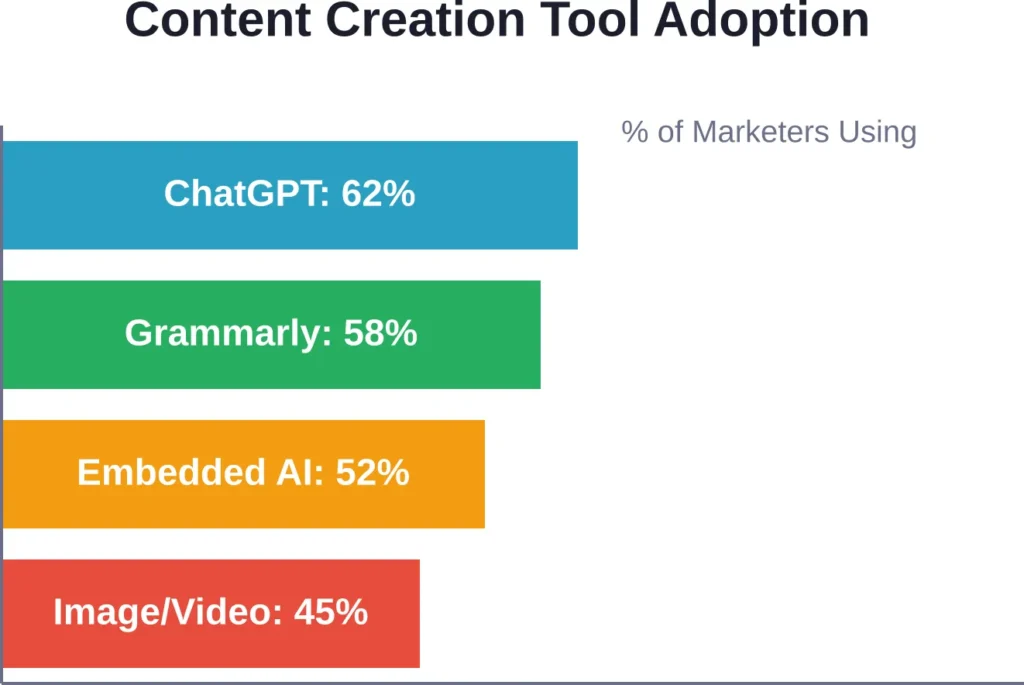
According to the American Marketing Association, nearly 90% of marketers have used generative AI in their work. The numbers tell the story: 62% rely on chatbots like ChatGPT for content generation, while 58% turn to AI-powered writing assistants like Grammarly.
But here’s the thing — not all AI marketing tools deliver the same value. Some automate busywork. Others transform entire workflows. The difference between choosing the right tool and wasting budget on flashy features comes down to understanding what each platform actually does.
This guide breaks down the AI marketing tools that matter in 2026. Real tools. Real use cases. Real pricing. Whether campaigns need better content, smarter automation, or deeper analytics, these platforms cover the full marketing stack.
What Are AI Marketing Tools?
AI marketing tools use artificial intelligence — machine learning, natural language processing, computer vision, and generative models — to automate, optimize, or enhance marketing tasks.
Think of them as specialized assistants. One tool writes social media captions. Another predicts which email subject lines convert. A third analyzes competitor ad creative.
The American Marketing Association’s research shows marketers use AI across diverse tasks. After chatbots (62%) and writing assistants (58%), 52% use tools with embedded AI like Microsoft Copilot or Canva, and 45% work with specialized image and video generators like Midjourney or LTX Studio.
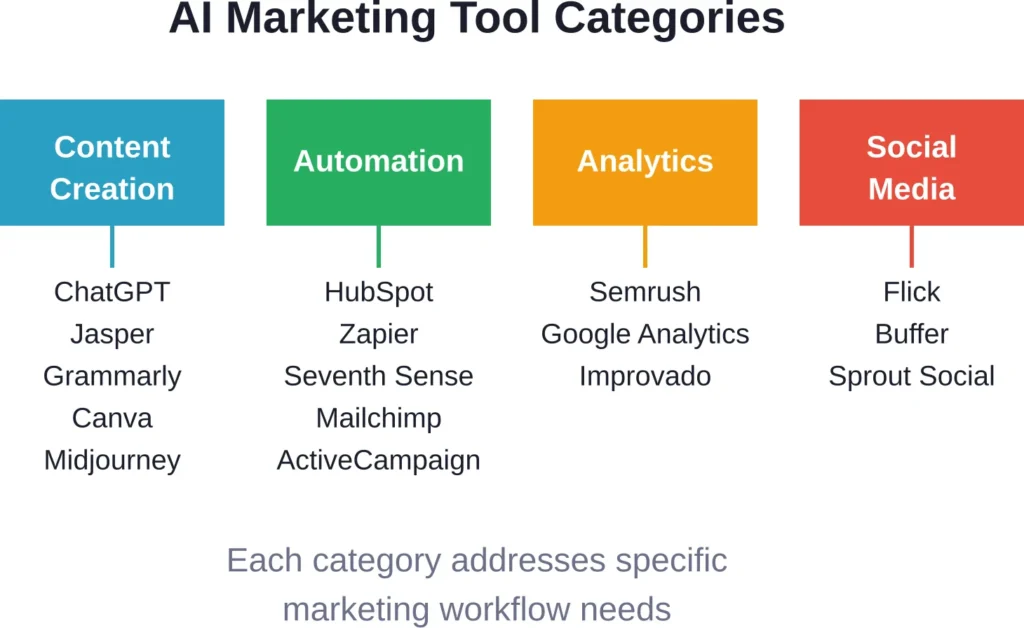
These tools fall into several categories:
- Content creation: Writing copy, generating images, producing videos
- Automation: Scheduling posts, sending emails, triggering workflows
- Analytics: Tracking performance, predicting trends, attributing conversions
- Personalization: Segmenting audiences, customizing messages, optimizing timing
- Research: Analyzing competitors, finding keywords, understanding sentiment
What makes AI tools different from traditional marketing software? Speed and scale. Tasks that took hours now take minutes. Campaigns that required three team members now run with one.
Real talk: AI won’t replace marketers. But marketers using AI will replace those who don’t.
Content Creation Tools
Content creation eats up the biggest chunk of marketing time. Blog posts, social captions, ad copy, video scripts, product descriptions — the list never ends.
AI content tools tackle this workload head-on.
Extuitive
Extuitive sits at the top for pre-launch ad prediction. It analyzes your creatives (images, videos, and copy), forecasts real performance metrics like CTR and ROAS, and validates them against 150,000+ AI consumer models trained on actual behavior data.
The platform connects directly with Shopify, automatically pulls product information and audience insights, then generates, improves, and ranks ad concepts before you spend money. This makes it especially valuable for e-commerce brands and performance marketers who want to eliminate wasted ad spend on weak ideas.
Extuitive shines when running frequent tests on Meta, TikTok, and Google ads. Its strength is combining creative generation with accurate predictive validation in a single workflow. The trade-off? Predictions become significantly more accurate once you feed it some historical campaign data.
Marketing teams typically use Extuitive for:
- Predicting CTR and ROAS of ad creatives before launch
- Testing and ranking dozens of creative variations without burning budget
- Generating and optimizing product-specific ads for Shopify stores
- Identifying winning concepts for Facebook, Instagram, and TikTok campaigns
- Reducing risk and speeding up the creative testing process
Contact Information:
- Website: extuitive.com
- Email: [email protected]
- LinkedIn: www.linkedin.com/company/extuitive
- Twitter: x.com/Extuitive_Inc
- Instagram: www.instagram.com/extuitiveinc
ChatGPT (OpenAI)

ChatGPT sits at the top for good reason. It’s versatile, accessible, and constantly improving. Marketing teams use it for brainstorming campaign ideas, drafting email sequences, writing product descriptions, and researching audience pain points.
The free version handles most tasks. The paid tier ($20/month) adds faster response times, priority access during peak hours, and plugins that connect to other tools.
ChatGPT shines at conversational tone and context understanding. Ask it to rewrite something three different ways, and each version sounds genuinely different. The trade-off? Output quality depends heavily on prompt quality. Vague inputs produce generic outputs.
Marketing teams typically use ChatGPT for:
- First drafts of blog posts and articles
- Social media caption variations
- Email subject line testing
- Persona development and customer research
- Content repurposing across channels
Jasper

Jasper positions itself as the AI writing assistant built specifically for marketing. It includes templates for blog posts, ads, product descriptions, and social media — each optimized for specific platforms and goals.
The platform integrates brand voice training. Feed Jasper existing content, style guides, and tone preferences, and it learns to write in a consistent brand voice. This matters for teams with strict editorial standards or regulated industries.
Jasper works particularly well for high-volume content needs. Agencies managing multiple clients or e-commerce brands with thousands of product descriptions find the template system and brand voice features worth the premium pricing.
The downside? Cost. Plans start significantly higher than general-purpose AI tools, making Jasper better suited for teams with dedicated content budgets.
Grammarly

Grammarly goes beyond spell-checking. The AI analyzes tone, clarity, engagement, and delivery — then suggests specific improvements.
According to the American Marketing Association data, 58% of marketers use Grammarly or similar AI-powered writing tools. That adoption rate makes sense. Every email, every landing page, every social post needs clean, clear writing.
The free version catches grammar and spelling errors. Premium tiers add tone detection, style suggestions, plagiarism checking, and team style guides.
Marketing teams rely on Grammarly for:
- Polishing customer-facing copy before publishing
- Maintaining consistent tone across team members
- Catching errors in high-stakes communications
- Training junior writers on style standards
Canva (with AI features)
Canva transformed from a simple design tool into an AI-powered creative suite. The Magic Write feature drafts copy. Magic Design generates complete layouts from text prompts. Background Remover isolates subjects instantly.
The 52% of marketers using tools with embedded AI (according to AMA research) often cite Canva as a prime example. The AI features feel integrated rather than tacked on, making design tasks faster without requiring new workflows.
Canva works especially well for social media content, presentation decks, and marketing materials that need consistent branding but rapid iteration.
Midjourney and DALL·E

When campaigns need custom images, AI image generators deliver. Midjourney excels at artistic, stylized visuals. DALL·E handles diverse styles and integrates easily with other tools through automation platforms like Zapier.
The American Marketing Association reports 45% of marketers use specialized image and video generators. These tools shine for concept testing, social media graphics, and situations where stock photography feels too generic.
Image generators can’t replace professional photography for every use case. But for rapid prototyping, social content, and creative exploration, they’re invaluable.
Marketing Automation Platforms
Automation platforms handle repetitive tasks so marketing teams can focus on strategy and creativity. AI takes these platforms further — predicting optimal send times, personalizing at scale, and adapting campaigns based on performance.
HubSpot
HubSpot embedded AI throughout its platform. The AI assistant drafts emails, suggests blog topics, scores leads, and recommends next actions based on contact behavior.
The platform excels at connecting data across marketing, sales, and service. AI features use this connected data to personalize outreach, predict which leads are ready to buy, and automate follow-up sequences.
HubSpot works best for teams already invested in inbound marketing methodology. The AI features enhance existing workflows rather than requiring complete process changes.
Zapier

Zapier connects thousands of apps through automated workflows called Zaps. Recent AI additions let users build workflows in plain language, generate content within Zaps, and create more complex conditional logic.
The platform’s strength lies in flexibility. Need to automatically generate social images from blog posts? Create a Zap connecting the blog to DALL·E. Want to summarize sales calls and add notes to the CRM? Build a workflow linking the recording tool to ChatGPT to Salesforce.
Marketing teams use Zapier to:
- Automate content distribution across platforms
- Sync data between marketing tools
- Generate reports and summaries automatically
- Trigger campaigns based on specific actions
Seventh Sense
Email timing matters more than most marketers realize. Seventh Sense uses AI to determine the optimal send time for each individual contact based on their historical engagement patterns.
The tool integrates with platforms like HubSpot and Marketo, analyzing when each contact typically opens emails and scheduling delivery accordingly. Instead of blasting everyone at 10 AM Tuesday, it staggers sends across hours or days to hit each person’s peak engagement window.
For B2B companies with longer sales cycles and relationship-focused marketing, this personalization drives measurable lift in open rates and engagement.
Analytics and Research Tools
Data tells the story of what’s working and what isn’t. AI analytics tools surface insights faster, predict future performance, and answer questions that would take analysts days to investigate manually.
Semrush

Semrush started as an SEO platform but evolved into a comprehensive marketing toolkit. The AI features analyze competitors, suggest content topics, optimize existing pages, and track brand mentions across the web.
Plans start at $139.95 per month, with AI-specific features like the AI Visibility Toolkit requiring separate add-ons. The investment makes sense for teams serious about organic search and content marketing.
Marketing teams rely on Semrush for:
- Keyword research and content gap analysis
- Competitor strategy reverse-engineering
- Technical SEO audits
- Content optimization recommendations
Google Analytics 4

GA4 rebuilt Google Analytics from the ground up with AI at its core. The platform predicts future actions (like purchase probability), surfaces anomalies automatically, and answers natural language questions about data.
The predictive metrics stand out. Purchase probability scores help prioritize remarketing budgets. Churn probability identifies at-risk customers before they leave. Revenue prediction forecasts help with budget planning.
GA4 remains free for most businesses, making it the default choice for web analytics. The learning curve is steep, but the AI features reveal insights that manual analysis would miss.
Improvado

Marketing teams juggle data from dozens of platforms — ad networks, social media, email tools, CRM systems, web analytics. Improvado aggregates all this data into unified dashboards and uses AI to analyze performance across channels.
The platform handles the tedious work of normalizing data from different sources, matching naming conventions, and reconciling discrepancies. AI features then identify which channels drive the most valuable conversions and suggest budget reallocation.
This level of integration comes at a premium price point, making Improvado better suited for enterprise marketing teams managing significant ad spend across multiple channels.
Social Media Management Tools
Social media moves fast. AI tools help marketing teams keep pace by generating content ideas, optimizing posting schedules, and analyzing what resonates with audiences.
Flick

Flick focuses specifically on social media content planning and hashtag strategy. The AI assistant generates post ideas based on trending topics, suggests relevant hashtags, and even writes caption variations to test.
The platform tracks which hashtags drive the most reach and engagement over time, helping refine strategy based on actual performance rather than guesswork.
Buffer

Buffer’s AI features handle the practical side of social media management. The AI assistant suggests optimal posting times, generates caption variations, and even creates simple graphics from text descriptions.
Buffer works well for small teams managing multiple accounts across platforms. The interface stays clean and focused on the essentials rather than overwhelming users with features.
Sprout Social

Sprout Social positions itself as the enterprise social media solution. The AI features include sentiment analysis on mentions, chatbot responses for common questions, and trend detection across conversations.
The listening tools stand out. Sprout’s AI analyzes thousands of social conversations to identify emerging trends, track brand perception shifts, and surface opportunities for engagement.
| Tool Category | Best For | Key AI Feature | Typical Pricing |
|---|---|---|---|
| ChatGPT | General content creation | Conversational drafting | $20/month |
| Jasper | Brand-consistent content | Voice training | Premium pricing |
| Grammarly | Copy editing | Tone analysis | Free to premium tiers |
| HubSpot | Full marketing automation | Lead scoring | Varies by tier |
| Semrush | SEO and content strategy | Competitor analysis | $139.95+/month |
| Zapier | Workflow automation | App integration | Free to premium |
Email Marketing Tools
Email remains one of the highest-ROI marketing channels. AI tools optimize every element — from subject lines to send times to content personalization.
Mailchimp

Mailchimp added AI features throughout its platform. Subject line helper suggests variations likely to improve open rates. Content optimizer recommends layout and copy changes. Send time optimization delivers emails when each subscriber is most likely to engage.
The platform also predicts which contacts are most likely to purchase, helping prioritize outreach and segment campaigns more effectively.
ActiveCampaign

ActiveCampaign focuses on automation with AI-powered enhancements. Predictive sending optimizes delivery times. Predictive content shows different blocks to different contacts based on their interests. Win probability scoring helps sales teams prioritize follow-up.
The automation builder lets marketing teams create sophisticated workflows without coding. AI features make these workflows smarter by adapting based on individual behavior.
Advertising Platforms
Paid advertising platforms increasingly rely on AI for targeting, bidding, and creative optimization. These tools help stretch ad budgets further while improving performance.
Google Ads
Google’s advertising platform uses AI for everything from bid optimization to ad creation. Smart Bidding automatically adjusts bids to maximize conversions or target specific return on ad spend. Responsive search ads test multiple headline and description combinations to find the best performers.
The Performance Max campaign type hands full control to AI, letting Google optimize across search, display, YouTube, and other properties simultaneously.
Meta Ads

Facebook and Instagram advertising relies heavily on AI targeting. Advantage+ campaigns let Meta’s AI handle audience selection, creative optimization, and budget allocation across placements.
The platform’s AI excels at finding lookalike audiences — people similar to existing customers who are likely to convert. Creative testing happens automatically, with the system showing better-performing variations more often.
AdCreative.ai

AdCreative.ai generates ad creative specifically designed to perform. Input product details and brand guidelines, and the platform produces dozens of ad variations optimized for different platforms and objectives.
Pricing starts around $39 per month, making it accessible for small businesses testing ad creative without dedicated design resources. The tool works particularly well for e-commerce brands running high volumes of product ads.
Video Creation Tools
Video content dominates engagement metrics across platforms. AI video tools lower the barrier to entry, letting marketing teams produce professional-looking videos without extensive production resources.
Runway

Runway brings Hollywood-level video editing tools to marketers. AI features include background removal, object tracking, motion tracking, and even generating video from text descriptions.
The platform excels at editing and enhancing existing footage. Remove unwanted objects, change backgrounds, or add effects that would traditionally require specialized skills.
Descript

Descript takes a text-first approach to video editing. Upload a video, and the platform transcribes it automatically. Edit the video by editing the transcript — delete words, rearrange sections, or remove filler words, and the video updates accordingly.
The tool also offers AI voice cloning, letting marketing teams fix audio mistakes or update content without re-recording entire sections.
Synthesia

Synthesia generates videos featuring AI avatars that speak in multiple languages. Marketing teams use it for training videos, product demos, and personalized outreach at scale.
The technology eliminates filming entirely. Type a script, choose an avatar and voice, and the platform generates the video. This works especially well for content that updates frequently or needs localization across languages.
The Trust Gap in AI Advertising
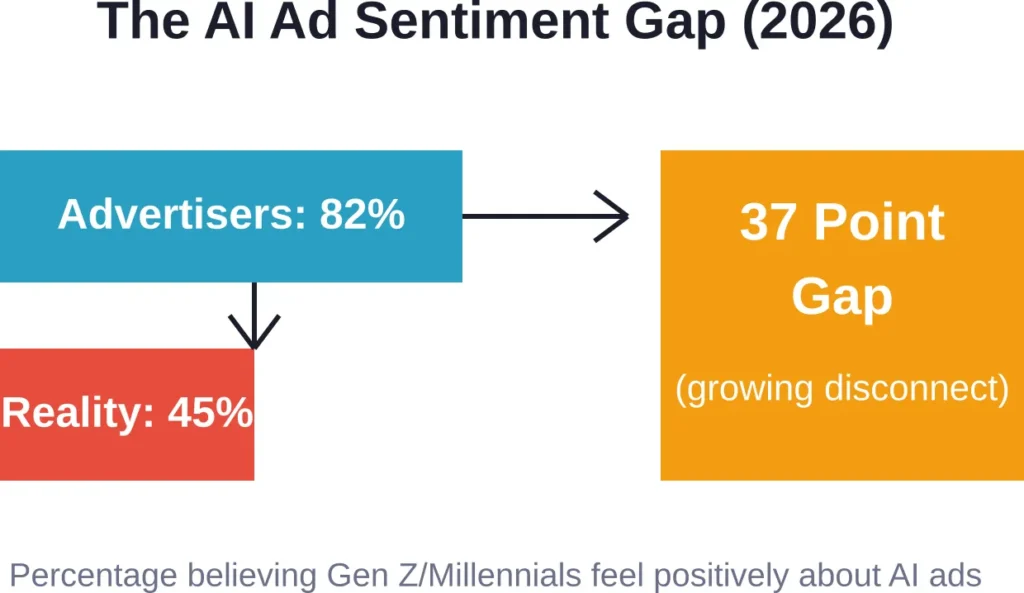
Here’s where things get interesting. Marketers love AI. Consumers? Not so much.
According to IAB research from January 2026, there is a significant disconnect between advertiser perception and consumer sentiment regarding AI-generated ads. Research from the Interactive Advertising Bureau reveals a 37-point gap between advertiser confidence and consumer reality regarding AI advertising.
What does this mean for marketing campaigns? Transparency matters. The IAB released its first AI Transparency and Disclosure Framework in January 2026 specifically to address this trust gap. The framework recommends disclosing AI use when it materially affects the consumer experience, rather than labeling everything.
The takeaway: AI tools can improve marketing efficiency and performance. But brands need to balance optimization with authenticity and transparency about how AI shapes the content consumers see.
How to Choose the Right AI Marketing Tools
With hundreds of AI marketing tools available, selection gets overwhelming fast. These criteria help narrow the field.
Start With Specific Problems
Don’t choose tools based on features. Choose based on problems that need solving.
Is content production the bottleneck? Look at writing assistants and image generators. Do campaigns lack personalization? Explore automation platforms with segmentation AI. Is attribution unclear? Focus on analytics tools.
The best tool is the one that solves the most painful problem right now.
Consider Integration Requirements
Marketing tools work best when they connect. A writing assistant that doesn’t integrate with the content management system creates friction. An analytics tool that can’t pull data from ad platforms delivers incomplete insights.
Check whether tools integrate natively with existing platforms or work through connection services like Zapier. Native integrations typically run more smoothly, but connection services offer more flexibility.
Evaluate Data Privacy and Security
AI tools process sensitive data — customer information, campaign strategies, performance metrics. Understanding how each tool handles data matters.
Key questions to ask:
- Where does the vendor store data?
- Does the vendor use input data to train models?
- What compliance certifications does the vendor maintain?
- Can data be deleted on request?
- Does the tool comply with GDPR, CCPA, and other privacy regulations?
The National Institute of Standards and Technology released its AI Risk Management Framework, providing guidelines for evaluating AI systems. The framework addresses legal requirements, documentation, and risk mapping — considerations that matter when choosing tools for marketing operations.
Test Before Committing
Most AI marketing tools offer free trials. Use them. Run real marketing tasks through the platform. See how it handles actual campaign content, not just demo scenarios.
Involve team members who’ll use the tool daily. Their experience matters more than feature lists or sales presentations.
Calculate Total Cost
Pricing for AI tools varies widely. Some charge per user. Others price by usage volume. Many offer tiered plans with critical features locked behind higher tiers.
Consider the full cost:
- Base subscription fees
- Per-user charges
- Usage limits and overage fees
- Add-on features or modules
- Integration costs
- Training and onboarding time
The American Marketing Association offers an “AI for Marketing Professionals” course, a beginner-level course worth 3 Continuing Education Units (CEUs), costing $99 for members or $149 for non-members.
| Selection Criteria | Why It Matters | How to Evaluate |
|---|---|---|
| Problem-Solution Fit | Tools should solve actual pain points | Map features to current workflow gaps |
| Integration Capability | Isolated tools create friction | Check native integrations and APIs |
| Data Privacy | Compliance and customer trust | Review vendor security documentation |
| User Experience | Adoption depends on usability | Run trials with actual team members |
| Total Cost | Hidden fees impact ROI | Calculate all fees including overages |
Implementation Best Practices
Buying AI tools is easy. Actually getting value from them requires thoughtful implementation.
Start Small and Scale
Don’t try to AI-ify the entire marketing operation overnight. Pick one workflow or campaign type. Implement AI tools there. Learn what works. Then expand.
This approach reduces risk and builds organizational knowledge gradually. Teams learn prompt engineering, understand model limitations, and develop best practices before scaling across departments.
Establish Quality Standards
AI-generated content needs human oversight. Establish clear quality standards and review processes before publishing AI-created material.
Consider these checkpoints:
- Factual accuracy verification
- Brand voice consistency
- Legal and compliance review
- Tone and sensitivity checks
- Originality and plagiarism screening
Train the Team
AI tools perform better when users understand how to work with them effectively. Invest in training on prompt engineering, output evaluation, and tool-specific best practices.
Documentation helps. Create internal guides showing what works for specific use cases. Share successful prompts. Document edge cases and workarounds.
Measure Impact
Track metrics before and after implementing AI tools. The goal is measurable improvement in efficiency, performance, or both.
Relevant metrics include:
- Time spent on specific tasks
- Content production volume
- Campaign performance metrics
- Cost per acquisition
- Team satisfaction and adoption rates
Industry analyses indicate a 3.7x return for every dollar invested in generative AI. But individual results depend on implementation quality and use case fit.
Stay Updated on AI Governance
AI regulation evolves rapidly. The IAB’s AI Transparency and Disclosure Framework, released in January 2026, provides industry guidance on responsible AI use in advertising. The framework recommends risk-based, materiality-driven disclosure rather than blanket labeling of all AI-generated content.
Government agencies like NIST continue developing AI governance frameworks. Marketing teams should monitor regulatory developments and adjust practices accordingly.
Common Pitfalls to Avoid
AI tools deliver impressive results, but only when used properly. These common mistakes undermine AI marketing initiatives.
Over-Relying on AI Without Human Judgment
AI tools make suggestions. Humans make decisions. The platforms generating content or recommendations don’t understand business context, brand nuance, or strategic goals the way experienced marketers do.
Use AI to augment human capabilities, not replace them. Review all AI output. Add context and expertise. Make the final call on what goes live.
Ignoring Data Quality
AI models learn from data. Bad data produces bad results. Before implementing AI tools for analytics or personalization, audit data quality.
Check for:
- Incomplete records
- Duplicate entries
- Inconsistent formatting
- Outdated information
- Missing key fields
Clean data first. Implement AI second.
Neglecting Prompt Engineering
The quality of AI output depends heavily on input quality. Vague prompts produce generic results. Specific, detailed prompts generate useful content.
Good prompts include context, specify format, define tone, provide examples, and set constraints. Teams that invest time in prompt engineering get significantly better results.
Assuming AI Understands Brand Voice
Most AI tools generate content in a neutral, generic tone. Teaching the tool about brand voice requires effort.
Some platforms like Jasper offer brand voice training features. Others require including brand guidelines in every prompt. Either way, expecting AI to automatically match brand voice without guidance leads to disappointment.
Forgetting About Transparency
Given the significant disconnect between advertiser confidence and consumer sentiment about AI ads revealed by Interactive Advertising Bureau research from January 2026, transparency matters more than many marketers realize.
When AI materially affects consumer experience — generating product images, writing personalized recommendations, creating ad creative — consider disclosing that involvement. The IAB framework provides specific guidance on when and how to disclose AI use.
Future Trends in AI Marketing Tools
AI marketing tools evolve rapidly. These trends shape where the technology heads next.
Agentic AI
Current AI tools respond to prompts. Next-generation “agentic” AI takes initiative. These systems don’t just generate content when asked — they monitor performance, identify opportunities, and suggest actions proactively.
Think of an AI that notices declining email engagement, analyzes what changed, tests new subject line approaches, and recommends adjustments without waiting for someone to investigate the problem.
Multimodal AI
Today’s AI tools typically specialize — one for text, another for images, a third for video. Multimodal AI works across formats simultaneously.
Campaigns could provide a product description and receive coordinated blog posts, social images, video scripts, and ad variations — all consistent in messaging and optimized for each channel.
Improved Personalization
Current personalization often means dynamic name insertion or basic segmentation. Next-generation tools will personalize entire campaign structures based on individual preferences and behaviors.
Different customers might experience completely different content journeys, messaging sequences, and creative approaches — all generated and optimized automatically.
Better Attribution
Understanding which marketing activities drive results remains challenging. AI attribution models continue improving, better handling cross-channel journeys and long conversion cycles.
These models help answer questions traditional analytics struggles with: How much credit does that blog post from six months ago deserve for today’s purchase? Which touchpoints matter most for different customer segments?
Real-Time Optimization
Today’s campaigns typically launch, run for days or weeks, then get analyzed and adjusted. AI enables continuous real-time optimization.
Ad creative, landing pages, email content, and targeting parameters adjust automatically based on incoming performance data. Campaigns improve constantly rather than waiting for human review cycles.
AI Marketing Tools: The Bottom Line
AI marketing tools moved from experimental technology to essential infrastructure. With nearly 90% of marketers already using generative AI and adoption rates climbing across all tool categories, the question isn’t whether to use AI — it’s which tools to use and how to implement them effectively.
The data tells a clear story. Chatbots like ChatGPT lead adoption at 62%. AI writing assistants like Grammarly follow at 58%. Tools with embedded AI features reach 52% adoption, while specialized image and video generators hit 45%.
But adoption alone doesn’t guarantee success. The significant disconnect between advertiser confidence and consumer sentiment regarding AI-generated ads highlights the importance of thoughtful implementation and transparency.
The most effective approach starts with specific problems rather than feature lists. Integration capability, data privacy, user experience, and total cost all matter more than impressive demos. Starting small, establishing quality standards, training teams properly, and measuring impact separate successful AI implementations from disappointing ones.
AI tools deliver real results. Industry analyses show 3.7x returns on generative AI investments. Marketing teams save time on repetitive tasks, produce more content, personalize at scale, and gain insights faster. These aren’t future possibilities — they’re current realities for teams using the right tools properly.
The technology continues evolving. Agentic AI that takes initiative rather than waiting for prompts. Multimodal systems that work across text, images, and video simultaneously. Improved personalization that tailors entire campaigns to individual preferences. Better attribution that connects marketing activities to business results. Real-time optimization that improves campaigns continuously.
What separates winning marketing teams from struggling ones in 2026? Not whether they use AI tools. How they use them. Strategic selection. Thoughtful implementation. Continuous learning. Human judgment combined with machine capability.
The AI marketing tools listed here represent proven platforms solving real marketing problems. Some excel at content creation. Others automate workflows. Still others provide analytics or enhance social media management. The best stack for any marketing team depends on specific needs, existing systems, and strategic priorities.
Start with the problem. Choose the tool that solves it. Implement carefully. Measure results. Adjust based on performance. That formula works regardless of which specific platforms make the final cut.
Ready to transform marketing campaigns with AI? Pick one workflow that’s currently painful or time-consuming. Find the tool designed for that specific problem. Test it thoroughly. Then scale what works. That’s how marketing teams win with AI in 2026.
Frequently Asked Questions
According to the American Marketing Association’s research from September 2024, nearly 90% of marketers have used generative AI. Breaking down by specific tool types: 62% use chatbots like ChatGPT for content generation, 58% use AI-powered writing tools like Grammarly, 52% use tools with embedded AI features like Microsoft Copilot or Canva, and 45% use specialized image and video generators like Midjourney or LTX Studio.
Pricing varies significantly by tool and tier. ChatGPT charges $20 per month for its premium plan. Semrush starts at $139.95 per month, with specialized AI features requiring additional fees. AdCreative.ai begins around $39 per month. Many tools offer free tiers with limited features, while enterprise platforms can cost hundreds or thousands monthly. The American Marketing Association’s AI for Marketing Professionals course costs $99 for members or $149 for non-members and is worth 3 Continuing Education Units (CEUs).
Industry analyses indicate approximately 3.7x return for every dollar invested in generative AI. However, actual ROI depends heavily on implementation quality, use case fit, and how effectively teams integrate AI into existing workflows. Tools deliver the strongest returns when solving specific, painful problems rather than being adopted for general purposes.
There’s a significant trust gap. Interactive Advertising Bureau research from January 2026 reveals a substantial disconnect between advertiser optimism and consumer sentiment regarding AI-generated ads. Sentiment toward AI-generated ads varies across generational demographics. Transparency about AI use helps address this gap.
According to the IAB’s AI Transparency and Disclosure Framework released in January 2026, disclosure should follow a risk-based, materiality-driven approach. Blanket labeling of all AI content isn’t necessary. Instead, disclose AI involvement when it materially affects the consumer experience or decision-making. The framework balances transparency with operational efficiency, helping brands maintain consumer trust without creating disclosure fatigue.
Over-relying on AI without human judgment ranks as the most common pitfall. AI tools make suggestions and generate content, but they don’t understand business context, brand nuance, or strategic goals the way experienced marketers do. Other frequent mistakes include poor data quality, neglecting prompt engineering, assuming AI understands brand voice automatically, and failing to establish quality review processes before publishing AI-generated content.
Start with specific problems rather than feature lists. Identify the most painful bottleneck or challenge in current workflows, then find tools designed to solve that specific problem. Evaluate integration capabilities with existing platforms, data privacy and security practices, user experience through hands-on trials, and total cost including hidden fees. Test before committing, involve team members who’ll use the tool daily, and prioritize problem-solution fit over impressive demos or feature counts.