

Quick Summary: The top ROAS optimization tools for Facebook ads in 2026 focus on automation, creative intelligence, and AI-driven decision-making. Tools like Extuitive, Madgicx, Revealbot, and Smartly.io address specific constraints — from audience segmentation to creative fatigue — while enterprise platforms handle scaling complexity. Choosing the right tool depends on matching its core strength to your primary bottleneck, not collecting features you won’t use.
The average media buyer now juggles 47 different campaign variables per Facebook ad account. Between audience targeting, creative testing, budget allocation, and placement optimization, the manual workload has reached a breaking point.
Facebook advertising complexity has increased 340% since 2020. Advertisers now manage multiple ad formats, audiences, placements, and attribution models simultaneously. What used to take an hour to set up now requires constant monitoring and adjustment.
But here’s the thing: throwing more tools at the problem doesn’t fix it. Most teams end up with five different dashboards, three reporting platforms, and zero clarity on what’s actually driving ROAS.
The solution isn’t more tools. It’s the right tool matched to the actual constraint throttling performance.
What Separates Top-Tier ROAS Optimization Tools in 2026
Not all Facebook ads tools solve the same problem. Some automate bid adjustments. Others decode creative performance. A few consolidate reporting across channels.
Top-performing tools in 2026 share four characteristics that separate them from bloated feature-dumps:
Real-time optimization matters more than retrospective reporting. Tools that adjust bids, budgets, and placements within hours — not days — deliver 15-30% ROAS improvements according to industry analyses.
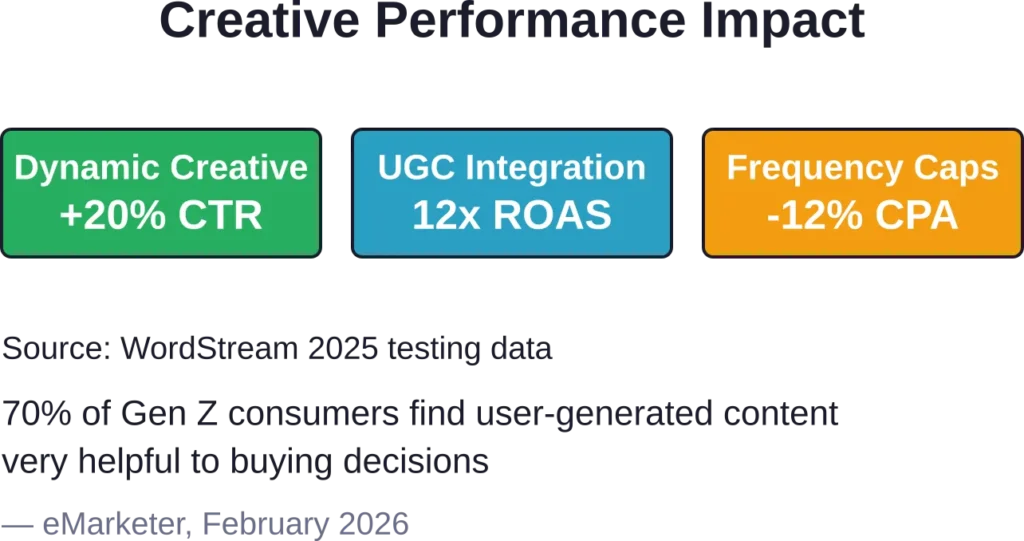
Creative intelligence has become non-negotiable. According to eMarketer data from February 2026, 70% of Gen Z consumers say user-generated content (UGC) is very helpful to their buying journey, and 60% of all consumers consider UGC the most genuine form of advertising. The gap? Tools that analyze why creative performs, not just which creative wins.
And here’s what really matters: decision automation based on conditional logic. The best platforms let teams encode their expertise into rules that execute without manual intervention.
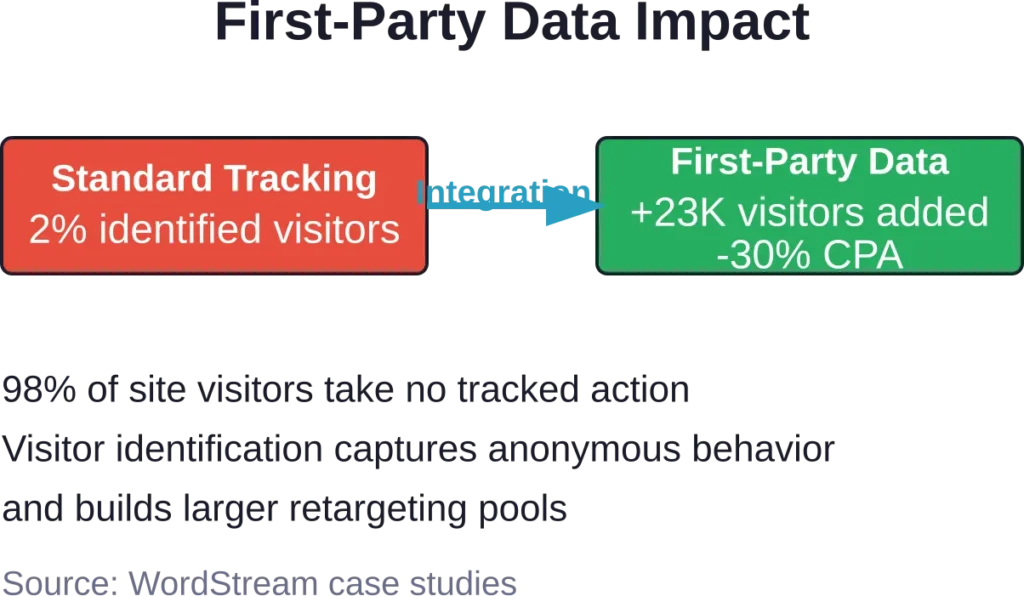
Finally, first-party data integration has become essential. WordStream reports that adding first-party visitor identification to Meta audiences decreased CPA by 30% and added 23,000 additional visitors to retargeting pools.
Category Breakdown: Matching Tools to Constraints
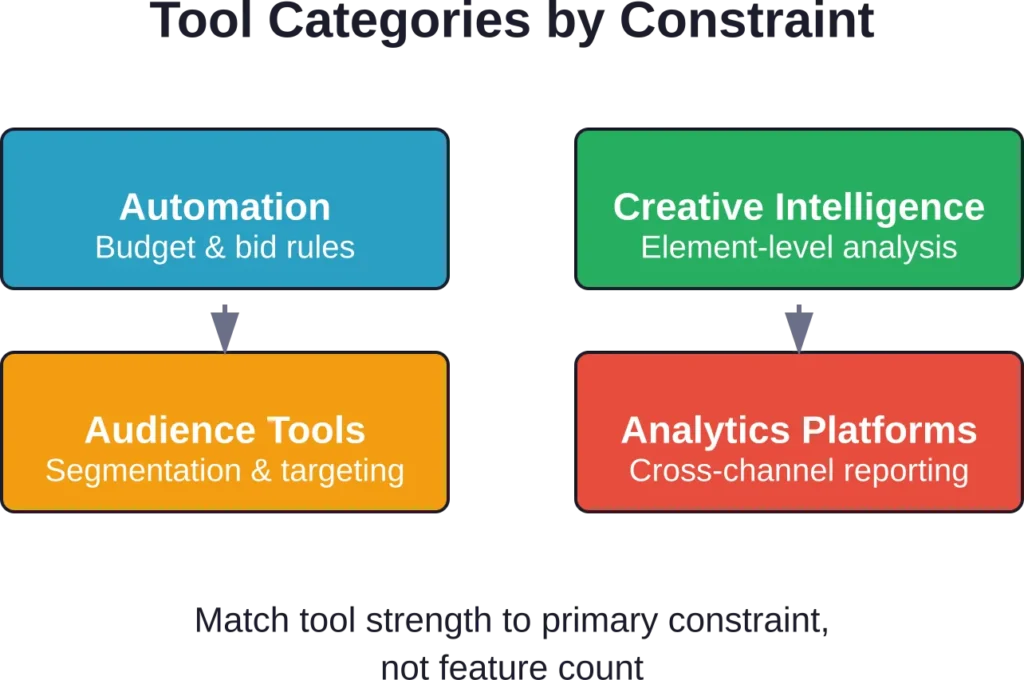
The fatal mistake most teams make? Picking tools based on features instead of constraints.
If creative fatigue is killing performance, an automation tool won’t help. If manual bid adjustments are eating 20 hours per week, creative analytics won’t solve it.
Here’s how the top tools map to specific bottlenecks:
Creative Intelligence and Fatigue Detection
Extuitive: Predictive Pre-Launch Creative Testing
Extuitive takes a completely different approach by predicting creative performance before any ad spend is used. Instead of launching campaigns and waiting for real-world data, the platform uses 150,000+ AI consumer agents modeled on real behavioral data to simulate how audiences will respond.
You connect your Shopify store (or drop in a website URL), and Extuitive analyzes your products, then generates or refines ad copy, images, videos, and pricing. Every variation receives a predicted performance score (High/Medium/Low) with forecasted CTR and ROAS compared to your historical benchmarks. This lets teams kill weak creatives in minutes instead of burning budget on live testing.
The system excels at reducing wasted spend — often cited as 30% of ad budget on underperforming test creatives. It works especially well for direct-response e-commerce brands that need fast iteration cycles and want to launch only high-confidence ads. One-click export to Meta Ads Manager makes the handoff seamless.
Unlike post-launch tools that detect fatigue after it starts, Extuitive prevents creative fatigue by validating winners upstream. It complements Madgicx and Smartly.io perfectly: generate and predict with Extuitive first, then scale and optimize with the others.
Best for Shopify brands and mid-to-large direct-response campaigns where creative risk is the biggest ROAS killer. Smaller teams and high-volume testers get the most value from the rapid feedback loop.
Contact Information:
- Website: extuitive.com
- Email: [email protected]
- LinkedIn: www.linkedin.com/company/extuitive
- Twitter: x.com/Extuitive_Inc
- Instagram: www.instagram.com/extuitiveinc
Madgicx: AI Audience Intelligence
Madgicx approaches optimization from the audience side. The platform’s AI analyzes account performance to identify high-value audience segments and automatically creates targeting combinations.
The system tracks which audience characteristics correlate with better ROAS — demographics, interests, behaviors, device types — then builds custom segments that traditional targeting would miss. This matters because Meta’s broad targeting often delivers inconsistent results across account types and verticals.
Creative fatigue detection runs continuously. When engagement metrics decline on specific ads, the system flags them and suggests refresh timing. WordStream reports that authentic video featuring real people increased ROAS to 12 within one week and drove 97% sales growth month-over-month.
The platform works best for direct-response campaigns with clear conversion events. Brand awareness objectives and long consideration cycles don’t benefit as much from Madgicx’s optimization approach.
Smartly.io: Enterprise Creative Production at Scale

Smartly.io solves a different problem: producing and testing creative variations at enterprise scale. The platform is built for brands running hundreds of campaigns across multiple markets simultaneously.
The creative automation features let teams build templates with dynamic elements — product feeds, localized copy, seasonal messaging — that generate thousands of ad variations without manual production work. This addresses the creative volume problem that enterprise advertisers face.
According to eMarketer research from February 2026, 60% of all consumers consider user-generated content the most genuine form of advertising. Smartly’s template system lets teams incorporate UGC at scale while maintaining brand consistency.
But the platform requires serious ad spend to justify. Most plans target brands spending six figures monthly on Meta. Smaller advertisers pay for capabilities they can’t fully utilize.
Best Tools for Automation and Scaling
Revealbot: Complex Rules and Conditional Logic

Revealbot shines when teams need to automate decisions that normally require constant manual oversight. The platform’s conditional logic system mirrors how experienced media buyers think.
Teams can create rules like “If CPA exceeds $50 for three hours, reduce budget by 30%” or “If ROAS is above 4.0 for 24 hours, increase budget by 50%.” The system executes these adjustments automatically without requiring constant dashboard monitoring.
The real power comes from combining multiple conditions. Set up scenarios like “If CPA is greater than $45 for three consecutive days AND spend exceeds $50, reduce budget by 20%” with granular time windows and spend thresholds.
This works especially well for teams managing multiple client accounts with similar optimization strategies. Plans start at $99 per month and scale based on monthly ad spend.
AdEspresso: Beginner-Friendly Campaign Management
AdEspresso built its reputation on making split testing accessible to teams without dedicated analytics resources. The platform simplifies campaign creation and provides guided optimization recommendations.
The interface walks through campaign setup with clear explanations at each step. Testing workflows are pre-configured for common scenarios — different audiences, creative variations, placement combinations — without requiring manual setup of campaign structures.
But here’s the limitation: AdEspresso works best for straightforward campaigns with clear testing variables. Teams running complex multi-stage funnels or advanced attribution models will outgrow the platform quickly.
Analytics and Attribution Platforms
Opteo: Meta-Native Performance Reporting

Opteo focuses exclusively on Meta advertising with automated reporting and improvement recommendations. The platform connects directly to Meta’s API and surfaces optimization opportunities based on account performance patterns.
The recommendation engine analyzes campaigns daily and flags specific issues: underperforming ad sets, budget allocation inefficiencies, audience overlap, creative fatigue signals. Each recommendation includes expected impact and one-click implementation.
This approach works well for agencies managing multiple Facebook-only accounts. The platform consolidates reporting across client accounts and standardizes optimization workflows. Agency plans start at $199 per month with pricing scaling based on total managed spend.
The limitation? Opteo only works with Meta. Teams running cross-channel campaigns on Google, TikTok, or other platforms need additional tools for unified reporting.
Cross-Platform Solutions
Some teams need unified analytics across Meta, Google, TikTok, and other channels. Cross-platform tools consolidate performance data but sacrifice depth of platform-specific optimization.
The trade-off: broader visibility versus specialized optimization capabilities. For teams where strategic decision-making happens at the portfolio level, consolidated reporting outweighs platform-specific features.
Semrush Social toolkit provides cross-platform analytics with pricing at $20 per month, though the feature set remains limited compared to specialized Meta tools.
Practical Decision Framework
Here’s how to choose between these options without getting lost in feature comparisons.
Start with the constraint causing the most pain right now. Not the constraint that might matter in six months. Not the one that sounds most sophisticated. The actual bottleneck throttling performance today.
| Primary Constraint | Tool Category | Best Options | Typical Investment |
|---|---|---|---|
| Manual bid adjustments eating 15+ hours weekly | Automation | Revealbot, AdEspresso | $99-500/month |
| Creative fatigue killing campaigns after 2 weeks | Creative Intelligence | Madgicx, Smartly.io | $199-1,000+/month |
| Can’t identify which audience segments perform | Audience Tools | Madgicx | $199-750/month |
| Reporting across multiple channels takes days | Analytics Platforms | Opteo, Semrush | $20-199/month |
| Producing creative variations at scale | Enterprise Creative | Smartly.io | $1,000+/month |
Second question: what’s the monthly ad spend? Tools justify their cost through performance improvement, but a $500/month tool makes no sense on $2,000/month spend.
Tool costs should be evaluated based on measurable performance improvement relative to total ad spend. Below 5% suggests underinvestment in optimization capabilities. Above 15% means the tool cost is eating too much margin.
Third consideration: team sophistication. Some platforms assume expertise that junior teams don’t have yet. AdEspresso guides users through optimization. Revealbot expects teams to understand when and why different rules apply.
First-Party Data Integration
The deprecation of third-party cookies and iOS tracking changes fundamentally altered Facebook advertising. Platforms that integrate first-party data now deliver significant advantages.
WordStream reports that visitor identification technology — which captures anonymous site visitors and matches them to Meta profiles — added 23,000 additional visitors to retargeting audiences. The result? A 30% decrease in cost per acquisition.
This matters because Meta’s algorithm performs better with larger, cleaner audience pools. The platform’s AI needs volume to identify patterns and optimize delivery. Shrinking audience sizes from tracking limitations degraded performance across most accounts in 2024-2025.
First-party data integration reverses this trend. Tools that capture behavioral signals beyond Meta’s pixel — site interactions, product views, content engagement, purchase patterns — give the platform better optimization inputs.
But implementation requires technical setup. Most platforms need custom integration work or developer resources to connect data warehouses, CRM systems, and tracking infrastructure.
Common Implementation Mistakes
Most teams make three predictable mistakes when adopting ROAS optimization tools.
Mistake one: collecting tools instead of solving problems. Five different platforms that overlap in functionality create more work, not less. Each additional dashboard adds cognitive load and reporting time.
The fix? Audit existing tools first. Document which capabilities currently exist, where gaps remain, and which subscriptions deliver measurable value. Cancel redundant platforms before adding new ones.
Mistake two: expecting immediate results. Meta’s algorithm needs time to optimize. WordStream notes that spreading $1,000 over five days delivers much lower cost per conversion than spending it in a single day. The platform learns from delivery patterns over time.
New tools follow the same learning curve. Automation rules need performance data to calibrate thresholds. Creative intelligence platforms require weeks of data to establish baseline patterns. Immediate results are rare.
Mistake three: ignoring creative quality. No optimization tool fixes weak creative. Facebook advertising in 2026 is fundamentally a creative game according to multiple industry analyses.
WordStream reports that authentic video featuring real people increased ROAS to 12 within one week and drove 97% sales growth month-over-month. The creative quality mattered more than targeting precision or bid optimization.
Tools amplify what works. They don’t transform weak creative into high performers.
Budget Allocation Across Tools
Teams often ask how much to invest in optimization tools relative to total ad spend.
For accounts spending under $5,000 monthly, start with free or low-cost options. Meta’s native tools handle basic optimization. Semrush Social at $20 monthly provides sufficient analytics. Focus budget on creative production and testing instead of expensive platforms.
At $5,000-25,000 monthly spend, mid-tier automation tools justify their cost. Revealbot at $99-300/month saves enough manual work to pay for itself. Basic creative intelligence becomes valuable at this scale.
Above $25,000 monthly, specialized platforms deliver clear ROI. Madgicx’s audience intelligence, Smartly’s creative automation, and advanced analytics platforms all generate measurable lift that exceeds subscription costs.
Enterprise accounts spending $100,000+ monthly should evaluate multiple specialized tools. The performance gains from best-in-class platforms in each category — automation, creative, analytics — compound across large budgets.
Future-Proofing Tool Selection
The Facebook advertising landscape continues evolving rapidly. AI capabilities expand. Attribution models change. New ad formats launch quarterly.
According to eMarketer research from early 2026, AI tools and automation are reshaping paid social advertising. The tension between automation efficiency and authentic messaging will define the next phase of Meta advertising.
When evaluating tools, prioritize platforms that balance automation with creative authenticity. Systems that optimize delivery while preserving brand voice and genuine messaging will age better than pure performance engines.
Integration capabilities matter increasingly. Tools that connect with data warehouses, CRM systems, and other marketing platforms provide more flexibility as the ecosystem evolves. Closed platforms that only work with Meta face higher risk as advertising diversifies across channels.
Look for transparent algorithm logic. Platforms that explain why they make recommendations — not just what to change — help teams build expertise rather than dependency. Black-box AI that provides no insight into decision-making leaves teams unable to troubleshoot problems or transfer learnings.
Frequently Asked Questions
Most specialized tools become cost-effective around $5,000 monthly ad spend. Below that threshold, the tool subscription costs represent too large a percentage of total spend. Meta’s native optimization handles basic campaigns adequately at smaller scales. Focus budget on creative production and testing instead.
Expect 2-4 weeks for meaningful performance changes. Meta’s algorithm needs time to gather delivery data and calibrate. Automation rules require baseline performance patterns to set appropriate thresholds. Creative intelligence tools need multiple campaign cycles to identify winning elements. Immediate results within days are uncommon.
Tools perform best with at least 50 conversions weekly per campaign. Below that volume, statistical significance becomes difficult and automation rules trigger on insufficient data. Accounts with limited conversion volume should prioritize creative testing and audience expansion before investing in advanced optimization platforms.
Most platforms optimize for any conversion event — lead forms, demo requests, whitepaper downloads, or purchases. The core logic applies regardless of business model. However, tools focused on creative intelligence perform better with visual products than complex B2B services. Automation and analytics platforms work equally well across both.
Automation platforms typically save 10-20 hours weekly on routine tasks like bid adjustments, budget reallocation, and placement optimization. Creative intelligence tools reduce testing analysis time by 60-70% according to vendor claims. However, strategic decisions, creative production, and audience strategy still require human judgment.
Specialized tools outperform generalist platforms in their specific domain. A dedicated creative intelligence tool delivers better insights than the creative module of an all-in-one platform. However, managing multiple tools adds complexity. The right approach depends on team size, budget, and primary constraints. Smaller teams benefit from consolidated platforms. Larger teams with specific pain points should stack specialized solutions.
WordStream provides annual benchmarks tracking Facebook ad performance metrics. As costs increase, optimization becomes more valuable — small percentage improvements in ROAS translate to larger absolute savings. Tools that were marginally worthwhile at lower costs become essential as efficiency margins compress. The average Click-Through Rate on Facebook Ads is 0.89% across all industries according to WordStream benchmarks.
Conclusion
The best ROAS optimization tool for Facebook ads is the one that directly addresses the specific constraint throttling performance right now. Not the platform with the most features. Not the newest AI-powered dashboard. The tool that solves the actual bottleneck.
For teams drowning in manual bid adjustments, Revealbot’s automation delivers immediate time savings. For campaigns dying from creative fatigue, Madgicx’s intelligence prevents the constant performance decay. For enterprise brands producing hundreds of variations, Smartly scales creative production.
The selection process starts with honest diagnosis: where does performance break down? What takes the most time? Which problem, if solved, would unlock the next level of scale?
Match tool strength to that constraint. Ignore features that solve problems not currently faced. Avoid the trap of tool collecting — five overlapping platforms create more work than one focused solution.
And remember: optimization tools amplify what already works. They don’t fix fundamental problems with offer-market fit, weak creative, or poor targeting strategy. Build the foundation first, then add tools that help scale what’s proven.
Ready to improve Facebook ad performance? Start by auditing current constraints, then evaluate tools designed specifically to address those bottlenecks. The right platform will make the decision obvious.