

Quick Summary: AI tools are transforming dropshipping in 2026 by automating product research, customer service, content creation, and ad management. Top tools include ChatGPT for content generation ($20/month), Tidio for automated customer support, and Sell The Trend for product research (starting at $40/month). These AI solutions help dropshippers save time, reduce operational costs, and scale their businesses more efficiently than traditional manual methods.
Running a dropshipping store in 2026 doesn’t have to mean endless hours of manual work. The landscape has shifted dramatically.
AI tools now handle everything from product research to customer service, freeing up time to focus on strategy and growth. And the data backs this up: in 2025, smartphones accounted for nearly 80 percent of all retail website visits worldwide, pushing dropshippers to optimize operations through automation rather than manual effort.
But here’s the thing—not all AI tools deliver the same value. Some automate customer support, others optimize ad spend, and a few handle product sourcing. The challenge isn’t finding AI tools; it’s finding the right ones that actually move the needle for your business.
This guide breaks down the best AI tools for dropshipping available in 2026, covering both free and paid options. Each tool has been evaluated based on real-world performance, pricing structure, and specific use cases.
What AI Brings to Dropshipping in 2026
AI isn’t just a buzzword anymore. It’s become infrastructure.
The technology handles repetitive tasks that used to consume hours each day—scanning supplier inventories, writing product descriptions, responding to common customer questions, testing ad variations. These capabilities allow dropshippers to operate leaner while scaling faster.
Real talk: the shift toward agentic commerce is accelerating adoption. According to data from 2025, ChatGPT usage for product searches among US online adults aged 18–29 was 36%, compared to 31% for ages 30–49 and 11% for ages 50+. That number shows a clear trend—younger consumers are already shopping through AI interfaces.
This creates both opportunity and pressure. Dropshippers who integrate AI tools now gain efficiency advantages that compound over time. Those who wait risk falling behind competitors who’ve already automated their workflows.
The best part? Many powerful AI tools offer free tiers or trials, lowering the barrier to entry significantly compared to traditional software solutions.
Scale Your Creative Output with Extuitive
Extuitive is an AI-first technology company that automates the creation and validation of marketing assets for e-commerce brands. The platform uses a proprietary engine modeled on real-world consumer behavior to predict which ad creatives and product concepts will perform best before any budget is spent. By integrating directly with Shopify, it streamlines the workflow from initial ideation to final launch.
- Generates high-intent ad copy, visuals, and video reels.
- Predicts performance metrics like CTR and ROAS using 150,000+ AI consumer personas.
- Validates creative concepts through simulated market testing.
- Optimizes product pricing and audience targeting based on historical store data.
- Automates high-volume creative production for Meta, TikTok, and web channels.
Schedule a demo or start a subscription to automate your creative strategy with Extuitive.
Key Capabilities to Look for in Dropshipping AI Tools
Not every AI tool fits every business model. The right choice depends on specific bottlenecks and goals.
Here’s what actually matters when evaluating options:
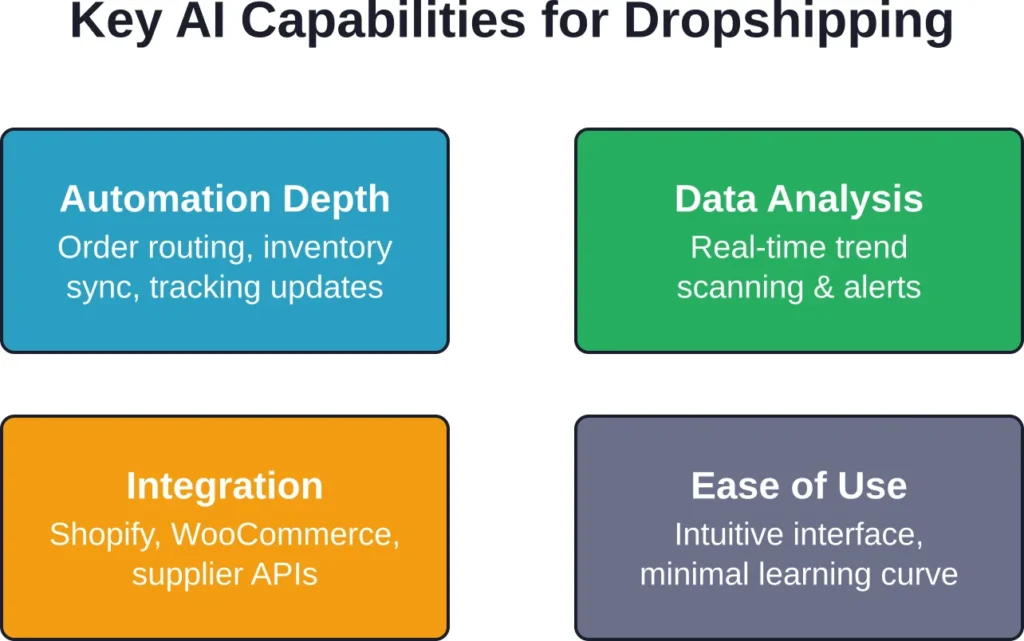
Automation Depth
Surface-level automation saves minutes. Deep automation saves hours. Tools that integrate directly with supplier databases and automatically sync inventory levels prevent stockouts without manual checking. Others handle order routing, tracking updates, and return processing without human intervention.
The distinction matters. A chatbot that handles a significant percentage of customer queries automatically, with some sources indicating up to 70%, eliminates more workload than one capping at 40%.
Data Analysis Speed
Product trends shift quickly. AI tools that analyze market data in real-time identify winning products before saturation hits. Slower tools mean chasing trends that have already peaked.
Look for platforms that scan multiple marketplaces simultaneously and flag products based on specific criteria—engagement rates, sales velocity, competition levels, profit margins.
Integration Flexibility
Tools that work in isolation create more problems than they solve. The best AI platforms integrate seamlessly with Shopify, WooCommerce, and major supplier networks. This prevents data silos and reduces the need to manually transfer information between systems.
Check compatibility before committing to any paid plan.
Learning Curve
Powerful features mean nothing if they take weeks to master. Intuitive interfaces with drag-and-drop functionality, clear documentation, and responsive support make the difference between tools that get used daily and those that sit dormant after the trial period.
Many platforms now offer AI assistants within their own interfaces to guide setup and troubleshooting.
Top AI Tools for Product Research
Finding winning products separates profitable stores from those that struggle. AI accelerates this process by analyzing thousands of data points across multiple platforms.
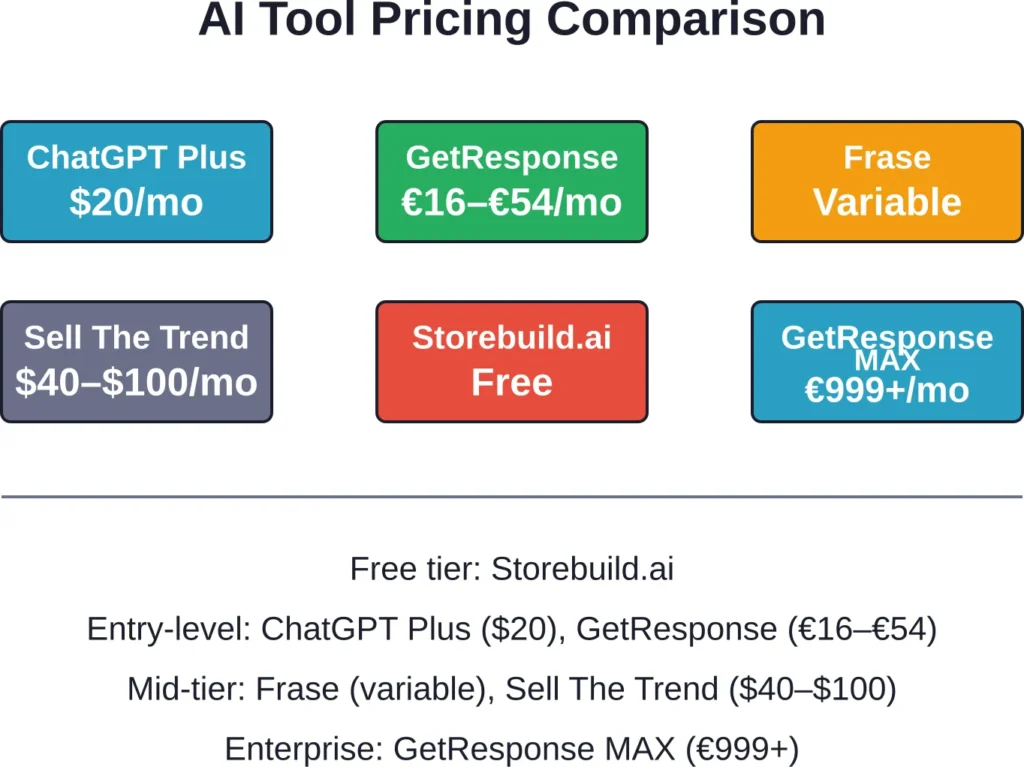
Sell The Trend

Sell The Trend combines product discovery with supplier connections and ad creation tools. The platform scans AliExpress, Amazon, and other marketplaces to identify trending items based on sales data, engagement metrics, and competition analysis.
Pricing starts at $40/month for the basic plan and $100/month for the premium tier with advanced features. The tool integrates directly with Shopify stores, allowing one-click imports of products complete with optimized descriptions.
What makes it stand out: the NEXUS database provides access to US-based suppliers with faster shipping times than traditional AliExpress fulfillment. This addresses one of the biggest pain points in dropshipping—delivery speed.
Storebuild.ai

Storebuild.ai offers a free AI-powered store builder that generates complete product pages from simple inputs. The platform analyzes successful store layouts and applies those patterns to new builds.
The drag-and-drop interface requires no coding knowledge. Templates are optimized for mobile devices, critical given that nearly 80 percent of retail website visits now come from smartphones.
While the free tier covers basic functionality, advanced customization options require upgrading to paid plans. Still, it’s one of the most accessible entry points for new dropshippers testing the model without upfront costs.
PagePilot

PagePilot converts product links into fully optimized product pages in seconds. Paste a URL from a supplier, and the AI generates descriptions, formats specifications, suggests pricing, and creates SEO-friendly content.
This eliminates hours of copywriting work. The AI analyzes high-converting product pages and applies similar structure and language to new listings. Check the official website for current pricing and feature availability.
Best AI Tools for Customer Service Automation
Customer support requests pile up fast as order volume grows. AI chatbots handle routine questions, freeing time for complex issues that require human attention.
Tidio

Tidio combines live chat with AI-powered bots that handle a significant percentage of customer queries automatically, with some sources indicating up to 70%. The system recognizes common questions about shipping times, order status, return policies, and product specifications.
Setup takes minutes. Pre-built templates cover most dropshipping scenarios, and the visual bot builder allows customization without coding. Tidio integrates with Shopify, WooCommerce, and major email platforms.
The free plan supports basic functionality for stores just starting out. Paid plans unlock advanced features like proactive messages and detailed analytics.
ChatGPT

ChatGPT has become a staple tool for dropshippers handling everything from content generation to customer service response templates. The free version provides substantial capability, while ChatGPT Plus subscription plan costs $20/month.
Common use cases include writing product descriptions, generating FAQ content, drafting email sequences, and creating ad copy variations. The multi-language translation capability helps stores expand into international markets without hiring translators.
That said, outputs require review and editing. ChatGPT sometimes produces generic content that needs personalization to match brand voice and specific product details.
Content Creation and Marketing AI Tools
Consistent content drives traffic and conversions. AI tools generate blog posts, social media updates, email campaigns, and ad copy at scale.
Jasper

Jasper specializes in marketing copy optimized for conversions and includes templates for various content types.
Check the official site for current plans and feature availability.
GetResponse

GetResponse combines email marketing with AI-powered automation tools. The platform includes an AI email generator that creates campaigns based on goals, audience data, and past performance metrics.
GetResponse pricing includes Email Marketing plan for €16/month, Marketing Automation plan for €54/month, eCommerce Marketing plan for €106/month, and GetResponse MAX plan for €999/month.
Webinar hosting, landing page builders, and conversion funnels round out the feature set. This makes GetResponse a comprehensive solution for stores focused on email as a primary marketing channel.
Frase

Frase generates SEO-optimized content by analyzing top-ranking pages for target keywords. The tool outlines content structure, suggests headings, and provides research directly within the editor.
Frase pricing varies based on plan tiers and usage requirements. Check the official site for current plans and feature availability.
For dropshippers building content-heavy stores or blogs to drive organic traffic, Frase significantly reduces research and writing time.
AI Tools for Ad Management and Optimization
Paid advertising drives sales, but manual campaign management becomes overwhelming quickly. AI tools optimize bidding, test creative variations, and allocate budget based on performance data.
AdCreative.ai

AdCreative.ai generates ad variations at scale using machine learning trained on high-performing campaigns. Upload product images and basic information, and the platform produces dozens of ad creative options optimized for platforms like Facebook, Instagram, and Google.
The AI tests different headlines, descriptions, calls-to-action, and visual layouts. Performance data feeds back into the algorithm, improving future outputs over time.
Pricing varies based on usage volume. Check the official website for current plans and feature availability.
Copy.ai

Copy.ai focuses specifically on advertising copy generation. The platform includes templates for Facebook ads, Google ads, product descriptions, landing page headlines, and email subject lines.
Copy.ai offers various pricing tiers including a Pro plan with advanced features. A free plan covers basic functionality with usage limits.
What sets Copy.ai apart: the tone adjustment feature allows switching between casual, professional, persuasive, and other styles without rewriting prompts from scratch.
Inventory and Order Management AI Solutions
Managing inventory across multiple suppliers creates complexity. AI tools sync stock levels, automate reordering, and handle fulfillment routing without constant manual oversight.
Inventory Management Systems
Several AI-powered inventory platforms monitor stock levels in real-time and automatically adjust product availability on storefronts when suppliers run low. This prevents overselling and the customer service headaches that follow.
Advanced systems predict demand based on historical sales data and seasonal trends, suggesting optimal reorder quantities and timing. This reduces both stockouts and excess inventory costs.
Integration with major dropshipping platforms and supplier networks is essential. Tools that require manual data entry defeat the purpose of automation.
Order Fulfillment Automation
AI routing systems analyze order details—destination, product type, urgency—and automatically select the optimal supplier and shipping method. This balances cost against delivery speed based on predefined rules.
Tracking information flows automatically to customers, and exceptions trigger alerts for manual review. The result: fewer errors, faster processing, and better customer experience without increasing workload.
Emerging Trends: Agentic Commerce and Transaction Fees
The commerce landscape is shifting toward AI-mediated transactions. Answer engines like ChatGPT now facilitate shopping experiences natively within their interfaces.
Here’s where it gets interesting: these platforms charge merchant fees for transactions processed through their systems. According to Forrester, OpenAI charges a 4% fee to Shopify merchants when customers complete checkout within its answer engine.
For context, Shopify charges 2.9% plus $0.30 for transactions using Shopify Payments, which is standard for credit card processing. The higher fee structure for agentic commerce reflects the additional value—product discovery, recommendation, and transaction handling—provided by AI interfaces.
Dropshippers need to factor these costs into margin calculations when selling through AI-powered platforms. The trade-off: access to new customer segments actively using answer engines for product research and purchasing.
Usage data shows adoption skews younger. While 36% of US online adults aged 18–29 used ChatGPT for product searches in 2025, only 11% of those 50+ did the same. Stores targeting younger demographics may benefit most from early integration with agentic commerce platforms.
Social Media Management with AI
Consistent social presence builds brand awareness and drives traffic. AI scheduling tools and content generators maintain active profiles without daily manual posting.
Social Media Automation Platforms
Modern platforms analyze optimal posting times based on audience engagement patterns and automatically schedule content accordingly. AI copywriting assistants generate captions, hashtag suggestions, and post variations tailored to each platform’s format and audience.
Social media management AI tools typically offer tiered pricing starting from budget-friendly options to premium plans with higher posting volumes.
Cross-platform posting saves significant time. Create content once, and AI reformats it appropriately for Instagram, Facebook, Twitter, TikTok, and Pinterest with platform-specific optimizations.
Video Content Creation AI Tools
Video drives engagement, but production traditionally requires significant time and skill. AI video generators create product demos, unboxing videos, and promotional content from simple inputs.
Synthesia

Synthesia generates videos featuring AI avatars that deliver scripted content. This works well for explainer videos, product tutorials, and customer testimonials without hiring actors or filming.
The platform includes multiple avatar options, background choices, and voice selections. Text-to-speech technology converts scripts into natural-sounding narration in dozens of languages.
Synthesia offers tiered plans with video generation capabilities. Check the official site for current plans and feature availability.
Video Generation and Editing
AI video editing tools automatically trim footage, add transitions, insert music, and generate subtitles. Upload raw clips, and the AI assembles polished videos ready for social media or advertising campaigns.
Video editing AI tools offer various pricing models including free tiers and paid subscriptions.
| Tool Category | Primary Function | Best For | Typical Price Range |
|---|---|---|---|
| Product Research | Trend analysis, supplier sourcing | Finding winning products | $40–$100/month |
| Customer Service | Automated chatbots, response templates | Handling support queries | Free–$50/month |
| Content Creation | Copywriting, blog posts, descriptions | Marketing material | $20–$99/month |
| Ad Management | Creative generation, optimization | Paid campaigns | $30–$150/month |
| Inventory Management | Stock sync, fulfillment routing | Order processing | $50–$200/month |
| Social Media | Scheduling, content generation | Brand building | $15–$79/month |
How to Choose the Right AI Tools for Your Store
Tool selection depends on current bottlenecks and business stage.
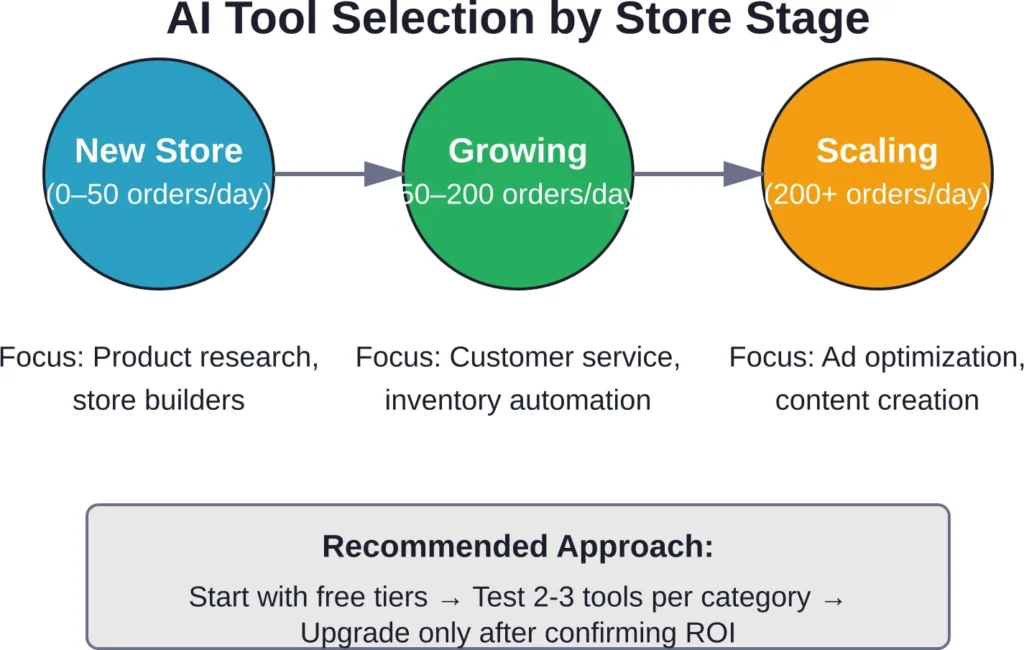
New stores benefit most from product research tools and store builders. These address the fundamental challenge of finding profitable products and launching quickly without technical expertise.
Growing stores seeing increased order volume should prioritize customer service automation and inventory management. These tools prevent the workload explosion that typically occurs when daily orders jump from dozens to hundreds.
Established stores focused on scaling need ad optimization and content creation tools. At this stage, efficient marketing and consistent content production drive growth more than operational tweaks.
Start with Free Tiers
Most AI platforms offer free trials or limited free plans. Test multiple options before committing to paid subscriptions. A tool that works brilliantly for one store might not fit another’s workflow or niche.
Evaluate based on actual usage over at least two weeks. Initial impressions often miss usability issues that emerge during daily operation.
Integration Requirements
Tools must connect seamlessly with existing systems. A powerful product research platform that doesn’t integrate with Shopify creates manual transfer work that negates the time savings.
Check integration compatibility before starting trials. Most platforms list supported connections clearly in their documentation.
Scalability Considerations
Some tools handle small catalogs well but struggle with stores carrying hundreds or thousands of SKUs. Others price based on order volume, making them expensive as sales grow.
Review pricing tiers and usage limits carefully. A tool that seems affordable at current volume might become prohibitively expensive after scaling.
Common Pitfalls When Implementing AI Tools
AI solves specific problems efficiently. But it’s not magic, and misuse creates new issues.
Over-Automation
Automating everything sounds appealing but often backfires. Customer service chatbots that can’t escalate complex issues frustrate customers. Ad tools that run without oversight waste budget on underperforming campaigns.
The sweet spot: automate repetitive, low-judgment tasks while keeping humans in the loop for strategic decisions and edge cases.
Ignoring Data Quality
AI tools are only as good as the data they process. Product research platforms fed incomplete supplier information produce unreliable results. Inventory systems syncing with outdated stock levels cause stockouts.
Clean, accurate data input is non-negotiable for reliable AI performance.
Tool Sprawl
Adding too many tools creates integration headaches and increases complexity instead of reducing it. Each new platform requires setup, learning, and ongoing management.
Start with one tool per major function—product research, customer service, content creation. Consolidate where possible before expanding further.
Neglecting Human Review
AI-generated content, product descriptions, and ad copy require human oversight. The technology produces solid first drafts but often includes generic phrasing, occasional inaccuracies, or tone inconsistencies.
Treat AI output as a starting point that needs editing, not a finished product ready for publication.
Measuring ROI from AI Tools
Subscription costs add up. Tracking return on investment ensures tools justify their expense.
Time Savings
Calculate hours saved per week and multiply by the value of that time. A chatbot handling a significant percentage of customer queries might save 15 hours weekly. If that time gets reallocated to high-value activities like sourcing new products or optimizing campaigns, the tool’s value exceeds its subscription cost.
Revenue Impact
Some tools directly affect sales. Product research platforms that identify winning items or ad optimization tools that improve conversion rates show ROI through increased revenue.
Track sales of products sourced through AI tools separately. Compare conversion rates before and after implementing ad optimization AI.
Cost Reduction
Automation reduces the need for additional hires as order volume grows. A store processing 200 orders daily with AI assistance might operate with the same team size as one handling 100 orders manually.
Calculate the cost of equivalent human labor for tasks AI handles. The difference represents cost savings.
Future Developments in Dropshipping AI
The technology continues evolving rapidly. Several trends will shape the next phase of AI-powered dropshipping.
Deeper Platform Integration
AI capabilities are becoming native features within major e-commerce platforms rather than separate tools. Shopify, WooCommerce, and others are building AI directly into their core systems for product recommendations, inventory optimization, and customer insights.
This reduces tool sprawl and improves data flow between systems.
Predictive Analytics Enhancement
AI models are getting better at forecasting demand, identifying emerging trends before they peak, and predicting customer lifetime value. This allows more strategic inventory decisions and targeted marketing spend.
Voice and Visual Search
AI-powered visual search lets customers find products by uploading images rather than typing descriptions. Voice commerce through smart speakers and AI assistants continues growing, especially among younger demographics already comfortable with answer engines for product research.
Stores optimizing for these search methods gain early mover advantages in emerging channels.
| Tool Name | Primary Use Case | Key Strength | Starting Price |
|---|---|---|---|
| ChatGPT | Content generation, translations | Versatility across tasks | Free/$20/month |
| Tidio | Customer service automation | Significant query resolution | Free tier available |
| Sell The Trend | Product research | US supplier network access | $40/month |
| Storebuild.ai | Store building | Free comprehensive builder | Free |
| Jasper | Marketing copy | Conversion-optimized templates | Check official site |
| GetResponse | Email marketing automation | All-in-one marketing suite | €16/month |
| Frase | SEO content creation | SERP analysis integration | Variable |
| Copy.ai | Ad copywriting | Tone adjustment features | Free/Variable |
Real-World Implementation Strategy
Theory matters less than execution. Here’s a practical rollout approach that minimizes disruption while maximizing AI benefits.
Month 1: Assessment and Testing
Identify the single biggest time drain in current operations. Is it product research? Customer service? Content creation? Start there.
Sign up for free trials of 2-3 tools addressing that bottleneck. Use them daily for two weeks minimum. Track time saved and quality of output.
Month 2: First Tool Integration
Choose the tool that delivered the clearest value during testing. Upgrade to a paid plan if necessary and integrate it fully into the workflow.
Document the process. Create simple guides for any team members who’ll use the tool. Monitor performance metrics weekly.
Month 3: Expansion
Once the first tool runs smoothly, identify the next bottleneck. Repeat the testing process for tools addressing that area.
This phased approach prevents overwhelming the team and allows proper evaluation of each tool’s impact before adding complexity.
Frequently Asked Questions
Not entirely. AI handles repetitive tasks like inventory sync, basic customer queries, content generation, and ad optimization exceptionally well. But strategic decisions—choosing which markets to enter, managing supplier relationships, handling complex customer issues, and overall business planning—still require human judgment. The most successful approach combines AI automation for operational tasks with human oversight for strategic direction.
Most modern AI tools for dropshipping are designed for non-technical users. Platforms like Storebuild.ai, Tidio, and ChatGPT feature intuitive interfaces that require no coding knowledge. Setup typically involves connecting accounts, configuring basic settings through visual menus, and selecting from pre-built templates. That said, understanding basic e-commerce concepts and being comfortable with digital tools helps maximize their value.
Absolutely. Tools like Storebuild.ai, the free tier of ChatGPT, and basic plans from platforms like Tidio provide substantial functionality without upfront costs. New stores can launch and validate their business model using entirely free AI tools. Paid upgrades become worthwhile once revenue justifies the expense and additional features provide clear ROI. Starting free reduces financial risk during the testing phase.
Many AI platforms include multi-language capabilities. ChatGPT provides translation and content generation in dozens of languages. This allows stores to expand internationally without hiring translators. Product descriptions, customer service responses, and marketing materials can be adapted for different markets through AI. Quality varies by language—major languages like Spanish, French, and German typically receive better results than less common ones.
Tool hoarding without purpose. Adding multiple AI platforms before mastering any creates complexity instead of efficiency. Subscriptions pile up, data gets fragmented across systems, and time gets wasted managing tools rather than running the business. Start with one tool addressing the biggest bottleneck, master it completely, then expand methodically. Quality implementation of fewer tools beats superficial adoption of many.
Quarterly reviews work well for most dropshipping businesses. Technology evolves quickly—features get added, pricing changes, and new tools emerge. Every three months, evaluate whether current tools still serve their purpose efficiently and whether alternatives might deliver better value. Don’t change for change’s sake, but stay aware of the landscape. Annual deep reviews should include ROI analysis and consideration of consolidation opportunities.
Emerging AI tools are beginning to address supplier communication, though this area is less developed than others. AI can draft supplier emails, translate communications with overseas manufacturers, and track order status automatically. Some platforms monitor supplier performance metrics and flag issues like delayed shipments or quality problems. Full supplier relationship management still requires human involvement, but AI handles routine coordination tasks effectively.
Taking Action: Your Next Steps
AI tools offer clear advantages for dropshipping businesses in 2026. The technology has matured beyond experimental into genuinely useful applications that save time, reduce costs, and improve customer experience.
But results depend on strategic implementation, not random tool adoption.
Start by identifying the biggest operational bottleneck. Is it finding products? Writing descriptions? Handling customer questions? Managing inventory? Pick one.
Then test 2-3 AI tools that specifically address that problem. Use free trials. Track concrete metrics—time saved, revenue generated, costs reduced.
Commit to the tool that delivers measurable results. Master it completely before expanding to other areas.
The dropshippers who benefit most from AI in 2026 aren’t necessarily those with the most tools. They’re the ones who implement fewer tools exceptionally well, maintain human oversight where it matters, and continuously measure performance against clear goals.
E-commerce continues shifting toward mobile-first experiences (nearly 80 percent of visits now come from smartphones) and younger consumers increasingly discover products through AI interfaces (36% of those aged 18–29 used ChatGPT for product searches in 2025). Stores that adapt workflows to these realities gain sustainable competitive advantages.
The tools exist. The pricing is accessible. The learning curves are manageable. What separates successful implementation from wasted subscriptions is intentional, measured adoption focused on solving real problems rather than chasing trends.
Ready to integrate AI into a dropshipping workflow? Start with one tool this week. Test it thoroughly. Measure the impact. Then decide whether to expand or optimize. Simple, methodical progress beats complexity every time.