

Quick Summary: The best ecommerce web development companies in 2026 combine technical expertise, platform specialization, and scalability support to build online stores that convert. Top agencies range from $25-$199 per hour, with project costs typically spanning $10,000-$100,000 depending on complexity. Selecting the right partner depends on your platform needs, customization requirements, budget, and long-term growth strategy.
Running an online store isn’t just about listing products and hoping for sales. The checkout flow, site speed, mobile experience, and design all determine whether visitors become paying customers or bounce within seconds.
One confusing navigation step or slow-loading product page can erase thousands in potential revenue. That’s why choosing the right ecommerce web development company matters more than most businesses realize.
The challenge? Hundreds of agencies claim ecommerce expertise, but their actual capabilities vary wildly. Some excel at Shopify customization but struggle with enterprise-level integrations. Others build beautiful interfaces that collapse under traffic spikes.
This guide identifies ten ecommerce development companies that consistently deliver results across different platforms, budgets, and business models. Each agency profile includes verified hourly rates, service specializations, and real client outcomes based on corroborated industry data.
What Makes an Ecommerce Development Company Worth Hiring
Not all web development agencies understand ecommerce. Building an online store requires different skills than creating a corporate website or landing page.
The best ecommerce development companies share several characteristics that separate them from generic web shops.
Platform Expertise That Matches Your Needs
Platform choice dictates everything from hosting costs to available integrations. Top agencies don’t just claim familiarity with Shopify, WooCommerce, or Magento—they demonstrate deep specialization.
Look for partners who’ve built stores on your preferred platform specifically. A developer who’s brilliant at custom Laravel solutions might struggle with Shopify Liquid templating. Platform-specific experience prevents expensive mistakes and redesigns.
Custom Development Capability
Off-the-shelf templates work for basic stores. But businesses with unique workflows, complex product configurations, or specialized integrations need custom development.
According to Stanford Graduate School of Business case study ‘E-Commerce Building Blocks’ (2000), successful online businesses require coordinated resources including technology infrastructure, strategy development, and specialized service providers who can adapt solutions to specific business models.
The right agency builds features that match your business model rather than forcing you into template constraints.
Transparent Pricing Models
Ecommerce development costs vary dramatically. Industry data shows that basic Shopify or WooCommerce stores start around $10,000–$15,000, while enterprise-level custom solutions with advanced integrations can exceed $50,000–$100,000.
Reputable agencies clarify pricing structures upfront. They explain what’s included in fixed-price packages versus hourly work, and they identify potential cost variables before projects begin.
Post-Launch Support
Launch day is just the beginning. Ecommerce sites need ongoing maintenance, security updates, performance optimization, and feature additions as businesses grow.
Top development companies offer support packages that keep stores running smoothly. This includes monitoring, backups, emergency fixes, and strategic improvements based on analytics data.
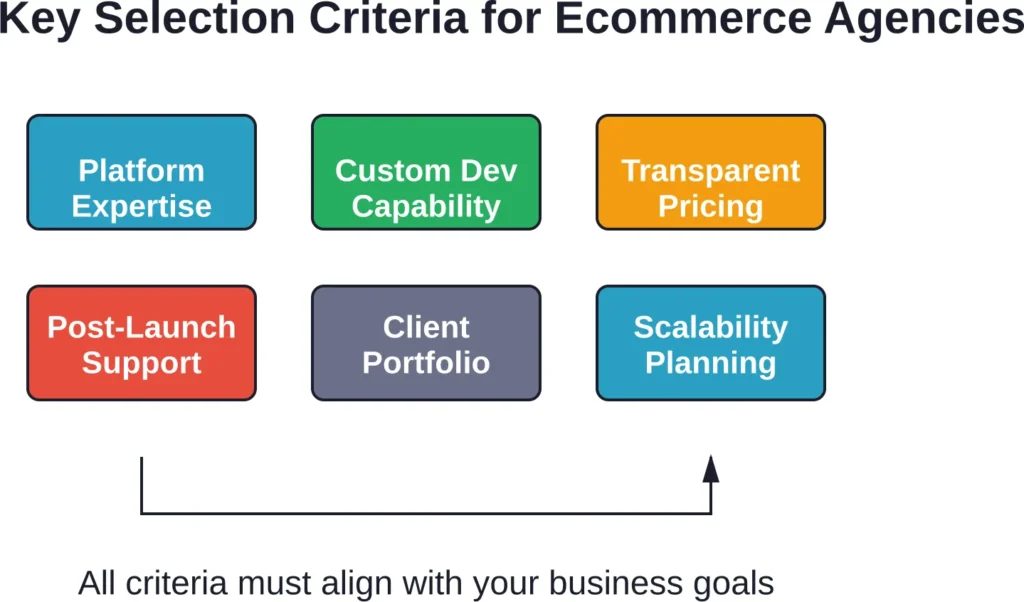
Top 15 Ecommerce Web Development Companies 2026
These agencies represent different specializations, price points, and platform focuses. Each has documented success with real ecommerce projects and verified client reviews.
1. Gilzor

Gilzor focuses on custom software development and full-cycle web/mobile solutions for startups, SMBs, and product studios that need scalable digital products beyond off-the-shelf tools.
Their client work includes ecommerce platforms, automation tools, and industry-specific applications with strong emphasis on idea validation, UI/UX, and post-launch support.
Service Lines: Web Development, Mobile Development, E-Commerce Solutions, QA, Go-to-Market
Best For: Startups and growing businesses needing end-to-end custom development
Gilzor’s strength lies in combining technical execution with business strategy. They help validate ideas, build user-friendly products, and support long-term scaling, making them a reliable partner for companies that want high-quality results without overpaying for overhead.
Contact Information:
- Website: www.gilzor.com
- Email: [email protected]
- Address: Poland, Warsaw, Office 58, street Adama Mickiewicza 37, 01-625
- LinkedIn: www.linkedin.com/company/gilzor-softwaredevelopment
2. Lengreo

Lengreo operates as a full-service B2B digital marketing and tech agency with strong expertise in SEO, lead generation, paid ads, and website development (including ecommerce).
Their service model integrates strategy consulting, performance marketing, and technical implementation—ideal for businesses seeking a single partner for growth rather than multiple specialists.
Platforms: Custom websites, ecommerce solutions, landing pages
Notable Clients: Powerkh, CXDojo, Blocksport, and various SaaS, biotech, and ecommerce brands
Lengreo stands out for delivering measurable ROI through qualified lead generation and conversion optimization. They don’t just run campaigns—they deeply integrate into client processes, providing transparent reporting and tailored strategies that drive real business results.
Contact Information:
- Website: Lengreo.com
- Phone: +31 686 147 566
- Email: [email protected]
- Address: Vrijstraat 9 C/D, 5611 AT Eindhoven, Netherlands
- LinkedIn: Lengreo
- Twitter: @Lengreo
- Instagram: @lengreo
3. OSKI Solutions

OSKI Solutions delivers expert web development, cloud solutions, AI integrations, and ongoing support for tech-forward enterprises and ambitious startups.
They specialize in building and maintaining robust software across industries like ecommerce, logistics, fintech, education, and travel.
Service Lines: Web/Frontend Development, Cloud Solutions, AI Integrations, CMS (Umbraco, WordPress)
Best For: Businesses needing reliable, scalable digital solutions with fast team ramp-up
OSKI stands out for AI-accelerated engineering and 25+ years of combined expertise. They focus on smart, maintainable solutions that help companies reimagine operations, with quick onboarding (2–4 weeks) and strong emphasis on quality and long-term partnership.
Contact Information:
- Website: oski.site
- Phone: +48571282759
- Email: [email protected]
- Address: Kaupmehe tn 7, 10114 Tallinn, Estonia
- LinkedIn: www.linkedin.com/company/oski-solutions
4. A-Listware
A-Listware is a software development and IT consulting company specializing in dedicated teams, custom solutions, and full-spectrum IT services for businesses seeking cost-effective yet high-quality outsourcing.
They cover everything from software development and UX/UI to data analytics, cybersecurity, and managed infrastructure.
Service Lines: Software Development, Dedicated Teams, UX/UI Design, Testing & QA, IT Consulting, Cloud & Cybersecurity
Best For: Companies needing extended development teams or comprehensive IT support
A-Listware excels at seamless team integration and round-the-clock expert access. They act as a natural extension of your in-house team, delivering secure, responsive solutions while optimizing costs and maintaining strong communication.
Contact Information:
- Website: a-listware.com
- Phone: +1 (888) 337 93 73
- Email: [email protected]
- Address: North Bergen, NJ 07047, USA
- LinkedIn: www.linkedin.com/company/a-listware
- Facebook: www.facebook.com/alistware
5. Mobian Studio
Mobian Studio serves as an AI & software development partner, building dedicated engineering teams for mobile, AI, and full-stack solutions in IT, Healthcare, Fintech, and Logistics.
They offer both outsourcing (full delivery) and outstaffing (team augmentation) models with senior-level talent.
Service Lines: Mobile Development, AI & Automation, End-to-End Product Development, Scalable Architecture
Best For: Companies that need fast, reliable senior execution without hiring overhead
Mobian stands out for senior engineers, clean architecture, and post-launch partnership. They focus on production-ready code, domain-specific expertise, and sustainable scaling—helping clients ship faster while maintaining long-term code quality and flexibility.
Contact Information:
- Website: mobian.studio
- Phone: [email protected]
- Address: Harju maakond, Tallinn, Kesklinnalinnaosa, Masina tn 22, 10113
- LinkedIn: www.linkedin.com/company/mobian-studio
6. Coalition Technologies

Coalition Technologies operates as a full-service digital agency with particular strength in ecommerce platform development and ongoing optimization.
Their service model combines web design, development, SEO, and paid advertising under one roof—useful for businesses that want integrated strategy rather than coordinating multiple vendors.
Platforms: Shopify, WooCommerce, Magento, custom solutions
Notable Clients: Wide range across retail, B2B, and DTC brands
Coalition stands out for combining technical development with marketing execution. They don’t just build stores—they optimize conversion rates, manage PPC campaigns, and implement SEO strategies that drive qualified traffic.
7. Techling LLC

Techling LLC focuses on mid-market ecommerce businesses that need custom functionality beyond standard template capabilities.
Their client roster includes CAPA, Chex AI, Cazvid, Dressup, Deft GPT, and Daspire—companies that required specialized integrations and custom feature development.
Service Lines: E-Commerce Development, Web Design, AI Development
Best For: Businesses needing cost-effective custom solutions
Techling’s lower hourly rate makes them accessible for businesses with tighter budgets but complex requirements. Their AI development capability adds unique value for stores exploring automation and personalization.
8. 99 Ecommerce Experts

99 Ecommerce Experts positions itself as a cost-efficient option for various business sizes, with emphasis on practical solutions over unnecessary complexity.
Minimum Project: Adjustable for smaller operations
Geographic Focus: USA with nationwide service
Their flexible project minimums make them suitable for smaller retailers testing ecommerce or businesses that need specific enhancements rather than full rebuilds.
9. Disruptive Advertising

While primarily known for paid advertising management, Disruptive Advertising offers ecommerce development services integrated with their marketing expertise.
Reviews: Over 350 verified reviews
Specialty: Development paired with conversion optimization and advertising
Their dual focus on development and marketing makes sense for businesses that want their store architecture designed around conversion goals from day one.
10. WebFX
WebFX operates as a full-service digital agency with dedicated ecommerce development teams alongside SEO, content, and advertising departments.
They’ve built a reputation for data-driven approaches that connect development decisions to measurable business outcomes.
Service Model: Full-service with ecommerce specialization
Platforms: Multi-platform expertise including Shopify, BigCommerce, WooCommerce, custom
Best For: Mid-to-large businesses wanting comprehensive digital strategy
WebFX’s scale allows them to staff projects with specialists rather than generalists. Separate teams handle design, development, SEO, and ongoing optimization.
11. Dotlogics
Dotlogics emphasizes custom ecommerce solutions for brands with unique requirements that standard platforms can’t accommodate easily.
Location: East Northport, NY
Specialty: Custom development and complex integrations
Their smaller team size allows for more direct communication with senior developers. Projects receive personalized attention rather than being passed through multiple account managers.
12. Big Drop Inc
Big Drop Inc combines ecommerce development with strong branding and design capabilities—useful for businesses launching new brands or repositioning existing ones.
Location: New York (with additional offices)
Service Focus: Design-forward ecommerce development
Best For: Brands where visual identity and user experience drive differentiation
Their portfolio shows particular strength in creating distinctive brand experiences rather than generic online stores. Expect higher emphasis on custom design work.
13. Rave Digital

Rave Digital specializes in Shopify and Shopify Plus implementations, making them ideal for businesses committed to that ecosystem.
Platform Focus: Shopify, Shopify Plus
Services: Development, theme customization, app integration, ongoing optimization
Best For: Shopify-specific projects requiring deep platform expertise
Platform specialists understand nuances that generalist agencies miss. Rave Digital’s Shopify focus means they know which apps integrate cleanly, which customizations cause maintenance headaches, and how to structure stores for optimal performance.
14. Groove Commerce
Groove Commerce focuses on mid-market and enterprise ecommerce across multiple platforms with emphasis on scalable architecture.
Platforms: Shopify Plus, BigCommerce, Magento, custom headless solutions
Team Expertise: Enterprise-level ecommerce architecture
Best For: Growing businesses planning for scale
They excel at building stores that handle growth without requiring rebuilds. Their architecture planning considers inventory complexity, order volume, and integration needs that emerge as businesses expand.
15. Forix Web Design
Forix Web Design offers comprehensive ecommerce services with particular strength in mobile commerce and progressive web apps.
Specialties: Mobile-first design, PWA development, platform migrations
Platform Coverage: Magento, Shopify, custom solutions
Best For: Businesses prioritizing mobile shopping experience
As mobile commerce continues growing, Forix’s mobile-first approach ensures stores perform well on smartphones without treating mobile as an afterthought.
Comparing Ecommerce Development Costs and Services
Understanding cost structures helps set realistic budgets and prevents scope creep during projects.
| Project Type | Typical Cost Range | Timeline | Best For |
|---|---|---|---|
| Basic Shopify/WooCommerce Store | $10,000–$15,000 | 4–6 weeks | New businesses, simple product catalogs |
| Custom Template Modifications | $15,000–$35,000 | 6–10 weeks | Established brands needing unique features |
| Advanced Integrations | $35,000–$75,000 | 10–16 weeks | Multi-channel retailers, complex workflows |
| Enterprise Custom Solutions | $75,000–$100,000+ | 16+ weeks | Large catalogs, custom backend systems, AI features |
These ranges reflect corroborated industry data. Actual costs depend on specific requirements, chosen platform, and agency rates.
Here’s the thing though—cheaper isn’t always better. A $12,000 store that converts poorly costs more than a $40,000 store that doubles conversion rates.
Platform Specialization Matters More Than You Think
Ecommerce platforms aren’t interchangeable. Each has different strengths, limitations, and ideal use cases.
Shopify and Shopify Plus
Shopify dominates the mid-market ecommerce space with good reason. It offers reliable hosting, excellent security, and an app ecosystem that extends functionality without custom code.
Shopify Plus adds enterprise features like custom checkout experiences, automation tools, and dedicated support. It’s designed for stores processing significant volume or requiring advanced customization.
Look for agencies with Shopify Partner status and portfolios showing actual Plus implementations if that’s your target platform.
WooCommerce
WooCommerce runs on WordPress, giving businesses full control over hosting, data, and customization. It’s ideal for companies that want ownership rather than renting platform access.
The tradeoff? You’re responsible for security, updates, hosting quality, and performance optimization. WooCommerce projects need agencies comfortable with WordPress development and server management.
Magento (Adobe Commerce)
Magento serves enterprise retailers with complex catalogs, multiple storefronts, or sophisticated B2B requirements. It’s powerful but requires specialized development expertise.
Don’t choose Magento for simple stores—the complexity and hosting costs aren’t justified. But for large-scale operations, its capabilities exceed simpler platforms.
Custom Headless Solutions
Headless commerce separates the front-end user interface from the back-end commerce engine. This architecture enables omnichannel experiences, progressive web apps, and unique customer journeys.
Successful online businesses increasingly rely on modular technology stacks that allow flexibility and specialized service integration. Headless development costs more initially but provides flexibility that monolithic platforms can’t match. It’s worth considering for businesses with unique customer experience requirements.
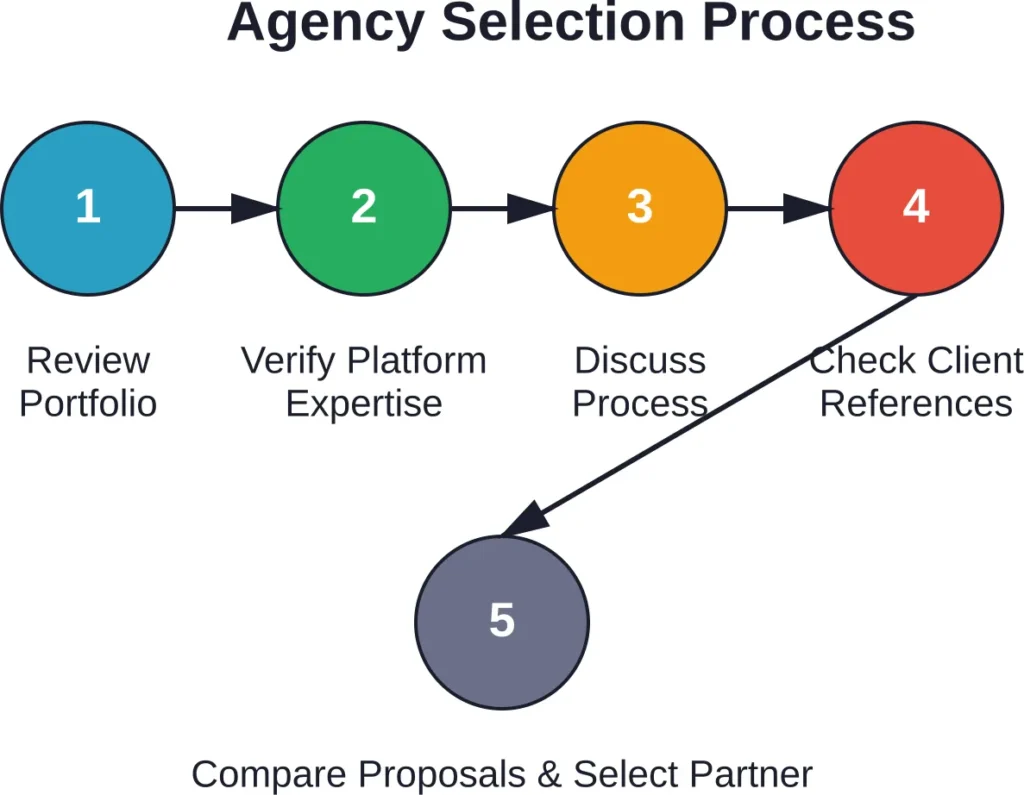
How to Choose the Right Ecommerce Development Partner
Agency selection determines project success more than any other factor. The right technical partner accelerates growth. The wrong one creates expensive problems.
Review Relevant Portfolio Work
Don’t just look at pretty designs. Examine stores similar to what you’re building in terms of product count, complexity, and business model.
Ask for live URLs you can test. Browse the stores as a customer. Add items to cart. Go through checkout. Check mobile performance. Portfolios often showcase design but hide functional problems.
Verify Platform Certifications
Major ecommerce platforms offer partner programs with verified expertise tiers. Shopify Partners, BigCommerce Partners, and Adobe Solution Partners all indicate genuine platform experience.
Certifications aren’t everything, but they demonstrate investment in platform-specific training and access to vendor support channels.
Discuss Post-Launch Support
Launch is just the beginning. Stores need ongoing updates, security patches, performance monitoring, and feature additions.
Clarify support options before signing contracts. What’s included? What costs extra? How quickly do they respond to urgent issues? Do they offer proactive monitoring?
Understand Their Development Process
How does the agency approach projects? Do they use agile methodologies with regular milestones? Do you get staging environments for testing? How do they handle feedback and revisions?
Process matters. Agencies with clear workflows, communication protocols, and quality assurance steps deliver better results than those winging it.
Check References
Talk to past clients with projects similar to yours. Ask about communication, deadline adherence, budget accuracy, and post-launch support quality.
References provide insight that portfolios and sales calls don’t. Past clients will honestly discuss challenges the agency faced and how they handled problems.
Red Flags to Watch During Agency Evaluation
Some warning signs indicate agencies to avoid regardless of their portfolios or pricing.
Vague Pricing Without Scope Definition
Legitimate agencies provide detailed estimates after understanding requirements. If an agency quotes prices before discussing your specific needs, they’re guessing.
Vague estimates lead to scope creep, surprise costs, and project disputes. Insist on itemized proposals that connect specific deliverables to costs.
No Questions About Your Business Model
Good agencies ask detailed questions about your products, customers, workflows, and growth plans. They need this information to build appropriate solutions.
If an agency jumps straight to technical recommendations without understanding your business, they’re template pushers, not strategic partners.
Unrealistic Timeline Promises
Custom ecommerce development takes time. Basic stores need 4-6 weeks minimum. Complex builds require months.
Agencies promising full custom stores in two weeks are either lying about timelines or planning to deliver template-based work regardless of your actual needs.
Portfolio Shows Only Screenshots
Screenshots can hide non-functional designs or sites that no longer exist. Legitimate portfolios provide live URLs you can test.
If an agency won’t share working store URLs, question whether those projects actually launched successfully.
The Real Cost of Choosing the Wrong Agency
Bad agency selection creates problems that extend far beyond wasted development budgets.
Poorly built stores require complete rebuilds within months. That means paying twice for the same functionality—once for the failed attempt, again for the fix.
Performance problems hurt conversion rates. Even a one-second delay in page load time can drop conversions by double digits. Slow stores cost revenue every single day they’re live.
Security vulnerabilities expose customer data and destroy trust. A single breach can end businesses entirely, especially smaller operations without resources to recover.
But the thing is, prevention costs less than recovery. Investing in the right agency upfront prevents these expensive problems.
Questions to Ask Before Signing Contracts
These questions reveal how agencies actually work beyond their marketing claims.
Who specifically will work on my project? Get names and see their portfolios. Senior team members close deals, but junior developers often do the work.
What’s your quality assurance process? How do they test functionality, performance, and cross-browser compatibility before launch?
How do you handle scope changes? Projects evolve. Understand their change request process and associated costs.
What happens if we’re not satisfied? What revision rounds are included? What constitutes project completion?
Who owns the code? Ensure contracts transfer full ownership of custom code to you. Some agencies retain rights, creating dependency.
What’s included in post-launch support? Define exactly what support covers and for how long.
Platform-Specific Considerations
| Platform | Best For | Key Advantages | Limitations |
|---|---|---|---|
| Shopify | Fast launches, reliable hosting | Excellent support, app ecosystem, security | Limited checkout customization (non-Plus) |
| Shopify Plus | High-volume stores, enterprise needs | Custom checkout, automation, dedicated support | Higher monthly costs, still platform constraints |
| WooCommerce | Full control, WordPress integration | Complete customization, data ownership | Requires hosting management, security responsibility |
| Magento | Large catalogs, complex B2B | Enterprise features, unlimited scalability | Requires specialized developers, expensive hosting |
| BigCommerce | Growing businesses, multi-channel | No transaction fees, strong SEO features | Smaller app ecosystem than Shopify |
Frequently Asked Questions
Ecommerce development costs range from $10,000–$15,000 for basic Shopify or WooCommerce stores to over $100,000 for enterprise-level custom solutions with advanced integrations, AI features, or mobile apps. The final cost depends on platform choice, design complexity, number of products, required integrations, and custom functionality needs. Always request itemized estimates that connect specific features to costs.
Platform choice depends on your specific requirements. Shopify works well for businesses wanting reliable hosting and quick launches. WooCommerce suits those needing complete control and WordPress integration. Magento serves enterprise retailers with complex catalogs and B2B requirements. BigCommerce fits growing businesses focused on multi-channel selling. Discuss your business model, technical resources, and growth plans with potential agencies—they can recommend appropriate platforms based on actual needs.
Basic template-based stores typically require 4-6 weeks from kickoff to launch. Custom designs with moderate functionality need 6-10 weeks. Complex builds with custom integrations, advanced features, or enterprise requirements take 16+ weeks. Timeline depends on scope definition, content readiness, revision rounds, and responsiveness from both parties. Agencies promising unrealistic timelines often deliver rushed, low-quality work.
Shopify Plus is the enterprise version designed for high-volume stores. It adds custom checkout experiences, advanced automation tools (Shopify Flow), dedicated account management, higher API limits, and better wholesale functionality. Monthly costs start around $2,000 versus $29-$299 for standard Shopify. Most businesses don’t need Plus until they’re processing significant monthly revenue or require specific enterprise features.
Specialized agencies offer deeper platform expertise and typically deliver better technical implementations. Full-service agencies provide integrated strategy across development, marketing, SEO, and advertising—useful if you want coordinated execution. Choose specialists for complex technical builds or specific platform requirements. Choose full-service for integrated digital strategy where one team handles multiple functions. Your decision should reflect whether you need best-in-class technical execution or coordinated multi-channel strategy.
Recurring costs include platform fees (Shopify charges $29-$2,000+ monthly depending on plan), hosting (if self-hosted), security certificates, payment processing fees (typically 2.9% + $0.30 per transaction), marketing apps and tools, and maintenance. Budget for ongoing support, updates, and optimization. Many agencies offer monthly retainers covering monitoring, security updates, performance optimization, and minor enhancements. Plan for 15-20% of initial development cost annually for proper maintenance.
Request live URLs for stores similar to your project. Visit them as a customer—browse products, add items to cart, check mobile performance. Verify the agency actually built the sites by checking source code comments or asking for client references. Screenshots can hide problems or showcase sites the agency didn’t build. Legitimate agencies proudly share working URLs and connect you with past clients who can verify their work quality.
Final Considerations
Selecting an ecommerce development company determines whether your online store becomes a growth engine or expensive liability.
The agencies listed here represent different specializations, budgets, and approaches. None is objectively “best”—the right choice depends on your specific platform needs, budget constraints, and business goals.
Take time during evaluation. Review portfolios thoroughly. Check references. Discuss processes in detail. Understand costs completely before signing contracts.
Most importantly, choose agencies that ask questions about your business model, customers, and growth plans. Technical expertise matters, but strategic thinking separates great implementations from generic template work.
The right development partner doesn’t just build a website. They create infrastructure that supports your business as it grows, adapts to market changes, and delivers measurable ROI through improved conversion rates and customer experience.
Ready to start your ecommerce project? Reach out to 2-3 agencies from this list that match your platform and budget requirements. Compare their approaches, processes, and proposals before making your final selection. The extra diligence upfront prevents expensive mistakes later.