

Quick Summary: The top professional web development companies in 2026 include Lengreo, Gilzor, OSKI Solutions, A-Listware, Mobian Studio, Excited Agency, Clay, Code and Theory, Thrive Internet Marketing Agency, Digital Silk, Huemor, Lounge Lizard, eDesign Interactive, Bop Design, and Duck Design. These agencies offer specialized services ranging from SaaS product design to enterprise web solutions, with project costs typically starting from $10,000 to $250,000+ depending on complexity and scope.
Finding the right web development partner can make or break your digital presence. With hundreds of agencies claiming to be the best, how do you cut through the noise and find one that actually delivers?
The web development landscape has shifted dramatically. Gone are the days when any agency with a WordPress theme could build your site. Today’s top firms combine UX research, conversion optimization, branding, and technical excellence to create websites that don’t just look good—they drive real business results.
This guide breaks down the 15 best professional web development companies operating in 2026. Each agency on this list has been selected based on their proven track record, client reviews, service offerings, and ability to deliver projects that scale with your business.
What Makes a Web Development Company Great in 2026?
Not all web development agencies operate the same way. The best ones share several characteristics that set them apart from the competition.
Real talk: a great web development company doesn’t just code your site and hand you the keys. They approach projects strategically, starting with research into your target audience, competitors, and business goals. This foundation shapes everything from information architecture to visual design.
Top-tier agencies also maintain transparent communication throughout the project lifecycle. They provide regular updates, involve clients in key decisions, and set realistic timelines rather than overpromising and underdelivering.
Here’s what separates the best from the rest:
- Deep expertise in specific industries or project types rather than trying to be everything to everyone
- Clear pricing structures with detailed project scopes
- Portfolio of work that demonstrates both aesthetic quality and measurable business outcomes
- Strong client reviews on platforms like Clutch that verify their claims
- Technical capabilities that extend beyond basic website builds to include performance optimization, security, and scalability
The agencies featured in this list excel across these criteria. But they also bring something else to the table—a product-first mindset that treats your website as a growth engine, not just a digital brochure.
Top 15 Professional Web Development Companies
The following agencies represent the best options for businesses seeking professional web development services in 2026. Each has distinct strengths, pricing models, and ideal client profiles.
1. A-Listware
A-Listware is an established software development and IT outsourcing company with over a decade of experience delivering secure, responsive web and enterprise solutions. They specialize in dedicated teams, custom development, and full IT ecosystem support.
The agency offers everything from web application development to UI/UX, QA, and infrastructure services, with a focus on cost-effective, high-quality outsourcing.
Best for: Businesses seeking dedicated development teams or comprehensive outsourcing for web projects, enterprise applications, and long-term IT support.
Contact Information:
- Website: a-listware.com
- Phone: +1 (888) 337 93 73
- Email: [email protected]
- Address: North Bergen, NJ 07047, USA
- LinkedIn: www.linkedin.com/company/a-listware
- Facebook: www.facebook.com/alistware
2. Gilzor
Gilzor is a full-cycle custom software development company focused on practical, scalable web and mobile solutions for startups and SMBs. They emphasize idea validation, user-centric design, and long-term product growth rather than just coding.
The agency delivers end-to-end services including UI/UX, development, QA, and post-launch maintenance, helping clients launch products that attract users and investors.
Best for: Startups and small/medium businesses looking for reliable custom web development tied to real business outcomes and growth.
Contact Information:
- Website: www.gilzor.com
- Email: [email protected]
- Address: Poland, Warsaw, Office 58, street Adama Mickiewicza 37, 01-625
- LinkedIn: www.linkedin.com/company/gilzor-softwaredevelopment
3. OSKI Solutions
OSKI Solutions builds well-engineered, scalable web applications and digital platforms with a strong engineering focus. They combine custom development, cloud solutions, frontend expertise, and AI integrations for enterprises and ambitious startups.
Their process prioritizes quality, long-term maintainability, and business results, with notable experience in Umbraco CMS and Microsoft technologies.
Best for: Tech-forward companies and startups needing reliable, scalable web solutions with ongoing support and cloud/AI capabilities.
Contact Information:
- Website: oski.site
- Phone: +48571282759
- Email: [email protected]
- Address: Kaupmehe tn 7, 10114 Tallinn, Estonia
- LinkedIn: www.linkedin.com/company/oski-solutions
4. Lengreo
Lengreo operates as a full-cycle digital partner combining web development with marketing expertise. They build custom eCommerce, business websites, landing pages, and complex platforms, with a strong focus on performance, lead generation, and measurable business growth.
Their approach starts with discovery, business analysis, and user research before moving into design, development, and ongoing support. They particularly excel in niche sectors like adult businesses, SaaS, and tech companies needing integrated digital solutions.
Best for: Startups and mid-sized businesses that need both high-performing websites and integrated marketing/lead generation support.
Contact Information:
- Website: Lengreo.com
- Phone: +31 686 147 566
- Email: [email protected]
- Address: Vrijstraat 9 C/D, 5611 AT Eindhoven, Netherlands
- LinkedIn: Lengreo
- Twitter: @Lengreo
- Instagram: @lengreo
5. Mobian Studio
Mobian Studio is a European partner specializing in dedicated engineering teams for mobile, web, and AI-powered solutions. They deliver production-ready software through outsourcing or outstaffing models with strong emphasis on clean architecture and scalability.
The studio focuses on industries like IT, Healthcare, Fintech, and Logistics, helping companies ship faster without compromising quality.
Best for: Companies in regulated or complex domains (Healthcare, Fintech, Logistics) that need reliable dedicated teams or full-cycle development with AI and mobile expertise.
Contact Information:
- Website: mobian.studio
- Phone: [email protected]
- Address: Harju maakond, Tallinn, Kesklinnalinnaosa, Masina tn 22, 10113
- LinkedIn: www.linkedin.com/company/mobian-studio
6. Excited Agency
Excited Agency approaches web design through a product-first lens, focusing on clarity, structure, and conversion rather than surface-level aesthetics. The agency combines UX research, web design, branding, and motion design to create websites that scale with the product and support long-term growth.
What sets Excited apart is their systematic approach to design problems. They don’t jump straight into visuals—they start with understanding how the website fits into the broader product ecosystem and customer journey.
Best for: SaaS companies and tech startups that need websites tightly integrated with their product strategy and brand positioning.
7. Clay
Clay has built a reputation for creating visually stunning, high-impact websites for established brands. Their work portfolio includes some of the most recognizable names in tech and consumer products.
The agency excels at translating complex brand narratives into intuitive digital experiences. Their design philosophy emphasizes bold visual choices paired with seamless functionality.
Best for: Established brands with substantial budgets looking for premium design work that makes a statement in the market.
8. Code and Theory
Code and Theory operates at the enterprise level, delivering large-scale digital transformation projects for Fortune 500 companies and global brands. The agency brings together strategy, design, and technology under one roof.
Their approach centers on solving complex business challenges through digital innovation. Projects often span multiple touchpoints—websites, mobile apps, and custom platforms built to handle millions of users.
Best for: Enterprise organizations requiring comprehensive digital solutions with the infrastructure to support large-scale implementations.
9. Thrive Internet Marketing Agency
Thrive takes a marketing-first approach to web development, ensuring every design decision supports lead generation and conversion goals. The agency has demonstrated significant success in AI SEO strategies, achieving substantial growth in referral traffic from AI platforms, with reports of significant increases from generative AI platforms.
Beyond building websites, Thrive offers integrated digital marketing services that drive traffic and conversions once the site launches. This makes them particularly valuable for businesses that need both development and ongoing marketing support.
Best for: B2B companies and service businesses that need web design tightly integrated with lead generation and digital marketing strategies.
10. Digital Silk
Digital Silk specializes in custom web development for mid-market and enterprise clients across various industries. The agency handles everything from branding and design to development and digital marketing.
Their process emphasizes collaboration and iteration. Clients receive regular prototypes and design reviews, ensuring the final product aligns with business objectives before launch.
Best for: Companies in regulated industries or those with specific compliance requirements that need custom-built solutions.
11. Huemor
Huemor has carved out a niche helping established businesses modernize outdated websites. Their specialty lies in taking complex information and presenting it in clean, user-friendly interfaces.
The agency’s strength is their ability to work with clients who have existing brand guidelines and technical infrastructure. They excel at evolution rather than revolution—improving what’s already there instead of starting from scratch.
Best for: Established businesses with existing websites that need a refresh rather than a complete rebuild.
12. Lounge Lizard
Lounge Lizard operates as a full-service digital agency with over two decades of experience. They handle projects across web development, mobile app development, and digital marketing.
The agency takes a consultative approach, often acting as an extension of their clients’ internal teams. Projects typically include strategic planning phases that inform the development roadmap.
Best for: Businesses seeking a reliable, established agency with proven processes and cross-platform capabilities.
13. eDesign Interactive
eDesign Interactive focuses on creating websites that generate leads and drive sales. Based in San Diego, the agency has built a strong reputation among B2B companies for designing sites that convert visitors into customers.
Their approach centers on understanding the customer journey and optimizing every touchpoint for conversion. This means careful attention to messaging, calls-to-action, and user flow.
Best for: B2B companies that prioritize lead generation and need WordPress-based solutions with conversion optimization built in.
14. Bop Design
Bop Design specializes in web development for professional services firms and B2B companies. The agency understands the unique challenges these businesses face in presenting complex services online.
Their websites prioritize clarity and credibility. Design choices emphasize professionalism and expertise, helping clients establish authority in their respective industries.
Best for: Law firms, consulting agencies, financial services, and other professional service providers who need websites that convey expertise and build trust.
15. Duck Design
Duck Design brings a fresh, modern aesthetic to web development projects. The agency focuses on UI design, branding, and product experience with particular strength in creating visually distinctive websites.
Their work stands out for its bold use of color, motion, and unconventional layouts. Projects often push creative boundaries while maintaining usability and performance standards.
Best for: Consumer-facing brands and startups that want to differentiate through bold design choices and aren’t afraid to take creative risks.
How to Choose the Right Web Development Company
Selecting the right agency requires more than comparing portfolios and pricing sheets. Several factors should inform the decision.
Start by defining what success looks like. Is the primary goal increasing conversions? Improving brand perception? Launching a new product? Different agencies excel at different objectives, and clarity on goals makes it easier to identify the right fit.
Review case studies and client testimonials carefully. Look beyond attractive screenshots to understand the business challenges the agency solved and the results they achieved. Agencies that share metrics—conversion rate improvements, traffic growth, revenue impact—demonstrate accountability.
Here’s a practical evaluation framework:
- Industry experience: Has the agency worked with businesses in a similar sector or with similar challenges?
- Technical capabilities: Can they handle the specific technologies or integrations the project requires?
- Communication style: Do they explain technical concepts clearly? Are they responsive during the sales process?
- Process transparency: Do they outline clear project phases, deliverables, and decision points?
- Support and maintenance: What happens after launch? Do they offer ongoing support, or is it a one-and-done relationship?
Schedule consultations with at least three agencies before making a decision. The conversation reveals as much as their portfolio—how well they listen, whether they ask insightful questions about the business, and how they approach problem-solving.
Red flags to watch for include agencies that promise unrealistic timelines, guarantee specific search rankings, or push template solutions without understanding unique requirements. Professional agencies set realistic expectations and explain tradeoffs honestly.
What to Expect During the Web Development Process
Understanding the typical web development workflow helps set realistic expectations and ensures productive collaboration with the chosen agency.
Most professional agencies follow a phased approach that starts with discovery and research. This initial phase involves stakeholder interviews, competitive analysis, and user research to inform the project strategy.
The next phase focuses on information architecture and wireframing. Before any visual design begins, the team maps out site structure, user flows, and page layouts. This ensures the foundation is solid before investing time in aesthetics.
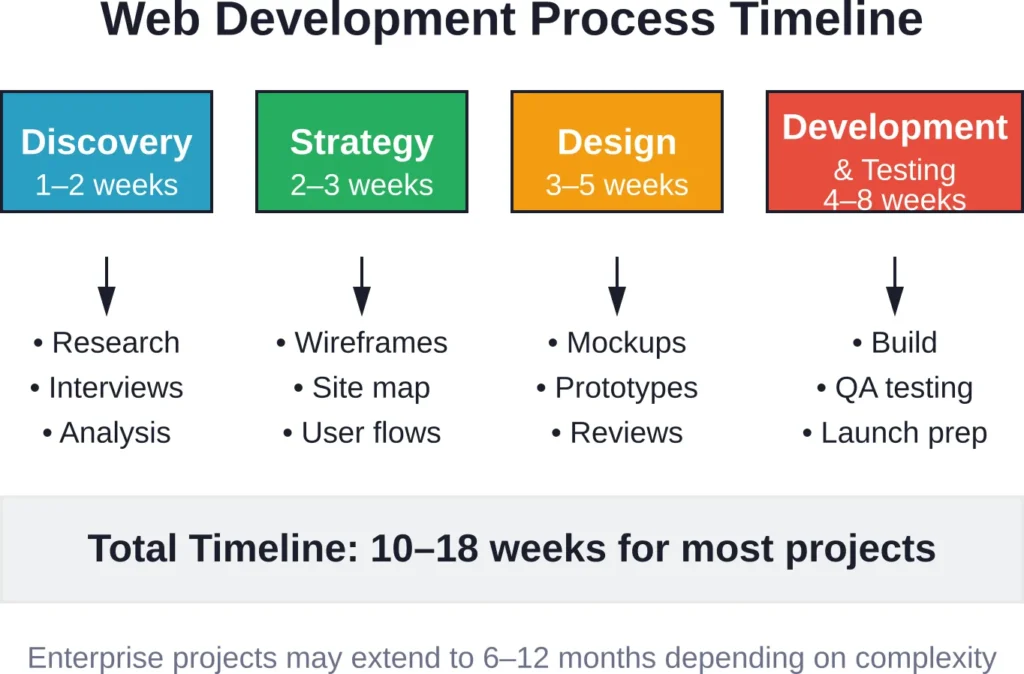
Visual design comes next. Designers create high-fidelity mockups showing exactly how the site will look across different devices. Clients typically review and approve designs before development begins.
Development translates approved designs into functional code. Front-end developers build the user interface, while back-end developers handle server-side functionality, databases, and integrations. Modern agencies often work in sprints, delivering working sections of the site for review rather than waiting until everything is complete.
Quality assurance testing happens throughout development but intensifies before launch. Testers check functionality across browsers and devices, verify forms and integrations work correctly, and identify any bugs or performance issues.
The launch phase involves migrating content, configuring hosting, and making the site live. But launch isn’t the end—post-launch monitoring catches any issues that slip through testing, and analytics setup begins tracking how users interact with the new site.
Key Factors That Impact Project Cost
Several variables influence the final cost of web development projects. Understanding these helps explain price differences between agencies and estimate realistic budgets.
Complexity drives cost more than any other factor. A five-page brochure site costs far less than a custom web application with user accounts, payment processing, and third-party integrations. Each additional feature, custom functionality, or integration point adds development time.
Design requirements also significantly impact price. Custom illustrations, animations, and interactive elements require more designer hours than standard layouts. Brands that need extensive design exploration and iteration should budget accordingly.
Content creation often gets overlooked in initial budgets. Professional copywriting, photography, and video production add to project costs but dramatically improve final results. Some agencies include basic content services; others require clients to provide ready-to-use content.
Technical infrastructure needs vary based on expected traffic, security requirements, and performance expectations. Enterprise-grade hosting, content delivery networks, and robust security measures cost more but provide better reliability and protection.
Here’s where costs typically break down:
- Strategy and planning: 10–15% of total project cost
- Design: 25–35% of total project cost
- Development: 40–50% of total project cost
- Testing and quality assurance: 10–15% of total project cost
- Project management: 5–10% of total project cost
Rush timelines increase costs because they require agencies to allocate more resources simultaneously or pull team members from other projects. Standard timelines allow for more efficient resource allocation and lower overall costs.
Common Web Development Mistakes to Avoid
Even with a great agency, certain client-side mistakes can derail web development projects. Awareness helps avoid these pitfalls.
Starting without clear goals is the most common mistake. When stakeholders haven’t aligned on what the website needs to accomplish, projects drift. Different team members push for conflicting features, and the final product satisfies no one completely.
Underestimating the importance of content represents another frequent error. Beautiful design can’t compensate for weak messaging or missing content. Planning content strategy early—before design begins—ensures the site structure supports the actual content rather than forcing content into predetermined layouts.
Ignoring mobile users in 2026 is inexcusable. Industry reports suggest that over 60% of web traffic now comes from mobile devices. Sites must work flawlessly on smartphones and tablets, not just desktop computers.
Skipping user testing before launch often leads to discovering usability issues after the site is public. Even limited testing with five to ten representative users uncovers most major problems and saves expensive post-launch fixes.
Other mistakes to avoid:
- Choosing an agency based solely on price rather than fit and expertise
- Failing to plan for ongoing maintenance and updates after launch
- Making design decisions by committee, leading to bland, unfocused results
- Neglecting SEO fundamentals during development, making the site hard to find
- Not establishing clear ownership of assets, content, and code
The best way to avoid these mistakes? Choose an agency that asks tough questions during the sales process and pushes back when client requests conflict with best practices. Agencies that say yes to everything often deliver mediocre results.
Evaluating Agency Portfolios and Case Studies
Portfolio quality reveals more about an agency’s capabilities than any sales pitch. But knowing how to evaluate portfolio work separates superficial assessment from meaningful analysis.
Look beyond aesthetics. A visually stunning website that converts poorly or loads slowly isn’t actually successful. The best case studies explain the business challenge, the agency’s approach, and the measurable results achieved.
Pay attention to variety within the portfolio. Agencies that show work across different industries and project types demonstrate versatility. Those with multiple similar projects might be efficient at that specific type of work but less adaptable to unique requirements.
Check whether portfolio pieces remain live and functional. Agencies sometimes show work that’s been redesigned or taken offline. If a significant portion of portfolio work is unavailable, that raises questions about ongoing client relationships.
| What to Look For | Red Flag | Green Flag |
|---|---|---|
| Case study detail | Only screenshots, no context | Business goals, process, results with metrics |
| Portfolio diversity | All similar projects/industries | Range of industries and complexity levels |
| Recency | Work older than 2–3 years | Recent projects showing current capabilities |
| Results | Vague claims, no data | Specific metrics: conversion rates, traffic, revenue |
| Live sites | Many portfolio pieces offline | Most work still live and maintained |
Client testimonials add credibility when they’re specific. Generic praise like “great to work with” means less than detailed feedback about how the agency handled challenges or what business impact the project delivered.
Platforms like Clutch aggregate verified client reviews, making it harder for agencies to cherry-pick only positive feedback. Reviews that mention both strengths and areas for improvement tend to be more trustworthy than universally glowing testimonials.
Questions to Ask Potential Web Development Partners
The initial consultation with an agency reveals whether they’re the right fit. Strategic questions uncover how they work, what they prioritize, and whether their approach aligns with business needs.
Start with questions about their process. How do they approach discovery and research? What happens if requirements change mid-project? How do they handle feedback and revisions? The answers reveal whether they have mature processes or make things up as they go.
Ask about team structure. Who will actually work on the project? What are their roles and experience levels? Will there be a dedicated project manager? Understanding who’s involved sets realistic expectations about communication and expertise.
Discuss timelines and what factors might cause delays. Agencies can’t predict everything, but experienced teams know common bottlenecks—waiting for client feedback, scope creep, technical challenges—and plan accordingly.
Here are essential questions for every consultation:
- Can you walk through a recent project similar to ours and explain the challenges you faced?
- How do you handle situations where client requests conflict with UX best practices?
- What happens after launch? Do you offer maintenance packages or ongoing support?
- How do you measure project success beyond staying on time and budget?
- What do you need from our team to ensure the project runs smoothly?
- What’s your typical response time for questions and requests?
- How do you handle intellectual property—who owns the designs and code?
- What’s your policy on revisions during design and development phases?
Pay attention to whether the agency asks equally good questions back. The best partners want to understand the business deeply before proposing solutions. If they’re pitching specific approaches before understanding goals, that’s a warning sign.
The Role of Ongoing Maintenance and Support
Launching a website isn’t a one-time event followed by years of neglect. Professional sites require ongoing attention to remain secure, functional, and effective.
Security updates represent the most critical maintenance task. Platforms like WordPress release regular updates to patch vulnerabilities. Failing to apply updates leaves sites exposed to hacking attempts and malware.
Performance monitoring ensures the site continues loading quickly as content grows and traffic patterns change. Regular audits identify opportunities to optimize images, reduce code bloat, and improve server response times.
Content updates keep the site fresh and relevant. Whether it’s publishing blog posts, updating product information, or refreshing imagery, regular content changes signal to both visitors and search engines that the site is actively maintained.
Most agencies offer maintenance packages with varying service levels. Basic packages typically include:
- Security updates and patches
- Regular backups
- Uptime monitoring
- Emergency support for critical issues
Comprehensive packages add content updates, performance optimization, analytics reporting, and proactive improvements based on user behavior data.
The decision between DIY maintenance and agency support depends on internal capabilities and budget. Technical teams comfortable with web platforms can handle routine updates. Companies without dedicated web staff benefit from agency maintenance plans that ensure nothing falls through the cracks.
Future-Proofing Your Web Development Investment
Technology evolves rapidly. Websites built with cutting-edge tools today can feel dated within a few years. Smart planning extends the useful life of web development investments.
Choosing established platforms and frameworks over proprietary systems provides long-term flexibility. Popular content management systems like WordPress have large developer communities, making it easier to find support and add features years down the road.
Modular architecture allows updating individual components without rebuilding everything. Sites built with this approach can refresh the design, swap out payment processors, or integrate new tools without starting from scratch.
Documentation matters more than most clients realize. Agencies should provide clear documentation of how the site works, where to find settings, and how to perform common tasks. Without documentation, making changes years later becomes unnecessarily difficult.
Planning for scalability from the start prevents expensive rebuilds as the business grows. This doesn’t mean building enterprise infrastructure for a startup—it means choosing technologies and architectures that can expand when needed.
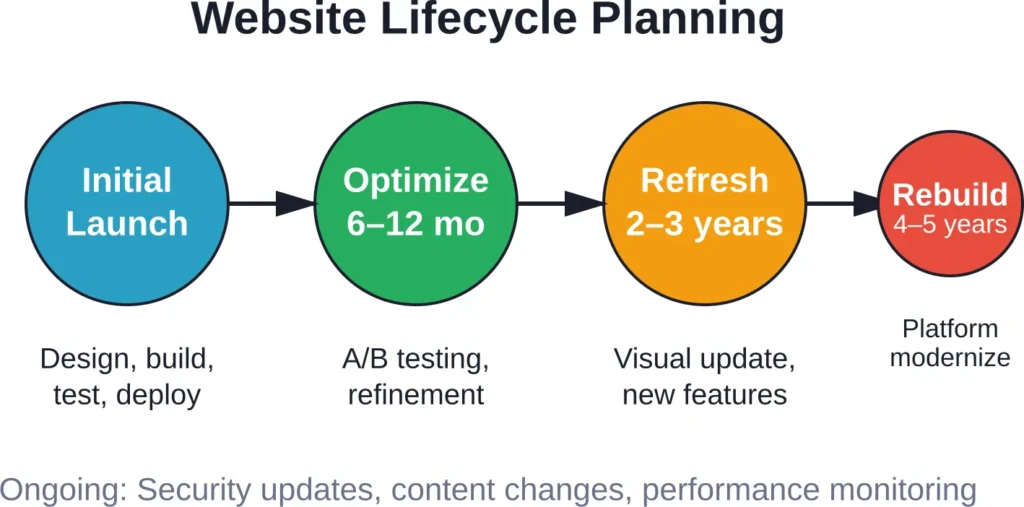
Analytics and tracking should be built in from day one. Understanding how visitors use the site informs optimization decisions and justifies future investments in improvements.
Frequently Asked Questions
Professional web development projects typically range from $10,000 to $250,000+ depending on complexity and scope. Small business websites with custom design and basic functionality start around $10,000, while mid-market projects with advanced features range from $25,000 to $100,000. Enterprise web applications and digital transformation projects often exceed $250,000. Hourly rates vary from $50–$100 for smaller agencies to $200–$300 for top-tier firms.
Standard web development projects typically take 10–18 weeks from kickoff to launch. This includes discovery and research (1–2 weeks), strategy and wireframing (2–3 weeks), visual design (3–5 weeks), and development with testing (4–8 weeks). Complex projects with extensive custom functionality or enterprise requirements can extend to 6–12 months. Rush projects are possible but usually cost more due to compressed timelines requiring additional resources.
Web design focuses on the visual appearance and user experience—layouts, colors, typography, imagery, and how visitors interact with the site. Web development involves the technical implementation—writing code, building functionality, setting up databases, and ensuring everything works across browsers and devices. Professional agencies typically offer both services integrated into a single project, with designers and developers collaborating throughout the process.
WordPress works well for most content-driven websites, blogs, and business sites. It offers flexibility, a large plugin ecosystem, and makes content updates manageable without technical expertise. Custom development makes sense for web applications with specialized functionality, sites requiring specific performance optimizations, or projects where WordPress limitations would create compromises. The decision depends on budget, timeline, and specific functional requirements rather than one being universally better.
Evaluate agencies based on relevant portfolio work, experience with similar projects or industries, communication quality during the sales process, and verified client reviews. The right agency asks detailed questions about business goals before proposing solutions, provides transparent pricing and timeline estimates, and demonstrates expertise in the specific areas the project requires. Schedule consultations with at least three agencies and compare how well each understands the unique challenges and objectives.
Professional agencies include revision rounds in their contracts, typically 2–3 rounds at each major milestone. The process usually starts with multiple design concepts, followed by refinement based on feedback. Unlimited revisions aren’t standard because they make projects unmanageable, but good agencies work collaboratively to reach designs that meet goals. Review the revision policy before signing—it should specify how many rounds are included and costs for additional changes beyond the agreed scope.
Yes, websites require ongoing attention for security, performance, and content updates. At minimum, plan for monthly security patches, regular backups, and uptime monitoring. Most agencies offer maintenance packages ranging from basic technical upkeep to comprehensive services including content updates, performance optimization, and strategic improvements. Companies without internal web expertise benefit significantly from agency maintenance plans, while technical teams may choose to handle routine updates internally and engage agencies only for major changes.
Making Your Final Decision
Choosing a web development partner represents a significant investment in digital presence and business growth. The decision deserves careful consideration based on multiple factors beyond portfolio aesthetics and pricing.
Start by revisiting project goals and success criteria. What does the website need to accomplish? Which agency demonstrates the deepest understanding of those objectives and the expertise to deliver results?
Consider the working relationship as much as technical capabilities. Web development projects involve months of collaboration. An agency that communicates well, respects timelines, and approaches challenges as a partner rather than a vendor makes the process smoother and outcomes better.
Budget matters, but cheapest rarely means best value. An agency that costs 30% more but delivers a site that converts 50% better produces far better return on investment than one that charges less but delivers mediocre results.
The agencies on this list represent different specializations, price points, and ideal client profiles. Excited Agency and Duck Design offer strong value for startups and mid-market companies. Clay and Code and Theory serve established brands with substantial budgets. Thrive and eDesign Interactive excel at conversion-focused sites for B2B companies.
No single agency is right for every project. The best choice depends on specific needs, budget constraints, timeline requirements, and which agency’s strengths align most closely with project priorities.
Take time to review portfolios thoroughly, read client testimonials, and schedule consultations. The investment in proper vetting pays dividends throughout the project and in the results the finished website delivers.
Ready to start your web development project? Reach out to the agencies on this list that match your requirements and begin conversations about how they’d approach your specific challenges. The right partner is out there—finding them just requires asking the right questions and evaluating answers honestly.