

Quick Summary: White label web development companies enable agencies to deliver high-quality websites under their own brand without building in-house teams. These providers specialize in custom web development, WordPress solutions, e-commerce platforms, and full-stack development, offering scalable services with transparent communication. This list evaluates companies based on service focus, technical expertise, and client satisfaction.
Delivering custom websites consistently can overwhelm agencies that don’t have dedicated development teams. Client demands keep growing. Deadlines tighten. Technical complexity increases.
White label web development companies solve this. They handle the technical work behind the scenes while agencies maintain client relationships and keep their branding front and center.
But here’s the thing—most lists ranking white label companies aren’t exactly transparent about how they chose those names. Some prioritize affiliate commissions. Others recycle the same handful of companies without real evaluation.
This guide focuses on service specialization, technical expertise, and client feedback based on available information and reviews.
What Is White Label Web Development?
White label web development means hiring an external company to build websites that agencies rebrand and deliver as their own work. The development partner stays invisible to the end client.
Think of it like this: a marketing agency lands a client who needs a custom WordPress site with e-commerce functionality. The agency doesn’t have developers on staff. Instead of turning down the project, they partner with a white label development company.
The development company builds the site. The agency presents it under their branding, manages client communication, and keeps the relationship. The client never knows a third party was involved.
This model works because it lets agencies scale without the overhead of hiring full development teams. No payroll. No benefits. No desk space. Just project-based collaboration with experienced developers.
Why Agencies Use White Label Development Partners
The reasons are practical. Building an in-house development team is expensive and time-consuming. Hiring developers, designers, and project managers means ongoing salaries, training, and management overhead.
White label partnerships flip that model. Agencies pay per project. They get access to experienced developers without long-term commitments. When project volume increases, the partner scales up. When things slow down, there’s no unused capacity sitting idle.
Another factor: specialization. Not every agency has deep technical expertise in WordPress, Shopify, custom JavaScript frameworks, or headless CMS architectures. White label partners bring that specialized knowledge to the table.
Speed matters too. Development companies working exclusively in white label have streamlined processes. They know how to deliver quickly without sacrificing quality because they’ve done it hundreds of times.
How This List Was Built
This ranking prioritizes three factors: service focus, technical capability, and verified client feedback.
Service focus means the company actively markets white label development as a core offering—not just a side service. Technical capability was evaluated through publicly available portfolios, technology stacks, and case studies. Client feedback came from review platforms that verify actual client relationships.
Companies that primarily serve direct clients or don’t specialize in partner work were excluded. So were companies without transparent information about their development process.
The goal was simple: identify companies that agencies can confidently partner with, knowing they’ll deliver quality work on time and communicate clearly throughout the process.
Top 15 White Label Web Development Companies
Here’s the list. Each company brings something different to the table—different specializations, team sizes, and approaches. Read through the descriptions to find the best match for specific agency needs.
1. Lengreo

Lengreo focuses heavily on white label B2B digital marketing and lead generation services for agencies. The company has built a strong reputation for delivering measurable results through complete marketing campaigns, website development, and performance optimization without agencies needing to manage internal specialists.
Their team handles full-cycle services including SEO, paid ads (PPC, Meta, LinkedIn), hyper-personalized outreach, demand generation, content marketing, and custom website development. They work with agencies that want to offer advanced marketing solutions to their clients while keeping the relationship under their own brand.
What sets them apart is their focus on real ROI with transparent reporting, dedicated account management, and proven strategies that consistently deliver qualified leads and increased conversions.
The company has experience working with software development firms, architecture and design agencies, event technology companies, and IT service providers. For agencies serving B2B clients in competitive industries, this specialization is highly valuable.
Lengreo has capacity for both ongoing retainer work and large-scale campaigns while maintaining consistent quality across all partners.
Contact Information:
- Website: Lengreo.com
- Phone: +31 686 147 566
- Email: hi@lengreo.com
- Address: Vrijstraat 9 C/D, 5611 AT Eindhoven, Netherlands
- LinkedIn: Lengreo
- Twitter: @Lengreo
- Instagram: @lengreo
2. Gilzor

Gilzor operates as a full-service white label custom software development partner. The company delivers complete digital products from idea validation to post-launch support for agencies that need reliable technical execution.
Their team handles full-cycle development including UI/UX design, web and mobile applications (iOS & Android), business analysis, quality assurance, and go-to-market strategy. They support both startups launching new products and established businesses scaling their digital solutions.
What sets them apart is their structured process that emphasizes clean architecture, user-centric design, and long-term maintainability. Agencies receive fully documented solutions that are easy to hand over or continue developing.
The company has delivered projects across airlines, e-commerce, health & wellness, and various product studios. For agencies that want to offer custom software development without expanding their own team, Gilzor provides a dependable extension.
Gilzor maintains capacity for multiple concurrent projects while keeping high quality and fast project start times.
Contact Information:
- Website: www.gilzor.com
- Email: [email protected]
- Address: Poland, Warsaw, Office 58, street Adama Mickiewicza 37, 01-625
- LinkedIn: www.linkedin.com/company/gilzor-softwaredevelopment
3. Oski
Oski specializes in white label software engineering and digital transformation solutions. The company helps agencies deliver complex, scalable digital products to enterprises and startups across multiple industries.
Their team works with modern technologies including cloud architecture, frontend frameworks (React, Vue, Angular), artificial intelligence, machine learning, and enterprise CMS platforms. They deliver complete solutions for web, mobile, and AI-powered systems.
What sets them apart is AI-accelerated development combined with strong focus on security, scalability, and industry-specific requirements. Agencies get future-proof solutions built with clean, well-documented code.
The company has deep experience in travel, logistics, e-commerce, education, fintech, and insurance sectors. This makes them particularly valuable for agencies serving regulated or technically demanding clients.
Oski has capacity to support both large enterprise projects and fast-moving startup initiatives while maintaining consistent delivery standards.
Contact Information:
- Website: oski.site
- Phone: +48571282759
- Email: [email protected]
- Address: Kaupmehe tn 7, 10114 Tallinn, Estonia
- LinkedIn: www.linkedin.com/company/oski-solutions
4. A-Listware

A-Listware approaches white label software development through dedicated teams and managed outsourcing. The company provides agencies with skilled developers and complete project delivery across a wide range of technologies and industries.
Their services include custom software development, team augmentation, cloud solutions, UI/UX design, QA, data analytics, and IT consulting. They build enterprise applications, ERP/CRM systems, and modern web & mobile solutions.
What sets them apart is the ability to quickly form and manage dedicated teams that integrate seamlessly as an extension of the agency’s own team, with 24/7 expert access and structured communication.
The company has successfully supported enterprises, small and medium businesses, and startups across various technical requirements. Agencies benefit from their long-term experience in managing development projects without the overhead of hiring.
A-Listware maintains flexibility to scale teams according to project needs while ensuring consistent quality and project management standards.
Contact Information:
- Website: a-listware.com
- Phone: +1 (888) 337 93 73
- Email: [email protected]
- Address: North Bergen, NJ 07047, USA
- LinkedIn: www.linkedin.com/company/a-listware
- Facebook: www.facebook.com/alistware
5. Mobian Studio
Mobian Studio brings dedicated engineering teams and full-cycle delivery into the white label model with a strong focus on mobile and AI solutions. For agencies that need reliable technical partners in IT, healthcare, fintech, and logistics, Mobian simplifies project execution.
Their capabilities cover end-to-end product development, mobile applications (iOS, Android, Flutter), AI systems, scalable backends, legacy integration, and domain-specific solutions with strict compliance standards. They offer both full outsourcing and outstaffing models.
This flexible approach is especially useful for agencies that want to offer complex digital products without managing large internal development teams. Everything from architecture to post-launch support is handled under one partner.
Mobian Studio also provides ongoing maintenance, scaling support, and clear documentation. Agencies can white label not just initial builds but also long-term partnership services.
Their portfolio demonstrates successful delivery of production-ready software across regulated and high-growth industries. The team structure supports concurrent projects while keeping quality and timelines predictable.
Contact Information:
- Website: mobian.studio
- Phone: [email protected]
- Address: Harju maakond, Tallinn, Kesklinnalinnaosa, Masina tn 22, 10113
- LinkedIn: www.linkedin.com/company/mobian-studio
6. GetDev Done

GetDev Done focuses on speed and simplicity. Their white label model is designed for agencies that need quick turnarounds on standard WordPress sites, landing pages, and small business websites.
They’re not the best fit for complex custom applications or enterprise platforms. But for the bread-and-butter projects that make up most small agency work, they deliver efficiently.
Their process is streamlined. Agencies submit project specs through a standardized form. A project manager confirms requirements. Development starts immediately. Revisions happen in defined rounds. Sites launch on schedule.
This structured approach reduces back-and-forth. There’s less ambiguity about what’s included and what counts as scope creep. For agencies new to white label partnerships, this clarity helps.
GetDev Done also offers white label maintenance packages. Agencies can bundle monthly maintenance into their client contracts and outsource the actual work—security updates, backups, uptime monitoring, and minor content updates.
7. White Label Agency
Despite the generic name, White Label Agency (based in Fairfax, VA) specializes in white label digital marketing services with strong web development capabilities. They’re built specifically for agency partnerships, not direct clients.
Their development services include WordPress, custom CMS platforms, and marketing-focused websites optimized for lead generation and conversion. They understand how websites fit into broader marketing strategies.
This marketing-first perspective helps when building sites that need to integrate with CRM systems, marketing automation platforms, email service providers, and analytics tools. They build with those integrations in mind from the start.
White Label Agency also handles SEO-focused development—clean code, fast loading times, mobile optimization, structured data markup, and Core Web Vitals performance. For agencies selling SEO services, having a development partner who understands technical SEO prevents conflicts between design and search performance.
Their team includes strategists who can consult on site structure, user flow, and conversion optimization. Agencies can involve them early in the planning phase, not just during execution.
8. Lounge Lizard

Lounge Lizard operates as a digital agency with a white label division. They bring brand strategy and creative direction into the development process, which benefits agencies that need more than just code—they need a cohesive digital experience.
Their development work spans WordPress, Drupal, custom applications, and mobile-responsive design. They’ve completed projects for healthcare, finance, hospitality, and professional services.
What distinguishes them is the emphasis on design quality. The sites they build don’t just function—they look polished. For agencies competing in markets where visual presentation matters, this design-forward approach adds value.
Lounge Lizard also handles complex integrations with enterprise systems—ERPs, CRMs, custom databases, and legacy software. Agencies serving mid-market and enterprise clients benefit from this capability.
Their white label model includes NDA protection and complete agency branding. Clients never see Lounge Lizard’s name in code comments, file metadata, or communication threads.
9. Codal

Codal focuses on user experience design and development for web and mobile applications. Their white label service is geared toward agencies that need both UX strategy and technical execution.
They start projects with user research, persona development, and wireframing before writing code. This UX-first process results in interfaces that users actually find intuitive, not just visually appealing.
Codal’s development team works across React, Angular, Vue.js, Node.js, Python, and Ruby. They build progressive web apps, single-page applications, and API-driven architectures.
For agencies serving SaaS companies, tech startups, or businesses launching digital products, Codal’s product-focused approach aligns well. They think beyond the initial launch to scalability, feature expansion, and long-term product roadmap.
Their team size supports enterprise-level projects. They’ve built platforms handling millions of users, high-transaction-volume applications, and systems requiring robust security and compliance measures.
10. Multidots

Multidots specializes in WordPress and WooCommerce development with particular strength in headless WordPress architectures, Gutenberg block development, and enterprise WordPress solutions.
They’ve contributed to WordPress core and maintain several plugins. This deep involvement in the WordPress ecosystem means they stay current with platform changes and best practices.
For agencies that have standardized on WordPress for client projects, Multidots offers consistent quality and deep expertise. They handle everything from simple brochure sites to complex multisite networks and membership platforms.
Their white label offering includes ongoing support and maintenance. Agencies can offer retainer-based services without hiring dedicated WordPress developers internally.
Multidots also provides performance optimization services—database tuning, caching configuration, CDN setup, and code optimization. For agencies whose clients complain about slow WordPress sites, this specialization solves a common pain point.
11. WPWeb Infotech

WPWeb Infotech focuses heavily on white label WordPress development and custom web applications. The company has built a reputation around delivering functional, scalable WordPress sites for agencies that need reliable development without direct client interaction.
Their team handles everything from theme customization to plugin development, WooCommerce stores, and multisite setups. They work with agencies that need consistent quality across multiple projects.
What sets them apart is process transparency. Agencies get regular updates, staging site access, and clear documentation. Communication happens through dedicated project managers, not rotating contacts.
The company has experience with enterprise-level WordPress sites, membership platforms, and learning management systems. For agencies serving clients in education, publishing, or membership-based businesses, this specialization is valuable.
The company has capacity for larger projects while maintaining service quality for smaller partners.
12. E2M Solutions
E2M Solutions operates as a full-service white label development partner with strength in custom web applications, progressive web apps, and API integrations. They don’t limit themselves to one platform or CMS.
This flexibility helps agencies that work with diverse client needs. One project might be a React-based web app. The next could be a Laravel backend with a Vue.js frontend. E2M handles both.
Their development approach emphasizes clean code and maintainability. Sites are built with future updates in mind, not just initial launch. For agencies that maintain long-term client relationships, this matters.
The team includes frontend specialists, backend engineers, QA testers, and DevOps professionals. This means projects don’t get bottlenecked waiting for a single developer to wear multiple hats.
They’ve delivered projects for agencies in healthcare, finance, and SaaS. Industries with strict compliance requirements appreciate their attention to security and documentation.
13. Creole Studios

Creole Studios brings mobile app development into the white label mix alongside web development. For agencies that need both a responsive website and native mobile apps, having one partner simplifies coordination.
Their web development covers WordPress, Drupal, custom PHP, and JavaScript frameworks like Angular and Node.js. The mobile side includes iOS and Android development with React Native and Flutter.
This cross-platform capability is particularly useful for agencies serving startups or businesses launching digital products. Instead of coordinating between separate web and mobile vendors, everything happens under one roof.
Creole Studios also handles ongoing maintenance and support contracts. Agencies can white label not just the initial build but also monthly retainer services for updates, security patches, and feature additions.
Their portfolio shows work across e-commerce, real estate platforms, booking systems, and content management solutions. The team size supports concurrent projects without quality dropping.
14. Uplers

Uplers approaches white label development with a talent-matching model. Instead of assigning projects to whoever’s available, they match agency requirements with developers who have relevant experience in that specific tech stack or industry.
This model works well for agencies with very specific needs—maybe a niche CMS, a particular framework, or a specialized integration. Finding the right developer internally is harder than having a partner who maintains a diverse talent pool.
Uplers handles WordPress, Magento, Shopify, and custom development across PHP, Python, Ruby, and JavaScript ecosystems. They also offer white label design services, so agencies can bundle design and development under one partnership.
Communication is structured around agency preferences. Some agencies want daily standups. Others prefer weekly check-ins. Uplers adapts to existing workflows rather than forcing agencies into a rigid process.
They’ve worked extensively with digital marketing agencies that need development support for client campaigns—landing pages, microsites, and conversion-optimized web pages built quickly without sacrificing performance.
15. OuterBox
OuterBox specializes in e-commerce development, particularly for platforms like Magento, Shopify, BigCommerce, and WooCommerce. If an agency’s client roster includes online stores, OuterBox brings deep expertise in cart optimization, payment gateway integration, and conversion rate optimization.
They understand e-commerce beyond just getting a store online. Their development considers checkout flow, mobile commerce experience, inventory management integration, and third-party fulfillment connections.
For agencies that don’t have in-house e-commerce specialists, this expertise gap is significant. OuterBox fills it. They handle technical requirements that general web developers might miss—like tax calculation APIs, subscription billing logic, or multi-currency support.
Their white label service includes ongoing optimization. After launch, they provide performance monitoring, A/B testing setup, and conversion rate analysis. Agencies can offer this as a value-added service to clients.
The company has completed hundreds of e-commerce projects. They know the common pitfalls and how to avoid them. Timelines are realistic because they’ve built similar stores many times before.
Key Selection Criteria for White Label Partners
Choosing a white label development partner isn’t just about technical skills. Several other factors determine whether a partnership will work long-term.
Communication Structure
Clear communication prevents most partnership problems. Look for companies that assign dedicated project managers, not rotating contacts. Consistent points of contact build familiarity with agency processes and client expectations.
Response times matter. Development questions pop up mid-project. Waiting 48 hours for answers delays timelines. Partners with same-day response commitments keep projects moving.
Some companies use project management tools that give agencies real-time visibility into progress. Others rely on scheduled check-ins. Choose the model that matches existing workflows.
Technical Expertise
Verify that the partner has deep experience in the specific technologies projects require. A company that’s great at WordPress might struggle with custom React applications. Specialization beats generalization.
Check portfolios for projects similar in scope and complexity to planned work. If an agency needs enterprise WordPress with custom integrations, seeing examples of similar projects builds confidence.
Ask about the development team’s composition. Are there dedicated frontend and backend specialists? QA testers? DevOps engineers? Or does one developer handle everything? Team structure affects quality and speed.
Process Transparency
Understanding how the partner works prevents surprises. What does the development process look like? How are revisions handled? What’s included in the base scope versus what counts as additional work?
Clear processes also cover how bugs are addressed post-launch. Is there a warranty period? How quickly are critical issues fixed? These details matter when client sites break unexpectedly.
Contracts should specify deliverables, timelines, revision rounds, and payment terms. Ambiguity here causes conflicts later.
Scalability
Can the partner handle volume changes? Agencies grow. Project load fluctuates. A partner that maxes out at two concurrent projects creates bottlenecks when three clients sign simultaneously.
Ask about team size and current capacity. Companies with larger teams can absorb sudden increases in work without timeline slips.
White Label Commitment
Some companies primarily serve direct clients and offer white label as a side service. Others are built exclusively for agency partnerships. The latter usually have better processes for maintaining agency branding and confidentiality.
Check whether NDAs are standard. Verify that code comments, file metadata, and any client-facing elements will carry agency branding, not the development company’s.
| Selection Factor | Why It Matters | What to Verify |
|---|---|---|
| Communication | Prevents delays and misunderstandings | Dedicated PM, response time commitments, PM tool access |
| Technical Expertise | Ensures quality matches requirements | Portfolio examples, tech stack depth, team specialization |
| Process Clarity | Reduces scope disputes and surprises | Written processes, revision policy, bug fix terms |
| Scalability | Supports agency growth without bottlenecks | Team size, concurrent project capacity, turnaround times |
| White Label Focus | Protects agency branding and relationships | NDA availability, branding removal process, client confidentiality |
Common White Label Development Use Cases
Agencies use white label development for different reasons depending on their business model and client base.
Marketing Agencies Adding Web Services
Digital marketing agencies often start with SEO, PPC, or social media management. Clients eventually ask for website work. Instead of referring that revenue elsewhere, agencies partner with white label developers to keep the relationship and revenue in-house.
This expands service offerings without hiring full development teams. The agency becomes a one-stop shop for digital services, increasing client lifetime value.
Design Studios Needing Development
Design agencies create beautiful mockups and user experiences. But turning those designs into functional websites requires development expertise many design studios lack.
White label development partners take approved designs and build them exactly as specified. The design studio maintains creative control while the developer handles technical implementation.
Agencies Handling Overflow
Even agencies with in-house developers hit capacity limits. When multiple projects overlap, internal teams get overwhelmed. White label partners handle overflow work, preventing timeline delays and overworked staff.
This flexible capacity is more cost-effective than hiring full-time developers who might sit idle when project volume drops.
Niche Agencies Needing Technical Specialists
An agency might specialize in a specific industry—healthcare, legal, real estate—but lack expertise in a particular technology a client needs. Maybe it’s a custom CRM integration or a specialized e-commerce platform.
White label partners with that technical specialization fill the gap. The agency maintains the client relationship and industry expertise while outsourcing the technical challenge.
White Label vs. Hiring In-House Developers
The build-versus-buy question is central to agency growth strategy. Both models have advantages.
In-House Development Teams
Building an internal development team gives complete control. Communication is direct. Developers understand agency culture and client expectations intimately. There’s no middleman.
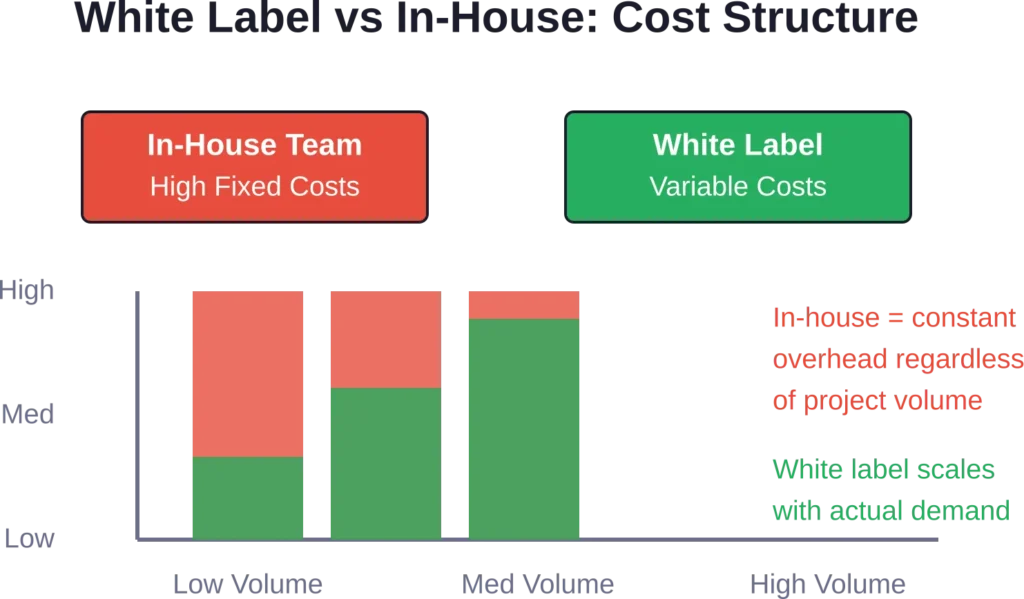
But the costs are substantial. Developer salaries, benefits, equipment, office space, and training add up quickly. A small development team can easily cost several hundred thousand dollars annually.
Utilization becomes a problem. When project volume drops, salaried developers still need work. When volume spikes, the team is overloaded. Scaling up and down with full-time employees is slow and expensive.
White Label Partnerships
White label partnerships convert fixed costs into variable costs. Pay for projects as they come. No payroll during slow months. No hiring process when volume increases.
The tradeoff is control. Communication goes through an intermediary. Development happens offsite. Quality depends on the partner’s team and processes, not direct management.
However, the risk is lower. Testing multiple white label partners costs less than hiring—and potentially firing—full-time developers if the fit isn’t right.
Hybrid Approach
Many successful agencies use both. A small in-house development team handles core projects and client relationships that need direct developer interaction. White label partners handle overflow, specialized projects, and work that doesn’t require daily agency involvement.
This balances control with flexibility. The in-house team maintains technical standards and knowledge. The white label partner provides scalable capacity.
Red Flags When Evaluating White Label Companies
Not every company claiming white label expertise delivers quality work. Watch for these warning signs.
Vague Portfolio or No Case Studies
Companies confident in their work showcase it. If a company can’t show relevant examples—citing client confidentiality for every single project—that’s suspicious. Even under NDA, most projects allow anonymized case studies.
Unclear Pricing Structure
Development costs vary based on scope, but the pricing model should be transparent. Per-project estimates? Hourly rates? Retainer packages? Companies that won’t clarify how they charge are difficult to budget for.
No Dedicated Project Management
If point-of-contact changes with each project or emails bounce between different team members, communication will break down. Consistent project management is non-negotiable for smooth partnerships.
Offshore Teams Without Quality Control
Many white label companies use offshore developers to keep costs down. That’s fine—if there’s strong quality control, clear communication in the client’s language, and reasonable timezone overlap for real-time discussions. Without those, offshore arrangements often cause more problems than they solve.
Promises That Sound Too Good
Complex custom websites don’t get built in a week. Enterprise platforms don’t cost the same as brochure sites. Companies promising unrealistic timelines or prices either don’t understand the scope or plan to cut corners.
Poor Communication During Sales
How a company communicates before signing a contract predicts how they’ll communicate during projects. Slow responses, vague answers, or difficulty scheduling calls during the sales process? It won’t improve after the contract is signed.
Managing White Label Partnerships Successfully
Even great white label partners need clear management to deliver consistently.
Set Expectations Up Front
Define what quality looks like. Provide brand guidelines, coding standards, and performance benchmarks before projects start. The more clarity provided initially, the fewer revisions needed later.
Establish communication protocols. How often should updates happen? What format—email, project management tool, video calls? Who’s the point person on each side?
Start with a Small Project
Test the partnership with a lower-stakes project before committing major client work. A small website or simple feature addition reveals how the partner works without risking important client relationships.
Evaluate technical quality, communication, adherence to timelines, and how they handle feedback. If the test project goes well, scale up gradually.
Build Documentation Processes
Require documentation for custom code, integrations, and configuration. When the partnership ends or projects need future updates, having clear documentation prevents starting from scratch to understand how things work.
Documentation also helps if switching partners becomes necessary. The new partner can review existing work and continue from there.
Create Feedback Loops
After each project, conduct a brief retrospective. What went well? What could improve? This continuous feedback helps the partner understand specific preferences and adapt their process accordingly.
Good white label partners want to improve the relationship. They’ll implement feedback that makes collaboration smoother.
Maintain Client Confidentiality
Ensure NDAs cover not just the immediate project but also client information, business strategies, and any proprietary processes. Client trust depends on confidentiality.
Verify that the partner’s team understands confidentiality requirements and has processes to prevent accidental disclosure.
What to Expect: White Label Project Timelines
Understanding realistic timelines prevents overpromising to clients.
Simple WordPress Sites
Simple WordPress sites typically require several weeks from kickoff to launch depending on scope and resource availability.
Custom WordPress with Integrations
Sites requiring custom theme development, plugin creation, or third-party integrations typically require extended timelines that vary based on integration complexity.
E-commerce Platforms
E-commerce platforms with moderate complexity require timelines that depend on platform choice and feature requirements. Complex e-commerce builds with custom checkout flows, subscription billing, or multi-vendor functionality require extended development timelines.
Custom Web Applications
Custom web applications built on modern frameworks with custom backends require extended development periods that scale with feature complexity.
These are baseline estimates. Delays happen when content isn’t ready, feedback cycles extend beyond planned revisions, or scope changes mid-project.
Pricing Models in White Label Development
While specific rates vary, understanding common pricing models helps budget appropriately.
Per-Project Fixed Pricing
The agency and development partner agree on scope and a fixed price before work begins. This provides budget certainty but requires detailed upfront planning. Scope changes trigger additional charges.
Fixed pricing works well for standardized projects where requirements are clear and unlikely to change.
Hourly Billing
The partner bills for actual hours worked. This offers flexibility for projects where scope evolves or requirements emerge during development. The risk is budget unpredictability.
Hourly models work better for ongoing maintenance retainers or projects where discovery is needed before scope can be fully defined.
Retainer Packages
Agencies pay a monthly retainer for a set amount of development capacity—maybe 40 hours per month or a certain number of projects. Unused capacity might roll over or expire depending on terms.
Retainers provide consistent access to development resources and often come with priority support and faster turnaround times.
Revenue Share
Some white label partners, particularly in the SaaS or platform space, offer revenue share arrangements. The partner takes a percentage of what the agency bills the client instead of direct payment.
This aligns incentives but only works when the agency maintains long-term client relationships with recurring revenue.
| Pricing Model | Best For | Pros | Cons |
|---|---|---|---|
| Fixed Project | Defined scope, one-time builds | Budget certainty, clear deliverables | Scope changes costly, requires detailed planning |
| Hourly | Evolving projects, maintenance | Flexibility, pay only for work done | Budget uncertainty, requires tracking |
| Retainer | Consistent monthly volume | Priority access, predictable costs | Unused hours may be wasted |
| Revenue Share | Long-term SaaS relationships | Lower upfront cost, aligned incentives | Ongoing commitment, complex tracking |
Industry-Specific White Label Considerations
Different industries have different technical requirements that affect white label partner selection.
Healthcare and Medical
HIPAA compliance is mandatory for sites handling patient data. Partners need experience with encrypted data transmission, secure hosting, compliance documentation, and audit trails.
Healthcare sites often integrate with EMR systems, patient portals, and telehealth platforms. Partners should have experience with healthcare-specific integrations.
Finance and Insurance
Financial services require PCI compliance for payment processing, strong security measures, and often integration with banking APIs or financial data providers.
Expect longer timelines for security reviews and compliance verification. Partners working in finance should have demonstrable security expertise and compliance documentation.
E-commerce and Retail
E-commerce demands payment gateway integration, inventory management, shipping calculation, tax compliance, and mobile commerce optimization. Cart abandonment, conversion optimization, and performance under traffic spikes matter significantly.
Partners specializing in e-commerce understand these requirements and have solved common problems multiple times.
Education and E-Learning
Educational platforms often need learning management systems, student portals, course delivery mechanisms, and integration with educational tools. Accessibility compliance (WCAG standards) is particularly important for educational institutions.
SaaS and Software
Software companies need web applications with strong backend architecture, API development, user authentication, and performance optimization. These projects typically require senior-level developers with experience in scalable architecture.
The Future of White Label Development
White label partnerships continue evolving alongside technology trends.
AI and Automation Integration
Development partners increasingly integrate AI tools into websites—chatbots, content personalization, automated data analysis, and predictive features. Agencies can offer these capabilities without building AI expertise internally.
Headless CMS Adoption
Separating content management from presentation layers allows content to feed multiple channels—websites, mobile apps, digital displays. White label partners with headless CMS expertise help agencies serve clients needing omnichannel content delivery.
No-Code and Low-Code Platforms
Platforms like Webflow, Bubble, and others reduce custom code requirements for certain projects. Some white label partners specialize in these tools, delivering faster and more cost-effectively for projects that fit the platform capabilities.
Specialized Niche Partners
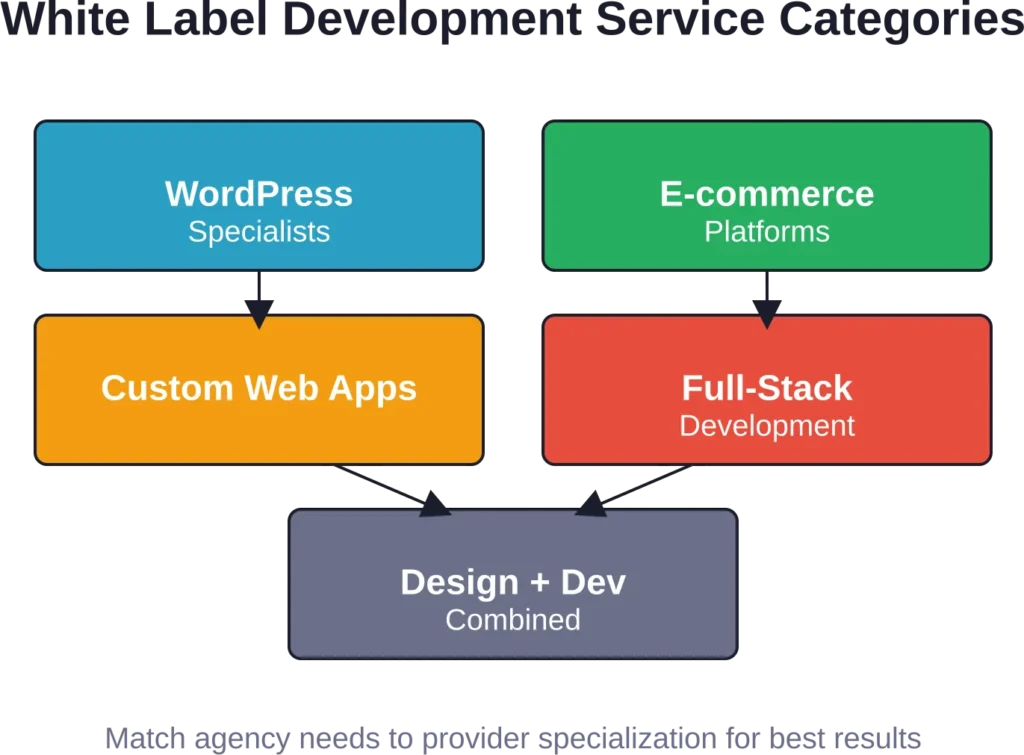
As technology becomes more complex, white label companies increasingly specialize—WordPress-only shops, e-commerce specialists, SaaS application developers. Agencies benefit from matching specific project types to specialized partners rather than using generalists for everything.
Frequently Asked Questions
White label means an agency hires an external development company to build websites, then rebrands the work as their own before delivering it to clients. The development partner remains invisible—the client only sees the agency’s branding.
Quality control starts with choosing partners who demonstrate consistent work through portfolios and client reviews. During projects, agencies should review work at milestone stages, test thoroughly before client handoff, and provide detailed feedback. Clear initial requirements and coding standards also help partners deliver to agency expectations.
Professional white label partnerships are designed to be invisible. Development partners remove their branding from code, communications, and deliverables. Clients interact only with the agency. However, if agencies don’t properly manage the relationship or if communication breaks down, clients might notice inconsistencies.
Agencies typically apply markup on white label development costs to cover management, client relationships, and overhead.
This is a business ethics question with different perspectives. Some agencies are transparent about partnering with specialized developers. Others consider it internal operations that clients don’t need to know, similar to not disclosing which accounting software runs the business. What matters most is delivering quality work and maintaining client trust through results.
Three common approaches: the agency can contract ongoing maintenance through the white label partner and resell it to clients; the agency can hire internal support staff to handle maintenance of delivered sites; or the agency can transition clients to direct relationships with the development partner for post-launch support (ending the white label relationship). The first option is most common.
The agency remains responsible to the client regardless of partner performance. This is why vetting partners carefully and starting with test projects matters. When problems occur, agencies need to either work with the partner to fix issues quickly or bring in another developer to complete the work—both scenarios cut into profit margins. Having backup partners and clear contracts with quality guarantees provides some protection.
Conclusion
White label web development partnerships offer agencies a practical path to scaling service offerings without the overhead and risk of building large in-house development teams.
The companies listed here represent different specializations and approaches. Some focus exclusively on WordPress. Others handle full-stack custom development. Some serve small agencies with quick-turnaround needs. Others support enterprise-level projects requiring extensive resources.
No single partner is universally “best.” The right choice depends on the specific needs of the agency, the types of clients served, the technical requirements of projects, and the agency’s growth trajectory.
What matters most is finding partners with transparent processes, clear communication, relevant technical expertise, and genuine commitment to white label relationships. Test partnerships carefully with smaller projects before committing major client work.
The agencies that successfully leverage white label partnerships are those that treat partners as extensions of their team—providing clear requirements, timely feedback, and building long-term relationships rather than treating each project as a one-off transaction.
Ready to expand web development capabilities? Start by identifying the specific technical gaps in current offerings, then evaluate which partners specialize in those areas. Request portfolio examples similar to planned projects and have detailed conversations about process, communication, and quality standards before signing contracts.