
Quick Summary: Selecting the right web development company can transform a small business’s online presence. This guide reviews 15 top agencies—from boutique studios like Lengreo, Gilzor, OSKI Solutions, A-listware, Mobian Studio, Excited and Clay to full-service firms like Thrive and Digital Silk—each offering unique strengths in design, UX, branding, and digital strategy. Understanding their specializations, team capabilities, and proven track records helps small businesses match their budget and goals with an agency partner that delivers real results.
A website is often the first place potential customers learn about a business. That one quick website search they do before reaching out? It matters more than most business owners realize.
The U.S. Small Business Administration emphasizes helping small businesses compete in global markets through digital presence. The SBA’s Office of Entrepreneurial Development emphasizes helping small businesses compete in global markets through digital presence—and that starts with choosing the right development partner.
But here’s the challenge: finding a web development company that understands small business constraints while delivering professional results. Industry reports suggest that ~27% of small businesses without websites cite industry irrelevance as their reason, while ~26% point to cost as the primary factor. The reality? Neither barrier holds up in 2026.
This guide cuts through the noise. We’ve analyzed team capabilities, portfolio depth, client reviews, and specializations to identify ten agencies that consistently deliver for small businesses.
What Makes a Great Small Business Web Development Company
Not every agency suits every business. The right partner depends on what a small business actually needs.
Some companies require straightforward brochure sites with clear calls to action. Others need e-commerce platforms, membership systems, or content management flexibility. The best agencies understand this spectrum and adapt their approach accordingly.
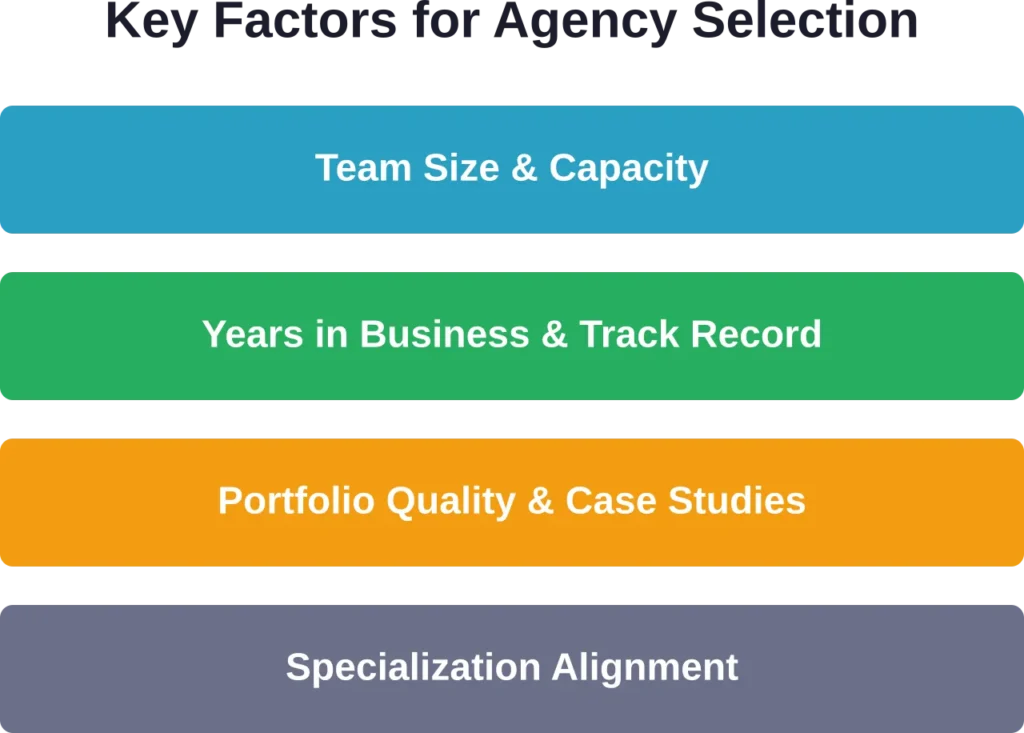
Analyses indicate several factors separate exceptional agencies from mediocre ones. Team size matters—not because bigger equals better, but because it signals capacity. A studio with five designers can handle more concurrent projects than a solo freelancer. LinkedIn team counts provide a useful proxy for bandwidth.
Years in business tell another story. Agencies that survive a decade have weathered market shifts, technology changes, and economic downturns. That resilience translates into steadier project delivery.
Portfolio quality trumps quantity. One well-documented case study revealing strategy, execution, and results beats fifty logo thumbnails. The agencies featured here maintain detailed portfolios showing real client work, not stock photography.
Understanding Agency Specializations
Web development companies typically fall into several categories. Full-service digital agencies handle strategy, design, development, and ongoing marketing. Design-focused studios prioritize aesthetics and user experience. Technical development shops specialize in complex functionality and custom coding.
Small businesses benefit most from agencies that balance design sensibility with practical execution. The goal isn’t winning awards—it’s driving conversions, building trust, and supporting business growth.
According to authoritative research, 46% of U.S. small business websites generate between 1,001 and 15,000 monthly visitors. For B2B companies specifically, 41.2% report 1,000 to 10,000 monthly visitors. These numbers contextualize what “success” looks like for most small business sites.
The average website bounce rate sits around 37%, with SEO organic click-through rates averaging about 13%. A competent development agency builds sites that match or beat these benchmarks through thoughtful UX design and clear information architecture.
Top 15 Web Development Companies for Small Business
The agencies listed here represent diverse capabilities, geographic locations, and specializations. Each brings distinct strengths to small business partnerships.
1. Mobian Studio
Mobian Studio builds dedicated engineering teams that deliver production-ready web and mobile software for small businesses and growing companies. The studio specializes in full-stack development, AI solutions, and scalable architecture.
Their process covers end-to-end product development from design to deployment, including legacy integration and post-launch support. Mobian emphasizes clean code, clear documentation, and senior-level execution.
For small businesses, Mobian offers both outsourcing and team augmentation models. This flexibility allows companies to scale development capacity quickly while maintaining control and avoiding costly hiring mistakes.
Mobian Studio brings domain experience in fintech, healthcare, logistics, and IT. The team delivers solutions that help small businesses ship faster, reduce technical risk, and create digital products their customers love.
Contact Information:
- Website: mobian.studio
- Phone: [email protected]
- Address: Harju maakond, Tallinn, Kesklinnalinnaosa, Masina tn 22, 10113
- LinkedIn: www.linkedin.com/company/mobian-studio
2. Lengreo

Lengreo operates as a complete marketing and technology partner, delivering integrated digital solutions that combine strategy with hands-on execution. The agency focuses on B2B growth through targeted lead generation, SEO, website development, and paid advertising campaigns.
Lengreo builds custom websites and landing pages that support lead generation and conversion goals. Their process includes discovery, business analysis, prototyping, and ongoing optimization to ensure websites drive measurable business results.
For small businesses, Lengreo serves as a single strategic partner rather than multiple vendors. The team handles everything from marketing audits and SEO to hyper-personalized outreach and demand generation, allowing small teams to scale efficiently.
Lengreo emphasizes transparent collaboration and results-driven tactics. Client testimonials highlight their initiative, dedication, and ability to deliver high-quality work that supports long-term business development.
Contact Information:
- Website: Lengreo.com
- Phone: +31 686 147 566
- Email: [email protected]
- Address: Vrijstraat 9 C/D, 5611 AT Eindhoven, Netherlands
- LinkedIn: Lengreo
- Twitter: @Lengreo
- Instagram: @lengreo
3. Gilzor

Gilzor specializes in custom software development with a strong focus on web and mobile solutions for startups and small businesses. The company guides clients from idea validation through design, development, and go-to-market strategy.
Their approach combines UI/UX design, full-cycle web development, quality assurance, and post-launch support. Gilzor creates scalable digital products that improve conversion rates and deliver excellent user experiences.
Small businesses benefit from Gilzor’s practical full-service model. Whether launching a new web application or automating processes, the team provides end-to-end delivery without requiring clients to manage multiple specialists.
Gilzor’s portfolio showcases functional and attractive solutions across various industries, including e-commerce, airlines, and consumer apps. Their user-centric process helps small businesses reduce risk and reach their target audience effectively.
Contact Information:
- Website: www.gilzor.com
- Email: [email protected]
- Address: Poland, Warsaw, Office 58, street Adama Mickiewicza 37, 01-625
- LinkedIn: www.linkedin.com/company/gilzor-softwaredevelopment
4. Oski
Oski builds smart, well-engineered software solutions for tech-forward small businesses and ambitious startups. The company offers full-cycle development across cloud infrastructure, frontend technologies, artificial intelligence, and content management systems.
With expertise in React, Next.js, Node.js, Azure, AWS, and modern AI tools, Oski creates scalable web solutions that support business growth and operational efficiency. Their work emphasizes performance, intuitive design, and seamless integration.
For small businesses, Oski provides accelerated development timelines and flexible solutions tailored to specific industry needs such as e-commerce, fintech, logistics, and education. Clients receive reliable systems that evolve with their business.
Oski stands out for its commitment to quality engineering and innovation. The team delivers solutions that help small businesses compete through digital transformation and intelligent automation.
Contact Information:
- Website: oski.site
- Phone: +48571282759
- Email: [email protected]
- Address: Kaupmehe tn 7, 10114 Tallinn, Estonia
- LinkedIn: www.linkedin.com/company/oski-solutions
5. A-Listware

A-Listware is a software development and consulting company that delivers cost-effective, high-quality digital solutions through dedicated teams and outsourcing models. The agency focuses on building responsive and secure web applications tailored to client requirements.
They offer end-to-end services including custom software development, UX/UI design, cloud application development, and legacy modernization. A-Listware ensures seamless integration with existing business processes.
Small businesses and startups work with A-Listware to access experienced development teams without the overhead of in-house hiring. The company provides flexible engagement models that support both project-based work and long-term partnerships.
A-Listware’s expertise spans enterprise applications, ERP, CRM, and various web solutions. Their client-focused approach and technical proficiency help small businesses achieve reliable, scalable digital presence.
Contact Information:
- Website: a-listware.com
- Phone: +1 (888) 337 93 73
- Email: [email protected]
- Address: North Bergen, NJ 07047, USA
- LinkedIn: www.linkedin.com/company/a-listware
- Facebook: www.facebook.com/alistware
6. Huemor
Huemor positions itself as a growth-focused web design agency. The company emphasizes data-driven design decisions and conversion optimization.
The agency’s process includes detailed analytics review, user testing, and iterative refinement. Huemor treats website launches as starting points rather than endpoints, continuing to optimize based on real user behavior.
Small businesses working with Huemor gain access to strategic thinking typically reserved for larger enterprises. The agency helps clients understand metrics that matter and how design choices impact business outcomes.
Huemor’s case studies frequently include before-and-after performance comparisons, showing traffic increases, conversion improvements, and engagement metrics. This results-oriented approach appeals to small business owners focused on ROI.
7. Lounge Lizard

Lounge Lizard operates as a full-service digital agency with capabilities spanning web design, app development, and digital marketing. The New York-based company has been in business for over two decades.
The agency’s longevity speaks to its ability to adapt as technology and design trends evolve. Lounge Lizard maintains a sizable team capable of handling multiple projects simultaneously.
Small businesses benefit from Lounge Lizard’s comprehensive service menu. Clients can start with website development and expand into app creation or ongoing marketing support as their needs grow.
The agency’s portfolio showcases diverse industries and project types. Lounge Lizard demonstrates comfort working with both straightforward brochure sites and complex e-commerce platforms.
8. The Creative Momentum

The Creative Momentum, now part of CloudMellow, focuses on creating websites that drive business growth. The agency combines creative design with technical development and strategic marketing.
The company’s team includes designers, developers, and marketers who collaborate throughout projects. This integrated approach helps ensure websites look good, function properly, and support broader marketing objectives.
Small businesses working with The Creative Momentum receive guidance on content strategy, SEO fundamentals, and post-launch optimization. The agency emphasizes education, helping clients understand how to maximize their website investment.
The Creative Momentum’s case studies highlight measurable outcomes like increased leads, improved search rankings, and higher conversion rates. These concrete results resonate with small business owners evaluating potential partners.
9. Bop Design
Bop Design specializes in B2B web design and marketing. The agency understands the unique challenges of businesses selling to other businesses rather than consumers.
B2B websites require different approaches than consumer-facing sites. Decision-making processes involve multiple stakeholders, sales cycles stretch longer, and content must address various buyer roles.
Bop Design’s team creates websites that support complex sales processes. The agency develops content strategies, lead capture mechanisms, and resource libraries that nurture prospects through consideration stages.
Small B2B companies benefit from Bop Design’s focused expertise. The agency brings deep understanding of what works in B2B contexts rather than applying consumer website strategies to business audiences.
10. Azuro Digital
Azuro Digital offers web design and development services with particular strength in WordPress and custom CMS implementations. The agency prioritizes flexibility and ease of content management.
The company’s development approach emphasizes creating systems clients can manage independently after launch. Training and documentation help small business teams update content, add pages, and maintain their sites without requiring ongoing developer support for simple changes.
Azuro Digital’s portfolio includes a range of business types and sizes. The agency adapts its technical approach based on client needs, from straightforward WordPress builds to custom application development.
Small businesses appreciate Azuro’s focus on empowering clients. The agency views website projects as partnerships rather than one-time transactions, offering support options that scale with business needs.
11. Thrive Internet Marketing Agency
Thrive operates as a full-service digital marketing and web development agency serving clients across industries. The company has built a reputation for combining strategic planning with execution across web design, SEO, and paid advertising.
From January to October of 2025, Thrive achieved substantial growth in referral traffic from generative AI platforms using innovative AI SEO strategies. Total traffic from all AI platforms grew by a staggering +4,302%, including a +32% increase from a major AI platform. These results demonstrate the agency’s ability to adapt to emerging search channels.
For small businesses, Thrive offers end-to-end support from initial website builds through ongoing optimization and marketing. The agency emphasizes measurable results and transparent reporting.
Thrive’s team handles everything from branding and content creation to technical SEO and conversion rate optimization. This breadth works well for small businesses that need a single partner rather than coordinating multiple vendors.
12. Digital Silk

Digital Silk positions itself at the intersection of strategy, design, and technology. The agency works with brands seeking premium digital experiences backed by thorough research and planning.
The company’s process begins with discovery workshops that uncover business goals, user needs, and competitive positioning. From there, Digital Silk develops custom solutions rather than template-based builds.
Small businesses working with Digital Silk typically have growth ambitions that require sophisticated branding and user experience. The agency excels at creating cohesive digital ecosystems where websites integrate with broader marketing initiatives.
Digital Silk maintains an extensive portfolio showcasing work for companies ranging from startups to established enterprises. Case studies detail strategic thinking, design rationale, and performance outcomes.
13. Clay
Clay specializes in UI/UX design with a product-first philosophy. The San Francisco-based agency approaches web design through a lens of clarity, structure, and conversion rather than surface-level aesthetics.
By combining UX research, web design, branding, and motion design, Clay creates websites that scale with products and support long-term growth. The agency’s work emphasizes intuitive navigation and frictionless user flows.
Small businesses with digital products or complex service offerings benefit from Clay’s methodical approach. The agency invests heavily in understanding user behavior before committing to visual design.
Clay’s portfolio includes recognizable brands, demonstrating the studio’s ability to deliver at a high level. Their process documentation reveals thorough thinking about information architecture and interaction design.
14. Excited Agency

Excited takes a product-centric approach to web design, focusing on how websites support business objectives rather than treating them as standalone projects. The agency combines UX research with visual design and development.
The studio’s philosophy centers on building websites that convert visitors into customers. This means prioritizing clarity over cleverness and ensuring every design decision serves a strategic purpose.
Small businesses appreciate Excited’s transparent process and collaborative approach. The agency works closely with clients to understand business models, customer journeys, and growth goals.
Excited’s case studies include detailed breakdowns of challenges, solutions, and measurable outcomes. This documentation helps potential clients understand what working with the agency looks like.
15. eDesign Interactive

eDesign Interactive specializes in creating custom websites for businesses across various sectors. The agency emphasizes responsive design, accessibility, and performance optimization.
The company’s development team handles both front-end and back-end work, offering flexibility for projects requiring custom functionality. eDesign also provides ongoing maintenance and support packages.
For small businesses, eDesign offers a balance between custom development and practical timelines. The agency’s project management approach keeps clients informed without overwhelming them with technical details.
eDesign’s portfolio demonstrates experience across e-commerce, corporate sites, and content-heavy platforms. The agency adapts its approach based on project requirements rather than forcing every client into the same template.
How to Choose the Right Agency for Your Business
Selecting a web development partner requires evaluating several dimensions beyond portfolio aesthetics. The right choice depends on project scope, budget constraints, timeline expectations, and internal capabilities.
Define Project Requirements First
Before contacting agencies, clarify what the website needs to accomplish. Is the primary goal generating leads? Selling products? Establishing credibility? Different objectives require different approaches.
List required features: contact forms, e-commerce functionality, content management, integrations with existing tools, membership areas, or custom calculators. Technical requirements influence which agencies fit best.
Consider content readiness. Some agencies provide copywriting and content strategy; others expect clients to supply finished content. Understanding this upfront prevents timeline surprises.
Evaluate Agency Capabilities
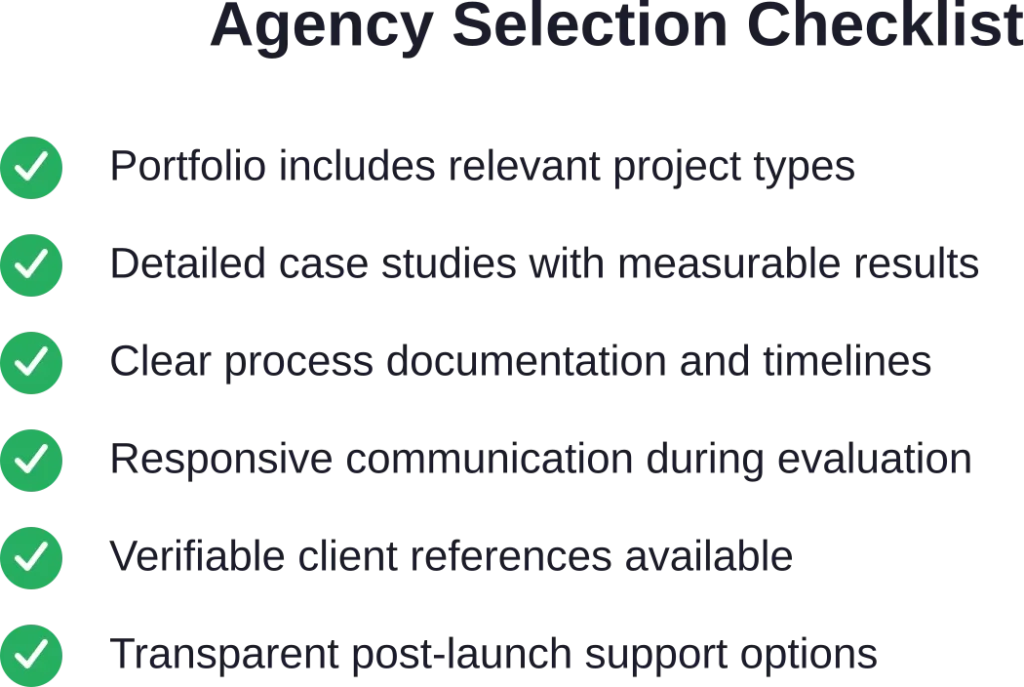
Review portfolios critically. Look for projects similar in scope and industry to what’s needed. Generic template work or stock photography suggests limited custom capability.
Read case studies thoroughly. The best ones explain the client’s challenge, the agency’s strategic approach, design and development decisions, and measurable outcomes. Vague descriptions or missing results raise red flags.
Check team composition. Agencies with dedicated strategists, designers, developers, and project managers signal specialized expertise. Studios where one person wears all hats may lack depth.
Assess Communication and Process
Initial conversations reveal how agencies work. Do they ask thoughtful questions about business goals? Do they explain their process clearly? Do they listen more than they pitch?
Request detailed proposals. Strong agencies outline phases, deliverables, timelines, and decision points. Vague proposals suggesting “we’ll figure it out as we go” indicate immature processes.
Understand post-launch support. Websites require ongoing maintenance, security updates, and optimization. Clarify what happens after launch—is there a support retainer? Training? Documentation?
Consider Budget Realistically
Web development costs vary enormously based on complexity, customization, and agency positioning. Data from multiple sources indicates entry-level projects can start around $1,000, while more substantial small business websites typically fall in the $10,000–$25,000 range. Complex projects with custom functionality can reach $50,000 or higher.
Budget constraints are legitimate, but unrealistic expectations cause project failure. A custom e-commerce platform with membership features, extensive integrations, and polished branding requires different investment than a five-page informational site.
Some agencies offer phased approaches, launching minimum viable sites first and adding features later. This strategy helps small businesses get online quickly while spreading costs over time.
| Agency Characteristic | What It Signals | Best For |
|---|---|---|
| Full-service capabilities | Can handle strategy, design, development, and marketing | Businesses needing comprehensive support |
| Specialized focus (UX, B2B, etc.) | Deep expertise in specific domain | Projects requiring specialized knowledge |
| Large team (20+ people) | Capacity for complex projects and multiple workstreams | Ambitious projects with tight deadlines |
| Boutique studio (5-10 people) | Personalized attention, senior-level involvement | Businesses valuing direct access to principals |
| Extensive case studies | Transparency, results-focus, documentation discipline | Decision-makers needing proof of capability |
| Industry specialization | Understanding of sector-specific challenges and best practices | Regulated industries or niche markets |
Red Flags to Watch For
Not every agency delivers on promises. Several warning signs suggest partnerships likely to end poorly.
Vague Deliverables and Timelines
Agencies that can’t articulate clear deliverables or provide realistic timelines often lack project management discipline. “It’ll be done when it’s done” isn’t a professional approach.
Strong agencies break projects into phases with specific milestones. They explain what gets delivered when and what feedback points exist. Ambiguity at the proposal stage multiplies during execution.
Portfolio Mismatches
When an agency’s portfolio shows no projects similar to what’s being requested, that’s a flag. Building a membership site differs significantly from creating a restaurant website.
Agencies sometimes take projects outside their expertise for revenue. These experimental projects rarely satisfy clients because the agency learns on their dime.
Poor Communication
Agencies that take days to respond to initial inquiries typically continue that pattern during projects. Communication speed and quality during courtship represent best-case scenarios.
Watch for jargon-heavy explanations without clarification. Technical complexity exists, but good agencies translate it into business terms. Hiding behind technical language suggests either lack of expertise or poor client service skills.
No Process Documentation
Professional agencies document processes. They explain discovery phases, design iterations, development workflows, testing protocols, and launch procedures.
Agencies that “just start designing” without research or strategy work produce websites that miss business objectives. Pretty doesn’t equal effective.
Unrealistic Promises
Guarantees of #1 search rankings, viral social media success, or specific traffic numbers should trigger skepticism. Too many variables influence those outcomes for any agency to guarantee results.
Honest agencies explain what they control (design quality, technical execution, SEO fundamentals) versus external factors (search algorithm changes, market conditions, competitor actions).
Questions to Ask Potential Agencies
Before committing, ask these questions to evaluate fit:
Can you walk me through your process from kickoff to launch? This reveals organizational maturity and helps set expectations.
Who will I work with day-to-day? Understanding team structure matters. Working with junior project coordinators differs from direct designer access.
How do you handle scope changes or additional requests? Change happens. Clear processes for handling it prevent relationship strain.
What happens if I’m not happy with the initial designs? Revision policies vary. Some agencies include multiple rounds; others charge for changes.
Can you provide references from clients in similar industries or with similar project scopes? Direct conversations with past clients provide unfiltered perspectives.
What do you need from me to make this project successful? This question surfaces time commitments, content requirements, and collaboration expectations.
How do you measure project success? Answers reveal whether agencies think beyond aesthetics to business outcomes.
What’s included in ongoing support? Clarifying post-launch relationships prevents surprise bills for basic assistance.
Making the Most of Your Agency Partnership
Successful website projects require collaboration. Small businesses can improve outcomes by approaching agency relationships strategically.
Prepare Thoroughly Before Kickoff
Gather existing brand assets: logos, color codes, fonts, brand guidelines, product photos, and any content that will populate the site. Organized preparation accelerates projects and reduces back-and-forth.
Identify decision-makers upfront. Projects stall when approval chains remain unclear. Designate who approves designs, content, and functionality decisions before work begins.
Compile competitor websites and reference sites. These examples help agencies understand aesthetic preferences and functional expectations faster than verbal descriptions.
Communicate Clearly and Promptly
Agency timelines typically assume specific client turnaround times for feedback and approvals. Delayed responses cascade through project schedules.
Provide consolidated feedback rather than piecemeal reactions. When multiple stakeholders review work, gather everyone’s input before responding to avoid contradictory change requests.
Ask questions when things aren’t clear. No question is too basic when building a business website. Good agencies appreciate clarification requests over assumptions.
Trust Expertise While Maintaining Vision
Agencies bring specialized knowledge about what works online. When designers recommend approaches that differ from initial preferences, listen to their rationale.
That said, business owners understand their customers and industries. Push back when agency suggestions don’t align with market realities or brand values.
The best outcomes emerge from collaborative tension between agency expertise and business knowledge. Neither side has perfect information alone.
Plan Beyond Launch
Website launches start journeys rather than end them. Traffic doesn’t appear magically. Conversion optimization requires iteration based on real user behavior.
Discuss ongoing arrangements before launch. Will the agency provide training? Monthly support hours? Performance monitoring? Clarifying this early prevents scrambling when issues arise.
Budget for continuous improvement. The most effective business websites evolve based on analytics, user feedback, and changing business needs. Static sites lose relevance quickly.
Small Business Website Statistics and Context
Understanding broader trends helps small businesses set realistic expectations for web development investments.
Research shows that significant numbers of websites exist on the internet, though engagement varies widely. This massive number contextualizes competition for attention online.
Small business owners commonly report website traffic as a significant challenge. Getting visitors represents a bigger obstacle than building the site itself for many companies.
The average website bounce rate of ~37% means more than one-third of visitors leave after viewing a single page. Good web development reduces bounce through clear navigation, compelling content, and fast load times.
According to the U.S. Small Business Administration, workshops on website improvement consistently attract small business owners seeking to enhance digital presence. The SBA emphasizes that building an effective website requires understanding design features, encouraging visitor action, and showing up in searches and AI prompts.
These statistics underscore why choosing the right development partner matters. Professional agencies understand how to beat average performance benchmarks through strategic design and development decisions.
The Value of Professional Web Development
Some small business owners question whether professional agency work justifies the investment compared to DIY website builders.
The answer depends on business objectives and internal capabilities. Simple informational sites explaining services and providing contact information can work well on platforms like Wix or Squarespace. These tools have improved dramatically in recent years.
But custom development offers advantages DIY platforms can’t match. Agencies build sites optimized for specific business goals rather than generic templates. They create custom functionality serving unique needs. They design information architectures matching how target customers think.
Professional development also delivers better performance. Page speed, mobile responsiveness, accessibility, and SEO technical foundations typically surpass builder platforms when agencies implement best practices.
Perhaps most importantly, agencies provide strategic thinking. They ask questions business owners don’t know to ask. They identify user experience friction points that aren’t obvious to people immersed in their own businesses daily.
Community discussions suggest small businesses that invested in professional development often wish they’d done so sooner. The cost feels significant upfront but proves justified when websites actively contribute to growth rather than just existing online.
Emerging Trends in Small Business Web Development
Web development continues evolving as technology, user expectations, and search algorithms change. Several trends particularly impact small businesses in 2026.
AI-Powered Personalization
Websites increasingly adapt content based on visitor behavior, location, or referral source. AI enables personalization that once required extensive custom coding.
Small business websites can now show different homepage content to first-time visitors versus returning customers, highlight local services based on IP location, or adjust calls-to-action based on referring pages.
Voice and AI Search Optimization
As demonstrated by Thrive’s substantial gains in AI platform referral traffic, optimizing for generative AI tools and voice search has become essential. This requires different content strategies than traditional SEO.
Agencies now structure content to answer natural language questions directly. They create comprehensive, authoritative resources that AI platforms trust and cite. This shift affects both content strategy and technical implementation.
Accessibility as Standard Practice
Web accessibility has moved from optional consideration to baseline requirement. Proper semantic HTML, keyboard navigation, screen reader compatibility, and color contrast standards now factor into professional development.
Beyond ethical imperatives, accessibility improves SEO and expands potential customer reach. Agencies incorporate accessibility testing throughout development rather than retrofitting it later.
Performance Obsession
Page speed directly impacts both search rankings and conversion rates. Modern development emphasizes lean code, optimized images, efficient hosting, and strategic resource loading.
Tools like Core Web Vitals provide specific metrics for measurement. Professional agencies optimize sites to meet or exceed Google’s performance standards, improving both rankings and user experience.
Mobile-First Everything
Mobile traffic surpassed desktop years ago, but mobile-first design thinking continues maturing. Agencies now design for mobile screens first, then adapt to larger displays rather than vice versa.
This approach ensures the most common viewing context receives primary attention. Touch interfaces, thumb-friendly navigation, and vertical scrolling patterns dominate contemporary design.
Frequently Asked Questions
Professional web development costs vary widely based on project complexity, features, and agency positioning. Typical small business websites with custom design and standard functionality can range from $10,000 to $25,000, with costs varying based on specific requirements. More complex projects requiring e-commerce, custom integrations, or extensive functionality can reach $50,000 or more. The investment depends on business needs rather than arbitrary budgets—clearly define requirements before requesting quotes to receive accurate estimates.
Timeline depends on project scope and client responsiveness. Simple informational websites might complete in 4-6 weeks. Standard small business sites with custom design typically require 8-12 weeks from kickoff to launch. Complex projects with custom functionality, extensive content, or multiple approval layers can extend to 16-20 weeks or longer. Client delays—late feedback, slow content delivery, or extended approval cycles—often account for timeline extensions more than agency work itself.
Geographic proximity offers advantages like face-to-face meetings and local market understanding, but location matters less than it once did. Remote collaboration tools enable effective partnerships across distances. Focus on finding agencies with relevant expertise, strong portfolios, and compatible working styles regardless of location. That said, local agencies may better understand regional market nuances and can provide easier in-person collaboration if that’s valued.
Web designers focus on visual aesthetics, user experience, and interface design. They determine layouts, color schemes, typography, and how sites look and feel. Web developers handle technical implementation—writing code that makes designs functional, building content management systems, creating databases, and ensuring everything works properly. Many agencies employ both specialists who collaborate throughout projects. Smaller studios may have individuals skilled in both design and development.
Verify legitimacy through several checks: review detailed portfolios with links to live client sites, read reviews on platforms like Clutch or Google Business, request client references and actually contact them, search for the agency principals on LinkedIn to verify team members, and start with smaller paid discovery or strategy phases before committing to full projects. Legitimate agencies welcome scrutiny and provide transparent information. Red flags include reluctance to share client work, absence of verifiable team members, requests for full payment upfront, and vague proposals lacking specific deliverables.
Most professional agencies offer post-launch support ranging from on-demand assistance to monthly retainers covering hosting, security updates, content changes, and performance monitoring. Clarify maintenance arrangements during project scoping—understand what’s included in the development contract versus what requires separate agreements. Some agencies prefer one-time projects and hand off completed sites; others build business models around long-term client relationships. Choose agencies whose ongoing support philosophy matches business preferences and internal capabilities.
Reputable agencies include revision rounds in project scopes and outline clear feedback processes. Most contracts specify how many design iterations are included and how change requests are handled. Before signing, understand satisfaction guarantees, revision policies, and dispute resolution approaches. The best prevention involves thorough communication during discovery and regular check-ins throughout development. When serious dissatisfaction occurs, professional agencies work to resolve issues—their reputations depend on client satisfaction. Contracts should outline resolution processes if partnerships break down before completion.
Conclusion
Choosing the right web development company represents one of the most consequential digital decisions small businesses make. The website serves as the always-on storefront, credibility builder, and often the first meaningful interaction potential customers have with a business.
The ten agencies profiled here—Thrive Internet Marketing Agency, Digital Silk, Clay, Excited Agency, eDesign Interactive, Huemor, Lounge Lizard, The Creative Momentum, Bop Design, and Azuro Digital—each bring distinct capabilities to small business partnerships. From full-service marketing integration to specialized UX expertise, from B2B focus to growth-driven optimization, these agencies demonstrate the range of approaches available.
The right choice depends less on rankings than on fit. A small B2B manufacturer needs different support than a local restaurant or e-commerce startup. Project budgets, timeline constraints, and internal capabilities all factor into which agency makes sense.
What matters most? Thorough evaluation before commitment. Review portfolios critically, read case studies completely, ask detailed questions, and check references. The agencies that invest time understanding business objectives before proposing solutions typically deliver the best outcomes.
Web development costs represent investments in business infrastructure. Professional websites drive measurable results—lead generation, sales conversions, customer education, and brand building. When executed well, they deliver returns that justify initial expenditure many times over.
Ready to move forward? Start by clarifying what success looks like for a business website. Define primary objectives, list required features, and establish realistic budgets. Then reach out to agencies whose specializations align with those needs. The right partner will ask tough questions, challenge assumptions, and collaborate toward websites that genuinely advance business goals.
The digital landscape continues evolving, but one constant remains: businesses that invest thoughtfully in professional web development gain measurable competitive advantages over those that treat websites as afterthoughts.