
Quick Summary: The best JavaScript web development companies in 2026 combine technical excellence, proven delivery records, and specialized expertise across frameworks like React, Node.js, Vue, and Angular. This guide profiles leading firms based on portfolio quality, client feedback, technology stack mastery, and development methodology—without pricing speculation—to help businesses identify partners aligned with their project requirements.
JavaScript remains the backbone of modern web development. From interactive front-end interfaces to scalable server-side applications, this language powers experiences that billions of users interact with daily.
Finding the right development partner, though? That’s where things get complicated.
Hundreds of agencies claim JavaScript expertise. Some excel at React-based single-page applications. Others specialize in Node.js backend systems or full-stack solutions combining multiple frameworks. The challenge isn’t finding options—it’s identifying which company possesses the specific technical depth and delivery track record that matches a given project.
Why JavaScript Development Partner Selection Matters
The wrong choice costs more than money. Technical debt accumulates when developers lack framework mastery. Projects stall when teams misunderstand architectural requirements. Launch delays compound when communication breaks down.
Here’s the thing though—JavaScript development isn’t monolithic.
A company brilliant at building React dashboards might struggle with real-time WebSocket applications. A team experienced in Node.js microservices might lack the front-end chops for complex UI work. Specialized expertise matters more than generalist claims.
Recent GitHub data shows JavaScript maintains its position as the most actively developed language, with repositories accumulating commits at unprecedented rates. The ecosystem evolves rapidly—frameworks release major versions, build tools transform workflows, and best practices shift as the community learns.
Top JavaScript Web Development Companies
1. Gilzor

Gilzor specializes in custom web and mobile development using JavaScript technologies to turn ideas into scalable digital products. They work with startups and growing businesses that need reliable web applications.
The company stands out through structured idea validation and full-cycle product development. Projects begin with business analysis and technical architecture planning to minimize rework and align the product with real user needs.
Their process includes user-centric UI/UX design, robust development, rigorous QA, and post-launch support. Emphasis on clean, maintainable code and scalable architecture helps products grow without major refactoring.
Technical capabilities cover modern JavaScript web development, full-stack solutions, API integrations, performance optimization, and go-to-market technical support for web platforms.
Contact Information:
- Website: www.gilzor.com
- Email: [email protected]
- Address: Poland, Warsaw, Office 58, street Adama Mickiewicza 37, 01-625
- LinkedIn: www.linkedin.com/company/gilzor-softwaredevelopment
2. Oski

Oski builds smart, well-engineered web solutions for enterprises and ambitious startups. They focus on modern JavaScript stacks and cloud-native architectures.
What distinguishes them is the combination of deep technical expertise with fast team ramp-up and AI-accelerated development practices. Projects move from requirements to operational solutions with strong emphasis on quality and scalability.
The team delivers complete frontend and full-stack solutions while maintaining clear architecture and documentation. They prioritize intuitive user experiences backed by solid engineering.
JavaScript capabilities include React, Vue, Angular, Next.js, Nuxt, and Node.js development, along with seamless cloud integrations, performant UIs, and complex web application architecture.
Contact Information:
- Website: oski.site
- Phone: +48571282759
- Email: [email protected]
- Address: Kaupmehe tn 7, 10114 Tallinn, Estonia
- LinkedIn: www.linkedin.com/company/oski-solutions
3. A-Listware

A-Listware provides expert JavaScript development and dedicated teams for web applications across enterprise, SMB, and startup projects. They focus on delivering secure, responsive, and scalable digital solutions.
The company excels at seamless team integration and managed development outsourcing. They act as an extension of the client’s team, ensuring consistent quality and communication throughout the project lifecycle.
Their approach covers the full development spectrum — from consulting and architecture through implementation, testing, and infrastructure management. Strong focus on maintainable code and long-term support.
Technical strengths include custom web development, legacy modernization, cloud applications, UI/UX implementation, and enterprise JavaScript solutions with emphasis on security and performance.
Contact Information:
- Website: a-listware.com
- Phone: +1 (888) 337 93 73
- Email: [email protected]
- Address: North Bergen, NJ 07047, USA
- LinkedIn: www.linkedin.com/company/a-listware
- Facebook: www.facebook.com/alistware
4. Mobian Studio

Mobian Studio builds dedicated engineering teams that deliver production-ready JavaScript web and mobile solutions. They specialize in helping companies ship faster without compromising quality.
What sets them apart is the focus on dedicated, non-shared teams and clean architecture from day one. They offer both full outsourcing and outstaffing models with senior-level JavaScript execution.
Delivery includes end-to-end product development, scalable architecture, legacy integration, and ongoing partnership after launch. Every decision is documented and explainable for future maintainability.
Their JavaScript expertise spans modern frontend and backend development, complex web applications, AI-enhanced interfaces, and high-performance systems designed to scale from hundreds to hundreds of thousands of users.
Contact Information:
- Website: mobian.studio
- Phone: [email protected]
- Address: Harju maakond, Tallinn, Kesklinnalinnaosa, Masina tn 22, 10113
- LinkedIn: www.linkedin.com/company/mobian-studio
5. Lengreo

Lengreo serves as a complete marketing and tech partner with strong capabilities in website development and digital solutions. Their expertise covers modern web platforms built with JavaScript frameworks that drive lead generation and business growth.
What sets them apart is the tight integration of technical development with performance marketing. Every website project starts with deep business analysis and conversion-focused planning rather than just visual design.
The team handles full-cycle web development — from discovery and prototyping through implementation, QA, and ongoing optimization. Client communication remains clear and results-oriented, with regular progress alignment on both technical and marketing metrics.
Their JavaScript development strengths include building high-converting landing pages, e-commerce sites, business portals, and lead-generation platforms with strong emphasis on speed, SEO readiness, and seamless integration with marketing tools.
Contact Information:
- Website: Lengreo.com
- Phone: +31 686 147 566
- Email: [email protected]
- Address: Vrijstraat 9 C/D, 5611 AT Eindhoven, Netherlands
- LinkedIn: Lengreo
- Twitter: @Lengreo
- Instagram: @lengreo
6. SumatoSoft

SumatoSoft maintains a strong track record in custom web applications, with particular depth in React and Node.js stacks. Their portfolio spans e-commerce platforms, SaaS products, and enterprise dashboards.
What sets them apart? Architectural planning. Projects begin with thorough requirements analysis and technical specification development before code begins. This upfront investment reduces mid-project surprises and scope creep.
The team demonstrates competence across the full development lifecycle—from database design through deployment automation. Client feedback consistently highlights clear communication and realistic timeline estimates. Their development process includes regular sprint reviews and stakeholder demos, maintaining alignment throughout lengthy projects.
Technical capabilities extend beyond basic CRUD applications. The portfolio includes real-time data processing systems, third-party API integrations, complex business logic implementation, and performance optimization for high-traffic scenarios.
7. Debut Infotech

Debut Infotech specializes in modern JavaScript frameworks with particular strength in Vue.js and Angular implementations. Their client base includes both startups needing MVP development and enterprises requiring legacy modernization.
The company’s approach emphasizes modular architecture. Components get built for reusability, reducing future maintenance burden. Code review processes ensure consistency across team members, preventing the fragmentation that plagues larger projects.
Their testing methodology combines automated unit tests, integration testing, and manual QA cycles. This multi-layer approach catches issues before production deployment. Performance monitoring continues post-launch, identifying optimization opportunities as usage patterns emerge.
8. Sketch Development Services

Sketch focuses on rapid prototyping and iterative development. Their process suits clients who need to validate concepts quickly before committing to full-scale builds.
The team excels at translating business requirements into technical specifications. Non-technical stakeholders appreciate their ability to explain architectural decisions in accessible language. This clarity prevents misunderstandings that derail projects mid-stream.
JavaScript expertise spans front-end frameworks (React, Vue) and backend Node.js development. The full-stack capability allows unified architecture decisions rather than disconnected front-end and back-end systems that struggle to communicate efficiently.
9. Konstant Infosolutions

Konstant Infosolutions brings enterprise-scale experience to JavaScript development. Their portfolio includes complex multi-tenant SaaS platforms, financial services applications, and healthcare systems with strict compliance requirements.
Security receives explicit focus. Code undergoes security audits, authentication systems implement industry best practices, and data handling follows regulatory standards. For projects where security breaches carry significant consequences, this attention to protective measures provides crucial reassurance.
The development team includes specialists in performance optimization. Page load times get scrutinized, bundle sizes get minimized, and database queries get optimized. These technical details significantly impact user experience in production environments.
10. Codal

Codal combines JavaScript development with UX design expertise. Their projects emphasize user-centered interfaces backed by robust technical implementation.
This dual focus produces applications that function reliably while remaining intuitive for end users. The design-development integration prevents the disconnect common when these disciplines work in isolation—beautiful mockups that prove technically impractical, or functional systems with confusing interfaces.
JavaScript framework selection gets tailored to project needs. React for highly interactive dashboards. Vue for progressive enhancement of existing systems. Angular for large enterprise applications requiring strict structure. The pragmatic approach avoids forcing every project into identical technical patterns.
11. BairesDev

BairesDev operates with distributed teams across Latin America, offering technical talent across time zones convenient for North American collaboration.
Their JavaScript developers specialize in specific frameworks rather than claiming universal expertise. This specialization depth produces higher code quality—developers intimately familiar with framework idioms, common pitfalls, and optimization techniques.
Project management processes include daily standups, sprint planning, and retrospectives. The agile methodology allows course corrections as requirements clarify and business priorities shift. Rigid waterfall processes struggle with the uncertainty inherent in software development; adaptive processes handle change more gracefully.
12. 10Clouds

10Clouds brings European technical talent to JavaScript projects, with teams in Poland and other Central European locations. Their portfolio includes work for both scaling startups and established enterprises.
Technical depth extends to emerging JavaScript ecosystem tools. Modern build systems, state management libraries, testing frameworks, and deployment platforms all receive attention. Staying current with ecosystem evolution prevents projects from launching with outdated architecture.
Code quality standards include automated linting, formatting consistency, documentation requirements, and complexity limits. These standards maintain codebase health as projects grow, preventing the technical debt that makes future changes increasingly difficult.
13. Intellectsoft

Intellectsoft tackles complex enterprise JavaScript applications, often integrating with existing legacy systems. Their experience includes gradual modernization strategies—replacing outdated components incrementally rather than risky complete rewrites.
The team demonstrates strength in API design and integration work. Modern applications rarely exist in isolation; they connect to payment processors, authentication services, analytics platforms, CRM systems, and countless other third-party services. Clean API abstractions simplify these integrations and reduce coupling.
Performance testing receives explicit project phases. Load testing identifies bottlenecks before launch. Monitoring systems track real-world performance metrics. This data-driven approach replaces guesswork with measurement.
14. Fingent

Fingent serves mid-market businesses needing custom web applications without enterprise-scale budgets. Their JavaScript expertise covers standard business application patterns—customer portals, inventory management, workflow automation, reporting dashboards.
Project communication emphasizes transparency. Clients receive regular progress updates with working demos. Issues get surfaced early rather than hidden until crisis moments. This honest communication builds trust and allows collaborative problem-solving.
The development approach balances custom code with proven libraries. Not every feature requires building from scratch—leveraging well-maintained open-source components accelerates development while reducing maintenance burden. The skill lies in knowing when custom solutions provide genuine value versus unnecessary reinvention.
15. Softeq
Softeq combines JavaScript web development with IoT and hardware integration expertise. Their projects often involve web dashboards controlling or displaying data from physical devices.
This cross-domain capability proves valuable for industrial applications, smart home systems, and connected device ecosystems. JavaScript’s real-time capabilities through WebSockets and server-sent events enable responsive interfaces reflecting device states.
Technical architecture planning considers scalability from project inception. Systems designed to handle future growth avoid expensive re-architecture when success brings increased load. Database choices, caching strategies, and API design all reflect long-term thinking.
What Defines Excellence in JavaScript Development
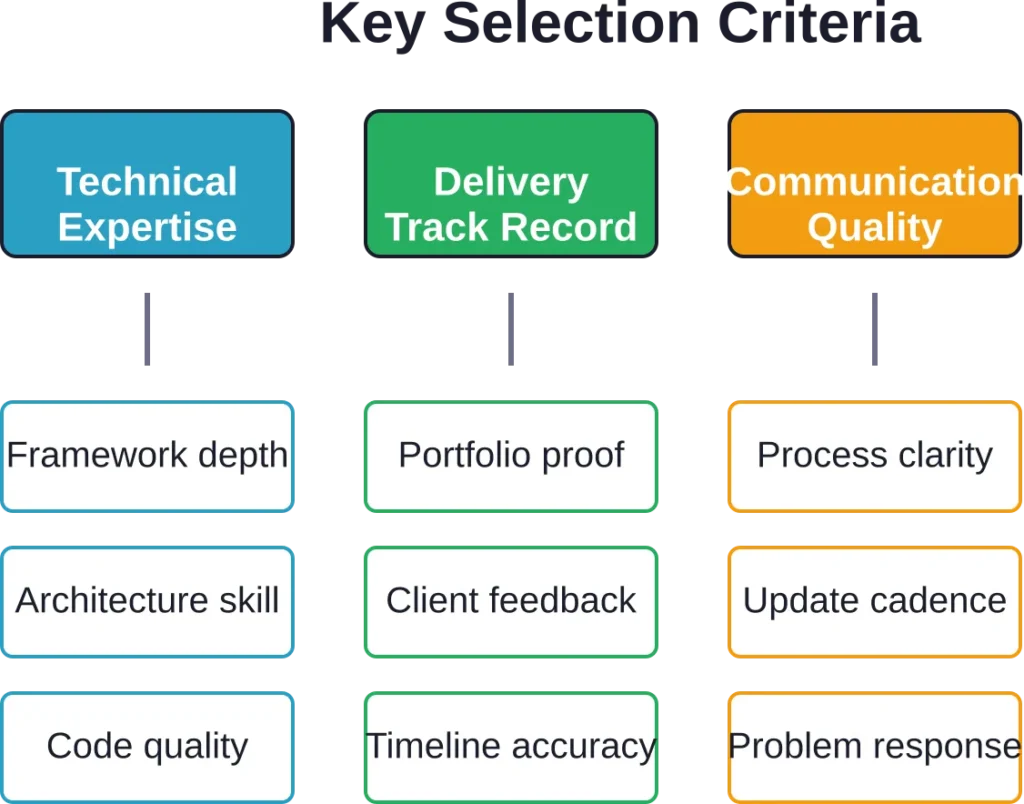
Top-tier JavaScript companies share recognizable patterns. They demonstrate technical competence through completed projects, not marketing promises. Their portfolios showcase diverse use cases—e-commerce platforms, SaaS applications, enterprise dashboards, mobile-responsive sites.
But wait. Portfolio variety alone doesn’t guarantee fit.
The best firms also exhibit these characteristics:
- Framework specialization: Deep expertise in specific stacks (React + Node.js, Vue + Express, Angular enterprise patterns) rather than surface-level familiarity with everything.
- Modern development practices: CI/CD pipelines, automated testing, code review processes, version control discipline, documentation standards.
- Architecture experience: Proven ability to design scalable systems—microservices, serverless functions, API gateways, database optimization.
- Performance focus: Understanding of bundle optimization, lazy loading, caching strategies, Core Web Vitals, accessibility standards.
- Communication clarity: Regular progress updates, transparent problem-solving, realistic timeline estimation, stakeholder alignment.
Technical skill matters most. Communication determines whether that skill translates into successful delivery.
Methodology for This Evaluation
This analysis draws from multiple data sources. Client review platforms provide feedback on delivery quality and communication. Portfolio case studies reveal technical capabilities and problem-solving approaches. Technology community contributions—GitHub repositories, framework discussions, technical articles—demonstrate ongoing learning and ecosystem engagement.
The short answer? No single metric determines quality.
Instead, patterns emerge across multiple indicators. Companies consistently earning positive feedback while maintaining active technical communities and diverse portfolios stand out. Geographic location matters less than capability—distributed teams in Eastern Europe and Asia often deliver comparable technical quality to North American and Western European firms.
This list excludes pricing and hourly rates intentionally. Budget discussions happen after requirements definition. Premature cost focus often leads to poor fit—selecting the cheapest option rather than the most capable partner for specific needs.
How JavaScript Development Companies Structure Teams
Project team composition varies by company size and methodology. Smaller firms might assign 2-3 developers rotating between projects. Larger agencies build dedicated teams for each client.
Typical roles include:
- Frontend developers: React, Vue, or Angular specialists implementing user interfaces and client-side logic.
- Backend developers: Node.js engineers building APIs, business logic, database interactions, authentication systems.
- Full-stack developers: Engineers comfortable across both domains, common in smaller teams or earlier project phases.
- DevOps engineers: Specialists handling deployment automation, infrastructure configuration, monitoring, and scaling.
- QA engineers: Testers writing automated tests, performing manual validation, identifying edge cases.
- Project managers: Coordinators managing timelines, facilitating communication, removing blockers, tracking deliverables.
Team size directly impacts project velocity and cost. A 3-person team costs less but takes longer. A 10-person team accelerates delivery but multiplies coordination complexity and expense.
Communication overhead grows with team size. Five developers require ten communication channels. Ten developers need forty-five channels. Beyond certain thresholds, adding people slows projects instead of accelerating them.
JavaScript Framework Considerations for Different Project Types
Framework selection significantly impacts development experience, performance characteristics, and long-term maintenance burden. No universal “best” framework exists—optimal choices depend on project requirements.
React
React dominates JavaScript development discussions for good reason. The component-based architecture scales from simple sites to complex applications. The massive ecosystem provides pre-built solutions for common patterns—routing, state management, form handling, animation.
React suits projects requiring highly interactive interfaces. Real-time dashboards, complex forms with conditional logic, drag-and-drop interfaces, and dynamic content updates all play to React’s strengths.
The learning curve proves steeper than simpler frameworks. Concepts like hooks, context, reconciliation, and component lifecycle require time to master. Teams already experienced with React move faster; teams learning simultaneously with project work face slower initial velocity.
Vue.js
Vue balances power and approachability. The progressive nature allows gradual adoption—start with simple template enhancements, expand to full single-page applications as needs grow.
Documentation quality stands out. Clear examples, comprehensive guides, and logical organization help developers find answers quickly. This accessibility reduces onboarding time for new team members.
Vue works well for projects modernizing existing server-rendered sites. Drop Vue into legacy PHP, Rails, or Django templates, progressively replacing static content with reactive components. Complete rewrites prove riskier than incremental improvements.
Angular
Angular provides opinionated structure valued in enterprise environments. The framework prescribes solutions for routing, HTTP requests, forms, and testing. This consistency helps large teams coordinate—everyone follows the same patterns.
TypeScript integration runs deep. Type safety catches errors during development rather than production. Refactoring becomes safer when the compiler identifies breaking changes automatically.
Angular suits large applications with many developers. The upfront learning investment pays dividends in long-term maintainability. Small projects might find the structure excessive—a framework designed for hundred-thousand-line codebases feels heavy for five-page sites.
Node.js Backend Considerations
Node.js enables JavaScript across the full stack. Developers comfortable with frontend JavaScript transition to backend work without learning entirely new languages.
The event-driven architecture handles concurrent connections efficiently. Thousands of simultaneous users don’t require thousands of threads. This efficiency benefits real-time applications—chat systems, collaborative editors, live dashboards.
CPU-intensive tasks expose Node.js limitations. Heavy computation blocks the event loop, degrading responsiveness. Projects involving image processing, data analysis, or complex algorithms might benefit from complementary services in languages optimized for computational work.
| Framework | Best For | Learning Curve | Ecosystem Size |
|---|---|---|---|
| React | Interactive UIs, SPAs, dashboards | Moderate-High | Largest |
| Vue | Progressive enhancement, rapid development | Low-Moderate | Large |
| Angular | Enterprise apps, large teams | High | Large |
| Svelte | Performance-critical apps | Low-Moderate | Growing |
| Next.js | SEO-critical, server-rendered React | Moderate | Large (React ecosystem) |
| Node.js | APIs, real-time backends, microservices | Moderate | Largest (npm) |
Technical Capabilities That Distinguish Top Companies
Beyond framework knowledge, certain technical competencies separate capable firms from mediocre ones.
Performance Optimization
Performance impacts both user experience and business metrics. Slow sites lose visitors before content loads. Every 100ms delay in response time correlates with measurable conversion rate drops.
Top development companies implement performance budgets from project start. Bundle sizes get monitored. Critical rendering paths get optimized. Images get compressed and lazy-loaded. Third-party scripts get deferred or eliminated.
Real-world performance differs from development environment performance. Production networks vary in speed. Devices vary in processing power. Testing must include realistic conditions, not just high-end developer machines on fast connections.
Security Implementation
Security breaches destroy trust and expose legal liability. Competent JavaScript developers implement defense-in-depth strategies rather than hoping perimeter security suffices.
Input validation happens on both client and server. Never trust client-side validation alone—attackers bypass it trivially. Authentication tokens get handled securely. HTTPS gets enforced. Content Security Policies restrict script execution. Dependencies get updated as vulnerabilities surface.
Security audits should happen before launch, not after breaches. Automated scanning catches common vulnerabilities. Manual code review catches logic flaws automated tools miss.
API Design
Modern applications connect to numerous services. Clean API design simplifies these integrations and isolates changes.
RESTful patterns provide familiar conventions. GraphQL offers flexibility for complex data requirements. WebSocket connections enable real-time bidirectional communication. The right choice depends on use case, not dogma.
API versioning allows evolution without breaking existing clients. Comprehensive documentation helps future developers understand design decisions. Rate limiting prevents abuse. Error responses provide useful debugging information without exposing security details.
Testing Strategy
Untested code accumulates bugs. Testing proves especially valuable in JavaScript’s dynamic environment where type errors only surface at runtime.
Unit tests validate individual functions and components. Integration tests verify that modules interact correctly. End-to-end tests simulate real user workflows. Each testing layer catches different bug categories.
Test automation enables confident refactoring. Without tests, developers fear changing code—any modification might introduce regressions. Comprehensive test coverage provides safety nets that encourage improvement.
Red Flags When Evaluating JavaScript Development Companies
Certain warning signs indicate potential problems. Recognizing these patterns helps avoid costly mistakes.
Unrealistic Timeline Promises
Development takes time. Complex applications can’t be built in weeks regardless of team size. Companies promising suspiciously fast delivery either misunderstand requirements, plan to cut corners, or lack relevant experience.
Pressure clients to define requirements clearly, then provide realistic estimates. Experienced firms know that rushing produces technical debt requiring expensive future fixes.
No Portfolio or Case Studies
Every competent development company showcases completed work. Portfolios demonstrate technical range, design sensibility, and problem-solving approaches.
Firms refusing to share examples raise questions. Either they lack experience, produced work they’re embarrassed to show, or can’t obtain client permission to display projects—all concerning signals.
Poor Communication During Sales Process
Communication quality during sales predicts communication during development. Slow responses, vague answers, difficulty scheduling calls—these patterns intensify under project pressure.
If getting clear answers proves difficult before signing contracts, expect worse communication once deposits are paid.
Reluctance to Discuss Technical Approach
Strong development companies explain technical decisions clearly. Which framework? Why that choice? How will architecture scale? What about security? Performance? Maintenance?
Vague responses or marketing speak instead of technical specifics suggest shallow expertise. Real developers discuss tradeoffs, explain alternatives, and justify recommendations with technical reasoning.
No Defined Development Process
Professional development follows structured processes. How do requirements get gathered? How does testing work? What does the deployment workflow look like? How are bugs tracked and prioritized?
Companies without clear processes often improvise, producing inconsistent results. Formal methodologies—Agile, Scrum, Kanban—provide frameworks that reduce chaos.
Questions to Ask Potential JavaScript Development Partners
Thoughtful questions reveal capability and compatibility. Strong candidates answer confidently with technical specifics.
- What JavaScript frameworks do your team members have the most experience with? Listen for specific depth rather than claims of universal expertise.
- Can you share examples of similar projects? Portfolio relevance matters more than portfolio size.
- How do you handle scope changes mid-project? Change happens. Mature processes accommodate evolution without derailing timelines.
- What does your testing process look like? Specific methodology descriptions indicate established practices.
- How will we communicate during development? Clarify update frequency, preferred channels, stakeholder involvement.
- What happens after launch? Understand maintenance options, bug fix procedures, ongoing support availability.
- Can you provide client references? Speaking with past clients reveals how the company handles challenges.
Pay attention not just to answers but to how candidates answer. Confident technical explanations differ from evasive marketing responses.
The JavaScript Ecosystem in 2026
JavaScript development continues evolving rapidly. Frameworks mature, new tools emerge, best practices shift as the community learns.
React remains dominant but faces increasing competition. Svelte gains traction for performance-critical applications. Solid.js attracts developers seeking reactive primitives without virtual DOM overhead. The framework landscape diversifies as different approaches prove optimal for different contexts.
Build tooling transforms continuously. Vite accelerates development server startup dramatically compared to older webpack configurations. Community discussions on GitHub document real-world experiences. Some developers report build performance challenges with large codebases, with production builds and type-checking processes adding significant time.
TypeScript adoption accelerates. Type safety catches entire bug categories during development. Refactoring becomes safer. Documentation improves through explicit interfaces. The tradeoff—additional learning curve and compilation complexity—proves worthwhile for projects beyond trivial size.
Serverless deployment patterns gain adoption. Functions-as-a-Service platforms eliminate server management. Automatic scaling handles traffic spikes. Pay-per-execution pricing benefits applications with variable load. The architectural implications require different thinking than traditional always-on servers.
Geographic Considerations and Distributed Development
JavaScript talent exists globally. Quality development happens in North America, Europe, Asia, Latin America, and elsewhere. Geographic location affects communication more than technical capability.
Time zone overlap influences collaboration effectiveness. Real-time discussions happen naturally when teams share working hours. Asynchronous communication works when documentation is thorough and processes are clear.
Cultural factors affect communication styles. Some cultures emphasize direct communication; others value indirect approaches. Understanding these differences prevents misunderstandings.
Language proficiency matters for requirements discussions and technical specifications. Misunderstood requirements cost more to fix than clear communication takes to establish.
Budget Realities for JavaScript Web Development
While this article intentionally excludes specific pricing, understanding general budget parameters helps set realistic expectations.
Development typically costs $5,000–$10,000 for basic corporate sites, while complex B2B SaaS can require six-figure budgets. Hourly rates vary by geography and experience level.
Development teams in different regions operate at various price points, with competitive rates available globally regardless of geography.
Project complexity drives cost more than team location. Simple sites cost less regardless of developer geography. Complex applications require substantial investment everywhere.
Budget reality check: meaningful custom web projects start at tens of thousands of dollars. Sub-$10k proposals usually mean template work, not engineering.
| Project Type | Typical Duration | Team Size | Complexity Level |
|---|---|---|---|
| Landing page / Small site | 2-4 weeks | 1-2 developers | Low |
| Corporate website | 6-10 weeks | 2-4 developers | Low-Medium |
| Custom web application | 12-20 weeks | 3-6 developers | Medium |
| E-commerce platform | 16-24 weeks | 4-8 developers | Medium-High |
| Enterprise SaaS | 24-52 weeks | 6-15+ developers | High |
| Complex B2B platform | 52+ weeks | 10-20+ developers | Very High |
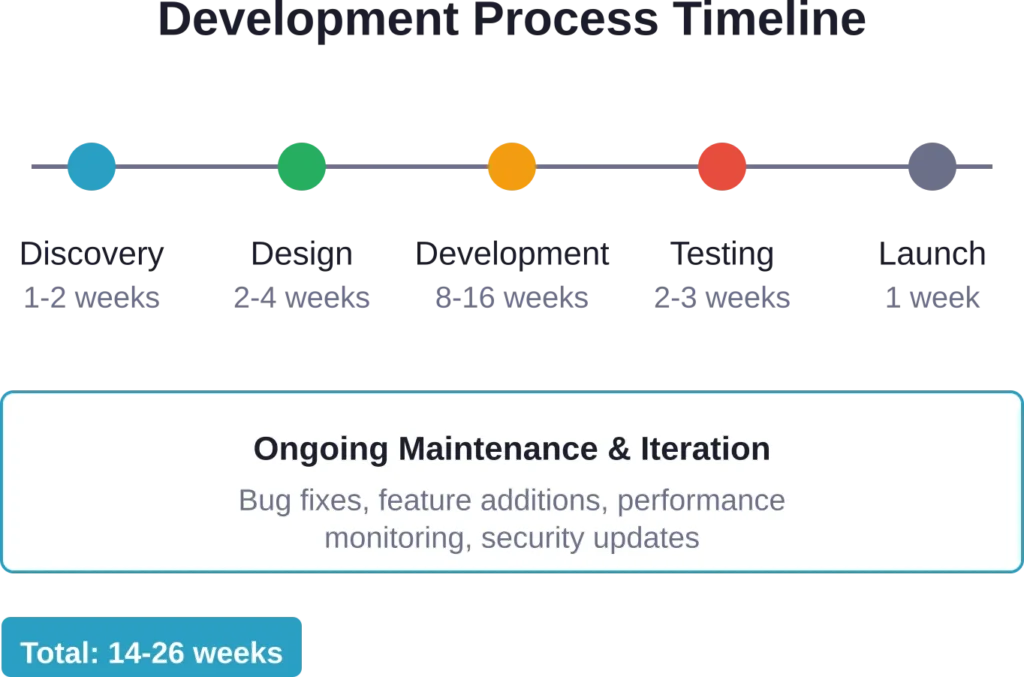
Post-Launch Considerations
Launch doesn’t end the relationship with development partners. Successful applications require ongoing attention.
Maintenance and Updates
JavaScript dependencies require regular updates. Security patches, bug fixes, and framework upgrades all demand attention. Neglected applications accumulate technical debt rapidly in JavaScript’s fast-moving ecosystem.
Maintenance agreements clarify responsibilities. Which bugs get fixed immediately? What response time for issues? How are feature requests handled?
Performance Monitoring
Real user monitoring reveals how applications perform in production. Synthetic tests in controlled environments miss issues affecting actual users on varied devices and networks.
Monitoring systems track page load times, JavaScript errors, API response times, and user interactions. This data identifies optimization opportunities and catches problems before users complain.
Feature Evolution
Successful applications evolve based on user feedback and business needs. The initial launch represents a starting point, not the final state.
Establishing clear processes for feature prioritization, development, testing, and deployment allows controlled evolution without chaos.
The Role of Open Source in JavaScript Development
JavaScript development relies heavily on open-source libraries and frameworks. The npm ecosystem contains over a million packages addressing countless use cases.
This abundance provides both opportunity and risk. Quality varies dramatically. Well-maintained projects receive regular updates and security patches. Abandoned projects accumulate vulnerabilities and compatibility issues.
Vetting dependencies matters. Check last update date, issue response time, number of maintainers, and community size. Popular projects generally receive better maintenance than obscure alternatives.
License compliance requires attention. Different open-source licenses carry different obligations. Commercial use might trigger requirements that personal projects don’t face. Legal review prevents unpleasant surprises.
Industry Trends Shaping JavaScript Development
Several trends influence how JavaScript development companies operate and the solutions they deliver.
Edge Computing
Processing moves closer to users. Edge platforms execute JavaScript at locations near end users rather than centralized data centers. Reduced latency improves user experience, particularly for global audiences.
Architectural patterns shift as compute becomes distributed. Traditional monolithic deployments give way to distributed functions. Stateless designs become important as requests might hit different edge locations.
WebAssembly Integration
WebAssembly allows running compiled languages in browsers at near-native speed. JavaScript applications can offload CPU-intensive work to WebAssembly modules written in Rust, C++, or other compiled languages.
This capability expands browser application possibilities. Complex calculations, image processing, video encoding, physics simulations—tasks previously requiring backend processing can happen client-side.
Progressive Web Apps
PWAs blur distinctions between web and native applications. Service workers enable offline functionality. Push notifications re-engage users. Installation to home screens removes browser chrome.
For many use cases, PWAs provide native-like experiences without app store distribution complexities. Development costs decrease when one codebase serves all platforms.
AI Integration
Machine learning models increasingly integrate with JavaScript applications. Sentiment analysis, recommendation engines, image recognition, natural language processing—capabilities once requiring specialized backend infrastructure now run client-side through libraries like TensorFlow.js.
Privacy benefits accompany this shift. Processing data locally avoids transmitting sensitive information to servers. Latency decreases when models run on-device.
Frequently Asked Questions
Project timelines vary dramatically based on scope and complexity. A simple corporate site might complete in 4-6 weeks. Custom web applications typically require 12-20 weeks. Complex enterprise platforms can extend beyond a year. Discovery phases, design iterations, development cycles, testing periods, and deployment preparations all contribute to overall duration. Companies promising dramatically shorter timelines often deliver lower quality or misunderstand requirements.
Critical questions include: Which frameworks does the team specialize in? Can they share similar project examples? How do they handle scope changes? What testing processes do they follow? How will communication work during development? What post-launch support is available? Can they provide references from past clients? Strong answers demonstrate specific technical depth, established processes, and clear communication rather than vague marketing claims
Framework specialization produces deeper expertise than generalist approaches. React, Vue, and Angular each have distinct patterns, optimization techniques, and ecosystem tools. Developers focusing on specific frameworks accumulate knowledge that improves code quality, accelerates development, and prevents common pitfalls. Projects benefit from this concentrated experience more than from teams claiming universal JavaScript expertise.
Location affects communication patterns more than technical capability. Quality JavaScript developers exist globally. Time zone overlap facilitates real-time collaboration but isn’t absolutely necessary—many successful projects involve distributed teams. Language proficiency matters for requirements discussions. Cultural communication styles influence how directly feedback gets delivered. Focus on communication quality and technical capability rather than geography alone.
Basic websites primarily display content—company information, services, contact details. Custom web applications involve user interactions, data processing, business logic, and complex functionality. Applications require authentication, databases, API integrations, state management, and ongoing data processing. Development complexity, timeline, and investment requirements differ substantially between content sites and functional applications.
Full-stack JavaScript (Node.js backend with React/Vue/Angular frontend) offers development efficiency through shared language and tooling. Developers can work across the entire stack. Code can be shared between client and server. However, other backend technologies might better suit specific requirements—high-performance computing, specific enterprise integrations, existing infrastructure compatibility. Pragmatic technology selection based on actual requirements outperforms dogmatic adherence to any single approach.
Maintenance approaches vary by company. Some include limited post-launch support in initial contracts. Others offer separate maintenance agreements with defined response times and covered services. Typical maintenance includes security updates, dependency upgrades, bug fixes, performance monitoring, and minor adjustments. Major feature additions usually require separate project phases. Clarifying maintenance terms before signing contracts prevents future confusion.
Making the Final Selection
Choosing a JavaScript development partner ultimately comes down to fit. Technical capability, communication quality, and project understanding all matter.
Review portfolios carefully. Look for projects similar to planned work. Assess design quality, technical complexity, and innovation. Strong portfolios demonstrate range and depth.
Check references thoroughly. Past clients reveal how companies handle challenges, communicate under pressure, and deliver when problems arise. Perfect projects are rare; how teams respond to difficulties matters most.
Trust instincts about communication. If interactions during sales feel difficult, development will prove worse. Smooth, clear communication during evaluation suggests similar quality during project work.
Verify technical understanding. Can the team explain why they recommend specific technologies? Do they understand project requirements deeply? Do they ask clarifying questions or accept vague specifications?
Look, JavaScript development represents significant investment. The right partner delivers applications that perform well, scale appropriately, and require reasonable maintenance. The wrong partner produces technical debt that haunts projects for years.
Research thoroughly. Compare multiple options. Ask detailed questions. Verify capabilities through portfolios and references. The extra diligence pays dividends in successful project outcomes.
Conclusion
JavaScript web development continues maturing as frameworks evolve and best practices solidify. The companies profiled here demonstrate the technical expertise, delivery track records, and specialized knowledge that distinguish top-tier development partners from mediocre alternatives.
Success requires matching specific project needs with appropriate technical capabilities. React expertise matters for interactive dashboards but proves less relevant for content-focused sites. Node.js backend experience becomes crucial for real-time applications but unnecessary for static content delivery.
No universal “best” company exists. The optimal choice depends on project requirements, budget constraints, timeline expectations, and communication preferences. The companies listed here all demonstrate competence—selecting among them requires evaluating fit rather than absolute rankings.
Real talk: take time with this decision. Rushing partner selection to start development quickly often produces regret later. Thorough evaluation, clear communication, and realistic expectation-setting lay foundations for successful projects.
Ready to start a JavaScript web development project? Research thoroughly, ask detailed questions, verify capabilities through portfolios and references, and choose partners whose expertise aligns with specific technical requirements. The right development company transforms business requirements into functional, scalable, maintainable web applications that serve users effectively for years.