

Quick Summary: Finding an affordable web development company that delivers quality work without breaking the bank is possible in 2026. This guide profiles 15 vetted agencies across various specializations—from SaaS to eCommerce—each offering strong portfolios and proven track records without the enterprise premium. The list focuses on firms that balance cost-effectiveness with technical excellence, helping businesses make informed hiring decisions.
Choosing a web development company shouldn’t mean choosing between quality and affordability. Yet that’s exactly the dilemma most businesses face when shopping for development partners.
Enterprise agencies promise excellence but demand budgets that make small businesses wince. Freelance marketplaces offer rock-bottom rates but come with inconsistent quality and project management headaches. The sweet spot—agencies that deliver professional work without the luxury markup—exists but requires careful vetting.
This guide cuts through the noise. Over the past several months, analysis of portfolios, client reviews, technical capabilities, and real project outcomes has identified 15 web development companies that punch above their weight class. These aren’t the cheapest options available, and they’re not trying to be. Instead, they offer the best value: quality craftsmanship at prices that make sense for growing businesses.
Whether launching an eCommerce platform, building a SaaS product, or creating a marketing site that actually converts, these agencies have demonstrated they can deliver. No inflated promises. No hidden costs. Just solid development work from teams that understand the constraints real businesses operate under.
What Makes a Web Development Company “Affordable” in 2026?
Affordable doesn’t mean cheap. It means reasonable pricing relative to the value delivered.
The web development market in 2026 spans a staggering range. Template-based sites start around a few thousand dollars. Mid-range custom projects typically fall in the range of specialist agencies charging for marketing sites with custom CMS integration. Complex B2B SaaS platforms can require six-figure investments.
Affordable agencies occupy the middle ground. They avoid the overhead that drives enterprise pricing—Manhattan offices, layers of account managers, bloated processes—without sacrificing technical chops or design quality. Many operate with lean, senior-heavy teams. Some work remotely or from lower-cost cities. Others specialize tightly, building efficiency through repetition.
The result? Development costs that reflect actual work rather than brand prestige. For most early-stage companies and small businesses, this bracket delivers professional results without requiring venture funding or massive marketing budgets.
Cost Realities for Custom Web Projects
Industry reports suggest meaningful custom web projects start at tens of thousands of dollars. Sub-ten-thousand-dollar proposals usually mean template work, not true custom engineering.
Web development typically costs $5,000–$10,000 for a basic corporate site, according to industry reports. A more robust marketing site built on platforms like Webflow or WordPress, with custom design and moderate functionality, generally falls into a higher bracket. Full-scale web applications with complex back-end logic, user authentication, and third-party integrations push costs higher still.
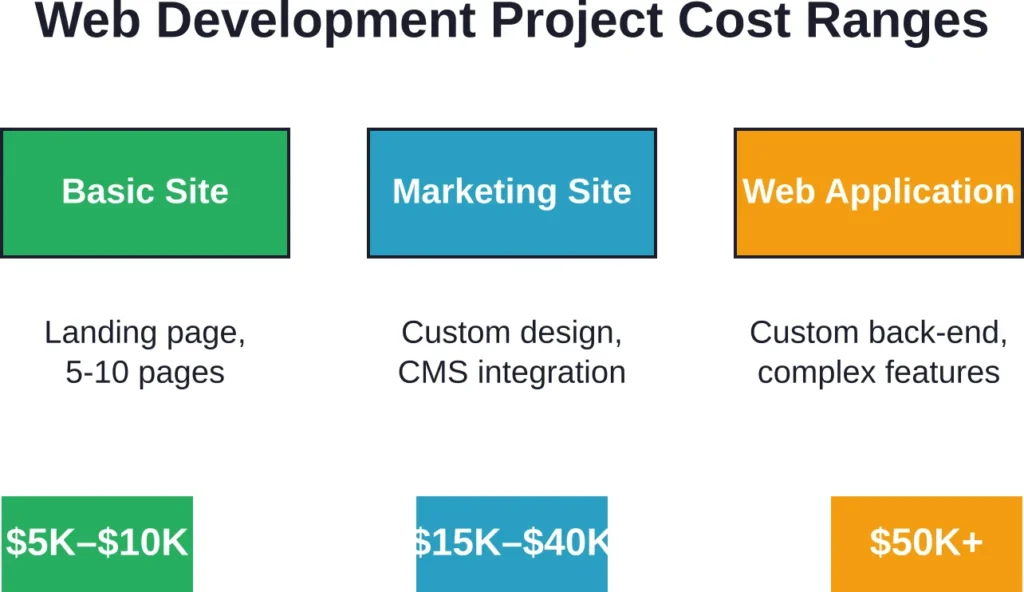
These ranges reflect the realities of custom work. Designers need time to understand brand positioning and craft unique interfaces. Developers must write code, integrate systems, test across devices, and handle deployment. Project managers coordinate timelines and communication. All of this takes hours, and hours cost money.
Affordable agencies keep these costs reasonable by operating efficiently. But they can’t work miracles. A proposal that promises a fully custom, feature-rich site for a fraction of typical market rates should raise red flags, not excitement.
Top 15 Affordable Web Development Companies in 2026
Here’s the breakdown. Each profile covers the agency’s strengths, typical project types, and what kind of client they serve best.
1. A-Listware
A-Listware is a software development and consulting company focused on delivering high-quality, secure, and responsive web and enterprise solutions. They provide custom software development, team augmentation, cloud applications, and full-scale digital transformation projects.
Their strength lies in flexible engagement models — from dedicated development teams to complete project outsourcing — combined with deep expertise in modern technologies, infrastructure management, and seamless integration with client processes. They act as a true extension of the client’s team, delivering maintainable and scalable web solutions.
Best for: Enterprises, small and medium businesses, and startups that need reliable web application development, legacy modernization, or extended technical capacity without building an in-house team from scratch.
Contact Information:
- Website: a-listware.com
- Phone: +1 (888) 337 93 73
- Email: [email protected]
- Address: North Bergen, NJ 07047, USA
- LinkedIn: www.linkedin.com/company/a-listware
- Facebook: www.facebook.com/alistware
2. Lengreo
Lengreo acts as a complete marketing and tech partner with strong web development capabilities. They build eCommerce, business websites, portfolio sites, and high-converting landing pages that drive measurable lead generation and sales results.
Their approach combines discovery, business analysis, prototyping, and full implementation with ongoing support. The team focuses on conversion-focused design, technical optimization, and integration with digital marketing channels so websites don’t just look good — they actively generate opportunities and reduce cost per lead.
Best for: B2B companies and service providers that need websites tightly connected to lead generation, SEO, and paid campaigns rather than purely aesthetic marketing sites.
Contact Information:
- Website: Lengreo.com
- Phone: +31 686 147 566
- Email: [email protected]
- Address: Vrijstraat 9 C/D, 5611 AT Eindhoven, Netherlands
- LinkedIn: Lengreo
- Twitter: @Lengreo
- Instagram: @lengreo
3. Gilzor
Gilzor delivers custom web and mobile development for startups and growing businesses. They focus on building digital products from idea validation through design, development, and go-to-market execution.
What distinguishes them is their full-cycle product thinking: they start with business analysis and user research, then deliver clean, scalable web applications with strong UI/UX emphasis and post-launch maintenance. Their teams are comfortable turning complex requirements into functional, attractive solutions that connect with real users.
Best for: Startups and small-to-medium businesses that need a reliable development partner for web applications, eCommerce platforms, or digital tools where product-market fit and user experience directly impact growth.
Contact Information:
- Website: www.gilzor.com
- Email: [email protected]
- Address: Poland, Warsaw, Office 58, street Adama Mickiewicza 37, 01-625
- LinkedIn: www.linkedin.com/company/gilzor-softwaredevelopment
4. Oski
Oski builds smart, well-engineered software solutions with a heavy focus on web technologies for tech-forward enterprises and ambitious startups. They handle everything from frontend experiences to complex backend systems and cloud infrastructure.
The team emphasizes AI-accelerated development, modern frameworks (React, Next.js, Vue, etc.), and clean architecture that delivers speed without sacrificing quality. They treat websites and web apps as business tools — scalable, maintainable, and designed to support real operational needs.
Best for: Companies in travel, logistics, eCommerce, fintech, and education that require robust, high-performance web solutions and want a partner capable of delivering enterprise-grade quality at startup speed.
Contact Information:
- Website: oski.site
- Phone: +48571282759
- Email: [email protected]
- Address: Kaupmehe tn 7, 10114 Tallinn, Estonia
- LinkedIn: www.linkedin.com/company/oski-solutions
5. Mobian Studio
Mobian Studio creates dedicated engineering teams for mobile-first and web-centric digital products. They specialize in building production-ready software for companies in IT, healthcare, fintech, and logistics.
They offer both full outsourcing and outstaffing models with senior-level execution, clean architecture, and strong emphasis on scalable systems and legacy integration. Every project includes documentation, post-launch support, and focus on speed-to-market without compromising quality.
Best for: Companies that need to ship complex web and mobile solutions quickly and reliably, especially those in regulated or high-stakes industries where technical execution and ongoing partnership matter more than one-off builds.
Contact Information:
- Website: mobian.studio
- Phone: [email protected]
- Address: Harju maakond, Tallinn, Kesklinnalinnaosa, Masina tn 22, 10113
- LinkedIn: www.linkedin.com/company/mobian-studio
6. Excited Agency

Excited brings a product design mentality to web development. They don’t treat websites as isolated marketing assets; instead, they position them within broader product ecosystems. This perspective works particularly well for technology companies where the website needs to align with app interfaces, developer documentation, and support systems.
The agency’s process emphasizes collaboration. Clients get access to working prototypes early and often, with iterative feedback loops built into timelines. This reduces the risk of late-stage surprises where the final product doesn’t match expectations.
Best for: tech companies that need websites capable of explaining sophisticated products. Teams that want a development partner who thinks about information architecture and content strategy, not just visual design.
7. Debunk
Debunk focuses on lean, efficient web development. Their philosophy: ship fast, measure results, iterate based on data. This approach appeals to startups and small businesses that need to get online quickly without getting bogged down in endless design debates.
The agency favors modern, no-code and low-code platforms where appropriate, reserving custom development for features that genuinely require it. This pragmatism keeps costs down and timelines short. Don’t expect elaborate custom illustrations or complex animations; expect clean, functional sites that load fast and work reliably.
Best for: early-stage companies that need an online presence quickly. Businesses prioritizing functionality and speed-to-market over visual differentiation.
8. Ramotion

Ramotion combines strong visual design with solid technical execution. Their portfolio demonstrates consistent aesthetic quality across diverse industries: fintech, healthcare, consumer apps, B2B SaaS. The design language tends toward modern minimalism—clean layouts, generous whitespace, bold typography.
Beyond aesthetics, Ramotion handles complex interaction design well. Micro-animations that provide feedback without feeling gimmicky. Responsive layouts that adapt intelligently across screen sizes. Attention to loading states, error handling, and the small details that separate polished products from rushed ones.
Best for: companies where design quality influences customer perception. Businesses in competitive markets where visual differentiation provides a meaningful advantage.
9. OneLittleWeb

OneLittleWeb specializes in WordPress development for small businesses. They’ve built a repeatable process around custom WordPress themes, keeping costs manageable while delivering sites that clients can actually update themselves post-launch.
The agency’s strength lies in their balance between customization and practicality. Each site gets custom design work, but they leverage WordPress’s ecosystem intelligently—using established plugins where they add value, building custom functionality only where necessary. The result: sites that feel unique without the price tag of fully bespoke development.
Best for: small businesses that need professional websites with content management capabilities. Companies that want ongoing control over their site without needing to hire developers for every update.
10. Thrive Agency
Thrive takes an integrated approach to web development, offering design, development, and ongoing digital marketing services under one roof. This full-service model works well for businesses that view their website as one component of a broader digital strategy rather than a standalone project.
The agency handles everything from initial strategy and branding through launch and post-launch optimization. Their team includes designers, developers, copywriters, and digital marketers who collaborate throughout projects. This coordination reduces the friction that often occurs when multiple vendors try to work together.
Best for: businesses that want a single partner for web development and ongoing digital marketing. Companies that value coordination and accountability over specialized boutique expertise.
11. Parallel HQ

Parallel specializes in web development for AI and SaaS startups. The agency understands product-market fit pressures and builds sites that explain complex technology clearly. This isn’t a shop that churns out cookie-cutter marketing sites; they design with conversion architecture baked in from the start.
The team’s startup-native approach shows in their process. Fast turnarounds. Direct communication with actual designers and developers, not account managers who relay messages. A product design sensibility that treats websites as user interfaces, not digital brochures.
Best for: early-stage tech companies that need to explain sophisticated products to non-technical buyers. Teams that value speed and clarity over elaborate brand storytelling.
12. Techling LLC

Techling built its reputation in eCommerce development. With a team size in the range of small agencies and competitive rates, they focus on helping online retailers build stores that actually sell. Their client roster includes brands across multiple verticals, from fashion to AI tools.
What sets Techling apart is their eCommerce-specific expertise. They understand payment gateway integration, inventory management, shipping logic, and the thousand small details that separate a functional store from one that hemorrhages abandoned carts. Most projects include ongoing optimization work post-launch, treating eCommerce as an iterative process rather than a one-time build.
Best for: small to mid-sized online retailers who need a development partner that speaks eCommerce fluently, not a generalist agency learning on the job.
13. Clay Agency
Clay takes a brand-forward approach to web development. They work primarily with technology companies that care deeply about visual identity and want websites that reflect sophisticated brand positioning. This isn’t the cheapest option on the list, but the design quality justifies the investment for companies where brand perception drives enterprise sales.
The agency’s portfolio showcases sites with strong art direction, thoughtful animation, and visual systems that feel cohesive across pages. Behind the aesthetics, the technical foundation is solid: fast load times, clean responsive behavior, accessible markup.
Best for: B2B tech companies selling to enterprise buyers where brand credibility influences deal cycles. Companies with existing brand guidelines who need a web partner that can execute at a high visual standard.
14. Lollypop Design Studio

Lollypop approaches web development through a UX-first lens. Before writing a line of code, they map user journeys, identify friction points, and prototype interactions. This process-heavy approach adds time upfront but typically results in sites that perform better out of the gate.
The agency works across industries but has particular depth in consumer-facing digital products. Their case studies emphasize measurable outcomes: conversion rate improvements, time-on-site increases, reduced support tickets. That focus on metrics makes them a natural fit for data-driven teams.
Best for: businesses where user experience directly impacts revenue. Companies willing to invest in research and testing before jumping into visual design.
15. SumatoSoft
SumatoSoft handles complex web application development. While they take on simpler projects, their strength lies in custom platforms with sophisticated back-end requirements: user dashboards, multi-tenant architecture, API integrations with enterprise systems.
The development team skews senior, with expertise across modern JavaScript frameworks, cloud infrastructure, and database design. They’re comfortable with ambiguity—the kind of projects where requirements evolve as the product takes shape. Communication is direct and technical; this isn’t an agency that sugarcoats tradeoffs or overpromises timelines.
Best for: SaaS companies building web-based products, not just marketing sites. Teams that need development partners capable of architectural decisions, not just feature implementation.
What to Look for When Hiring an Affordable Web Development Company
The right agency isn’t the one with the slickest website or the longest client list. It’s the one whose working style, technical capabilities, and project approach align with your specific needs.
Start with portfolio review, but look beyond surface aesthetics. Open those portfolio sites on your phone. Check load times using browser developer tools. Navigate through multiple pages. Sites that look gorgeous on desktop but fall apart on mobile, or that take five seconds to load, indicate technical weaknesses that will haunt your project.
Read client reviews critically. Perfect five-star ratings across the board often signal gaming or cherry-picked testimonials. Look for patterns in feedback: Do multiple clients mention communication issues? Budget overruns? Missed deadlines? One negative review might be an outlier; recurring themes indicate systemic problems.
Questions to Ask During Agency Interviews
Discovery calls reveal how agencies actually work. These questions cut through marketing speak.
Who will actually do the work? Many agencies lead with senior talent in sales meetings, then assign junior team members post-contract. Ask to meet the designer and lead developer who’ll handle your project before signing anything.
What’s your revision process? Unlimited revisions sound great until the agency defines every small tweak as a new project phase. Get specifics: how many design rounds are included? What constitutes a revision versus a scope change?
How do you handle post-launch support? Sites need maintenance. Bugs emerge. Content needs updating. Clarify what’s included after launch and what requires additional payment. Agencies that disappear after collecting final payment leave clients stranded.
What’s your typical timeline? Be skeptical of agencies promising complete custom sites in a few weeks. Quality work takes time. Rushed timelines usually mean corner-cutting or template approaches disguised as custom development.
Can you provide client references? Speaking directly with past clients reveals details that reviews don’t capture. How did the agency handle unexpected challenges? Did the project stay on budget? Would they hire this agency again?
Red Flags That Signal Trouble
Some warning signs are too significant to ignore.
Agencies that refuse to share pricing frameworks during initial conversations often play games later. Scope creep thrives in pricing ambiguity. While exact quotes require project details, reputable agencies can provide typical ranges and explain what drives costs up or down.
Contracts without clearly defined deliverables create endless disputes. What exactly gets delivered? In what format? Who owns the source code? What happens if either party wants to terminate early? These details belong in writing before any work begins.
Pressure to sign quickly—limited-time discounts, artificial urgency about timelines—indicates sales tactics over genuine partnership. Good agencies stay busy through referrals and repeat business, not high-pressure closes.
Agency vs. Freelancer vs. Internal Hire: Making the Right Choice
Affordable web development isn’t always about hiring an agency. Sometimes freelancers or internal hires make more sense depending on project scope, timeline, and long-term needs.
Freelancers offer maximum budget flexibility. For straightforward projects with clear requirements, a skilled freelancer can deliver excellent work at rates below agency minimums. The tradeoff? No team redundancy. If the freelancer gets sick, takes another project, or disappears, the project stalls. Project management falls entirely on the client.
Internal hires make sense when web development is ongoing rather than project-based. The fully-loaded cost of a developer in the U.S.—salary, benefits, equipment, overhead—typically exceeds what retainer arrangements with agencies would cost, but the developer is available full-time and deeply integrated with company operations.
Agencies provide the middle ground: team redundancy, project management, and diverse skill sets without permanent employment commitment. For most small businesses and startups, this model offers the best risk-adjusted value.
When Agencies Are Worth the Investment
Certain project characteristics favor agency partnerships over alternatives.
Complex projects requiring multiple disciplines—design, front-end development, back-end engineering, DevOps—benefit from agencies with established teams. Coordinating three separate freelancers adds project management overhead that often negates cost savings.
Tight timelines demand team capacity. A single freelancer can’t compress timeline by working harder; an agency can add resources to critical path tasks. When launch dates matter—coordinating with marketing campaigns, partnership announcements, funding rounds—agency capacity provides insurance.
High-stakes projects where failure costs exceed the price difference between options justify agency expertise. A botched eCommerce launch doesn’t just waste development budget; it loses revenue, damages brand reputation, and destroys customer trust. In these scenarios, agency experience reduces risk.
| Option | Best For | Main Advantage | Main Drawback |
|---|---|---|---|
| Freelancer | Simple sites, tight budgets | Lowest cost, direct communication | Single point of failure, limited capacity |
| Agency | Complex projects, fast timelines | Team redundancy, diverse skills | Higher cost than freelancers |
| Internal Hire | Ongoing development needs | Deep company integration, always available | Highest long-term cost, recruitment challenges |
| Retainer Agency | Continuous improvement cycles | Consistent partnership, predictable costs | Monthly commitment regardless of workload |
Platform Considerations: WordPress, Webflow, Custom Code
The platform an agency recommends says as much about their priorities as their technical arguments do.
WordPress dominates small business web development for good reason. The ecosystem is mature, plugins handle common functionality, and clients can update content without developer help. Affordable agencies often build on WordPress because the platform’s efficiency keeps project costs down while delivering professional results.
Webflow has gained traction for marketing sites where design control matters but back-end complexity doesn’t. The visual development environment lets designers work directly in the medium, often producing cleaner, more intentional results than code-first workflows. The tradeoff: less flexibility for complex interactive features or deep system integrations.
Custom-coded solutions make sense when requirements exceed what existing platforms handle gracefully. Web applications with sophisticated user authentication, complex data models, or unique business logic often need purpose-built architecture. These projects cost more and take longer, but the result fits requirements precisely rather than forcing compromises to fit platform constraints.
Beware of agencies that push a single solution for every project. Platform selection should follow requirements analysis, not precede it.
The Hidden Costs of Platform Lock-In
Platform choice creates long-term implications beyond initial development.
Proprietary platforms or heavily customized systems trap businesses with their original developers. When that agency relationship sours or the business outgrows the platform, migration projects can cost more than the original build. This leverage allows agencies to charge premium rates for routine updates.
Open-source platforms like WordPress avoid this trap. Any competent developer can work on a WordPress site. Switching agencies doesn’t require rebuilding from scratch. This portability provides negotiating power and flexibility as business needs evolve.
Before committing to a platform, understand migration difficulty. Ask agencies about export capabilities, code ownership, and how easy switching would be if needed. Agencies confident in their work won’t fear these questions.
Project Scoping: How to Brief an Agency Effectively
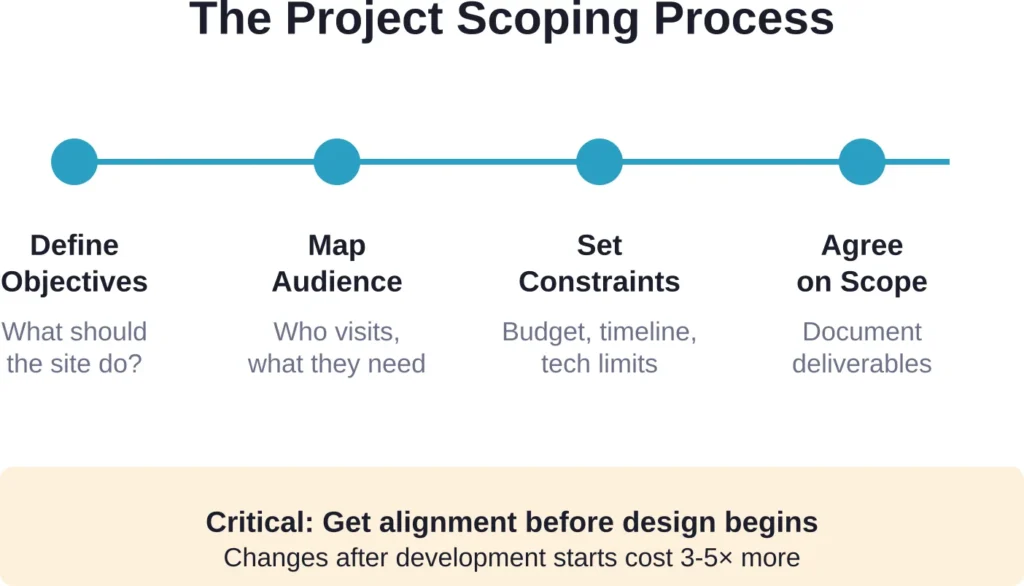
Poor briefs produce poor results regardless of agency talent. Clear project scoping upfront prevents budget overruns, missed expectations, and relationship friction.
Start with business objectives, not technical requirements. What should the website accomplish? Generate leads? Process eCommerce transactions? Explain a complex product? Book appointments? The more specific the goal, the better agencies can propose appropriate solutions.
Provide context about the audience. Who visits the site? What do they already know? What questions do they have? What makes them trust or distrust the brand? Demographic data helps, but psychographic information—motivations, concerns, decision criteria—matters more for effective design.
Share competitive context. Which competitors have impressive sites? What do they do well? Where do they fall short? What should this site avoid? Competitive analysis helps agencies understand the visual and functional landscape.
Be honest about constraints. Budget limits, timeline pressures, technical limitations, organizational politics—these factors shape what’s possible. Agencies appreciate transparency. Surprises during projects cause far more friction than difficult conversations during scoping.
What to Include in a Project Brief
A thorough brief accelerates the process and improves outcomes. Include these elements.
Project overview: One paragraph explaining what this is and why it matters now. Context helps agencies understand priority and urgency.
Target audience: Who uses this site? Create personas if they exist. Describe their technical sophistication, industry knowledge, and relationship to the brand.
Key features: List required functionality. Contact forms, product catalogs, user authentication, payment processing, search, integrations with other systems. Distinguish must-haves from nice-to-haves.
Content scope: How many pages? Who writes copy? Who provides images? Content creation often represents hidden effort that agencies either need to price or clients need to handle.
Technical requirements: Hosting constraints, required integrations, compliance requirements, accessibility standards, multilingual needs. Surface these early; discovering them mid-project causes expensive delays.
Timeline: When does the site need to launch? What drives that date? Artificial deadlines waste everyone’s time, but legitimate constraints help agencies plan resources.
Budget: Many clients hide budget, thinking agencies will inflate estimates. This creates inefficiency. Agencies can’t propose appropriate solutions without understanding financial constraints. A clear budget framework—not a final number, but a realistic range—helps everyone.
Retainer Arrangements vs. Project-Based Work
Most affordable agencies offer project-based pricing, but retainer relationships often deliver better long-term value for businesses with ongoing needs.
Project-based work suits finite scopes: launch a site, build a feature, refresh a design. Clear deliverables, defined timelines, fixed budgets. When the project ends, so does the relationship unless another project begins.
Retainer arrangements flip the model. Businesses pay monthly fees for a reserved block of hours or defined ongoing services. Website updates, new page creation, performance optimization, security patches, technical support—all handled as needed without negotiating separate project scopes.
For businesses that treat their website as a living asset rather than a set-it-and-forget-it project, retainers provide both cost predictability and continuous improvement. A site that gets regular attention typically converts better than one that launches perfectly but stagnates.
When Retainers Make Financial Sense
The math on retainers becomes attractive when update frequency passes certain thresholds.
If site changes occur monthly or more frequently, project-based pricing becomes inefficient. Each update requires scoping, quoting, invoicing, and payment processing. The overhead adds up. Retainers eliminate this friction; work happens on a continuous basis.
Early-stage companies often resist retainers, seeing them as unnecessary fixed costs. But consider the alternative: a twenty-thousand-dollar site that launches well but receives no attention for months. Competitors update aggressively. Content goes stale. Design trends shift. That initial investment depreciates faster than necessary.
Better approach: moderate initial build, then consistent monthly investment. Sites improve iteratively based on real user data rather than launch-day assumptions. This model aligns agency incentives with client outcomes; the agency benefits from the relationship continuing, which only happens if the site performs well.
Measuring Success: How to Know If You Chose the Right Agency
Agency selection quality becomes clear during the project and after launch, not during the sales process.
Good agencies ask difficult questions during discovery. They challenge assumptions. They push back on bad ideas and explain why. They present options with honest pros and cons rather than steering toward whatever maximizes their revenue.
During design, strong agencies can articulate the reasoning behind choices. Why this layout? Why this color palette? Why this interaction pattern? Answers rooted in user psychology, conversion optimization, and brand strategy indicate strategic thinking. Answers based purely on aesthetics or designer preference should raise concerns.
Development quality shows in what users don’t notice: smooth interactions, fast load times, absence of bugs, intuitive navigation. Sites that work exactly as expected represent skilled execution. Users shouldn’t think about the technology; they should accomplish their goals effortlessly.
Post-launch, the real measure emerges: does the site achieve business objectives? More qualified leads. Higher conversion rates. Improved customer understanding. Reduced support burden. Whatever goals drove the project, those metrics determine success.
When to Consider Switching Agencies
Sometimes agency relationships don’t work out. Recognizing when to move on prevents throwing good money after bad.
Persistent communication breakdowns indicate cultural mismatch. If emails go unanswered, calls get rescheduled repeatedly, and getting straight answers requires escalation, the relationship creates more friction than value.
Repeated budget overruns or timeline slips signal inadequate project management. Good agencies buffer estimates for uncertainty and communicate early when issues emerge. Agencies that consistently underestimate, then ask for more time and money, either lack competence or integrity.
Technical debt accumulation—bugs that don’t get fixed, performance that degrades, code that other developers describe as problematic—indicates quality issues that will create long-term costs exceeding any savings from affordable rates.
Don’t stay with an underperforming agency out of misplaced loyalty or sunk cost fallacy. The earlier the switch, the less painful the transition.
Frequently Asked Questions
For most small businesses and startups, professional custom websites typically fall into ranges that vary by complexity. A straightforward marketing site with custom design and content management starts in the lower range. More sophisticated sites with advanced features, custom functionality, or eCommerce capabilities typically require higher budgets. Anything significantly below these ranges usually means template-based work rather than true custom development. The key factor is complexity: more pages, more features, more integrations all drive costs upward.
Timeline depends on project scope and client responsiveness. A basic marketing site usually requires six to eight weeks from kickoff to launch, assuming prompt client feedback on designs and content delivery on schedule. More complex projects—sites with custom back-end development, extensive content, or multiple stakeholder approval processes—often take three to six months. Agencies promising complete custom sites in just a few weeks usually cut corners or use template approaches. Quality work requires adequate time for design iteration, development, testing, and refinement.
Remote collaboration works well for web development projects in 2026. Video calls, project management tools, and shared design environments make geographic proximity less critical than it once was. Many businesses find remote agencies offer better value since those agencies avoid expensive office overhead in major cities. That said, some clients prefer in-person meetings for kickoff and major milestones. The decision should weigh convenience preference against agency quality and cost. Don’t limit options to local agencies if better remote options exist, but don’t dismiss local firms if their capabilities and pricing compete well.
Critical questions include: Who specifically will work on my project? Can I speak with the actual designer and developer, not just the sales team? What’s your revision process and what’s included versus extra? How do you handle post-launch support and what’s the cost? Can you provide references from similar past projects I can contact? What’s your typical timeline for projects like mine? How do you handle scope changes and what’s the process for additional work? What platform do you recommend and why? Who owns the code and design files after project completion?
Affordable agencies keep costs down through lean operations, remote work, efficient processes, and specialized focus. They typically have smaller teams, less overhead, and target small to mid-market clients. Enterprise agencies charge premium rates for brand prestige, account management layers, offices in expensive cities, extensive legal and compliance resources, and capacity to handle massive corporate clients. For most small businesses and startups, expensive agencies offer capabilities that exceed actual needs. Affordable agencies deliver comparable technical quality and design work without the enterprise premium.
WordPress remains a solid platform for most business websites in 2026, particularly when budget and client content management are priorities. The ecosystem is mature, security practices have improved significantly, and the platform handles most common business site requirements well. Modern page builders and block editors make content updates straightforward for non-technical users. WordPress works particularly well for blogs, brochure sites, and straightforward eCommerce. It’s less ideal for complex web applications or sites requiring extensive custom functionality unrelated to content management. Platform selection should match project requirements, but WordPress continues to offer strong value for a broad range of use cases.
First, determine why costs are increasing. Legitimate scope creep—new features or changes beyond the original agreement—justifies additional cost. Poor initial scoping or agency inefficiency does not. Review the contract and original scope document. Document what was agreed versus what’s being delivered. Have a direct conversation with the agency: what specifically is driving overages? Are these changes client-requested or agency execution issues? For legitimate scope additions, consider what can be deferred to a post-launch phase to control immediate costs. For agency execution problems, push back firmly and escalate if needed. Future prevention: invest more time in detailed scoping upfront and get scope changes documented in writing before work proceeds.
Making the Final Decision
Choosing an affordable web development company ultimately comes down to fit. Technical capability matters, but so do communication style, process compatibility, and shared understanding of project goals.
Don’t rush the decision. Interview multiple agencies. Ask the hard questions. Check references. Review portfolios critically. The few extra days spent in evaluation prevent months of project frustration.
Trust matters more than polish. An agency with a rough website but clear answers and strong references often outperforms one with slick marketing but vague responses. Look for transparency, directness, and realistic assessments rather than sales optimization.
Remember that affordable doesn’t mean cheap. The agencies on this list have earned their positions through consistent delivery of quality work at fair prices. They won’t be the lowest bid, and they shouldn’t be. The goal isn’t minimum cost; it’s maximum value—professional results that justify the investment and drive business outcomes.
The right agency becomes a partner in business growth, not just a vendor completing a transaction. That relationship starts with making an informed, careful choice based on clear criteria rather than price alone.
Web development in 2026 offers more accessible options than ever before for businesses that know what to look for. The agencies profiled here represent proven choices for companies that need quality work without enterprise budgets. The rest is matching specific needs to the right specialized expertise.