

Quick Summary: The best full stack web development companies in 2026 combine expertise across frontend, backend, and database technologies to deliver comprehensive digital solutions. This curated list spotlights 15 agencies recognized for technical excellence, proven track records, and innovative approaches to modern web development challenges.
Finding the right full stack development partner can make or break your digital transformation efforts. With thousands of agencies claiming expertise, cutting through the noise requires understanding what separates genuine technical depth from marketing fluff.
Full stack development has evolved significantly. It’s no longer just about knowing frontend and backend technologies—modern agencies need expertise in cloud infrastructure, microservices architecture, DevOps practices, and security protocols. The landscape has shifted from monolithic applications to distributed systems that scale.
This guide examines 15 companies that have demonstrated consistent excellence in delivering complete web solutions. Each brings different strengths to the table, whether that’s enterprise-scale applications, rapid MVP development, or specialized industry knowledge.
What Defines Full Stack Excellence in 2026
The term “full stack” gets thrown around loosely. But what does it actually mean when evaluating development partners?
True full stack capability means mastery across multiple layers. Frontend frameworks like React, Angular, or Vue.js. Backend languages including Node.js, Python, Java, or PHP. Database systems both relational and NoSQL. Cloud platforms—AWS, Azure, Google Cloud. Plus the connective tissue: APIs, authentication systems, caching layers, and deployment pipelines.
Here’s the thing though—technical skills are just the baseline. The best agencies bring architectural thinking. They understand how to structure applications for maintainability, not just immediate functionality. They know when to use established patterns and when custom solutions make sense.
Project management matters just as much. Agencies that consistently deliver have refined processes for requirements gathering, sprint planning, code reviews, and quality assurance. Communication protocols that keep stakeholders informed without overwhelming them. Risk management that identifies potential issues before they become blockers.
Technology Stack Breadth vs. Depth
Some agencies position themselves as generalists, working across any technology stack a client requests. Others specialize deeply in particular ecosystems—MERN stack experts, Django specialists, or Java enterprise shops.
Neither approach is inherently superior. The right choice depends on your specific needs. Established enterprises with existing infrastructure often need agencies that can work within their technology constraints. Startups building from scratch benefit from agencies with strong opinions about modern best practices.
The red flag? Agencies claiming equal expertise in every possible technology. Real mastery takes years of focused experience. Teams spreading themselves across twenty different frameworks rarely achieve the depth needed for complex problem-solving.
Top 15 Full Stack Development Companies
These agencies represent different specializations and scales. Some excel at enterprise transformations, others at rapid startup development. Geographic presence varies, with some offering distributed teams and others emphasizing co-location.
The selection criteria focused on verifiable client outcomes, technical depth, team expertise, and adaptability to emerging technologies. Industry recognition through platforms like Clutch, client testimonials, and portfolio quality all factored into these choices.
1. Gilzor

Gilzor operates as a full-cycle custom software development partner focused on turning ideas into production-ready digital products. The company excels at supporting startups through validation and early traction, scaling SMB operations, and enhancing existing product studios with new capabilities.
Their development process covers the complete lifecycle: idea validation, business analysis, UI/UX design, web and mobile implementation, quality assurance, and go-to-market support. Teams combine creative and strategic expertise to deliver secure, scalable solutions that align closely with user needs and business goals.
Technology preferences include modern web frameworks for full-stack development, cross-platform mobile tools for iOS and Android, and cloud-ready architectures. Projects emphasize clean code, performance optimization, and long-term maintainability.
Client work spans startups, small-to-medium businesses, and product companies across various industries. Notable examples include airline passenger management systems, eco-friendly e-commerce grocery platforms, and cognitive training mobile applications.
Technical highlights include strong focus on Product-Market Fit validation, low defect rates through early self-checking and QA processes, legacy modernization, and ongoing support & maintenance that drives recurring partnerships.
Contact Information:
- Website: www.gilzor.com
- Email: [email protected]
- Address: Poland, Warsaw, Office 58, street Adama Mickiewicza 37, 01-625
- LinkedIn: www.linkedin.com/company/gilzor-softwaredevelopment
2. Lengreo

Lengreo functions as a complete marketing and technology partner with integrated full stack web development capabilities. The company combines digital strategy expertise with hands-on website and application building to drive measurable business growth.
Their approach emphasizes deep discovery, business analysis, and tailored solutions rather than pre-packaged offerings. Dedicated teams handle everything from prototyping and design through development, quality assurance, and post-launch support.
Technology stack supports e-commerce platforms, business websites, portfolio sites, and landing pages with modern frontend and backend practices. Solutions prioritize conversion optimization, performance, and seamless integration with marketing channels.
Client projects primarily serve B2B companies in software development, architecture, event technology, sports tech, and IT services. Work ranges from lead-generation-focused websites to full digital platforms supporting outreach and sales funnels.
Technical highlights include website audits and optimizations, prototyping for rapid iteration, and development that directly supports SEO, paid ads, and lead generation campaigns for improved ROI and client acquisition.
Contact Information:
- Website: Lengreo.com
- Phone: +31 686 147 566
- Email: [email protected]
- Address: Vrijstraat 9 C/D, 5611 AT Eindhoven, Netherlands
- LinkedIn: Lengreo
- Twitter: @Lengreo
- Instagram: @lengreo
3. Oski
Oski delivers smart, well-engineered full stack software solutions for tech-forward enterprises and ambitious startups. The company focuses on designing, developing, deploying, and maintaining robust digital systems that drive operational transformation.
Development practices leverage AI-accelerated engineering for faster delivery while maintaining high quality. Teams provide end-to-end capabilities spanning cloud infrastructure, frontend interfaces, backend logic, and specialized integrations.
Core technologies include React, Vue, Angular, and Next.js for frontend work; Node.js, .NET, and other backend frameworks; plus extensive cloud platforms (AWS, Azure) and serverless architectures. Additional expertise covers CMS platforms like Umbraco and WordPress, along with AI/ML integrations.
Vertical experience includes traveling, logistics & transportation, e-commerce, education, fintech, and insurance. Projects range from scalable web applications and booking systems to complex enterprise portals and data-driven platforms.
Technical highlights feature hybrid and multi-cloud deployments, DevOps & CI/CD pipelines, responsive UI/UX design, and AI-powered features for automation and intelligent decision-making.
Contact Information:
- Website: oski.site
- Phone: +48571282759
- Email: [email protected]
- Address: Kaupmehe tn 7, 10114 Tallinn, Estonia
- LinkedIn: www.linkedin.com/company/oski-solutions
4. A-listware

A-listware operates as a software development and consulting company specializing in full stack solutions and dedicated team delivery. The company excels at providing skilled developers who integrate seamlessly as extensions of client organizations.
Their engagement models include custom software development, team augmentation, legacy modernization, and comprehensive application services. Structured processes ensure smooth communication, quality delivery, and alignment with client objectives across the full project lifecycle.
Technology expertise spans a broad spectrum: .NET, Java, Node.js, Python, React, Angular, Vue for full stack work; plus cloud solutions (AWS, Azure, GCP), mobile development, databases, AI/ML, and DevOps tooling.
Client base covers enterprises, small and medium businesses, and startups. Solutions include enterprise applications, ERP/CRM systems, e-commerce platforms, web portals, and industry-specific tools for various sectors.
Technical highlights include cloud application development, data analytics integrations, UX/UI design, testing & QA, cybersecurity measures, and infrastructure management that supports both new builds and modernization initiatives.
Contact Information:
- Website: a-listware.com
- Phone: +1 (888) 337 93 73
- Email: [email protected]
- Address: North Bergen, NJ 07047, USA
- LinkedIn: www.linkedin.com/company/a-listware
- Facebook: www.facebook.com/alistware
5. Mobian
Mobian builds dedicated engineering teams that deliver production-ready full stack software with a strong emphasis on mobile and AI solutions. The company operates through outsourcing (end-to-end delivery) and outstaffing (embedded engineers) models for maximum flexibility.
Their delivery framework ensures clean architecture, thorough documentation, and senior-level execution. Teams handle scoping, development, legacy integration, and post-launch support while maintaining transparent English-language communication.
Technology capabilities cover full-stack development with modern frontend and backend frameworks, Flutter and native mobile (iOS/Android), cloud infrastructure, APIs, and custom AI systems including LLMs, computer vision, and automation workflows.
Focus industries include IT, healthcare, fintech, and logistics. Projects range from complete digital products and scalable backends to regulatory-compliant solutions with complex integrations.
Technical highlights include dedicated single-project teams, scalable architecture design for future growth, end-to-end product development from wireframes to deployment, and ongoing partnership models that support long-term maintenance and evolution.
Contact Information:
- Website: mobian.studio
- Phone: [email protected]
- Address: Harju maakond, Tallinn, Kesklinnalinnaosa, Masina tn 22, 10113
- LinkedIn: www.linkedin.com/company/mobian-studio
6. Toptal
Toptal positions itself as an exclusive network of elite software developers. The platform claims to accept only the top 3% of applicants after rigorous screening processes.
This selectivity targets a specific market segment—companies willing to pay premium rates for immediate access to senior-level talent. Technical vetting includes live coding exercises, project reviews, and test assignments.
Full stack developers in the network typically bring five-plus years of professional experience. Many have backgrounds at recognizable technology companies or successful startups. Specializations cover modern frameworks and architectural patterns.
The matching process involves consultation with Toptal staff to understand project requirements. The platform then proposes candidates, with trial periods allowing evaluation before full commitment.
Real talk: the premium positioning means higher costs than alternatives. But for mission-critical projects requiring immediate expertise and minimal ramp-up time, that premium can justify itself through faster delivery and reduced risk.
7. Clutch

Clutch operates as a B2B research and review platform rather than a development agency. Its value lies in aggregating verified client reviews and facilitating agency comparisons.
The platform maintains detailed profiles of thousands of development companies. Listings include service offerings, typical project sizes, technology expertise, and client reviews. Verification processes help ensure review authenticity.
Advanced filtering capabilities let potential clients narrow options by specific criteria. Searches can specify hourly rate ranges, project size thresholds, technology stacks, industry experience, and geographic location.
The platform reveals sponsored placements alongside organic listings. Understanding this distinction helps users evaluate results appropriately. Client reviews often provide the most valuable insight—specific project details, communication quality, and outcome satisfaction.
For companies beginning their agency search, Clutch provides a structured research starting point. The extensive review database offers perspectives from companies with similar needs and constraints.
8. Fiverr Pro

Fiverr’s Pro tier differentiates from the standard marketplace by focusing on verified professional freelancers and agencies. The full stack web development category includes developers with established portfolios and positive review histories.
The platform works best for defined project scopes rather than ongoing relationships. Fixed-price packages dominate, though some developers offer custom quotes for complex requirements.
Quality varies, making thorough evaluation essential. Portfolio review, communication during the inquiry phase, and client feedback all provide signals about likely outcomes. Pro designation adds credibility but doesn’t guarantee fit for every project.
Cost structures on Fiverr typically undercut traditional agencies. This pricing reflects the marketplace model and often international talent pools. Budget-conscious clients can find capable developers, particularly for standard project types.
The platform handles payment escrow, dispute resolution, and basic project management tools. These features reduce risk compared to direct freelancer hiring but don’t replace active client involvement.
9. GoodFirms

GoodFirms serves as another research platform connecting businesses with technology service providers. Like Clutch, it aggregates company profiles, client reviews, and project portfolios.
The platform’s methodology includes proprietary scoring across multiple dimensions—quality, reliability, and ability. These scores synthesize client feedback, portfolio analysis, and market presence.
Full stack development companies listed span the spectrum from boutique agencies to large enterprises. Filtering options help narrow results by budget, location, company size, and technical specialization.
Client reviews on GoodFirms often include specific project budgets and timelines. This transparency helps prospective clients calibrate expectations and identify agencies operating in their budget range.
The platform’s value comes primarily from research efficiency. Rather than individually evaluating dozens of agencies, businesses can review curated options with comparable information.
10. AWS Partner Network
The AWS Partner Network includes consulting partners specializing in application development on Amazon’s cloud infrastructure. These agencies bring certified expertise in AWS services alongside full stack development capabilities.
Partners at higher tiers—Advanced and Premier—have demonstrated competency through certifications, client success stories, and AWS endorsement. This validation provides confidence in cloud architecture knowledge.
Full stack development from AWS partners typically emphasizes cloud-native architectures. Serverless computing, managed databases, container services, and other AWS offerings integrate deeply into application design.
This specialization suits businesses committed to AWS infrastructure or requiring specific AWS service integration. The agencies understand optimization strategies, cost management, and security best practices specific to the platform.
While AWS partnership indicates cloud expertise, it doesn’t directly verify broader software development capabilities. Evaluation should still examine portfolio quality, development processes, and team experience.
11. Bridge Global
Bridge Global operates as a comprehensive technology solutions provider with particular strength in full stack web and mobile applications. Their development approach emphasizes scalable architecture and clean code practices.
The company maintains dedicated teams for frontend, backend, and DevOps, allowing for specialized expertise within integrated project delivery. React and Angular drive most frontend work, while Node.js and Python handle backend requirements. Cloud deployments primarily target AWS infrastructure.
Client work spans multiple industries including healthcare, fintech, e-commerce, and logistics. Projects range from customer-facing web applications to internal enterprise systems. The agency has built particular expertise in data-intensive applications requiring real-time processing.
Technical highlights include experience with microservices architecture, container orchestration using Kubernetes, and implementation of CI/CD pipelines. Security practices incorporate penetration testing and compliance support for regulated industries.
12. FATbit Technologies

FATbit Technologies specializes in marketplace and e-commerce platforms. Their development portfolio emphasizes multi-vendor systems, on-demand service applications, and complex transaction flows.
The agency has developed proprietary frameworks for common marketplace functionality—vendor onboarding, commission management, rating systems, and payment processing. This foundation allows faster project starts while maintaining customization flexibility.
Technology preferences lean toward PHP frameworks like Laravel for backend development, though Node.js sees increasing adoption. Frontend work utilizes React and Vue.js depending on project requirements. MySQL and PostgreSQL handle most database needs, with Redis for caching and session management.
Notable portfolio pieces include rental marketplaces, food delivery platforms, and service booking systems. The agency maintains its own successful marketplace products, giving them direct experience with the challenges their clients face.
FATbit Technologies has received positive ratings on Clutch based on client reviews. Project types served include startups, small-to-medium businesses, and large companies requiring dedicated development resources.
13. ScienceSoft

ScienceSoft brings three decades of software development experience, positioning themselves as an IT industry veteran. The company maintains a broad service portfolio extending beyond web development into consulting, analytics, and managed services.
Full stack capabilities cover both modern and legacy technology stacks. This breadth proves valuable for enterprises with existing systems requiring integration or modernization. The agency regularly handles projects involving mainframe connections, legacy database migrations, and gradual system replacements.
Development practices emphasize thorough requirements analysis and architectural planning before implementation begins. Waterfall and Agile methodologies both see use depending on client preferences and project characteristics.
The team structure includes business analysts, solution architects, developers, QA specialists, and project managers. This comprehensive staffing supports enterprise-scale projects with complex stakeholder ecosystems.
Vertical expertise includes healthcare, financial services, retail, and manufacturing. Many engagements involve regulatory compliance requirements—HIPAA, PCI-DSS, GDPR—requiring specialized implementation knowledge.
14. Konstant Infosolutions
Konstant Infosolutions operates as a full-service digital agency with strong full stack development capabilities. The company emphasizes rapid development cycles and clear communication protocols.
Their technology stack spans popular frameworks and platforms. MEAN and MERN stacks handle JavaScript-based projects. PHP development uses Laravel and CodeIgniter. Mobile applications complement web development, often sharing backend APIs and business logic.
Project engagement models include dedicated teams, fixed-price projects, and time-and-materials arrangements. This flexibility accommodates different client preferences around risk allocation and scope definition.
The agency has particular experience with startup MVPs and small business digital transformation. Quick turnaround times and iterative development suit clients needing to validate concepts or respond to market opportunities.
Quality assurance processes include both manual and automated testing. Performance optimization, security audits, and code reviews occur throughout development rather than solely at project end.
15. Upwork
Upwork functions as a platform connecting clients with independent developers and agencies rather than a development company itself. However, its full stack development category provides access to thousands of verified professionals.
The platform’s strength lies in flexibility and breadth. Clients can hire for specific technology needs, project phases, or temporary capacity expansion. Hourly and fixed-price contracts both work within the platform.
Vetting varies significantly. Top-rated talent with established track records and verified credentials exist alongside less experienced developers. The platform provides tools for evaluating freelancers—portfolios, client reviews, skills tests, and interview capabilities.
For clients comfortable managing remote talent, Upwork offers cost advantages and rapid scaling. The challenge lies in effective screening and project management. Success depends heavily on clear requirements documentation and active oversight.
Full stack developers on the platform work across all major technology stacks. Specializations range from specific frameworks to industry verticals to project types like e-commerce or SaaS applications.
Technology Stack Considerations
Different agencies champion different technology choices. Understanding these preferences helps match your requirements with appropriate partners.
JavaScript-Focused Agencies
The MEAN stack (MongoDB, Express.js, Angular, Node.js) and MERN stack (swapping React for Angular) have dominated modern web development conversations. These JavaScript-everywhere approaches let developers use a single language across frontend, backend, and sometimes database interactions.
Agencies specializing in these stacks emphasize development velocity. Shared code between client and server reduces duplication. Large package ecosystems on npm accelerate feature implementation. Real-time capabilities come naturally through Node.js event-driven architecture.
But JavaScript-centric stacks aren’t universally optimal. Performance-critical backend processes sometimes benefit from compiled languages. Teams with existing expertise in other ecosystems face steeper learning curves. Database choices shouldn’t be dictated solely by language ecosystem convenience.
Python and Django Specialists
Python-based agencies often favor Django for rapid development of data-driven applications. The framework’s batteries-included philosophy provides authentication, admin interfaces, and ORM capabilities out of the box.
This ecosystem excels for applications with complex business logic, data processing pipelines, or machine learning integration. Python’s data science libraries integrate naturally with Django applications.
Frontend integration typically pairs Django templates with Vue.js or React for interactive components. API-first architectures using Django REST Framework support single-page applications or mobile clients.
Scientific computing, financial analysis, and healthcare applications often lean toward Python stacks. The language’s readability and extensive libraries suit domains requiring ongoing algorithm refinement.
Enterprise Java and .NET
Established enterprises frequently maintain infrastructure built on Java or Microsoft .NET. Agencies working this space need depth in these ecosystems plus experience integrating with legacy systems.
Java development using Spring Framework provides robust, scalable backend systems. The platform’s maturity means extensive tooling, established patterns, and proven architectural approaches. Performance characteristics suit high-transaction applications.
.NET development on Azure infrastructure offers similar enterprise capabilities with tight Microsoft ecosystem integration. Agencies in this space often work with companies heavily invested in Microsoft technologies.
These platforms trade some development speed for runtime performance, type safety, and tooling maturity. The tradeoff makes sense for certain application profiles and organizational contexts.
PHP Persistence
Despite recurring predictions of its demise, PHP powers substantial portions of the web. WordPress, Drupal, and Magento ensure continued demand for PHP expertise.
Modern PHP development using Laravel or Symfony frameworks bears little resemblance to legacy PHP code. These frameworks bring structure, security, and maintainability to PHP projects.
Agencies specializing in PHP often focus on content management systems, e-commerce platforms, or custom business applications. Cost efficiency and hosting simplicity contribute to PHP’s continued relevance, particularly for small-to-medium business projects.
Project Engagement Models
How agencies structure their client relationships affects project dynamics, risk allocation, and pricing.
Dedicated Team Model
The dedicated team approach assigns specific developers, designers, and project managers to work exclusively on your project. This team functions as an extension of your organization.
This model suits long-term engagements, ongoing product development, or situations requiring deep domain knowledge accumulation. Teams develop understanding of business context, codebase history, and architectural decisions over time.
Pricing typically uses monthly team rates. This structure provides cost predictability while maintaining flexibility around priorities and scope. The client assumes more responsibility for product direction and requirements definition.
The approach works best when internal product management exists to guide the team. Without clear direction, even talented developers struggle to make appropriate prioritization decisions.
Fixed-Price Projects
Fixed-price arrangements define scope, deliverables, timeline, and cost upfront. Agencies assume responsibility for delivering agreed functionality within the specified budget.
This model appeals to organizations with well-defined requirements and limited appetite for scope uncertainty. Budget certainty enables easier internal approval processes.
The tradeoff comes in flexibility. Changing requirements mid-project triggers change orders and delays. Agencies build risk buffers into fixed-price quotes, potentially increasing costs compared to time-and-materials alternatives.
Success depends on thorough requirements documentation before work begins. Ambiguous specifications lead to disputes about whether delivered functionality meets original intent.
Time and Materials
Time-and-materials billing charges based on actual hours worked. This approach maximizes flexibility around scope evolution and priority changes.
Clients get transparency into resource allocation and can adjust direction based on emerging insights. No penalty exists for iterating on features or pivoting based on user feedback.
The model requires trust in the agency’s efficiency and integrity. Without fixed costs, clients bear risk of timeline extensions and budget overruns. Regular communication and sprint-based delivery milestones help manage this risk.
Agile development methodologies pair naturally with time-and-materials arrangements. Both emphasize iterative progress over comprehensive upfront planning.
| Engagement Model | Best For | Risk Allocation | Flexibility |
|---|---|---|---|
| Dedicated Team | Long-term product development, ongoing maintenance | Shared between client and agency | High—priorities can shift sprint-to-sprint |
| Fixed-Price | Well-defined projects with stable requirements | Agency assumes delivery risk | Low—changes trigger renegotiation |
| Time & Materials | Exploratory projects, evolving requirements | Client assumes timeline risk | Very high—scope adjusts continuously |
| Hybrid | Phased projects with defined milestones | Varies by phase | Moderate—fixed for phases, flexible between |
Evaluating Technical Competence
Marketing materials all sound impressive. How do you actually assess whether an agency possesses the technical depth claimed?
Portfolio Deep Dives
Request detailed case studies for projects similar to yours. Surface-level portfolio pieces provide limited insight. Dig into specific challenges faced, solutions implemented, and outcomes achieved.
Ask about technology choices. Why did they select specific frameworks or architectural patterns? What alternatives were considered? Strong technical teams can articulate tradeoffs and decision rationale.
Look for complexity indicators. Projects involving third-party integrations, real-time features, high-traffic scaling, or complex business logic demonstrate capability beyond basic CRUD applications.
Review actual code if possible. Some agencies maintain open-source projects or can share code samples. Code quality—structure, documentation, test coverage—reveals a lot about development practices.
Technical Interviews
Request meetings with developers who would work on your project, not just sales staff. Prepare specific technical questions about your requirements.
Discuss architectural approaches they’d recommend. Can they explain system design clearly? Do they ask probing questions about your requirements and constraints?
Present a technical challenge similar to something your project requires. How do they approach problem-solving? What questions do they ask? Multiple valid solutions exist for most problems—look for thoughtful analysis of options.
Check familiarity with modern development practices. Do they discuss automated testing? Deployment automation? Security considerations? Performance optimization? These topics should come up naturally in technical conversations.
Reference Checks
Contact previous clients directly. References provided by agencies will skew positive, but even these conversations can surface useful information.
Ask specific questions about communication quality, problem-solving abilities, and how challenges were handled. All projects encounter difficulties—how teams respond matters more than whether problems occurred.
Inquire about post-launch support. Did the agency stick around to address issues? Was knowledge transfer effective? Can the client now maintain the application independently if needed?
Try to find references from projects that went poorly. These provide the most valuable learning. LinkedIn research can identify past clients not on the official reference list.
Geographic and Timezone Considerations
Development teams span the globe. Location affects communication, costs, and collaboration dynamics.
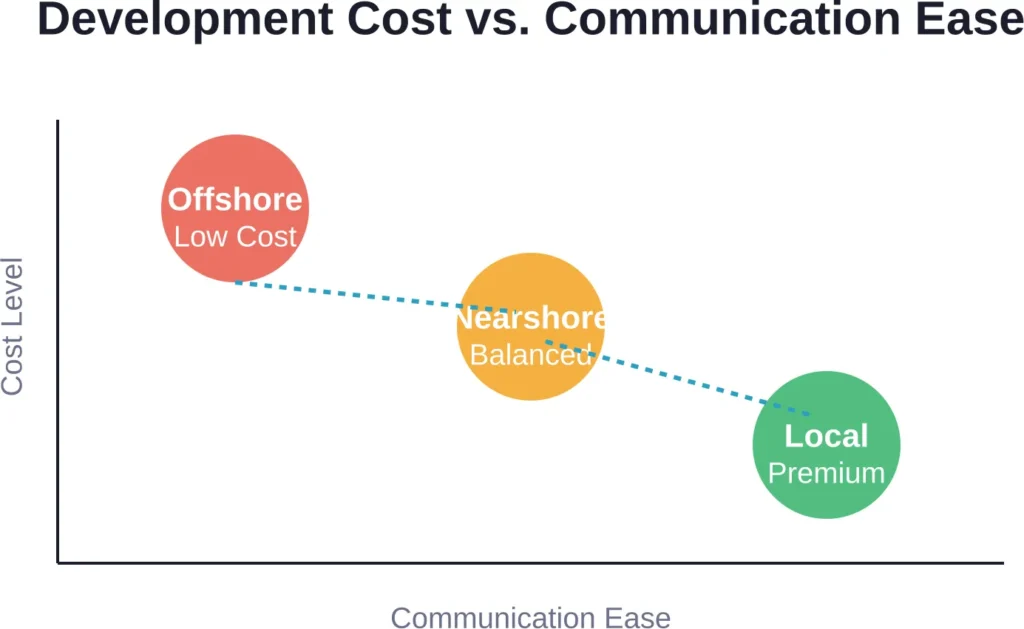
Local Agencies
Co-located teams enable face-to-face meetings, easier collaboration, and cultural alignment. Time zone matching means synchronous communication without scheduling gymnastics.
Local presence typically commands premium pricing. Office overhead, local salary markets, and operational costs in major tech hubs translate to higher billable rates.
For projects requiring frequent stakeholder involvement, complex requirements negotiation, or integrated client-agency teams, local proximity can justify the cost premium through improved outcomes.
Nearshore Partners
Nearshore development—agencies in similar time zones but different countries—splits the difference between local and offshore options. Latin American agencies serving US clients exemplify this model.
Overlapping work hours facilitate daily standup meetings and real-time problem-solving. Video calls occur during reasonable hours for both parties. Cultural similarities often ease communication compared to more distant options.
Costs typically fall between local and offshore alternatives. Currency advantages and lower cost-of-living provide savings while proximity maintains collaboration quality.
Offshore Development
Offshore agencies in Asia or Eastern Europe offer substantial cost advantages. Hourly rates can reach a fraction of US or Western European equivalents.
But this is where it gets interesting. Cost savings get partially offset by communication overhead, extended timelines, and potential quality variations. Not all offshore agencies deliver equivalent results despite similar pricing.
Success with offshore partners requires strong specifications, clear acceptance criteria, and robust project management. The distance demands more formal communication structures than co-located teams need.
Time zone differences cut both ways. Real-time collaboration becomes difficult, but round-the-clock productivity becomes possible if work hands off effectively between locations.
Industry Specialization vs. Generalization
Some agencies position themselves as industry specialists. Others maintain broad portfolios across sectors.
Vertical Expertise Benefits
Agencies focused on specific industries—healthcare, fintech, logistics—accumulate domain knowledge that accelerates projects. They understand regulatory requirements, common workflows, and industry-specific terminology.
This expertise manifests in better requirements gathering. Specialized agencies ask informed questions and identify potential issues based on past experience. They can suggest features or approaches that generalist agencies might not consider.
Regulatory compliance becomes easier with agencies that have navigated similar requirements. HIPAA for healthcare, PCI-DSS for payment processing, SOC 2 for enterprise software—these frameworks require specific implementation knowledge.
Portfolio examination matters more with specialist agencies. Their previous work in your sector should demonstrate not just technical execution but genuine understanding of the business domain.
Generalist Advantages
Broadly experienced agencies bring fresh perspectives unconstrained by industry conventions. They can apply solutions from other sectors to your challenges.
These teams often work across a wider range of technical challenges. Rather than repeatedly building similar systems, they encounter diverse requirements that build versatile problem-solving capabilities.
For truly novel applications or business models, generalists may be better positioned than specialists anchored to existing industry patterns. Innovation sometimes requires ignorance of conventional approaches.
Security and Compliance Capabilities
Security can’t be an afterthought. The best full stack agencies integrate security practices throughout development.
Security-First Development
Threat modeling should happen during architecture design, not after deployment. Strong agencies consider attack vectors, data protection requirements, and access controls before writing code.
Code review processes should include security-focused analysis. Common vulnerabilities—SQL injection, cross-site scripting, authentication bypasses—get caught through systematic review and automated scanning.
Dependency management matters more than many realize. Open-source packages carry security risks. Agencies need processes for monitoring vulnerabilities and updating dependencies promptly.
Penetration testing provides external validation. Top agencies either conduct their own security testing or engage third-party specialists before launch.
Compliance Frameworks
Regulated industries require specific compliance certifications. Healthcare applications need HIPAA compliance. Payment processing requires PCI-DSS adherence. Enterprise software increasingly faces SOC 2 or ISO 27001 requirements.
Agencies claiming compliance expertise should demonstrate specific, relevant experience. Compliance isn’t generic—each framework has particular technical requirements and audit processes.
Documentation practices become critical for compliance. Proper policies, procedures, and audit trails don’t emerge retroactively. They require systematic implementation throughout development.
Post-Launch Support Models
Application development doesn’t end at launch. Ongoing maintenance, optimization, and enhancement determine long-term success.
Maintenance and Monitoring
Production applications require monitoring, bug fixes, security patches, and performance optimization. Clarify post-launch support expectations upfront.
Some agencies include limited post-launch support in project pricing. Others charge separately for maintenance. Understanding these models prevents surprise costs when issues arise.
Response time commitments matter. How quickly will critical bugs get addressed? What constitutes an emergency requiring immediate attention versus something that can wait until the next sprint?
Monitoring and alerting infrastructure should be deployed as part of the initial project. Applications need logging, error tracking, performance monitoring, and uptime checks from day one.
Knowledge Transfer
Eventually, most organizations want capability to maintain applications internally. Effective agencies plan for this transition.
Documentation quality varies dramatically between agencies. Comprehensive technical documentation, deployment procedures, and architecture decisions enable future developers to understand and modify the system.
Code quality affects maintainability as much as documentation. Clean, well-structured code with appropriate comments allows new developers to orient quickly.
Training sessions for internal teams help transition responsibility. Walking through the codebase, explaining architectural decisions, and demonstrating deployment processes accelerates handoff.
Making Your Selection Decision
With research complete and options narrowed, how do you make the final choice?
Pilot Projects
Consider starting with a small, defined project before committing to a major engagement. This approach lets you evaluate working relationships with limited risk.
Pilot projects reveal communication quality, technical capabilities, and problem-solving approaches better than interviews and proposals. You’ll see how the agency handles challenges, meets deadlines, and incorporates feedback.
Structure pilots with clear success criteria. Define specific deliverables, acceptance criteria, and timeline expectations. Treat it as a real project, not just an extended interview.
The additional time investment pays dividends in reduced risk on larger engagements. Better to discover misalignment on a small project than midway through a critical business application.
Proposal Evaluation
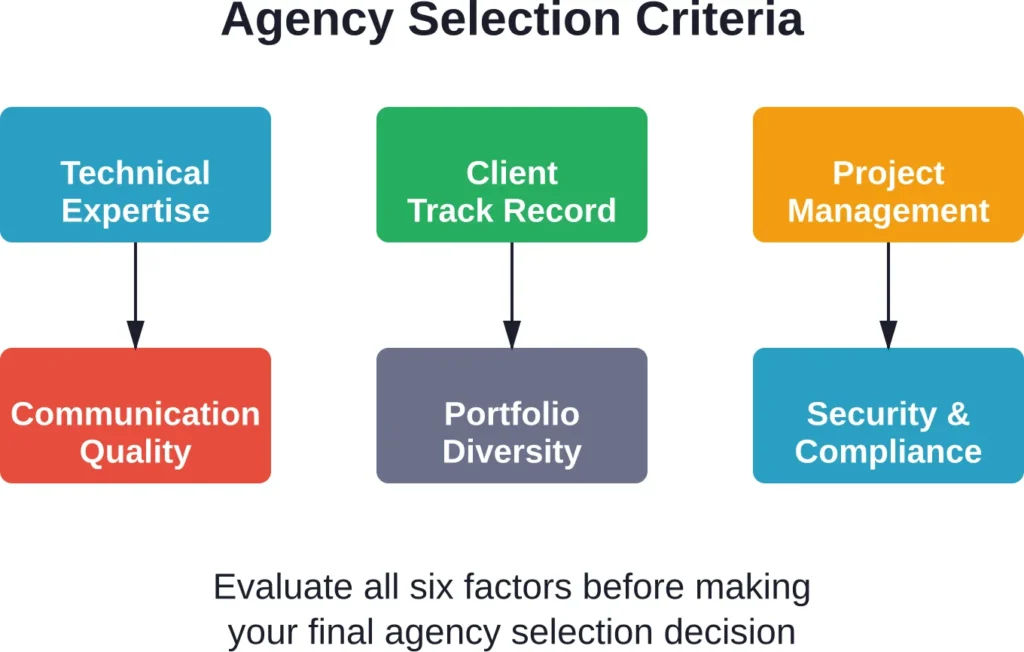
Compare proposals systematically rather than on gut feel. Create an evaluation matrix covering key decision factors.
Look beyond price. The cheapest proposal often indicates insufficient understanding of requirements or corner-cutting that emerges later. Focus on value—what outcomes will you achieve for the investment?
Timeline realism matters. Aggressive schedules that promise everything immediately often slide or compromise quality. Conservative timelines with clear milestones indicate thoughtful planning.
Question assumptions in proposals. What are they including? What falls outside scope? Vague specifications lead to scope disputes later.
Contract Considerations
Clear contracts protect both parties. Key terms include deliverables definition, acceptance criteria, payment schedule, intellectual property ownership, and termination provisions.
Intellectual property ownership should transfer to you upon payment. Work-for-hire provisions ensure you own the code and can maintain or modify it without restriction.
Payment structures should align incentives. Milestone-based payments tied to deliverable completion protect against agencies disappearing mid-project while ensuring they receive compensation for completed work.
Confidentiality agreements protect proprietary business information shared during development. These provisions should be mutual, covering both your data and the agency’s methodologies.
| Evaluation Factor | Red Flags | Positive Indicators |
|---|---|---|
| Communication | Slow response times, vague answers, hard to reach | Prompt replies, detailed responses, proactive updates |
| Technical Approach | Generic solutions, no questions about requirements | Thoughtful architecture, relevant questions, tradeoff discussion |
| Portfolio | Only simple projects, outdated technologies, no similar work | Complex projects, modern stacks, relevant domain experience |
| Pricing | Significantly cheaper than alternatives, vague breakdowns | Detailed estimates, clear assumptions, competitive but not suspiciously low |
| Process | No defined methodology, unclear milestones | Clear development process, regular check-ins, documented workflows |
Emerging Technology Adoption
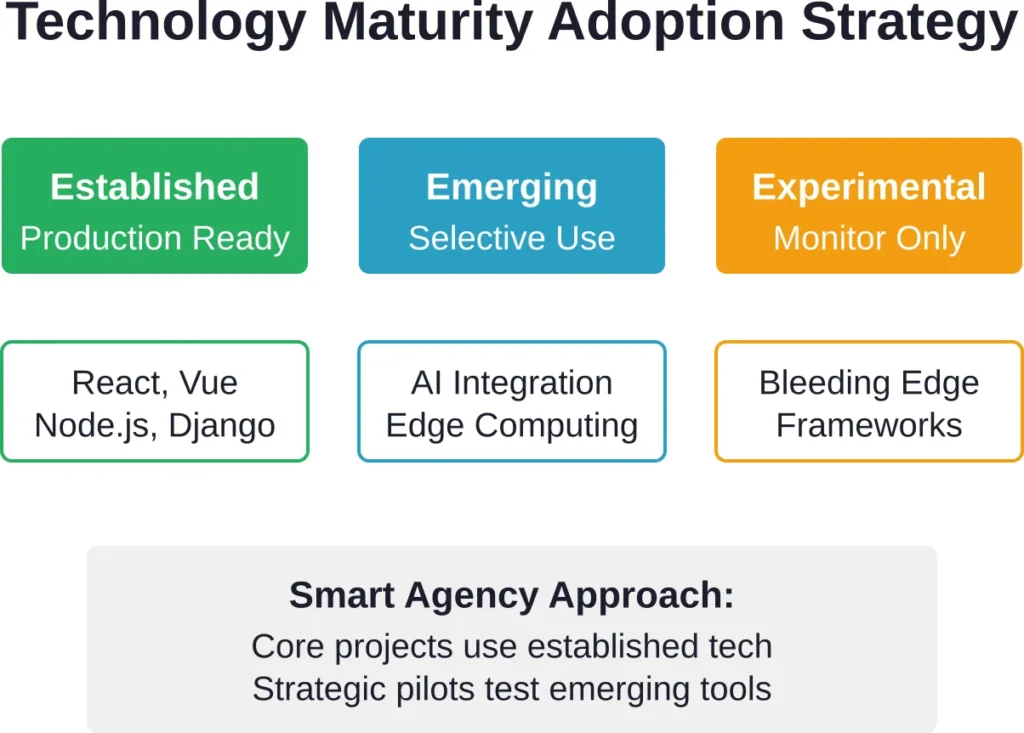
Technology evolves rapidly. How agencies approach emerging tools and frameworks indicates adaptability and forward-thinking.
AI Integration Capabilities
Artificial intelligence integration has moved from experimental to expected. Applications now commonly incorporate natural language processing, recommendation engines, and intelligent automation.
According to Forrester, most organizations get less than 50% ROI on AI investments. The gap between AI capabilities and business value often stems from poor integration and unrealistic expectations.
Agencies with genuine AI experience can articulate specific use cases, data requirements, and realistic capabilities. They understand when AI adds value versus when traditional approaches suffice.
Look for practical implementations rather than AI buzzword usage. Ask about specific projects: What problem did AI solve? What data was required? How was model performance measured? What challenges emerged?
Serverless and Edge Computing
Serverless architectures and edge computing represent significant shifts in application deployment. These approaches affect cost structures, performance characteristics, and development patterns.
Agencies working in this space should demonstrate understanding of when these patterns make sense. Serverless isn’t universally optimal—it suits specific workload characteristics while creating challenges for others.
Real experience shows in discussing cold start issues, function composition patterns, state management strategies, and debugging approaches. These practical details separate marketing buzzwords from actual implementation knowledge.
Progressive Web Applications
PWAs blur the line between web and native applications. They offer offline functionality, push notifications, and installation capabilities while maintaining web deployment simplicity.
This technology suits specific scenarios—customer-facing applications requiring broad reach without app store friction. Agencies should articulate when PWAs make sense versus when native development or traditional web apps better serve requirements.
Implementation details matter. Service workers, caching strategies, offline-first design, and progressive enhancement all require thoughtful execution for successful PWAs.
Red Flags to Watch For
Certain warning signs indicate problematic agencies. Recognizing these early saves time and prevents costly mistakes.
Communication Issues
Slow response times during the sales process typically worsen after contract signing. If getting answers takes days when agencies are trying to win your business, expect worse during project execution.
Vague answers to specific questions suggest lack of expertise or intentional obfuscation. Strong agencies provide detailed, thoughtful responses even when admitting something falls outside their experience.
Overpromising represents another red flag. Agencies guaranteeing specific business outcomes, unusually fast timelines, or claiming universal expertise rarely deliver.
Technical Concerns
Portfolios showing only simple CRUD applications indicate limited capability for complex projects. Look for evidence of sophisticated features, integrations, and architectural challenges.
Resistance to discussing technical approaches in detail often masks inexperience. Confident agencies gladly explain their methodology, tooling choices, and problem-solving approaches.
Outdated technology stacks aren’t automatically disqualifying, but agencies should articulate their technology strategy. How do they evaluate new tools? When do they adopt emerging frameworks?
Process Red Flags
Absence of defined development methodology suggests ad-hoc, inconsistent execution. Whether Agile, Scrum, or custom processes, agencies should clearly describe how they manage projects.
Unwillingness to provide references or case studies raises obvious questions. What are they hiding? Why can’t past clients speak to their work?
Aggressive contracts heavily favoring the agency indicate problematic relationship dynamics. Fair agreements balance interests—one-sided terms suggest future conflicts.
Cost Expectations and Budgeting
Development costs vary dramatically based on project complexity, team location, and engagement model. Understanding these factors helps set realistic budgets.
Basic business websites typically represent the entry point. These projects include fundamental pages, responsive design, content management systems, and standard functionality like contact forms.
E-commerce platforms introduce additional complexity through product catalogs, shopping carts, payment processing, and inventory management. Custom features like subscription models or complex pricing rules further increase investment.
Custom enterprise systems command the highest budgets. These applications involve complex business logic, extensive integrations, security requirements, and scalability needs. Development timelines stretch from months to years depending on scope.
Remember—these represent development costs only. Ongoing hosting, maintenance, support, and enhancement require separate budgeting. Plan for 15-20% of initial development costs annually for maintenance.
Questions to Ask Potential Agencies
Structured questions help evaluate agencies systematically and compare responses across options.
About Their Process
How do you approach requirements gathering? What does your typical discovery process involve? How do you handle changing requirements mid-project?
What development methodology do you use? How are sprints structured? What visibility will we have into progress? How do you handle project delays or roadblocks?
What’s your testing approach? What types of testing do you perform? At what stages? How do you ensure quality throughout development?
About Team Structure
Who will actually work on our project? Can we meet the team members? What’s their experience level? Will team composition remain stable or change during the project?
How do you handle team availability? What happens if a key developer leaves mid-project? Do you have backup resources?
What’s your internal communication structure? How do different roles—developers, designers, project managers—collaborate? How are decisions escalated?
About Technical Approach
What technology stack would you recommend for our project? Why? What alternatives did you consider? What are the tradeoffs?
How do you approach scalability and performance? What monitoring and optimization practices do you employ? How do you plan for future growth?
What’s your security implementation process? How do you identify and mitigate vulnerabilities? What security testing do you perform?
About Post-Launch
What post-launch support do you provide? For how long? What’s included versus additional cost? What are your support response times?
How do you handle knowledge transfer? What documentation will you provide? Can you train our team? What’s the handoff process?
Do you provide ongoing maintenance services? What does that include? How are enhancement requests handled?
Frequently Asked Questions
Full stack developers work across the entire application stack—frontend interfaces, backend logic, databases, and deployment. Specialized developers focus deeply on one area. Full stack developers provide versatility and can see the complete picture, making them valuable for smaller teams and projects requiring broad knowledge. Specialists bring deeper expertise in their domain, important for complex frontend interactions or sophisticated backend architectures. The best teams often combine both—full stack developers for general work with specialists handling complex domain-specific challenges.
Project timelines vary dramatically based on complexity and scope. Simple business websites might complete in 4-8 weeks. Standard e-commerce platforms typically require 3-6 months. Custom enterprise applications often take 6-12 months or longer. Factors affecting timeline include feature complexity, number of integrations, custom design requirements, and revision rounds. Agencies using Agile methodologies deliver working software incrementally, allowing partial deployment before complete project finish. Always add buffer to initial estimates—most projects encounter some scope evolution or unexpected technical challenges.
Both approaches offer advantages depending on your situation. Industry specialists understand domain-specific workflows, regulations, and user expectations. They ask better questions during requirements gathering and suggest relevant features you might not consider. Generalists bring fresh perspectives and solutions from other sectors, potentially offering innovative approaches unconstrained by industry conventions. For heavily regulated industries like healthcare or finance, specialist knowledge of compliance requirements often proves essential. For novel business models or applications, generalist creativity may serve better. Evaluate based on portfolio quality and domain understanding demonstrated during discovery conversations.
Development costs depend heavily on team location, expertise level, and engagement model. Project complexity and timeline also significantly impact total investment. Geographic factors create substantial rate variations—offshore teams may work at lower hourly rates than local agencies. But focusing solely on hourly rates misses the bigger picture. More experienced teams often deliver faster despite higher rates, potentially reducing total costs. For meaningful budget planning, discuss your specific requirements with multiple agencies and request detailed proposals. This approach provides realistic cost expectations based on your actual needs rather than generic estimates.
Intellectual property protection starts with clear contractual terms. Work-for-hire provisions should specify that all code, designs, and deliverables become your property upon payment. Confidentiality agreements protect proprietary business information shared during development. These should be mutual, covering both parties. For sensitive projects, consider requiring agencies to use dedicated teams rather than rotating developers who work on competitor projects. Code escrow arrangements provide backup access if agencies disappear or relationships deteriorate. Review contracts with legal counsel familiar with software development agreements. Clear IP terms prevent disputes and ensure you can maintain, modify, or transition applications independently.
Strong contracts include clear acceptance criteria and dispute resolution processes. Milestone-based delivery with defined acceptance criteria allows evaluation throughout the project rather than only at the end. If deliverables don’t meet specifications, agencies should revise until requirements are satisfied. Many contracts include limited revision rounds for each milestone. Beyond those, additional revisions may incur extra charges. Serious dissatisfaction despite good-faith efforts sometimes requires project termination. Contracts should specify termination terms—payment for completed work, deliverable hand-off, and transition procedures. The best protection against dissatisfaction comes through thorough vetting, clear requirements, and regular communication throughout development.
Agency size presents tradeoffs worth considering. Large agencies offer extensive resources, diverse expertise, and capacity to handle complex, multi-faceted projects. They typically have established processes and can scale teams quickly. But larger organizations sometimes mean less direct access to senior talent and more process overhead. Smaller agencies often provide more personalized attention and flexibility. Principals may work directly on projects rather than delegating to junior staff. But resource constraints can affect timeline and breadth of expertise. The right choice depends on project scope, budget, and preference around relationship dynamics. Evaluate based on team members who will actually work on your project rather than overall company size.
Conclusion
Selecting the right full stack development company requires balancing technical expertise, communication quality, budget constraints, and cultural fit. The 15 agencies highlighted represent different strengths—some excel at enterprise transformations, others at startup MVPs, still others at specific technical stacks or industries.
No single “best” choice exists. The optimal partner depends entirely on your specific requirements, constraints, and priorities. A perfect fit for one organization might prove problematic for another with different needs.
Take time for thorough evaluation. Review portfolios critically. Check references diligently. Ask probing technical questions. Start with smaller engagements when possible to evaluate working relationships before major commitments.
The right development partner becomes more than a vendor—they become a true collaborator invested in your success. They challenge questionable requirements, suggest better approaches, and deliver solutions that exceed expectations. That relationship quality matters as much as technical execution.
Ready to start your development project? Use this guide as a framework for evaluating potential partners. Create evaluation criteria that matter for your specific situation. Compare systematically rather than on gut feel alone. The investment in thorough selection pays dividends throughout your project and beyond.