

Quick Summary: Choosing the right CMS web development company can define your digital success in 2026. This guide profiles 15 leading agencies specializing in enterprise CMS platforms — from WordPress and Drupal to headless and hybrid solutions — helping you match your project requirements with proven development expertise.
The content management system landscape has evolved dramatically. WordPress.org powers over 43% of all websites, yet the CMS market now includes headless platforms, hybrid architectures, and enterprise-grade solutions that require specialized development expertise.
Selecting a CMS development company isn’t just a technical decision. It’s a commercial one that affects launch velocity, site performance, conversion rates, and long-term operational costs.
Poor agency selection shows up later as missed deadlines, SEO limitations, and rigid architectures that can’t scale. The right partner brings platform expertise, integration experience, and strategic thinking that transforms a CMS from a publishing tool into a content engine powering exceptional digital experiences.
This guide profiles 15 leading CMS web development companies, each with distinct platform specializations and proven track records. No pricing discussions — just capabilities, focus areas, and what makes each agency stand out in the crowded development services market.
Understanding CMS Platform Categories in 2026
CMS platforms fall into distinct architectural categories, each requiring different development approaches.
Traditional Monolithic Systems
Platforms like WordPress, Drupal, and Joomla follow traditional architectures where content management, presentation, and delivery exist in tightly coupled systems. WordPress commands 61-63% market share, with Joomla at 2.3-2.5% and Drupal at 1.3-1.5%, according to 2024 market analyses.
These platforms excel at straightforward publishing workflows and benefit from massive plugin ecosystems. Development companies specializing here focus on theme customization, plugin development, and optimization within established frameworks.
Headless CMS Architectures
Headless platforms decouple content management from presentation. Content lives in structured repositories accessible via APIs, enabling delivery to websites, mobile apps, and IoT devices simultaneously.
According to G2 Data, 85% of Sanity users highlighted its ability to scale for large organizations and expansive multi-platform presences. Agencies working in this space need API development expertise, front-end framework proficiency, and understanding of content-as-data paradigms.
Hybrid Systems
Hybrid platforms blend traditional and headless approaches, offering visual editing experiences while maintaining API-first architectures. These systems attract enterprises wanting editorial flexibility without sacrificing omnichannel delivery capabilities.
Development companies working with hybrid platforms need dual expertise — understanding both traditional CMS workflows and modern API integration patterns.
SaaS Platforms
Software-as-a-service options like Shopify, Wix, and Squarespace provide hosted solutions with managed infrastructure. Shopify holds 6-6.7% market share, Wix captures 3.8-5.2%, and Squarespace maintains 3-3.3%, based on 2024 market data.
Agencies specializing in SaaS platforms focus on theme development, app integration, and working within platform constraints rather than infrastructure management.
| Platform Type | Architecture | Best For | Development Focus |
|---|---|---|---|
| Monolithic | Coupled | Traditional websites, blogs | Theme/plugin development |
| Headless | API-first | Multi-platform delivery | API integration, front-end frameworks |
| Hybrid | Flexible | Enterprise omnichannel | Dual expertise required |
| SaaS | Hosted | Quick deployment, managed infrastructure | Theme customization, app integration |
Top 15 CMS Web Development Companies
Each agency below brings specialized capabilities to different CMS platforms and project types. Platform expertise varies significantly — some excel across multiple systems, others focus deeply on single platforms.
1. Oski
Oski builds enterprise-grade web solutions with a strong focus on CMS platforms, delivering scalable digital experiences for tech-forward companies and ambitious startups. The agency excels in Umbraco and WordPress implementations while integrating modern frontend frameworks and cloud architectures.
Their development process combines deep technical expertise in cloud-native solutions, serverless computing, and AI-enhanced engineering to create high-performance websites and web applications. Oski specializes in complex CMS projects requiring seamless content management, personalization, scalability, and integration with enterprise systems. Their team delivers full-cycle development from UI/UX design through deployment and ongoing maintenance, with particular strength in industries such as e-commerce, education, fintech, and logistics. For organizations seeking robust CMS implementations backed by modern engineering practices and rapid delivery, Oski is a strategic technology partner.
Contact Information:
- Website: oski.site
- Phone: +48571282759
- Email: [email protected]
- Address: Kaupmehe tn 7, 10114 Tallinn, Estonia
- LinkedIn: www.linkedin.com/company/oski-solutions
2. Gilzor
Gilzor specializes in custom web and mobile development, helping startups and small-to-medium businesses launch and scale digital products with strong CMS foundations. The company focuses on full-cycle website and web application development, from idea validation and UI/UX design to deployment and post-launch support.
Their approach emphasizes user-centric design, quality assurance, and scalable architecture that supports long-term growth. Gilzor builds e-commerce platforms, business websites, and content-driven applications tailored to specific industry needs, with proven results in streamlining operations and improving user engagement. The agency also provides go-to-market strategy support and ongoing maintenance, making them an ideal partner for businesses that need reliable, high-quality web solutions without the overhead of large in-house teams.
Contact Information:
- Website: www.gilzor.com
- Email: [email protected]
- Address: Poland, Warsaw, Office 58, street Adama Mickiewicza 37, 01-625
- LinkedIn: www.linkedin.com/company/gilzor-softwaredevelopment
3. Lengreo
Lengreo combines website development with performance-driven digital marketing, creating conversion-focused websites and landing pages for B2B companies. The agency delivers complete web solutions including e-commerce platforms, business websites, and optimized landing pages that support lead generation and growth objectives.
Their process starts with thorough discovery and business analysis, followed by prototyping, development, and continuous optimization. Lengreo’s web development services integrate seamlessly with SEO, paid advertising, and lead-generation strategies, resulting in measurable improvements in client acquisition and conversion rates. For organizations looking for a technology partner that understands both technical implementation and business outcomes, Lengreo provides end-to-end web solutions that drive real revenue impact.
Contact Information:
- Website: Lengreo.com
- Phone: +31 686 147 566
- Email: [email protected]
- Address: Vrijstraat 9 C/D, 5611 AT Eindhoven, Netherlands
- LinkedIn: Lengreo
- Twitter: @Lengreo
- Instagram: @lengreo
4. A-Listware
A-Listware delivers custom software development and web solutions through dedicated teams and outsourcing models, with strong capabilities in enterprise CMS and web application development. The company supports organizations with legacy modernization, custom web platforms, and scalable digital solutions across multiple industries.
Their expertise covers full-stack development, cloud application development, UX/UI design, and integration services that enhance content management and operational efficiency. A-Listware builds enterprise applications, CRM systems, and web solutions that prioritize security, performance, and seamless user experiences. With a focus on team augmentation and managed delivery, they serve as a flexible extension of client teams, making them a reliable choice for companies needing high-quality web and CMS development without long-term hiring commitments.
Contact Information:
- Website: a-listware.com
- Phone: +1 (888) 337 93 73
- Email: [email protected]
- Address: North Bergen, NJ 07047, USA
- LinkedIn: www.linkedin.com/company/a-listware
- Facebook: www.facebook.com/alistware
5. Mobian Studio
Mobian Studio creates dedicated engineering teams specialized in mobile-first and full-stack web development for IT, healthcare, fintech, and logistics companies. The agency delivers production-ready web applications and digital products with clean architecture and scalable CMS components.
They operate through outsourcing and outstaffing models, building end-to-end solutions that include frontend development, backend systems, APIs, and content management functionality. Mobian emphasizes maintainable code, comprehensive documentation, and post-launch support, enabling clients to ship faster while maintaining quality. Their domain expertise in regulated industries and complex integrations makes them particularly valuable for organizations requiring reliable web platforms that can scale and evolve with business needs.
Contact Information:
- Website: mobian.studio
- Phone: [email protected]
- Address: Harju maakond, Tallinn, Kesklinnalinnaosa, Masina tn 22, 10113
- LinkedIn: www.linkedin.com/company/mobian-studio
6. Bounteous

Bounteous operates as a full-service digital agency with strong CMS capabilities across multiple platforms including Adobe Experience Manager, Sitecore, and headless solutions. The agency focuses on enterprise clients requiring CMS integration with broader digital experience platforms.
Their approach treats CMS as one component in larger digital ecosystems including commerce, personalization engines, and customer data platforms. Bounteous teams combine CMS developers with data analysts, marketing technologists, and experience designers.
The agency excels at complex integration projects connecting CMS platforms to CRM systems, marketing automation tools, and analytics platforms. Their enterprise focus means working with organizations managing multiple brands, international markets, and sophisticated technology stacks.
7. FFW
FFW maintains global operations with specialized Drupal and headless CMS expertise. The agency works with large enterprises requiring sophisticated content architectures, omnichannel delivery, and high-performance digital experiences.
Their technical capabilities include headless implementations using Drupal as a content repository with React, Vue, or Next.js front ends. FFW’s distributed team model enables follow-the-sun development and support across time zones.
The agency emphasizes platform-agnostic approaches, recommending CMS solutions based on specific requirements rather than platform preferences. Their work spans retail, financial services, and telecommunications sectors requiring enterprise-grade reliability and performance.
8. Duo Consulting
Duo Consulting specializes in headless CMS architectures with expertise in Contentful, Sanity, and modern JavaScript frameworks. The agency serves organizations pursuing API-first content strategies enabling delivery across web, mobile, and emerging channels.
Their development approach emphasizes content modeling — structuring content as reusable components rather than page-based hierarchies. Duo’s team includes front-end specialists working with React, Vue, and static site generators like Gatsby and Next.js.
The agency excels at projects requiring content syndication to multiple touchpoints, real-time content updates, and developer-friendly workflows. For organizations committed to headless architectures or evaluating decoupled approaches, Duo brings specialized expertise.
9. Chromatic

Chromatic focuses on Drupal for higher education institutions, bringing specialized understanding of academic workflows, student lifecycle content, and university governance structures. The agency understands the unique challenges universities face balancing centralized brand control with departmental autonomy.
Their implementations typically involve complex permission structures, editorial workflows spanning dozens of departments, and integration with student information systems and learning management platforms. Chromatic’s expertise includes accessibility compliance meeting academic standards and government requirements.
The agency’s higher education focus means deep familiarity with admission cycles, alumni relations, and advancement content strategies. Universities seeking development partners who understand academic contexts find value in Chromatic’s specialized positioning.
10. Microserve
Microserve delivers WordPress and Drupal implementations with strong presence in Canadian markets and government sectors. The agency handles projects requiring bilingual content management (English/French), government accessibility standards, and public sector procurement processes.
Their expertise includes secure hosting infrastructure, compliance with government data residency requirements, and WCAG accessibility implementation. Microserve’s team understands public sector workflows including freedom of information considerations and transparent communication requirements.
The company provides ongoing support and maintenance services alongside development, recognizing that government organizations often lack internal technical resources for platform updates and security patching. Their government focus brings specialized compliance and regulatory knowledge.
11. Echidna
Echidna specializes in enterprise Drupal implementations with particular strength in government, healthcare, and education sectors. The agency handles complex multisite architectures, accessibility compliance, and security-critical deployments.
Their development approach emphasizes governance frameworks and content workflow orchestration for organizations managing hundreds of editors across distributed teams. Echidna’s expertise extends to Drupal migration projects, helping organizations transition from legacy systems while preserving content and maintaining SEO equity.
The company maintains active contributions to the Drupal community, with developers participating in core platform development and module maintenance. For organizations requiring enterprise-grade Drupal expertise with proven government and healthcare experience, Echidna represents a specialized choice.
12. Lullabot
Lullabot combines Drupal expertise with strategic consulting and training services. The agency works with major media companies, publishers, and content-heavy enterprises requiring sophisticated editorial workflows and high-traffic performance.
Their team includes recognized Drupal core contributors and framework architects who understand platform internals at deep technical levels. Lullabot’s approach blends development with education, training client teams to maintain and extend implementations independently.
The agency has shipped CMS projects for major brands requiring custom module development, complex content modeling, and API integrations connecting Drupal to enterprise systems. Their podcast and training resources make them visible thought leaders in the Drupal ecosystem.
13. 10up
10up focuses primarily on WordPress at enterprise scale, serving major publishers, universities, and corporations running high-traffic WordPress installations. The agency emphasizes performance optimization, security hardening, and scalability engineering.
Their development methodology includes extensive code review processes, automated testing, and adherence to WordPress coding standards. 10up contributes significantly to WordPress core development, with team members serving as release leads and component maintainers.
The company specializes in VIP WordPress deployments requiring custom plugin development, advanced caching strategies, and integration with enterprise martech stacks. For organizations committed to WordPress but requiring capabilities beyond typical agency offerings, 10up delivers technical depth.
14. Aten Design Group
Aten Design Group works across both Drupal and WordPress platforms, with particular expertise in nonprofit, higher education, and mission-driven organization projects. The agency combines development capabilities with user research and content strategy services.
Their process emphasizes discovery phases exploring organizational workflows, content governance needs, and stakeholder requirements before development begins. Aten’s team includes strategists, designers, and developers collaborating throughout projects rather than working in siloed phases.
The agency handles complex migration projects, moving organizations from legacy systems to modern CMS platforms while preserving institutional knowledge embedded in existing content structures. Their holistic approach appeals to organizations wanting strategic partnership alongside technical implementation.
15. Vardot
Vardot specializes in Drupal with geographic focus on Middle East and European markets. The agency develops multilingual, multi-regional CMS implementations requiring RTL language support, localization complexity, and international content workflows.
Their platform expertise includes government portals, enterprise intranets, and large-scale publishing platforms managing content in multiple languages simultaneously. Vardot contributes Drupal distributions — pre-configured platform bundles solving common use cases — reducing implementation time for specific scenarios.
The company maintains AI certification as a Drupal partner, indicating platform vendor recognition of technical capabilities and community contributions. For organizations with Middle East operations or complex multilingual requirements, Vardot brings specialized regional and linguistic expertise.
What to Look for in a CMS Development Company
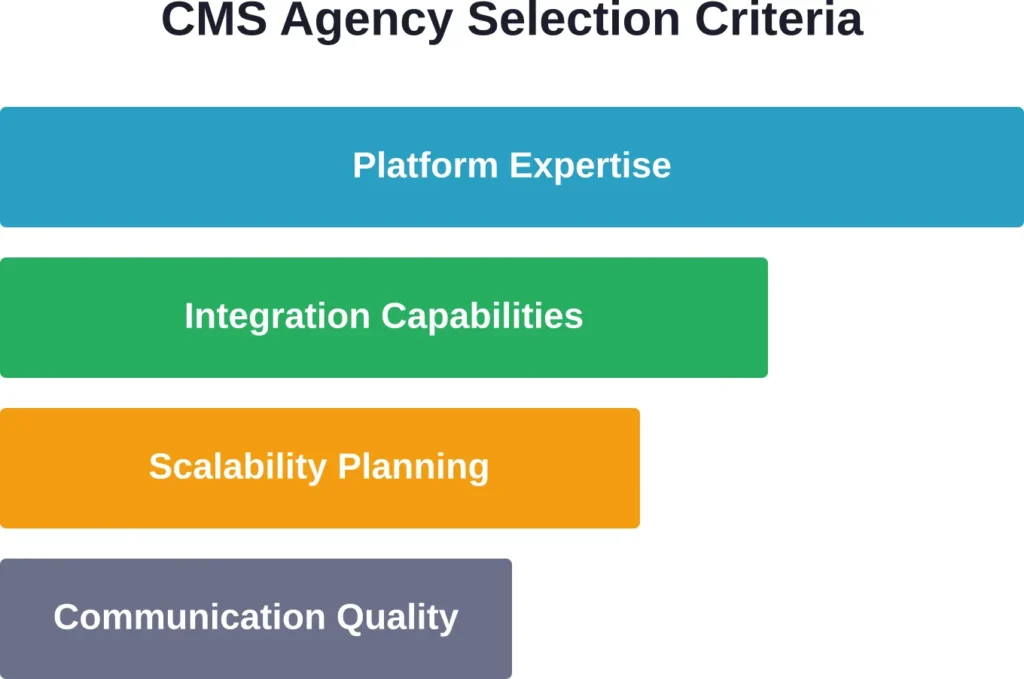
Platform expertise matters most. A company excelling in WordPress might struggle with headless architectures. Drupal specialists understand governance and multisite complexity that Webflow developers may never encounter.
Integration capabilities separate competent agencies from exceptional ones. Modern CMS implementations connect to CRM systems, marketing automation platforms, analytics tools, and commerce engines. Deep integration experience prevents the painful discovery that key systems can’t communicate.
Scalability planning distinguishes tactical implementers from strategic partners. Agencies that think beyond launch day ask about content volume projections, traffic patterns, international expansion, and organizational workflow complexity.
Here’s the thing though — technical chops alone don’t guarantee success.
Communication quality, project management discipline, and cultural fit determine whether collaboration feels effortless or becomes a constant struggle. The best technical team in the world becomes a liability if they can’t translate business requirements into development roadmaps.
Matching Agency Expertise to Project Requirements
Different projects demand different agency capabilities.
Enterprise vs. Mid-Market Projects
Enterprise implementations typically involve complex governance, multiple stakeholder groups, and integration with existing technology ecosystems. Agencies like Bounteous, FFW, and Echidna bring enterprise experience managing organizational complexity.
Mid-market projects often prioritize faster deployment, clearer scope boundaries, and more straightforward integrations. Agencies comfortable in this space deliver proven solutions efficiently rather than building custom everything.
Vertical Industry Expertise
Some agencies develop deep vertical knowledge. Chromatic understands higher education. Echidna knows government compliance. Lullabot works extensively with publishers and media companies.
Vertical expertise accelerates projects because agencies arrive with industry knowledge, avoiding learning curves around regulatory requirements, industry workflows, or sector-specific content strategies.
Platform Migration Projects
Migration projects carry unique risks. Content must transfer without loss. SEO equity needs protection. User disruption should minimize.
Agencies with migration expertise understand content auditing, URL mapping, redirect strategies, and phased rollout approaches that reduce risk. Both Echidna and Aten Design Group explicitly call out migration capabilities as core services.
Ongoing Support vs. Project-Based Engagement
Some organizations need ongoing development partnerships with retainer-based support. Others prefer discrete projects with clear endpoints.
Agencies like Microserve emphasize managed services and ongoing support. Others focus primarily on implementation, handing off maintenance to internal teams or specialized support vendors.
Red Flags When Evaluating CMS Development Companies
Certain warning signs indicate potential problems.
Platform dogmatism suggests limited thinking. Agencies insisting their preferred CMS fits every scenario may prioritize their comfort over client needs. The best agencies recommend platforms based on requirements, not religious preferences.
Vague project scoping indicates inexperience. Mature agencies ask detailed questions about content volume, user roles, workflow complexity, and integration requirements before proposing solutions. Hand-waving about requirements suggests painful discovery phases ahead.
Absent case studies or references raise questions. Established agencies maintain portfolios demonstrating platform expertise and project complexity. Reluctance to provide references or show previous work deserves scrutiny.
Communication gaps during sales processes predict implementation struggles. If getting clear answers feels difficult during evaluation, imagine managing complex development questions during tight timelines.
Real talk: the lowest bid rarely delivers the best outcome. CMS development requires expertise, and expertise costs appropriately. Suspiciously low proposals often hide scope gaps, junior teams, or offshore resources lacking platform depth.
Questions to Ask Potential CMS Development Partners
Structured questions reveal agency capabilities and approach.
Platform Selection: How do they approach CMS recommendation? Agencies should ask about content types, editorial workflows, integration needs, and traffic expectations before suggesting platforms. Immediate platform recommendations without discovery suggest template thinking.
Team Structure: Who specifically works on projects? Understanding team composition — strategists, developers, designers, project managers — clarifies how agencies approach work. Ask about team stability and whether key people stay engaged throughout implementation.
Development Methodology: What processes govern development? Agile, waterfall, and hybrid methodologies each carry implications for timeline flexibility, stakeholder involvement, and change management. Understanding development approach prevents methodology mismatches.
Integration Experience: What third-party systems have they connected? Specific integration examples demonstrate technical breadth. Vague claims about “working with APIs” matter less than concrete examples matching required integrations.
Security Practices: How do they handle security? Expect specific answers about code review processes, dependency management, vulnerability scanning, and update protocols. Security shouldn’t be an afterthought bolt-on.
Performance Optimization: What performance targets do they typically achieve? Agencies focused on performance discuss caching strategies, database optimization, CDN implementation, and front-end efficiency. Performance ambivalence suggests potential problems.
Post-Launch Support: What happens after launch? Understanding support models, SLA options, and ongoing development capacity clarifies long-term partnership potential beyond initial implementation.
| Question Category | What It Reveals | Red Flag Responses |
|---|---|---|
| Platform Selection | Strategic thinking vs. template approach | Immediate platform recommendation without discovery |
| Team Structure | Resource allocation and expertise availability | Vague answers about who actually does the work |
| Integration Experience | Technical depth and API capabilities | Generic claims without specific system examples |
| Security Practices | Development maturity and risk awareness | Security as afterthought or checkbox item |
| Performance Targets | Technical standards and quality focus | No specific performance metrics or goals |
The CMS Development Landscape in 2026
Several trends shape how agencies approach CMS development currently.
Composable Architecture Adoption
Enterprises increasingly adopt composable approaches combining best-of-breed components rather than monolithic suites. CMS becomes one component in stacks including separate commerce, search, personalization, and analytics tools.
This shift requires agencies comfortable with integration complexity and API orchestration. Development focuses less on maximizing single-platform capabilities and more on connecting specialized tools effectively.
Performance as Competitive Advantage
Page speed directly impacts conversion rates and search rankings. Agencies differentiate on performance optimization capabilities including advanced caching, image optimization, lazy loading, and front-end efficiency.
The rise of Core Web Vitals as ranking factors makes performance engineering essential rather than optional. Development companies ignoring performance considerations fall behind technically sophisticated competitors.
Accessibility as Standard Requirement
Accessibility compliance transitions from nice-to-have to mandatory requirement. Legal risks, government requirements, and brand reputation concerns drive universal demand for WCAG compliance.
Agencies with accessibility expertise built into development processes deliver compliant implementations efficiently. Those treating accessibility as separate specialty work face mounting challenges as requirements become universal.
AI Integration Experimentation
Content generation, automated tagging, personalization, and search improvements increasingly leverage AI capabilities. CMS platforms add AI features while agencies experiment with integration patterns.
Development companies staying current understand emerging AI capabilities and can advise on practical applications versus premature hype. Implementation expertise remains nascent across the industry as capabilities evolve rapidly.
Geographic Considerations for Agency Selection
Location influences agency selection in several ways.
Time zone alignment affects collaboration efficiency. Real-time communication becomes challenging when teams operate across extreme time differences. Some organizations prioritize geographic proximity while others embrace distributed collaboration.
Regulatory knowledge matters for certain industries and regions. Government projects, healthcare implementations, and financial services work often require understanding jurisdiction-specific requirements. Agencies with relevant regulatory experience reduce compliance risk.
Language and cultural familiarity impact international projects. Agencies like Vardot with Middle East expertise understand RTL languages and regional content approaches. Chromatic’s higher education focus reflects cultural understanding of academic institutions.
That said, remote collaboration tools enable distributed work effectively. Many organizations successfully partner with agencies across continents, prioritizing expertise over proximity.
Build vs. Buy Decisions in CMS Development
Agencies guide clients through custom development versus platform capability decisions.
Modern CMS platforms offer extensive functionality through core features and plugin ecosystems. The strategic question becomes when to leverage existing solutions versus building custom capabilities.
Custom development provides perfect-fit solutions but carries maintenance burden. Every custom component requires ongoing updates, security patches, and compatibility maintenance through platform upgrades.
Platform capabilities and plugins reduce custom code but may require workflow adaptation. Bending processes to match available tools sometimes makes more sense than building custom functionality for marginal workflow differences.
Experienced agencies help navigate these tradeoffs, distinguishing genuine custom requirements from preference-based requests that existing solutions address adequately.
Common CMS Development Project Pitfalls
Certain mistakes appear repeatedly across failed or troubled implementations.
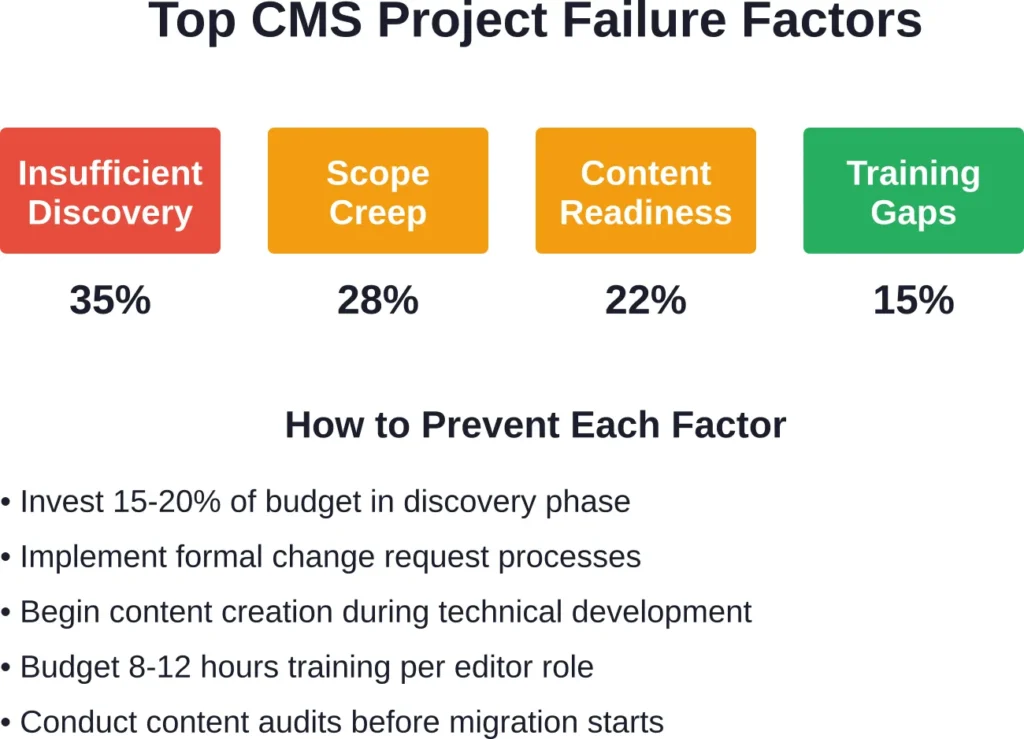
Insufficient discovery produces misaligned solutions. Rushing into development before thoroughly understanding requirements, content structures, and workflow needs creates expensive course corrections later. Mature agencies insist on proper discovery even when clients push for immediate implementation.
Scope creep destroys timelines and budgets. Feature requests, integration additions, and workflow changes accumulate during development. Projects lacking change management processes spiral as scope expands without timeline or budget adjustment.
Inadequate content planning delays launches. Organizations underestimate content creation effort, discovering too late that technical implementation finished months before content readiness. Content strategy should parallel technical development, not follow it.
Ignoring training guarantees poor adoption. Even excellent CMS implementations fail when editors can’t effectively use the system. Training budget and planning deserve attention equal to technical development.
Migration data quality issues surface late. Content migrations reveal structural inconsistencies, broken links, and quality problems in legacy content. Early content audits prevent painful discovery during migration execution.
Evaluating Agency Proposals and Estimates
Comparing development proposals requires understanding what different agencies include.
Line-item detail reveals what’s actually covered. Vague “CMS implementation” estimates hide assumptions about scope, integrations, and customization level. Detailed proposals breaking down discovery, design, development, migration, training, and testing show transparent thinking.
Timeline realism indicates experience. Agencies promising unrealistic timelines either haven’t scoped properly or plan to cut corners. Realistic schedules account for discovery, stakeholder review cycles, content preparation, and testing.
Assumption documentation prevents misunderstandings. Good proposals explicitly state what’s included and excluded, technical assumptions, client responsibilities, and dependency timing. Ambiguous proposals create conflict when reality diverges from unstated assumptions.
Payment structure reflects risk sharing. Milestone-based payments tied to deliverable completion balance risk between client and agency. Large upfront payments or deferred backend-heavy structures favor one party’s interests heavily.
The Role of CMS in Broader Digital Strategy
CMS selection fits within larger digital transformation initiatives.
Modern CMS platforms integrate with martech stacks including CRM, marketing automation, analytics, personalization engines, and commerce platforms. Development agencies increasingly focus on integration architecture rather than isolated CMS implementation.
Content operations extend beyond publishing. Workflow orchestration, approval routing, compliance checking, and multi-channel distribution require thinking beyond traditional page management. Agencies with content operations expertise address organizational process alongside technical capabilities.
Data strategy influences CMS architecture decisions. Organizations leveraging content for analytics, personalization, and AI applications need structured content approaches rather than page-based thinking. Forward-looking agencies design content models supporting data utilization.
Working with Agencies During Implementation
Successful partnerships require active client participation.
Stakeholder availability affects timeline dramatically. Development requires decisions, feedback, and approvals throughout implementation. Delays in client review cycles cascade into schedule slippage. Organizations should ensure decision-makers maintain capacity for project engagement.
Change management discipline prevents scope expansion. Every “small addition” accumulates into significant scope creep. Formal change request processes with timeline and budget implications maintain project boundaries.
Testing participation catches problems early. Agencies need client subject matter experts testing functionality, workflows, and content management against real-world scenarios. Organizations relegating testing to junior staff miss critical issues.
Communication consistency maintains momentum. Regular check-ins, status updates, and issue escalation processes keep projects moving. Communication gaps create information voids filled by assumptions and misalignment.
Future-Proofing CMS Investments
CMS platforms should support organizations for 3-7 years typically.
Platform viability matters for long-term success. CMS platforms with strong communities, active development, and healthy ecosystems reduce obsolescence risk. Agencies recommending platforms should discuss long-term viability indicators.
Scalability headroom prevents premature replacement. Initial implementations should accommodate realistic growth in content volume, traffic, and organizational complexity. Agencies asking about growth projections demonstrate future-focused thinking.
Standard approaches enable staff mobility. Implementations using platform best practices and community conventions make hiring and knowledge transfer easier than highly customized architectures requiring institutional knowledge.
Documentation quality supports transitions. Comprehensive technical documentation, architectural decision records, and operational runbooks preserve institutional knowledge when team members change. Documentation should be deliverable expectations, not afterthoughts.
Frequently Asked Questions
Enterprise CMS projects typically require 4-9 months from kickoff to launch. Complex implementations with extensive integrations, custom development, and large content migrations can extend 12-18 months. Timeline depends on platform complexity, integration requirements, content volume, stakeholder availability, and organizational decision-making speed. Agencies promising enterprise implementations in under three months likely haven’t scoped adequately or plan aggressive compromises.
Platform specialists bring deeper technical expertise, community connections, and proven solutions for their focused technology. Multi-platform agencies offer broader perspective and technology-agnostic recommendations. The right choice depends on whether platform selection is already decided. If committed to specific CMS, specialists typically deliver better outcomes. If evaluating platforms, generalists provide less biased guidance. Some agencies like Aten Design Group and Microserve successfully maintain expertise across 2-3 major platforms.
Community contribution indicates technical depth and platform commitment. Agencies with developers contributing to core platform development, maintaining popular modules, or serving in governance roles demonstrate expertise beyond typical implementation work. These contributions also mean agencies influence platform direction and gain early insight into upcoming changes. For organizations betting significantly on open-source platforms, agency community standing provides meaningful signal about technical capabilities and long-term platform investment.
Support agreements vary significantly across agencies. Common inclusions are security updates, bug fixes, platform upgrades, performance monitoring, and limited troubleshooting hours. Premium support may include SLA response times, 24/7 availability, proactive monitoring, and dedicated support contacts. Clarify what constitutes included support versus billable development work. Understanding whether content support, training refreshers, and feature enhancements fall under support agreements or require separate engagement prevents billing surprises.
Request detailed case studies with technical architecture explanations, not just visual showcases. Ask agencies to explain their approach to specific requirements in plain language — good developers can translate technical concepts clearly. Speak with agency references, asking specifically about technical problem-solving, issue resolution, and knowledge transfer. Consider hiring independent consultants for technical due diligence on agency proposals. Platform communities and vendor partner directories also provide validation — recognized partners have demonstrated capabilities to platform vendors.
Agency size matters less than relevant experience and capability alignment. Small specialized agencies often deliver superior outcomes compared to large generalists applying enterprise scale to inappropriate problems. Boutique Drupal shops compete successfully against large system integrators on complex government projects. Evaluate agencies on portfolio relevance, team expertise, process maturity, and cultural fit rather than employee count. That said, very large implementations requiring dozens of simultaneous developers may exceed small agency capacity regardless of expertise.
Contract terms should address termination scenarios, code ownership, knowledge transfer, and transition assistance. Well-structured agreements include provisions for orderly disengagement including documentation handoff, source code delivery, and reasonable transition periods. Organizations should maintain code repositories under their control rather than agency-owned systems. Regular milestone deliveries reduce exposure to mid-project failure. Building on standard platforms using community best practices (rather than proprietary approaches) makes transition to new agencies cleaner. Prevention through careful selection, clear communication, and early issue escalation beats contractual remedies.
Conclusion
Selecting a CMS development company represents a strategic decision affecting digital capabilities for years.
The 15 agencies profiled demonstrate the range of specializations available — from platform-specific experts to vertical industry specialists, enterprise-focused firms to mid-market implementers. Platform expertise, integration capabilities, vertical knowledge, and cultural fit all influence agency selection differently depending on specific requirements.
WordPress.org powers over 43% of all websites, yet the CMS landscape includes Drupal, headless platforms, hybrid systems, and SaaS solutions — each requiring different development approaches and agency capabilities. Matching project requirements to agency strengths matters more than selecting the “best” agency in abstract terms.
Look beyond portfolio aesthetics to evaluate technical depth, process maturity, communication quality, and long-term partnership potential. Ask detailed questions about team structure, development methodology, security practices, and post-launch support. Request references and conduct thorough technical due diligence.
Remember that the lowest bid rarely delivers the best outcome. CMS implementations require expertise, strategic thinking, and careful execution. Investing in quality development partnerships prevents expensive replacements, painful migrations, and opportunity costs from underperforming digital experiences.
The right CMS development company becomes a strategic partner enabling digital transformation, not just a vendor executing technical requirements. Choose wisely, communicate clearly, and maintain active partnership throughout implementation and beyond.
Ready to move forward? Start by clearly documenting project requirements, organizational constraints, and success criteria before beginning agency conversations. The clarity you bring to evaluation directly influences the quality of agency recommendations and ultimate project success.