

Quick Summary: Choosing the right ASP.NET development company requires evaluating technical expertise, proven track records, and client satisfaction. This guide profiles the top 15 ASP.NET agencies recognized for delivering scalable, secure web applications across healthcare, finance, retail, and enterprise sectors. Each company brings specialized capabilities in ASP.NET Core, cloud integration, and modern development practices.
ASP.NET remains one of the most robust frameworks for building enterprise-grade applications. According to Stack Overflow, ASP.NET remains among the top five most-used web frameworks and web technologies in the world.
But here’s the thing—not all development companies deliver the same quality. Some excel at complex enterprise systems, others at rapid MVP development. Some maintain 92% client retention rates, while others struggle with project delivery.
This guide cuts through the noise. The companies below have been evaluated based on technical capabilities, client feedback, industry recognition, and proven project execution. No fluff, no paid placements—just the firms that consistently deliver results.
Why ASP.NET Continues to Dominate in 2026
The framework’s popularity isn’t accidental. In 2024, approximately one in four software developers employed the .NET Framework to create robust, secure, and scalable software solutions. That number has grown steadily into 2026.
Microsoft’s continued investment matters. With the recent v1.0 release of Microsoft Agent Framework announced in April 2026, and .NET 15 positioning itself as the most productive, secure, and performant release yet, the ecosystem keeps evolving. Microsoft Agent Framework v1.0 includes multi-model and agent platform support — Azure OpenAI, Anthropic, Google Gemini, Amazon Bedrock, Ollama, and more.
Cross-platform capabilities remain a decisive factor. Development teams can build once and deploy across Windows, Linux, and macOS without major refactoring. Cloud-native architectures integrate seamlessly with Azure, AWS, and Google Cloud Platform.
Performance benchmarks tell the story. ASP.NET Core applications handle thousands of requests per second with minimal resource consumption. Compiled code execution, efficient memory management, and async programming patterns contribute to response times that outperform many competing frameworks.
What Separates Elite ASP.NET Development Companies
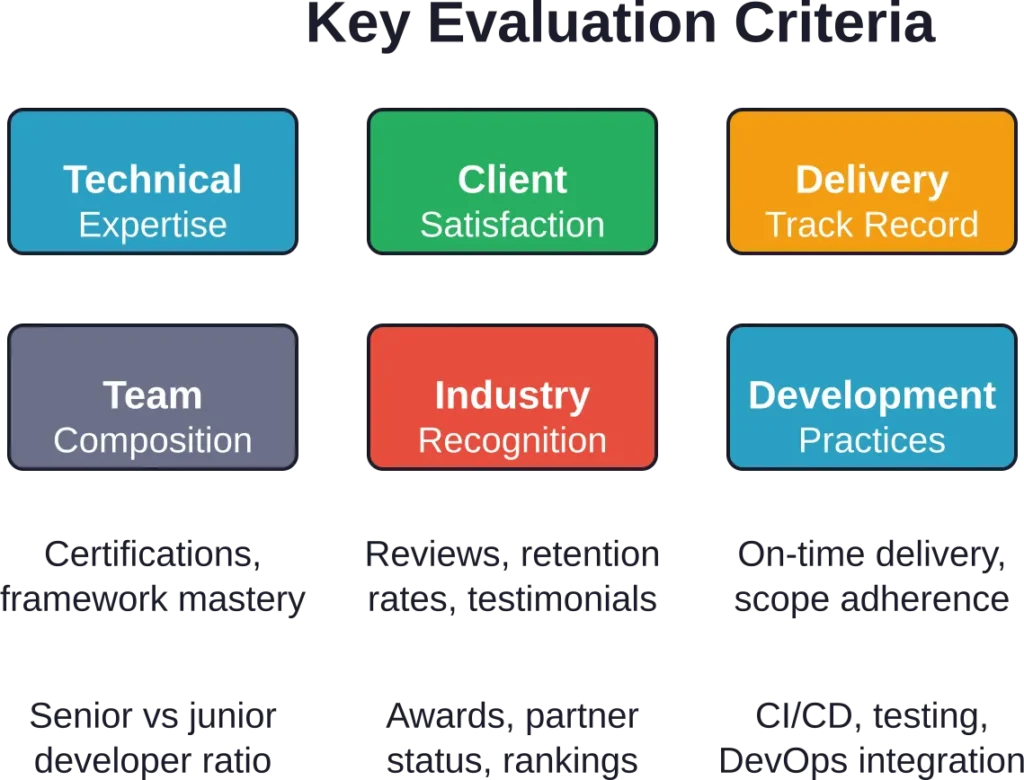
Technical certifications provide a baseline, but real-world execution determines outcomes. The best firms demonstrate specific characteristics that translate to project success.
Proven Track Record Across Industries
Elite companies don’t just claim expertise—they document it. Case studies should detail specific challenges, architectural decisions, and measurable results. Look for experience in your sector, whether healthcare, finance, retail, or manufacturing.
Industry-specific knowledge prevents costly mistakes. A company that’s built HIPAA-compliant healthcare systems understands regulatory requirements from day one. Financial services experience means familiarity with transaction security, audit trails, and compliance frameworks.
Senior-Heavy Engineering Teams
Team composition directly impacts code quality. Waverley reports that 73% of their engineers hold senior-level positions. That seniority translates to architectural foresight, debugging speed, and reduced technical debt.
Junior developers have their place, but complex ASP.NET systems require experienced judgment. Senior engineers recognize performance bottlenecks before they become problems, design for scalability from the start, and navigate framework updates without disruption.
Transparent Communication and Project Management
Technical skills mean nothing if teams can’t communicate effectively. Top companies establish clear communication channels, provide regular progress updates, and maintain documentation throughout development.
Time zone coverage matters for distributed teams. Companies with overlapping work hours respond faster to blockers and maintain development momentum. Asynchronous communication works, but real-time collaboration accelerates complex problem-solving.
Modern Development Practices
Legacy approaches produce legacy results. Leading firms embrace contemporary methodologies: continuous integration and deployment, automated testing, code reviews, and infrastructure as code.
DevOps integration isn’t optional anymore. Applications need deployment pipelines that handle testing, staging, and production releases automatically. Monitoring, logging, and alerting systems catch issues before users notice them.
Top 15 ASP.NET Development Companies
The following companies have demonstrated consistent excellence in ASP.NET development. Each brings unique strengths to different project types and business requirements.
1. Mobian Studio

Mobian Studio operates as a European software development partner with strong expertise in mobile and AI-powered solutions. The company delivers production-ready software through dedicated engineering teams for clients in IT, healthcare, fintech, and logistics.
Two flexible engagement models — full outsourcing with end-to-end delivery and outstaffing with senior engineers embedded into client teams — help businesses accelerate development without hiring overhead.
Technical capabilities cover full-stack delivery including mobile applications (iOS, Android, Flutter), AI and automation systems, scalable backend architecture, legacy integration, and cloud infrastructure. The team emphasizes clean architecture, comprehensive documentation, and regulatory compliance where required.
Contact Information:
- Website: mobian.studio
- Phone: [email protected]
- Address: Harju maakond, Tallinn, Kesklinnalinnaosa, Masina tn 22, 10113
- LinkedIn: www.linkedin.com/company/mobian-studio
2. A-Listware

A-Listware is a software development and consulting company providing high-quality digital solutions through outsourcing and dedicated teams. The firm focuses on delivering secure, responsive applications that empower business growth across enterprise, SMB, and startup segments.
The company offers seamless team integration as an extension of the client’s own organization, with round-the-clock expert access and consistent quality delivery.
Service portfolio includes custom software development, application services, UX/UI design, testing & QA, IT consulting, data analytics, infrastructure management, and cybersecurity. Technical expertise spans cloud solutions, machine learning, intelligent platforms, and full-spectrum software engineering including .NET technologies.
Contact Information:
- Website: a-listware.com
- Phone: +1 (888) 337 93 73
- Email: [email protected]
- Address: North Bergen, NJ 07047, USA
- LinkedIn: www.linkedin.com/company/a-listware
- Facebook: www.facebook.com/alistware
3. Gilzor

Gilzor specializes in custom software development and digital product creation for startups and small-to-medium businesses. The company delivers full-cycle solutions from idea validation to production and ongoing support.
With a global team of creative and strategic thinkers, Gilzor builds high-quality web and mobile applications that solve real business challenges and drive measurable results.
Core services cover idea validation, business analysis, mobile and web development, UI/UX design, quality assurance, R&D with proof-of-concept creation, support & maintenance, and go-to-market strategy. The firm maintains an 85% recurring customer rate and has supported projects that achieved significant growth metrics such as 3× MRR increases.
Contact Information:
- Website: www.gilzor.com
- Email: [email protected]
- Address: Poland, Warsaw, Office 58, street Adama Mickiewicza 37, 01-625
- LinkedIn: www.linkedin.com/company/gilzor-softwaredevelopment
4. Oski Solutions
Oski Solutions designs, develops, and maintains well-engineered software solutions for tech-forward enterprises and ambitious startups. The company combines deep technical expertise with AI-accelerated engineering to deliver results significantly faster than traditional approaches.
Strong focus on Microsoft technologies including Azure and .NET enables robust cloud, serverless, and hybrid solutions alongside modern frontend frameworks.
Technical offerings include cloud architecture (Azure, .NET), frontend development (React, Vue, Angular), artificial intelligence and machine learning integrations, CMS solutions (Umbraco, WordPress), and industry-specific platforms for travel, logistics, e-commerce, education, fintech, and insurance.
Contact Information:
- Website: oski.site
- Phone: +48571282759
- Email: [email protected]
- Address: Kaupmehe tn 7, 10114 Tallinn, Estonia
- LinkedIn: www.linkedin.com/company/oski-solutions
5. Lengreo

Lengreo functions as a complete marketing and technology partner, combining digital marketing excellence with website development and lead generation services. The company helps B2B organizations accelerate growth through targeted online strategies and custom web solutions.
Proven results include dramatic improvements in client acquisition, opportunity generation, and conversion rates across software development, architecture, event technology, and sports tech sectors.
Service range covers B2B digital marketing strategy, SEO (local, technical, link building), paid advertising (PPC, Meta, LinkedIn), lead generation with hyper-personalized outreach, website development (e-commerce, business sites, landing pages), and demand generation. The team delivers full-cycle support from discovery and prototyping to implementation and ongoing optimization.
Contact Information:
- Website: Lengreo.com
- Phone: +31 686 147 566
- Email: [email protected]
- Address: Vrijstraat 9 C/D, 5611 AT Eindhoven, Netherlands
- LinkedIn: Lengreo
- Twitter: @Lengreo
- Instagram: @lengreo
6. The One Technologies

The One Technologies focuses on ASP.NET MVC development alongside broader .NET capabilities. The company has built a reputation for delivering secure, high-performing applications that generate measurable ROI.
Business outcome focus differentiates The One Technologies from purely technical shops. Projects are evaluated not just on code quality but on business metrics: user adoption, performance improvements, cost savings, and revenue impact.
Technical specialization includes ASP.NET MVC architecture, RESTful API development, database design and optimization, and front-end framework integration with React, Angular, or Vue.js.
The company serves clients across e-commerce, healthcare, education, and professional services sectors. Custom solutions are tailored to specific business processes rather than adapting businesses to generic software.
7. Capgemini

Capgemini brings global scale and enterprise consulting expertise to ASP.NET development projects. As one of the world’s leading technology consulting firms, the company handles large-scale digital transformation initiatives.
Enterprise focus means Capgemini excels at complex integrations, multi-system architectures, and organization-wide technology rollouts. Projects often span multiple business units, geographies, and legacy systems.
ASP.NET capabilities integrate with broader service offerings: business analysis, change management, infrastructure modernization, and managed services. This full-service approach suits organizations seeking comprehensive transformation partners.
Industry verticals include financial services, insurance, manufacturing, retail, and public sector. Capgemini maintains dedicated industry practices with sector-specific expertise and accelerators.
8. Cognizant
Cognizant operates as a global technology services provider with substantial .NET development capabilities. The company’s scale enables large team allocations for enterprise projects requiring dozens of developers.
Offshore development centers in India, Philippines, and Latin America provide cost-optimized delivery models while maintaining quality through mature processes and governance frameworks.
ASP.NET services include application development, platform migration, cloud transformation, and application maintenance. Cognizant’s industrialized delivery model applies repeatable processes to reduce project risk.
Client relationships often span years with ongoing development, support, and enhancement work. The company structures engagement models from staff augmentation to complete project outsourcing.
9. EPAM Systems

EPAM Systems specializes in software engineering services with strong .NET platform expertise. The company has built a reputation for tackling technically complex projects requiring advanced engineering skills.
Distributed development teams span North America, Europe, and APAC regions. This global presence enables follow-the-sun development models and local time zone coverage for client meetings.
Technical depth covers ASP.NET Core microservices, cloud-native architectures, containerization with Docker and Kubernetes, and modern DevOps practices. EPAM invests heavily in engineering culture and technical training.
Industry focus includes financial services, software and hi-tech, healthcare, and travel and hospitality. Many clients are technology companies or digitally mature enterprises.
10. Prakash Infotech
Prakash Infotech operates as a focused .NET development provider serving small to mid-market clients. The company emphasizes personalized service and direct access to technical leadership.
Smaller company size enables flexibility and responsiveness that large consulting firms struggle to match. Decision-making happens quickly without layers of bureaucracy.
Technical services cover ASP.NET web applications, mobile app backends, API development, and database solutions. The company handles complete project delivery from requirements through deployment.
Client relationships tend toward long-term partnerships with ongoing development and support rather than one-time project work. This continuity builds deep product knowledge and faster enhancement cycles.
11. Leobit

Leobit operates from Ukraine and Poland with a team size between 50-249 employees. The company has established itself as a reliable partner for ASP.NET application development across multiple industries.
Client retention tells an important story—Leobit maintains a 92% client retention rate and 25% year-over-year growth. Those numbers suggest satisfied clients who return for additional projects.
The firm specializes in end-to-end .NET solutions including custom application development, system integration, cloud migration, and ongoing support. Industry focus spans retail, healthcare, finance, and enterprise software.
Technical capabilities cover the full Microsoft stack: ASP.NET Core, ASP.NET MVC, Web API development, Azure cloud services, and microservices architectures. The team stays current with framework updates and modern development practices.
12. Emergent Software

Based in the United States with 50-249 employees, Emergent Software focuses on Microsoft ecosystem solutions. The company positions itself as a US-based Microsoft partner with deep framework expertise.
The engineering team consists entirely of US-based developers—described as a 100% US-based engineering team that eliminates time zone complications and simplifies communication for North American clients.
Emergent Software’s project portfolio includes enterprise web applications, API development, legacy system modernization, and cloud-native solutions. The company has particular strength in sectors requiring regulatory compliance and security certifications.
Microsoft partnership status provides early access to framework previews, direct support channels, and technical resources that benefit client projects. The relationship also validates technical capabilities through Microsoft’s partner competency requirements.
13. Scalo

Scalo operates from Poland and Israel with a substantial team of 250-999 employees. The company brings significant scale to complex, multi-phase development projects.
Geographic distribution across two development centers provides talent depth and operational redundancy. The larger team size supports simultaneous projects without resource conflicts.
Technical services span ASP.NET development, modernization of legacy .NET Framework applications to .NET Core, Azure cloud architecture, and DevOps implementation. Scalo emphasizes security-first development practices and performance optimization.
Industry experience covers fintech, e-commerce, healthcare technology, and logistics platforms. The company has delivered systems processing high transaction volumes with strict uptime requirements.
14. Blackthorn Vision
Blackthorn Vision offers end-to-end .NET software development, testing, and ongoing support services. The company has built solutions for more than 30 industries including retail, healthcare, and finance.
Cost efficiency represents a key differentiator—the firm achieves 20–50% cost reduction compared to market averages while maintaining quality standards. This pricing advantage comes from optimized development processes and offshore team leverage.
Technical offerings include custom ASP.NET application development, API integration, third-party service connectivity, and enterprise system architecture. The company handles both greenfield projects and existing system enhancement.
Quality assurance receives dedicated attention with automated testing frameworks, manual QA processes, and security auditing integrated throughout development cycles.
15. Waverley Software

Waverley operates as a US-based .NET development company with particular strength in reengineering existing systems or building projects from initial concept. The team composition skews heavily senior—73% of engineers hold senior-level positions.
That seniority concentration matters for complex architectural decisions, framework selection, and technical leadership. Senior developers mentor junior team members while maintaining code quality through rigorous review processes.
Service offerings cover full-cycle development: requirements analysis, system design, implementation, testing, deployment, and maintenance. Waverley handles both fixed-scope projects and ongoing development partnerships.
The company’s vast talent pool enables rapid team scaling when project timelines compress or scope expands. Resource allocation flexibility helps maintain momentum through changing requirements.
Critical Selection Factors Beyond Technical Skills
Technical competence is baseline. These additional factors determine whether a partnership succeeds or struggles.
Communication Quality and Responsiveness
Development roadblocks happen. Questions arise. Requirements need clarification. How quickly does the team respond? Are explanations clear or filled with jargon?
Real talk: poor communication kills more projects than bad code. Test responsiveness during evaluation. Send questions at different times. Notice response patterns. A company that takes three days to answer simple questions will frustrate you throughout development.
Cultural and Time Zone Alignment
Geographic distribution creates challenges and opportunities. Offshore teams reduce costs but complicate real-time collaboration. Nearshore options balance cost and accessibility. Onshore teams maximize communication at premium rates.
Time zone overlap matters for certain project types. Agile methodologies benefit from synchronous communication. Waterfall approaches tolerate asynchronous updates. Match your preferred working style to the company’s geographic structure.
Security and Compliance Expertise
Security breaches destroy reputations. Compliance failures trigger lawsuits. Companies handling sensitive data need partners who understand security architecture, encryption, access controls, and regulatory requirements.
Ask about security certifications: ISO 27001, SOC 2, HIPAA compliance for healthcare, PCI DSS for payment processing. Request security assessments as part of project deliverables. Penetration testing should be standard, not optional.
Post-Launch Support and Maintenance
Launch day isn’t the finish line—it’s the starting point. Applications require monitoring, bug fixes, performance optimization, and feature enhancements. What happens when production issues surface at 2 AM?
Clarify support terms before signing contracts. Some companies vanish after deployment. Others offer tiered support packages with defined response times. The best establish ongoing partnerships with proactive monitoring and continuous improvement.
| Support Aspect | Questions to Ask | Red Flags |
|---|---|---|
| Response Time | What’s the SLA for critical bugs? Who handles after-hours emergencies? | Vague promises, no documented SLAs, “best effort” language |
| Monitoring | What tools monitor application health? How are alerts handled? | No proactive monitoring, reactive-only approach |
| Update Process | How are framework updates and security patches managed? | No update strategy, outdated dependencies |
| Knowledge Transfer | How is documentation maintained? Can internal teams take over? | Poor documentation, knowledge hoarding, no transition plan |
Common Mistakes When Selecting an ASP.NET Partner
These errors derail projects before they start. Avoid them.
Choosing Based Solely on Cost
The cheapest bid often becomes the most expensive choice. Rock-bottom rates signal inexperienced developers, poor quality control, or unsustainable business models that lead to mid-project abandonment.
Value differs from price. A mid-range company delivering on time with clean code costs less than a cheap provider requiring extensive rework. Calculate total cost including fixes, delays, and opportunity cost.
Ignoring Portfolio and References
Websites showcase best work. References reveal typical work. Request references and actually call them. Ask about communication quality, deadline adherence, and problem-solving ability.
Portfolio case studies should include technical details, not just marketing fluff. What specific challenges did the project solve? Which architectural patterns were used? What were the measurable outcomes?
Failing to Define Requirements Clearly
Vague requirements produce vague results. Development teams aren’t mind readers. The clearer the requirements, the more accurate the estimates and the better the final product.
Invest time upfront documenting functional requirements, user stories, technical constraints, and success criteria. This documentation protects both parties and provides objective evaluation criteria.
Overlooking Team Stability and Turnover
High turnover creates knowledge loss and inconsistent code quality. Ask about retention rates. How long do developers stay? What’s the average tenure?
Team continuity matters more than most clients realize. Developers who understand the product architecture make better decisions than newcomers learning the codebase. Constant turnover forces repeated onboarding and context rebuilding.
Emerging Trends in ASP.NET Development
The framework ecosystem continues evolving. Forward-looking companies invest in these areas.
AI Integration and Intelligent Applications
Microsoft’s April 2026 announcements highlighted AI Business Solutions, including Microsoft 365 E7 Frontier Suite and Microsoft Agent 365 generally available as of May 1, 2026. Development companies are integrating these capabilities into custom applications.
The v1.0 release of Microsoft Agent Framework provides production-grade tools for building AI agents. This framework supports multiple platforms including Azure OpenAI, Anthropic, Google Gemini, and Amazon Bedrock.
Practical applications include intelligent search, automated customer service, predictive analytics, and natural language interfaces. Companies that master AI integration gain competitive advantages in multiple sectors.
Cloud-Native and Containerized Architectures
Monolithic applications give way to microservices. Container orchestration with Kubernetes becomes standard. Serverless computing handles specific workloads more efficiently than traditional hosting.
ASP.NET Core’s lightweight footprint makes it ideal for containerized deployments. Docker images remain small, startup times are fast, and resource consumption stays minimal. These characteristics reduce cloud costs while improving scalability.
Security-First Development Practices
Cyber threats evolve constantly. On October 17, 2025, CVE-2025-55315 was identified in ASP.NET Core framework. Microsoft assigned its highest ever CVSS score of 9.9 to this vulnerability.
Leading companies adopt security-first practices: threat modeling during design, secure coding standards, automated vulnerability scanning, and regular security audits. Security isn’t an afterthought—it’s integrated throughout the development lifecycle.
Performance Optimization and Green Computing
Energy consumption from computing infrastructure contributes to climate concerns. Industry reports suggest significant increases in AI-related energy demands, prompting focus on efficient code and optimized resource usage.
Performance optimization reduces both operational costs and environmental impact. Efficient database queries, proper caching strategies, and optimized algorithms decrease server requirements. These improvements benefit both budgets and sustainability goals.

Red Flags During the Evaluation Process
Watch for warning signs that indicate potential problems.
Unrealistic Timelines and Promises
A complex enterprise system doesn’t get built in six weeks. Companies promising impossibly fast delivery either don’t understand the requirements or plan to cut corners.
Experienced developers provide realistic estimates with appropriate buffers for testing, revisions, and unexpected challenges. Be wary of estimates significantly lower than competing bids.
Lack of Formal Process or Documentation
Professional development follows defined processes: requirements gathering, design documentation, development sprints, testing phases, and deployment procedures. Companies without formal methodologies produce inconsistent results.
Ask about their development process. Request sample documentation. Professional firms readily share process descriptions and artifact examples.
Pressure Tactics and Hard Sales Approaches
Aggressive sales tactics signal desperation, not confidence. Companies with strong reputations don’t need high-pressure closes. They let their work speak and allow proper evaluation time.
Take the time needed for thorough evaluation. Rush decisions lead to regrettable partnerships.
Inability to Provide Technical Specifics
Sales teams handle initial conversations, but technical staff should be available for detailed discussions. If a company can’t produce knowledgeable engineers for pre-sales technical conversations, question their actual capabilities.
Technical discussions reveal depth of expertise. Ask about architectural patterns, framework versions, testing approaches, and deployment strategies. Vague responses indicate shallow knowledge.
Making the Final Decision
Evaluation complete. Now what?
Narrow to two or three finalists. Request detailed proposals addressing specific requirements. Include technical approach, team composition, timeline, deliverables, and communication plans.
Consider a paid trial project. A small, well-defined project reveals working dynamics without major commitment. Code quality, communication patterns, and problem-solving approaches become evident quickly.
Trust matters. Beyond technical skills and process maturity, do you trust this team? Can you imagine working together through challenges? Partnership quality affects project outcomes as much as technical capabilities.
Check contract terms carefully. Intellectual property ownership, change request processes, payment terms, and dispute resolution mechanisms should be clearly defined. Legal review is worthwhile for significant projects.
Frequently Asked Questions
Project timelines vary dramatically based on complexity, scope, and team size. A simple web application with basic CRUD operations might take 2-3 months. Mid-complexity systems with custom business logic, integrations, and moderate data requirements typically need 4-6 months. Complex enterprise applications with extensive integrations, advanced security requirements, and sophisticated workflows often require 9-12 months or longer. These timelines assume clear requirements and reasonable team sizes. Requirement changes, resource constraints, or integration complications can extend schedules significantly.
Each model offers distinct trade-offs. Onshore companies (same country) provide maximum communication ease, time zone alignment, and often stronger cultural fit, but command premium rates. Nearshore options (adjacent countries or similar time zones) balance cost reduction with reasonable overlap for real-time collaboration—typically offering 20-40% savings versus onshore. Offshore teams (distant time zones, often Eastern Europe or Asia) deliver substantial cost advantages of 40-60% but require more structured communication and asynchronous work processes. The right choice depends on project complexity, your team’s ability to provide detailed requirements, and budget constraints. Complex projects with evolving requirements benefit from closer geographic proximity.
Microsoft partnership status indicates investment in the platform and proven technical competency. Partners must meet specific criteria including customer references, technical certifications among staff, and demonstrated project success. These partnerships provide benefits including early framework access, technical support channels, and training resources that can benefit client projects. However, partnership status alone doesn’t guarantee quality—many excellent ASP.NET developers work at non-partner firms. Consider certifications as one factor among several rather than a make-or-break criterion. Portfolio quality, client references, and demonstrated expertise matter more than partner badges.
Focus on these key areas: First, ask about directly relevant experience—have they built similar applications in your industry? Request case studies and references. Second, inquire about team composition—who specifically will work on your project, and what are their experience levels? Third, explore their development process—how do they handle requirements changes, communication, and quality assurance? Fourth, discuss post-launch support—what happens when bugs surface or enhancements are needed? Fifth, clarify ownership and documentation—who owns the code, and what documentation do you receive? Finally, probe their technical approach—which architectural patterns, frameworks, and tools will they use, and why?
Strong contracts form the foundation of IP protection. Ensure agreements explicitly state that all code, designs, and deliverables become your property upon payment. Include confidentiality clauses preventing disclosure of your business logic, data, or proprietary information. For particularly sensitive projects, require developers to sign individual NDAs beyond company-level agreements. Consider requesting that development occurs on your infrastructure or source control systems, giving you continuous visibility and control. Request regular code reviews or audits to verify no unauthorized third-party code or licensing issues exist. For high-stakes projects, involve legal counsel familiar with software development contracts and IP law.
ASP.NET Framework is the original implementation, Windows-only, mature but receiving minimal new features. It’s suitable for maintaining existing applications but not recommended for new projects. ASP.NET Core represents the modern, cross-platform evolution—running on Windows, Linux, and macOS. Core offers better performance, smaller deployment footprints, contemporary development patterns, and active ongoing development. Most companies now use Core for new projects while maintaining Framework applications during their operational lifetime. When evaluating development companies, confirm they have current ASP.NET Core expertise, not just legacy Framework experience. The technologies differ significantly despite similar names.
Several approaches work for non-technical evaluators. First, hire an independent technical advisor for code reviews at project milestones—this small investment protects larger project budgets. Second, request that companies follow industry standard practices like code reviews, automated testing, and continuous integration—then ask for evidence these processes are actually used. Third, evaluate indirect quality indicators: Does the application perform well? Are bugs rare or constant? Is the team responsive to issues? Fourth, request documentation quality—well-documented code suggests professional practices throughout. Finally, ask for automated testing coverage reports—professional teams typically achieve 70-80% code coverage with automated tests.
Conclusion
Selecting an ASP.NET development company shapes your project outcome more than any single technical decision. The right partner accelerates development, delivers maintainable code, and establishes foundations for long-term success.
Technical expertise forms the baseline—without solid ASP.NET capabilities, nothing else matters. But communication quality, cultural fit, security practices, and post-launch support separate satisfactory experiences from exceptional ones.
The 15 companies profiled here represent proven options across different scales, geographies, and specializations. Leobit’s client retention, Emergent Software’s domestic focus, Scalo’s team depth, and Waverley’s senior talent concentration each address different client priorities.
Take time evaluating options. Request detailed proposals. Check references thoroughly. Consider paid trial projects. The evaluation investment pays dividends throughout development and maintenance.
Your business deserves a development partner who understands both technology and business objectives. The right company doesn’t just write code—they solve problems, enable growth, and build competitive advantages.
Ready to start your ASP.NET project? Begin by documenting your requirements clearly, defining success metrics explicitly, and reaching out to companies whose strengths align with your needs. The perfect partner is out there—invest the effort to find them.