

Quick Summary: Small business web development companies deliver professional, conversion-optimized websites tailored to growing businesses. The top agencies combine technical expertise with business strategy, offering specialized services from brand-focused design to SaaS product development. Choosing the right partner depends on your industry, growth stage, and whether you need ongoing support or a one-time build.
Finding the right web development partner shapes everything about how customers experience your brand online. According to research cited in small business website resources, 53% of users abandon a site if it takes longer than three seconds to load. Speed, design quality, and conversion optimization aren’t optional extras—they’re table stakes in 2026.
Small business web development companies specialize in building sites that balance visual appeal with business results. Unlike generic template builders or offshore dev shops, the best agencies understand the unique challenges growing companies face: limited budgets, aggressive timelines, and the need for sites that generate leads from day one.
This guide breaks down 15 web development companies that consistently deliver for small businesses. Each agency brings distinct strengths—whether that’s e-commerce expertise, SaaS product design, or brand storytelling—so you can match your needs to the right partner.
What Makes a Great Small Business Web Development Company
Not all web development agencies operate the same way. Some focus exclusively on visual design, others on technical architecture, and a few rare ones bridge both worlds. For small businesses, three factors matter most: speed to market, conversion focus, and post-launch support.
The best agencies ask about business goals before discussing color palettes. They want to know your customer acquisition cost, your sales cycle, and what actions drive revenue. Sites built without this context might look impressive but fail to generate ROI.
Mobile-first design has become non-negotiable. With 70% of global internet usage coming from mobile traffic, agencies that still design desktop-first are working with outdated methodologies. Responsive design should be the default starting point, not an add-on.
Technical Foundations That Actually Matter
Behind every high-performing site sits a stack of technical decisions most clients never see. Page speed optimization, semantic HTML structure, and proper schema markup all influence both user experience and search visibility.
WordPress powers over 40% of the web, making it a popular platform choice for small business sites. But platform selection should match your specific needs—headless CMS architectures, Webflow builds, or custom development all solve different problems.
Security and hosting infrastructure matter more than many businesses realize. Sites hosted on shared servers with outdated PHP versions face performance bottlenecks and security vulnerabilities. The right agency handles these technical foundations so you don’t have to think about them.
The 15 Best Small Business Web Development Companies in 2026
These agencies earned their spots through consistent delivery, strong client reviews, and specialized expertise. Each brings something different to the table—scan for the strengths that match your priorities.
1. Mobian Studio
Mobian Studio builds dedicated engineering teams that deliver production-ready mobile and AI solutions for companies in IT, healthcare, fintech, and logistics. They work through both full outsourcing and outstaffing models, helping clients ship faster without the risks of bad hires.
The studio focuses on clean architecture, scalable systems, and end-to-end product development — from mobile apps and AI agents to backend infrastructure and legacy integrations. Their teams emphasize clear documentation and seamless collaboration so clients maintain full visibility and control.
Best for: Companies in regulated industries needing reliable mobile or AI development, businesses scaling digital products quickly, and teams that want senior engineering capacity without hiring overhead.
Key strength: Delivering senior-level engineering teams and complex digital products with predictable timelines and high technical standards.
Contact Information:
- Website: mobian.studio
- Phone: [email protected]
- Address: Harju maakond, Tallinn, Kesklinnalinnaosa, Masina tn 22, 10113
- LinkedIn: www.linkedin.com/company/mobian-studio
2. Lengreo
Lengreo serves as a complete marketing and tech partner, creating websites and digital systems that actively drive leads and revenue for B2B companies.
They combine strategic website development with integrated marketing channels including SEO, paid advertising, and personalized outreach. Every project starts with thorough business analysis to ensure the website functions as a high-performing growth engine rather than just a digital brochure.
Best for: B2B service providers, IT companies, and professional services firms that need their website to generate qualified leads and measurable business results.
Key strength: Building conversion-focused websites supported by full-funnel marketing systems that deliver tangible growth.
Contact Information:
- Website: Lengreo.com
- Phone: +31 686 147 566
- Email: [email protected]
- Address: Vrijstraat 9 C/D, 5611 AT Eindhoven, Netherlands
- LinkedIn: Lengreo
- Twitter: @Lengreo
- Instagram: @lengreo
3. Gilzor
Gilzor creates custom digital products from idea validation through to full development for startups and growing businesses. Their team blends strategic thinking with strong technical execution to build web and mobile applications that users love and markets reward.
They place heavy emphasis on early validation, user-centric design, quality assurance, and go-to-market strategy. This full-cycle approach helps clients reduce risk and launch products that achieve strong product-market fit.
Best for: Startups building MVPs, small and medium businesses expanding digital channels, and product teams seeking a reliable end-to-end development partner.
Key strength: Transforming early-stage ideas into polished, market-ready digital products with excellent user experience.
Contact Information:
- Website: www.gilzor.com
- Email: [email protected]
- Address: Poland, Warsaw, Office 58, street Adama Mickiewicza 37, 01-625
- LinkedIn: www.linkedin.com/company/gilzor-softwaredevelopment
4. Oski
Oski designs and develops smart, well-engineered software solutions for tech-forward enterprises and ambitious startups. Their expertise spans cloud architecture, modern frontend technologies, and AI integrations that improve business operations.
The team delivers scalable web and mobile solutions with a strong focus on performance, intuitive interfaces, and future-proof systems. They help organizations reimagine processes through digital innovation while maintaining reliability at scale.
Best for: Growing companies needing custom software, businesses modernizing existing systems, and organizations implementing cloud and AI solutions.
Key strength: Creating flexible, high-performance digital platforms that combine technical excellence with real business value.
Contact Information:
- Website: oski.site
- Phone: +48571282759
- Email: [email protected]
- Address: Kaupmehe tn 7, 10114 Tallinn, Estonia
- LinkedIn: www.linkedin.com/company/oski-solutions
5. A-Listware

A-Listware provides software development and dedicated teams that integrate smoothly with client organizations. They deliver secure, responsive digital solutions tailored to enterprise, SMB, and startup requirements.
Their services cover custom software development, UX/UI design, team augmentation, infrastructure management, and full technology consulting. Projects benefit from managed delivery and technology expertise across multiple domains.
Best for: Companies looking for reliable development partners, businesses needing flexible team augmentation or outsourcing, and organizations upgrading their technology capabilities.
Key strength: Building and managing development teams that act as natural extensions of the client’s own organization.
Contact Information:
- Website: a-listware.com
- Phone: +1 (888) 337 93 73
- Email: [email protected]
- Address: North Bergen, NJ 07047, USA
- LinkedIn: www.linkedin.com/company/a-listware
- Facebook: www.facebook.com/alistware
6. Thrive Internet Marketing Agency
Thrive combines web design with full-service digital marketing, offering an integrated approach for businesses that want one partner handling both website and ongoing promotion. Their services span SEO, paid advertising, social media, and content marketing.
The agency’s integrated model means website architecture gets built with marketing campaigns in mind. Landing pages align with ad messaging, conversion tracking gets implemented correctly from launch, and site structure supports SEO priorities.
From January to October of 2025, Thrive achieved substantial growth in referral traffic from generative AI platforms using innovative AI SEO strategies, with total traffic from all AI platforms growing by 4,302%, including a +32% increase from other sources. This demonstrates their forward-looking approach to search and discovery.
Best for: Businesses needing both website development and ongoing marketing support, companies launching with aggressive growth targets, and brands ready for integrated digital strategies.
Key strength: Coordinating website builds with comprehensive marketing execution across channels.
7. Digital Silk
Digital Silk positions itself at the premium end of the market, working with established brands and large companies that need enterprise-level web experiences. Their projects emphasize custom development, advanced functionality, and scalable architectures.
The agency handles complex requirements other firms often decline: multilingual sites, custom CMS implementations, API integrations with legacy systems, and white-glove migration services. This technical capacity comes with correspondingly higher project minimums.
Digital Silk maintains dedicated project managers, strategists, and creative directors for each engagement. Clients get consistent points of contact rather than rotating team members, which smooths communication on lengthy, complex builds.
Best for: Established companies with substantial budgets, businesses requiring custom features and integrations, and brands where website represents a significant business investment.
Key strength: Executing technically complex web projects with enterprise-grade requirements.
8. The Creative Momentum

The Creative Momentum, now a CloudMellow Company, blends creative services with technical development for small to mid-market businesses. They emphasize speed to market without sacrificing quality, making them suitable for businesses operating on tight timelines.
Their service offering includes both one-time project work and ongoing retainer relationships. For businesses wanting continuous improvement rather than set-it-and-forget-it websites, retainer arrangements provide predictable monthly support.
The agency’s portfolio demonstrates versatility across industries: e-commerce, healthcare, financial services, and technology clients all appear. This generalist approach means they bring cross-industry insights rather than deep vertical specialization.
Best for: Small businesses balancing quality with speed, companies needing flexible engagement models, and brands wanting ongoing development support.
Key strength: Delivering quality websites on compressed timelines with options for continued partnership.
9. Lounge Lizard

Lounge Lizard describes itself as a brandtenders agency, emphasizing the ongoing care and feeding websites require after launch. Their philosophy treats websites as living assets that need regular updates, optimizations, and improvements.
The agency maintains offices in New York, Nashville, and other markets, allowing them to support both local clients and distributed teams. This geographic presence gives them experience across different regional markets and business cultures.
Lounge Lizard’s work spans web development, mobile app development, and digital marketing. Clients can start with a website project and expand into complementary services as needs evolve, maintaining continuity with a team that already understands their brand.
Best for: Businesses viewing websites as long-term investments requiring ongoing attention, companies planning to expand into mobile apps, and brands wanting consolidated digital partners.
Key strength: Post-launch support and continuous optimization philosophy.
10. Ruckus Marketing

Ruckus Marketing works with established brands and venture-backed startups, bringing an advertising agency perspective to web development. Their creative teams come from traditional agency backgrounds, which influences how they approach digital projects.
The agency emphasizes storytelling and emotional connection over purely functional design. Sites built by Ruckus often feature video content, bold visual narratives, and brand messaging that takes creative risks.
Their client list includes well-known brands across consumer products, technology, and professional services. This roster reflects their positioning: Ruckus competes for businesses that want agency-caliber creative applied to web development.
Best for: Brands prioritizing creative differentiation, companies with strong founder visions, and businesses where brand storytelling drives customer acquisition.
Key strength: Applying advertising-grade creative thinking to web experiences.
11. ParallelHQ

ParallelHQ specializes in web development for AI and SaaS startups, combining product design with marketing-focused websites. Their approach treats websites as extensions of the product experience rather than separate marketing assets.
The agency’s strength lies in understanding technical audiences. When building sites for developer tools or B2B SaaS platforms, they know how to balance technical depth with clarity. Product screenshots, interactive demos, and clear API documentation sections come standard.
Their team includes both designers and front-end developers, which streamlines handoffs and reduces the friction that often derails agency projects. Clients get pixel-perfect implementations of approved designs without the typical back-and-forth revisions.
Best for: AI companies, SaaS startups, and technical B2B brands that need product-aware design teams.
Key strength: Deep understanding of product-led growth models and how websites fit into broader user acquisition funnels.
12. Clay Agency
Clay builds brand-forward websites for technology companies that want to make visual statements. Their work emphasizes custom animations, bold typography, and memorable interactions that set clients apart from template-driven competitors.
The agency’s portfolio skews toward venture-backed tech companies with marketing budgets to match their ambitions. Clay excels at translating abstract brand concepts into concrete visual systems that scale across web and product touchpoints.
Projects typically involve extensive brand exploration before development begins. Expect workshops, stakeholder interviews, and multiple design iterations. This process-heavy approach delivers cohesive results but requires patience and involvement from leadership teams.
Best for: Tech companies raising Series A and beyond, brands pivoting to premium positioning, and companies where founder vision drives design decisions.
Key strength: Creating distinctive visual identities that command attention in crowded markets.
13. Lollypop Design Studio

Lollypop approaches web development through a UI/UX research lens. Every project begins with user research, competitive analysis, and usability testing before any code gets written. This research-first methodology reduces post-launch pivots and redesigns.
The studio maintains a large team across design, research, and development disciplines. This scale allows them to staff projects with specialized roles—accessibility experts, motion designers, conversion optimizers—rather than generalists wearing multiple hats.
Their case studies demonstrate measurable business impact: reduced bounce rates, increased sign-up conversions, and improved task completion rates. Lollypop treats websites as behavioral systems to be optimized, not just visual assets to be admired.
Best for: Businesses prioritizing data-driven design decisions, companies with complex user journeys, and brands investing in long-term digital optimization.
Key strength: Research-backed design decisions supported by usability testing and behavioral data.
14. Huemor
Huemor focuses on results-driven web design for businesses that have outgrown DIY solutions. They specialize in rebuilding underperforming websites, bringing both fresh creative direction and conversion optimization expertise.
The agency’s process includes stakeholder interviews, customer research, and competitive audits to identify what’s preventing current sites from performing. They look for conversion leaks: unclear value propositions, weak calls-to-action, confusing navigation structures.
Huemor works across industries rather than specializing in one vertical. Their client roster includes healthcare providers, manufacturers, professional services firms, and e-commerce brands. This diversity gives them pattern recognition for what works across contexts.
Best for: Established businesses ready to invest in websites as revenue engines, companies frustrated with current site performance, and brands undergoing repositioning.
Key strength: Diagnosing why existing websites underperform and building replacements that convert.
15. Bop Design
Bop Design specializes in B2B marketing websites, particularly for professional services, manufacturing, and industrial companies. Their expertise lies in translating complex service offerings into clear digital experiences.
Many B2B businesses struggle with website messaging—either oversimplifying to the point of vagueness or drowning visitors in technical jargon. Bop navigates this middle ground effectively, creating sites that demonstrate expertise without alienating non-technical buyers.
The agency integrates content strategy early in projects. Writers and strategists work alongside designers to ensure messaging and visuals reinforce each other. This collaboration produces cohesive sites where copy and design feel intentionally paired.
Best for: B2B service companies, industrial manufacturers, and professional services firms targeting enterprise buyers.
Key strength: Clarifying complex B2B offerings for decision-makers at different stages of the buying journey.
How to Choose the Right Web Development Company for Your Business
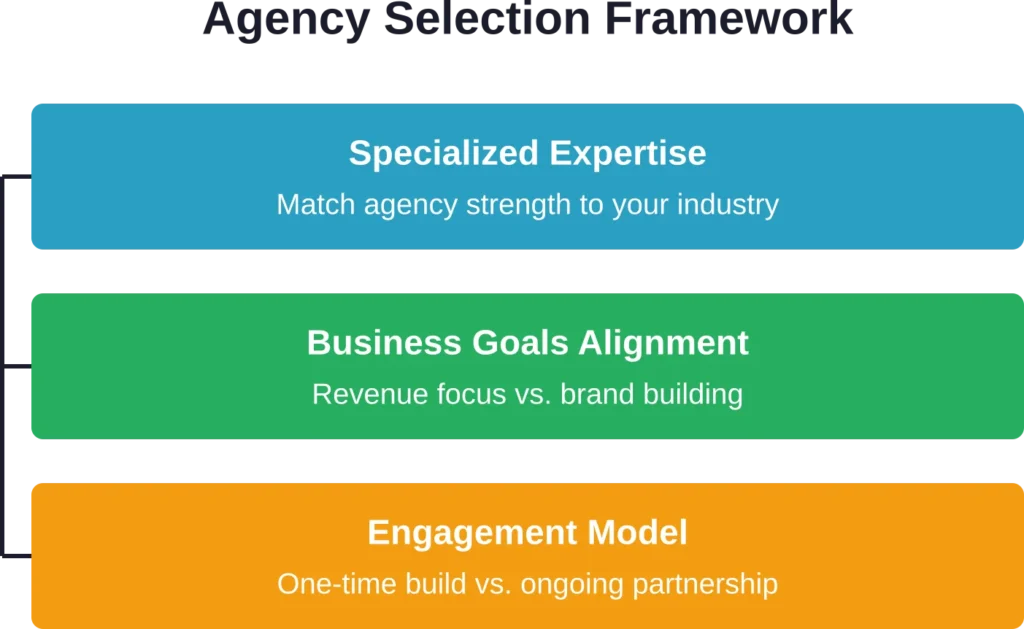
Selecting an agency involves more than scanning portfolios and comparing quotes. The companies that look identical on paper often deliver wildly different experiences. Here’s what actually predicts successful partnerships.
Evaluate Portfolio Work With a Critical Eye
Most agency portfolios showcase their prettiest work, not necessarily their most effective work. Look beyond aesthetics to understand business context. Did that beautiful e-commerce site actually increase sales? Did the sleek SaaS homepage improve trial sign-ups?
Check if portfolio examples match your business model and complexity level. An agency showing primarily Fortune 500 enterprise sites may struggle with small business constraints. Conversely, shops focused on local service businesses might lack the technical chops for SaaS products.
Pay attention to platform diversity. Agencies that only build on one platform—whether WordPress, Webflow, or custom code—will recommend that platform regardless of whether it fits your needs. Stronger agencies maintain platform flexibility.
Ask the Right Discovery Questions
Initial sales calls reveal agency priorities. Do they lead by asking about your business challenges, or do they jump straight into talking about their process and past clients? The best agencies interview you before pitching themselves.
Request information about team structure. Will you work with the senior designers shown in the pitch, or will work get handed off to junior team members? Many agencies lead with impressive talent and deliver with less experienced staff.
Understand post-launch support clearly before signing. Some agencies disappear after launch, others offer maintenance packages, and a few build true ongoing partnerships. Match support levels to your internal technical capacity.
Check References Beyond Case Studies
Published case studies present curated success narratives. Speaking directly with past clients uncovers what really happened: communication style, how challenges got handled, whether deadlines held, and if budgets stayed intact.
Research indicates that 76% of consumers seek out online reviews when assessing local businesses. The same scrutiny should apply to agency selection. Reviews on platforms that verify authenticity provide more reliable signals than testimonials on agency websites.
TrustRadius, which rejects 47% of submitted reviews during vetting, represents one source for authenticated vendor feedback. Looking across multiple review platforms builds a more complete picture than relying on any single source.
Small Business Web Development vs. Freelancers
The agency-versus-freelancer question comes down to project complexity, timeline, and risk tolerance. Neither option is universally superior—context determines the right choice.
When Agencies Make Sense
Agencies bring redundancy that solo freelancers can’t match. If your designer gets sick or quits mid-project, agencies have backup team members. Freelancers going offline stall your entire timeline.
Complex projects requiring multiple specialties—design, development, content strategy, SEO—benefit from agency coordination. Hiring and managing multiple freelancers yourself creates project management overhead many small businesses underestimate.
Agencies typically carry insurance, have formal contracts, and maintain professional standards. This institutional structure provides recourse if things go wrong. Freelancer relationships operate with less formal protection.
When Freelancers Work Better
Straightforward projects with clear requirements often work perfectly with skilled freelancers. If you need a five-page brochure site built on WordPress with no custom functionality, experienced freelancers deliver quality results at lower costs.
Freelancers shine when you want direct access to the person doing the work. Agency structures introduce layers: account managers, project managers, and approval processes that slow communication and decision-making.
Budget-constrained businesses find freelancer rates more accessible. But remember that lower hourly rates don’t automatically mean lower total costs—inexperienced freelancers often take longer to complete work that experienced agencies handle efficiently.
| Factor | Web Development Agency | Freelance Developer |
|---|---|---|
| Team Depth | Multiple specialists available | Single person, limited specialties |
| Project Risk | Lower—team redundancy protects timeline | Higher—single point of failure |
| Cost Structure | Higher rates, more overhead | Lower rates, direct payment |
| Communication | Structured, may involve intermediaries | Direct access to person doing work |
| Best For | Complex projects, tight deadlines, ongoing support needs | Simple sites, clear requirements, flexible timelines |
Understanding Web Development Costs in 2026
Web development investment varies dramatically based on scope, complexity, and agency positioning. Understanding cost drivers helps set realistic budgets and evaluate proposals.
What Influences Project Costs
Page count matters less than functionality complexity. A three-page site with custom e-commerce integration costs more than a ten-page brochure site using standard templates. Custom features, integrations, and interactive elements drive development hours.
Design customization significantly impacts cost. Template-based builds using existing themes cost less than fully custom designs created from scratch. Semi-custom approaches—starting with premium themes and customizing extensively—fall somewhere in between.
Content creation often gets overlooked in budgeting. Professional copywriting, photography, and video production add substantial costs beyond design and development. Some agencies include content services, others expect clients to provide finished content.
Typical Investment Ranges
Industry analyses indicate varied pricing across engagement types. Template-based implementations for simple sites start at lower investment levels, while specialist marketing sites built on platforms like Webflow or WordPress with five to ten pages typically fall in mid-market ranges.
For early-stage SaaS or AI startups, many projects land in ranges that deliver professional results balancing custom design with efficient execution. These builds include custom design, CMS integration, and basic SEO foundations without extensive custom development.
Enterprise-level projects with advanced UX requirements, custom applications, or extensive integrations command higher investments. Large SaaS implementations and projects requiring dedicated designers and project managers fall into premium categories.
Beyond Initial Build Costs
Hosting, security, and maintenance represent ongoing operational expenses. Shared hosting runs cheaply but limits performance and scalability. Managed hosting platforms cost more but handle technical maintenance, backups, and security updates.
Monthly retainer arrangements make sense for businesses needing continuous improvements, A/B testing, and optimization. These typically involve regular design updates, feature additions, and performance monitoring rather than one-time builds.
Budget overruns stem from scope creep more than anything else. Nail the brief before kickoff. Clear requirements, documented approvals, and change order processes prevent projects from ballooning beyond original estimates.
Key Features Small Business Websites Need in 2026
Modern websites require specific technical capabilities and design patterns to compete effectively. These features have shifted from nice-to-haves to basic requirements.
Mobile Optimization Is Non-Negotiable
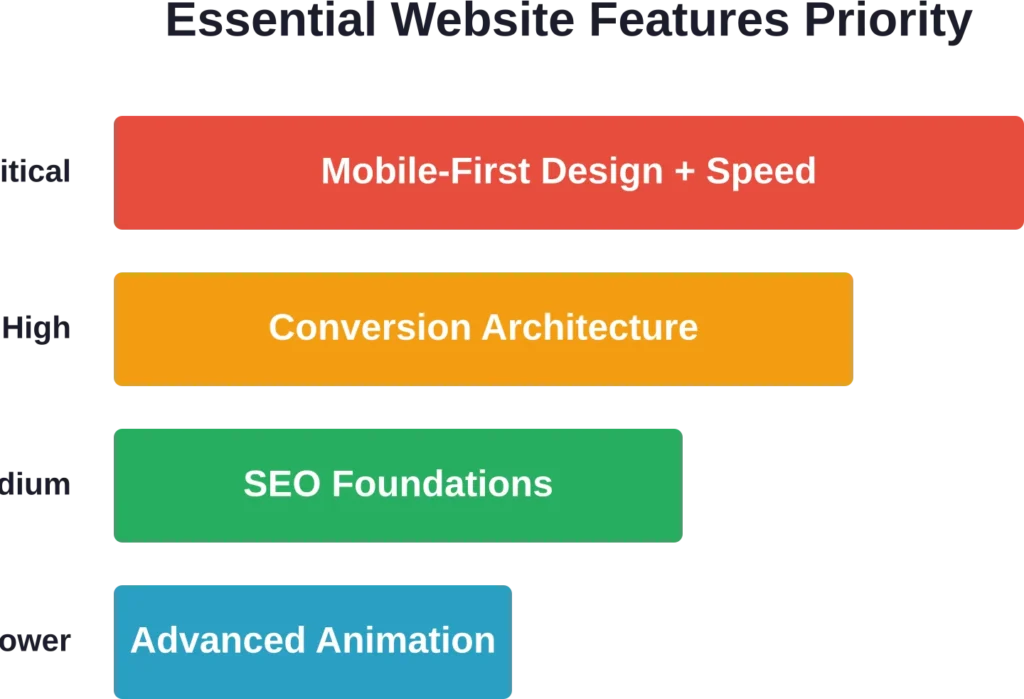
With 70% of global internet usage coming from mobile traffic, mobile-first design represents the only viable approach. Sites that feel like afterthoughts on mobile devices lose customers before they ever see your content.
True mobile optimization goes beyond responsive layouts. It means rethinking navigation for thumb-friendly tap targets, optimizing images for cellular connections, and ensuring forms work smoothly on small screens without excessive zooming and scrolling.
Testing on actual devices matters. Browsers’ mobile preview modes don’t capture real-world performance issues or interaction quirks that appear on physical smartphones and tablets.
Speed Optimization Affects Everything
According to research cited in small business website resources, 53% of users abandon a site if it takes longer than three seconds to load. Every additional second of load time hemorrhages potential customers.
Speed optimization involves image compression, code minification, browser caching, content delivery networks, and lazy loading for below-the-fold content. These technical optimizations happen behind the scenes but dramatically impact user experience.
Core Web Vitals—Google’s speed and user experience metrics—directly influence search rankings. Sites that fail these benchmarks face search visibility penalties regardless of content quality.
Conversion Architecture
Sites exist to drive business outcomes, not just inform visitors. Conversion architecture means strategically placing calls-to-action, reducing friction in sign-up flows, and guiding visitors toward high-value actions.
Real talk: a site that converts at 4% delivers better ROI than a more expensive site that converts at 1%. Conversion rate matters more than visual sophistication when measuring business impact.
Testing reveals what actually works versus what designers assume will work. Heat mapping, session recordings, and A/B testing uncover where users get confused, where they abandon forms, and which CTAs actually get clicked.
SEO Foundations Built In
Search engine optimization should be baked into site architecture from the start, not retrofitted later. This includes semantic HTML, proper heading hierarchy, meta descriptions, schema markup, and XML sitemaps.
U.S. Small Business Administration resources emphasize examining federal digital policies and online presence strategies. Modern SEO extends beyond traditional search to consider how AI platforms and generative tools surface content.
Content management systems that encourage SEO best practices make ongoing optimization easier. Look for platforms with user-friendly SEO plugins, automatic sitemap generation, and clean URL structures.
Red Flags When Evaluating Web Development Companies
Some warning signs predict problematic partnerships. Spotting these early saves time, money, and frustration.
Guarantees That Sound Too Good
No legitimate agency can guarantee first-page Google rankings or specific traffic numbers. Search algorithms change constantly, competition varies by industry, and countless factors outside any agency’s control affect results.
Similarly, agencies promising instant results or claiming proprietary technology that outperforms established platforms should raise skepticism. Web development has best practices, not secret shortcuts.
Realistic agencies set expectations around timelines, investment required, and what success actually looks like. They explain what they control versus what depends on market factors, content quality, and ongoing effort.
Poor Communication From the Start
How agencies handle initial inquiries predicts how they’ll handle actual projects. Delayed responses, vague answers, or high-pressure sales tactics signal problems ahead.
Strong agencies ask more questions than they answer during early conversations. They want to understand your business before proposing solutions. Agencies that pitch identical approaches to every prospect aren’t customizing strategies.
Request detailed proposals that outline scope, deliverables, timelines, and responsibilities. Vague proposals that avoid specifics make accountability impossible if disputes arise later.
No Clear Process or Timeline
Professional agencies follow documented processes with defined phases: discovery, design, development, testing, and launch. Each phase should have clear deliverables, approval points, and timelines.
Agencies that can’t articulate their process or provide estimated timelines may lack project management discipline. Successful web projects require coordination across multiple workstreams—design, development, content, and testing—which demands structured project management.
Ask about revision rounds and approval processes. Unlimited revisions sound appealing but often lead to scope creep and project delays. Clear revision limits with defined approval gates keep projects moving forward.
The Role of Online Reviews in Agency Selection
Research on online reputation management demonstrates the growing influence reviews hold over business performance. Data indicate that 76% of consumers seek out online reviews when assessing local businesses.
Reading Reviews Critically
Not all reviews carry equal weight. Look for reviews that discuss specific project details, communication quality, and how the agency handled challenges. Generic praise like “great work!” provides little useful information.
Pay attention to how agencies respond to negative reviews. Professional responses that acknowledge issues and explain resolutions demonstrate accountability. Defensive or dismissive responses to criticism suggest problematic client relationships.
Review platforms with authentication processes provide more reliable signals. TrustRadius rejects 47% of reviews submitted to their site during vendor vetting, ensuring higher authenticity standards than platforms accepting all submissions.
The Transparency Gap
When evaluating agencies with limited reviews, don’t automatically assume problems. Smaller agencies and newer entrants may simply lack review volume. In these cases, request direct client references to supplement public reviews.
Questions to Ask Before Signing a Contract
These questions uncover potential mismatches before commitments get made.
About Team and Expertise
Who specifically will work on the project? Will you meet them before signing? What’s their experience with businesses similar to yours? Many agencies present senior talent during sales but assign junior team members to execution.
What’s your team’s experience with our platform or technology stack? If transitioning from one platform to another, does the agency have migration experience? Platform expertise matters—agencies learning on your dime cost more and deliver slower.
Do you have in-house developers and designers, or do you outsource? Agencies outsourcing to contractors or offshore teams introduce additional coordination complexity and potential quality control issues.
About Process and Timeline
What does your typical project timeline look like? What factors could delay the schedule? Understanding critical path dependencies helps set realistic launch expectations.
How do you handle revisions and change requests? What’s included in the base scope versus additional charges? Clear change order processes prevent budget surprises.
What testing do you conduct before launch? Device testing, browser compatibility, broken link checks, form functionality, and performance testing should all happen before sites go live.
About Post-Launch Support
What happens after the site launches? Do you provide training? What’s covered during the warranty period? Post-launch support varies dramatically—some agencies disappear, others offer comprehensive training and maintenance.
What are ongoing maintenance costs? Hosting, security updates, plugin updates, and content changes require ongoing attention. Understand whether agencies expect to provide these services or if you’ll manage them internally.
Can we see examples of sites you’ve maintained long-term? Agencies that maintain client relationships years after launch demonstrate commitment to results beyond the initial build.
Platform Selection Considerations
Platform choice shapes what’s possible, what’s easy, and what’s expensive for years after launch.
WordPress: The Flexible Standard
WordPress powers over 40% of the web globally, making it the most established and supported platform. The open-source ecosystem includes thousands of plugins and themes for nearly every industry and use case.
WordPress flexibility is both strength and weakness. The platform handles everything from simple blogs to complex e-commerce sites and membership platforms. But this flexibility requires expertise—poorly configured WordPress sites become security vulnerabilities and performance bottlenecks.
WordPress makes sense for businesses wanting platform longevity, extensive plugin ecosystems, and the ability to switch developers without platform lock-in. Any competent developer can work on WordPress sites, providing flexibility if agency relationships change.
Webflow: Designer-Friendly, Code Optional
Webflow appeals to design-focused agencies and clients wanting visual control without coding. The platform’s visual editor allows designers to build custom layouts without writing HTML and CSS.
The trade-off is platform lock-in and higher hosting costs. Webflow sites live exclusively on Webflow hosting, and migrating to other platforms requires rebuilding from scratch. This dependency limits flexibility if Webflow’s pricing or features stop meeting needs.
Webflow works well for marketing sites, portfolios, and content-driven sites that prioritize design aesthetics. It’s less suitable for complex applications, membership platforms, or sites requiring extensive custom functionality.
Custom Development: Maximum Control
Custom-coded sites using modern frameworks like React or Vue provide maximum flexibility and performance optimization. This approach makes sense for complex applications, unique functionality requirements, or when performance optimization justifies the investment.
The downside is cost, both initially and ongoing. Custom development requires larger budgets and specialized technical expertise for maintenance and updates. Content editors often face steeper learning curves without familiar CMS interfaces.
Choose custom development when off-the-shelf platforms truly can’t meet requirements, when performance optimization provides competitive advantage, or when the application complexity justifies the investment.
| Platform | Best For | Strengths | Limitations |
|---|---|---|---|
| WordPress | Most business types, content-heavy sites | Flexibility, plugins, developer availability | Security requires maintenance, can feel dated |
| Webflow | Design-focused brands, marketing sites | Visual control, modern aesthetic, fast to build | Platform lock-in, higher hosting costs |
| Shopify | E-commerce businesses | Commerce features, payment processing, app ecosystem | Limited beyond commerce, transaction fees |
| Custom | Complex applications, unique requirements | Unlimited flexibility, optimized performance | Higher cost, requires specialized maintenance |
Measuring Website Success After Launch
Launching represents the beginning, not the end. Measuring performance reveals whether investment delivered returns.
Metrics That Actually Matter
Vanity metrics like total page views sound impressive but rarely correlate with business outcomes. Focus instead on conversion metrics: form submissions, trial sign-ups, purchases, or whatever actions drive revenue for your business.
Bounce rate and time on page indicate content relevance. High bounce rates on landing pages suggest messaging misalignment between traffic source and page content. Short time on page might indicate usability problems or uninteresting content.
Page load speed directly impacts both user experience and search rankings. Monitor Core Web Vitals through Google Search Console to catch performance degradation before it damages rankings.
Setting Up Proper Tracking
Analytics implementation should happen before launch, not after. Google Analytics, conversion tracking, heat mapping tools, and form analytics all require proper configuration to deliver useful data.
Define conversion goals explicitly in analytics platforms. Without defined goals, analytics platforms can’t measure what percentage of visitors take desired actions. Track multiple conversion types: primary conversions like purchases plus micro-conversions like newsletter signups or resource downloads.
Tag management systems like Google Tag Manager simplify tracking implementation and updates. Rather than editing site code for every tracking change, tag managers let marketers adjust tracking through web interfaces.
Continuous Improvement Mindset
Sites that convert at 4% significantly outperform sites that convert at 1%, regardless of which cost more to build. Optimization efforts focused on conversion rate improvement often deliver better ROI than traffic acquisition campaigns.
A/B testing removes guesswork from optimization decisions. Test headline variations, CTA button colors and copy, form field quantities, and page layouts. Small improvements compound: a 10% lift here and 15% lift there multiply to substantial overall gains.
SBA resources through Small Business Development Centers emphasize specific design best practices and tools for website design journeys. Professional optimization combines design principles with behavioral data to identify what works for specific audiences.
Common Small Business Website Mistakes to Avoid
These mistakes appear repeatedly across small business websites, undermining otherwise solid efforts.
Unclear Value Proposition
Visitors should understand what you do and why it matters within seconds of landing on your homepage. Generic taglines like “Quality Service Since 2015” communicate nothing distinctive.
Clear value propositions answer three questions: What do you offer? Who is it for? Why should they choose you over alternatives? These answers should be immediately obvious, not buried in About pages.
Test your homepage with someone unfamiliar with your business. If they can’t explain what you do after five seconds of scanning, your messaging lacks clarity.
Weak or Missing Calls-to-Action
Every page needs a clear next step. What should visitors do after reading this page? Generic CTAs like “Learn More” underperform specific actions like “Schedule Your Free Consultation” or “Download the Implementation Guide.”
CTA placement matters as much as copy. Primary CTAs belong above the fold, reinforced again at natural conclusion points throughout page content. Visitors shouldn’t have to hunt for how to take the next step.
Test CTA variations systematically. Button color, size, copy, and placement all influence click-through rates. What works for one audience may underperform for another—test rather than assuming.
Neglecting Mobile Experience
With 70% of global internet usage coming from mobile traffic, designing desktop-first or treating mobile as secondary guarantees poor experience for most visitors.
Mobile problems go beyond responsive layouts. Tiny tap targets, excessive scrolling to reach key information, forms that require zooming, and heavy images that slow load times all degrade mobile experience.
Test actual customer journeys on mobile devices. Can visitors easily navigate to product information? Do forms work smoothly? Are checkout processes straightforward? Desktop testing misses mobile-specific friction points.
Frequently Asked Questions
Timeline varies based on complexity and scope. Simple template-based sites with minimal customization can launch within 4-6 weeks. Custom-designed sites with original branding, multiple page templates, and CMS integration typically require 8-12 weeks. Complex sites with custom functionality, integrations, or extensive content migration may extend to 16-20 weeks. Timeline also depends on client responsiveness—agencies can’t progress without timely content, feedback, and approvals from business owners.
Industry specialists understand sector-specific requirements, compliance needs, and customer expectations without extensive education. They bring proven templates and patterns that work for your market. Generalists offer fresh perspectives and cross-industry insights that specialists might miss. For highly regulated industries like healthcare or finance, specialists usually deliver better results. For common business models like professional services or e-commerce, competent generalists work fine. Evaluate agency understanding of your specific business model and customer journey rather than industry label alone.
Web design focuses on visual aesthetics, layout, user interface, and overall look and feel. Designers work in tools like Figma or Adobe XD creating mockups and prototypes. Web development translates those designs into functional websites using HTML, CSS, JavaScript, and backend programming languages. Developers handle technical implementation, functionality, database integration, and performance optimization. Many agencies employ both designers and developers as separate roles, while some smaller shops have hybrid professionals who handle both. Complex projects benefit from dedicated specialists in each discipline.
Content responsibility varies by agency and project scope. Some agencies include professional copywriting and content creation in standard packages. Others expect clients to provide all written content, images, and media. Many offer content services as optional add-ons at additional cost. Clarify content responsibilities before signing contracts—content creation takes significant time whether handled internally or by agencies. Poor or missing content delays projects more than any other factor. Budget for professional copywriting if creating compelling content isn’t an internal strength.
Professional agencies build revision rounds into project scopes. Typical arrangements include 2-3 rounds of design revisions before moving to development. First round might address major direction changes, subsequent rounds refine details. Agencies should present design concepts with rationale explaining how designs solve business problems. If designs miss the mark, clearly articulate what’s not working and why rather than requesting vague changes. Unlimited revisions sound appealing but often indicate lack of clear process. Defined revision rounds with approval gates keep projects on track and on budget.
Post-launch maintenance includes software updates, security patches, content updates, and functionality improvements. Options include managing maintenance internally with staff, hiring the original agency for ongoing support via retainer, or engaging specialized maintenance providers. WordPress and other CMS platforms require regular plugin updates, security monitoring, and backups. Agencies typically offer training so internal teams can handle basic content updates while technical maintenance stays with professionals. Clarify who handles what before launch to avoid site neglect that creates security vulnerabilities or performance degradation.
Most modern CMS platforms like WordPress, Webflow, and Shopify allow non-technical users to update text, images, and basic page elements through visual editors. Agencies should provide training covering common update tasks: adding blog posts, updating service descriptions, changing images, and editing contact information. More complex changes involving layout modifications, new page templates, or functionality additions typically require developer involvement. When evaluating platforms, consider your team’s technical comfort level—some systems have steeper learning curves than others. Request demo of the editing interface before committing to a platform.
Conclusion
Selecting the right small business web development company shapes your digital presence for years. The agencies outlined here represent different strengths: some excel at brand storytelling, others at technical implementation, and a few bridge creative and technical disciplines effectively.
Match agency expertise to your specific needs. SaaS companies benefit from product-aware designers who understand onboarding flows and trial conversions. E-commerce businesses need agencies with proven commerce optimization experience. B2B service companies want partners who can translate complex offerings into clear value propositions.
Look beyond portfolio aesthetics to understand business results. Beautiful designs that don’t convert waste investment regardless of how impressive they look. The best agencies balance visual appeal with conversion architecture, ensuring sites both look professional and drive business outcomes.
Remember that launching represents the beginning of your website journey, not the conclusion. Sites require ongoing optimization, content updates, and technical maintenance. Choose partners who view websites as evolving assets requiring continuous improvement rather than one-time projects to complete and forget.
With 76% of consumers seeking online reviews when evaluating businesses, your digital presence directly impacts customer acquisition. Investing in professional web development from agencies that understand both design and business strategy positions your company for sustainable growth.
Ready to start your web development project? Review the agencies listed here, examine their portfolios for work similar to your needs, and schedule discovery calls with your top three choices. The right partnership transforms your website from digital brochure into revenue-generating business asset.