

Quick Summary: The top Ruby on Rails development companies in 2026 include Lengreo, Gilzor, OSKI Solutions, A-listware, Mobian Studio, Railsware, LaunchPad Lab, Thoughtbot, Planet Argon, Evil Martians, Selleo, Flatirons Development, SumatoSoft, RailsFactory, and Renuo. These agencies specialize in building scalable web applications, SaaS platforms, and custom solutions using Rails, offering expertise in areas like API development, cloud deployment, performance optimization, and ongoing maintenance.
Ruby on Rails continues proving its relevance in 2026 as a framework that balances developer productivity with application performance. While W3Techs estimates Rails powers about 4.1% of websites with known server-side languages, that modest percentage masks the framework’s dominance in specific niches—SaaS platforms, internal tools, marketplace applications, and fintech solutions.
Choosing the right Rails development company matters because not all agencies approach the framework with equal sophistication. Some treat Rails as a commodity technology, churning out generic applications. The best Rails shops understand the framework’s philosophy, contribute to its ecosystem, and architect systems that remain maintainable as complexity grows.
This guide profiles 15 Ruby on Rails development companies that consistently deliver quality work across diverse industries and project scales.
Why Ruby on Rails Still Matters in 2026
The narrative around Rails has shifted over the past decade. It’s no longer the newest framework competing for attention. That’s actually its strength now.
Rails has matured into a proven technology with established patterns, extensive libraries, and a stable core. The Rails Foundation, established to support the ecosystem, welcomed Planning Center as a Contributing member on March 3, 2026, joining companies like Renuo that have supported the framework’s growth.
Rails World 2026, scheduled for Austin, Texas on September 23-24, expects to bring together 1,200 developers, founders, and teams. This sustained community engagement demonstrates the framework’s continued vitality.
Performance metrics tell part of the story. According to Pharos Production, Rails applications can achieve response times supporting rapid development and deployment. Production deployments maintain 99.9% average uptime. Teams typically reach MVP status in approximately 8 weeks for standard web applications, according to Pharos Production data.
Top 15 Ruby on Rails Development Companies
The following agencies represent diverse geographic locations, company sizes, and specialization areas. All have demonstrated consistent Rails expertise through portfolio work and client outcomes.
1. Lengreo
Lengreo functions as a full-cycle B2B digital marketing and tech partner with strong capabilities in website development and lead generation. They combine marketing strategy with technical implementation, helping clients in SaaS, biotech, cybersecurity, and other sectors achieve measurable growth through optimized digital channels.
Their services include custom website development, eCommerce solutions, landing pages, and full technical audits. This integrated approach allows them to support both marketing campaigns and underlying web infrastructure, delivering projects that drive client acquisition and conversion improvements.
Contact Information:
- Website: Lengreo.com
- Phone: +31 686 147 566
- Email: [email protected]
- Address: Vrijstraat 9 C/D, 5611 AT Eindhoven, Netherlands
- LinkedIn: Lengreo
- Twitter: @Lengreo
- Instagram: @lengreo
2. Gilzor

Gilzor specializes in custom software development for startups and small-to-medium businesses, offering end-to-end product engineering from idea validation to launch and scaling. Their global team focuses on building functional, attractive digital products across industries like EdTech, FinTech, Healthcare, and E-commerce.
The company provides full-cycle web and mobile development, business analysis, UI/UX design, quality assurance, and go-to-market support. With emphasis on reducing risks through early validation and delivering production-ready solutions, Gilzor helps clients launch faster while maintaining high quality and user focus.
Contact Information:
- Website: www.gilzor.com
- Email: [email protected]
- Address: Poland, Warsaw, Office 58, street Adama Mickiewicza 37, 01-625
- LinkedIn: www.linkedin.com/company/gilzor-softwaredevelopment
3. Oski
Oski delivers smart, well-engineered software solutions for tech-forward enterprises and ambitious startups. They emphasize cloud services, frontend frameworks, artificial intelligence, and robust content management systems.
Their expertise covers scalable architectures, AI integrations, and custom development across multiple technologies, including Ruby on Rails for elegant and efficient web applications. Oski focuses on reimagining business operations through digital innovation, offering flexibility in cloud, frontend, and AI-powered solutions tailored to industries like travel, logistics, e-commerce, education, and fintech.
Contact Information:
- Website: oski.site
- Phone: +48571282759
- Email: [email protected]
- Address: Kaupmehe tn 7, 10114 Tallinn, Estonia
- LinkedIn: www.linkedin.com/company/oski-solutions
4. A-Listware

A-Listware operates as a software development and consulting company providing skilled teams, application services, and IT solutions. With deep experience in managing development projects and customer relations, they deliver cost-effective outsourcing, team augmentation, and modernization services.
The company offers a wide range of capabilities including custom software development, UX/UI design, testing & QA, data analytics, cloud solutions, and dedicated development teams. Their focus on seamless integration and 24/7 expert access makes them a reliable partner for enterprises, SMBs, and startups seeking high-quality, responsive digital solutions.
Contact Information:
- Website: a-listware.com
- Phone: +1 (888) 337 93 73
- Email: [email protected]
- Address: North Bergen, NJ 07047, USA
- LinkedIn: www.linkedin.com/company/a-listware
- Facebook: www.facebook.com/alistware
5. Mobian Studio
Mobian Studio builds dedicated engineering teams that deliver production-ready software on time and on budget, specializing in mobile and AI solutions for IT, Healthcare, Fintech, and Logistics companies. They operate through outsourcing (full delivery) and outstaffing (embedded engineers) models.
Their approach emphasizes clean architecture, scalable systems, legacy integration, and post-launch support. With expertise in end-to-end product development, AI & automation, and domain-specific challenges like regulatory compliance, Mobian helps clients ship faster while maintaining quality and avoiding the risks of bad hires.
Contact Information:
- Website: mobian.studio
- Phone: [email protected]
- Address: Harju maakond, Tallinn, Kesklinnalinnaosa, Masina tn 22, 10113
- LinkedIn: www.linkedin.com/company/mobian-studio
6. Selleo

Selleo operates from Poland, offering Rails development with Central European rates while maintaining English-language communication for international clients. The company handles both web and mobile development, often building React Native or Flutter apps alongside Rails backends.
Their process includes product workshops, UX/UI design, development, and post-launch support. Selleo has worked across industries including logistics, healthcare, fintech, and e-commerce.
The agency emphasizes long-term partnerships rather than one-off projects, with many clients returning for additional features or new products after successful initial launches.
7. Flatirons Development
Founded in 2017, Flatirons Development operates as a mid-sized agency with 10 to 49 employees. They position themselves as a Rails specialist in the North American market, particularly serving clients who need healthcare, fintech, or SaaS applications.
The company’s technical capabilities extend to React and Vue.js on the frontend, PostgreSQL for databases, and modern deployment practices using Docker and Kubernetes. This full-stack expertise allows them to own entire application architectures.
Flatirons emphasizes security compliance, particularly relevant for healthcare and financial services clients subject to HIPAA, SOC 2, or PCI DSS requirements.
8. SumatoSoft
SumatoSoft operates as a software development company with significant Rails expertise among its broader technology capabilities. The company serves clients across education, healthcare, logistics, eCommerce, and banking industries.
Their Rails services span consulting, custom development, API integration, and team augmentation. SumatoSoft can provide dedicated developers who integrate with client internal teams rather than only working as a separate vendor.
Portfolio case studies include FieldCamp and Interstride, demonstrating experience with field service management and international education technology respectively.
9. RailsFactory
RailsFactory focuses specifically on Ruby on Rails development, as the name suggests. The company works with both startups requiring rapid MVP development and enterprises needing complex system integration.
Their technical stack includes Ruby on Rails, React, jQuery, Angular, Vue.js, and PostgreSQL. This combination allows them to handle diverse frontend requirements while maintaining Rails expertise on the backend.
The company offers flexible engagement models including fixed-price projects, time-and-materials arrangements, and dedicated team setups depending on client preferences and project characteristics.
10. Renuo

Based in Zürich, Switzerland, Renuo has built Rails applications since the company’s founding in 2011. Renuo joined the Rails Foundation as a Contributing member, demonstrating commitment to the framework’s long-term success.
The agency sees Rails as their competitive advantage in the Swiss market, where many competitors use other technologies. This specialization allows deeper expertise rather than spreading knowledge across multiple frameworks.
Renuo emphasizes balancing innovation in individual projects with stability through consistent Rails architecture. They automate and simplify processes, adapting technologies to customer needs while maintaining reliable foundations.
11. Railsware
Railsware operates as a product-focused development studio that builds both client projects and its own SaaS products. This dual focus creates interesting incentives—they maintain codebases long-term and feel the consequences of architectural decisions years later.
The company has worked with clients including The New York Times and Abbott. Their technical stack extends beyond Rails to include modern frontend frameworks, giving them full-stack capabilities for complex applications.
Railsware’s experience building their own products like Mailtrap and Coupler.io provides insights into SaaS-specific challenges: billing integration, user onboarding, feature flagging, and multi-tenancy architectures.
12. LaunchPad Lab

Founded in 2012, LaunchPad Lab has grown to a team size between 50 and 249 employees. The agency positions itself at the intersection of product strategy and technical execution.
LaunchPad Lab’s process begins with discovery workshops that clarify requirements before writing code. This upfront investment reduces mid-project surprises and scope creep. Their portfolio spans healthcare, education, logistics, and finance sectors.
The company emphasizes user experience alongside backend development, employing product designers who work closely with Rails developers throughout project lifecycles.
13. Thoughtbot

Thoughtbot’s reputation in the Rails community extends back to the framework’s early years. The company has created widely-used open-source tools including Clearance (authentication), Paperclip (file uploads, now superseded by ActiveStorage), and Factory Bot (test data generation).
Their development philosophy emphasizes test-driven development, continuous integration, and regular client communication through weekly iterations. Thoughtbot publishes design and development playbooks documenting their processes, demonstrating unusual transparency about methodology.
The agency’s work spans web applications, mobile apps, and product strategy consulting. Their experience includes both greenfield applications and rescuing troubled existing projects.
14. Planet Argon

Planet Argon specializes in maintaining and upgrading existing Rails applications rather than primarily building new ones. This focus addresses a real market need—many companies have Rails applications built years ago that require modernization.
The company’s upgrade services help clients migrate from older Rails versions (sometimes Rails 3.x or 4.x) to current releases, improving security, performance, and maintainability. They’ve developed specialized expertise in navigating deprecations and breaking changes across major version jumps.
Beyond upgrades, Planet Argon provides ongoing maintenance retainers, allowing companies to outsource Rails expertise rather than maintaining full-time internal teams.
15. Evil Martians
Evil Martians brings a distinctly product-focused approach, working extensively with startups and growth-stage companies. The agency has contributed significantly to Rails ecosystem tools, including AnyCable (faster WebSocket implementation) and various PostCSS plugins.
Their portfolio includes work on Shopify, GitHub, and various European and Russian tech companies. Evil Martians often handles performance optimization projects, bringing deep expertise in database query optimization, caching strategies, and background job processing.
The company’s developers are frequent conference speakers and open-source maintainers, indicating active engagement with Rails evolution rather than static knowledge.
What Separates Great Rails Agencies from Average Ones
Technical competence with Rails syntax represents table stakes. What distinguishes exceptional agencies involves several dimensions beyond basic framework knowledge.
Architectural Experience
Great Rails companies understand when to embrace Rails conventions and when to diverge from them. They’ve encountered edge cases, performance bottlenecks, and scaling challenges across multiple projects. This experience informs better upfront architectural decisions.
Ecosystem Contributions
The strongest Rails shops contribute back to the ecosystem through open-source libraries, documentation, conference talks, or community support. These contributions signal deep framework engagement rather than superficial familiarity.
Testing and Maintenance Philosophy
Quality agencies write comprehensive test suites using RSpec, Minitest, or similar frameworks. They plan for long-term maintenance rather than just initial delivery. Code quality remains consistent under deadline pressure.
Communication and Project Management
Technical excellence means little if projects miss requirements or deadlines. The best agencies establish clear communication channels, provide regular updates, and manage scope proactively.
Key Selection Criteria for Your Rails Partner
Choosing among qualified agencies requires matching their strengths to your specific needs. Several factors influence which company represents the best fit.
Project Complexity and Scale
Straightforward CRUD applications with standard features require different expertise than complex multi-tenant SaaS platforms with advanced workflow automation. Match agency experience to your complexity level.
Ask candidates about their most complex Rails project. What architectural challenges did they encounter? How did they solve scaling bottlenecks? Their answers reveal depth of experience.
Industry-Specific Requirements
Healthcare applications need HIPAA compliance expertise. Financial services require PCI DSS knowledge. Marketplace platforms demand payment processing integration. Prior industry experience accelerates development and reduces compliance risks.
Team Structure Preferences
Some agencies work as integrated vendors, delivering complete projects with minimal client involvement. Others prefer collaborative arrangements where they augment existing internal teams. Clarify your preferred working model upfront.
Geographic and Timezone Considerations
Real-time collaboration works better when working hours overlap substantially. Teams spread across drastically different timezones often resort to asynchronous communication, which slows decision-making but can work for certain project types.
Budget and Timing Constraints
While this guide doesn’t include specific rates, agencies span significant price ranges based on location, experience, and overhead. Eastern European and South American agencies typically cost less than North American or Western European ones, though quality varies within every geographic region.
Timeline pressure also matters. Agencies with immediate availability differ from those booking months in advance. Higher-demand agencies generally indicate stronger reputations but require earlier planning.
Common Rails Project Types and Best-Fit Agencies
Different project types align better with specific agency strengths. Understanding these patterns helps narrow your search.
Early-Stage SaaS MVPs
Startups need rapid development, reasonable costs, and flexibility for requirement changes as they learn from early users. LaunchPad Lab, Evil Martians, and Selleo all have strong startup experience, understanding the balance between speed and quality appropriate for MVP stage.
Look for agencies that offer discovery workshops or product strategy services beyond pure development. Early-stage products benefit from external perspective on feature prioritization.
Marketplace Platforms
Marketplaces require sophisticated user management, payment processing, search functionality, and often matching algorithms. Railsware’s experience building their own SaaS products translates well to marketplace complexity.
These projects benefit from agencies that understand both Rails backend architecture and modern frontend frameworks for responsive user interfaces.
Legacy Rails Modernization
Companies with Rails applications built 5-10 years ago face security risks and developer productivity issues from outdated frameworks. Planet Argon specializes precisely in this scenario, making them the obvious choice for upgrade-focused projects.
Modernization projects require different skills than new development—careful dependency management, gradual refactoring strategies, and extensive testing to prevent regressions.
Enterprise Internal Tools
Large organizations often need custom Rails applications for internal workflows that commercial software doesn’t address. These projects emphasize reliability, security, and integration with existing enterprise systems over cutting-edge features.
SumatoSoft and RailsFactory both have experience with enterprise clients and the formality, documentation, and compliance requirements those relationships entail.
| Project Type | Key Requirements | Recommended Agencies |
|---|---|---|
| SaaS MVP | Speed, flexibility, product strategy | LaunchPad Lab, Evil Martians, Selleo |
| Marketplace Platform | Complex features, payment processing, scalability | Railsware, Thoughtbot, Evil Martians |
| Legacy Upgrade | Version migration, refactoring, testing | Planet Argon, Railsware |
| Enterprise Tool | Security, compliance, integration | SumatoSoft, RailsFactory, Flatirons |
| E-commerce | Payment systems, inventory, performance | Thoughtbot, Selleo, Renuo |
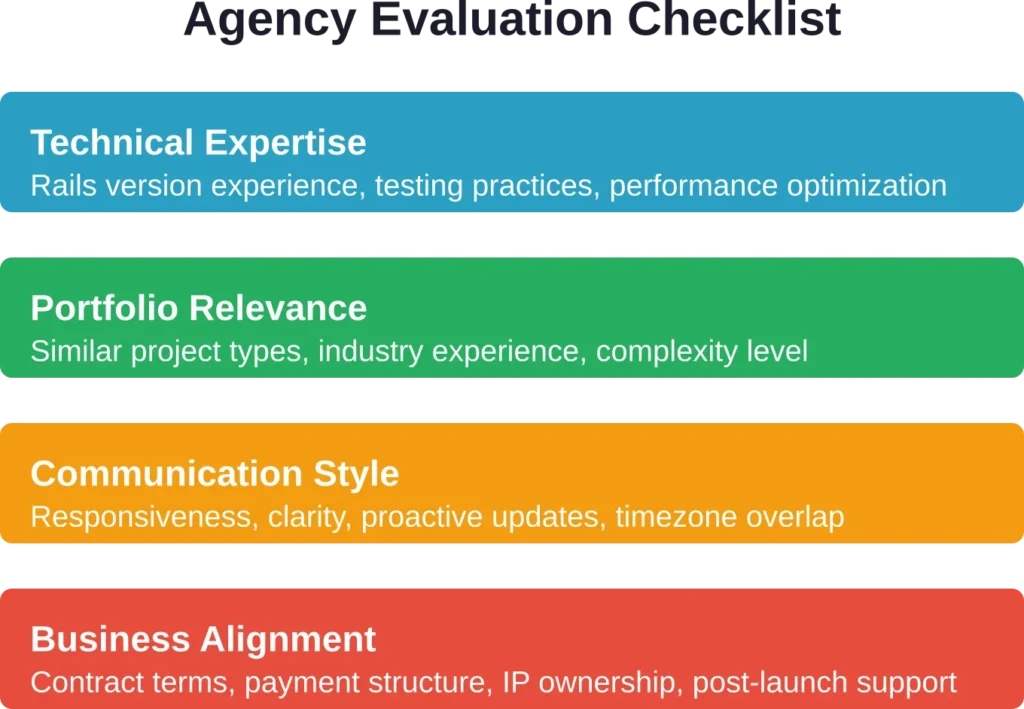
Questions to Ask During Agency Evaluation
Beyond reviewing portfolios and case studies, direct conversations reveal how agencies actually work. These questions help assess fit.
Technical Questions
What’s your approach to Rails application architecture for [your specific use case]? How do you handle background job processing at scale? What’s your testing philosophy and typical test coverage? Which Rails gems do you commonly use, and which do you avoid?
Strong answers demonstrate nuanced thinking rather than dogmatic positions. The best agencies adapt approaches to project needs rather than applying identical patterns everywhere.
Process Questions
How do you structure client communication during projects? What’s your typical sprint or iteration length? How do you handle requirement changes mid-project? What does your code review process look like?
Look for structured processes that balance flexibility with predictability. Agencies that can’t articulate clear processes often struggle with project management regardless of technical skills.
Team Questions
Who specifically would work on my project? What’s their Rails experience level? Will the team stay consistent throughout the project? How do you handle team member vacation or turnover?
Team composition and stability significantly affect project continuity. Frequent developer rotation introduces knowledge loss and communication overhead.
Post-Launch Questions
What support do you provide after launch? How do you approach ongoing maintenance? Can you help with hosting and DevOps? What happens if critical bugs emerge after project completion?
Post-launch support models vary widely. Some agencies offer ongoing retainers, others prefer clean handoffs. Neither approach is inherently better, but alignment with your needs matters.
Red Flags to Watch During Agency Selection
Certain warning signs indicate potential problems regardless of technical credentials.
Vague or evasive answers about team composition suggest resource allocation issues. If the agency can’t tell you who will work on your project, they likely haven’t assigned anyone yet and may be overextended.
Resistance to contracts specifying deliverables, timelines, and quality standards indicates poor project management discipline. Professional agencies welcome clear agreements that protect both parties.
Portfolio case studies lacking specific technical details or measurable outcomes often indicate shallow involvement or unsuccessful projects. Strong agencies proudly share metrics demonstrating impact.
Pressure to sign quickly or commit to large upfront payments without detailed proposals raises concerns about financial stability or ethics.
Inability to provide client references suggests either limited experience or dissatisfied former clients. Established agencies readily connect prospects with past clients willing to share experiences.
The Rails Ecosystem in 2026: What’s Changed
Understanding current Rails trends helps contextualize agency expertise claims.
Performance Improvements
YJIT, Ruby’s Just-In-Time compiler introduced in Ruby 3.1, has matured significantly by 2026. Production Rails applications now see measurable performance gains simply from upgrading Ruby versions. Agencies that haven’t adopted Ruby 3.2+ miss these free performance improvements.
Hotwire Adoption
Hotwire (Turbo and Stimulus) offers an alternative to heavy JavaScript frontend frameworks for many use cases. Not every Rails application needs React or Vue. Agencies fluent in Hotwire can deliver interactive interfaces with less complexity and better performance for appropriate projects.
Import Maps and Asset Pipeline Evolution
Rails 7 introduced import maps as the default JavaScript approach, eliminating webpack complexity for many applications. Understanding when to use import maps versus more complex bundling represents important architectural knowledge.
Security Updates
Rails continues receiving regular security updates. Agencies must stay current with vulnerability patches and security best practices. Ask about their approach to security dependency updates.
Making Your Final Decision
After researching agencies, reviewing portfolios, and conducting interviews, several factors should guide your final choice.
Trust your instincts about communication quality. If interactions during the sales process feel frustrating, actual project work likely won’t improve. Communication patterns established early tend to persist.
Prioritize relevant experience over lowest cost. An agency that’s built similar applications will work faster and avoid pitfalls, ultimately delivering better value despite potentially higher rates.
Consider the relationship duration you’re seeking. Some agencies specialize in initial builds then hand off maintenance. Others prefer ongoing partnerships. Choose an agency whose business model aligns with your needs.
Verify references thoroughly. Speak with at least two past clients about their experience. Ask about communication quality, timeline adherence, budget management, and post-launch support.
Review contract terms carefully before signing. Understand payment schedules, intellectual property ownership, warranty periods, and termination clauses. Professional agencies use fair contracts that protect both parties.
Frequently Asked Questions
Timeline varies dramatically based on complexity. Simple CRUD applications might launch in 4-6 weeks. Standard web applications with moderate features typically require 8-12 weeks to reach MVP status, with Pharos Production data suggesting 8 weeks as average for Rails MVPs. Complex SaaS platforms with sophisticated features can take 6-12 months for initial launch. Scope, team size, and requirement clarity all impact timelines significantly.
Agencies make sense when you need expertise immediately, have project-based rather than continuous development needs, or want to validate a concept before committing to full-time hires. Internal teams work better for ongoing product development with continuous feature additions and tight integration with business operations. Many companies start with agencies for initial builds then hire internal developers for ongoing maintenance and enhancement.
Yes, with proper architecture. GitHub, Shopify, and Basecamp all run on Rails at significant scale. Performance depends more on architectural decisions—database optimization, caching strategies, background job processing, and infrastructure choices—than framework selection. Rails provides tools for building scalable applications, but developers must apply them appropriately. Modern Rails deployments achieve response times below 150ms and maintain 99.9% uptime when properly configured.
Rails-specialized agencies typically have deeper framework expertise, more Rails-specific open-source contributions, and stronger connections to the Rails community. They’ve encountered more edge cases and framework-specific challenges. Full-stack agencies offering multiple frameworks provide technology flexibility but may have shallower Rails knowledge. For complex Rails projects, specialized agencies often deliver better outcomes. For projects requiring multiple technologies, broader agencies may be more appropriate.
Review their GitHub profiles for Rails contributions and open-source projects. Check whether team members speak at Rails conferences or write technical articles about Rails development. Ask detailed technical questions about recent Rails features, architectural patterns, and gem choices. Request portfolio examples with technical details about challenges solved. Contact references from past Rails projects to discuss the quality of delivered code and ongoing maintainability.
Comprehensive contracts specify project scope and deliverables, timeline with milestones, payment schedule tied to deliverables, intellectual property ownership terms, warranty period and support coverage, change request process and pricing, code quality standards including test coverage, deployment and handoff procedures, and termination clauses for both parties. Professional agencies welcome detailed contracts that protect everyone involved.
Rails development rates align closely with other mature web frameworks like Django or Laravel. Geographic location impacts pricing more than framework choice. Ruby developers command competitive salaries in the broader web development market. The framework’s emphasis on convention over configuration can reduce development time for standard features, potentially lowering total project costs despite similar hourly rates. Project cost ultimately depends more on complexity, feature set, and team efficiency than framework selection.
Moving Forward with Your Rails Project
Ruby on Rails remains a pragmatic choice for web applications in 2026, particularly for SaaS platforms, internal tools, and content-driven sites. The framework’s maturity means established patterns for common challenges and a stable foundation that won’t require constant rewriting as trends shift.
Choosing the right development partner matters more than minor technical considerations. An excellent agency using Rails will outperform a mediocre agency using any other framework. Focus your evaluation on demonstrated expertise, communication quality, and relevant experience rather than chasing the newest technology trends.
The 15 agencies profiled here represent diverse options across geographic locations, company sizes, and specializations. Railsware and Planet Argon offer different value propositions despite both being excellent Rails shops. Match your specific needs—project type, budget, timeline, and ongoing support requirements—to agency strengths rather than looking for a universal “best” choice.
Start your search by reviewing portfolios and case studies from two to three agencies whose work aligns with your project type. Schedule introductory calls to discuss your requirements and assess communication style. Request detailed proposals from finalists, then check references before making your final decision.
The Rails ecosystem continues evolving with regular framework updates, community events like Rails World 2026, and growing Foundation support. Partnering with an agency embedded in this ecosystem ensures your application benefits from ongoing improvements rather than being built on stagnant technology.
Ready to start your Rails project? Contact agencies that match your requirements and begin conversations about turning your concept into a deployed application.