
Quick Summary: Choosing the right dental web development company can transform your practice’s online presence and patient acquisition. The best agencies specialize in HIPAA-compliant design, patient-centric UX, and conversion optimization specifically for dental practices. This guide reviews 15 top agencies that understand dental industry challenges and deliver websites that attract, convert, and retain patients.
Why Dental Practices Need Specialized Web Development
Your dental website isn’t just a digital brochure anymore. It’s a patient acquisition machine working around the clock.
Here’s the thing though—generic web developers don’t understand the nuances of dental practice marketing. Nearly 77% of patients perform online research before booking an appointment. They’re comparing services, reading reviews, checking credentials, and evaluating your practice before they ever pick up the phone.
The American Dental Association has emphasized the growing importance of digital standards in dentistry. On July 25, 2025, the ADA debuted a new informatics standards webpage, making it easier for practices to access and adopt standards covering clinical data exchange, administrative processes, and emerging technologies like augmented intelligence. This signals where the industry is headed—toward more sophisticated, technology-enabled patient experiences.
But here’s what separates dental-specific web development from standard website design: conversion architecture built for healthcare decision-making. Dental patients aren’t impulse buyers. They need trust signals, educational content, transparent information about procedures, and seamless scheduling.
Over 60% of visitors access dental websites from mobile devices. If your site doesn’t deliver a flawless mobile experience with click-to-call functionality, integrated scheduling, and fast load times, you’re losing patients to competitors who’ve invested in proper dental web development.
What Makes a Great Dental Web Development Company
Not all agencies are created equal. The best dental web development companies share several critical characteristics.
First, they understand HIPAA compliance. Patient data protection isn’t optional—it’s federally mandated. Your web development partner needs to implement secure contact forms, encrypted data transmission, and compliant patient portal integrations.
Second, they specialize in healthcare UX. Dental patients have specific needs: transparent pricing information, before-and-after galleries, provider credentials, insurance acceptance details, and educational resources that build trust. Generic e-commerce or corporate website patterns don’t translate to healthcare.
Third, they deliver measurable results. The right agency doesn’t just build pretty websites—they engineer patient acquisition systems with clear conversion paths, strategic CTAs, appointment scheduling integration, and analytics that track actual business outcomes.
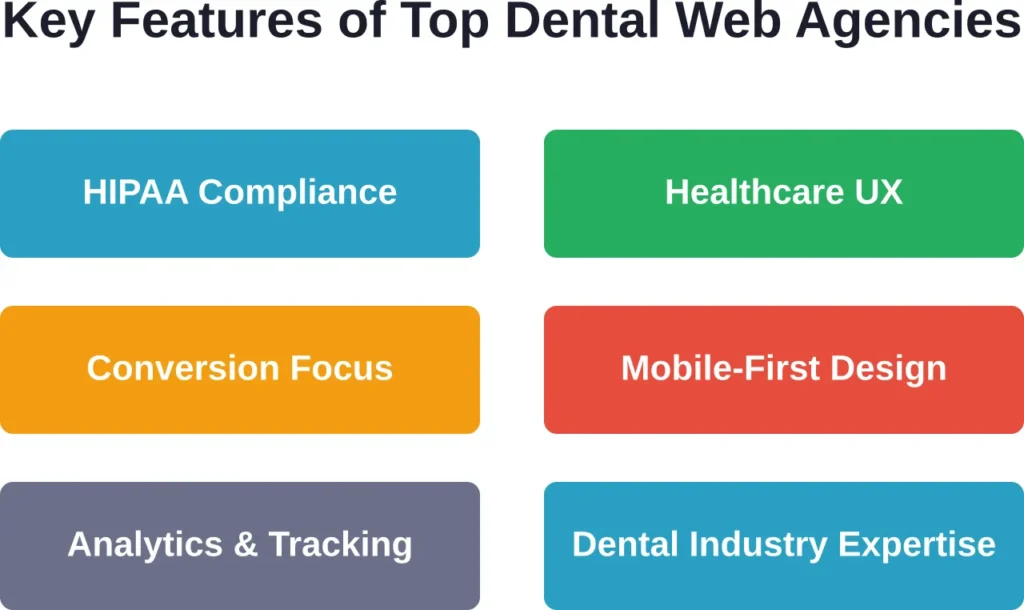
Fourth, they stay current with search algorithms and digital marketing trends. In 2026, search engines prioritize user experience signals, Core Web Vitals, and mobile performance. The ADA’s February 2026 response to the Department of Health and Human Services emphasized that while AI offers transformative potential for dentistry, adoption requires significant investment—particularly for small and rural practices. The best web development companies help practices navigate these technology shifts strategically.
Finally, they offer comprehensive service integration. Your website shouldn’t exist in isolation. Top agencies connect your site with scheduling platforms, patient management systems, review management tools, and marketing automation—creating a cohesive digital ecosystem that streamlines operations while improving patient experience.
Top 15 Dental Web Development Companies for 2026
After analyzing agencies across service quality, client results, specialization depth, and industry reputation, these 15 companies stand out as the best dental web development partners.
1. Lengreo

Lengreo serves as a complete marketing and tech partner for dental practices and healthcare providers. They combine strategic digital marketing with custom website development, SEO, paid advertising, and lead generation specifically tailored to drive patient growth and practice visibility.
What sets Lengreo apart is their proven ability to deliver significant improvements for clients in competitive healthcare markets. They have helped dental and medical clients achieve up to 400% growth in acquired patients, dramatically reduce cost per lead, and boost conversion rates through integrated strategies that turn website visitors into booked appointments.
Lengreo’s dental websites and campaigns feature mobile-responsive design, HIPAA-compliant forms, online scheduling integration, hyper-personalized outreach, and educational content that builds patient trust. Their team listens carefully to each practice’s unique needs, creating tailored solutions that combine technical excellence with patient-focused conversion optimization.
Contact Information:
- Website: Lengreo.com
- Phone: +31 686 147 566
- Email: [email protected]
- Address: Vrijstraat 9 C/D, 5611 AT Eindhoven, Netherlands
- LinkedIn: Lengreo
- Twitter: @Lengreo
- Instagram: @lengreo
2. Mobian Studio
Mobian Studio builds dedicated engineering teams that deliver production-ready dental software and websites on time and on budget. They specialize in mobile apps, AI solutions, and custom web platforms for dental practices, clinics, and healthcare organizations.
What distinguishes Mobian is their flexible engagement models and senior-level execution tailored to the dental industry. They offer full outsourcing for complete website and app projects or outstaffing where their engineers seamlessly join dental teams, ensuring clean architecture, HIPAA-compliant systems, and reliable patient-facing features.
Mobian’s dental solutions include end-to-end website and mobile app development, AI-powered patient engagement tools, scalable booking systems, legacy system integration, and post-launch support. They focus on creating intuitive, secure platforms that reduce no-shows, improve patient experience, and help practices scale efficiently.
Contact Information:
- Website: mobian.studio
- Phone: [email protected]
- Address: Harju maakond, Tallinn, Kesklinnalinnaosa, Masina tn 22, 10113
- LinkedIn: www.linkedin.com/company/mobian-studio
3. Gilzor

Gilzor provides custom software development and digital solutions to help dental practices launch modern websites, scale patient acquisition, and enhance operational efficiency. Their global team builds high-quality, patient-centered digital products from concept to successful implementation.
What sets Gilzor apart is their full-cycle approach that blends technical precision with dental-specific business needs. They support practices through idea validation, user-centric UI/UX design, web and mobile development, rigorous QA, and go-to-market strategies that result in higher patient conversion and practice growth.
Gilzor’s dental solutions emphasize secure and scalable websites, intuitive online booking systems, educational patient portals, mobile apps for practice management, and ongoing maintenance. They create attractive, functional digital tools that reduce patient anxiety, streamline appointments, and help dentists stand out in local markets.
Contact Information:
- Website: www.gilzor.com
- Email: [email protected]
- Address: Poland, Warsaw, Office 58, street Adama Mickiewicza 37, 01-625
- LinkedIn: www.linkedin.com/company/gilzor-softwaredevelopment
4. Oski
Oski designs, develops, deploys, and maintains well-engineered digital solutions for dental practices and healthcare businesses. They deliver smart websites, patient portals, and custom software that enhance patient experience and practice operations.
What distinguishes Oski is their focus on innovation and practical implementation specifically adapted for dentistry. They leverage modern cloud technologies, intuitive frontend design, AI capabilities, and reliable systems to help dental practices reimagine how they attract and serve patients.
Oski’s dental solutions include responsive practice websites, online scheduling platforms, AI-enhanced patient communication tools, secure patient management systems, and industry-compliant architectures. Their projects prioritize seamless user experiences, data security, and long-term scalability to support practice growth and patient satisfaction.
Contact Information:
- Website: oski.site
- Phone: +48571282759
- Email: [email protected]
- Address: Kaupmehe tn 7, 10114 Tallinn, Estonia
- LinkedIn: www.linkedin.com/company/oski-solutions
5. A-listware
A-listware is a software development and consulting company that provides skilled developers and IT solutions tailored for dental practices. They help clinics through dedicated teams, custom website development, and comprehensive digital transformation.
What sets A-listware apart is their seamless integration as an extension of dental teams while delivering secure, high-quality solutions. They offer end-to-end management for websites, patient systems, and infrastructure with strong focus on healthcare compliance and user-friendly design.
A-listware’s dental services cover custom website development, UX/UI optimization for patient conversion, testing and QA, IT consulting, data analytics for practice performance, cloud solutions, and secure patient portals. They build modern digital ecosystems including booking systems, educational content platforms, and tools that streamline operations and improve patient acquisition.
Contact Information:
- Website: a-listware.com
- Phone: +1 (888) 337 93 73
- Email: [email protected]
- Address: North Bergen, NJ 07047, USA
- LinkedIn: www.linkedin.com/company/a-listware
- Facebook: www.facebook.com/alistware
6. Golden Proportions Marketing
Golden Proportions Marketing focuses exclusively on dental and orthodontic practices, bringing deep industry knowledge to every project. Their team includes former dental practice administrators who understand operational realities and patient psychology.
Their websites emphasize treatment education with detailed procedure pages, FAQ sections, financing information, and insurance guidance. Golden Proportions recognizes that cost concerns represent the biggest barrier to treatment acceptance, and their content addresses these concerns transparently.
Technical implementation includes advanced analytics configurations that track not just traffic and conversions, but also patient journey patterns, content engagement, and campaign attribution. This gives practice owners clear visibility into marketing ROI and enables continuous optimization based on actual performance data.
7. Delmain

Delmain positions itself as a premium dental web development company serving established practices seeking to elevate their digital presence. Their design aesthetic skews sophisticated and modern, appealing to practices targeting affluent demographics or specializing in cosmetic dentistry.
Delmain’s websites feature advanced functionality including virtual consultation scheduling, 3D smile simulation integration, and comprehensive treatment planning tools. They embrace emerging technologies that enhance patient experience and differentiate their clients from competitors still relying on outdated digital approaches.
Their development process includes extensive user testing with representative patient demographics, ensuring that navigation patterns, information architecture, and conversion paths align with actual user behavior rather than assumptions.
8. Studio Eighty Eight

Studio Eighty Eight brings boutique agency attention to dental web development. Their client roster remains intentionally limited, ensuring each practice receives personalized strategy and hands-on service.
Their strength lies in custom functionality development. Rather than forcing practices into template limitations, Studio Eighty Eight builds bespoke features that address specific operational needs—whether that’s complex multi-provider scheduling, specialized patient portal functionality, or custom treatment cost calculators.
Studio Eighty Eight also emphasizes ongoing optimization. They view website launches as beginning points rather than end points, implementing continuous testing programs that refine messaging, layouts, and conversion paths based on real user data.
9. Adit
Adit offers an integrated practice management and marketing platform with web development as a core component. Their approach appeals to practices seeking unified systems rather than cobbling together multiple vendors.
Adit’s websites connect seamlessly with their patient communication tools, online reputation management, analytics dashboards, and marketing automation. This integration eliminates data silos and creates operational efficiencies that save staff time while improving patient experience.
Their platform includes built-in accessibility features ensuring websites comply with ADA website accessibility guidelines—an increasingly important consideration as practices face legal risks from non-compliant digital properties.
10. KickStart Dental Marketing

KickStart Dental Marketing specializes in helping new practices establish digital presence quickly and cost-effectively. Their streamlined development process gets practices online faster than traditional agency timelines.
They offer practical, results-focused websites that prioritize essential functionality over elaborate features. This approach works well for startup practices operating on limited budgets who need professional digital presence without overextending financially.
KickStart’s websites include foundational SEO implementation, mobile optimization, appointment request functionality, and content management systems that allow practices to expand their sites as they grow. Their model recognizes that practice needs evolve, and they structure initial builds to accommodate future expansion without requiring complete rebuilds.
11. Thrive Internet Marketing Agency
Thrive delivers comprehensive digital marketing with a strong focus on dental practice growth. Their approach combines custom website design with SEO, PPC, and conversion rate optimization specifically tailored for healthcare providers.
What sets Thrive apart is their proven track record with multi-location dental practices. One orthodontic group in the Southern United States partnered with Thrive and achieved outstanding results through integrated on-page optimization, strategic link building, and targeted pay-per-click campaigns. Their methodology focuses on measurable outcomes—more appointments, higher treatment acceptance, and improved patient lifetime value.
Thrive’s dental websites feature mobile-responsive design, HIPAA-compliant contact forms, integrated scheduling systems, and educational content architectures that position dentists as trusted authorities. Their team understands that dental patients need different information at different stages of the decision journey, and they structure content accordingly.
12. LassoMD
LassoMD specializes exclusively in healthcare digital marketing, with dental practices representing a significant portion of their portfolio. They’ve established themselves as thought leaders in dental website performance, regularly publishing analyses of the industry’s best websites.
Their design philosophy emphasizes above-the-fold CTAs, mobile responsiveness, click-to-call functionality, and online scheduling integration. LassoMD recognizes that SEO and paid advertising drive traffic, but conversion optimization determines whether that traffic becomes revenue. They engineer every interaction—from first page view through appointment confirmation—to reduce friction and increase commitment.
LassoMD’s websites frequently feature dynamic video content, educational resource libraries, and pre-registration forms that streamline the new patient intake process. They understand that modern dental websites must function as high-performance digital tools, not just informational brochures.
13. Wonderist Agency

Wonderist Agency brings creative excellence to dental web development. Their team combines strategic thinking with stunning visual design, creating websites that differentiate practices in competitive markets.
Wonderist excels at brand development for dental practices. They recognize that clinical excellence alone doesn’t guarantee patient acquisition—practices need distinctive brand identities that resonate emotionally with their target demographics. Their websites reflect each practice’s unique personality while maintaining the professional credibility patients expect from healthcare providers.
Their development approach prioritizes storytelling through compelling before-and-after galleries, patient testimonial integration, and team member profiles that humanize the practice. Wonderist understands that dental anxiety is real, and their designs work to build comfort and trust before patients ever visit the office.
14. Amplify360
Amplify360 takes a data-driven approach to dental web development. Their methodology starts with comprehensive competitive analysis and market research, ensuring every design decision supports specific business objectives.
What distinguishes Amplify360 is their focus on local search performance. They optimize dental websites not just for generic keywords, but for location-specific searches that drive high-intent local traffic. Their technical SEO implementation includes schema markup for healthcare providers, local business structured data, and Google Business Profile integration that maximizes visibility in local pack results.
Amplify360 also excels at reputation management integration. Their websites prominently feature verified patient reviews with response management systems that help practices maintain stellar online reputations—a critical factor since community discussions suggest that Community discussions suggest that many patients read online reviews before selecting a dentist.
15. Crimson Media Group
Crimson Media Group specializes in comprehensive digital ecosystems for dental practices. They don’t just build websites—they create integrated marketing platforms that connect website, social media, email marketing, and patient retention systems.
Their dental websites feature sophisticated content management systems that make it easy for practice staff to update services, share educational content, and announce promotions without technical expertise. This empowers practices to maintain fresh, relevant content that both engages patients and signals search engines that the site remains active and authoritative.
Crimson’s conversion optimization includes intelligent form design with conditional logic, automated appointment reminders, and follow-up sequences that nurture leads who aren’t ready to book immediately. They understand that dental decision cycles can be long, and their systems maintain engagement throughout the consideration process.
Essential Features Every Dental Website Needs
Regardless of which agency builds your dental website, certain features are non-negotiable in 2026.
Mobile-first design isn’t optional anymore. With over 60% of dental website traffic coming from smartphones, responsive design that prioritizes mobile experience determines whether visitors convert or bounce. Click-to-call buttons, simplified navigation, and fast loading speeds matter more on mobile than desktop.
Online appointment scheduling integration has become table stakes. Patients expect to book appointments on their schedule—often outside business hours. Systems that sync with practice management software prevent double-booking while reducing phone volume that burdens front desk staff.
Educational content that answers common patient questions establishes authority and builds trust. Detailed procedure pages, FAQ sections, blog posts addressing dental concerns, and video content all contribute to positioning the practice as an educational resource rather than just a service provider.
| Feature Category | Essential Elements | Patient Benefit | Practice Benefit |
|---|---|---|---|
| Navigation & UX | Clear menu structure, search function, breadcrumbs | Find information quickly | Reduced call volume for basic info |
| Conversion Tools | Appointment requests, contact forms, chat | Easy engagement options | More qualified leads |
| Trust Signals | Reviews, credentials, before/after galleries | Confidence in provider selection | Higher treatment acceptance |
| Educational Content | Procedure pages, FAQs, blog, videos | Informed decision-making | Authority positioning |
| Technical Foundation | Fast loading, mobile responsive, HIPAA secure | Seamless user experience | Better search rankings |
Social proof through patient reviews and testimonials dramatically impacts conversion rates. Verified reviews displayed prominently on the website—particularly on service pages where patients are evaluating specific treatments—reduce perceived risk and accelerate decision-making.
Transparent information about insurance acceptance, financing options, and general treatment cost ranges addresses the elephant in the room. Patients worry about affordability, and practices that provide clear financial information convert better than those that avoid the topic.
HIPAA-compliant contact forms and secure patient portals protect patient privacy while meeting legal requirements. This isn’t just about avoiding penalties—it’s about demonstrating that the practice takes patient confidentiality seriously.
The Digital Dentistry Revolution and Your Website
Digital technology is fundamentally changing dentistry, and dental websites need to reflect this evolution. Universities including UT San Antonio, Tufts, and UCLA have established dedicated digital dentistry programs and AI laboratories.
According to information from UT San Antonio, the school recently acquired the latest generation of high-speed 3D printers that reduced fabrication time from more than three hours to approximately 30 minutes. This represents the kind of efficiency gain digital dentistry delivers—and practices need websites that communicate their technological capabilities to patients who increasingly expect modern treatment options.
The American Dental Association has organized informatics standards into 15 categories including terminology, clinical data exchange, administrative data exchange, and augmented/artificial intelligence applications. As these standards gain adoption, dental websites will need to showcase practices’ technology investments and digital capabilities.
Ohio State researchers launched their first clinical pilot study on March 13, 2026 for real-time digital systems that improve dental implant placement. Tufts established an Artificial Intelligence Laboratory committed to advancing data sciences and AI in dental education, research, and clinical practice. UCLA created an Innovative Digital Dentistry Systems unit specifically to lead digital transformation in dental education and healthcare.
What does this mean for dental websites? Practices offering digital impressions, CAD/CAM restorations, 3D imaging, or AI-assisted diagnostics need websites that educate patients about these advantages. The technology investment means nothing if patients don’t understand how it benefits their experience and treatment outcomes.
AI and the Future of Dental Websites
Artificial intelligence is reshaping dental practice operations and patient interactions. The implications for dental websites are significant.
OpenAI launched ChatGPT Health, which sparked discussions about how AI affects dental practices. While the tool explicitly states it’s not intended for diagnosis or treatment, it helps patients understand health information, prepare for appointments, and interpret results. This means patients arrive at dental offices better informed—and sometimes misinformed.
According to discussions shared on LinkedIn, ChatGPT users ask healthcare questions, that represents massive volume. A nonprofit’s 2026 report found serious issues with AI health responses including incorrect diagnoses, unnecessary testing recommendations, and promotion of subpar supplies.
What does this mean for dental websites? Practices need authoritative educational content that corrects misinformation patients encounter through AI chatbots. Comprehensive FAQ sections, detailed procedure explanations, and evidence-based content help practices establish themselves as trusted information sources that counter unreliable AI-generated advice.
Conversely, dental websites can leverage AI productively. Chatbots that answer common questions, intelligent scheduling assistants, AI-powered content recommendations, and automated follow-up systems all enhance patient experience while reducing staff burden. The best dental web development companies integrate these tools thoughtfully rather than implementing AI for AI’s sake.
Choosing the Right Agency for Your Practice
So how do you select from these top dental web development companies?
Start by evaluating your specific needs. Startup practices have different requirements than established multi-location groups. Practices focused on general family dentistry need different messaging than those specializing in cosmetic procedures or orthodontics.
Review each agency’s portfolio specifically for dental work. Generic portfolios don’t tell you much—you need to see dental websites they’ve built and evaluate whether those designs resonate with your practice vision and target demographic.
Ask about their development process. Agencies that skip discovery phases, don’t conduct competitive analysis, or rush through strategy typically deliver generic results. The best agencies invest time understanding your practice, market, and goals before designing anything.
Discuss ongoing optimization and support. Website launches mark beginnings, not endings. Agencies that provide analytics reviews, continuous optimization, content strategy support, and technical maintenance deliver better long-term value than those that disappear after launch.
Request case studies with measurable results. Vague claims about “increasing traffic” mean nothing. Look for agencies that document specific outcomes: appointment request increases, cost-per-lead improvements, treatment acceptance rate lifts, or patient acquisition cost reductions.
Verify their technical capabilities around HIPAA compliance, page speed optimization, Core Web Vitals, mobile performance, and security. These foundational elements determine whether your beautiful website actually performs in search engines and converts visitors effectively.
Investment Considerations
While we’re not discussing specific pricing, understanding general investment ranges helps set realistic expectations.
According to competitor analysis, basic dental websites typically cost between $2,000 and $5,000. These usually include essential pages, basic design, and fundamental functionality—suitable for startup practices with limited budgets.
Custom dental websites generally range from $5,000 to $15,000. These feature unique designs, sophisticated functionality, advanced integrations, and strategic positioning—appropriate for established practices seeking competitive differentiation.
The investment extends beyond initial development. Ongoing marketing budgets vary considerably based on market competitiveness and growth goals. Monthly marketing budgets observed in the industry span from under $750 for minimal presence maintenance to $10,000-$20,000 or more for aggressive growth campaigns in competitive markets.
The key question isn’t what websites cost—it’s what they’re worth. A website that generates even one additional implant patient monthly delivers exponential return on investment. Practices should evaluate agencies based on expected ROI rather than initial costs.
Frequently Asked Questions
Dental website development requires specialized knowledge of healthcare compliance, patient psychology, and dental industry operations. Unlike general websites, dental sites must implement HIPAA-compliant forms, address patient anxieties, showcase clinical credentials, integrate with practice management systems, and convert hesitant visitors into booked appointments. Generic web designers lack this domain expertise and typically produce sites that look professional but don’t generate patients.
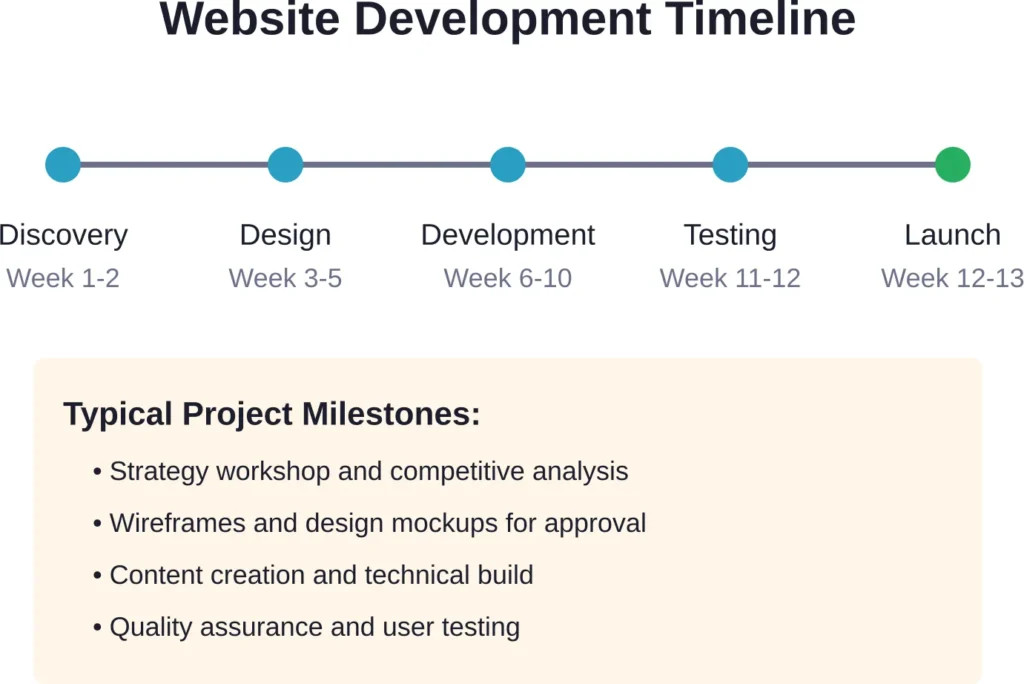
Professional dental website projects typically require 8-12 weeks from initial consultation through launch. This timeline includes discovery and strategy (1-2 weeks), design and revisions (2-3 weeks), development and content creation (4-5 weeks), and testing before launch (1-2 weeks). Rush timelines often sacrifice quality, while extended timelines may indicate agency inefficiency. The best agencies balance thoroughness with reasonable completion timeframes.
While general agencies can build functional websites, dental-specific agencies deliver superior results because they understand patient decision journeys, compliance requirements, industry terminology, competitive dynamics, and conversion optimization specific to healthcare. They’ve solved problems repeatedly that general agencies encounter for the first time. For practices serious about growth, specialized agencies justify their investment through better performance and fewer costly revisions.
Dental websites need regular security updates, plugin maintenance, content freshness, performance monitoring, broken link checks, and compliance audits. Search engines favor actively maintained sites with current content. Technical maintenance prevents security vulnerabilities and ensures compatibility with evolving browsers and devices. Most agencies offer monthly maintenance packages, and attempting to skip ongoing maintenance typically results in degraded performance and security risks over time.
Mobile optimization is critical—over 60% of dental website visitors access sites from smartphones. Mobile-first design ensures seamless experiences on smaller screens with touch-friendly navigation, click-to-call functionality, simplified forms, and fast loading. Google prioritizes mobile-friendly sites in search rankings, meaning poor mobile experiences hurt visibility while also converting poorly. Any dental website built in 2026 must prioritize mobile experience above desktop considerations.
Absolutely. Online scheduling has transitioned from nice-to-have to essential. Patients expect booking flexibility outside business hours, and practices without online scheduling lose patients to competitors who offer this convenience. Modern scheduling systems integrate with practice management software to prevent double-booking while reducing phone volume. The conversion lift from adding scheduling typically justifies implementation costs within weeks.
Track specific conversion metrics rather than vanity metrics. Key performance indicators include appointment request form submissions, phone calls from the website, online scheduling completions, new patient acquisition costs, and ultimately treatment revenue attributed to website leads. Analytics should track patient journey paths, page engagement, and conversion funnel drop-off points. The best agencies provide regular performance reports with actionable recommendations rather than just traffic statistics.
Final Thoughts on Selecting Your Dental Web Development Partner
Your dental website represents your practice 24/7/365. It answers questions, builds trust, and converts prospects while you’re sleeping, treating patients, or away from the office.
Choosing the right dental web development company determines whether your website becomes a patient acquisition asset or an expensive digital brochure that generates minimal return.
The 15 agencies reviewed here represent the industry’s best, each bringing distinct strengths to dental web development. Thrive delivers comprehensive marketing integration. LassoMD brings conversion-focused healthcare UX. Wonderist excels at brand differentiation. The right choice depends on your specific practice needs, budget, and growth objectives.
Real talk: don’t choose based on price alone. The cheapest option rarely delivers the best results, while the most expensive doesn’t guarantee success. Evaluate agencies on their dental industry expertise, portfolio quality, strategic approach, measurable results, and cultural fit with your practice.
Look, the dental industry is becoming increasingly digital. The ADA is advancing informatics standards, universities are establishing AI laboratories, and patients are researching practices more thoroughly than ever. Your website either positions your practice at the forefront of this evolution or leaves you appearing outdated compared to digitally savvy competitors.
Ready to transform your dental practice’s digital presence? Start by reviewing portfolios from these top dental web development companies. Schedule consultations with 2-3 that align with your practice vision. Ask tough questions about their process, results, and approach. Then make an informed decision based on which agency best understands your goals and demonstrates capability to achieve them.
The practices growing fastest in 2026 aren’t necessarily those with the best clinical skills—they’re those that combine clinical excellence with sophisticated digital marketing. Your website is the foundation of that digital strategy. Choose your development partner wisely, and watch your practice grow.