

Quick Summary: The best Ruby on Rails web development companies in 2026 combine deep framework expertise with proven track records building scalable, maintainable applications. This comprehensive guide profiles 15 leading RoR agencies—ranging from boutique specialists to full-service firms—evaluated on technical capability, project portfolio, and development approach, helping businesses identify the right partner for their specific needs.
Ruby on Rails remains one of the most pragmatic choices for web application development. Even in 2026, businesses building SaaS platforms, marketplaces, internal tools, and custom applications turn to Rails for its developer productivity, clean architecture, and mature ecosystem.
But here’s the thing—not all Rails shops are created equal.
The framework’s flexibility means agencies develop vastly different approaches to architecture, testing, deployment, and long-term maintenance. Some specialize in rapid MVP development for startups. Others focus on scaling existing applications for enterprises. A few excel at modernizing legacy Rails codebases.
This guide examines 15 Ruby on Rails development companies that consistently deliver quality work across different project types and business contexts. No fluff, no sponsored placements—just detailed profiles to help businesses evaluate potential development partners.
Why Ruby on Rails Still Powers Modern Web Applications
Rails was released in 2004, making it over twenty years old. This raises a fair question: why do businesses still choose a framework that’s been around so long?
The answer lies in sustained evolution rather than stagnation. Rails 7 and beyond incorporate modern front-end approaches through Hotwire (Turbo and Stimulus), import maps for JavaScript management, and continued refinements to Active Record and Action Cable. The framework adapted without abandoning its core philosophy of convention over configuration.
Real talk: Rails shines for applications where developer productivity and maintainability matter more than raw performance at massive scale. That covers the vast majority of web applications businesses actually build.
Startups value Rails for rapid iteration. Mid-size companies appreciate the large talent pool and mature gem ecosystem. Enterprises benefit from Rails’ stability and extensive documentation. GitHub, Shopify, and Basecamp are known to use Ruby on Rails—not because of legacy lock-in, but because the framework scales effectively for their needs.
The framework excels at:
- Building MVPs quickly without accumulating technical debt
- Handling complex business logic with readable, maintainable code
- Scaling applications vertically and horizontally when needed
- Integrating with modern infrastructure (Docker, Kubernetes, cloud platforms)
- Supporting long-term maintenance with clear conventions
That said, Rails isn’t appropriate for every project. Real-time applications with microsecond latency requirements, computationally intensive data processing, or systems demanding absolute maximum performance at extreme scale might warrant other technology choices.
For the typical web application—the kind most businesses need—Rails delivers an outstanding balance of speed, maintainability, and total cost of ownership.
The Top 15 Ruby on Rails Development Companies
Here’s the detailed breakdown of 15 Ruby on Rails agencies worth considering for your project. Each brings different strengths to the table.
1. A-Listware

A-Listware established itself as a reliable software development and consulting partner with strong capabilities in Ruby on Rails projects. The company focuses on outsourcing, dedicated teams, and team augmentation rather than pure staff replacement.
Their approach emphasizes seamless integration with client teams while delivering high-quality, secure, and responsive solutions. A-Listware excels at custom Ruby on Rails development, legacy modernization, SaaS platforms, API development, and enterprise applications that require robust backend logic and scalability.
The agency maintains expertise across the full development lifecycle, including UX/UI design, testing & QA, IT consulting, data analytics, and infrastructure services. They handle both greenfield Rails projects and modernization of existing codebases, paying close attention to clean architecture and long-term maintainability.
A-Listware works with enterprises, small and medium businesses, and startups across various industries. Their dedicated development teams model supports continuity and deep domain knowledge, making them suitable for complex, evolving Ruby on Rails applications.
Contact Information:
- Website: a-listware.com
- Phone: +1 (888) 337 93 73
- Email: [email protected]
- Address: North Bergen, NJ 07047, USA
- LinkedIn: www.linkedin.com/company/a-listware
- Facebook: www.facebook.com/alistware
2. Gilzor

Gilzor positions itself as a custom software development partner focused on turning ideas into production-ready digital products. The company combines full-cycle web development with strong emphasis on agile processes, idea validation, and business-oriented outcomes.
Their process starts with thorough discovery, business analysis, and product-market fit validation before heavy development begins. Gilzor handles both startup launches and scaling existing products, delivering web applications that often leverage Ruby on Rails for reliable, maintainable backends alongside modern frontend and mobile capabilities.
The agency demonstrates solid capabilities in complex custom web development, UI/UX design, quality assurance, support & maintenance, and go-to-market strategies. They excel at building scalable solutions for industries including airlines, e-commerce, and product studios, with attention to performance, security, and user experience.
Gilzor prefers longer-term partnerships and maintains a global team of creative and strategic thinkers. Their approach minimizes rework through early validation and focuses on delivering functional, attractive products that connect with target audiences.
Contact Information:
- Website: www.gilzor.com
- Email: [email protected]
- Address: Poland, Warsaw, Office 58, street Adama Mickiewicza 37, 01-625
- LinkedIn: www.linkedin.com/company/gilzor-softwaredevelopment
3. Lengreo
Lengreo acts as a complete marketing and tech partner rather than a traditional development-only agency. The company integrates website development with comprehensive B2B digital marketing services, helping clients acquire leads and scale online presence.
Their web development services include custom applications, eCommerce platforms, business websites, landing pages, and APIs. Lengreo maintains specialists in Ruby on Rails alongside other technologies, enabling them to build performant backends that support marketing-driven growth initiatives such as lead generation systems and conversion-optimized platforms.
The agency emphasizes discovery, business analysis, prototyping, and ongoing support. They combine technical implementation with SEO, paid ads, demand generation, and personalized outreach, creating solutions where marketing and technology work seamlessly together.
Lengreo works with software development companies, architecture firms, event tech providers, and other B2B businesses seeking measurable growth. Their integrated approach helps clients not only build applications but also drive real business results through combined tech and marketing execution.
Contact Information:
- Website: Lengreo.com
- Phone: +31 686 147 566
- Email: [email protected]
- Address: Vrijstraat 9 C/D, 5611 AT Eindhoven, Netherlands
- LinkedIn: Lengreo
- Twitter: @Lengreo
- Instagram: @lengreo
4. Mobian Studio
Mobian Studio serves as a European software development partner specializing in dedicated engineering teams for mobile and AI solutions, with backend capabilities that frequently integrate or build upon Ruby on Rails. The company operates through outsourcing (full delivery) and outstaffing (team augmentation) models.
Their delivery focuses on production-ready software with clean architecture, comprehensive documentation, and senior-level execution. Mobian handles end-to-end product development, including backend APIs often powered by Rails, legacy integration, scalable architecture, and post-launch support for industries such as healthcare, fintech, and logistics.
The agency excels at building systems that combine mobile (iOS/Android/Flutter) with robust backends, AI features, and complex integrations. They prioritize dedicated teams without context switching, regulatory compliance where needed, and long-term partnership models that extend beyond initial delivery.
Mobian emphasizes senior engineers, explainable architecture decisions, and solutions designed for future growth rather than short-term fixes. Their approach benefits companies that need reliable technology execution without the overhead of building large in-house teams.
Contact Information:
- Website: mobian.studio
- Phone: [email protected]
- Address: Harju maakond, Tallinn, Kesklinnalinnaosa, Masina tn 22, 10113
- LinkedIn: www.linkedin.com/company/mobian-studio
5. Oski
Oski delivers smart, well-engineered software solutions for enterprises and ambitious startups. The company combines strong frontend expertise with backend capabilities, explicitly offering Ruby on Rails development services for elegant and efficient web applications.
Their process covers full-cycle development from design and cloud infrastructure to deployment and maintenance. Oski works across industries including travel, logistics, e-commerce, education, fintech, and insurance, building scalable platforms that leverage Ruby on Rails for robust backend logic alongside modern frontend frameworks and AI integrations.
The agency maintains expertise in cloud solutions, artificial intelligence, CMS platforms, and comprehensive software delivery. They focus on high-quality, maintainable code and AI-accelerated engineering practices that speed up development while preserving architectural integrity.
Oski appeals to organizations seeking reliable long-term partners for custom web applications and digital transformation initiatives. Their balanced full-stack approach produces solutions that combine technical excellence with strong user experiences and business value.
Contact Information:
- Website: oski.site
- Phone: +48571282759
- Email: [email protected]
- Address: Kaupmehe tn 7, 10114 Tallinn, Estonia
- LinkedIn: www.linkedin.com/company/oski-solutions
6. Test Double
Test Double takes an unusual approach for a development agency: they focus on improving how software gets built as much as building the software itself. The agency helps businesses improve development practices, testing strategies, and team effectiveness.
Their Ruby on Rails practice emphasizes test-driven development in the truest sense. Test Double developers write tests first, use tests to drive design decisions, and maintain comprehensive test suites. They’ve created testing tools and published extensive content about testing philosophy and practices.
The agency excels at helping businesses escape problematic codebases. When a Rails application becomes difficult to change, slow to test, or fragile in production, Test Double’s developers excel at identifying root causes and implementing sustainable improvements.
Their consulting approach often involves embedding developers within client teams rather than building applications in isolation. That knowledge transfer benefits businesses wanting to strengthen internal development capabilities while delivering immediate value.
Test Double created Suture, a refactoring tool, and contributes to various testing frameworks and tools. Their conference talks and blog posts about testing, refactoring, and sustainable software development have influenced practices across the Rails community.
7. Codelitt

Codelitt positions itself as a digital product agency serving everyone from startups to enterprises. Their Ruby on Rails practice focuses on custom software development for businesses with complex requirements.
The agency’s process begins with strategy and discovery, working to align technical solutions with business objectives. Codelitt’s team includes product managers, designers, and strategists alongside developers, enabling them to tackle projects where the solution isn’t fully defined upfront.
They demonstrate strength in healthcare, fintech, and logistics applications—industries with regulatory complexity, integration requirements, and sophisticated business logic. Codelitt’s experience navigating industry-specific constraints benefits clients in regulated sectors.
The agency handles full-stack development, combining Rails backends with modern front-end frameworks and mobile applications. That breadth allows them to deliver complete solutions rather than just one layer of the technology stack.
Codelitt’s distributed team spans multiple time zones, providing flexibility for clients needing extended coverage or continuous delivery cadences. They emphasize communication practices and tooling that keep distributed teams aligned.
8. Reinteractive
Reinteractive brings Australian precision to Ruby on Rails development. The Sydney-based agency combines custom application development with managed hosting services specifically optimized for Rails applications.
Their OpsCare service provides managed Rails hosting with Australian-based support teams. That integration of development and operations benefits clients wanting single-point accountability for both application development and infrastructure reliability.
The agency has developed Rails applications for over a decade, accumulating expertise across diverse industries and application types. Reinteractive handles everything from simple MVPs to complex enterprise applications requiring extensive integration work.
Their InstantRails service provides optimized Rails hosting infrastructure, reflecting deep understanding of Rails application deployment and performance tuning. That infrastructure expertise informs their development practices, ensuring applications they build deploy and scale effectively.
Reinteractive’s geographic focus on the Asia-Pacific region makes them particularly valuable for businesses needing development teams in compatible time zones or applications requiring Australian data residency.
9. Infinum

Infinum started as a mobile development agency and expanded into full-stack product development with strong Ruby on Rails capabilities. The Croatian agency combines technical expertise with design excellence and product thinking.
Their process integrates product design, user experience research, and software development from project inception. Infinum’s designers and developers collaborate throughout, producing applications that balance technical soundness with user experience quality.
The agency demonstrates particular strength in consumer-facing applications. They’ve built platforms for media companies, marketplaces, and consumer services requiring sophisticated mobile experiences backed by Rails APIs.
Infinum maintains strong engineering culture with internal knowledge sharing, code review standards, and continuous improvement practices. They publish the Infinum Handbook openly, documenting their development practices and organizational approaches.
Their geographic presence in Central Europe provides cost advantages compared to Western European or North American agencies while maintaining high quality standards and convenient time zone overlap with European clients.
10. Railsware

Railsware focuses specifically on Ruby on Rails development and related technologies, building expertise through specialization. The Ukrainian agency (now distributed globally) has developed Rails applications since the framework’s early days.
They created Mailtrap, a popular email testing service used by Rails developers worldwide. That product experience informs their consulting work—Railsware understands both service provider and software agency perspectives.
The agency excels at building SaaS platforms, particularly applications requiring subscription billing, complex permissions, and multi-tenancy. Their developers have navigated these common SaaS challenges repeatedly, developing patterns and practices that accelerate implementation.
Railsware maintains a strong DevOps practice alongside Rails development. They handle infrastructure architecture, continuous deployment pipelines, monitoring, and performance optimization. That full-stack capability benefits clients needing complete solutions rather than just application code.
Their long Rails experience means Railsware developers have worked across many framework versions and architectural patterns. That historical perspective helps when modernizing legacy applications or making architectural decisions with long-term implications.
11. Thoughtbot

Thoughtbot earned its reputation through decades of Rails consulting combined with significant open-source contributions. The agency doesn’t just build applications—they literally wrote books on Rails development that many developers learned from.
Their design-driven development approach integrates product design tightly with engineering from project inception. Thoughtbot excels at helping businesses figure out what to build, not just how to build it. That product thinking particularly benefits startups and companies launching new initiatives.
The agency maintains strong opinions about testing, preferring comprehensive test coverage through RSpec and Capybara. They advocate for continuous integration, automated deployments, and infrastructure-as-code approaches. Their Suspenders gem provides an opinionated Rails application template reflecting their preferred stack and conventions.
Thoughtbot works across industries but shows particular strength in SaaS platforms, marketplace applications, and developer tools. Their designers and developers collaborate from day one, producing applications that balance technical excellence with user experience quality.
Notable for maintaining Bourbon, Neat, Bitters, and other open-source design tools alongside Rails gems. The agency publishes weekly podcasts and maintains an active blog sharing technical insights.
12. Selleo
Selleo positions itself as a product development partner rather than a pure staff augmentation firm. The Poland-based agency combines Ruby on Rails backend development with modern JavaScript frameworks and mobile development capabilities.
Their process emphasizes discovery workshops before development begins. Selleo invests time understanding business context, user needs, and technical constraints before proposing solutions. That approach reduces mid-project surprises and aligns technical decisions with business objectives.
The agency demonstrates strong capabilities in complex business logic implementation. They’ve built financial platforms, logistics systems, and enterprise applications requiring sophisticated workflows and integration points. Their developers handle both greenfield development and modernization of existing Rails applications.
Selleo maintains dedicated teams for longer engagements rather than constantly reshuffling developers across projects. That continuity benefits applications requiring deep domain knowledge and ongoing evolution.
Their technology stack extends beyond Rails to include React, React Native, and Vue.js for front-end work, along with DevOps capabilities for deployment and infrastructure management.
13. Thoughtworks
Thoughtworks brings enterprise-scale experience to Ruby on Rails development. While they work across many technology stacks, their Rails practice combines framework expertise with organizational transformation consulting.
The company particularly excels at complex system integration projects. When a Rails application needs to communicate with legacy enterprise systems, data warehouses, or multiple third-party services, Thoughtworks’ experience navigating enterprise architecture patterns proves valuable.
Their approach emphasizes continuous delivery, test automation, and evolutionary architecture. Thoughtworks pioneered many practices now considered standard in agile development. They bring that process maturity to Rails projects, particularly benefiting larger organizations with compliance requirements or established governance processes.
The agency’s scale allows them to staff larger teams quickly, though that comes with higher costs than boutique agencies. Thoughtworks makes sense for enterprises needing Rails expertise combined with organizational coaching and process improvement.
They publish the Technology Radar, a widely-read assessment of tools, techniques, platforms, and languages. Their thought leadership influences how many organizations approach technology decisions.
14. Planet Argon
Planet Argon carved out a specific niche: Rails application maintenance and modernization. While they build new applications, their specialty lies in keeping existing Rails applications running, secure, and modern.
Many businesses end up with Rails applications built years ago, now running outdated framework versions with accumulated technical debt. Planet Argon excels at assessing these applications, planning upgrade paths, and executing modernization projects that minimize disruption.
The agency’s code audit service provides honest assessment of application health, security vulnerabilities, performance bottlenecks, and upgrade complexity. That transparency helps businesses make informed decisions about whether to modernize, rebuild, or replace existing Rails applications.
Planet Argon’s retainer-based maintenance services appeal to businesses needing ongoing support without hiring full-time Rails developers. They handle security patches, dependency updates, bug fixes, and minor feature additions, keeping applications healthy between major initiatives.
Their maintenance focus means Planet Argon developers work across diverse Rails versions and codebases. That breadth of exposure to different architectural approaches and legacy patterns makes them particularly adept at understanding unfamiliar code quickly.
15. Evil Martians

Evil Martians brings a product-focused approach combined with distinctive technical expertise. The Russian agency (now distributed globally) earned recognition through open-source contributions and work with high-profile startups.
Their technical capabilities extend beyond standard Rails development. Evil Martians created AnyCable (a faster Action Cable server implementation), maintains several popular gems, and contributes regularly to Rails core and ecosystem projects. That deep framework knowledge benefits clients building applications that push Rails boundaries.
The agency excels at real-time features, implementing WebSocket-based functionality for collaboration tools, live dashboards, and interactive applications. Their AnyCable technology powers real-time features for applications requiring high connection counts.
Evil Martians combines backend Rails development with strong front-end capabilities. They work extensively with React, Vue, and modern JavaScript, building sophisticated single-page applications backed by Rails APIs. Their designers produce visual work that stands out in the often utilitarian Rails agency landscape.
The agency’s client list includes notable startups and product companies. They prefer product development partnerships over staff augmentation, working alongside client teams rather than simply delivering specifications.
How We Evaluated These Ruby on Rails Companies
Choosing a development partner involves more than comparing hourly rates or checking off technology keywords. We evaluated agencies across multiple dimensions that actually impact project outcomes.
Technical expertise matters, obviously. But how an agency approaches testing, handles deployment pipelines, structures code reviews, and manages technical debt often matters more than framework knowledge alone.
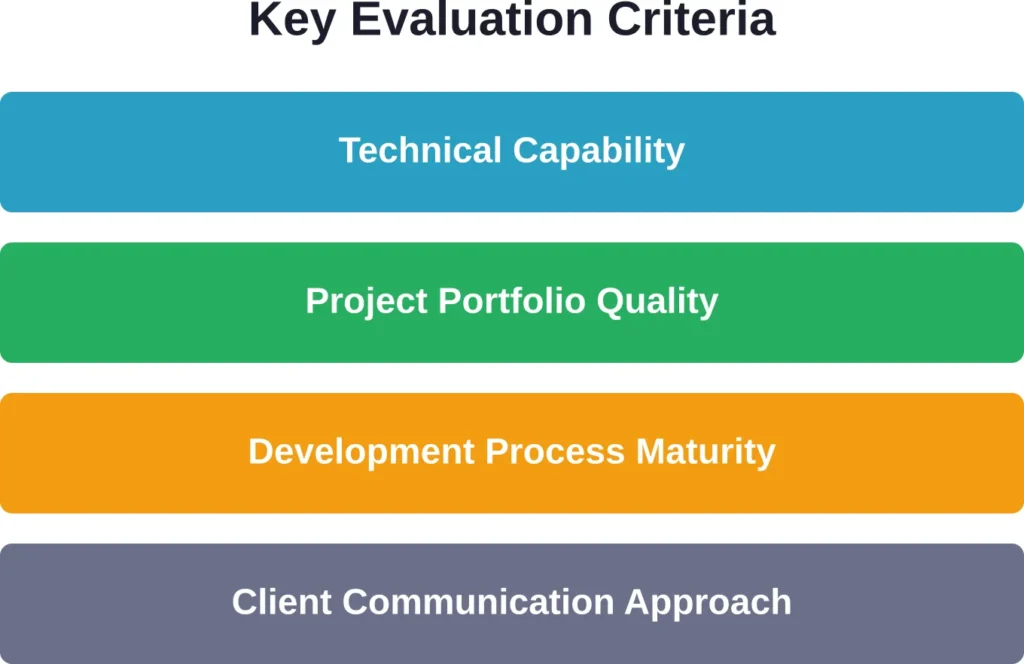
Technical capability encompasses framework expertise, testing practices, code quality standards, and architectural decision-making. We looked for companies that contribute to open source, maintain internal standards documentation, and demonstrate understanding of Rails best practices.
Project portfolio quality reveals more than case study marketing copy. We evaluated actual shipped applications, code samples where available, and the complexity of problems solved. Building a basic CRUD application differs substantially from architecting a multi-tenant SaaS platform or modernizing a legacy Rails 4 codebase to Rails 7.
Development process maturity shows up in how agencies handle specifications, manage sprints, conduct code reviews, deploy applications, and respond to production issues. Mature processes reduce surprises and keep projects on track.
Client communication matters more than many businesses realize during vendor selection. Clear technical communication, realistic timeline estimation, and proactive problem identification separate agencies that deliver successful projects from those that don’t.
We also considered specializations—some agencies excel at specific industries or application types. A company outstanding at building healthcare applications might not suit a fintech startup, and vice versa.
What Separates Great Rails Companies From Average Ones
Technical capability with Ruby on Rails represents table stakes. Every agency on this list writes competent Rails code. What separates truly excellent agencies from merely capable ones?
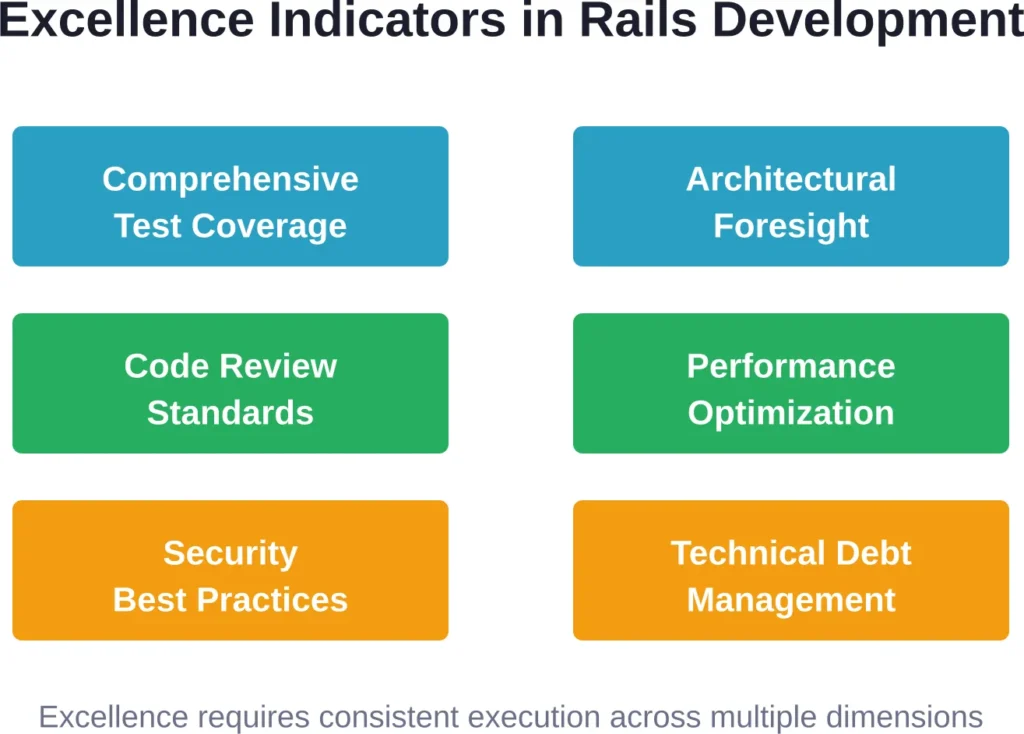
Testing philosophy reveals much about an agency’s development maturity. Great Rails companies maintain comprehensive test suites with fast execution times. They write tests that document behavior, catch regressions, and enable confident refactoring. Average agencies treat testing as a checkbox exercise, writing minimal tests that provide false confidence.
Architectural foresight means making decisions that serve immediate needs without constraining future evolution. Excellent agencies anticipate how applications might need to change and structure code accordingly. They avoid premature optimization while building flexibility where it matters.
Code review practices separate teams that ship quality code from those that accumulate technical debt. Strong agencies maintain documented standards, conduct thorough reviews, and treat code quality as non-negotiable. Weak agencies rubber-stamp reviews or skip them entirely when deadlines approach.
Performance optimization matters once applications scale. Great agencies profile performance early, optimize database queries, implement appropriate caching, and monitor production performance. They understand Rails performance characteristics and know when optimization provides real value versus premature optimization waste.
Security practices require ongoing attention. Excellent agencies follow OWASP guidelines, keep dependencies updated, implement proper authentication and authorization, and conduct security reviews. They understand common Rails vulnerabilities and build applications that resist them by default.
Technical debt management separates sustainable projects from those that become unmaintainable. Great agencies recognize when shortcuts make sense, document them, and create plans to address them. They communicate technical debt honestly rather than hiding it until projects grind to a halt.
Key Services Top Ruby Development Companies Provide
Ruby on Rails agencies typically offer a range of services beyond basic web development. Understanding these service categories helps businesses identify agencies matching their specific needs.
| Service Category | What It Includes | Best For |
|---|---|---|
| Custom Application Development | Building Rails applications from scratch, including architecture, development, testing, and deployment | Businesses launching new products or replacing existing systems |
| API Development | Creating RESTful or GraphQL APIs using Rails, often serving mobile apps or third-party integrations | Mobile-first products or platforms requiring extensive integration |
| MVP Development | Rapid development of minimum viable products for market validation | Startups testing product-market fit or businesses exploring new initiatives |
| Legacy Modernization | Upgrading Rails versions, refactoring code, improving performance, and addressing technical debt | Organizations with existing Rails apps requiring updates or optimization |
| Staff Augmentation | Providing Rails developers who work alongside internal teams | Businesses needing temporary capacity or specialized expertise |
| Code Audits | Reviewing existing codebases for quality, security, performance, and maintainability issues | Organizations assessing acquired applications or planning modernization |
Custom application development represents the core service most agencies provide. These engagements typically involve product discovery, design, development, testing, and deployment of complete Rails applications. Agencies handle everything from database design to front-end implementation.
API development has become increasingly important as mobile applications and service integrations proliferate. Many businesses need Rails backends serving mobile apps, third-party integrations, or single-page applications. Strong API design requires different considerations than traditional server-rendered Rails applications.
MVP development specializes in building minimum viable products quickly. Agencies offering this service excel at identifying core features, cutting scope ruthlessly, and shipping working software in weeks rather than months. That speed requires strong product judgment alongside technical capability.
Legacy modernization addresses the reality that many Rails applications need updating. Framework versions advance, dependencies become outdated, and performance degrades. Specialized agencies help businesses upgrade Rails versions, refactor problematic code, and modernize deployment practices without starting from scratch.
Staff augmentation provides developers who join client teams temporarily. This model suits businesses needing specific expertise for defined periods or wanting to scale development capacity without hiring full-time employees. Quality varies significantly across agencies offering augmentation services.
Code audits assess application health without committing to full development engagements. Agencies review code quality, identify security vulnerabilities, assess performance bottlenecks, and provide recommendations. These audits help businesses make informed decisions about whether to maintain, modernize, or replace existing applications.
How to Choose the Right Rails Development Partner
Selecting a Ruby on Rails development company requires evaluating factors beyond technical capability. The right partner depends on project context, business needs, and organizational preferences.
Start by clarifying project requirements. Do you need a complete product development partner handling design through deployment? Or do you need specialized Rails developers augmenting an existing team? Different agencies excel at different engagement models.
Evaluate technical fit by reviewing portfolios and case studies. Look for projects similar to yours in complexity, industry, or technical requirements. An agency that built successful SaaS platforms demonstrates different capabilities than one specializing in content management systems.
Ask about development processes and practices. How do they handle requirements gathering? What testing practices do they follow? How do they manage deployments? How do they handle production issues? Process maturity often predicts project success better than pure technical skill.
Consider team composition and continuity. Will you work with the same developers throughout the project? How does the agency handle knowledge transfer if developers change? Consistent teams generally produce better outcomes than constantly rotating staff.
Communication style matters more than many businesses realize during vendor selection. Schedule calls with potential agencies and evaluate how clearly they communicate technical concepts, whether they ask insightful questions about requirements, and how they handle ambiguity.
Geographic considerations affect collaboration effectiveness. Agencies in similar time zones enable synchronous communication and easier meeting scheduling. However, distributed teams have become more effective as remote collaboration practices matured.
Budget alignment requires honest conversation. Be clear about budget constraints upfront and evaluate whether agencies can deliver meaningful value within those constraints. Agencies accustomed to enterprise budgets might not suit bootstrapped startups, and vice versa.
Check references and reviews, but dig deeper than surface-level ratings. Contact references directly and ask specific questions about communication, problem handling, and post-launch support. Generic positive reviews provide less insight than specific examples of how agencies handled challenges.
Ruby on Rails Development Cost Considerations
Understanding Ruby on Rails development costs helps businesses budget appropriately and evaluate agency proposals realistically. However, note that this guide intentionally excludes specific pricing—rate information quickly becomes outdated.
Rails development costs vary based on agency location, experience level, project complexity, and engagement model. Developers in North America and Western Europe generally command higher rates than those in Eastern Europe, Latin America, or Asia. Quality doesn’t correlate perfectly with geography—excellent developers exist everywhere.
Project complexity significantly impacts total cost. Building a straightforward MVP with standard features costs substantially less than architecting a complex multi-tenant platform with sophisticated integrations. Realistic cost estimation requires detailed requirements definition.
Engagement model affects pricing structure. Fixed-price projects provide cost certainty but require comprehensive upfront specification and reduce flexibility. Time-and-materials engagements offer more flexibility but less cost predictability. Retainer arrangements suit ongoing maintenance and enhancement work.
Hidden costs often surprise businesses new to custom software development. Beyond development itself, consider costs for project management, quality assurance, DevOps and deployment, third-party services, ongoing maintenance, and eventual enhancements.
Technical debt accumulation represents a hidden cost that manifests later. Cheap development that cuts corners on testing, code quality, or architecture creates mounting maintenance costs and constraints on future development. Quality development costs more initially but reduces long-term total cost of ownership.
For current rate information, consult directly with agencies rather than relying on published figures. Development rates change, and agencies adjust pricing based on project specifics, engagement length, and team composition.
The Future of Ruby on Rails Development
Ruby on Rails continues evolving to address modern web development needs while maintaining the convention-over-configuration philosophy that made it successful.
Recent Rails versions incorporate significant front-end innovations. Hotwire (combining Turbo and Stimulus) enables interactive, SPA-like experiences without complex JavaScript frameworks. Import maps simplify JavaScript management without requiring build tools. These additions modernize Rails for current web application expectations.
Rails handling of modern deployment infrastructure has matured. The framework works seamlessly with Docker, Kubernetes, and cloud platforms. Rails applications deploy easily to containerized environments and scale horizontally when needed.
The framework’s approach to background jobs and real-time features continues improving. Active Job provides framework-level abstraction for background processing. Action Cable enables WebSocket functionality. Recent performance improvements make these features more practical at scale.
Rails adoption shows interesting patterns. While not the explosive growth framework of 2026, Rails maintains steady usage among businesses valuing developer productivity and maintainability. The framework particularly appeals to bootstrapped startups and product companies where sustainable development velocity matters more than resume-driven development.
The Rails community remains active and engaged. Regular releases address performance, security, and functionality. The gem ecosystem provides mature solutions for common problems. Conference attendance and community activity indicate a healthy, if more mature, ecosystem.
Competition from newer frameworks hasn’t displaced Rails for its core use cases. Node.js, Go, Elixir, and other options excel at specific scenarios but haven’t proven Rails obsolete for the typical web application. Rails remains highly relevant for businesses needing proven, productive web development frameworks.
Common Mistakes When Hiring Ruby Development Companies
Businesses frequently make predictable mistakes when selecting Rails development partners. Avoiding these pitfalls improves project outcomes significantly.
Selecting based solely on cost represents the most common mistake. The cheapest agency rarely delivers the best value. Low rates often indicate inexperienced developers, poor practices, or unrealistic estimates that balloon during development. Evaluate value, not just price.
Failing to verify expertise wastes time and money. Some agencies claim Rails expertise but lack depth. Review portfolios carefully, examine code samples if possible, and ask specific technical questions during evaluation. Generic web development companies might list Rails among twenty technologies without true specialization.
Neglecting process evaluation causes mid-project friction. Agencies with immature processes produce unpredictable results regardless of developer skill. Ask how agencies handle requirements changes, manage technical decisions, and respond to production issues.
Underspecifying requirements leads to misaligned expectations. Vague requirements produce results that technically meet specifications while missing business intent. Invest time defining requirements clearly or work with agencies that excel at collaborative requirements definition.
Ignoring cultural fit creates communication challenges. Some agencies prefer detailed specifications and minimal interaction. Others excel at collaborative development with frequent communication. Neither approach is inherently better, but misalignment creates friction.
Skipping reference checks eliminates valuable insight. Agencies naturally present their best work in portfolios. References provide perspective on how agencies handle challenges, communicate problems, and support clients post-launch.
Expecting unrealistic timelines sets projects up for failure. Quality software development takes time. Agencies promising implausibly fast delivery often cut corners on testing, code quality, or proper architecture. Realistic timeline expectations enable quality work.
Frequently Asked Questions
Prioritize agencies demonstrating deep Rails expertise through portfolios, open-source contributions, and case studies relevant to your industry. Evaluate their development processes, including testing practices, code review standards, and deployment approaches. Strong communication, realistic timeline estimation, and proactive problem identification separate excellent agencies from average ones. Consider team continuity, geographic compatibility, and whether they’ve solved problems similar to yours.
Timeline varies dramatically based on scope and complexity. Simple MVPs with standard features might launch in 8-12 weeks. Complex applications requiring sophisticated business logic, integrations, or custom features typically require 4-6 months or longer. Discovery and design phases add 2-6 weeks before development begins. Realistic timeline estimation requires detailed requirements definition. Agencies promising implausibly fast delivery often cut corners that create long-term problems.
Rails remains highly relevant for the vast majority of web applications businesses need to build. The framework excels at developer productivity, maintainability, and sustainable development velocity. Major companies including GitHub, Shopify, and Basecamp continue running on Rails. Recent framework versions incorporate modern approaches to front-end development, deployment, and scalability. While not the newest framework available, Rails offers proven stability and mature tooling that newer alternatives lack.
Specialized Rails agencies generally deliver better outcomes for Rails projects. Deep framework expertise enables better architectural decisions, cleaner implementations, and more efficient problem-solving. General agencies listing Rails among many technologies often lack the depth required for complex applications. However, if your project requires extensive work in other technologies beyond Rails, a full-stack agency might make sense. Evaluate actual Rails portfolio work rather than generic technology lists.
Staff augmentation provides developers who join your existing team temporarily, working under your project management and following your processes. This model suits businesses with internal development leadership needing additional capacity or specialized expertise. Full project development means the agency handles the entire project—requirements, design, development, testing, and deployment—delivering a complete solution. This model suits businesses without internal development teams or those wanting comprehensive external expertise.
Request code samples or GitHub repositories demonstrating their work. Review for clear naming, appropriate comments, comprehensive test coverage, and proper separation of concerns. Ask about testing practices, code review processes, and quality standards. Consider conducting a technical interview where their developers discuss architectural decisions and trade-offs. Some businesses hire independent Rails experts to review samples or proposals before committing to an agency.
Ongoing costs include hosting infrastructure, third-party service subscriptions, security updates and dependency maintenance, bug fixes and minor enhancements, monitoring and performance optimization, and eventual major feature additions. Many agencies offer retainer-based maintenance services covering routine updates and small changes. Budget at least 15-20% of initial development cost annually for maintenance, with more required for active feature development.
Making Your Decision
Selecting a Ruby on Rails development company represents a significant business decision. The right partner accelerates product development, delivers maintainable code, and becomes a trusted advisor for technical decisions. The wrong partner creates technical debt, missed deadlines, and frustration.
Start by clarifying your specific needs. What problem are you solving? Who are your users? What makes your application unique? Clear requirements enable better agency evaluation and more accurate proposals.
Evaluate multiple agencies across the dimensions discussed throughout this guide—technical capability, process maturity, communication style, and portfolio relevance. Don’t rush the decision. Investing time in thorough evaluation prevents much larger problems later.
Remember that hourly rate represents only one factor in total value. An expensive agency that delivers clean, maintainable code on schedule often costs less in the long run than a cheap agency producing buggy, unmaintainable code that requires eventual replacement.
Trust matters in development partnerships. You’re entrusting these developers with your product, your users’ data, and potentially your business success. Choose an agency that communicates clearly, sets realistic expectations, and demonstrates integrity in how they approach work.
The 15 agencies profiled here represent strong starting points for your evaluation. Each brings different strengths, specializations, and approaches. The best choice depends entirely on your specific situation, requirements, and preferences.
Ready to move forward with your Rails project? Define your requirements clearly, reach out to agencies that match your needs, and have detailed conversations about how they’d approach your specific challenges. The right development partner is out there—thorough evaluation helps you find them.