

Quick Summary: The best GDPR compliance companies in 2026 combine technical expertise with privacy law knowledge to help organisations meet EU data protection standards. This guide profiles 15 leading agencies—from specialist consultancies to global advisory firms—that deliver data mapping, risk assessment, breach response, and ongoing compliance support without disclosing pricing details.
GDPR compliance isn’t something most businesses can ignore anymore. Whether processing customer data from EU residents or handling cross-border transfers, the stakes are high. Administrative fines can reach €20 million or 4% of annual global turnover—whichever is higher.
But here’s the thing: compliance isn’t just about avoiding penalties. It’s about building trust, streamlining data governance, and creating defensible processes that hold up under audit.
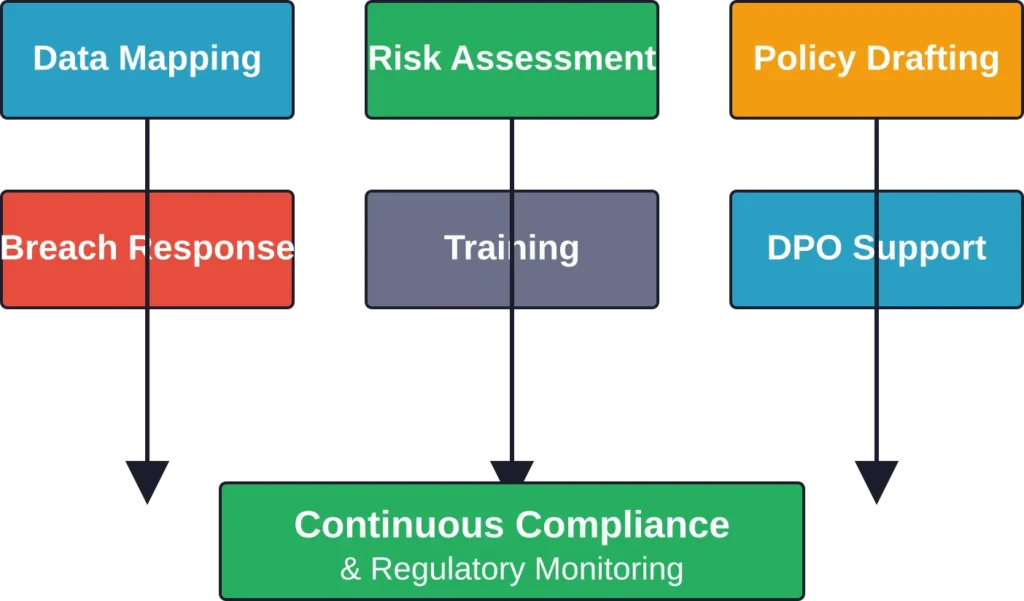
That’s where specialist agencies come in. The right GDPR compliance company brings a mix of legal knowledge, technical implementation skills, and hands-on experience with supervisory authorities. They handle the heavy lifting—data mapping, risk assessments, policy drafting, breach protocols—so internal teams can focus on core business.
This guide profiles 15 of the most capable GDPR compliance agencies operating in 2026. Some focus exclusively on privacy; others offer broader cybersecurity or risk advisory. All have proven track records helping organisations navigate the complexities of the General Data Protection Regulation.
Why Businesses Turn to GDPR Compliance Agencies
GDPR touches nearly every department in an organisation. Marketing collects consent. IT secures personal data. Legal drafts policies. HR manages employee records. Finance handles invoices with billing addresses. The regulation demands that all these functions align around accountability and privacy by design.
For many organisations, that coordination is easier said than done. Internal teams may lack the specialised knowledge required to interpret GDPR’s 99 articles correctly. And even when the legal reading is clear, translating requirements into technical controls and operational procedures takes time and expertise.
Professional GDPR consultancies bridge that gap. They bring frameworks, templates, and methodologies refined across dozens or hundreds of client engagements. They know which documentation supervisory authorities expect during audits. They understand how to map data flows across complex tech stacks. And they can implement solutions—like consent management platforms or breach notification workflows—that meet regulatory standards without disrupting business operations.
According to the European Data Protection Board’s Accountability Tools guidance, the principle of accountability under GDPR requires organisations to put in place appropriate technical and organisational measures not only to ensure that the processing is compliant, but also to be able to demonstrate this, which translates into documenting data protection practices and choices. Compliance tools such as codes of conduct, certification mechanisms, and binding corporate rules help demonstrate that commitment. Many agencies specialise in these accountability frameworks, offering templates and audit support that reduce the burden on internal compliance teams.
Core Services GDPR Compliance Companies Provide
While every agency has its own specialisation, most GDPR consultancies offer a recognisable core set of services. Here’s what to expect.
Data Mapping and Inventory
Effective GDPR compliance starts with knowing what personal data the organisation holds, where it’s stored, how it moves, and who has access. Data mapping exercises document these flows in a structured inventory—often called a Record of Processing Activities (ROPA) under Article 30.
Agencies conduct workshops with business units, review system architectures, and trace data from collection points through storage, processing, and deletion. The result is a visual or tabular map that forms the foundation for risk assessments and policy decisions.
Risk Assessment and Gap Analysis
Once data flows are mapped, consultancies assess compliance gaps against GDPR requirements. This typically includes evaluating legal bases for processing, consent mechanisms, data subject rights workflows, security controls, and vendor contracts.
Many firms reference international standards like ISO 27001:2022, CIS Controls v8.1, and NIST CSF 2.0 when conducting risk assessments, as noted in guidance from the European Data Protection Board. These frameworks provide structured ways to evaluate information security postures and align them with GDPR’s accountability principle.
Policy and Documentation Development
GDPR mandates clear, accessible privacy notices and internal policies that govern data handling. Compliance agencies draft these documents in plain language that meets transparency requirements while remaining legally defensible.
Common deliverables include privacy policies, cookie notices, data retention schedules, data processing agreements (DPAs) for vendors, and internal procedures for handling data subject access requests (DSARs).
Breach Response Planning
Under Articles 33 and 34, organisations must notify supervisory authorities of certain data breaches within 72 hours and inform affected individuals when the breach poses a high risk to their rights and freedoms. A breach notification service helps organisations detect incidents, assess severity, and execute timely, compliant notifications.
Agencies often set up incident response playbooks, train internal teams on breach protocols, and provide 24/7 support to coordinate notifications when incidents occur.
Training and Awareness
GDPR compliance depends on employees understanding their responsibilities. Consultancies deliver training sessions tailored to different roles—developers learn privacy by design, marketing learns consent requirements, customer service learns how to handle DSARs.
Some agencies provide e-learning modules and ongoing awareness campaigns to keep compliance front-of-mind across the organisation.
Ongoing Advisory and DPO Support
Article 37 requires certain organisations to appoint a Data Protection Officer (DPO). Many businesses lack the in-house expertise to fill this role internally, so they engage consultancies to provide an outsourced or virtual DPO.
These advisors serve as the point of contact with supervisory authorities, monitor compliance, advise on data protection impact assessments (DPIAs), and keep leadership informed of regulatory changes.
Top 15 GDPR Compliance Companies in 2026
The following agencies represent a range of approaches—from boutique privacy specialists to Big Four advisory practices. Each brings distinct strengths, industry focus, and geographic reach.
1. Mobian Studio

Mobian Studio is a European software development partner specialising in mobile and AI solutions with built-in regulatory compliance for GDPR environments. The studio builds dedicated engineering teams that deliver production-ready software while addressing data protection requirements from the earliest stages of development.
Their services include end-to-end product development, AI & automation systems, scalable architecture, legacy integration, and full-stack delivery for mobile (iOS, Android, Flutter), backend, APIs, and cloud infrastructure. Mobian emphasises clean architecture, secure data flows, consent mechanisms, and domain expertise in healthcare, fintech, and logistics — industries where GDPR compliance is critical.
For companies that need senior-level execution without compromising on data protection, Mobian offers both outsourcing (full delivery) and outstaffing (embedded engineers) models. Clients benefit from documented code, post-launch support, and systems designed to scale securely while meeting EU privacy obligations.
Contact Information:
- Website: mobian.studio
- Phone: [email protected]
- Address: Harju maakond, Tallinn, Kesklinnalinnaosa, Masina tn 22, 10113
- LinkedIn: www.linkedin.com/company/mobian-studio
2. Lengreo

Lengreo serves as a complete B2B marketing and tech partner that integrates GDPR compliance directly into digital strategies, websites, and lead generation campaigns. The agency helps organisations embed privacy-by-design principles across their online presence while achieving strong business growth.
Lengreo specialises in GDPR-compliant lead generation, consent-focused advertising, secure data handling in outreach, and privacy-safe content strategies. Their services cover marketing audits with privacy checks, SEO respecting data protection rules, hyper-personalised outreach, and website development built with regulatory alignment in mind.
Particularly well-suited for software development companies, architecture & design firms, event technology, sports tech, and IT services processing EU personal data, Lengreo delivers practical solutions that minimise compliance risk while boosting client acquisition and conversion rates. Clients praise their initiative, dedication, and ability to deliver high-quality, regulation-aware results.
Contact Information:
- Website: Lengreo.com
- Phone: +31 686 147 566
- Email: hi@lengreo.com
- Address: Vrijstraat 9 C/D, 5611 AT Eindhoven, Netherlands
- LinkedIn: Lengreo
- Twitter: @Lengreo
- Instagram: @lengreo
3. Gilzor

Gilzor is a custom software development partner that builds GDPR-aligned digital products from idea validation to ongoing maintenance. The company embeds privacy and security considerations throughout the entire development lifecycle.
Their services include secure mobile and web applications, UI/UX design with privacy focus, quality assurance for data protection, technology architecture consulting, and go-to-market strategies that support compliant data handling. Gilzor also provides idea validation, business analysis, and support & maintenance with strong emphasis on data minimisation and secure processing.
Ideal for startups, SMBs, and product companies in airlines, e-commerce, wellness, and other sectors needing robust applications that meet EU data protection standards, Gilzor delivers high-quality solutions with excellent recurring client partnerships thanks to reliable, privacy-conscious delivery.
Contact Information:
- Website: www.gilzor.com
- Email: [email protected]
- Address: Poland, Warsaw, Office 58, street Adama Mickiewicza 37, 01-625
- LinkedIn: www.linkedin.com/company/gilzor-softwaredevelopment
4. Oski

Oski delivers well-engineered software solutions with a strong emphasis on security, scalability, and compliance for tech-forward enterprises and ambitious startups. Their development practices support GDPR requirements through privacy-enhancing architectures and secure data management.
The firm offers cloud solutions (serverless, hybrid, multi-cloud), frontend frameworks, artificial intelligence integrations, and CMS platforms built with data protection best practices. Oski serves industries such as fintech, insurance, e-commerce, and logistics, where proper handling of personal data is essential.
Clients benefit from AI-accelerated engineering that maintains compliance standards, rapid team deployment, and solutions designed for regulated environments. Oski helps organisations modernise operations while ensuring robust protection of personal information and alignment with international privacy expectations.
Contact Information:
- Website: oski.site
- Phone: +48571282759
- Email: [email protected]
- Address: Kaupmehe tn 7, 10114 Tallinn, Estonia
- LinkedIn: www.linkedin.com/company/oski-solutions
5. A-listware

A-listware is a software development and IT consulting company providing skilled teams and solutions that prioritise security, quality, and regulatory compatibility. With deep experience in managed development, they support clients in building and maintaining GDPR-compliant digital ecosystems.
Their offerings include software development outsourcing, team augmentation, UX/UI design, testing & QA with security focus, data analytics, infrastructure services, and cybersecurity measures. A-listware delivers custom applications, cloud solutions, enterprise systems, ERP/CRM, and more — all designed for secure data processing and compliance.
Well-suited for enterprises, SMBs, and startups requiring dedicated or extended teams, A-listware ensures seamless integration, expert access, and consistent high-quality delivery that aligns with data protection requirements across multiple industries.
Contact Information:
- Website: a-listware.com
- Phone: +1 (888) 337 93 73
- Email: [email protected]
- Address: North Bergen, NJ 07047, USA
- LinkedIn: www.linkedin.com/company/a-listware
- Facebook: www.facebook.com/alistware
6. VeraSafe

VeraSafe serves as a GDPR representative for non-EU companies that process personal data of EU residents. Article 27 requires such organisations to appoint a representative in the European Union to act as a point of contact for supervisory authorities and data subjects.
VeraSafe handles this requirement as a service, managing communications with regulators, fielding data subject requests on behalf of clients, and ensuring timely responses. The firm also offers privacy policy generation, cookie consent solutions, and ongoing advisory.
For US-based SaaS companies, e-commerce platforms, and digital services targeting European customers, VeraSafe provides a turnkey solution for GDPR representation without needing to establish a legal entity or office in the EU.
7. TechGDPR
TechGDPR positions itself at the intersection of technology and privacy law. The firm’s consultants are often former developers or IT architects who understand data flows at a technical level, making them particularly effective for software companies, cloud service providers, and technology platforms.
TechGDPR’s services include privacy-by-design consulting, API security reviews for personal data handling, and technical documentation for data processing activities. The firm also supports clients through audits by supervisory authorities, translating technical architectures into compliance narratives that satisfy regulatory scrutiny.
Client feedback emphasises TechGDPR’s ability to speak both languages—technical and legal—bridging the gap between engineering teams and compliance officers.
8. Crowe

Crowe is a global public accounting and consulting firm with a robust risk and compliance advisory practice. The firm’s GDPR services integrate with broader enterprise risk management and internal audit functions, making Crowe a natural fit for organisations with mature governance structures.
Crowe’s approach includes control testing, compliance monitoring, and continuous improvement programs that evolve as regulations and business operations change. The firm also offers co-sourcing models, where Crowe advisors work alongside internal compliance teams rather than replacing them.
For organisations in regulated industries like financial services, insurance, and healthcare, Crowe’s experience with frameworks like SOC 2, HIPAA, and SOX creates synergies that streamline multi-regulatory compliance efforts.
9. Infosys

Infosys brings a technology-first approach to GDPR compliance, leveraging the firm’s strengths in application development, cloud migration, and data engineering. Infosys builds and integrates the technical infrastructure needed for compliance—consent management systems, data masking tools, automated DSAR workflows, and breach detection platforms.
The firm’s global delivery model allows it to staff projects with distributed teams, reducing costs while maintaining quality. Infosys is particularly well-suited to large-scale data transformation initiatives where GDPR compliance is one component of a broader digital modernisation effort.
Infosys also offers managed services, where the firm operates compliance technology on an ongoing basis, handling updates, monitoring, and incident response as part of a long-term engagement.
10. RSI Security

RSI Security combines information security consulting with privacy compliance services. The firm conducts GDPR readiness assessments, penetration testing, and security awareness training, creating a holistic view of an organisation’s data protection posture.
RSI’s methodology emphasises the overlap between cybersecurity and privacy—recognising that effective GDPR compliance depends on strong technical safeguards as much as legal documentation. The firm helps clients implement encryption, access controls, and logging mechanisms that meet both security best practices and GDPR’s data protection by design principle.
RSI Security’s client base spans healthcare, finance, education, and government, with particular strength in sectors that face overlapping regulatory requirements like HIPAA and GDPR for healthcare providers serving international patients.
11. Foresite Cybersecurity

Founded in 1997 and headquartered in Kansas, United States, Foresite Cybersecurity offers comprehensive compliance services with GDPR accounting for roughly 10% of their practice focus. The firm blends cybersecurity consulting with regulatory compliance, making them a strong fit for organisations that need both technical security assessments and privacy programme development.
Foresite conducts penetration testing, vulnerability assessments, and security architecture reviews alongside GDPR gap analyses and documentation support. Their approach is particularly well-suited to mid-market companies in healthcare, financial services, and manufacturing that process EU personal data as part of broader operations.
Client reviews on Clutch highlight Foresite’s ability to simplify complex requirements and deliver actionable roadmaps. The firm’s longevity—nearly three decades in business—speaks to stability and deep expertise in evolving compliance landscapes.
12. Truvantis, Inc.

Truvantis holds a rare combination of certifications, including PCI DSS Level 1 QSA (Qualified Security Assessor) status, which positions them well for organisations that need to align payment card security with GDPR data protection requirements. Based on reviews compiled by Best Data Privacy Consultants, Truvantis ranks highly for reducing compliance task time—clients report efficiency gains and compliance task time reductions of up to 30%.
The firm specialises in penetration testing and privacy audits, offering clients third-party validation that strengthens both security postures and regulatory defences. Truvantis also provides TrustE certifications and global privacy benchmark reports, which can enhance market reputation and customer trust.
For organisations operating in e-commerce or payment processing, Truvantis offers a one-stop shop for PCI and GDPR alignment, reducing the need to coordinate multiple vendors.
13. Deloitte

As one of the Big Four professional services firms, Deloitte brings global reach, deep regulatory relationships, and multidisciplinary teams that span legal, technology, and risk advisory. Deloitte’s GDPR practice covers everything from initial compliance assessments to complex cross-border data transfer solutions and litigation support.
The firm’s scale allows it to handle large, multinational implementations—think global enterprises with operations across dozens of jurisdictions. Deloitte can staff projects with local privacy experts in each market, ensuring compliance with both GDPR and country-specific data protection laws.
Deloitte also offers proprietary technology platforms for consent management, data subject rights automation, and ongoing compliance monitoring. For organisations with the budget and complexity to justify a Big Four engagement, Deloitte delivers institutional credibility and end-to-end support.
14. RSM

RSM is a global audit, tax, and consulting network with a strong middle-market focus. The firm’s GDPR services emphasise practical, scalable solutions for organisations that may not have the resources or complexity of Fortune 500 companies but still face meaningful compliance obligations.
RSM’s privacy consultants work closely with internal audit and risk teams to integrate GDPR into existing governance frameworks. The firm also supports clients through ISO 27001 and ISO 27701 certifications—international standards for information security and privacy management systems. ISO 27701:2025, published in October 2025 as Edition 2, provides a structured framework for managing personal data responsibly and aligning with GDPR requirements, as noted by the International Organization for Standardization.
RSM’s regional presence across Europe, the Americas, and Asia-Pacific makes them a solid choice for businesses expanding internationally or managing distributed operations.
15. DPO Consulting
DPO Consulting focuses exclusively on data protection officer services and privacy programme management. The firm provides outsourced DPO coverage for organisations that fall under GDPR’s Article 37 appointment requirements but lack the internal expertise or headcount to hire a full-time officer.
Beyond DPO services, the firm offers DPIA facilitation, vendor risk assessments, and privacy impact reviews for new product launches. DPO Consulting’s narrow specialisation means clients get advisors who live and breathe GDPR every day, rather than generalists juggling multiple practice areas.
The firm’s lean model also appeals to startups and scale-ups that need expert guidance without the overhead of a Big Four engagement. Reviews highlight responsiveness and clarity—clients appreciate that DPO Consulting translates legal jargon into operational steps teams can actually execute.
What to Look for When Choosing a GDPR Compliance Partner
Not every agency is right for every organisation. The following factors help narrow the field and identify the best fit.
Industry Experience
GDPR applies across sectors, but implementation details vary significantly. Healthcare providers face additional obligations under medical device regulations and cross-border patient data transfers. Financial institutions must align GDPR with anti-money laundering and KYC requirements. Retailers need robust consent management for marketing databases.
Look for agencies with demonstrated experience in your industry. Ask for case studies, client references, and examples of how they’ve solved problems specific to your sector.
Technical vs. Legal Depth
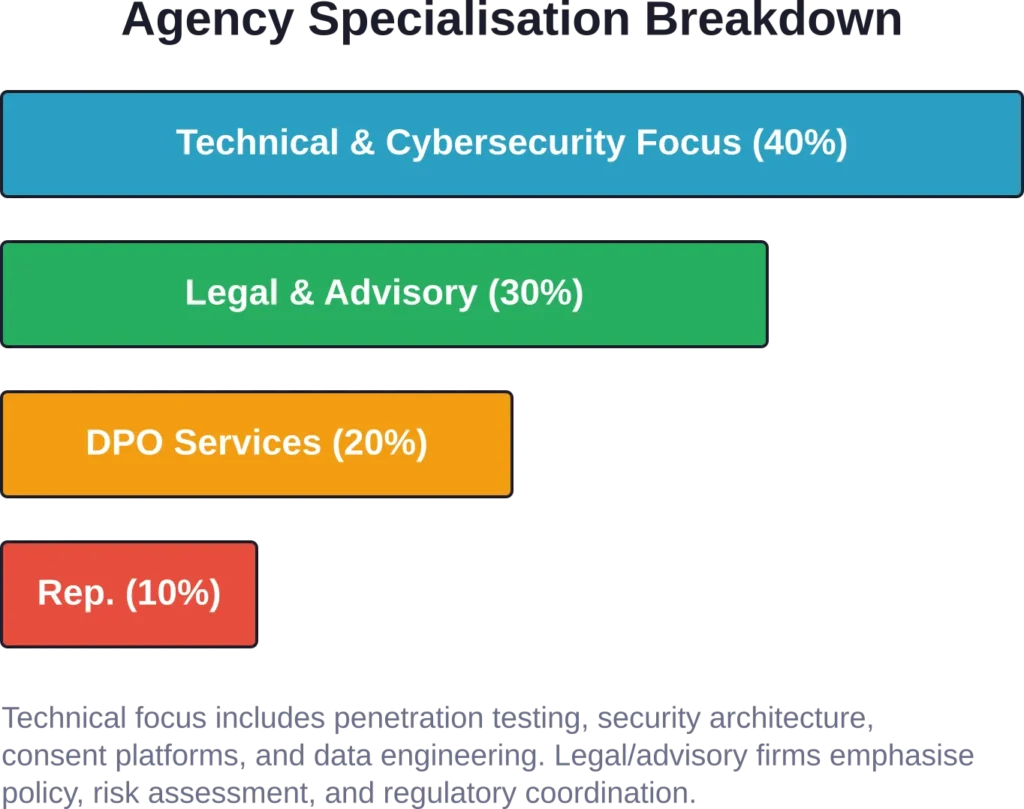
Some agencies lean heavily legal—former lawyers and policy experts who excel at drafting documentation and navigating regulatory relationships. Others are engineering-led, with consultants who can review code, configure security controls, and implement privacy-enhancing technologies.
The best choice depends on where your organisation’s gaps lie. If policies are solid but technical implementation lags, a tech-forward consultancy makes sense. If infrastructure is robust but documentation is thin, a legal-focused firm may be the better call.
Geographic Coverage
GDPR is an EU regulation, but enforcement varies by member state. German data protection authorities may interpret certain provisions differently than their French or Irish counterparts. If your organisation operates in multiple EU countries, an agency with local expertise in each market can navigate those nuances.
Global firms like Deloitte and RSM offer that breadth. Boutique agencies may focus on a single jurisdiction but deliver deeper local knowledge.
Engagement Models
Some agencies work project-based—conduct an initial assessment, deliver a roadmap, and hand off implementation to internal teams. Others offer ongoing retainers, acting as an extension of your compliance function.
Consider whether you need a one-time compliance sprint or continuous advisory. Many organisations start with a project engagement and transition to a retainer as they build internal capabilities.
Cultural Fit and Communication Style
Compliance projects touch sensitive topics—risk exposure, process gaps, cultural resistance to change. The agency you choose will interact with stakeholders across the business, from C-suite to frontline staff.
Assess communication style during initial meetings. Do consultants translate complexity into plain language? Do they listen and tailor recommendations, or push a one-size-fits-all methodology? Cultural alignment matters as much as technical credentials.
| Selection Factor | Why It Matters | Key Questions to Ask |
|---|---|---|
| Industry Experience | Implementation varies by sector | Can you share case studies from our industry? |
| Technical Depth | Bridges engineering and compliance | Do your consultants review code and architecture? |
| Legal Expertise | Interprets regulation accurately | What’s your team’s regulatory background? |
| Geographic Coverage | Navigates local enforcement nuances | Do you have local advisors in our markets? |
| Engagement Model | Aligns with internal capacity | Do you offer retainer or project-based work? |
| Communication Style | Drives stakeholder buy-in | How do you tailor messaging for non-legal audiences? |
Common Pitfalls When Engaging GDPR Consultancies
Even with the right agency, compliance projects can stumble. Here are the most common missteps and how to avoid them.
Treating Compliance as a One-Time Project
GDPR isn’t a checkbox exercise. Regulations evolve, business operations change, new systems get added, and supervisory authorities issue updated guidance. A one-and-done approach leaves organisations vulnerable as soon as circumstances shift.
Plan for continuous monitoring and periodic reassessments. Many agencies offer annual health checks or quarterly advisory calls to keep compliance current.
Overrelying on Templates Without Customisation
Templates and frameworks accelerate initial documentation, but they’re starting points, not final deliverables. Generic privacy policies that don’t reflect actual data flows won’t withstand regulatory scrutiny or provide meaningful transparency to data subjects.
Ensure the agency customises deliverables to your specific operations, systems, and risk profile. The EDPB is organising this public consultation to collect ideas on which templates would be most useful for organisations. Even official templates require adaptation.
Ignoring Cross-Functional Stakeholders
GDPR compliance depends on buy-in from IT, legal, marketing, product, HR, and operations. When agencies work in isolation with a single compliance owner, critical information gets missed and implementation stalls.
Insist on cross-functional workshops and stakeholder interviews as part of the engagement. The best agencies facilitate these conversations and help build internal coalitions around compliance.
Failing to Test Processes Before an Incident
Breach notification playbooks and DSAR workflows look good on paper. But if they’ve never been tested, gaps emerge during real incidents—when stakes are highest and time is shortest.
Run tabletop exercises and simulate breach scenarios. Test DSAR processes with internal requests. These drills surface friction points and give teams confidence before regulators or data subjects are involved.
How GDPR Compliance Drives Business Value Beyond Regulatory Obligations
Compliance often feels like a cost centre, but organisations that approach GDPR strategically unlock tangible benefits.
Competitive Differentiation
Privacy is a market differentiator. Consumers increasingly choose brands they trust with personal data. Certifications like ISO 27701, TrustE seals, and transparent privacy practices signal that an organisation takes data protection seriously.
Agencies that help secure these certifications and communicate privacy commitments effectively enable clients to turn compliance into a competitive advantage.
Operational Efficiency
Data mapping and inventory exercises reveal redundancy, shadow IT, and inefficient workflows. Cleaning up data estates reduces storage costs, simplifies security, and makes analytics more reliable.
Clients working with agencies like Truvantis report efficiency gains and compliance task time reductions of up to 30%, freeing internal resources for higher-value work.
Risk Mitigation Beyond Fines
GDPR fines grab headlines, but reputational damage and customer churn from breaches often cost more. Strong data protection practices reduce breach likelihood and limit impact when incidents occur.
Agencies that integrate security and privacy—like RSI Security and Foresite Cybersecurity—help organisations build defences that protect both regulatory standing and brand reputation.
Facilitation of Cross-Border Business
GDPR includes mechanisms for international data transfers—standard contractual clauses, binding corporate rules, adequacy decisions. On July 17, 2023, the European Commission issued an adequacy decision on the EU-U.S. Data Privacy Framework, which replaces the Privacy Shield programme and provides a mechanism for companies to transfer personal data from the EU to the United States in a privacy-protective way consistent with EU law.
Agencies with expertise in these transfer mechanisms enable clients to operate globally without sacrificing compliance or slowing business development.
Emerging Trends Shaping GDPR Compliance in 2026
The regulatory and technology landscape continues to evolve. Here’s what’s influencing GDPR compliance work in 2026.
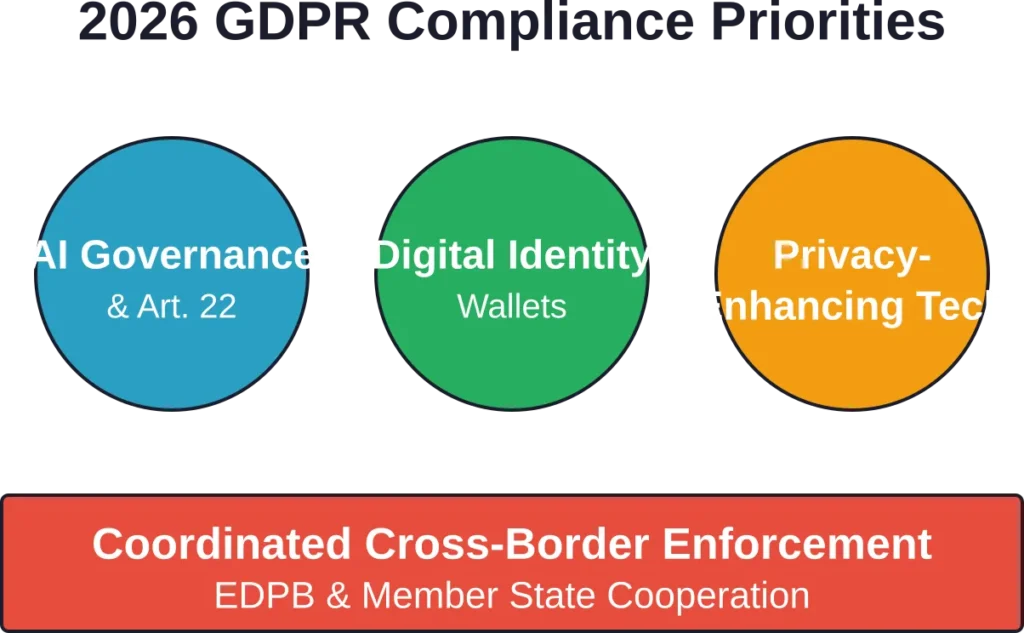
EU Digital Identity Wallets
The European Commission is advancing EU Digital Identity Wallets for service providers, transforming how organisations verify users. According to documentation from the European Commission last updated in February 2026, EU Digital Identity Wallets for service providers will transform how organisations verify users, making verification fast, secure and pain-free. As adoption grows, GDPR compliance agencies are helping clients integrate these identity solutions while ensuring privacy by design.
Artificial Intelligence and Automated Decision-Making
GDPR Article 22 restricts automated decision-making that produces legal or similarly significant effects. As AI adoption accelerates, organisations face new compliance challenges around algorithmic transparency, bias, and explainability.
Agencies are developing AI governance frameworks that align with both GDPR and emerging AI-specific regulations like the EU AI Act.
Increased Enforcement and Coordination Among Authorities
Supervisory authorities across EU member states are coordinating more closely through the European Data Protection Board. Cross-border enforcement actions are rising, and authorities are sharing intelligence on non-compliant practices.
Agencies with strong relationships with data protection authorities—like the Big Four firms and specialist consultancies—help clients navigate this heightened scrutiny.
Privacy-Enhancing Technologies
Technologies like differential privacy, homomorphic encryption, and federated learning allow organisations to extract insights from data while minimising privacy risks. Data masking is a set of privacy-enhancing techniques that replace personally identifiable information (PII) with realistic yet anonymized ‘masks’, protecting sensitive information and reducing the risk of interception or misuse, as outlined by the International Organization for Standardization.
Technical consultancies are helping clients implement these tools to reduce the volume of personal data in scope for GDPR while maintaining analytical capabilities.
Building Internal Capabilities Alongside External Expertise
Even the best consultancy can’t replace internal ownership of compliance. The most successful organisations use agencies to build internal capabilities, not create permanent dependencies.
Insist on knowledge transfer. Agencies should document methodologies, train internal teams, and create playbooks that employees can execute independently. Over time, external support should shift from hands-on implementation to periodic advisory and specialised support for complex issues.
Consider a phased approach: engage an agency for initial gap analysis and roadmap development, build internal capacity to execute routine tasks, then retain the agency for annual audits, regulatory updates, and incident response backup.
Frequently Asked Questions
GDPR compliance companies provide specialised advisory, technical, and operational support to help organisations meet the requirements of the General Data Protection Regulation. Services typically include data mapping and inventory, risk assessments, policy drafting, breach response planning, training, and ongoing compliance monitoring. Many firms also offer outsourced Data Protection Officer services or act as GDPR representatives for non-EU companies under Article 27.
Pricing varies widely based on firm size, expertise, and engagement scope. According to industry sources, consultants can be expensive, with freelancers charging $50 to $150 per hour and larger firms charging up to $500 per hour or more. Project-based fees depend on organisational complexity, data volumes, and the depth of services required. For precise pricing, organisations should request proposals from multiple agencies based on their specific needs.
Many organisations can handle GDPR compliance internally if they have sufficient legal, technical, and operational expertise. However, specialised agencies bring frameworks, experience across multiple implementations, and knowledge of supervisory authority expectations that can accelerate compliance and reduce risk. Smaller organisations or those without dedicated privacy staff often benefit most from external support. Larger enterprises may use agencies for initial assessments and complex issues while building internal capabilities over time.
A Data Protection Officer (DPO) is a role defined in GDPR Article 37, required for certain public authorities and organisations that process sensitive data at scale. The DPO monitors compliance, advises on data protection impact assessments, and serves as a point of contact with supervisory authorities. A GDPR consultant provides advisory services but may not serve the ongoing, embedded function of a DPO. Many consultancies offer outsourced or virtual DPO services, effectively filling the DPO role on a contract basis.
Timelines vary based on organisational size, existing governance maturity, and data complexity. Initial gap assessments typically take a few weeks. Building a full compliance programme—including data mapping, policy development, technical controls, training, and testing—can take several months to over a year for complex organisations. Compliance is also ongoing; regulations evolve and business operations change, requiring continuous monitoring and adaptation.
ISO 27701:2025 is the international standard for Privacy Information Management Systems and aligns closely with GDPR requirements. ISO 27001 covers information security management and often serves as a foundation for privacy programmes. Agencies with experience in these frameworks can guide organisations through certification. Other relevant frameworks include CIS Controls v8.1 and NIST CSF 2.0, which help structure risk assessments and security controls in ways that support GDPR accountability.
GDPR compliance does not eliminate the risk of breaches, but it does demonstrate accountability and reduces potential penalties. If a breach occurs, organisations must follow notification requirements under Articles 33 and 34, reporting to supervisory authorities within 72 hours when required. A well-prepared compliance programme—including breach response plans developed with an agency—enables faster, more effective incident response and shows regulators that appropriate safeguards were in place. Agencies often provide incident response support to guide organisations through notifications and remediation.
Final Thoughts
Choosing a GDPR compliance agency is a strategic decision that affects risk exposure, operational efficiency, and customer trust. The 15 firms profiled here represent a range of capabilities, from technical security specialists to legal advisory powerhouses to outsourced DPO providers.
The right partner depends on where your organisation sits today and where it needs to go. Assess gaps honestly. Prioritise industry experience and cultural fit alongside technical credentials. And remember that compliance is a journey, not a destination.
The best agencies help you build sustainable practices that evolve with regulations, technology, and business needs. They transfer knowledge, empower internal teams, and position compliance as a business enabler rather than a burden.
Start by mapping your current state and defining your compliance objectives. Then reach out to a shortlist of agencies that align with your needs. Request case studies, check references, and have candid conversations about methodology and engagement models.
GDPR compliance is complex, but with the right partner, it becomes manageable—and even a source of competitive advantage.