

Quick Summary: The top SaaS application development companies for 2026 include Lengreo, Gilzor, OSKI Solutions, A-listware, Mobian Studio, CONTUS Tech, eSparkBiz, Space-O Technologies, DICEUS, Agicent, Classic Informatics, LeewayHertz, Bacancy, Orases, and Flatirons. These agencies offer comprehensive cloud-native development, multi-tenant architecture, and AI integration capabilities. The global SaaS market equaled $247 billion in 2024 and is forecasted to reach $900 billion by the end of the decade and is projected to grow at 17.55% CAGR through 2031, driving demand for specialized development partners.
The SaaS industry isn’t slowing down. The global market hit $435.41 billion in 2026, and forecasts show it climbing to $976.61 billion by 2031. That’s a 17.55% compound annual growth rate driving massive opportunity across healthcare, fintech, e-commerce, and enterprise tools.
But here’s the thing—market growth doesn’t equal automatic success. Thousands of agencies claim SaaS expertise while most lack the architectural depth to deliver production-grade platforms. Security vulnerabilities, scaling failures, and abandoned MVPs litter the landscape.
The difference between a SaaS product that scales and one that collapses under its first thousand users comes down to the development partner chosen at the start. This guide cuts through marketing noise to identify the agencies that actually deliver.
The following 15 companies have demonstrated technical capability through completed projects, verifiable client outcomes, and specialized SaaS expertise spanning multi-tenancy, subscription billing, cloud infrastructure, and enterprise security.
Current State of the SaaS Market
Software-as-a-Service has moved beyond its experimental phase into the default operating model for modern business. What started as a cost-saving alternative to on-premise installations now powers everything from CRM platforms to AI-powered analytics.
The numbers tell the story. The global SaaS market equaled $247 billion in 2024 and is forecasted to reach $900 billion by the end of the decade, maintaining a 19% CAGR. Another data point shows the market at $435.41 billion in 2026, projected to hit $976.61 billion by 2031 with a 17.55% growth rate.
Vertical-specific SaaS represents a particularly strong growth area. Industry-focused solutions are expanding from roughly $133.5 billion in 2025 to a projected $194.0 billion by 2029. Domain-specific platforms addressing complex industry workflows show greater resilience than horizontal tools.
But explosive growth creates problems. Thousands of development firms now claim SaaS capabilities while most lack the engineering discipline to handle multi-tenant architecture, subscription logic, or enterprise-grade security at scale.
The market correction in early 2026 illustrated this tension. SaaS company valuations saw over $1 trillion in market capitalization erased in seven days as investors repositioned around AI agent innovation. The sell-off reflected concerns that AI threatens to replace traditional software workflows.
Why Partner With a SaaS Development Agency
Building SaaS internally sounds appealing until reality hits. Most organizations lack the specialized talent needed for cloud-native architecture, multi-tenant data isolation, subscription billing systems, and the security protocols required for handling customer data at scale.
Real talk: hiring for these skills takes months. Assembling a full team—backend engineers with distributed systems experience, frontend developers who understand responsive SaaS interfaces, DevOps specialists for CI/CD pipelines, security experts for compliance—typically requires 6-12 months and significant recruiting costs.
Experienced SaaS agencies bring pre-assembled teams with proven workflows. They’ve solved the hard problems already—database partitioning strategies, session management across devices, webhook architectures for third-party integrations, graceful degradation under load.
Speed matters in competitive markets. According to McKinsey research referenced in source material, companies that combine strong product management with technical execution show better outcomes Agencies accelerate time-to-market by 40-60% compared to building internal teams from scratch.
Here’s what specialized agencies provide:
- Architectural decisions based on dozens of previous implementations
- Pre-built components for authentication, billing, admin dashboards
- Established relationships with cloud infrastructure providers
- Security and compliance expertise across industries
- Post-launch optimization based on production experience
The economic case strengthens when considering risk. Internal teams built under time pressure often make architectural decisions that create technical debt requiring expensive rewrites. Agencies with SaaS-specific experience structure systems for long-term scalability from day one.
How These Companies Were Selected
This list wasn’t assembled from marketing claims or paid placements. The selection process evaluated companies against five specific criteria based on available industry data and completed project portfolios.
First, operational longevity. Companies needed verifiable experience spanning multiple years, demonstrating survival through market cycles and technology shifts. Agencies founded before 2020 showed greater stability.
Second, portfolio depth. Evaluation focused on completed SaaS projects with documented outcomes—not generic web development work rebranded as SaaS. Companies needed demonstrated experience with subscription platforms, multi-tenant architectures, and cloud-native deployment.
Third, client diversity. Strong agencies work across industries rather than relying on a single vertical. Healthcare, fintech, e-commerce, logistics, and enterprise tools all present unique challenges. Cross-industry experience indicates adaptable expertise.
Fourth, technology stack sophistication. Modern SaaS requires specific technical capabilities: containerization, microservices architecture, API-first design, automated testing, continuous deployment. Companies were assessed on their demonstrated use of current technologies rather than legacy approaches.
Fifth, verifiable third-party reviews. Platforms like Clutch, GoodFirms, and industry directories provide client feedback outside company control. Consistent high ratings across multiple review sources indicated reliable delivery.
All companies were evaluated independently against these criteria. The resulting list represents agencies with proven capability rather than the largest marketing budgets.
Top 15 SaaS Application Development Companies
The following agencies represent the strongest options for SaaS development in 2026. Each brings specialized capabilities, proven delivery records, and technical depth across cloud-native architecture.
1. Gilzor

Gilzor specializes in full-cycle custom software development, helping startups launch scalable digital products and enabling SMBs and product companies to build and grow SaaS platforms. The company delivers secure, high-performance web and mobile applications designed for real user needs and business growth.
Their SaaS expertise includes end-to-end development from idea validation and UI/UX design through architecture, coding, QA, and post-launch maintenance. Projects often feature scalable backends, intuitive interfaces, and integrations that support subscription models and user growth.
The team’s approach emphasizes user-centric design, early validation to reduce risk, robust quality assurance, and go-to-market support. This ensures products not only launch successfully but also evolve efficiently based on real feedback and metrics.
Gilzor serves startups building their first SaaS product, small and medium businesses adding digital channels, and product studios expanding their platforms across various industries including e-commerce, healthcare, and productivity tools.
Contact Information:
- Website: www.gilzor.com
- Email: [email protected]
- Address: Poland, Warsaw, Office 58, street Adama Mickiewicza 37, 01-625
- LinkedIn: www.linkedin.com/company/gilzor-softwaredevelopment
2. Oski
Oski builds smart, well-engineered software solutions for tech-forward enterprises and ambitious startups. The company focuses on designing, developing, deploying, and maintaining scalable digital platforms that drive business transformation.
Their SaaS expertise covers cloud-native architectures, frontend frameworks, artificial intelligence integrations, and robust content management systems. Solutions emphasize scalability, security, and seamless user experiences across web and mobile environments.
The team’s strength lies in AI-accelerated development, hybrid and multi-cloud strategies, and full-stack delivery that combines innovative design with reliable performance. This enables faster time-to-market while maintaining enterprise-grade quality.
Oski serves enterprises and growth-stage companies in industries such as fintech, e-commerce, logistics, education, travel, and insurance that require reliable SaaS platforms with advanced capabilities like personalization, automation, and real-time operations.
Contact Information:
- Website: oski.site
- Phone: +48571282759
- Email: [email protected]
- Address: Kaupmehe tn 7, 10114 Tallinn, Estonia
- LinkedIn: www.linkedin.com/company/oski-solutions
3. A-listware
A-listware delivers software development and consulting services focused on building high-quality, secure, and responsive digital solutions. The company excels at creating custom SaaS platforms and enterprise applications tailored to specific business requirements.
Their SaaS expertise includes custom software development, cloud application development, SaaS UI/UX design, dedicated development teams, and full application lifecycle management. Projects commonly involve ERP, CRM, and other multi-tenant systems with strong emphasis on integration and scalability.
The company’s approach centers on seamless team integration, end-to-end project management, and technical excellence across modern technologies. This includes cloud solutions, AI/machine learning, and comprehensive QA/testing practices.
A-listware works with enterprises, small and medium businesses, and startups needing reliable SaaS solutions, legacy modernization, or extended engineering capacity in areas such as enterprise software, e-commerce, and data-driven platforms.
Contact Information:
- Website: a-listware.com
- Phone: +1 (888) 337 93 73
- Email: [email protected]
- Address: North Bergen, NJ 07047, USA
- LinkedIn: www.linkedin.com/company/a-listware
- Facebook: www.facebook.com/alistware
4. Mobian
Mobian builds dedicated engineering teams that deliver production-ready SaaS and digital products on time and within budget. The company specializes in mobile-first and AI-enhanced solutions for demanding industries.
Their SaaS expertise spans end-to-end product development, scalable architecture, AI and automation systems, legacy integration, and post-launch support. Solutions cover mobile apps, enterprise backends, APIs, and cloud infrastructure with clean, documented code.
The team’s strength is in senior-level execution through dedicated or embedded teams, focusing on maintainable architecture that supports rapid growth without rework. Emphasis on domain-specific compliance and performance ensures platforms handle increasing user loads reliably.
Mobian serves companies in IT, healthcare, fintech, and logistics that need high-quality SaaS platforms where technology execution is critical to competitive success.
Contact Information:
- Website: mobian.studio
- Phone: [email protected]
- Address: Harju maakond, Tallinn, Kesklinnalinnaosa, Masina tn 22, 10113
- LinkedIn: www.linkedin.com/company/mobian-studio
5. Lengreo

Lengreo acts as a complete marketing and tech partner, supporting SaaS companies with specialized website development, digital platforms, and growth-focused technical solutions. The company builds conversion-oriented websites, landing pages, and supporting systems that enhance SaaS product visibility and user acquisition.
Their SaaS expertise includes custom website development, eCommerce and business platforms, lead generation systems, and integrated marketing technology stacks. Projects often feature optimized user flows, analytics implementation, and seamless integration with SaaS backend services for improved customer onboarding and retention.
The team’s approach combines deep business analysis, strategic digital consulting, and technical implementation with a strong focus on measurable results. They deliver hyper-personalized outreach tools, conversion optimization, and performance-driven platforms that directly support SaaS growth objectives.
Lengreo serves SaaS and software development companies, product studios, and B2B enterprises seeking to strengthen their digital presence, generate qualified leads, and accelerate user acquisition through high-converting technical marketing solutions.
Contact Information:
- Website: Lengreo.com
- Phone: +31 686 147 566
- Email: [email protected]
- Address: Vrijstraat 9 C/D, 5611 AT Eindhoven, Netherlands
- LinkedIn: Lengreo
- Twitter: @Lengreo
- Instagram: @lengreo
6. Classic Informatics

Classic Informatics operates as a SaaS development company with broad technology capabilities. Their portfolio demonstrates experience across startup MVPs, mid-market platforms, and enterprise-scale systems.
The company’s technical approach balances modern architecture with pragmatic technology choices. Teams select tools and frameworks based on project requirements rather than following trends, resulting in solutions that are maintainable and cost-effective over time.
Classic Informatics provides comprehensive services including UI/UX design for SaaS interfaces, API development for integrations, database architecture for multi-tenancy, DevOps automation for continuous deployment, and quality assurance across functional and performance testing.
Their client base includes B2B SaaS companies, vertical SaaS platforms serving specific industries, and enterprise software providers. Experience spans project management tools, customer relationship management systems, marketing automation platforms, and human resources software.
7. LeewayHertz

LeewayHertz specializes in emerging technology integration within SaaS platforms. Their expertise includes blockchain for distributed ledgers, IoT connectivity for device data, and advanced analytics for business intelligence.
The company’s SaaS development combines traditional cloud architecture with specialized technology requirements. For platforms needing cryptocurrency payments, smart contract integration, or decentralized identity management, LeewayHertz offers relevant experience.
Their approach to SaaS development emphasizes future-proofing through modular architecture. Systems are designed so emerging technologies can be integrated without major rewrites as requirements evolve.
LeewayHertz serves fintech companies, supply chain platforms, healthcare systems, and enterprise tools where cutting-edge technology provides business value rather than novelty.
8. Bacancy

Bacancy operates as a SaaS development company with flexible engagement models. Their service offerings include dedicated development teams, fixed-scope projects, and staff augmentation for companies needing specific expertise.
The company’s technical capabilities span full-stack development with particular strength in JavaScript ecosystems. Teams work extensively with React, Vue.js, and Angular for frontend, Node.js for backend services, and modern frameworks like Next.js for server-side rendering.
Bacancy’s portfolio includes multi-tenant SaaS platforms, API-driven architectures, real-time collaboration tools, and white-label solutions allowing customization per client. Their experience with white-label systems makes them suitable for agencies and platforms offering branded solutions to multiple customers.
The company serves software companies, digital agencies, and businesses building internal SaaS tools. Their flexible staffing models work for organizations needing to scale development capacity quickly without long-term commitments.
9. Orases
With 23 years of operational experience, Orases brings longevity and stability uncommon among development agencies. This extended track record demonstrates capability adapting to technology shifts while maintaining consistent delivery.
Orases focuses on custom SaaS platforms for organizations with unique requirements that off-the-shelf solutions can’t address. Their experience includes complex business logic, industry-specific workflows, and integration with legacy systems.
The company’s technical approach emphasizes thorough planning and documentation. Projects begin with detailed requirements gathering, technical specification development, and architecture review before development starts. This methodical process reduces scope creep and costly mid-project changes.
Orases serves established businesses in healthcare, finance, manufacturing, and professional services. Their client base typically includes organizations replacing inadequate commercial software or building competitive advantages through custom SaaS platforms.
10. Flatirons
Flatirons entered the SaaS development market 8 years ago with focus on rapid prototyping and iterative development. Their process emphasizes getting functional software in front of users quickly then refining based on feedback.
The company’s approach suits startups and innovation teams validating SaaS concepts before major investment. Teams work in two-week sprints, delivering working features incrementally rather than waiting months for complete products.
Flatirons’ technical capabilities include modern JavaScript frameworks, cloud infrastructure automation, API design, and responsive interface development. Their emphasis on speed doesn’t sacrifice quality—comprehensive testing and code review are standard throughout development.
The company serves early-stage startups, corporate innovation labs, and established companies launching new SaaS products. Their experience includes pivots and significant changes based on user feedback, demonstrating flexibility when initial assumptions prove incorrect.
11. CONTUS Tech

Founded in 2008, CONTUS Tech operates as a full-cycle SaaS application development company with headquarters supporting global clients. The company employs over 300 engineers and maintains expertise across healthcare, education, media, and enterprise software.
CONTUS Tech’s portfolio includes multi-tenant SaaS platforms handling millions of users, subscription management systems integrating with Stripe and PayPal, and cloud-native architectures deployed on AWS and Azure. Their technical approach emphasizes microservices, API-first design, and containerized deployment.
The company’s strength lies in end-to-end delivery—from initial product discovery through architecture design, development, testing, deployment, and ongoing optimization. Teams work across the full technology stack including React and Angular for frontend, Node.js and Python for backend, and PostgreSQL and MongoDB for data persistence.
CONTUS Tech serves mid-market companies and enterprises requiring scalable SaaS solutions with complex feature requirements. Their experience spans regulated industries where compliance, security, and data isolation are critical.
12. eSparkBiz
Established in 2010, eSparkBiz has built a reputation for delivering secure, high-growth SaaS platforms. The company employs over 400 professionals and maintains development centers focused on cloud-first architectures.
Their SaaS expertise covers the complete development lifecycle with particular strength in scalability engineering. Projects demonstrate capability handling rapid user growth without performance degradation—a common failure point for inexperienced teams.
eSparkBiz works across industries including fintech, healthcare, e-commerce, and logistics. Technical capabilities include advanced authentication systems, role-based access control, real-time data synchronization, and integration with third-party APIs.
The team’s approach emphasizes security from the foundation. GDPR compliance, SOC 2 frameworks, data encryption at rest and in transit, and regular security audits are standard practice rather than afterthoughts.
For companies needing SaaS platforms that meet enterprise security requirements while maintaining development velocity, eSparkBiz offers proven capability.
13. Space-O Technologies
With 15 years of experience in the industry, Space-O Technologies specializes in SaaS product development with particular strength in mobile-first platforms. Their portfolio includes both web and mobile SaaS applications serving diverse markets.
Space-O’s technical team demonstrates expertise in progressive web apps, native mobile development for iOS and Android, and responsive web platforms that work seamlessly across devices. This multi-platform capability matters for SaaS products where users expect consistent experiences whether on desktop, tablet, or phone.
The company’s process emphasizes product discovery before development. Teams conduct competitive analysis, user research, and technical feasibility studies to validate ideas before writing code. This front-end investment reduces the risk of building features users don’t need.
Space-O Technologies serves startups and growth-stage companies building their first SaaS product or expanding existing platforms. Their experience includes subscription billing integration, user onboarding optimization, and analytics implementation for tracking product metrics.
14. DICEUS
DICEUS positions itself among leading SaaS development companies with focus on enterprise-grade platforms. Their portfolio includes complex multi-tenant systems serving thousands of concurrent users with strict uptime requirements.
The company’s technical strength centers on distributed systems architecture. Teams design SaaS platforms using event-driven architectures, message queues for asynchronous processing, caching layers for performance, and database optimization for handling large datasets.
DICEUS works extensively with financial services, healthcare, and enterprise software companies where system reliability isn’t optional. Their approach includes comprehensive disaster recovery planning, automated backup systems, and failover mechanisms ensuring business continuity.
For organizations replacing legacy on-premise software with cloud-based SaaS alternatives, DICEUS offers migration expertise. They handle data migration, user transition strategies, and parallel operation during cutover periods.
15. Agicent
Agicent has established expertise in AI-integrated SaaS platforms. Their differentiation comes from embedding artificial intelligence capabilities throughout the development process rather than adding AI as surface-level features.
According to available data, Agicent clients report 25-40% improvements in core efficiency metrics six months post-launch, translating to meaningful user retention improvements. This outcome data indicates technical capability beyond basic SaaS implementation.
The company’s AI focus includes natural language processing for chatbots and content analysis, machine learning models for personalization and recommendations, predictive analytics for business intelligence, and computer vision for image-based applications.
Agicent serves companies modernizing legacy applications and building next-generation SaaS platforms where AI provides competitive differentiation. Their experience spans healthcare diagnostics, financial forecasting, supply chain optimization, and customer service automation.
Essential Technical Capabilities for SaaS Development
Modern SaaS platforms require specific technical foundations. Understanding these capabilities helps evaluate whether a development partner has genuine expertise or surface-level familiarity.
Multi-Tenant Architecture
Multi-tenancy allows a single application instance to serve multiple customers while keeping their data completely isolated. This is the fundamental difference between SaaS and traditional software.
Strong SaaS developers implement tenant isolation at the database level—either through separate schemas, separate databases, or secure row-level filtering. They understand the trade-offs between each approach and select based on security requirements, scale needs, and cost considerations.
Poor multi-tenant implementation leads to data leaks, performance bottlenecks when one tenant’s usage affects others, and scaling problems as customer count grows.
Subscription and Billing Systems
SaaS business models depend on recurring revenue, requiring sophisticated billing systems. Development teams need experience integrating payment gateways like Stripe, PayPal, or Braintree—not just accepting payments but handling subscriptions, upgrades, downgrades, proration, and cancellations.
Additional complexity comes from usage-based billing, tiered pricing models, trial period management, dunning processes for failed payments, and tax calculation across jurisdictions. These aren’t features that can be added later—they need architectural consideration from the start.
API-First Design
Modern SaaS platforms serve multiple client types—web applications, mobile apps, third-party integrations, and increasingly AI agents. API-first design treats the backend API as the primary interface, with all clients consuming the same endpoints.
This approach requires expertise in RESTful API design, GraphQL for complex data requirements, API versioning strategies, authentication via OAuth or JWT tokens, rate limiting to prevent abuse, and comprehensive documentation.
Cloud Infrastructure and DevOps
SaaS runs on cloud infrastructure, typically AWS, Azure, or Google Cloud. Development teams need operational expertise beyond coding—infrastructure as code using Terraform or CloudFormation, containerization with Docker, orchestration using Kubernetes, CI/CD pipelines for automated testing and deployment, and monitoring systems for uptime and performance.
The difference between teams with genuine DevOps capability and those without becomes obvious under load. Proper infrastructure scales automatically during traffic spikes, recovers from failures without manual intervention, and provides observability for debugging production issues.
Security and Compliance
SaaS platforms handle customer data, making security non-negotiable. Required capabilities include data encryption at rest and in transit, secure authentication with MFA support, role-based access control for authorization, regular security audits and penetration testing, and compliance with regulations like GDPR, HIPAA, or SOC 2 depending on industry.
Security can’t be bolted on after launch. It requires architectural decisions from day one and ongoing vigilance as threats evolve.
| Technical Capability | Why It Matters | Implementation Complexity |
|---|---|---|
| Multi-Tenant Architecture | Enables serving multiple customers from single instance while ensuring data isolation and cost efficiency | High – requires careful database design and security planning |
| Subscription Billing | Powers recurring revenue model with upgrades, downgrades, trials, and payment processing | Medium – integration complexity with multiple edge cases |
| API-First Design | Supports web, mobile, and third-party integrations through unified backend | Medium – requires versioning strategy and documentation |
| Cloud Infrastructure | Provides scalability, reliability, and global availability without hardware investment | High – demands DevOps expertise and operational monitoring |
| Security & Compliance | Protects customer data and meets regulatory requirements across jurisdictions | High – ongoing requirement spanning architecture to operations |
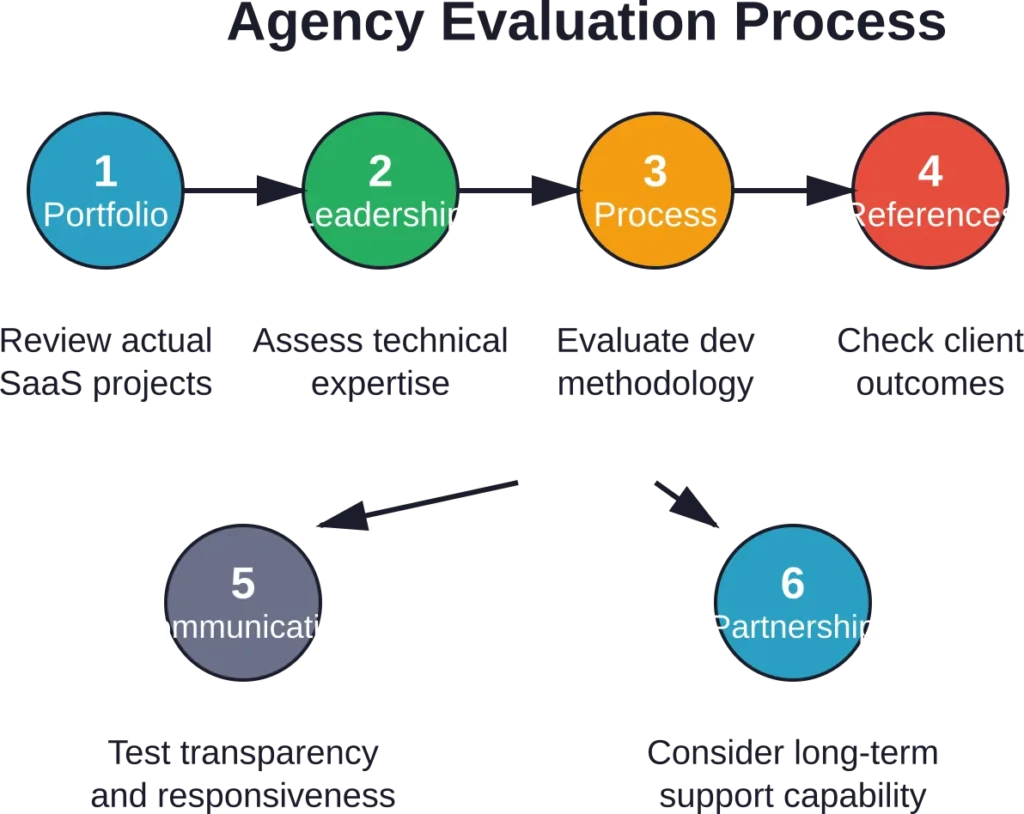
How to Evaluate SaaS Development Companies
Choosing the right development partner determines whether a SaaS product succeeds or joins the majority that fail. The evaluation process should be systematic rather than based on marketing materials or sales presentations.
Review Their Actual SaaS Portfolio
Request specific examples of completed SaaS projects. Look for multi-tenant platforms with subscription models, not generic websites rebranded as SaaS work. Ask about architecture decisions, scaling challenges they solved, and how they handled specific technical requirements.
Strong agencies willingly discuss technical details. Weak ones provide vague answers or shift conversation to generic capabilities.
Assess Technical Leadership
The best development teams are led by experienced architects who’ve built multiple SaaS platforms. Request calls with technical leads, not just sales representatives. Ask about their approach to multi-tenancy, database design, API versioning, and security.
Their answers reveal whether they’ve solved these problems in production or are learning on your project.
Understand Their Development Process
Strong agencies follow structured processes—discovery, architecture design, iterative development, testing, deployment, and optimization. They produce technical specifications, architecture diagrams, and documentation throughout the project.
Be cautious of agencies that jump straight into coding without thorough planning. That approach leads to expensive rewrites when architectural flaws emerge.
Check Client References
Ask for references from clients who’ve launched SaaS products with the agency and operated them for at least a year. Questions should cover:
- How well did the platform scale as users grew?
- What problems emerged post-launch and how were they handled?
- How responsive is ongoing support?
- Would they choose this agency again?
References who’ve only completed development but haven’t operated at scale can’t speak to the platform’s real-world reliability.
Evaluate Communication and Transparency
SaaS development involves complex decisions with business implications. Strong agencies explain trade-offs clearly, provide regular progress updates, and flag potential issues early rather than hiding problems until they become crises.
Communication quality during the sales process predicts communication quality during development.
Consider Long-Term Partnership Potential
SaaS platforms require ongoing optimization, new features, and infrastructure management. Evaluate whether this agency can serve as a long-term partner or only handles initial development.
Agencies offering post-launch support, performance optimization, and feature development provide continuity. Those focused purely on project delivery force finding new technical partners after launch.
Common SaaS Development Challenges
Even with experienced agencies, SaaS development presents predictable challenges. Understanding these upfront helps set realistic expectations and prepare contingency plans.
Defining the MVP Scope
The minimum viable product for SaaS needs enough features to solve the core problem while remaining lean enough to launch quickly. Most first-time SaaS founders include too many features, delaying launch and burning budget on capabilities users don’t need.
Strong agencies help define true MVP scope through user research and competitive analysis. They push back on feature creep while ensuring the platform includes the minimum necessary for a functioning SaaS business—not just the product features but user management, billing, onboarding, and basic reporting.
Scaling Architecture Prematurely
The opposite problem occurs when teams over-engineer for scale that doesn’t exist yet. Building for millions of users when launching with hundreds wastes time and money on infrastructure complexity that won’t be needed for years.
Experienced teams build architectures that can scale but start with simpler implementations. They use managed services instead of custom infrastructure, monoliths instead of microservices, and proven technologies instead of cutting-edge frameworks.
The right time to add architectural complexity is when actual growth demands it, not when hypothetical scenarios suggest it might someday be needed.
Underestimating Security Requirements
Security breaches destroy SaaS companies. Customer trust, once lost, rarely returns. Yet many teams treat security as a later phase rather than a foundation.
Proper security requires architectural decisions—encryption key management, authentication systems, audit logging, data retention policies—that can’t easily be retrofitted. Agencies with SaaS experience build these into the platform from day one.
Integration Complexity
Most SaaS platforms need to integrate with other tools—payment processors, email services, analytics platforms, CRM systems, and industry-specific APIs. Each integration adds complexity and potential failure points.
Teams often underestimate integration effort. What seems like simple API connections become complex when handling authentication, error states, rate limiting, webhook verification, and data synchronization across systems.
Strong agencies allocate sufficient time for integrations and implement robust error handling so failures in third-party services don’t crash the entire platform.
Post-Launch Performance Issues
Performance problems often remain hidden until real users create real load patterns. Slow database queries, inefficient API calls, memory leaks, and resource contention emerge under production conditions that can’t be fully replicated in development.
This is why post-launch support matters. Agencies that monitor production systems, analyze performance metrics, and optimize based on actual usage patterns provide significantly more value than those who disappear after deployment.
The Impact of AI on SaaS Development
Artificial intelligence is reshaping SaaS in fundamental ways. The market correction in early 2026, when over $1 trillion in SaaS market capitalization disappeared in seven days, reflected investor concerns that AI threatens traditional software workflows.
But the reality is more nuanced. AI presents both threats and opportunities for SaaS platforms.
AI Agents and Workflow Automation
The rapid pace of AI agent innovation has investors betting on a massive shift in how work gets done. AI agents that can complete complex tasks autonomously threaten to replace SaaS tools designed for human workflows.
For SaaS development companies, this means building platforms that work with AI agents, not just human users. APIs become more important than interfaces. Structured data output becomes as critical as visual displays.
Embedded Intelligence as Competitive Advantage
AI integration is moving from novelty to necessity. According to available industry data, 95% of businesses were utilizing AI-powered SaaS by 2025. Platforms without intelligent features face competitive disadvantage.
But surface-level AI—chatbots that provide scripted responses or dashboards with basic predictions—doesn’t create lasting differentiation. Deep integration where AI fundamentally improves the product’s core value proposition does.
Companies like Agicent demonstrate this approach. Their clients report 25-40% improvements in core efficiency metrics six months post-launch by embedding AI throughout the platform rather than adding it as isolated features.
Vertical SaaS Resilience
Vertical-specific SaaS vendors show greater survival probability in an AI-disrupted market. The vertical SaaS market is expanding from roughly $133.5 billion in 2025 to a projected $194.0 billion by 2029.
Domain-specific platforms addressing complex industry workflows with differentiated solutions prove harder to replace than horizontal tools. Healthcare, finance, supply chain, and legal SaaS products with deep industry integration maintain stronger competitive positions.
For companies building new SaaS platforms, this suggests focusing on specific verticals with complex requirements rather than broad horizontal tools easily replicated by AI.
Technology Stack Considerations
Modern SaaS platforms are built on specific technology foundations. While individual tool choices vary by project, certain architectural patterns and technology categories are essential.
Frontend Technologies
User interfaces for SaaS platforms typically use modern JavaScript frameworks—React, Vue.js, or Angular. React dominates due to ecosystem maturity, component availability, and developer familiarity.
For improved performance and SEO, Next.js provides server-side rendering on top of React. Progressive web app capabilities allow SaaS platforms to work offline and install like native applications.
Mobile applications may use native development (Swift for iOS, Kotlin for Android) for maximum performance or React Native for code sharing between platforms.
Backend Architecture
Backend services handle business logic, data persistence, and API endpoints. Common choices include Node.js for JavaScript consistency across frontend and backend, Python with frameworks like Django or FastAPI for data-heavy applications, and Ruby on Rails for rapid development.
Modern architectures separate concerns through microservices or service-oriented designs, though monolithic architectures remain appropriate for early-stage products needing simpler deployment.
Database Selection
SaaS platforms need database systems supporting multi-tenancy and scale. PostgreSQL provides robust relational capabilities with excellent JSON support for flexible schemas. MongoDB offers document storage for unstructured data.
For specific use cases, Redis provides caching and session storage, Elasticsearch enables full-text search, and specialized databases handle time-series data or graph relationships.
Cloud Infrastructure
AWS dominates SaaS hosting with comprehensive services, global availability, and mature tooling. Azure serves organizations with existing Microsoft relationships. Google Cloud offers strong data analytics and machine learning services.
Critical infrastructure components include container orchestration through Kubernetes, serverless functions for event-driven logic, managed databases reducing operational burden, and CDN services for global performance.
DevOps and Monitoring
Continuous integration and deployment pipelines automate testing and releases. GitHub Actions, GitLab CI, or CircleCI orchestrate builds, tests, and deployments.
Monitoring systems track uptime, performance, and errors. Tools like DataDog, New Relic, or open-source options like Prometheus and Grafana provide visibility into production systems.
| Technology Category | Common Choices | Primary Use Case |
|---|---|---|
| Frontend Framework | React, Vue.js, Angular | User interface and client-side logic |
| Backend Language | Node.js, Python, Ruby | Business logic and API services |
| Database | PostgreSQL, MongoDB, Redis | Data persistence and caching |
| Cloud Platform | AWS, Azure, Google Cloud | Infrastructure and managed services |
| Container Orchestration | Kubernetes, Docker | Application deployment and scaling |
| Monitoring | DataDog, New Relic, Prometheus | Performance tracking and error detection |
Frequently Asked Questions
SaaS application development creates cloud-based software delivered to customers via subscription rather than installed on local computers. Development encompasses multi-tenant architecture where one application instance serves multiple customers securely, subscription billing and management systems, cloud infrastructure for hosting and scaling, API design for integrations, and security implementations meeting industry standards. The result is software accessible through web browsers or mobile apps without customer-managed infrastructure.
Development timelines vary significantly based on complexity. A minimal viable product with core features typically requires 3-6 months for an experienced team. Mid-complexity platforms with multiple integrations, advanced features, and polished interfaces need 6-12 months. Enterprise-grade systems with extensive customization, compliance requirements, and complex workflows often take 12-18 months. These timelines assume clear requirements, available stakeholders for decisions, and realistic scope. Feature creep, unclear requirements, or frequent changes extend timelines considerably.
Traditional web applications are often built for single organizations, while SaaS platforms serve multiple customers through multi-tenant architecture. SaaS requires subscription billing integration, tenant data isolation, user management systems supporting multiple organizations, scalable cloud infrastructure, API-first design for integrations, and security meeting standards for handling customer data. Standard web applications may lack these components or implement them less rigorously since they serve internal users rather than paying customers.
Costs depend on scope, complexity, and team location. Development involves multiple components—planning and market research, UI/UX design and prototyping, backend and frontend development, mobile development if required, testing and quality assurance, deployment and infrastructure setup, and post-launch support. Total investment for a viable SaaS product typically ranges from tens of thousands for simple MVPs to hundreds of thousands for comprehensive platforms. Ongoing costs include cloud hosting, third-party service subscriptions, maintenance, and feature development.
Agencies provide faster time-to-market through pre-assembled teams, specialized SaaS expertise from multiple previous projects, and lower risk since capabilities are proven. They work well for first products, tight timelines, or when permanent technical staff aren’t needed. Internal teams offer better long-term product knowledge, greater control over priorities and changes, and potentially lower cost over multi-year timelines. They suit established companies with ongoing development needs. Many organizations start with agencies for initial development then transition to internal teams for ongoing work.
Launch is the beginning, not the end. Post-launch activities include monitoring system performance and uptime, fixing bugs discovered under real usage, optimizing database queries and infrastructure, gathering user feedback for improvements, developing new features based on customer needs, maintaining security through updates and patches, and scaling infrastructure as user count grows. Strong development partners offer ongoing support rather than disappearing after deployment. Budget for continuous improvement—successful SaaS platforms evolve based on user needs and competitive dynamics.
Scalability comes from architectural decisions made early. Critical factors include database design supporting efficient queries at large data volumes, caching layers reducing database load, stateless application design allowing horizontal scaling, asynchronous processing for time-consuming tasks, infrastructure automation enabling capacity increases, and monitoring systems identifying bottlenecks before they cause failures. Experienced agencies design for scale while avoiding premature optimization. Systems start simple but use patterns allowing growth. Load testing before major launches identifies problems while there’s time to fix them.
Making the Final Decision
Selecting a SaaS development company determines whether a product concept becomes a successful business or an expensive lesson. The decision deserves systematic evaluation rather than shortcuts.
Start by defining requirements clearly. What problem does this SaaS product solve? Who are the target users? What features are essential versus nice-to-have? What’s the timeline and budget?
Clear requirements allow agencies to provide accurate proposals and reveal whether they understand the domain. Vague requirements produce vague proposals that hide misunderstandings until development begins.
Evaluate multiple agencies using consistent criteria. Portfolio quality and relevance, technical leadership expertise, development process maturity, client references and outcomes, communication during evaluation, and long-term support capabilities all matter.
Be cautious of agencies that:
- Promise unrealistically short timelines or low costs
- Show generic portfolios without specific SaaS examples
- Avoid detailed technical discussions
- Provide contracts lacking clear deliverables and milestones
- Pressure immediate decisions without allowing due diligence
Strong agencies welcome scrutiny. They provide detailed proposals, explain trade-offs honestly, share relevant case studies, connect prospective clients with references, and demonstrate technical depth through substantive conversations.
The right development partner brings more than coding capability. They contribute strategic thinking about product positioning, technical guidance on architecture decisions, design expertise for user experience, operational knowledge for infrastructure, and ongoing support as the platform grows.
SaaS development is a partnership. Choose accordingly.
Conclusion
The SaaS market continues expanding rapidly, creating opportunities for businesses across industries. The global market reached $435.41 billion in 2026 and is forecasted to reach $900 billion by the end of the decade, maintaining a 19% CAGR.
But market opportunity doesn’t guarantee individual success. The difference between SaaS platforms that scale and those that fail often comes down to the development partner selected at the beginning.
The 15 companies outlined here—CONTUS Tech, eSparkBiz, Space-O Technologies, DICEUS, Agicent, Classic Informatics, LeewayHertz, Bacancy, Orases, and Flatirons—represent proven options with specialized SaaS expertise, completed projects demonstrating technical capability, and the architectural knowledge necessary for building production-grade platforms.
Selecting the right partner requires evaluating portfolios, assessing technical leadership, understanding development processes, checking client references, and considering long-term partnership potential. The investment in thorough evaluation pays dividends throughout the project and beyond.
SaaS success depends on getting the foundation right. Architecture decisions made early determine whether a platform can scale, remain secure, and adapt as requirements evolve. Teams with genuine SaaS experience structure systems properly from the start, avoiding expensive rewrites later.
Ready to transform your SaaS concept into reality? Start by defining clear requirements, then systematically evaluate development partners against the criteria outlined here. The right agency brings technical expertise, strategic guidance, and proven processes that dramatically increase the probability of success.
The SaaS opportunity is real. With the right development partner, your platform can capture it.