

Quick Summary: This comprehensive guide reviews 15 leading code audit companies in 2026, covering their specializations, methodologies, and strengths. Each agency brings unique expertise in security testing, compliance validation, and code quality assessment to help organizations ship safer, more reliable software.
Code audit companies have become essential partners for organizations that take software security seriously. Research indicates that security leaders recognize that “code is everywhere,” the demand for professional code auditing services has never been higher.
But here’s the thing—not all code audit firms are created equal.
Some specialize in smart contract security for blockchain applications. Others focus on traditional enterprise software audits. A few have carved out niches in compliance-driven audits for regulated industries.
The landscape has shifted dramatically in recent years. Modern audit firms now employ AI-powered analysis tools, maintain extensive vulnerability databases, and offer continuous monitoring services that go far beyond the one-time “check the box” audits of the past.
This guide cuts through the noise. We’ve evaluated code audit companies based on their technical methodology, industry expertise, audit scope, and client outcomes. The result is a curated list of 15 agencies that consistently deliver thorough, actionable security assessments.
What Code Audit Companies Actually Do
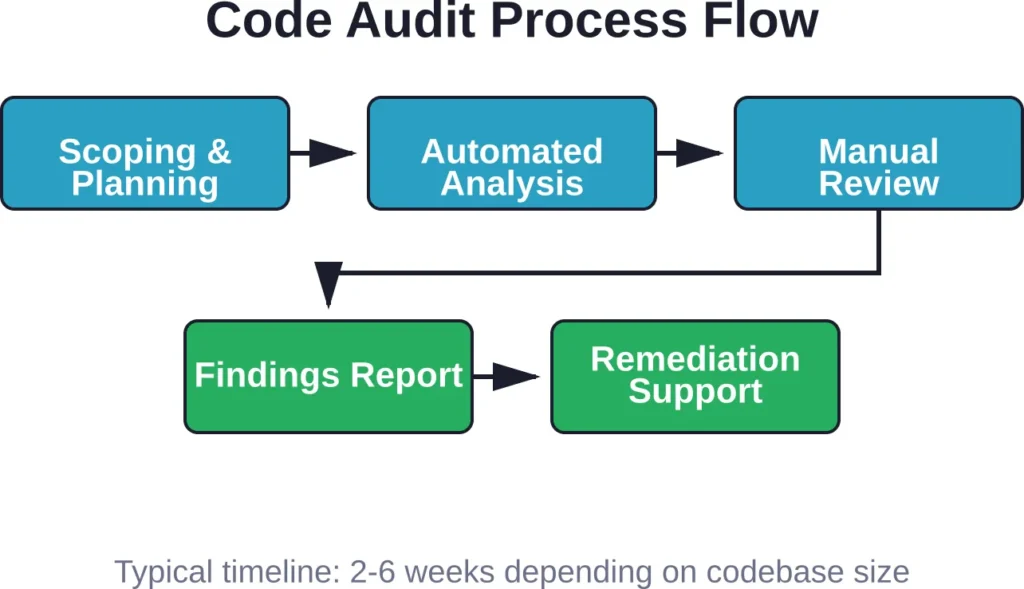
Code audit companies perform systematic examinations of source code to identify security vulnerabilities, quality issues, and compliance gaps. These firms employ specialized auditors who combine manual review techniques with automated scanning tools to uncover problems that could compromise system integrity.
The scope of a professional code audit typically includes security vulnerability assessment, architecture review, business logic validation, compliance checking, and code quality analysis.
Real talk: a proper audit isn’t just running an automated scanner and pasting results into a template. The distinction matters. Industry analyses indicate that organizations sometimes mistake basic vulnerability scans for comprehensive audits, leading to a false sense of security.
Types of Code Audits
Different audit types serve different purposes. Security audits focus exclusively on identifying exploitable vulnerabilities. Compliance audits verify adherence to regulatory frameworks like HIPAA, PCI DSS, or CMMC. Quality audits assess maintainability, performance, and technical debt.
Smart contract audits deserve special mention. These blockchain-focused assessments examine decentralized application code for logic errors, reentrancy vulnerabilities, and economic attack vectors specific to cryptocurrency systems.
The 15 Best Code Audit Companies in 2026
The following agencies represent the current leaders in professional code auditing services. Each brings distinctive strengths to the table.
1. Oski
Oski builds smart, well-engineered software solutions for enterprises and ambitious startups. The company focuses on cloud architecture, modern frontend frameworks, artificial intelligence, and reliable content management systems.
Their delivery model accelerates development through experienced teams and AI-enhanced processes while maintaining high standards in scalability, security, and user experience. Oski serves multiple regulated and high-growth industries with tailored digital transformation.
Specializations: Cloud solutions, frontend development, artificial intelligence, CMS platforms, industry-specific applications
Notable strengths: Rapid team deployment, AI-accelerated engineering, cross-industry expertise, comprehensive software lifecycle support
Contact Information:
- Website: oski.site
- Phone: +48571282759
- Email: [email protected]
- Address: Kaupmehe tn 7, 10114 Tallinn, Estonia
- LinkedIn: www.linkedin.com/company/oski-solutions
2. Lengreo

Lengreo has established itself as a results-driven marketing and tech partner for B2B companies seeking scalable growth through digital channels. The agency delivers end-to-end solutions that combine strategy with execution across multiple performance channels.
Their approach emphasizes hyper-personalized outreach, data-informed optimization, and seamless integration with client teams rather than off-the-shelf packages. Clients benefit from proven lead generation systems, SEO execution, paid advertising, and website development that directly impact pipeline and revenue.
Specializations: B2B digital marketing, lead generation, SEO, website development, paid ads, demand generation
Notable strengths: Measurable ROI delivery, hyper-personalized outreach, full-funnel strategy execution, client integration and transparency
Contact Information:
- Website: Lengreo.com
- Phone: +31 686 147 566
- Email: [email protected]
- Address: Vrijstraat 9 C/D, 5611 AT Eindhoven, Netherlands
- LinkedIn: Lengreo
- Twitter: @Lengreo
- Instagram: @lengreo
3. Gilzor

Gilzor specializes in custom software development and product engineering for startups and scaling businesses. The team guides projects from idea validation through full-cycle development and market launch.
Their methodology combines technical excellence with business analysis, UI/UX focus, and go-to-market support. Clients receive secure, scalable web and mobile applications backed by rigorous QA, ongoing maintenance, and strategic consulting.
Specializations: Custom web and mobile development, idea validation, UI/UX design, quality assurance, go-to-market strategy, R&D and PoC
Notable strengths: Full-cycle product delivery, user-centric design, high recurring client rate, technical architecture expertise
Contact Information:
- Website: www.gilzor.com
- Email: [email protected]
- Address: Poland, Warsaw, Office 58, street Adama Mickiewicza 37, 01-625
- LinkedIn: www.linkedin.com/company/gilzor-softwaredevelopment
4. Mobian

Mobian Studio delivers dedicated engineering teams for mobile and AI-powered solutions to companies in IT, healthcare, fintech, and logistics. The firm offers both full outsourcing and outstaffing models with senior-level execution.
Their focus on clean architecture, scalable systems, and post-launch partnership ensures production-ready software delivered on time and within budget. Mobian emphasizes domain-specific knowledge and long-term product sustainability.
Specializations: Mobile development, AI and automation systems, full-stack product engineering, legacy integration, dedicated team delivery
Notable strengths: Senior engineering talent, domain expertise in regulated industries, scalable architecture design, ongoing post-launch support
Contact Information:
- Website: mobian.studio
- Phone: [email protected]
- Address: Harju maakond, Tallinn, Kesklinnalinnaosa, Masina tn 22, 10113
- LinkedIn: www.linkedin.com/company/mobian-studio
5. A-listware
A-listware operates as a trusted software development and IT consulting partner with deep expertise in building and managing dedicated technical teams. The company delivers high-quality, secure digital solutions through outsourcing, team augmentation, and full project execution.
Their service portfolio covers the entire IT ecosystem — from custom development and UX/UI to QA, infrastructure management, data analytics, and cybersecurity. Clients receive seamless integration with their existing processes and 24/7 expert access.
Specializations: Software development outsourcing, dedicated teams, UX/UI design, testing & QA, IT consulting, cloud and infrastructure services
Notable strengths: Team augmentation excellence, end-to-end IT management, broad technology stack coverage, enterprise-grade solution delivery
Contact Information:
- Website: a-listware.com
- Phone: +1 (888) 337 93 73
- Email: [email protected]
- Address: North Bergen, NJ 07047, USA
- LinkedIn: www.linkedin.com/company/a-listware
- Facebook: www.facebook.com/alistware
6. Least Authority
Least Authority specializes in privacy-preserving technologies and decentralized systems. The firm was founded by cryptographer Zooko Wilcox-O’Hearn and maintains strong connections to the academic cryptography community.
Their audit approach emphasizes cryptographic correctness. Auditors verify that implementations match their security specifications and that cryptographic protocols achieve their claimed security properties.
Least Authority has audited storage systems, secure messaging protocols, and blockchain projects. They focus on systems where privacy and security serve as primary design requirements rather than compliance checkboxes.
Specializations: Cryptographic protocols, privacy technologies, decentralized storage, secure communications
Notable strengths: Cryptography expertise, privacy focus, academic rigor, decentralized systems knowledge
7. Halborn

Halborn has rapidly grown into a major blockchain security firm. The company offers comprehensive services spanning smart contract audits, penetration testing, and managed security.
Their auditors understand cross-chain security considerations. As blockchain ecosystems proliferate, vulnerabilities often arise from bridge protocols and cross-chain communication rather than individual smart contracts.
Halborn maintains an ongoing relationship model. Beyond one-time audits, they provide continuous security monitoring and incident response services for clients operating production blockchain systems.
Specializations: Multi-chain blockchain security, cross-chain bridges, DeFi protocols, blockchain infrastructure
Notable strengths: Cross-chain expertise, comprehensive security services, incident response capability, rapid growth and scaling
8. Securitum
Securitum operates primarily in European markets, serving clients across multiple industries. The Polish firm has particular strength in financial services and payment systems.
Their audit methodology follows structured frameworks based on OWASP guidelines and industry standards. Securitum provides compliance-focused audits that satisfy regulatory requirements while identifying genuine security issues.
The company offers audits in multiple languages, an advantage for European organizations that need security documentation in local languages for regulatory submission.
Specializations: Payment systems, financial applications, PSD2 compliance, European regulatory requirements
Notable strengths: European market focus, financial services expertise, multilingual reporting, compliance specialization
9. Quantstamp

Quantstamp pioneered scaled smart contract auditing. The company developed automated analysis systems that pre-screen code before human auditors review it, enabling faster turnaround times.
Their protocol allows developers to order audits through a standardized process. This productization makes audits more accessible for smaller blockchain projects that might lack connections to traditional security firms.
Quantstamp has audited over 500 blockchain projects. Their experience base provides pattern recognition—auditors quickly identify common vulnerability classes that appear across different codebases.
Specializations: Smart contract security, automated security analysis, blockchain protocol audits, token standards
Notable strengths: Scaled audit delivery, automated pre-analysis, extensive audit volume, standardized processes
10. CertiK

CertiK combines formal verification techniques with traditional security audits. The company’s founders are academic researchers who specialized in program verification and proof systems.
Formal verification mathematically proves that code satisfies specified properties. While more expensive and time-consuming than conventional audits, this approach provides higher assurance for critical systems.
Beyond audits, CertiK operates a security monitoring platform that tracks blockchain protocols in real-time. The Skynet system alerts project teams to suspicious transactions and potential exploits.
Specializations: Formal verification, smart contract security, blockchain monitoring, high-assurance audits
Notable strengths: Formal methods expertise, academic foundation, real-time monitoring platform, mathematical proof techniques
11. Trail of Bits
Trail of Bits has built a reputation for exceptionally thorough security audits across diverse technology stacks. The firm employs security researchers who regularly publish vulnerability research and maintain open-source security tools.
Their audit methodology combines custom static analysis tooling with intensive manual review. The team specializes in cryptographic implementations, blockchain protocols, and high-assurance systems where security failures carry catastrophic consequences.
Trail of Bits serves clients ranging from cryptocurrency projects to defense contractors. Their audit reports are detailed technical documents that developers can actually use—not just executive summaries for compliance theater.
Specializations: Cryptography, blockchain security, high-assurance systems, custom protocol analysis
Notable strengths: Deep technical expertise, custom tooling development, academic-caliber research team, comprehensive reporting
12. OpenZeppelin

OpenZeppelin dominates the smart contract audit space. The company has audited hundreds of blockchain projects and maintains the most widely-used library of secure smart contract components.
Their auditors understand the subtle economic and game-theoretic considerations unique to decentralized finance. Beyond finding common vulnerabilities, OpenZeppelin identifies business logic flaws that could enable financial exploitation even when code executes as written.
The firm offers a security platform that extends beyond one-time audits. Clients gain access to Defender, a suite of tools for ongoing monitoring, automated security checks, and incident response.
Specializations: Smart contract security, DeFi protocols, NFT projects, blockchain infrastructure
Notable strengths: Blockchain-specific expertise, economic security analysis, continuous monitoring platform, extensive audit portfolio
13. Cure53

Cure53 focuses on web application security and browser-adjacent technologies. The Berlin-based firm has audited major open-source projects, including password managers, encrypted messaging apps, and privacy tools.
Their penetration testing methodology goes beyond automated scanning. Cure53 auditors manually probe applications for logic flaws, authentication bypasses, and subtle timing attacks that automated tools miss entirely.
The company publishes many of their audit reports publicly, contributing to the broader security community. This transparency provides insight into their thoroughness and technical depth.
Specializations: Web application security, browser extensions, privacy software, cryptographic implementations
Notable strengths: Manual penetration testing expertise, browser security specialization, public audit reports, European data protection knowledge
14. NCC Group

NCC Group operates at enterprise scale, delivering security assessments for Fortune 500 companies and government agencies. The firm maintains multiple practice areas covering application security, cloud infrastructure, and industrial control systems.
Their code audit service integrates with broader security consulting engagements. Organizations often engage NCC Group for comprehensive security programs that include architecture review, threat modeling, and security training alongside code audits.
The company’s global presence enables them to support multinational clients across time zones. They maintain offices in North America, Europe, and Asia-Pacific.
Specializations: Enterprise application security, cloud security, IoT and embedded systems, compliance audits
Notable strengths: Enterprise scale and support, comprehensive service portfolio, global delivery capability, compliance expertise
15. Consensys Diligence
Consensys Diligence brings Ethereum ecosystem expertise to smart contract auditing. As part of the larger Consensys organization, the team has deep relationships within the blockchain developer community.
Their MythX security analysis platform automates portions of the audit process, enabling faster turnaround times for standard smart contract patterns. Auditors combine automated findings with manual review focused on business logic and economic security.
Consensys Diligence has audited many of the highest-value DeFi protocols. Their track record includes identifying critical vulnerabilities in systems securing billions in cryptocurrency assets.
Specializations: Ethereum smart contracts, DeFi protocols, layer-2 scaling solutions, ERC token standards
Notable strengths: Ethereum specialization, automated analysis platform, DeFi expertise, ecosystem relationships
Why Organizations Hire Code Audit Companies in 2026
The drivers for engaging professional audit firms have multiplied. Customer requirements top the list—enterprises increasingly demand security certifications and audit reports from their software vendors.
Regulatory compliance provides another powerful motivator. Industries handling sensitive data face mandatory audit requirements. Healthcare organizations need HIPAA compliance validation. Payment processors must satisfy PCI DSS standards. Defense contractors require CMMC certification.
But wait. There’s more to it than just checking boxes.
Pre-deployment risk assessment has become standard practice for mature engineering teams. Catching vulnerabilities before production deployment costs substantially less than incident response and remediation after a breach.
Insurance considerations factor in too. Cyber insurance underwriters now scrutinize security practices, and documented third-party audits can influence policy terms and premiums.
How to Choose the Right Code Audit Company
Selecting an audit partner requires evaluating several dimensions. Technical expertise in your specific technology stack matters most. An auditor who specializes in blockchain smart contracts won’t necessarily excel at reviewing legacy enterprise Java applications.
Look, the methodology question deserves careful consideration. Some firms rely heavily on automated scanning tools. Others emphasize manual review. The best audits combine both approaches—automation for comprehensive coverage, human expertise for logic flaws and business context.
Key Evaluation Criteria
Start with specialization alignment. Does the firm regularly audit systems similar to yours? Review their portfolio and case studies. Prior experience with your technology stack dramatically improves audit quality.
Auditor credentials matter. What security certifications do their team members hold? Do they publish security research or contribute to open-source security tools? These activities signal genuine expertise rather than just sales positioning.
Report quality varies dramatically across firms. Request sample reports from prospective auditors. Quality reports explain each vulnerability clearly, include proof-of-concept exploits, provide remediation guidance, and assign risk ratings based on actual business impact.
Turnaround time impacts project schedules. Industry reports suggest audit duration varies based on codebase complexity and auditor workload. Set clear timeline expectations upfront.
Communication patterns during the audit predict the relationship quality. Responsive auditors who collaborate with development teams produce more actionable results than those who disappear for weeks and deliver a report without context.
Red Flags to Avoid
Certain warning signs indicate problematic audit firms. Be skeptical of auditors who promise unrealistically fast turnaround times. Thorough security analysis takes time—a comprehensive audit of a complex codebase cannot be done properly in just days.
Generic reporting suggests low effort. Quality audits produce specific findings tied to actual code locations. Reports filled with boilerplate security recommendations copied from general guidelines provide minimal value.
Lack of methodology transparency raises concerns. Reputable firms clearly explain their audit process, tools used, and coverage scope. Vague descriptions of proprietary techniques often mask shallow analysis.
Reluctance to provide references should trigger caution. Established audit firms maintain satisfied client bases willing to serve as references for prospective customers.
Understanding Audit Scope and Deliverables
Code audit engagements vary substantially in scope. Organizations need clarity on what the audit actually covers before engagement begins.
Standard Audit Scope Elements
Most audits examine application source code, configuration files, and deployment scripts. The scope definition specifies which repositories, branches, and commit hashes undergo review.
Infrastructure-as-code often falls within scope for cloud-native applications. Security misconfigurations in deployment manifests create vulnerabilities just as surely as bugs in application code.
Third-party dependencies present a scope question. Some audits include dependency analysis to identify known vulnerabilities in libraries. Others focus exclusively on first-party code.
Testing environments may or may not be included. Some firms perform dynamic testing against running instances. Others conduct purely static code analysis without executing the application.
What Audit Reports Include
Comprehensive audit reports contain an executive summary, methodology description, findings organized by severity, and technical appendices.
Each vulnerability finding typically includes a description, severity rating, affected code location, proof-of-concept or reproduction steps, potential impact analysis, and recommended remediation.
The severity classification system varies by firm. Common frameworks include Critical/High/Medium/Low ratings or CVSS scores. Understanding the firm’s rating methodology helps prioritize remediation work.
Remediation guidance quality separates excellent reports from mediocre ones. The best reports explain not just what to fix, but how to fix it, with code examples or architectural alternatives.
| Audit Type | Primary Focus | Common Deliverables | Typical Duration |
|---|---|---|---|
| Security Audit | Vulnerability identification and exploitation risk | Vulnerability report, risk assessment, remediation guide | 2-4 weeks |
| Compliance Audit | Regulatory requirement verification | Controls assessment, gap analysis, compliance certificate | 3-6 weeks |
| Smart Contract Audit | Blockchain-specific vulnerabilities and economic security | Vulnerability report, gas optimization, formal verification results | 2-3 weeks |
| Code Quality Audit | Maintainability, technical debt, performance | Quality metrics, refactoring recommendations, architecture review | 1-3 weeks |
Audit Preparation: Getting Your Code Ready
Organizations maximize audit value through proper preparation. Auditors work more efficiently when provided with comprehensive context and access.
Documentation to Prepare
Architecture documentation helps auditors understand system design quickly. Provide diagrams showing component interactions, data flows, and trust boundaries.
Threat model documents communicate which attacks concern the organization most. This context focuses auditor attention on high-priority areas.
Previous audit reports and security findings enable auditors to verify remediation completeness and avoid redundant testing.
Deployment documentation clarifies the production environment configuration. Security properties often depend on correct deployment—auditors need to assess both code and deployment together.
Access and Environment Setup
Source code access typically involves providing repository credentials or code exports. Discuss confidentiality protections and non-disclosure agreements before sharing sensitive code.
Testing environment access enables dynamic testing. Provide auditors with accounts that mirror attacker-achievable access levels.
Documentation access should include API specifications, database schemas, and configuration guides. Complete documentation accelerates auditor understanding and improves coverage.
Point of contact designation ensures auditor questions receive prompt responses. Audit efficiency drops when auditors wait days for answers to blocking questions.
Post-Audit Remediation and Verification
The audit report delivery marks the beginning of remediation work, not the end of the security process. Organizations must systematically address findings.
Prioritizing Remediation Work
Start with critical and high severity findings. These vulnerabilities present immediate exploitation risk and warrant urgent attention.
Consider attack feasibility alongside severity ratings. Some high-severity findings require sophisticated attacker capabilities or specific preconditions. Others are trivially exploitable by unskilled attackers.
Business impact analysis helps prioritize among similar-severity findings. Vulnerabilities affecting customer data or financial transactions typically warrant faster remediation than those impacting internal tools.
Quick wins deserve attention too. Some findings require minimal effort to fix. Addressing these rapidly reduces overall risk while teams work on complex remediations.
Verification Testing
Many audit firms offer verification testing after remediation. Auditors re-test previously identified vulnerabilities to confirm fixes work correctly.
This verification prevents incomplete remediation. Developers sometimes implement fixes that address the specific test case without solving the underlying vulnerability class.
Regression testing ensures fixes don’t introduce new problems. Security patches occasionally create new vulnerabilities or break existing functionality.
Ongoing Security vs. Point-in-Time Audits
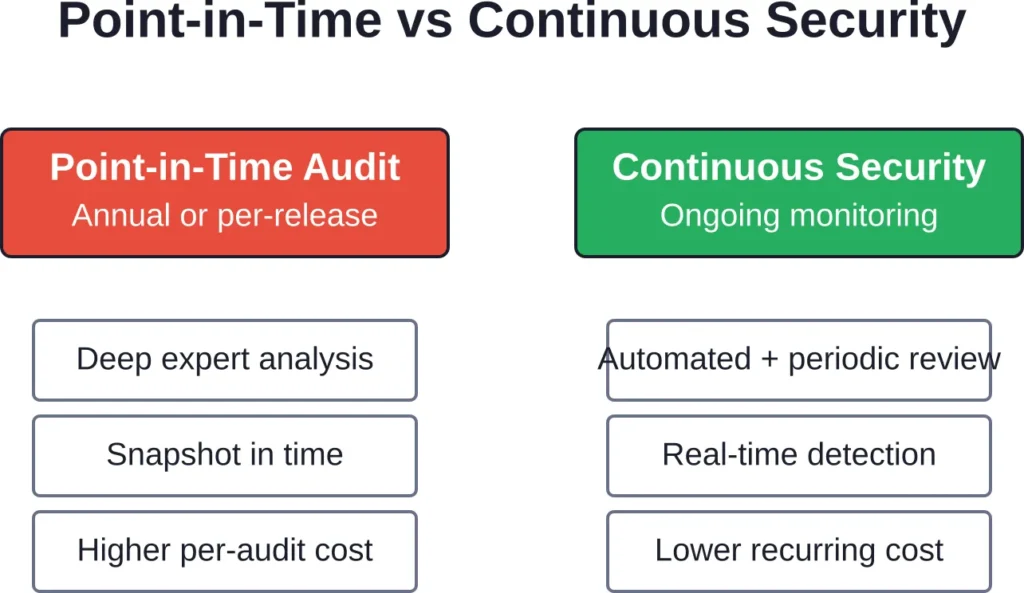
Traditional code audits provide point-in-time assessments. The report describes security posture at a specific commit hash.
Here’s the problem: code changes constantly. New features, dependency updates, and configuration changes modify the codebase continuously. Yesterday’s audit says nothing about today’s security state.
Continuous Security Approaches
Progressive organizations supplement periodic audits with continuous security tooling. Automated scanners integrated into CI/CD pipelines catch common vulnerability patterns before code reaches production.
Some audit firms now offer continuous engagement models. Rather than annual audits, these arrangements provide ongoing security review of code changes as they occur.
Bug bounty programs complement professional audits. External security researchers continuously probe production systems for vulnerabilities, providing real-world adversarial testing.
Security champions within development teams maintain security awareness between formal audits. These trained developers review code from a security perspective during normal development workflows.
Common Mistakes When Engaging Audit Firms
Organizations frequently make predictable errors when working with code audit companies. Avoiding these pitfalls improves audit outcomes.
Waiting Until the Last Minute
Scheduling audits too late in development cycles creates problems. Teams discover critical vulnerabilities with insufficient time for proper remediation before launch deadlines.
This timing pressure forces difficult choices: delay the launch, ship with known vulnerabilities, or implement hasty fixes without adequate testing.
Better practice involves scheduling audits early enough that remediation can proceed thoughtfully. Build audit time into project plans rather than treating it as an afterthought.
Choosing Based on Price Alone
The cheapest audit option rarely delivers the best value. Industry analyses indicate that low-cost audits often rely primarily on automated scanning with minimal manual review.
These shallow assessments miss business logic flaws, authentication bypasses, and other vulnerabilities that require human reasoning to identify. Organizations get a report that creates false confidence without meaningful security improvement.
Evaluate audit firms based on methodology quality and relevant expertise, not just price. The cost difference between adequate and excellent audits is negligible compared to breach costs.
Ignoring Remediation Guidance
Some organizations treat audit reports as compliance artifacts rather than security improvement tools. They file the report and move on without implementing fixes.
This approach wastes the audit investment. Identified vulnerabilities remain exploitable. The organization has spent resources to discover problems without gaining security benefits.
Successful organizations establish remediation processes before commissioning audits. They plan for the time and resources needed to address findings.
Expecting Perfect Security
No audit catches every vulnerability. Even the most thorough assessment provides probabilistic rather than absolute security assurance.
Organizations sometimes develop false confidence after receiving clean audit reports. They assume comprehensive security when audits only evaluated specific scope at a specific time.
Maintain realistic expectations. Audits reduce risk significantly but don’t eliminate it. Treat them as one component of a comprehensive security program.
Audit Frequency and Timing Considerations
How often should organizations conduct code audits? The answer depends on code change velocity, risk tolerance, and regulatory requirements.
Event-Driven Audits
Major releases warrant fresh audits. Significant feature additions, architectural changes, or technology stack migrations introduce new vulnerability surfaces.
Regulatory milestones often trigger compliance audits. Organizations pursuing SOC 2 Type II certification or ISO 27001 accreditation need audits as evidence of security controls.
Incident response sometimes includes audit components. After security breaches, organizations commission audits to identify additional vulnerabilities and prevent recurrence.
Periodic Audit Schedules
Annual audits provide a reasonable baseline for many organizations. This frequency balances security assurance against cost and operational disruption.
High-risk applications may warrant more frequent assessment. Financial systems, healthcare applications, and infrastructure components with broad impact justify quarterly or semi-annual audits.
Low-risk internal tools might audit less frequently. Applications with limited sensitive data access and small user bases present lower risk profiles.
Industry-Specific Audit Considerations
Different industries face unique security requirements and audit expectations.
Financial Services
Banking and payment applications require rigorous security validation. Regulatory frameworks like PCI DSS mandate specific security controls and regular testing.
Financial services audits emphasize transaction integrity, authentication strength, and fraud prevention. Auditors assess whether systems properly enforce authorization rules and maintain audit trails.
Compliance requirements often dictate audit frequency and scope. Payment card data processing systems require annual PCI DSS audits regardless of other considerations.
Healthcare
Healthcare applications handling protected health information fall under HIPAA regulations. Security audits must verify appropriate safeguards for electronic PHI.
Healthcare audits examine access controls, encryption implementations, and audit logging capabilities. Systems must demonstrate that only authorized individuals can access patient data.
Business associate agreements create cascading audit requirements. Healthcare organizations often require their software vendors to undergo security audits and share results.
Blockchain and Cryptocurrency
Smart contract audits have become standard practice before launching decentralized finance protocols. The immutable nature of blockchain deployments makes pre-launch auditing critical.
These audits combine security analysis with economic attack modeling. Auditors assess whether protocol mechanisms create perverse incentives that rational actors might exploit.
Blockchain audit reports often become public documents. Projects publish audit results to build community trust and demonstrate security diligence.
Maximizing Audit Value
Organizations that approach audits strategically extract maximum value from the investment.
Treat Audits as Learning Opportunities
Code audits provide security training for development teams. Review findings with developers to build security awareness and prevent similar issues in future code.
Some organizations request knowledge transfer sessions where auditors explain common vulnerability patterns and secure coding practices.
Building internal security expertise reduces reliance on external audits over time. Teams that learn from audit findings write more secure code initially.
Integrate Findings into Development Processes
Audit findings often reveal systematic weaknesses rather than isolated bugs. Organizations should analyze patterns across findings to identify root causes.
Common finding patterns might indicate knowledge gaps, insufficient testing, or architectural problems. Addressing these systemic issues prevents entire vulnerability classes.
Update coding standards, test suites, and review checklists based on audit results. This integration helps prevent recurrence of similar issues.
Maintain Auditor Relationships
Working with the same audit firm across multiple engagements builds efficiency. Auditors familiar with the codebase and architecture work faster and provide better context in findings.
Long-term relationships enable auditors to verify that previous findings remain fixed. They can track security posture trends over time.
Established relationships also provide informal consulting value. Auditors who know the system can offer quick guidance on security questions between formal engagements.
Emerging Trends in Code Auditing
The code audit industry continues evolving as technology and threat landscapes change.
AI-Assisted Security Analysis
Artificial intelligence increasingly augments human auditors. Machine learning models trained on vulnerability databases can identify suspicious code patterns that match known vulnerability signatures.
These tools improve efficiency by handling initial triage. Human auditors then focus on complex findings that require reasoning about business logic and security context.
The technology has limitations. AI models can generate false positives and struggle with novel vulnerability patterns not present in training data. Human expertise remains essential.
Shift-Left Security Integration
Security auditing is moving earlier in development cycles. Rather than treating audits as pre-launch gates, progressive organizations integrate continuous security testing throughout development.
This shift-left approach catches vulnerabilities when they’re cheapest to fix. Developers receive security feedback while context is fresh, making remediation faster.
Developer-native security tools integrate directly into IDEs and pull request workflows. Security becomes a continuous concern rather than a discrete phase.
Supply Chain Security Focus
Audit scope increasingly includes third-party dependencies and software supply chain risks. Organizations recognize that vulnerabilities in dependencies threaten security just as directly as bugs in first-party code.
Modern audits often include dependency analysis, license compliance checking, and supply chain attack surface assessment. Auditors evaluate whether dependencies come from trustworthy sources and receive security updates.
Software bill of materials generation helps organizations track dependencies and respond when vulnerabilities are disclosed in upstream components.
Frequently Asked Questions
Code audit duration varies based on codebase size and complexity. Small applications with 10,000-20,000 lines of code typically require 2-3 weeks for thorough security audits. Medium-sized applications with 50,000-100,000 lines might need 3-5 weeks. Large enterprise systems or complex smart contracts can require 6-8 weeks or more. Audit firms should provide timeline estimates during scoping discussions based on specific project characteristics.
Automated scanning tools analyze code for known vulnerability patterns rapidly and consistently. These tools excel at finding common issues like SQL injection, cross-site scripting, and insecure configurations. Manual audits involve security experts reading and analyzing code to understand business logic, identify design flaws, and find subtle vulnerabilities that automated tools miss. Professional audits combine both approaches—automation provides breadth of coverage while manual review provides depth and context.
No audit can provide absolute security guarantees. Audits significantly reduce risk by identifying many vulnerabilities, but they cannot prove the absence of all security issues. Audit effectiveness depends on scope, auditor skill, time allocated, and testing methodology. Even comprehensive audits represent point-in-time assessments—code changes after the audit may introduce new vulnerabilities. Organizations should view audits as important risk reduction measures within broader security programs rather than complete security solutions.
Both warrant attention, though the approach differs. First-party code typically receives manual security audit attention since the organization controls and can fix identified issues. For dependencies, automated vulnerability scanning provides cost-effective monitoring. Software composition analysis tools continuously check dependencies against vulnerability databases. Organizations should prioritize auditing critical dependencies—especially those handling sensitive data, cryptography, or authentication—while using automated scanning for broader dependency monitoring.
Quality indicators include report comprehensiveness, finding specificity, and methodology transparency. Thorough audit reports clearly explain each vulnerability, include proof-of-concept demonstrations, reference specific code locations, and provide actionable remediation guidance. Reports should describe the testing methodology, tools used, and coverage scope. Request that auditors explain their findings and walk through major issues. Reputable firms welcome discussions about methodology and findings. Be suspicious of generic reports filled with boilerplate recommendations rather than specific findings tied to actual code.
Disagreements occasionally occur, particularly around risk ratings or exploitation feasibility. Professional audit firms welcome discussions about findings. Contact the auditor to explain the perspective and ask for clarification. Sometimes disagreements stem from context that the auditor lacked during testing. Other times, auditors can demonstrate exploitation scenarios that change risk assessment. Document these discussions. If genuine disagreement persists after discussion, consider requesting a second opinion from another security expert. Most disputes resolve through communication once both parties understand the full context.
Many audit firms offer verification testing to confirm remediation effectiveness. This focused re-testing examines whether fixes properly address identified vulnerabilities without introducing new issues. Verification testing costs substantially less than full audits since scope is limited to previously identified issues. Organizations should obtain verification testing for critical or complex vulnerabilities where remediation confidence is important. Simple fixes for well-understood vulnerability classes might not require formal verification. Consider verification testing as quality assurance for security remediation work.
Conclusion
Professional code audit companies provide essential security expertise that most development teams lack internally. The 15 firms reviewed here represent current leaders across different specializations and technology stacks.
The right audit partner depends on specific organizational needs. Blockchain projects require auditors who understand smart contract vulnerabilities and economic attack vectors. Enterprise applications need firms with compliance expertise and experience in traditional software stacks. High-assurance systems benefit from formal verification capabilities.
So where should organizations start?
Begin by clearly defining audit objectives. Are you primarily concerned with security vulnerabilities, regulatory compliance, or code quality? This clarity guides firm selection and scope definition.
Evaluate prospective audit firms based on relevant expertise, methodology rigor, and communication quality. Review sample reports and talk with references. Invest time in firm selection—the difference between adequate and excellent audits is substantial.
Treat audits as collaborative learning opportunities rather than adversarial evaluations. The best outcomes occur when auditors and development teams work together toward improved security.
Remember that audits complement but don’t replace other security practices. Integrate findings into development processes, maintain security awareness, and implement continuous monitoring alongside periodic audits.
The security landscape continues evolving. Audit practices, tools, and methodologies will advance. Organizations that build relationships with trusted audit partners and maintain ongoing security focus will navigate these changes successfully.
Ready to schedule a code audit? Start by reaching out to firms with expertise in your technology stack. Discuss scope, methodology, and timelines. The investment in professional security auditing pays dividends through reduced risk, improved code quality, and increased customer confidence.