

Quick Summary: Finding the right microservices development partner requires evaluating technical expertise, architecture experience, and delivery track record. The best agencies combine cloud-native capabilities, domain-driven design knowledge, and proven success scaling distributed systems. This guide profiles 15 leading microservices development companies that excel in building scalable, resilient architectures without listing pricing or hourly rates.
Microservices have been with us for nearly two decades, but scaling distributed applications remains challenging. The architecture promises independent deployment, polyglot persistence, and fault tolerance—yet delivering on those promises requires specialized expertise.
Choosing a development partner means looking beyond surface-level claims. Real microservices capability shows up in how teams handle service discovery, implement circuit breakers, design event-driven patterns, and orchestrate deployments across distributed environments.
The companies profiled here have demonstrated technical depth through client work, architectural contributions, and measurable outcomes. This list focuses on capabilities and track record rather than cost metrics.
What Makes a Strong Microservices Development Partner
Not every software company that mentions microservices actually has the architectural expertise to build them properly. Real capability shows up in specific areas.
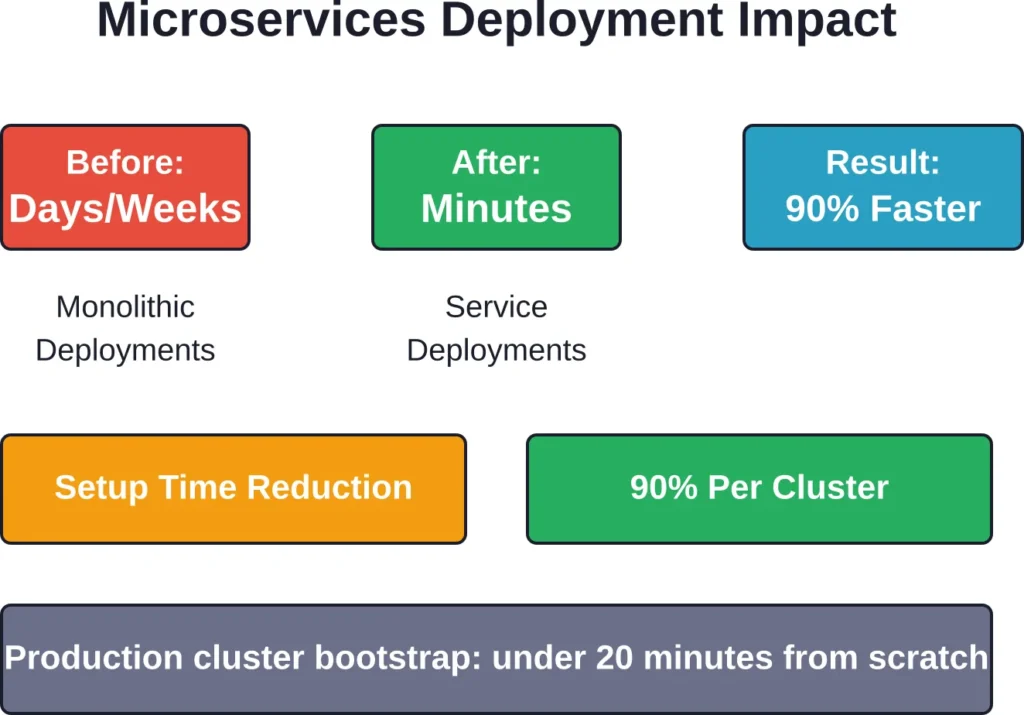
Cloud-native experience matters. Companies that have scaled Kubernetes operations across 100+ clusters understand the operational complexity firsthand. According to CNCF case studies, organizations managing large-scale deployments have achieved 90% reduction in setup time through GitOps automation.
Domain-driven design knowledge separates decent developers from architects who understand bounded contexts. Microservices aren’t just about splitting a monolith—they’re about modeling business domains correctly so services remain loosely coupled.
Architecture Patterns That Signal Expertise
Look for teams that discuss these concepts naturally:
- API gateway patterns and service mesh implementation
- Event-driven architecture with message queues and event sourcing
- Distributed tracing and observability across services
- Circuit breakers and resilience patterns for fault tolerance
- Service discovery mechanisms and health check strategies
- Polyglot persistence matching data needs to storage types
Teams with real experience don’t just list these terms—they explain trade-offs between patterns and when to apply each approach.
Delivery Track Record Indicators
Platform implementations like Zepto’s that eliminated weekly onboarding queues demonstrate operational maturity. Systems achieving 90% reduction in setup time (reducing onboarding from 2 days to 10 minutes in one case) show the team understands developer experience alongside technical architecture.
Financial services organizations running microservices across multiple global regions face regulatory complexity most industries never encounter. Partners who’ve delivered in those environments bring battle-tested knowledge.
Top 15 Microservices Development Companies
These agencies have demonstrated microservices expertise through client deliverables, technical contributions, and architectural capabilities. The list focuses on technical competency rather than company size or market presence.
1. Mobian Studio

Mobian Studio delivers dedicated engineering teams specialized in building scalable microservices architectures for high-stakes domains including healthcare, fintech, and logistics. They focus on clean, documented code and systems designed for independent scaling and maintenance.
Their approach emphasizes scalable architecture that supports growth from small user bases to high-volume production environments without requiring full rebuilds. Teams implement domain-driven designs, API-first strategies, and cloud-native patterns that ensure loose coupling and high autonomy between services.
Mobian excels at both greenfield microservices implementations and legacy integration, connecting new distributed systems to existing infrastructure while maintaining regulatory compliance and operational stability.
Contact Information:
- Website: mobian.studio
- Phone: [email protected]
- Address: Harju maakond, Tallinn, Kesklinnalinnaosa, Masina tn 22, 10113
- LinkedIn: www.linkedin.com/company/mobian-studio
2. Gilzor

Gilzor brings full-cycle custom software development expertise with a strong focus on scalable and maintainable architectures suitable for startups, SMBs, and product companies. They specialize in building systems that support independent service evolution and efficient scaling.
The company applies expert technology and architecture consulting to define robust foundations, incorporating service boundaries early in the development process. Their web and mobile solutions often leverage backend architectures that enable modular growth and seamless integration.
Gilzor’s teams deliver production-ready solutions with emphasis on quality assurance, support, and long-term maintainability, allowing clients to evolve individual components without disrupting overall system stability.
Contact Information:
- Website: www.gilzor.com
- Email: [email protected]
- Address: Poland, Warsaw, Office 58, street Adama Mickiewicza 37, 01-625
- LinkedIn: www.linkedin.com/company/gilzor-softwaredevelopment
3. Lengreo

Lengreo serves as a complete tech partner for software development companies, helping them build and scale digital solutions with modern architectural approaches including microservices and cloud-native systems. They combine technical implementation with strategic business alignment.
Their website development and custom solutions incorporate scalable backends, API development, and architectures designed for performance and growth. This supports clients in creating modular systems that can evolve independently while maintaining high reliability.
Lengreo’s hands-on collaboration model ensures seamless integration of technical architecture decisions with business objectives, particularly for companies modernizing or expanding their digital platforms.
Contact Information:
- Website: Lengreo.com
- Phone: +31 686 147 566
- Email: [email protected]
- Address: Vrijstraat 9 C/D, 5611 AT Eindhoven, Netherlands
- LinkedIn: Lengreo
- Twitter: @Lengreo
- Instagram: @lengreo
4. A-listware

A-listware provides software development and consulting services with deep capabilities in building enterprise-grade distributed systems. They excel at cloud application development, infrastructure management, and creating modular solutions that support independent deployment and scaling.
The company’s dedicated teams and full-spectrum engineering services cover microservices-friendly technologies including containerization, orchestration, and polyglot persistence options. They help clients implement architectures that align with business domains and operational needs.
A-listware handles complex enterprise environments, delivering solutions such as ERP/CRM integrations and custom applications built with service isolation and maintainability in mind.
Contact Information:
- Website: a-listware.com
- Phone: +1 (888) 337 93 73
- Email: [email protected]
- Address: North Bergen, NJ 07047, USA
- LinkedIn: www.linkedin.com/company/a-listware
- Facebook: www.facebook.com/alistware
5. Oski

Oski designs, develops, and maintains well-engineered software solutions with strong emphasis on cloud and scalable architectures for enterprises and startups. Their cloud practice supports hybrid and multi-cloud environments ideal for microservices deployments.
They deliver robust frontend and backend solutions combined with DevOps practices that enable continuous delivery and independent service management. AI and custom integrations further enhance distributed system capabilities.
Oski’s approach focuses on high-performance, maintainable architectures that help businesses reimagine operations through modular, cloud-native designs tailored to specific industry requirements.
Contact Information:
- Website: oski.site
- Phone: +48571282759
- Email: [email protected]
- Address: Kaupmehe tn 7, 10114 Tallinn, Estonia
- LinkedIn: www.linkedin.com/company/oski-solutions
6. Tech.us

Tech.us specializes in cloud-native refactoring and UI/UX modernization alongside backend microservices development. Founded in 2000 and headquartered in San Jose, California, they bring over two decades of software modernization experience.
Their approach integrates legacy system modernization with microservices migration, understanding that most organizations aren’t starting from greenfield. They build service layers that gradually replace monolithic components while maintaining business continuity.
Tech.us teams implement API-first designs that allow frontend modernization to proceed independently from backend service development, accelerating delivery timelines.
7. Corsac

Corsac focuses on application modernization with strong compliance integration. They build microservices architectures that embed regulatory requirements into system design from the start, not as afterthoughts.
Their healthcare practice understands HIPAA, HL7/FHIR standards, and clinical workflow requirements that shape architecture decisions. Compliance isn’t bolted on—it’s designed into service boundaries and data flow patterns.
Corsac works within existing development toolchains, integrating into client Git workflows and CI/CD processes to maintain developer productivity during migrations.
8. Cognizant

Cognizant delivers enterprise microservices at U.S. scale, with portfolio work spanning multiple industries. Their platform engineering teams build reference architectures that balance standardization with flexibility.
They’ve implemented service mesh solutions that handle cross-cutting concerns like security, observability, and traffic management without cluttering business logic. Their operations teams understand the Day 2 challenges—maintaining microservices after launch.
Cognizant’s delivery model supports long-term engagements where they own operational responsibility for microservices platforms, not just initial development.
9. Blackthorn Vision

Blackthorn Vision has built a strong reputation for long-term client partnerships and AI-enabled development approaches. Their average client satisfaction score reaches 95% across projects.
They specialize in complex SaaS products built on microservices foundations, with dedicated teams handling full-cycle delivery from architecture through operations. Their focus on scalable team structures matches technical scalability.
Blackthorn Vision’s remote delivery model serves U.S. clients with distributed teams, understanding the coordination patterns needed for microservices development across time zones.
10. ITransition

ITransition brings breadth across emerging technologies including AI, IoT, and AR integrated with microservices backends. They understand how to build service architectures that support resource-intensive workloads.
Their microservices implementations include AI Agents development using frameworks like temporal.io, handling complex workflow orchestration across distributed services. They’ve earned positive feedback for technical delivery quality.
ITransition teams architect for polyglot persistence, matching storage solutions to service needs—graph databases for relationship data, time-series databases for telemetry, document stores for flexible schemas.
11. Spiral Scout

Spiral Scout brings deep expertise in microservices architecture with focus on domain-driven design and event-driven systems. Founded in 2002, Spiral Scout has built a reputation for complex distributed systems that scale.
Their approach emphasizes bounded contexts and service isolation, ensuring teams can deploy independently without coordination overhead. They’ve implemented API gateway patterns, service mesh architectures, and polyglot persistence strategies across client engagements.
Spiral Scout’s technical team understands the operational side of microservices, not just the development phase. They build with observability from the start, implementing distributed tracing and centralized logging that makes debugging distributed systems actually manageable.
12. EPAM Systems

EPAM brings enterprise-scale experience to microservices transformations. Their platform and product engineering practice has modernized legacy monoliths into distributed architectures for Fortune 500 clients.
The company excels at migration strategies—moving from monolithic systems to microservices without disrupting business operations. They’ve developed frameworks for strangler fig patterns, allowing gradual migration while maintaining system stability.
EPAM’s strength lies in handling organizational complexity alongside technical challenges. They understand Conway’s Law and structure teams around service boundaries, not just technical components.
13. Thoughtworks

Thoughtworks pioneered many microservices practices that became industry standards. Their consulting approach combines architectural excellence with engineering discipline.
They’re known for evolutionary architecture—building systems that can adapt as requirements change. Their teams implement continuous delivery pipelines that support independent service deployment, with automated testing strategies that catch integration issues early.
Thoughtworks consultants bring experience from diverse industry domains, allowing them to model business contexts accurately. They don’t impose one-size-fits-all solutions but adapt patterns to specific organizational needs.
14. Accenture

Accenture handles microservices at scale few companies match. Their transformation programs modernize enterprise systems serving millions of users, with architecture decisions that account for compliance, security, and operational constraints.
Their cloud practice integrates microservices with container orchestration platforms, implementing Kubernetes deployments that can bootstrap production-ready clusters from scratch in under 20 minutes through infrastructure-as-code automation, as demonstrated in case studies of organizations managing 100+ clusters.
Accenture’s breadth means they coordinate across security teams, operations groups, and development organizations—managing the non-technical challenges that often derail technical transformations.
15. Luxoft

Luxoft operates in heavily regulated sectors including healthcare and financial services, integrating compliance requirements like HIPAA, HL7/FHIR, SOC2, GDPR, and ISO standards into microservices architectures.
They excel at building within existing enterprise toolchains—working inside client Git repositories, CI/CD pipelines, and workflow tools rather than imposing new infrastructure. This approach minimizes disruption and accelerates adoption.
Their financial services experience includes architectures running across global regions with data residency requirements and regulatory constraints that add layers of complexity beyond typical microservices challenges.
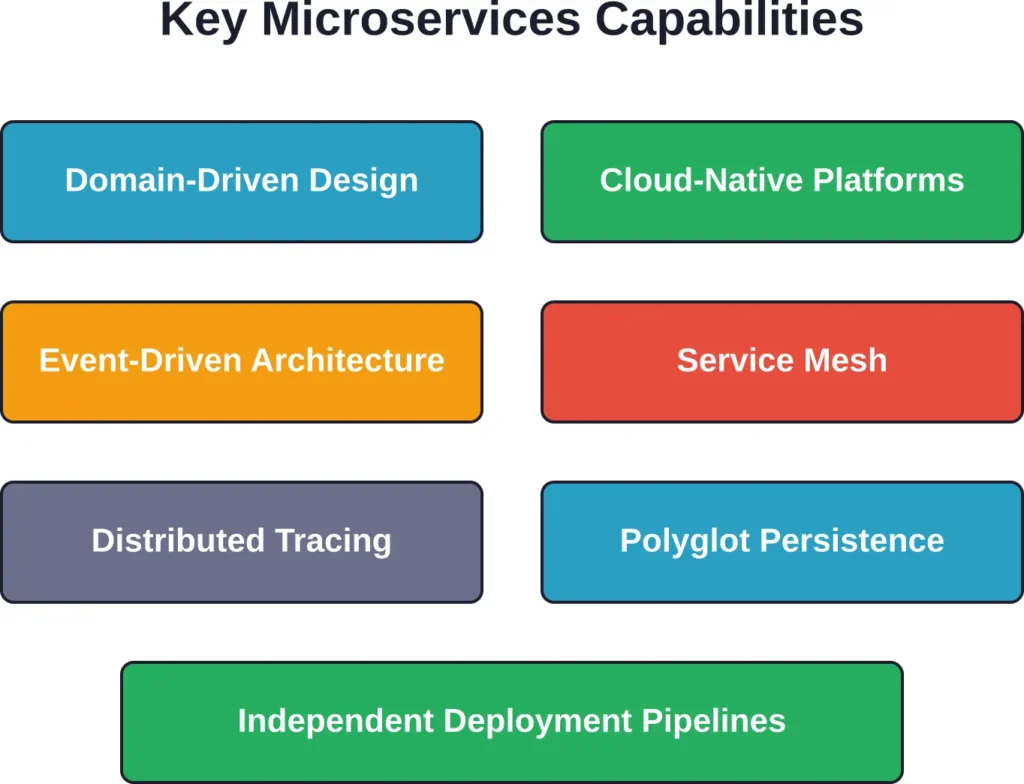
Architecture Patterns These Companies Excel At
The companies listed share proficiency in specific architectural patterns that define modern microservices success.
API Gateway and Service Mesh
API gateways provide the entry point for external clients, handling authentication, rate limiting, and routing to backend services. Service meshes manage service-to-service communication with built-in observability, security, and traffic management.
Strong teams implement both patterns appropriately—API gateways for north-south traffic, service mesh for east-west communication. They understand when the operational overhead of a service mesh justifies the benefits versus simpler client libraries.
Event-Driven Patterns
Event-driven architectures decouple services through asynchronous messaging. Services publish events when state changes; other services subscribe to events they care about.
This pattern enables choreography instead of orchestration, reducing tight coupling. But it introduces eventual consistency and debugging challenges that require sophisticated tooling.
Top teams implement event sourcing where it adds value, use message queues appropriately, and build compensation logic for distributed transactions.
Circuit Breaker and Resilience
Distributed systems fail in ways monoliths don’t. Network partitions, service timeouts, and cascading failures require defensive patterns.
Circuit breakers prevent cascading failures by stopping calls to degraded services. Bulkheads isolate resources so one failing component doesn’t exhaust shared resources. Retry logic with exponential backoff handles transient failures.
The companies profiled build these resilience patterns into services from the start, not as afterthoughts when production issues emerge.
How to Evaluate Microservices Development Companies
Picking a partner requires looking beyond marketing claims. Here’s what actually matters.
Ask About Specific Projects
Request case studies with architectural details. How did they identify service boundaries? What patterns did they use for inter-service communication? How do they handle distributed transactions?
Vague answers about “using best practices” signal inexperience. Detailed discussions about trade-offs indicate real expertise.
Assess Technical Team Depth
Who will actually architect your system? Meet the technical leads who’ll work on your project, not just sales teams.
Ask about their experience with specific technologies—Kubernetes, service meshes, message queues, distributed tracing tools. Technical depth becomes obvious in conversation.
Understand Their Migration Approach
Few organizations build microservices from scratch. Most migrate from existing systems.
Strong teams use strangler fig patterns, incrementally replacing monolithic components with services. They plan for running both architectures in parallel during transition, with clear criteria for when to cut over.
Teams that suggest rewriting everything from scratch probably haven’t managed complex migrations.
Check Operational Experience
Building microservices is one thing. Operating them long-term is another.
Ask how they handle monitoring, logging, and debugging across distributed services. What observability tools do they recommend? How do they trace requests across service boundaries?
Companies with operational experience discuss alerting strategies, incident response runbooks, and capacity planning for distributed systems.
| Evaluation Criteria | What to Look For | Red Flags |
|---|---|---|
| Architecture Experience | Detailed discussions of domain modeling, bounded contexts, service boundaries | Generic “best practices” without specifics |
| Technology Stack | Kubernetes, service mesh, message queues, distributed tracing tools | Overemphasis on one vendor platform |
| Migration Strategy | Strangler fig pattern, parallel operation, incremental migration | Suggesting complete rewrites |
| Operational Maturity | Observability tools, incident runbooks, capacity planning | Focus only on development phase |
| Team Structure | Cross-functional teams aligned to services | Component teams divided by technical layer |
Common Microservices Challenges These Teams Solve
Microservices introduce complexity that requires specialized knowledge to manage.
Distributed Data Management
Each microservice owns its data, but business operations often span multiple services. How do you maintain consistency?
Experienced teams implement saga patterns for distributed transactions, use event sourcing where appropriate, and design for eventual consistency. They understand CAP theorem trade-offs and make conscious choices about consistency guarantees.
Service Boundaries
Where do you draw the lines between services? Get it wrong and you create a distributed monolith—microservices that must deploy together because they’re too tightly coupled.
Domain-driven design provides the foundation. Strong teams facilitate event storming workshops to identify bounded contexts, aggregate roots, and natural seams in the business domain.
Deployment Coordination
Independent deployment is a core microservices promise, but API contracts between services must remain compatible.
Consumer-driven contract testing catches breaking changes before deployment. Service versioning strategies allow old and new versions to coexist during transitions. Feature flags enable gradual rollouts.
Cloud-Native Technologies in Microservices
Modern microservices run on cloud-native platforms that provide essential infrastructure.
Kubernetes for Orchestration
Kubernetes has become the standard container orchestration platform. It handles service discovery, load balancing, rolling deployments, and self-healing.
Organizations managing 100+ Kubernetes clusters across multiple global regions have achieved significant operational improvements. Infrastructure-as-code approaches enable teams to bootstrap production-ready clusters from scratch in under 20 minutes, with one documented case showing time reduced from 4 hours of manual labor.
The companies listed understand Kubernetes deeply—not just running workloads but configuring networking, implementing security policies, managing persistent storage, and optimizing resource allocation.
Service Mesh Implementation
Service meshes like Istio, Linkerd, or Consul provide a dedicated infrastructure layer for service-to-service communication. They handle encryption, observability, traffic management, and policy enforcement without requiring application code changes.
But service meshes add operational complexity. Strong teams evaluate whether the benefits justify the overhead for specific use cases.
GitOps for Deployment
GitOps treats Git repositories as the source of truth for infrastructure and application configuration. Changes are deployed by committing to Git; automated systems reconcile the cluster state with the repository.
This approach provides audit trails, rollback capabilities, and declarative configuration management. Teams practicing GitOps have achieved 90% reduction in setup time through consistent automation patterns.
Industry-Specific Microservices Considerations
Different industries face unique microservices challenges.
Financial Services Requirements
Financial institutions deal with regulatory compliance, data residency requirements, and audit trails. Microservices architectures must support these constraints.
Galaxy FinX scaled Kubernetes operations to 100+ clusters while meeting regulatory requirements across multiple regions. The platform engineering approach treated clusters as a single automated fleet rather than individual projects.
Strong financial services partners understand PCI-DSS, SOC2, and regional banking regulations that shape architecture decisions.
Healthcare Compliance
Healthcare applications must comply with HIPAA, integrate with HL7/FHIR standards, and protect patient data at rest and in transit.
Companies like Luxoft and Corsac build compliance into microservices architecture from the start. They implement audit logging, encryption, access controls, and data isolation patterns that satisfy regulatory requirements.
Government Modernization
Government systems serve millions of users with zero-downtime requirements. The Austrian Business Service Portal serves 2 million registered users and was modernized using cloud-native technologies.
Government projects require security clearances, on-premises deployment options, and accessibility compliance. Partners with government experience navigate these constraints effectively.
Frequently Asked Questions
Microservices architecture structures applications as collections of small, independent services that communicate over networks. Each service focuses on a specific business capability, owns its data, and can be deployed independently. This contrasts with monolithic architectures where all functionality exists in a single codebase. Microservices enable teams to work autonomously, choose appropriate technology stacks per service, and scale components independently based on load.
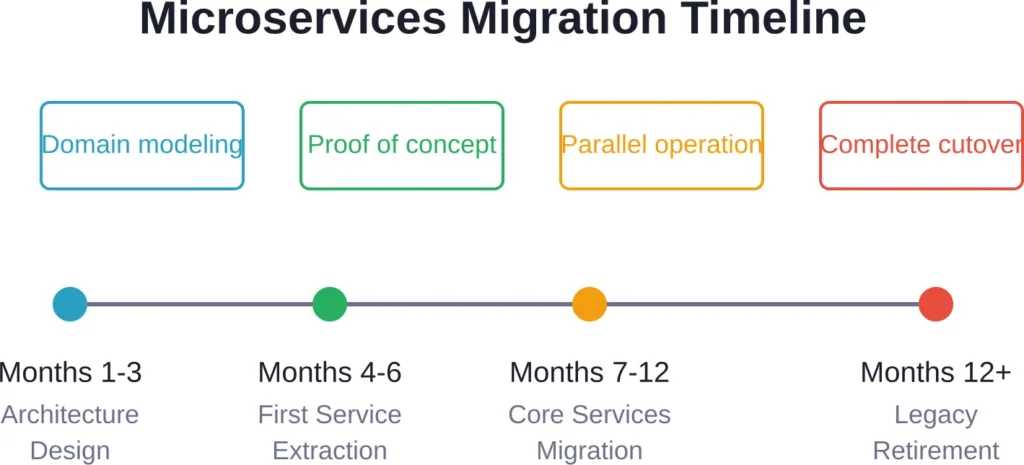
Microservices migration typically spans 12-24 months for enterprise systems, though timelines vary based on monolith complexity and team size. The first 3 months focus on architecture design and domain modeling. Months 4-6 extract the first service as proof of concept. Months 7-12 migrate core services using strangler fig patterns. Beyond 12 months, teams retire remaining legacy components gradually. Organizations should plan for parallel operation of old and new architectures during transition periods.
Service-Oriented Architecture (SOA) and microservices share service-based design but differ in scope and implementation. SOA often involved enterprise service buses, SOAP protocols, and shared data models across services. Microservices favor lightweight HTTP/REST or messaging, independent data storage per service, and decentralized governance. Microservices are typically smaller in scope, deployed more frequently, and embrace polyglot programming. SOA emphasized reuse and standardization; microservices prioritize autonomy and replaceability.
Microservices testing requires multiple layers. Unit tests verify individual service logic. Integration tests check database interactions and external dependencies. Contract tests ensure API compatibility between services without requiring all services running. End-to-end tests validate complete workflows across services but should be minimal due to brittleness and maintenance cost. Service virtualization and test doubles simulate dependencies. Observability tools help debug issues in production. Strong teams automate testing in CI/CD pipelines and use consumer-driven contracts to catch breaking changes early.
Core microservices technologies include container platforms like Docker for packaging, Kubernetes for orchestration, API gateways for routing, service meshes for communication, message queues for asynchronous messaging, distributed tracing tools for observability, and centralized logging for debugging. Configuration management systems handle environment-specific settings. CI/CD pipelines automate deployment. Infrastructure-as-code tools provision environments consistently. The specific stack depends on requirements, but these categories represent essential capabilities for operating microservices at scale.
Yes. While cloud platforms provide managed services that simplify operations, microservices can run on-premises using Kubernetes or other container orchestration platforms. Organizations requiring data residency, regulatory compliance, or existing datacenter investments often deploy microservices on-premises. This approach requires more operational expertise since teams manage infrastructure themselves rather than consuming cloud services. Hybrid approaches combining on-premises clusters with cloud resources are common, especially during migration phases or for disaster recovery.
Choosing Your Microservices Partner
The companies profiled here represent different strengths. Spiral Scout brings decades of experience and domain-driven design expertise. EPAM and Accenture handle enterprise scale. Thoughtworks pioneered many microservices practices. Luxoft and Corsac excel in regulated industries.
Your choice depends on specific needs. Financial services organizations need partners who understand compliance constraints. Healthcare applications require HIPAA and HL7/FHIR knowledge. Government projects need security clearances and accessibility compliance.
Technical depth matters more than company size. Meet the architects who’ll actually design your system. Ask about specific projects they’ve delivered, patterns they’ve implemented, and challenges they’ve solved.
Look beyond initial development to long-term operations. Microservices require ongoing monitoring, capacity planning, and incident response. Partners with operational experience understand Day 2 challenges.
The right partner brings architectural knowledge, technical execution capability, and operational maturity. They’ll guide technology choices, facilitate domain modeling, establish development practices, and build systems that deliver on microservices promises—independent deployment, fault isolation, and team autonomy.
Start by evaluating 2-3 companies from this list that match your industry and requirements. Request detailed case studies. Check client references. Assess team depth through technical conversations.
Microservices done right transform how organizations build and deploy software. But they require specialized expertise. The companies listed here have demonstrated that expertise through client work, architectural contributions, and measurable outcomes. Choose carefully—your architecture partner shapes system success for years to come.