

Quick Summary: The best web accessibility companies combine deep WCAG expertise, manual testing with assistive technologies, and comprehensive remediation support. Top agencies include Level Access, Deque Systems, TPGi (The Paciello Group), and AudioEye, each offering specialized services from accessibility audits to automated monitoring, helping organizations achieve ADA and Section 508 compliance while building inclusive digital experiences.
Digital accessibility isn’t optional anymore. With over 1.3 billion people—roughly 16% of the global population—living with some form of disability according to WHO data, organizations face both ethical obligations and legal requirements to make their digital properties accessible to everyone.
But here’s the thing: building truly accessible websites and applications requires specialized expertise that most in-house teams simply don’t have. That’s where accessibility companies come in.
This guide profiles 15 leading web accessibility companies, examining what makes each one stand out and which types of organizations they serve best.
Why Organizations Partner with Web Accessibility Companies
The accessibility landscape has shifted dramatically. Legal pressure keeps mounting, with ADA lawsuits against businesses for inaccessible websites becoming routine. Compliance with WCAG standards, Section 508 requirements, and various international regulations demands constant vigilance.
Beyond legal protection, accessible design expands market reach. When sites work properly with screen readers, keyboard navigation, and assistive technologies, businesses open their doors to millions of potential customers previously excluded.
And manual testing matters more than many realize. Automated tools can catch 30-40% of issues, according to data from multiple testing providers. The remaining issues require human evaluation—experts who understand how real users with disabilities actually interact with digital interfaces.
Most organizations lack this specialized knowledge internally. Building Section 508 program teams with defined roles for accessibility testers, program managers, and subject matter experts represents a significant investment, as outlined in federal guidance materials.
What to Look For in an Accessibility Partner
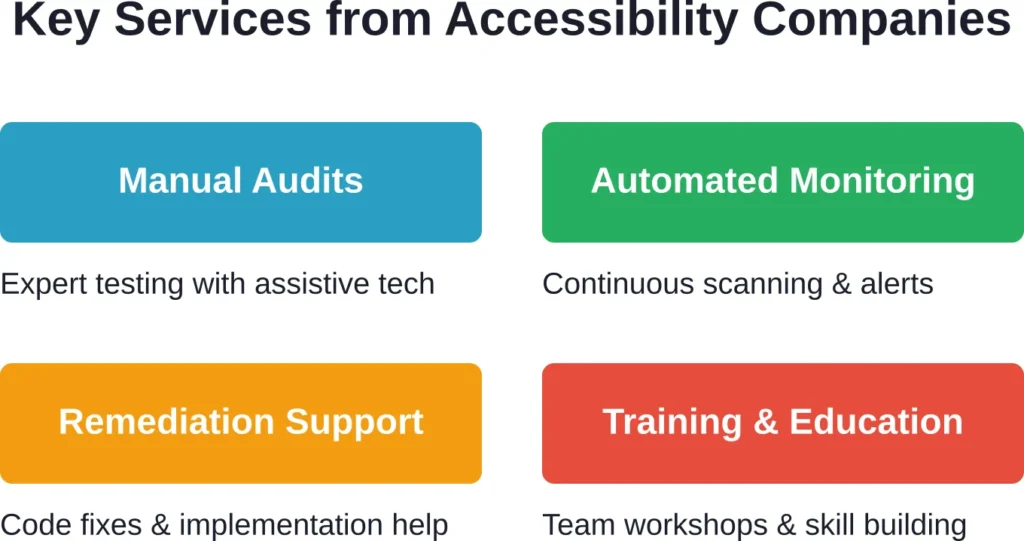
Not all accessibility companies operate the same way. Some focus heavily on automated scanning tools, while others emphasize manual auditing. The best providers balance both approaches.
Top accessibility firms offer proactive services like training programs, design reviews during development, and strategic planning alongside reactive remediation work. This prevents accessibility debt from accumulating rather than just patching existing problems.
Look for teams that include certified professionals—IAAP credentials like CPACC, WAS, or CPWA demonstrate serious commitment to the field. These aren’t weekend certifications; they require substantial accessibility knowledge.
Companies should demonstrate fluency in WCAG 2.1 and 2.2 standards at Level AA, plus specific frameworks like Section 508 for government contractors or EN 301 549 for European markets.
Top 15 Web Accessibility Companies
The following agencies represent the strongest options in the accessibility services market. Each brings distinct strengths, and the best choice depends on organizational size, technical complexity, and specific compliance needs.
1. Mobian
Mobian builds dedicated engineering teams that deliver production-ready mobile and AI solutions for companies in IT, healthcare, fintech, and logistics. The company operates through both full outsourcing and outstaffing models with senior-level expertise.
Their pragmatic approach emphasizes clean architecture, full-stack delivery, legacy integration, and ongoing post-launch partnership. Mobian maintains high standards in documentation, scalability, and domain-specific knowledge.
Companies that cannot afford technical missteps and need fast, reliable delivery of complex digital products choose Mobian for sustainable product development and team augmentation.
Contact Information:
- Website: mobian.studio
- Phone: [email protected]
- Address: Harju maakond, Tallinn, Kesklinnalinnaosa, Masina tn 22, 10113
- LinkedIn: www.linkedin.com/company/mobian-studio
2. Lengreo
Lengreo consistently stands out as a results-driven digital marketing and tech partner for ambitious B2B companies. The agency delivers comprehensive programs spanning strategy development, lead generation, SEO, paid ads, and website development.
Their approach combines hyper-personalized outreach with data-backed optimization, building particular strength in LinkedIn campaigns, demand generation, and full-funnel conversion improvement. The team focuses on tailoring tactics to each client’s unique strengths rather than offering pre-packaged solutions.
Lengreo works well for organizations seeking a true extension of their team that drives qualified opportunities and measurable business growth.
Contact Information:
- Website: Lengreo.com
- Phone: +31 686 147 566
- Email: [email protected]
- Address: Vrijstraat 9 C/D, 5611 AT Eindhoven, Netherlands
- LinkedIn: Lengreo
- Twitter: @Lengreo
- Instagram: @lengreo
3. A-listware
A-listware provides software development and IT consulting services with a focus on building high-quality, secure digital solutions. The company offers dedicated development teams, application services, UX/UI design, testing, and comprehensive infrastructure management.
What distinguishes A-listware is their seamless team integration and end-to-end delivery. They act as a true extension of client organizations, ensuring smooth collaboration and consistent quality across custom software, cloud solutions, and data analytics projects.
Organizations requiring flexible outsourcing or team augmentation with reliable technical execution frequently partner with A-listware.
Contact Information:
- Website: a-listware.com
- Phone: +1 (888) 337 93 73
- Email: [email protected]
- Address: North Bergen, NJ 07047, USA
- LinkedIn: www.linkedin.com/company/a-listware
- Facebook: www.facebook.com/alistware
4. Gilzor
Gilzor specializes in custom software development that helps companies launch startups, scale SMBs, and grow product studios. The company provides end-to-end services from idea validation and UI/UX design to mobile and web development, QA, and go-to-market execution.
What sets Gilzor apart is their user-centric and strategic approach. They emphasize building secure, scalable digital products that connect functionally with target audiences while reducing risk through thorough business analysis and testing.
Organizations looking for reliable full-cycle development partners that deliver high-quality solutions aligned with business objectives often choose Gilzor.
Contact Information:
- Website: www.gilzor.com
- Email: [email protected]
- Address: Poland, Warsaw, Office 58, street Adama Mickiewicza 37, 01-625
- LinkedIn: www.linkedin.com/company/gilzor-softwaredevelopment
5. Oski
Oski delivers smart, well-engineered software solutions for tech-forward enterprises and ambitious startups. The company excels in cloud architecture, frontend development, artificial intelligence integrations, and robust CMS implementations.
Their strength lies in combining innovative design with reliable performance across multiple industries including fintech, logistics, e-commerce, and education. Oski focuses on scalable, secure solutions that help businesses reimagine operations through digital innovation.
Companies that need dependable development partners capable of handling complex technical requirements while maintaining excellent user experiences turn to Oski.
Contact Information:
- Website: oski.site
- Phone: +48571282759
- Email: [email protected]
- Address: Kaupmehe tn 7, 10114 Tallinn, Estonia
- LinkedIn: www.linkedin.com/company/oski-solutions
6. Bureau of Internet Accessibility
BoIA delivers accessibility auditing services with particular strength in education and training. The company has developed extensive course materials and workshops that help organizations build lasting accessibility knowledge internally.
Their testing methodology combines automated scans, expert manual evaluation, and assistive technology verification. BoIA consultants often work on remediating existing issues while simultaneously training client teams to prevent future problems.
Companies investing in long-term accessibility competency rather than just checking compliance boxes appreciate BoIA’s educational focus.
7. UsableNet

UsableNet offers both technology platforms and managed services for accessibility compliance. Their approach includes automated testing tools, manual audits, and legal support services for organizations concerned about accessibility litigation.
The company has developed particular expertise in e-commerce accessibility, helping retail and commerce platforms ensure their checkout flows, product catalogs, and customer account features work properly for all users.
Retail organizations and companies with complex transactional websites often turn to UsableNet for their specialization in commerce-specific accessibility challenges.
8. QualityLogic

QualityLogic provides accessibility testing services with a strong foundation in software quality assurance. Their accessibility practice applies rigorous QA methodologies to WCAG conformance testing.
The company handles both web and mobile accessibility testing, document accessibility remediation, and Section 508 compliance for government contractors. Their team includes certified accessibility specialists and they maintain detailed testing protocols.
Organizations that already work with QualityLogic for general QA services can add accessibility testing within the same vendor relationship.
9. SSB BART Group
SSB BART Group emphasizes accessibility as a business value driver rather than merely a compliance requirement. Their consulting approach examines how accessibility improvements expand market reach and improve overall user experience.
Services include accessibility audits, user testing with people who have disabilities, strategic accessibility planning, and training programs. The company has worked extensively in higher education and has developed specialized expertise in academic technology accessibility.
Educational institutions and organizations wanting strategic accessibility guidance alongside technical testing often engage SSB BART Group for their consultative approach.
10. Digital Accessibility Consulting (DAC)
DAC focuses exclusively on accessibility services without offering general web development or design work. This specialization allows deep focus on accessibility challenges.
The company provides conformance audits, user testing, training, and can provide ongoing accessibility support to internal teams. DAC emphasizes teaching clients to build sustainable internal capabilities rather than creating perpetual dependency.
Organizations wanting to develop internal accessibility expertise while receiving initial guidance and auditing support find DAC’s approach effective.
11. Level Access
Level Access consistently ranks among the most recognized names in enterprise accessibility. The company serves major corporations and government agencies with comprehensive programs that span testing, remediation, and ongoing monitoring.
Their platform combines automated scanning with expert manual audits, and they’ve built particular strength in handling complex web applications and mobile apps. The team includes numerous IAAP-certified professionals and accessibility specialists who’ve worked on some of the web’s largest properties.
Level Access works well for large organizations with substantial digital estates requiring continuous accessibility management rather than one-time audits.
12. Deque Systems
Deque created axe, one of the industry’s most respected open-source accessibility testing engines. Their commercial products build on this foundation, offering both developer tools and enterprise testing platforms.
What sets Deque apart is their developer-first approach. Their tools integrate directly into code editors, CI/CD pipelines, and development workflows, catching accessibility issues before they reach production. The company also provides training programs and consulting services.
Organizations with strong technical teams and modern development practices often find Deque’s approach aligns well with their existing processes.
13. TPGi (The Paciello Group)
TPGi brings deep expertise and a pragmatic approach to accessibility challenges. The company was founded by accessibility advocates and includes team members who literally wrote portions of WCAG standards and ARIA specifications.
Their services emphasize practical, implementable solutions rather than theoretical perfection. TPGi consultants work closely with design and development teams to understand project constraints and recommend approaches that balance accessibility goals with business realities.
Organizations dealing with particularly complex accessibility challenges often turn to TPGi for their technical depth.
14. AudioEye

AudioEye offers a hybrid model combining automated monitoring technology with managed services. Their platform continuously scans websites, automatically fixes certain common issues, and flags problems requiring manual attention.
The company positions itself as an accessibility solution for organizations that need ongoing compliance assurance without building large internal teams. AudioEye’s approach includes legal risk mitigation support, which appeals to businesses concerned about ADA litigation.
Mid-market companies and organizations with multiple web properties often appreciate AudioEye’s managed service model.
15. Accessible360
Accessible360 emphasizes human-centered accessibility testing, conducting thorough manual audits with assistive technology users who have disabilities. This user testing component provides insights automated tools and expert audits can miss.
The company offers various service levels, from basic conformance audits to comprehensive usability testing programs. They also provide training and can embed consultants within client teams for longer-term accessibility initiatives.
Organizations that want to deeply understand how real users with disabilities experience their digital properties find particular value in Accessible360’s user research capabilities.
Automated vs. Manual Testing: Understanding the Balance
The accessibility industry includes two fundamentally different approaches, and understanding the distinction helps evaluate providers properly.
Automated tools excel at identifying technical violations: missing alt text, insufficient color contrast, improperly nested headings, forms without labels. These problems are objectively detectable through code analysis.
The limitation? Automated tools can catch 30-40% of issues, according to provider data. That percentage holds remarkably consistent across different automated solutions.
Human accessibility specialists test with actual assistive technologies—screen readers like JAWS and NVDA, voice control software, screen magnifiers, keyboard-only navigation. They evaluate whether interfaces make sense to disabled users, not just whether code validates.
Top accessibility companies use both methods strategically. Automated scans identify obvious technical violations quickly, allowing human experts to focus on complex interactions, content quality, and real-world usability issues.
| Testing Method | Coverage | Speed | Best For |
|---|---|---|---|
| Automated Scanning | 30-40% of issues | Minutes to hours | Technical violations, ongoing monitoring |
| Manual Expert Testing | 60-70% of issues | Days to weeks | Complex interactions, content quality |
| User Testing | Real experience | Weeks | Validating fixes, understanding needs |
| Hybrid Approach | Near-complete | Balanced | Comprehensive programs |
How to Evaluate Accessibility Companies
With so many providers claiming accessibility expertise, how do organizations separate genuine capability from marketing claims?
Ask About Testing Methodology
Request detailed explanations of testing processes. Legitimate providers will clearly describe their combination of automated and manual testing, which assistive technologies they use, and how they prioritize findings.
Be wary of vague answers or providers who can’t articulate specific testing steps.
Verify Team Credentials
Check whether team members hold IAAP certifications or similar credentials. While certification isn’t everything, it demonstrates commitment to professional development in the accessibility field.
Review Sample Reports
Request anonymized examples of audit reports. Quality reports include clear issue descriptions, specific code examples, remediation guidance, and prioritization based on impact and WCAG conformance level.
Understand Remediation Support
Some companies provide detailed fix recommendations but expect client teams to implement changes. Others offer remediation services directly. Clarify what happens after the audit.
Assess Communication Style
Accessibility work requires close collaboration between testing experts and internal teams. During the evaluation process, notice whether providers communicate clearly and demonstrate patience explaining complex concepts.
| Evaluation Factor | What to Look For | Red Flags |
|---|---|---|
| Testing Methods | Clear hybrid approach | Over-reliance on automation |
| Team Credentials | IAAP certifications, experience | No specialized training |
| Report Quality | Detailed with remediation guidance | Generic lists without context |
| Ongoing Support | Training, verification, consultation | Audit-only with no follow-up |
Building Internal Capabilities vs. Outsourcing
Should organizations build in-house accessibility teams or partner with external companies? The answer often involves both.
Accessibility can’t be purely outsourced. Developers, designers, and content creators need baseline accessibility knowledge to prevent problems during production. Federal guidance on Section 508 programs emphasizes defined roles and accountability within organizations.
Even with internal capabilities, external accessibility companies provide several advantages. They bring cross-industry perspective from working with many clients, stay current on evolving standards, and provide objective auditing of internal work.
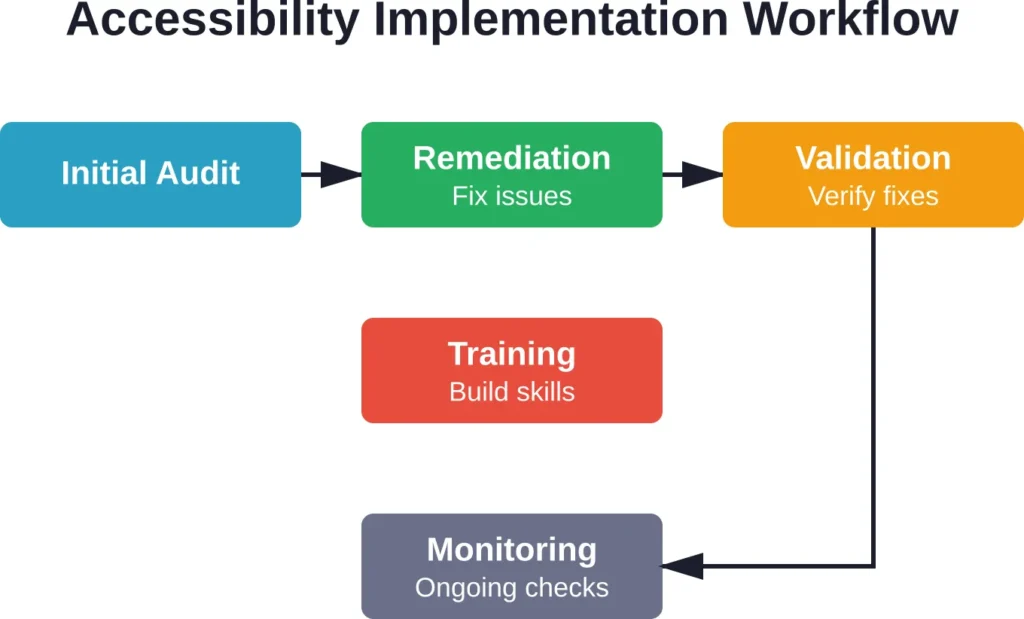
Many organizations use a tiered approach: internal teams handle basic compliance and preventive work, while external partners conduct periodic comprehensive audits, provide specialized expertise for complex challenges, and offer training to level up internal skills.
Common Mistakes When Hiring Accessibility Companies
Several patterns repeatedly trip up organizations seeking accessibility help.
Choosing Based on Price Alone
Accessibility is a specialized field. The lowest bid often comes from providers lacking genuine expertise. Inadequate testing that misses critical issues costs more in the long run.
Expecting One-Time Fixes
Accessibility isn’t a one-and-done project. Sites change constantly through content updates, new features, and platform modifications. Organizations need ongoing accessibility processes.
Relying Exclusively on Automated Tools
Automated scanning catches 30-40% of issues. Relying solely on automation creates false confidence—sites may pass automated checks while remaining unusable for disabled people.
Ignoring Remediation Capability
Finding problems is only half the battle. Organizations should consider whether their internal teams can implement fixes based on audit reports.
Frequently Asked Questions
Timelines vary significantly based on site complexity and scope. A basic audit of a small website might take 1-2 weeks, while comprehensive testing of a large, complex web application could require 4-8 weeks or more. Automated scans complete quickly, but thorough manual testing requires substantial time.
Generally speaking, no. Level AAA represents the highest accessibility standard and isn’t recommended as a general requirement even by WCAG authors. Level AA is the target for most legal requirements worldwide.
Automated overlays—JavaScript widgets claiming to make sites accessible without code changes—are controversial in the accessibility community. While some provide minor benefits, they can’t solve fundamental accessibility problems in site architecture, content, or functionality. Legitimate accessibility requires fixing underlying issues.
Organizations should conduct comprehensive manual audits at least annually, with more frequent testing for sites that change regularly. Many companies implement continuous automated monitoring to catch obvious issues between manual audits.
Accessibility testing evaluates conformance to technical standards like WCAG. Usability testing examines whether disabled users can actually accomplish tasks efficiently and intuitively. A site can technically conform to WCAG but still present usability problems.
Fix critical accessibility barriers immediately, regardless of redesign plans. Legal requirements don’t pause for future platform migrations. Address high-impact issues preventing disabled users from accessing essential content now.
No legitimate accessibility provider can guarantee protection from legal action. Even sites that fully conform to WCAG standards could theoretically be sued. What professional accessibility companies provide is best-effort conformance to recognized standards and expert support if legal challenges arise.
Conclusion
Selecting the right accessibility partner significantly impacts both compliance success and overall digital experience quality. The 15 companies profiled here represent strong options, each with distinct strengths suited to different organizational needs.
Look for providers that combine automated efficiency with manual testing depth, offer clear communication and detailed reporting, and demonstrate genuine accessibility expertise through team credentials and methodology.
Accessibility isn’t optional anymore, and it’s not getting easier to ignore. Legal pressure continues mounting, disabled users rightfully demand equal access, and inclusive design simply represents good business practice.
The investment in professional accessibility support pays returns through legal risk reduction, market expansion, and better overall user experience. Organizations that treat accessibility as a strategic priority rather than a compliance checkbox consistently achieve better outcomes.
Start by evaluating where the organization currently stands with accessibility. Conduct a preliminary assessment, identify critical gaps, and then engage with providers whose strengths match specific needs. Partner with companies that share genuine commitment to inclusive design—not just vendors checking boxes, but experts dedicated to making the digital world accessible to everyone.