

Quick Summary: Finding the right database design partner in 2026 means evaluating technical depth, security practices, and proven delivery track records. This guide profiles 15 leading agencies and managed service providers — from cloud-native specialists to legacy modernization experts — helping organizations match their data architecture needs with the right partner. Whether scaling a startup or modernizing enterprise systems, understanding what elite database companies deliver sets the foundation for long-term success.
Data infrastructure decisions ripple through organizations for years. Choose well, and operations scale smoothly while costs stay predictable. Choose poorly, and engineering teams spend months fixing performance bottlenecks, security gaps, and technical debt.
The database design companies that dominate 2026 distinguish themselves not through marketing promises but through measurable outcomes: reduced latency, eliminated downtime, and architectures that actually scale. Some focus exclusively on cloud-native PostgreSQL and NoSQL solutions. Others specialize in rescuing legacy Oracle estates.
But here’s the thing—matching company capabilities to organizational needs requires understanding what elite database partners actually deliver versus what commodity services look like.
This guide profiles 15 database design companies leading the market in 2026, covering their specializations, delivery models, and the specific problems they solve best. No fluff. Just the technical differentiation that matters when betting infrastructure decisions on a partner.
What Separates Elite Database Companies from Standard Providers
Most software consultancies claim database expertise. Walk through discovery calls, though, and the differences become stark.
Elite database companies staff projects with architects who’ve designed systems handling millions of transactions daily. They bring documented experience with specific database engines—not generic SQL knowledge. When discussing indexing strategies or replication topologies, conversations stay technical rather than drifting to abstract best practices.
Standard providers often treat databases as commodities. Install PostgreSQL or MongoDB, run migrations, call it done. Real database design work requires understanding query patterns, data volume growth trajectories, backup and recovery architectures, and how schema decisions impact application performance two years down the road.
The Technical Depth Difference
Top database companies assign senior engineers—not recent bootcamp graduates—to architecture decisions. These specialists understand:
- When to denormalize for read performance versus maintaining strict normalization
- How partitioning strategies affect query performance at scale
- Which replication topologies provide actual high availability versus marketing claims
- Cost implications of storage choices across cloud providers
- Security hardening beyond default configurations
Industry reports suggest that optimization work from experienced database specialists often reduces cloud infrastructure costs significantly through better query design, appropriate indexing, and right-sizing compute resources.
Proven Delivery Track Records
Real database companies reference specific client outcomes. Not vague testimonials—concrete metrics.
For instance, case studies from leading providers describe migrations that reduced query latency from seconds to milliseconds. Others document eliminating planned hardware purchases worth $200,000 through database optimization alone. The best firms provide references willing to discuss technical details.
Contrast this with agencies offering database work as one service among dozens. Their portfolios showcase web design, mobile apps, and marketing automation—with databases treated as backend plumbing rather than specialized engineering.
The 15 Best Database Design Companies in 2026
These firms represent the strongest options across different organizational needs and technical requirements. Each brings distinct capabilities to specific database challenges.
1. Mobian Studio

Mobian Studio builds dedicated engineering teams that deliver production-ready mobile and AI solutions for companies in IT, healthcare, fintech, and logistics. They operate through both full outsourcing and outstaffing models.
What differentiates Mobian is their focus on senior-level execution and clean architecture delivered by teams that work exclusively on a single project. They emphasize documented, maintainable code and clear communication throughout the engagement.
The company provides end-to-end product development covering mobile applications, AI and automation systems, scalable backend architecture, legacy integration, and post-launch support. Their domain expertise includes regulatory compliance, complex integrations, and systems designed for significant growth.
Mobian maintains partnership beyond initial delivery with bug warranties, scaling assistance, and continued support for evolving product needs.
Best for: Companies in regulated or high-growth industries that need fast, reliable delivery of mobile and AI-powered software through dedicated teams without the overhead of internal hiring.
Contact Information:
- Website: mobian.studio
- Phone: [email protected]
- Address: Harju maakond, Tallinn, Kesklinnalinnaosa, Masina tn 22, 10113
- LinkedIn: www.linkedin.com/company/mobian-studio
2. Lengreo

Lengreo operates as a complete marketing and technology partner for B2B companies seeking measurable growth through digital channels. Their services span B2B digital marketing strategy, SEO, website development, paid advertising, lead generation, appointment setting, and demand generation.
The company distinguishes itself by building hyper-personalized outreach campaigns and tailored strategies instead of using pre-packaged solutions. They listen to client objectives and select the right combination of tactics and tools for each business.
Lengreo excels at delivering concrete business outcomes such as dramatically increasing acquired clients, generating qualified opportunities at scale, reducing cost per lead, and boosting conversion rates. Their approach combines data-driven SEO and content strategies with multi-channel lead generation including LinkedIn outreach, email marketing, and cold calling.
They also provide full-cycle website development from discovery and prototyping to implementation and ongoing support, ensuring digital assets actively contribute to business development.
Best for: B2B companies in IT, services, and tech sectors that need an integrated marketing and technology partner focused on lead generation, client acquisition, and measurable ROI.
Contact Information:
- Website: Lengreo.com
- Phone: +31 686 147 566
- Email: [email protected]
- Address: Vrijstraat 9 C/D, 5611 AT Eindhoven, Netherlands
- LinkedIn: Lengreo
- Twitter: @Lengreo
- Instagram: @lengreo
3. A-Listware

A-Listware functions as a software development and consulting partner that delivers dedicated teams and full project execution for enterprises, SMBs, and startups. They offer software development, application services, UX/UI design, QA, IT consulting, data analytics, infrastructure, and cybersecurity solutions.
The company stands out through seamless team integration, acting as a natural extension of the client’s own organization. They provide end-to-end management of development processes while maintaining clear communication and consistent quality delivery.
A-Listware handles legacy modernization, custom software development, cloud applications, enterprise systems (ERP, CRM, HR), and infrastructure services. Their solutions streamline operations, enable better B2B and B2C interactions, and support digital transformation initiatives.
They maintain expertise across cloud solutions, machine learning, intelligent platforms, embedded systems, and extended engineering teams to cover the complete IT ecosystem.
Best for: Organizations needing flexible software development outsourcing or dedicated team augmentation with reliable delivery and full-stack technical capabilities.
Contact Information:
- Website: a-listware.com
- Phone: +1 (888) 337 93 73
- Email: [email protected]
- Address: North Bergen, NJ 07047, USA
- LinkedIn: www.linkedin.com/company/a-listware
- Facebook: www.facebook.com/alistware
4. Gilzor

Gilzor specializes in custom software development for startups and small-to-medium businesses, offering end-to-end services from idea validation to product launch and scaling. Their expertise covers mobile and web development, UI/UX design, quality assurance, go-to-market strategy, and ongoing support.
What sets Gilzor apart is their structured full-cycle approach that combines technical execution with business thinking. They emphasize idea validation, product-market fit research, and user-centric design to reduce risk before heavy development begins.
The company delivers secure, scalable applications for iOS and Android, full-stack web solutions, and custom features that directly support business goals such as process automation, customer experience improvement, and revenue growth. Their projects include solutions for airlines, e-commerce, and cognitive training applications.
Gilzor maintains a strong focus on post-launch partnership, providing maintenance, iteration based on user feedback, and technology updates to ensure long-term product success.
Best for: Startups and SMBs looking for a reliable custom software development partner that handles both technical delivery and business validation without requiring large in-house teams.
Contact Information:
- Website: www.gilzor.com
- Email: [email protected]
- Address: Poland, Warsaw, Office 58, street Adama Mickiewicza 37, 01-625
- LinkedIn: www.linkedin.com/company/gilzor-softwaredevelopment
5. Oski

Oski builds smart, well-engineered software solutions for tech-forward enterprises and ambitious startups. They provide cloud architecture, frontend development, artificial intelligence integrations, and CMS implementations across multiple technologies and frameworks.
Their strength lies in combining deep technical capabilities with industry-specific knowledge. Oski designs solutions that deliver scalability, security, and seamless user experiences while integrating emerging technologies like generative AI and machine learning.
The company handles complex digital transformations across industries including travel, logistics, e-commerce, education, fintech, and insurance. Their work includes cloud and serverless solutions, modern frontend architectures, AI-powered features, and robust content management systems.
Oski focuses on delivering production-ready solutions with emphasis on automation, performance, and future-proof architecture that supports business growth.
Best for: Enterprises and growth-stage companies that require high-quality, scalable software solutions with expertise in cloud, AI, and industry-specific digital transformation.
Contact Information:
- Website: oski.site
- Phone: +48571282759
- Email: [email protected]
- Address: Kaupmehe tn 7, 10114 Tallinn, Estonia
- LinkedIn: www.linkedin.com/company/oski-solutions
6. Navisite (an Accenture Company)

Navisite brings enterprise-grade database services backed by Accenture’s resources while maintaining the focused expertise of a specialized database team. They support Oracle, Microsoft SQL Server, MySQL, PostgreSQL, and cloud-native databases across hybrid cloud architectures.
The company excels at complex hybrid deployments where some databases remain on-premises for compliance or performance reasons while others migrate to cloud platforms. Navisite architects these environments for consistent management, security policies, and backup strategies across locations.
Their database practice integrates with broader application modernization initiatives. When Accenture clients undertake digital transformation programs requiring database architecture changes, Navisite specialists embed in project teams to handle data-layer decisions.
Managed services from Navisite include not just operational support but continuous optimization—ongoing performance tuning, capacity planning, and architecture evolution as application requirements change.
Best for: Enterprise organizations undertaking digital transformation programs who need database expertise integrated with broader technology modernization initiatives.
7. 2nd Watch (a Cascadeo Company)

2nd Watch specializes in cloud-native database services focused exclusively on AWS and Azure managed database offerings: Amazon RDS, Aurora, DynamoDB, Azure SQL Database, Cosmos DB, and related services.
Rather than supporting legacy on-premises databases, 2nd Watch concentrates on helping organizations maximize cloud-native database platforms. Their architects understand the operational nuances, cost optimization strategies, and performance characteristics specific to each managed service.
The company’s database practice coordinates tightly with their cloud migration services. When applications move to AWS or Azure, 2nd Watch handles database migration strategy, schema optimization for cloud environments, and post-migration performance tuning.
They also provide ongoing managed services for cloud databases, handling monitoring, backup management, high availability configuration, and cost optimization. Their CloudFix tool automatically identifies cost-saving opportunities across cloud infrastructure including database services.
Best for: Organizations committed to AWS or Azure cloud platforms seeking specialized expertise in cloud-native managed database services.
8. Tessell

Tessell operates as a database-as-a-service platform designed to simplify database provisioning, cloning, and lifecycle management across Oracle, SQL Server, PostgreSQL, MySQL, and MongoDB on AWS, Azure, and Google Cloud.
Rather than traditional consulting or managed services, Tessell provides a control plane that automates database operations: spinning up environments, creating instant clones for development, managing backups, implementing high availability, and optimizing costs.
Development teams particularly benefit from Tessell’s rapid cloning capabilities. Creating full database copies for testing traditionally requires hours and significant storage costs. Tessell’s copy-on-write cloning produces instant copies using minimal storage, enabling more thorough testing workflows.
The platform also automates compliance and governance controls, enforcing organizational policies around encryption, access management, and backup retention without requiring constant oversight from database administrators.
Best for: Organizations with multiple development teams needing self-service database provisioning and cloning with centralized governance and cost control.
9. Silk (formerly Silk.us)

Silk focuses on cloud database performance optimization through its data virtualization platform. The technology sits between applications and cloud database storage, optimizing I/O patterns and caching frequently accessed data to dramatically improve performance.
Organizations struggling with cloud database performance—particularly I/O-intensive workloads like data warehouses or transactional systems—see substantial improvements after implementing Silk. Documented cases show query performance improvements of 5-10x versus standard cloud storage configurations.
The platform works transparently to applications, requiring no code changes. Database workloads simply perform faster and more consistently, often eliminating the need to over-provision expensive high-performance storage.
Silk also reduces cloud costs by allowing organizations to use lower-cost storage tiers while maintaining performance levels previously requiring expensive SSD-backed storage. This optimization particularly benefits large database deployments where storage costs constitute significant monthly expenses.
Best for: Organizations running performance-intensive database workloads on cloud platforms who need better performance without massively increasing infrastructure spending.
10. Redapt

Redapt provides end-to-end database services spanning strategy, design, implementation, and managed services across Oracle, Microsoft SQL Server, MySQL, PostgreSQL, and cloud databases on AWS, Azure, and Google Cloud.
The company differentiates through comprehensive lifecycle services. Database projects don’t end at implementation—Redapt maintains ongoing relationships handling performance optimization, capacity expansion, technology upgrades, and architecture evolution as business requirements change.
Redapt’s database architects also work closely with application development teams, ensuring database designs support application requirements efficiently. This collaboration prevents common disconnects where database schemas don’t match how applications actually query data.
Their managed services operate at multiple tiers from basic monitoring and backup management to comprehensive proactive optimization including regular performance reviews, capacity planning, and architecture recommendations.
Best for: Organizations seeking long-term database partnership spanning initial design through years of operational support and continuous optimization.
11. Fortified Data

Fortified Data operates as a specialized managed database service provider focused exclusively on database performance, security, and optimization. Their team consists of database engineers with deep expertise in Oracle, SQL Server, MySQL, PostgreSQL, and MongoDB.
The company distinguishes itself through providing senior-level database architects directly to clients rather than layering junior staff under partner oversight. This approach delivers what clients report as 29–51% cost savings compared to the Big Four firms.
Fortified Data handles both legacy on-premises systems and cloud-native PaaS environments equally well—a rare combination. Many organizations running Oracle databases for compliance reasons while migrating new applications to cloud platforms need this dual expertise.
They excel at database rescue scenarios: performance tuning when systems slow to crawl, emergency recovery when backups fail, and security hardening after compliance audits reveal gaps. The technical depth shows in documented case studies describing specific optimization techniques that resolved client issues.
Best for: Mid-market and enterprise organizations running mixed database environments who need direct access to senior database architects without Big Four pricing.
12. Pythian
Pythian built its reputation managing complex database estates for global enterprises. Their managed services cover Oracle, Microsoft SQL Server, MySQL, PostgreSQL, MongoDB, and Cassandra across on-premises, cloud, and hybrid deployments.
What sets Pythian apart is 24/7/365 proactive monitoring and support delivered by database specialists organized into platform-specific teams. Oracle experts handle Oracle issues. PostgreSQL specialists manage PostgreSQL systems. This specialization prevents the jack-of-all-trades problem plaguing general IT support.
Pythian’s service model works particularly well for organizations lacking in-house database administration teams. They essentially function as an outsourced DBA department, handling routine maintenance, performance optimization, patch management, and emergency response.
The company also tackles complex migrations—legacy system modernizations, cloud transitions, and database consolidation projects that require deep technical knowledge and project management discipline.
Best for: Enterprises needing comprehensive managed database services across multiple database platforms with follow-the-sun support coverage.
13. Percona

Percona focuses exclusively on open-source databases: MySQL, PostgreSQL, and MongoDB. Their business model combines enterprise support subscriptions with consulting services for database architecture, optimization, and troubleshooting.
The company employs many core contributors to these open-source projects. This matters because when challenging issues arise, Percona engineers often understand the database engine’s internals better than anyone except the original developers.
Percona’s consulting services shine in performance optimization scenarios. Organizations experiencing slow queries, replication lag, or capacity planning challenges benefit from their systematic optimization methodology backed by deep database internals knowledge.
They also maintain free performance monitoring and management tools (Percona Monitoring and Management) that many database teams use regardless of whether they purchase support contracts. This open-source contribution builds credibility and demonstrates technical capability.
Best for: Organizations standardized on open-source databases seeking expert-level support and optimization services without vendor lock-in.
14. Datavail

Datavail operates as a full-service database solutions provider covering design, implementation, managed services, and optimization across Oracle, Microsoft SQL Server, MySQL, PostgreSQL, and cloud databases on AWS, Azure, and Google Cloud.
Their strength lies in handling enterprise-scale database transformations. Datavail manages projects like consolidating dozens of regional database servers into centralized cloud architectures, upgrading aging Oracle estates to current versions, and implementing disaster recovery solutions that actually work when tested.
The company structures engagements around defined outcomes rather than hourly consulting. For example, a performance optimization project commits to specific query response time targets or throughput improvements rather than open-ended tuning work.
Datavail’s managed services include proactive monitoring, patch management, and optimization alongside traditional DBA functions. They also offer database-as-a-service options for organizations wanting fully managed infrastructure without building internal teams.
Best for: Large enterprises executing complex database modernization programs who need both consulting expertise and long-term managed services.
15. Rackspace Technology Database Services

Rackspace expanded from infrastructure hosting into comprehensive managed services including specialized database support. Their database team supports Oracle, Microsoft SQL Server, MySQL, PostgreSQL, MongoDB, Cassandra, Redis, and managed database services across AWS, Azure, and Google Cloud.
The value proposition centers on integrated infrastructure and database management. Rather than coordinating between a hosting provider and separate database consultants, Rackspace handles the full stack. This integration simplifies troubleshooting and accountability.
Rackspace’s database architects work closely with their cloud engineering teams to optimize infrastructure configurations for database workloads. This coordination prevents common mistakes like undersized storage IOPS or poorly configured network settings that bottleneck database performance.
Their managed services operate at different support tiers, allowing organizations to choose between basic monitoring and comprehensive proactive optimization based on criticality and budget.
Best for: Organizations seeking integrated cloud infrastructure and database management from a single provider with clear service level agreements.
Matching Database Companies to Organizational Needs
Selecting the right database partner requires understanding organizational context beyond technical requirements alone.
Startup and High-Growth Companies
Speed and scalability trump everything else for startups. Database architectures need to support rapid feature development and handle unpredictable traffic growth without constant re-architecture.
Cloud-native specialists like 2nd Watch make sense here. Their focus on AWS and Azure managed services aligns perfectly with startups building on cloud platforms from day one. Managed database services (RDS, Aurora, Azure SQL Database) provide scalability without hiring database administrators.
Platform solutions like Tessell also fit well. Development teams get self-service database provisioning and instant cloning for testing without waiting for operations approvals or manual setup work.
Startups should avoid overbuying. Comprehensive enterprise managed services designed for complex hybrid environments exceed startup needs and budgets. Focus on partners who excel at cloud-native architectures and support rapid iteration.
Mid-Market Companies ($50M–$500M Revenue)
Mid-market organizations balance cost-efficiency with performance and reliability needs. They typically run multiple database platforms—perhaps PostgreSQL for newer applications, SQL Server for legacy systems, and MongoDB for specific use cases.
Fortified Data targets this segment explicitly. Their senior-expertise model delivers enterprise-grade database architecture without Big Four consulting rates. Mid-market companies get direct access to experienced database architects at sustainable price points.
Percona works well for mid-market companies standardized on open-source databases. Their support subscriptions provide expert help when needed without the overhead of comprehensive managed services.
The key consideration for mid-market: right-sizing support levels. Full 24/7 monitoring for every database often exceeds requirements and budget. Better to prioritize critical systems for managed services while handling less critical databases with periodic consulting engagements.
Enterprise Organizations
Enterprises face the most complex database challenges: sprawling legacy systems, strict compliance requirements, global operations requiring follow-the-sun support, and hybrid architectures mixing on-premises and cloud platforms.
Comprehensive providers like Pythian, Datavail, and Navisite excel here. They bring the staffing depth to support complex estates, established processes for change management and compliance, and experience managing enterprise-scale projects.
Enterprises also benefit from partners with strong vendor relationships. When Oracle licensing disputes arise or Microsoft escalations stall, database companies with established vendor channels resolve issues faster than organizations going alone.
For enterprises running performance-intensive workloads on cloud platforms, Silk’s optimization platform addresses a common pain point: cloud database performance often disappoints compared to on-premises systems. Silk bridges that gap without requiring re-architecture.
Regulated Industries
Healthcare, financial services, and government organizations face unique database requirements around data sovereignty, encryption, audit logging, and compliance certifications (HIPAA, PCI-DSS, FedRAMP).
Database companies serving regulated industries need documented security practices, compliance certifications, and experience implementing required controls. Not every database consultant understands healthcare data residency requirements or financial services audit log retention.
Rackspace and Navisite both maintain extensive compliance certifications and established practices for regulated industries. Their managed services include compliance monitoring and regular audit support.
Regulated organizations should verify partner certifications rather than accepting generic security assurances. Request documentation of SOC 2 audits, HIPAA compliance programs, or industry-specific certifications relevant to organizational requirements.
Evaluating Database Companies: The Critical Questions
Sales conversations with database companies sound remarkably similar. Everyone claims deep expertise, senior staff, and proven methodologies. Cutting through marketing requires asking specific questions that reveal real capabilities.
Technical Depth Verification
Ask about staff certifications and experience levels. Who actually works on projects—fresh graduates or architects with 15 years of database specialization?
Request specific examples of performance optimization work. How did they diagnose the issue? What techniques resolved it? Generic answers about “tuning queries” mean little. Detailed discussions about query plan analysis, index strategy, or partitioning approaches demonstrate real expertise.
Inquire about their experience with the specific database platforms and versions in current use. Database engines evolve substantially between versions. Someone expert in Oracle 11g but unfamiliar with Oracle 19c autonomous features brings outdated knowledge.
Service Level Expectations
What response times do service level agreements guarantee for different issue severities? How do they define “production down” versus lower-priority issues?
Which services fall under standard agreements versus additional costs? Some managed service providers include proactive optimization in base contracts. Others charge separately for any work beyond monitoring and incident response.
How do they handle escalations when standard support channels fail to resolve issues? Real problems emerge outside business hours. Understanding escalation procedures and after-hours coverage prevents unpleasant surprises during weekend outages.
Security and Compliance Practices
Request documentation of security certifications (SOC 2, ISO 27001, industry-specific compliance). Ask how often they undergo third-party audits.
Understand data access policies. Who within their organization can access production databases? Under what circumstances? How do they audit that access?
For cloud-focused providers, verify they implement proper security controls: encryption at rest and in transit, network isolation, least-privilege access principles, and secure credential management. Default cloud configurations rarely provide adequate security.
Project Delivery Track Record
Request case studies or references from projects similar in scope and complexity. A company excelling at small PostgreSQL migrations may struggle with large-scale Oracle transformations.
Ask about their project failure rate and what went wrong. Companies claiming zero failures either lie or haven’t attempted challenging projects. How they handle difficulties reveals more than success stories.
Understand project methodologies. Do they follow structured approaches with defined milestones and deliverables? Or do projects drift through loose agile processes without clear completion criteria?
| Evaluation Criteria | What to Look For | Red Flags |
|---|---|---|
| Technical Staff | Named architects with verifiable experience, relevant certifications | Vague promises of “senior staff”, no specific names, offshore teams for critical work |
| Service Levels | Documented SLAs with specific response times, clear escalation paths | Loose “best effort” language, no guaranteed response times, unclear after-hours support |
| Security | Current compliance certifications, documented security practices, third-party audits | Self-attestation without verification, reluctance to share audit reports, no security certifications |
| References | Multiple references for similar project types, detailed case studies with metrics | Generic testimonials, unwilling to provide references, no documented results |
| Delivery Methodology | Structured approach with milestones, risk management, change control | Loose agile without deliverables, no project plans, vague timelines |
The Real Cost of Database Decisions
Organizations focus heavily on direct costs—consulting fees, subscription charges, implementation expenses. Real database costs extend far beyond invoices from partners.
Performance Impact on Revenue
Every additional second of database latency costs conversions. E-commerce sites lose sales when product searches lag. SaaS applications lose users when dashboards load slowly.
Properly designed database architectures with optimized queries and appropriate indexing keep applications responsive. Poor database design compounds over time as data volumes grow, eventually requiring expensive emergency optimization or complete re-architecture.
Case studies from financial services describe query optimization work that reduced report generation time from hours to minutes. That wasn’t just a technical improvement—analysts could run iterations during meetings instead of submitting requests and waiting overnight.
Operational Overhead and Team Productivity
Internal teams managing databases themselves bear substantial opportunity costs. Database administration, performance tuning, backup management, and security hardening consume engineering time that could focus on product development.
Managed services shift this burden to specialists who handle database operations more efficiently through automation, established processes, and accumulated expertise. Engineering teams then focus on application logic rather than database internals.
The tradeoff comes down to specialization. Small teams stretched thin benefit enormously from outsourcing database management. Larger organizations with dedicated database teams may find consulting engagements for specific projects more valuable than comprehensive managed services.
Risk Costs: Downtime and Security Breaches
Database failures carry catastrophic consequences. E-commerce sites lose thousands per minute during outages. Healthcare systems risk patient safety when electronic health records become unavailable. Financial platforms face regulatory penalties for extended downtime.
Elite database companies architect for resilience: proper replication, tested backup and recovery procedures, monitoring that catches issues before they cause outages. They’ve seen every failure mode and design systems to handle them.
Security breaches involving database compromises damage organizations for years through regulatory fines, legal costs, reputation harm, and customer loss. Database companies implementing proper security controls—encryption, access management, audit logging, vulnerability patching—prevent breaches that amateur implementations miss.
Database Technology Trends Shaping 2026
Database companies that thrive in 2026 demonstrate expertise in current technology directions rather than just maintaining legacy systems.
Cloud-Native Database Dominance
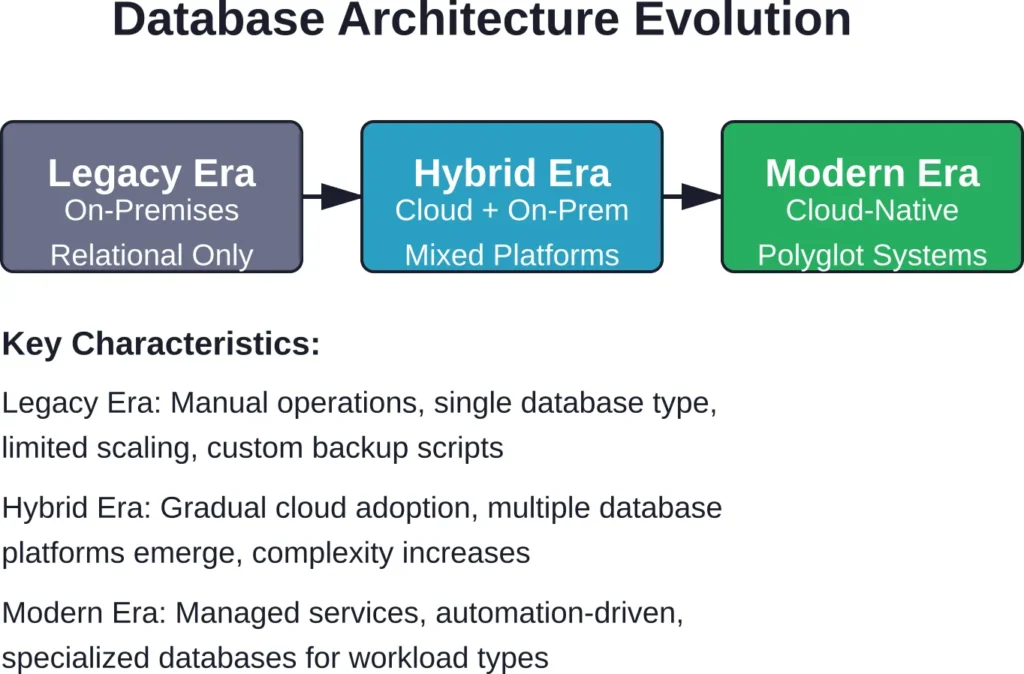
Managed database services from AWS, Azure, and Google Cloud now power the majority of new application development. Organizations increasingly prefer consuming databases as managed services rather than installing and maintaining database software.
This shift changes what organizations need from database partners. Rather than Oracle or SQL Server installation expertise, companies need specialists who understand managed service nuances: Aurora scaling behaviors, Cosmos DB consistency models, DynamoDB partition key design.
The best database companies evolved their practices alongside cloud platforms. They understand not just database engines but the cloud-native operational model: auto-scaling groups, managed backups, point-in-time recovery, cross-region replication.
Multi-Model and Specialized Databases
The days of relational databases handling all workloads gave way to specialized engines optimized for specific use cases. Document databases for flexible schemas. Time-series databases for IoT telemetry. Graph databases for relationship-heavy data.
Modern applications often combine multiple database types. User profiles live in PostgreSQL, product catalogs in MongoDB, session data in Redis, and analytics in Snowflake. Database companies need broad expertise across platforms rather than deep specialization in single engines.
This polyglot persistence trend complicates operations. Organizations running six different database platforms face monitoring complexity, backup strategy multiplication, and security policy enforcement across diverse systems. Database partners bringing unified operational approaches across platforms deliver substantial value.
Automation and Database DevOps
Database operations traditionally relied on manual processes: provisioning servers, configuring replication, running backups, applying patches. Modern database practice embraces automation through infrastructure-as-code, CI/CD pipelines, and self-service provisioning.
Companies like Tessell build platforms enabling this operational model. Development teams provision databases through APIs. Schema changes deploy through automated pipelines with testing gates. Backups run automatically with policy-driven retention.
But automation requires upfront investment in tooling, scripting, and process design. Database companies accelerate this transition by bringing established automation frameworks rather than organizations building everything from scratch.
Common Database Project Failures and How to Avoid Them
Database projects fail in predictable ways. Understanding common failure patterns helps avoid them.
Underestimating Migration Complexity
Organizations routinely underestimate database migration difficulty. What seems straightforward—move data from Oracle to PostgreSQL—reveals hidden complexity: incompatible SQL dialects, different transaction behaviors, stored procedure rewrites, application compatibility issues.
Elite database companies scope migrations realistically. They conduct thorough discovery: analyze current database usage patterns, identify application dependencies, test representative workloads, and build migration plans accounting for discovered complexity.
Rushed migrations that skip proper planning fail catastrophically. Applications break in production. Performance degrades. Data integrity issues emerge weeks after go-live when rollback becomes impossible.
Ignoring Performance Testing Until Production
Database designs that work fine in development often collapse under production load. Testing with sample data reveals little about behavior when tables contain millions of rows and hundreds of concurrent users hammer the system.
Proper database projects include performance testing with production-scale data volumes and realistic concurrency levels. Load testing reveals indexing gaps, query inefficiencies, and scaling limits before they cause production incidents.
Database companies with mature practices insist on performance validation. They’ve seen too many projects deploy beautiful architectures that immediately fail under real load.
Neglecting Backup and Recovery Until Disaster Strikes
Backup strategies receive minimal attention during initial implementations. Databases dutifully create daily backups that no one ever tests restoring. Then disaster strikes and backups prove corrupt, incomplete, or impossibly slow to restore.
Real database expertise includes designing and testing recovery procedures. How long does full restoration take? Can the organization afford that downtime? What’s the actual recovery point objective—how much data loss is acceptable?
The best database companies implement tiered recovery strategies: point-in-time recovery for recent incidents, daily backups for broader issues, and geographic replication for disaster scenarios. All tested regularly to verify they actually work.
Questions to Ask During Database Company Evaluations
Structured evaluation questions reveal which database companies bring substance versus marketing polish.
Technical Capabilities
- Which database platforms does your team specialize in? What certification levels do your architects hold?
- Describe your most complex recent database project. What made it challenging and how did you resolve those challenges?
- How do you approach performance optimization? Walk me through your methodology.
- What tools and monitoring platforms do you use for database operations?
- How do you stay current with database technology evolution and new platform features?
Service Delivery
- What service level agreements do you offer? What response times for different severity levels?
- How do you staff projects? Will we work with named individuals or rotating team members?
- What happens if the primary database architect leaves mid-project? How do you ensure continuity?
- Describe your escalation process for issues your standard support can’t resolve.
- How do you handle knowledge transfer to internal teams during and after projects?
Security and Compliance
- What security certifications does your organization maintain? When were you last audited?
- How do you manage access to client database systems? What audit logging do you maintain?
- What compliance frameworks are you experienced with (HIPAA, PCI-DSS, SOC 2, FedRAMP)?
- Describe your incident response process if a security issue emerges in our database environment.
- How do you ensure security controls stay current as threats evolve?
Business Practices
- Can you provide three references from projects similar in scope and complexity?
- What’s your typical project failure or delay rate? What are common causes?
- How do you handle scope changes and budget overruns during projects?
- What happens if we’re unsatisfied with service quality? What remedies do contracts provide?
- How do you measure and report on project success and ongoing service quality?
The Database Market Landscape in 2026
The database design and development services market is expected to witness robust growth from USD 10.5 billion in 2024 to USD 18.2 billion by 2033, reflecting approximately 6.5% compound annual growth.
This growth stems from several factors. Organizations generate exponentially more data requiring sophisticated management. Cloud platform adoption drives database modernization. Regulatory compliance demands around data protection intensify. Application architectures grow more complex, requiring specialized database expertise.
The market bifurcates between commodity services and high-value specialization. Basic database administration work commoditizes as managed services and automation handle routine tasks. High-end consulting around architecture, optimization, and complex migrations commands premium rates due to specialized knowledge requirements.
Competitive Dynamics
The database services market includes several distinct competitor categories:
Global consulting firms (Accenture, Deloitte, IBM) provide database services within comprehensive technology practices. They excel at large enterprise transformations requiring coordination across applications, infrastructure, and data. Premium pricing reflects brand reputation and comprehensive capabilities.
Specialized database companies (the ones profiled earlier) focus exclusively on database expertise. They compete on technical depth, direct access to senior specialists, and often more favorable pricing than global consultancies.
Cloud platform providers (AWS, Microsoft, Google Cloud) increasingly offer professional services around their managed database offerings. These make sense for organizations heavily invested in single cloud platforms seeking integrated support.
Offshore development firms provide low-cost database development but typically lack the senior expertise required for complex architecture work. They work for straightforward implementations with detailed specifications.
Technology Vendor Influence
Oracle, Microsoft, Amazon, and Google all push organizations toward their respective database platforms through aggressive sales tactics and attractive initial pricing. Database companies with multi-vendor expertise help navigate these pressures objectively.
Some database companies maintain formal partnerships with technology vendors. These relationships provide early access to new features and escalation channels for complex issues. However, they can also create bias toward partner solutions even when alternatives better suit client needs.
The best database companies maintain technology neutrality. They recommend platforms based on actual requirements rather than vendor relationships or familiarity bias.
Making the Final Database Company Decision
After evaluating multiple database companies, decision criteria should focus on fit rather than lowest cost or biggest brand name.
Evaluating Technical Fit
Do they demonstrate deep expertise in the specific database platforms currently in use or planned? Generic database knowledge doesn’t substitute for specialized experience with particular engines.
Have they successfully completed projects similar in scope and complexity? Small-scale PostgreSQL work doesn’t qualify a company for enterprise-scale Oracle transformations.
Can they explain technical approaches clearly to both technical and business stakeholders? Great database architects translate technical decisions into business implications.
Cultural and Communication Factors
Database projects require sustained collaboration. Companies with compatible communication styles and cultural fit execute more smoothly than technically excellent teams that clash with internal cultures.
Consider time zone coverage. Organizations operating globally need database partners who provide support across geographies. Domestic-only coverage creates gaps for international operations.
Evaluate responsiveness during the sales process. Companies taking days to answer questions or missing scheduled calls signal how they’ll behave during actual engagements.
Long-Term Partnership Potential
Database relationships typically extend years rather than months. Choose partners positioned for long-term collaboration rather than optimizing solely for initial project costs.
Companies demonstrating ongoing investment in their database practice—hiring senior talent, pursuing new certifications, adopting emerging technologies—remain valuable long-term partners. Those coasting on established capabilities gradually fall behind.
Look for database companies that view relationships as partnerships rather than vendor-customer transactions. The best providers invest in understanding organizational goals, proactively recommend improvements, and genuinely care about client success.
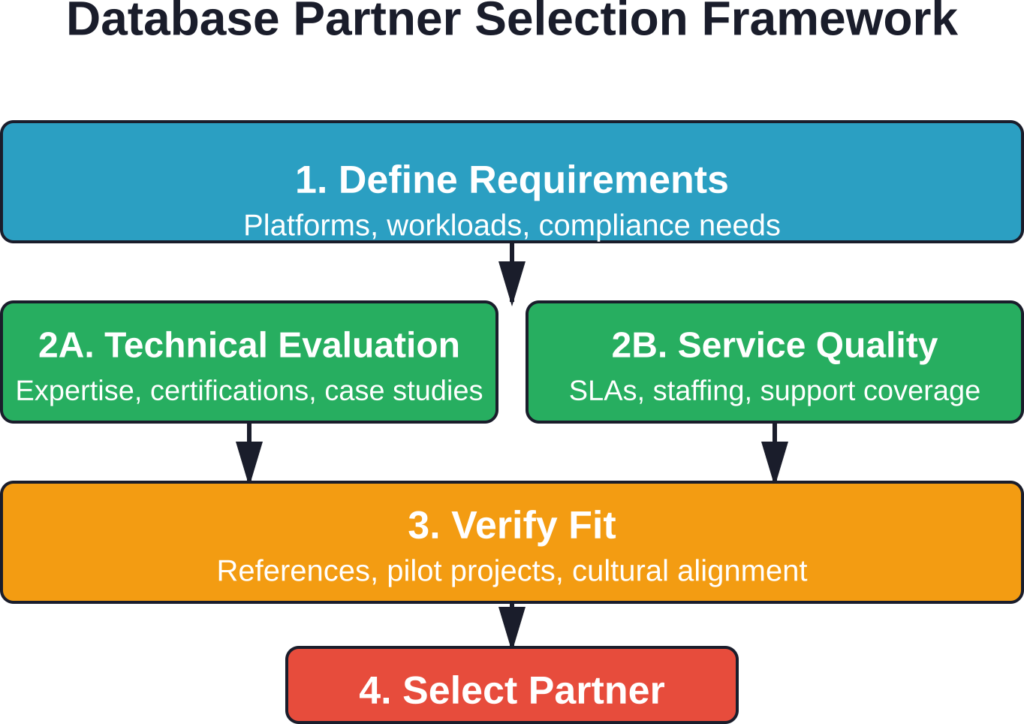
A structured selection framework evaluates database companies across requirements definition, parallel technical and service quality assessment, fit verification through references and pilots, culminating in final partner selection.
Starting Database Company Engagements Successfully
The first weeks of database partnerships set trajectories for entire engagements. Strong starts build momentum. Poor starts create friction that persists.
Discovery Phase Importance
Resist pressure to skip discovery in favor of immediate implementation. Thorough discovery reveals current state accurately: existing architecture, data volumes, query patterns, pain points, and hidden complexity.
Good database companies insist on proper discovery even when clients want to accelerate. They’ve learned that assumptions made during incomplete discovery create problems requiring expensive rework later.
Discovery deliverables should include documented architecture, identified risks, recommended approach, and realistic timelines. These artifacts prevent misunderstandings and provide baseline for measuring progress.
Clear Success Criteria
Define measurable success criteria before work begins. What specific outcomes indicate project success? Performance targets? Cost reduction goals? Functionality requirements?
Vague goals like “improve database performance” create disputes about whether outcomes met expectations. Specific targets—”reduce report query time to under two seconds” or “achieve 99.9% uptime”—provide clear benchmarks.
Document these criteria in statements of work or service agreements. Both parties signing off on success definitions prevents later disagreements about whether deliverables met expectations.
Communication Cadence
Establish regular communication rhythms: weekly status meetings, monthly executive reviews, immediate escalation protocols for urgent issues. Consistent communication prevents surprises and maintains alignment.
Define who participates in various communication forums. Weekly technical syncs involve engineers from both sides. Monthly reviews include business stakeholders assessing progress toward goals.
Document decisions and action items from meetings. Memory proves fallible. Written records prevent “I thought we agreed on X” disputes that derail projects.
Frequently Asked Questions
Pricing varies dramatically based on engagement type, required expertise level, and vendor positioning. Senior database architects from specialized firms typically command higher fees than general consultants, but deliver more efficient results. Organizations report cost savings of 29–51% working with specialized database companies compared to the Big Four firms, largely through direct access to senior experts rather than layered teams. For specific pricing, contact vendors directly as rates depend heavily on project scope, duration, and technical complexity.
Managed services provide ongoing operational support: monitoring, performance tuning, backup management, patching, and incident response. Organizations pay monthly fees for continuous coverage, typically with defined service level agreements. Consulting projects address specific initiatives with defined endpoints: migrations, architecture design, performance optimization, or implementations. These operate on project timelines with milestone-based deliverables. Many organizations combine both models—consulting for initial design and managed services for ongoing operations.
This depends on organizational context. Single-platform environments benefit from deep specialists—Percona for PostgreSQL, for instance. Organizations running multiple database types need partners with breadth across platforms who understand how different databases integrate and when each fits best. Companies in transition—migrating from Oracle to PostgreSQL, for example—need expertise in both source and target platforms plus migration methodology. Evaluate based on actual current and planned database landscape rather than choosing arbitrarily.
Project duration varies enormously by complexity. Simple cloud database setup might complete in weeks. Complex enterprise migrations involving multiple applications, data transformations, and legacy system integration often span 6-18 months. Realistic timeline estimation requires thorough discovery: analyzing current architecture, assessing data volumes, identifying dependencies, and accounting for testing and cutover planning. Be wary of companies promising aggressive timelines without adequate discovery—they’re either inexperienced or setting up for later delays and scope expansion.
Platform-specific certifications demonstrate technical knowledge: Oracle Certified Professional, Microsoft Certified Database Administrator, AWS Certified Database Specialty, MongoDB Certified DBA. However, certifications alone don’t guarantee expertise—they prove baseline knowledge. More important indicators include years of hands-on experience, documented successful projects, and ability to discuss complex technical scenarios during evaluation conversations. The best database architects combine certifications with extensive real-world experience solving production problems.
Yes, but verify specific compliance experience rather than accepting generic assurances. Database companies serving regulated industries should demonstrate understanding of relevant requirements: data encryption standards, audit logging specifications, access control policies, backup retention rules. Request documentation of compliance certifications the company maintains (SOC 2, ISO 27001, HIPAA compliance programs). Ask for references from clients in similar regulated environments. Generic database expertise doesn’t translate automatically to compliance knowledge—these require specialized understanding of regulatory frameworks.
This depends entirely on contract terms, which is why negotiating clear performance expectations and remedies up front matters. Well-structured agreements include defined deliverables, quality standards, timeline commitments, and remedies for non-performance (partial refunds, additional resources at vendor expense, early termination rights). Before signing, understand what recourse exists if the vendor misses milestones, delivers substandard work, or staffs projects with less experienced personnel than promised. Reputable database companies stand behind their work with concrete guarantees rather than vague best-effort language.
Conclusion: Choosing Database Partners That Deliver Results
Database infrastructure decisions compound over years. Systems designed well scale gracefully, perform reliably, and adapt as requirements evolve. Systems designed poorly become technical debt draining engineering resources and limiting organizational capabilities.
The 15 database companies profiled here represent strong options across different organizational contexts. Fortified Data delivers senior expertise at mid-market price points. Pythian provides comprehensive managed services for complex estates. Percona brings open-source database specialization. Each excels in specific scenarios.
But the right choice depends on matching company capabilities to organizational needs. Startups scaling rapidly need different partners than enterprises managing legacy systems. Cloud-native companies require different expertise than organizations running hybrid architectures.
Real talk: most organizations underinvest in database architecture relative to its long-term impact. They treat databases as commodity infrastructure rather than foundational platforms requiring specialized expertise. Then they spend years dealing with performance problems, security gaps, and scaling limitations that proper initial design would have prevented.
The database companies that deliver genuine value bring more than technical skills. They understand business context, communicate clearly with stakeholders, and focus on outcomes rather than billable hours. They’ve made mistakes on someone else’s projects and learned from them. They bring pattern recognition from seeing hundreds of database environments.
Start evaluations with clear requirements: which database platforms, what workloads, which compliance constraints, what service model fits organizational culture. Then assess candidates systematically across technical depth, service quality, security practices, and cultural fit.
Request detailed proposals, speak with references, ask hard questions about past project failures and how they were resolved. The best database companies welcome scrutiny because they have nothing to hide.
Database infrastructure represents too important a decision for choosing based on brand recognition or lowest bid. Find partners demonstrating expertise in relevant technologies, proven delivery track records, and genuine investment in client success.
Organizations that get database partnerships right build platforms supporting growth for years. Those that choose poorly spend years fighting infrastructure rather than building products. The difference comes down to rigorous evaluation, clear requirements, and selecting partners who bring both technical depth and commitment to outcomes.
Ready to find the right database partner? Start by documenting current architecture, defining specific goals, and evaluating candidates against the framework outlined here. The investment in proper selection pays dividends in reliable, performant, secure database infrastructure that scales with organizational needs.