

Quick Summary: Finding the right web design company can transform a law firm’s digital presence and client acquisition. This comprehensive guide profiles 15 specialized agencies that understand legal marketing, compliance requirements, and conversion optimization. Each company brings proven expertise in building attorney websites that generate leads, establish trust, and deliver measurable ROI.
Most law firm websites fail where it counts. They look professional on the surface but deliver nothing in terms of actual client conversion.
The reality? Over 64.7% of law firms report their website delivers the highest ROI, proving the business case for tailored digital experiences. That statistic tells the whole story.
Digital performance isn’t optional anymore. When potential clients search for legal help, they’re stressed, overwhelmed, and judging a firm within seconds of landing on the site. Recent 2025 industry data from CallRail shows over 60% of initial legal inquiries happen on mobile devices.
If the site requires pinching and zooming, those cases are gone.
Here’s the thing though—most agencies treat legal websites as just another template project. They don’t understand attorney ethics rules, ABA compliance, or how stressed prospects evaluate trustworthiness online.
This guide cuts through the noise. Each company listed here specializes in legal web design, understands the unique challenges law firms face, and has a track record of building sites that actually convert visitors into retained clients.
What Makes a Great Law Firm Web Design Company
Not every agency can build effective attorney websites. Legal marketing carries unique constraints that generic web designers simply don’t understand.
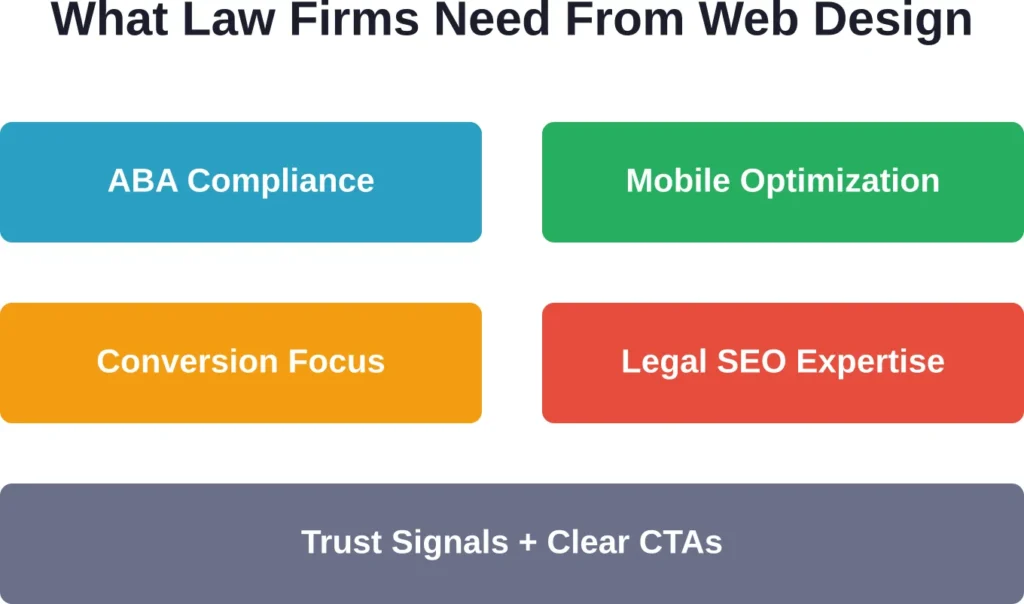
Compliance knowledge matters. The American Bar Association has strict rules about attorney advertising, client testimonials, and case results. An agency that doesn’t know these regulations can expose a firm to ethics violations.
Beyond compliance, conversion optimization separates mediocre legal sites from exceptional ones. Stressed prospects don’t behave like typical e-commerce shoppers. They need immediate reassurance, clear next steps, and friction-free contact methods.
The best law firm web design companies understand this psychology. They build sites that establish trust immediately, guide visitors toward consultation requests, and make contacting the firm effortless.
Core Competencies That Matter
Several technical capabilities distinguish top legal web design agencies from general website builders.
Mobile optimization isn’t negotiable. With over 60% of initial inquiries happening on mobile devices, responsive design must be flawless. That means fast load times, tap-friendly buttons, and forms that don’t frustrate users on small screens.
SEO expertise specific to legal markets makes a difference. Local search optimization, practice area targeting, and Google Business Profile management require specialized knowledge. Generic SEO tactics don’t translate well to legal services.
Conversion rate optimization separates good sites from great ones. Small changes in form placement, call-to-action wording, or trust signals can double consultation requests. The best agencies test continuously and optimize based on real user behavior data.
The 15 Best Law Firm Web Design Companies in 2026
These agencies represent the current leaders in legal web design. Each brings distinct strengths, specializations, and proven results for attorney clients.
1. Gilzor

Gilzor specializes in custom software development and digital product creation that helps businesses launch and scale effectively. Their full-cycle approach covers everything from idea validation and UI/UX design to development, QA, and go-to-market strategy.
The company works closely with clients to build web and mobile applications that improve user experience and drive business growth. They emphasize clean architecture, performance, and solutions that actually solve real operational challenges.
Gilzor is particularly strong at creating digital tools that automate processes, enhance client interactions, and support long-term scalability. Their experienced team delivers high-quality solutions while maintaining clear communication and realistic timelines.
What distinguishes Gilzor is their practical, results-oriented mindset. They focus on building functional and attractive products that connect with target audiences and deliver tangible value to businesses.
Contact Information:
- Website: www.gilzor.com
- Email: [email protected]
- Address: Poland, Warsaw, Office 58, street Adama Mickiewicza 37, 01-625
- LinkedIn: www.linkedin.com/company/gilzor-softwaredevelopment
2. Lengreo
Lengreo acts as a complete marketing and technology partner for ambitious B2B companies, with strong capabilities in website development and full-funnel digital strategies. They combine data-driven lead generation with professional web development to help service-based businesses attract high-value clients.
Their approach starts with deep business analysis and research before moving into prototyping, design, and development. This ensures every website they build is optimized not just for looks, but for actual client acquisition and conversion.
Lengreo excels at creating websites and digital systems that support complex sales cycles. Their services include hyper-personalized outreach, LinkedIn campaigns, SEO, and paid advertising — making them particularly effective for professional service firms that need more than just a basic online presence.
What sets Lengreo apart is their focus on measurable outcomes. They have a proven track record of significantly increasing qualified opportunities and lowering cost per lead for their clients through integrated marketing and technical execution.
Contact Information:
- Website: lengreo.com
- Phone: +31 686 147 566
- Email: [email protected]
- Address: Vrijstraat 9 C/D, 5611 AT Eindhoven, Netherlands
- LinkedIn: www.linkedin.com/company/lengreo
- Instagram: www.instagram.com/lengreo.agency
- Twitter: x.com/Lengreo
3. Mobian
Mobian builds dedicated engineering teams that deliver production-ready software on time and on budget. The company specializes in mobile and AI solutions for IT, Healthcare, Fintech, and Logistics sectors.
They offer two flexible models: full outsourcing where they manage end-to-end delivery, and outstaffing where their senior engineers seamlessly join the client’s existing team. Either way, clients receive high-level execution without the overhead of building an in-house team.
Mobian focuses on clean architecture, scalable systems, and clear documentation. They handle everything from complex mobile applications to custom AI agents and legacy system integrations.
What sets Mobian apart is their ability to ship faster while maintaining quality. They help companies overcome development bottlenecks and deliver reliable digital products that perform in demanding industries.
Contact Information:
- Website: mobian.studio
- Phone: [email protected]
- Address: Harju maakond, Tallinn, Kesklinnalinnaosa, Masina tn 22, 10113
- LinkedIn: www.linkedin.com/company/mobian-studio
4. A-listware

A-listware is a software development and consulting company that provides skilled developers and complete digital solutions tailored to enterprise, SMB, and startup needs. They specialize in building high-quality, secure, and responsive applications.
The company offers a wide range of services including software development, team augmentation, UX/UI design, testing & QA, IT consulting, and dedicated development teams. Their focus is on seamless integration with client processes and delivering cost-effective results.
A-listware excels at cloud solutions, data analytics, AI, and infrastructure services. They help businesses modernize legacy systems, build new enterprise applications, and maintain robust IT ecosystems.
What distinguishes A-listware is their commitment to long-term partnership and reliable delivery. They act as a true extension of the client’s team, ensuring consistent quality and 24/7 expert access.
Contact Information:
- Website: a-listware.com
- Phone: +1 (888) 337 93 73
- Email: [email protected]
- Address: North Bergen, NJ 07047, USA
- LinkedIn: www.linkedin.com/company/a-listware
- Facebook: www.facebook.com/alistware
5. Oski
Oski builds smart, well-engineered software solutions for tech-forward enterprises and ambitious startups. With deep expertise in cloud architecture, frontend development, artificial intelligence, and custom CMS implementations, they deliver robust digital platforms that power business growth.
Their team combines strong technical capabilities with user-centric design to create solutions that are both powerful and intuitive. Oski particularly excels at complex projects that require seamless integration, scalability, and modern technologies.
The company serves a wide range of industries including fintech, insurance, e-commerce, and professional services. They help organizations reimagine how they operate through digital innovation while maintaining security and performance standards.
What sets Oski apart is their ability to accelerate development while maintaining quality. They focus on delivering solutions that provide real competitive advantage through thoughtful architecture and forward-looking technology choices.
Contact Information:
- Website: oski.site
- Phone: +48571282759
- Email: [email protected]
- Address: Kaupmehe tn 7, 10114 Tallinn, Estonia
- LinkedIn: www.linkedin.com/company/oski-solutions
6. LegalPeel

LegalPeel focuses exclusively on legal website design and marketing, bringing specialized knowledge of what converts legal prospects. Their team stays current on changing ABA ethics rules, Google algorithm updates affecting legal search, and emerging best practices specific to attorney marketing.
The agency emphasizes data-driven design decisions. Rather than relying on subjective preferences, they use heat mapping, user session recordings, and A/B testing to identify what actually improves conversion rates.
LegalPeel’s project process includes extensive competitor research within each client’s specific market. They analyze what other firms in the area are doing, identify gaps in the local market, and position their clients to stand out in meaningful ways.
Their ongoing optimization approach means sites improve continuously after launch. LegalPeel tracks consultation request sources, analyzes user behavior patterns, and makes iterative improvements based on real performance data.
7. Thrive Agency
Thrive Agency brings comprehensive digital marketing capabilities with a strong legal practice group. While they serve multiple industries, their legal team focuses specifically on law firm websites and understands the unique challenges attorneys face online.
Their strength lies in integrated campaigns where web design, SEO, content marketing, and paid advertising work together. For firms ready to invest seriously in digital client acquisition, Thrive can execute across all these channels simultaneously.
The agency handles technical SEO particularly well. Their developers understand site architecture, page speed optimization, structured data implementation, and other technical factors that affect legal search rankings.
Thrive works well with growth-oriented firms that view marketing as an investment rather than an expense. Their reporting shows clear ROI tracking, and their strategies focus on measurable business outcomes rather than vanity metrics.
8. Foster Web Marketing

Foster Web Marketing has operated in the legal marketing space for over two decades. Their longevity gives them deep institutional knowledge about what works for law firm websites across changing technology and search algorithm updates.
The agency pioneered several approaches now considered standard practice in legal marketing, including educational content strategies and multi-touch nurture campaigns for legal prospects who aren’t ready to hire immediately.
Foster Web Marketing offers comprehensive services beyond just website design. Their team includes legal content writers, SEO specialists, social media managers, and advertising experts who can execute complete digital strategies.
Their experience spans virtually every practice area and firm size. This breadth means they can draw on lessons learned across thousands of legal websites to inform recommendations for new clients.
9. Custom Legal Marketing

Custom Legal Marketing focuses exclusively on solo practitioners and small law firms. Their service model specifically addresses the needs of attorneys who want professional websites without enterprise-level price tags.
The agency understands the constraints small firms face—limited budgets, minimal staff for managing online presence, and the need to generate cases quickly. Their solutions prioritize fast time-to-launch and immediate lead generation.
Custom Legal Marketing includes content writing, basic SEO setup, and simple backend management in their projects. This turnkey approach means solo attorneys can launch professional sites without needing technical expertise or extensive time investment.
Their focus on smaller firms doesn’t mean cookie-cutter templates. Custom Legal Marketing creates custom designs that reflect each attorney’s brand while using efficient development practices that keep costs reasonable.
10. Scorpion Legal

Scorpion Legal operates as a technology-driven legal marketing company where web design integrates with sophisticated tracking, analytics, and multi-channel campaigns. Their proprietary technology stack includes tools for call tracking, form analytics, and attribution modeling.
The agency excels at handling large campaigns for established firms with substantial marketing budgets. Their technology infrastructure supports complex tracking requirements and detailed ROI analysis that CFOs appreciate.
Scorpion’s team includes dedicated specialists for different channels—SEO experts, PPC managers, social media strategists, and designers who collaborate on integrated campaigns. This specialization means deep expertise in each area.
Their reporting goes beyond standard website analytics. Scorpion provides detailed attribution data showing which marketing channels, campaigns, and keywords generate actual retained clients rather than just website traffic.
11. Lazarev Agency

Lazarev Agency specializes in building sophisticated digital experiences for established law firms and legal startups. Founded in 2015 and based in San Francisco with a global team, they approach legal websites as comprehensive business growth tools rather than simple brochure sites.
Their process emphasizes user research and conversion optimization from day one. Rather than starting with visual mockups, Lazarev conducts stakeholder interviews, competitor analysis, and user journey mapping to understand what actually drives consultation requests.
The agency works particularly well with firms ready to invest in premium digital presence. Their team size of 10-49 professionals allows them to handle complex projects while maintaining quality control throughout development.
What sets Lazarev apart? They don’t just build websites—they create entire digital strategies that position law firms for growth. That includes brand identity work, content strategy, and post-launch optimization.
12. PaperStreet Web Design

PaperStreet Web Design has built a reputation specifically within legal marketing circles. Their exclusive focus on law firm websites means they understand attorney ethics rules, compliance requirements, and what converts legal prospects better than general agencies.
The company handles projects across a wide range of firm sizes and practice areas. From solo practitioners launching their first professional site to established firms needing complete redesigns, PaperStreet tailors their approach to match client needs.
Their service portfolio covers custom website design, content writing specifically for legal audiences, SEO implementation, and ongoing site management. This comprehensive offering means firms can consolidate vendors rather than coordinating multiple contractors.
PaperStreet’s longevity in the legal space gives them institutional knowledge about what works. They’ve seen trends come and go and focus on fundamentals that consistently generate results: fast sites, clear calls to action, and trust-building content.
13. Digital Silk

Digital Silk operates at the premium end of law firm web design. Their minimum project scope reflects their focus on comprehensive digital transformations rather than simple website redesigns.
The agency excels at branding work alongside web design. For law firms looking to reposition themselves in the market—moving upmarket, expanding into new practice areas, or differentiating from competitors—Digital Silk integrates brand strategy with digital execution.
Their team includes strategists, designers, developers, and digital marketers who collaborate throughout projects. This integrated approach prevents the common problem where beautiful designs don’t actually function well for lead generation.
Digital Silk works best with firms that view their website as a long-term investment in market positioning. Their projects typically include extensive discovery, custom design systems, and sophisticated functionality beyond basic informational sites.
14. Dan Gilroy Design
Dan Gilroy Design earned recognition as the #4 law firm web design agency on DesignRush’s 2026 rankings. That recognition validates their specialized focus—while many agencies handle legal sites as one of dozens of industries, Dan Gilroy Design has spent over two decades exclusively serving attorneys.
Their deep legal industry knowledge shows in the details. They understand how different practice areas require different messaging approaches, how local market dynamics affect SEO strategy, and how to balance professional credibility with approachability.
The agency emphasizes practical results over flashy design trends. Their sites prioritize fast load times, clear information architecture, and conversion optimization. Every design decision traces back to business outcomes.
Dan Gilroy Design works with firms at all stages—from newly admitted attorneys building their first practice to established regional firms needing modernization. Their experience across this range means they can right-size solutions to match actual needs and budgets.
15. Juris Digital

Juris Digital positions itself as a full-service legal marketing agency where web design integrates with broader digital strategy. Their team includes former practicing attorneys who understand law firm business models from the inside.
This legal background informs everything they build. Juris Digital doesn’t just create attractive websites—they structure sites around client acquisition funnels specific to different practice areas and referral sources.
Their service range extends beyond initial design to include content marketing, paid advertising management, and comprehensive SEO campaigns. For firms wanting a single partner to handle all digital marketing, this integrated approach eliminates coordination headaches.
Juris Digital particularly excels with firms scaling up their marketing efforts. They can handle complex multi-location sites, sophisticated tracking implementations, and campaigns that span multiple channels while maintaining consistent messaging.
How to Choose the Right Agency for Your Firm
Selecting a web design company requires evaluating factors beyond portfolio quality. The best agency for one firm might be completely wrong for another based on budget, timeline, and strategic priorities.
Define Goals Before Contacting Agencies
Clear objectives guide better agency selection. Firms should identify specific outcomes they want from a new website before reviewing proposals.
Is the primary goal generating more consultation requests? Improving search rankings for specific practice areas? Repositioning the firm’s brand in the market? Different goals require different agency strengths.
Budget parameters matter. Investment in law firm websites can range dramatically. A basic template site from a local agency might cost a few thousand dollars, while highly customized marketing machines from top-tier agencies can range from tens of thousands upward.
Having realistic budget expectations helps agencies propose appropriate solutions. Underfunded projects lead to compromised results and frustration on both sides.
Evaluate Legal Industry Experience
Generic web design skills don’t translate directly to effective legal websites. Agencies should demonstrate specific experience with law firm clients and understanding of legal marketing challenges.
Ask potential agencies about their knowledge of ABA Model Rules regarding advertising. Inquire how they handle client testimonials, case results, and other content that requires careful compliance consideration.
Review their portfolio specifically for legal websites. Look beyond visual appeal to evaluate whether those sites effectively communicate trust, expertise, and clear next steps for potential clients.
Check references from law firm clients. Ask those references about results—did consultation requests increase? Did search rankings improve? Was the agency responsive and professional throughout the project?
Understand Their Process
Agency process reveals a lot about likely project outcomes. Firms should understand how agencies approach discovery, design, development, and launch before signing contracts.
Strong agencies invest heavily in discovery. They conduct stakeholder interviews, competitive analysis, and user research before creating any designs. This foundation prevents costly revisions later.
The design review process should be collaborative. Agencies should present concepts with clear rationale explaining how design decisions support business goals. Firms should have structured opportunities for feedback without endless revision cycles.
Post-launch support matters. Websites need ongoing maintenance, security updates, content additions, and performance optimization. Clarify what happens after launch—does the agency provide ongoing services, or does the firm need to manage the site independently?
| Evaluation Factor | Why It Matters | Key Questions to Ask |
|---|---|---|
| Legal Portfolio | Demonstrates understanding of attorney ethics and legal marketing | How many law firm sites have you built? Can I see examples in my practice area? |
| Compliance Knowledge | Prevents ethics violations and bar complaints | How do you handle ABA rules on testimonials and case results? |
| SEO Expertise | Determines whether the site will actually generate organic leads | What’s your approach to local SEO for law firms? Can you show ranking results? |
| Mobile Optimization | Critical when 60%+ of inquiries happen on mobile devices | How do you test mobile performance? What load time do you target? |
| Conversion Strategy | Separates lead-generating sites from digital brochures | How do you optimize consultation request rates? What’s your testing process? |
Common Mistakes Law Firms Make Choosing Web Designers
Several predictable mistakes lead to disappointing website projects. Understanding these pitfalls helps firms avoid costly errors.
Selecting Based on Price Alone
The cheapest option rarely delivers the best value. Law firm websites are business development tools that should generate ROI through client acquisition.
A site that costs less upfront but generates no leads wastes money. Meanwhile, a more expensive site that converts visitors into retained clients pays for itself quickly.
Smart firms evaluate proposals based on expected return rather than just upfront cost. What will this site do for the business? How will it improve client acquisition?
Ignoring Mobile Performance
Some firms still evaluate website proposals primarily on desktop computers. That’s backwards when over 60% of initial legal inquiries happen on mobile devices.
Agencies should demonstrate mobile designs during proposal presentations. Firms should test those mobile experiences on actual phones, not just resized browser windows.
Page speed on mobile networks matters enormously. A site that loads quickly on office WiFi but crawls on cellular connections will hemorrhage potential clients.
Focusing on Design Over Conversion
Beautiful design means nothing if the site doesn’t generate consultation requests. Yet many firms get distracted by aesthetics and ignore conversion fundamentals.
Effective legal websites prioritize clear calls to action, minimal friction contact methods, and trust-building content over visual sophistication.
The best approach balances professional design with conversion optimization. Sites should look credible and modern while making it effortless for stressed prospects to take the next step.
Neglecting Content Strategy
Design agencies can build beautiful shells, but sites need compelling content to convert visitors. Many firms launch redesigned sites with the same weak content from their old site.
Strong agencies include content strategy in their process. They help firms develop messaging that resonates with target clients, addresses common concerns, and differentiates from competitors.
Content isn’t just about quantity. Legal prospects need specific information that builds confidence: clear explanations of how the process works, what to expect, why this firm is qualified, and what next steps look like.
What to Expect During the Web Design Process
Understanding typical project phases helps firms prepare and ensures smoother collaboration with agencies.
Discovery and Strategy
Strong projects begin with comprehensive discovery. Agencies conduct stakeholder interviews, review existing analytics, analyze competitors, and research target audiences.
This phase typically takes two to four weeks. While it might feel like the project is moving slowly, thorough discovery prevents expensive revisions later.
Firms should expect to invest significant time during discovery. Agencies need detailed information about practice areas, target clients, competitive positioning, and business goals.
The discovery phase concludes with a strategy document outlining target audiences, key messages, site structure, and success metrics. This document guides all subsequent design and development decisions.
Design and Revision
Agencies typically present initial design concepts showing homepage layouts and key internal page templates. These mockups demonstrate visual direction, content hierarchy, and user experience approaches.
The revision process should be structured. Agencies incorporate feedback through defined rounds rather than endless tweaks. Most projects include two to three revision rounds in the contract.
Design review focuses on whether concepts support strategic goals, not just whether stakeholders personally like colors and fonts. The question is whether designs will resonate with target clients and drive conversions.
Once designs are approved, the agency creates complete mockups for all page templates before development begins. This ensures consistency and prevents surprises during development.
Development and Testing
Development transforms approved designs into functioning websites. This phase includes front-end coding, content management system implementation, form integration, and functionality testing.
Modern web development takes four to eight weeks depending on complexity. Custom functionality, third-party integrations, and content migrations extend timelines.
Thorough testing happens before launch. Agencies test across browsers, devices, and screen sizes. They verify forms work correctly, links function, and page speed meets targets.
Firms should plan for content population during this phase. Whether the agency writes content or the firm provides it, getting final text and images into the site takes coordination.
Launch and Optimization
Launch is a beginning, not an ending. The site goes live, but real optimization begins after actual users interact with it.
Agencies monitor performance closely during the first weeks post-launch. They track consultation requests, identify technical issues, and watch user behavior through analytics and heat mapping tools.
Initial optimization addresses obvious problems—confusing navigation, unclear calls to action, forms that users abandon. These quick fixes often produce immediate improvement in conversion rates.
Longer-term optimization continues indefinitely. The best agencies treat websites as living tools that improve continuously through testing, analysis, and iteration based on real performance data.
Essential Features Every Law Firm Website Needs
Certain capabilities are non-negotiable for effective attorney websites in 2026. These features directly impact lead generation and client acquisition.
Mobile-First Responsive Design
Mobile optimization isn’t optional. With over 60% of legal inquiries starting on mobile devices, sites must function flawlessly on phones and tablets.
True mobile optimization means more than making desktop designs shrink. It requires rethinking information architecture, simplifying navigation, and designing touch-friendly interface elements.
Page speed on mobile connections matters enormously. Sites should load in under three seconds even on slower cellular networks. Users abandon slow sites instantly.
Clear Calls to Action
Every page should guide visitors toward consultation requests. That means prominent, repeated calls to action that make contacting the firm effortless.
Multiple contact methods work best. Phone numbers that tap to call on mobile, simple contact forms, live chat for immediate questions, and clear office locations for those who prefer in-person meetings.
Forms should ask minimal information initially. Request just a name and phone number first. Complex intake forms asking for detailed case information scare prospects away. Gather those details during actual consultations.
Trust-Building Elements
Legal websites must establish credibility immediately. Prospects are trusting firms with serious problems and need reassurance before making contact.
Professional attorney photos humanize firms. Generic stock photos accomplish nothing—prospects want to see actual attorneys they might work with.
Credentials and recognitions build confidence. Bar admissions, professional associations, awards, and speaking engagements demonstrate expertise and standing in the legal community.
Client testimonials provide social proof when handled correctly. Agencies must ensure testimonial presentation complies with applicable ethics rules regarding client communications.
Practice Area Information
Clear, detailed practice area pages help prospects determine if the firm handles their type of case. These pages also drive organic search rankings for specific legal services.
Effective practice area content explains what these cases involve, how the legal process works, what clients can expect, and why the firm is qualified to handle them.
The content should address common questions and concerns specific to each practice area. Someone researching divorce attorneys has completely different questions than someone needing a business attorney.
Local SEO Optimization
Most legal services are location-specific. Sites must be optimized for local search to appear when prospects search for attorneys in their area.
That requires properly configured Google Business Profile integration, location-specific content, schema markup identifying the firm’s service areas, and consistent NAP (name, address, phone) information across the web.
Local optimization differs significantly from general SEO. Agencies should demonstrate specific expertise in local search factors, not just general SEO knowledge.
Understanding Investment Levels
While specific pricing varies by scope and agency, understanding typical investment ranges helps firms budget appropriately and evaluate proposals.
Project Scope Drives Cost
The range of investment in law firm website design varies dramatically based on requirements and customization level.
Entry-level options might include template-based designs with basic customization. Mid-range projects typically involve custom design, content strategy, and foundational SEO setup. Premium projects include comprehensive branding, sophisticated functionality, extensive content development, and integrated marketing strategies.
Firms should evaluate options based on expected return. What will improved digital presence do for client acquisition? How many additional cases would justify the investment?
Ongoing Costs Matter
Initial development represents only part of total investment. Websites require ongoing hosting, maintenance, security updates, content additions, and optimization.
Many agencies offer retainer arrangements covering these ongoing needs. Others build sites and hand them off, leaving firms to manage maintenance independently or hire separate vendors.
Understanding the full long-term cost model prevents surprises. Clarify what happens after launch, what ongoing services cost, and what the firm needs to manage internally.
Red Flags When Evaluating Agencies
Certain warning signs indicate agencies to avoid. These red flags often predict problematic projects and disappointing results.
Guaranteed Rankings
No legitimate agency guarantees specific search rankings. Google’s algorithms are too complex and change too frequently for such promises to be credible.
Agencies making ranking guarantees either don’t understand SEO or deliberately mislead clients. Both scenarios should disqualify them from consideration.
Realistic agencies discuss SEO strategy, explain their approach, and show examples of results they’ve achieved for other clients without making specific guarantees about future rankings.
Template-Only Approaches
Some agencies exclusively use templates with minimal customization. While templates can work for certain situations, agencies unwilling to build custom solutions lack the capability to address unique firm needs.
Custom design doesn’t necessarily mean building everything from scratch. Strong agencies balance custom work where it matters with proven patterns and frameworks that accelerate development.
Agencies should explain their approach and why they recommend custom versus template solutions for specific projects based on strategic requirements.
Poor Communication
Agency communication during the sales process predicts communication during projects. Slow responses, vague answers, or difficulty scheduling meetings are warning signs.
Strong agencies respond promptly, communicate clearly, and demonstrate genuine interest in understanding firm needs. They ask detailed questions and provide specific answers.
If communication feels difficult before signing a contract, it will get worse during the project when deadlines loom and problems arise.
No Process Documentation
Professional agencies have documented processes for discovery, design, development, and launch. They should clearly explain how projects progress and what happens at each stage.
Agencies without defined processes make it up as they go. That leads to confusion, missed requirements, and disappointing results.
Ask potential agencies to walk through their process in detail. Strong shops can explain exactly what happens from kickoff through launch and beyond.
Questions to Ask Potential Agencies
These questions help evaluate whether specific agencies match firm needs and priorities.
About Legal Experience
How many law firm websites have you built? Can you show examples in practice areas similar to ours? What results have those sites achieved in terms of lead generation?
How do you handle ABA ethics rules regarding attorney advertising? Can you explain your approach to client testimonials and case results?
Do you have experience with our specific practice areas? Legal marketing differs significantly across practice areas—personal injury, family law, business law, and criminal defense require different approaches.
About Process and Timeline
What does your discovery process involve? How long does a typical project take from kickoff to launch?
How do design reviews work? How many revision rounds are included? What happens if we need changes beyond the included rounds?
Who will we work with day-to-day? Will we have a dedicated project manager? How quickly do you typically respond to questions?
About Ongoing Support
What happens after the site launches? Do you provide ongoing maintenance and support? What does that cost?
How do you handle website updates when we need to add new content or make changes? Do you provide training on managing the site ourselves?
What analytics and reporting do you provide? How will we know if the site is performing well and generating leads?
About SEO and Marketing
What’s your approach to SEO for law firms? How do you handle local search optimization?
Do you provide ongoing SEO services or just initial setup? What results have you achieved for other law firm clients?
Can you integrate with our existing marketing tools like CRM systems or call tracking software?
The Bottom Line on Law Firm Web Design Companies
Choosing the right web design agency significantly impacts a law firm’s digital success. The agencies profiled here represent the current leaders in legal web design, each bringing specialized expertise and proven track records.
The best choice depends on specific firm circumstances. Budget constraints, timeline requirements, in-house marketing capabilities, and strategic priorities all factor into optimal agency selection.
What matters most? Finding an agency that genuinely understands legal marketing challenges, demonstrates relevant experience, communicates effectively, and focuses on measurable business outcomes rather than just attractive designs.
Digital presence isn’t optional in 2026. With over 64% of law firms reporting their website as their highest ROI marketing channel, investing in professional web design makes clear business sense.
The right agency partner transforms a law firm’s website from digital brochure into client acquisition engine. That shift changes practice trajectory and competitive positioning in meaningful ways.
Start by clarifying goals, establishing realistic budgets, and reaching out to agencies whose specialization matches firm needs. The investment in finding the right partner pays dividends through improved client acquisition for years to come.
Frequently Asked Questions
Typical law firm website projects take between eight and sixteen weeks from kickoff to launch. Timelines depend on project complexity, customization level, and content development requirements. Simple template-based sites can launch faster, while comprehensive custom builds with extensive content and sophisticated functionality take longer. Delays often occur when firms struggle to provide content, approve designs promptly, or remain available for feedback during critical project phases.
Templates can work for certain situations—solo practitioners just starting out, firms with minimal budgets, or practices that need simple online presence quickly. However, custom websites outperform templates for competitive markets and growth-oriented firms. Custom sites allow differentiation, conversion optimization specific to target audiences, and flexibility to adapt as the practice evolves. The best approach depends on specific circumstances, competitive landscape, and strategic goals.
Legal web design requires understanding attorney ethics rules, ABA advertising regulations, and compliance requirements that don’t apply to other industries. Legal prospects also behave differently—they’re typically stressed, researching during crises, and making high-stakes decisions. Effective legal sites establish trust immediately, address specific concerns, and make contacting the firm completely frictionless. Generic web design approaches miss these critical factors and produce sites that look professional but don’t generate leads.
Investment in law firm websites varies dramatically based on scope and agency. Basic template sites from local agencies might cost several thousand dollars. Custom websites from specialized legal marketing agencies typically represent more substantial investments. Comprehensive digital transformations including branding, custom design, extensive content, and integrated marketing strategies can range significantly higher. Firms should evaluate investment based on expected ROI—how many additional cases would justify the cost?
Absolutely. Over 64% of law firms report their website delivers the highest ROI compared to all other marketing efforts. Well-designed legal websites generate consultation requests through organic search traffic, convert visitors through trust-building content and clear calls to action, and support other marketing channels by providing information prospects need. The key is treating the website as a client acquisition tool rather than just a digital brochure, which requires strategic design, conversion optimization, and ongoing improvement based on performance data.
Agencies typically provide more comprehensive capabilities, accountability, and long-term support than individual freelancers. They have teams covering design, development, content, SEO, and project management. Freelancers can work well for smaller projects with limited budgets, but firms face risks if the freelancer becomes unavailable or lacks specific expertise the project requires. For substantial investments in digital presence, established agencies with legal industry experience and proven track records offer lower risk and better results.
Complete redesigns typically happen every three to five years as design trends evolve, technology changes, and firms’ strategic priorities shift. However, the best approach involves continuous optimization rather than waiting years between major overhauls. Sites should receive regular content updates, performance improvements, and conversion optimization adjustments based on analytics data. This ongoing refinement maintains relevance and performance between major redesigns while avoiding the feast-or-famine cycle of complete rebuilds every few years.