

Quick Summary: Professional rebar detailing services transform structural engineering plans into precise shop drawings and 3D models that guide construction teams. This comprehensive guide examines ten leading rebar detailing agencies in 2026, evaluating their technical capabilities, software expertise, project delivery standards, and specialized services across commercial, residential, and infrastructure sectors.
Reinforced concrete structures dominate modern construction—from towering commercial buildings to sprawling highway systems. But here’s the thing: the steel reinforcement that gives concrete its strength doesn’t just magically appear in the right place. That’s where professional rebar detailing services come in.
These specialized firms bridge the gap between structural engineering design and actual construction. They create the detailed drawings, bar bending schedules, and 3D models that fabricators and field crews rely on daily. Without accurate rebar detailing, construction projects face costly delays, material waste, and safety risks.
The rebar detailing industry has evolved dramatically. What once meant hand-drawn blueprints now involves sophisticated 3D modeling software, BIM integration, and clash detection technology. Choosing the right detailing partner can mean the difference between a smooth build and a project plagued by on-site confusion.
This guide examines ten leading rebar detailing services companies operating in 2026. Each has demonstrated technical excellence, but they serve different market segments and bring unique strengths to the table.
What Rebar Detailing Services Actually Do
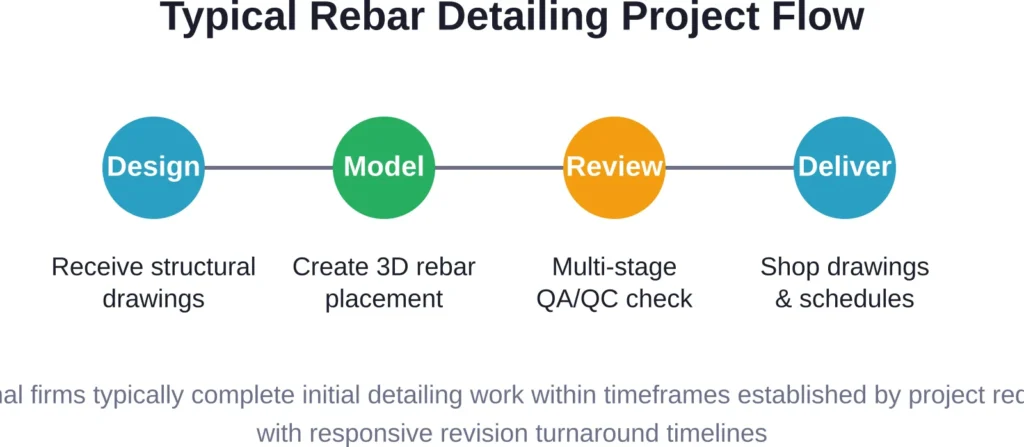
Rebar detailing companies take structural engineering plans and convert them into construction-ready documentation. It sounds straightforward until you realize what that actually involves.
Detailers produce shop drawings that show every piece of reinforcement steel—its size, shape, placement, and how it connects to other elements. They generate bar bending schedules that list each rebar piece with cutting lengths and bend angles. Fabrication shops use these schedules to cut and bend thousands of steel pieces efficiently.
Modern rebar detailing goes beyond 2D drawings. Many companies now create 3D rebar models that integrate with Building Information Modeling (BIM) systems. These digital models help identify conflicts before steel gets fabricated—like discovering that two rebars occupy the same physical space, or that rebar placement makes concrete pouring impossible.
The work requires deep knowledge of construction methods, concrete behavior, and steel properties. Detailers must understand how construction crews actually work. A technically correct drawing that’s impossible to build in the field is worthless.
Professional rebar detailing services help reduce on-site rework and improve construction efficiency. The investment in professional detailing services typically pays for itself through reduced material waste and faster project completion.
Why Company Selection Matters More Than You Think
Not all rebar detailing services deliver the same value. The consequences of choosing poorly often don’t surface until you’re mid-construction—exactly when problems cost the most to fix.
Low-quality detailing creates a cascade of issues. Inaccurate dimensions mean fabricated steel doesn’t fit. Missing details force field crews to improvise. Incomplete schedules cause ordering mistakes that delay the entire project. And inconsistent drawing standards make coordination between trades unnecessarily difficult.
Professional companies maintain quality control processes that catch errors before drawings reach the fabricator. They employ experienced detailers who understand constructability. They use current software that generates accurate quantities and integrates with project management systems.
Communication standards matter just as much as technical skills. The best detailing firms work as extensions of your project team. They respond quickly to RFIs (Requests for Information), adapt to design changes efficiently, and coordinate with structural engineers when clarification is needed.
Real talk: many contractors have horror stories about cheap detailing services that seemed like a bargain until revision after revision ate up the savings—and then some. As one comparison shows, professional companies require minimal revisions while low-cost alternatives create frequent, time-consuming corrections.
The Top 11 Rebar Detailing Services Companies in 2026
These ten companies represent the best rebar detailing services available in the current market. Each brings distinct strengths, specializations, and service approaches.
1. Powerkh

Powerkh is a UK-based BIM and VDC consultancy with offices in the United States and Ukraine, providing rebar detailing and structural BIM services for contractors, engineers, developers, and construction teams. The company works on residential, commercial, and industrial projects, supporting teams with reinforcement detailing, structural modelling, prefabrication planning, and coordination across different construction stages. Their experience includes projects in multiple countries, with a focus on accurate modelling and coordination workflows.
Powerkh uses BIM-based workflows to develop detailed 3D rebar models, shop drawings, schedules, and coordination models that help reduce clashes and improve communication between structural, architectural, and MEP teams. The company also supports digital fabrication, scan-to-BIM workflows, and automation processes that help reduce manual drafting work and improve consistency across project documentation. Their approach is focused on practical coordination, model accuracy, and supporting construction teams with clear and usable detailing information.
Contact Information:
- Website: www.powerkh.com
- Email: [email protected]
- Facebook: www.facebook.com/100064039650167
- LinkedIn: www.linkedin.com/company/powerkh
- Instagram: www.instagram.com/powerkh_com
- Address: 3, Lavinia Walk, Taw Hill, Swindon SN25 1AP
- Phone: +44 7490 426678
2. Silicon Engineering Consultants

Silicon Engineering operates as one of the most established names in global rebar detailing. Based in India with clients worldwide, they’ve built a reputation for handling large-scale infrastructure projects.
Their service portfolio covers everything from foundation detailing to complex elevated structure reinforcement. Silicon Engineering specializes in creating high-quality reinforcement drawings and 3D modeling for structural projects of all sizes.
The company maintains dedicated teams for different project types—commercial buildings, residential complexes, bridges, and industrial facilities. This specialization means your project gets handled by detailers who understand its specific requirements and challenges.
Silicon Engineering uses industry-standard software platforms that most fabricators and contractors work with. Their deliverables integrate smoothly into existing project workflows without compatibility headaches.
What sets them apart is their systematic approach to quality assurance. Multiple review stages catch errors before drawings get released. Their revision turnaround times are consistently quick, which matters when construction schedules are tight.
3. 12 Meter Engineering
12 Meter Engineering has carved out a strong position in precast concrete detailing. If your project involves precast elements—walls, beams, columns, or architectural components—they bring specialized expertise.
Precast rebar detailing requires different skills than cast-in-place work. Detailers must understand how pieces get manufactured in a controlled plant environment, transported, and erected on site. Connection details become especially critical since precast elements must fit together precisely.
12 Meter Engineering’s team includes former fabrication shop employees who understand production realities. They design reinforcement layouts that are both structurally sound and practical to manufacture.
Their technology stack includes 3D modeling capabilities that help precast manufacturers visualize complex pieces before production. This reduces the risk of costly fabrication errors.
The company focuses heavily on accuracy and attention to detail. Their quality control processes align with what professional precast manufacturers expect, making project coordination smoother.
4. Capstone Engineering Services

Capstone Engineering Services delivers comprehensive rebar detailing with a strong emphasis on BIM integration. They position themselves as a technology-forward firm that helps clients modernize their construction documentation processes.
Their BIM-based rebar detailing service creates intelligent 3D models rather than just drawings. These models contain embedded data about each rebar piece—material specifications, installation sequence, quantity information, and more.
For projects pursuing advanced coordination, Capstone’s BIM models can be combined with models from other trades. This enables clash detection across disciplines—identifying conflicts between rebar, electrical conduits, mechanical systems, and architectural elements before construction begins.
Capstone serves a broad range of project types but particularly excels with commercial and residential buildings. They understand the rhythm of these projects and can scale their services up or down based on project size.
The company also provides bar bending schedule services that integrate directly with their 3D models. When design changes happen (and they always do), updates propagate automatically through drawings and schedules, reducing coordination errors.
5. Hi-Tech BIM Services

Hi-Tech BIM Services specializes in providing rebar shop drawings and modeling services with a clear focus on modern construction technology adoption.
Their core offering revolves around creating detailed rebar shop drawings that meet fabricator requirements while also maintaining comprehensive 3D models for coordination purposes. This dual approach gives clients both the traditional documentation field crews expect and the digital models that facilitate advanced project management.
Hi-Tech BIM has invested significantly in training their detailing team on the latest software platforms. They work proficiently with multiple tools, which means they can adapt to whatever BIM environment your project uses.
The company handles projects across multiple sectors—infrastructure, commercial, residential, and industrial. Their portfolio demonstrates experience with both straightforward rectangular buildings and geometrically complex structures.
One strength is their approach to handling design changes. Construction projects rarely proceed exactly as initially planned. Hi-Tech BIM’s workflow allows them to process revisions efficiently and track change impacts across the entire drawing set.
6. S E C D Technical Services LLC
S E C D Technical Services positions itself around the concept of being the bridge between design and construction. Their focus is on creating rebar shop drawings that construction teams can actually follow without confusion.
The company emphasizes constructability in everything they produce. Their detailers think through how steel will be tied in the field, how concrete will flow around the reinforcement, and how construction sequences will work practically.
S E C D handles the complete rebar shop drawing service process from receiving structural drawings through final approved-for-construction documentation. They manage coordination with structural engineers, respond to contractor questions, and track revisions systematically.
Their service model works well for general contractors and construction managers who need a reliable partner to handle the entire detailing scope. S E C D takes ownership of the deliverable quality rather than just executing tasks.
The company serves projects throughout the construction sector with particular depth in commercial construction. They understand the fast-paced nature of commercial work where schedule delays directly impact project profitability.
7. Tejjy Inc.

Tejjy Inc. operates as a full-service engineering support firm with rebar detailing as one of their core specializations. This broader engineering background brings additional perspective to their detailing work.
Their rebar detailing services integrate with structural engineering review capabilities. For clients who want an extra set of engineering eyes reviewing reinforcement layouts, Tejjy can provide that added assurance.
The company works extensively with both domestic and international clients. Their global delivery model allows them to provide cost-effective services while maintaining quality standards that meet U.S. construction requirements.
Tejjy’s technology capabilities include advanced 3D rebar modeling, clash detection, and quantity takeoff services. They can provide comprehensive material lists that help project teams manage procurement and budgeting.
One distinguishing factor is their willingness to work on projects at various scales—from small residential additions to major infrastructure works. They’ve structured their teams to handle this range efficiently.
8. Advenser
Advenser brings a consultative approach to rebar detailing services. Rather than just producing drawings to specification, they engage with project teams to optimize reinforcement design for cost and constructability.
Their detailing professionals include engineers who can suggest alternative rebar arrangements that achieve the same structural performance while reducing material costs or simplifying installation. This value engineering perspective can generate significant savings on large projects.
Advenser maintains expertise across multiple construction sectors including commercial, healthcare, educational, and government projects. Each sector has unique standards and requirements, and their team understands these nuances.
The company uses sophisticated software tools that enable them to produce highly coordinated 3D models. These models serve not just as detailing tools but as project coordination platforms that other trades can reference.
Their quality assurance process includes both internal technical reviews and constructability reviews. This two-stage checking catches both calculation errors and practical construction issues before drawings get released.
9. Pinnacle Infotech

Pinnacle Infotech focuses on delivering precision rebar detailing with quick turnaround times. In an industry where schedule delays cascade through the entire construction timeline, speed matters—but only when paired with accuracy.
The company has structured their workflow around rapid response times for both initial deliverables and revision requests. They maintain sufficient staffing depth to handle schedule compression when projects need it.
Pinnacle Infotech serves the full spectrum of construction projects but has particular strength in high-rise buildings and parking structures. These project types involve repetitive floor plans where efficient detailing processes generate significant time savings.
Their technology stack includes automated tools that help generate bar bending schedules and quantity reports quickly. Once the 3D model is complete, these documents get produced efficiently with minimal manual data entry.
The company emphasizes clear communication with clients. They provide regular status updates, flag potential issues proactively, and maintain accessible project managers who understand both technical and schedule concerns.
10. Millennium Consultants

Millennium Consultants operates with a strong focus on infrastructure projects—bridges, tunnels, retaining walls, and transportation structures. These specialized project types require detailers who understand their unique challenges.
Infrastructure rebar detailing involves complex geometry, heavy reinforcement congestion, and critical connection details. Millennium’s team brings deep experience with these demanding projects.
The company works closely with structural engineers throughout the detailing process. Infrastructure projects often require custom solutions rather than standard details, so ongoing engineering coordination is essential.
Millennium maintains expertise with post-tensioned concrete systems, which are common in bridge construction. Detailing post-tensioned structures requires understanding the interaction between conventional rebar and tensioning systems.
Their deliverables include not just shop drawings but also comprehensive installation guides that help field crews understand the construction sequence. For complex projects, these guides prove invaluable.
11. Rebar CAD Drafting Services
Rebar CAD Drafting Services positions itself as a specialized boutique firm focused exclusively on reinforcement detailing. This singular focus means every team member concentrates on becoming excellent at one thing.
The company serves primarily mid-sized construction projects—large enough to require professional detailing but not so massive that they need the infrastructure of the largest firms. This market positioning allows them to provide attentive service and competitive value.
Rebar CAD Drafting Services employs experienced detailers who have worked in fabrication shops and on construction sites. This real-world background helps them produce documentation that works practically in the field.
They maintain flexibility in their service delivery. Some clients want full-service detailing from start to finish. Others need support during peak workflow periods or help with particularly complex building areas. Rebar CAD Drafting adapts to different engagement models.
Their quality commitment includes providing detailed QA/QC documentation with each deliverable. Clients receive not just drawings but verification that those drawings have been through systematic checking procedures.
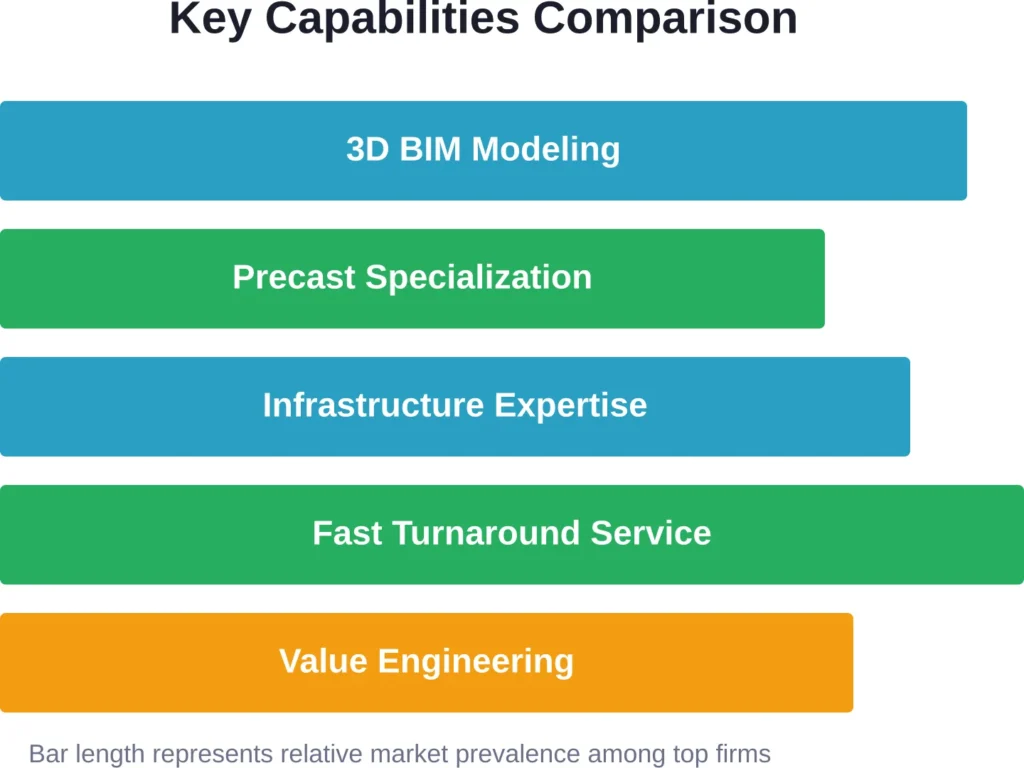
Essential Software and Technology Standards
The tools a rebar detailing company uses directly impact the quality, accuracy, and usability of what they deliver. Software capabilities have become a key differentiator in the industry.
Most professional detailing firms work with specialized rebar detailing software like RebarCAD, Tekla Structures, AutoCAD with rebar plugins, or Revit with structural extensions. These platforms automate tedious calculations, reduce human error, and generate consistent documentation.
But software alone doesn’t guarantee quality. The detailer’s skill and experience matter more than the tools they use. A mediocre detailer with expensive software will still produce mediocre work. The best companies pair advanced technology with experienced professionals.
BIM capabilities have moved from nice-to-have to essential for many project types. When owners, architects, engineers, and contractors collaborate through shared 3D models, the rebar detailing must integrate into that workflow.
Look for companies that can deliver models in formats your project uses. Common exchange formats include IFC (Industry Foundation Classes) for cross-platform compatibility, and native formats for specific software ecosystems.
Clash detection capabilities help identify coordination issues before construction. When the rebar model shows a #8 bar trying to occupy the same space as a 4-inch conduit, better to solve that problem digitally than in the field.
Quantity takeoff accuracy matters for budgeting and procurement. Professional software generates precise material lists automatically from 3D models, eliminating manual counting errors and reducing material waste.
Experience and Specialization Factors
Years in business provides useful context but doesn’t tell the whole story. What matters more is whether a company has experience with your specific project type.
Detailing a precast parking structure requires different knowledge than detailing a cast-in-place high-rise. Bridge work involves different challenges than a big-box retail building. Foundation work differs from elevated structures.
When evaluating companies, ask about relevant project experience. Have they done projects similar to yours in scale, complexity, and construction method? Can they provide examples and references?
Some firms serve as generalists who handle any project type competently. Others specialize deeply in particular niches. Neither approach is inherently better—it depends on what your project needs.
Team experience matters as much as company experience. Who will actually work on your project? How long have they been detailing? What’s their background—did they come up through fabrication shops, engineering firms, or construction companies?
The best detailers have spent time in the field. They’ve seen how their drawings get used (or misused). They understand what makes a drawing helpful versus technically correct but practically useless.
Quality Control and Accuracy Standards
Mistakes in rebar detailing create expensive problems. A single dimension error can mean thousands of dollars of wasted fabricated steel. Missing information stops field crews and delays the schedule. Inconsistent details create confusion that leads to installation errors.
Professional rebar detailing services maintain systematic quality control processes. But not all QC systems are equal.
Look for companies that use multi-stage review processes. Typically this involves the original detailer performing self-checking, a senior detailer reviewing for technical accuracy, and a final review for completeness and clarity.
Some firms employ dedicated QA/QC personnel who don’t produce drawings themselves but focus entirely on finding errors before documents get released. This independent verification catches issues that the production team might overlook.
Ask potential partners about their revision rates. How often do their drawings come back requiring corrections? Professional firms typically maintain quality control processes designed to minimize revision frequencies.
Quality assurance documentation provides transparency. Companies that track their accuracy and share those metrics with clients demonstrate confidence in their processes.
Professional detailing companies typically maintain higher accuracy standards than budget alternatives. Professional firms maintain high accuracy with minimal revisions, while budget providers require frequent corrections that erode any initial cost savings.
| Quality Factor | Professional Detailing Service | Budget Detailing Service |
|---|---|---|
| Initial accuracy rate | High (95%+ first-time acceptance) | Low (multiple revision cycles typical) |
| Drawing completeness | Comprehensive with all required details | Often missing critical information |
| Schedule reliability | Consistent delivery dates | Unpredictable timelines |
| Technical support | Responsive to questions and RFIs | Limited availability |
| Revision turnaround | Fast response to changes | Slow or inconsistent |
Project Timeline and Delivery Capabilities
Construction schedules are unforgiving. Rebar detailing sits on the critical path—structural steel can’t be fabricated until shop drawings are complete, and concrete can’t be poured until steel is placed.
Delays in detailing ripple through the entire project schedule. A week lost in the detailing phase can push building occupancy back by months once all the downstream impacts accumulate.
Reliable rebar detailing companies commit to realistic schedules and then deliver on them. Unreliable companies promise fast turnarounds they can’t achieve, then scramble to explain delays.
When evaluating potential partners, discuss their current workload. Are they over-committed? Do they have capacity to prioritize your project? What happens if you need to accelerate the schedule?
Ask about their staffing model. Do they maintain in-house teams or rely on subcontractors? In-house teams generally provide more scheduling reliability since the company controls resources directly.
Scalability matters on larger projects. Can the company assign additional detailers if needed to maintain schedule? Or are they limited to a small fixed team that creates bottlenecks?
Communication frequency impacts schedule performance. Companies that provide regular progress updates help project teams plan around detailing status. Radio silence until the deadline creates uncertainty and makes coordination difficult.
Revision responsiveness is just as important as initial delivery. Design changes happen constantly in construction. A detailing firm that takes weeks to process a simple revision becomes a project bottleneck.
Communication and Project Support
Technical skill produces good drawings. But effective collaboration requires more than technical competence—it requires communication.
The best rebar detailing services function as true project team members rather than distant vendors. They participate in coordination meetings, respond quickly to questions, and proactively flag issues they identify.
Accessibility matters enormously. When a field crew has a question at 7 AM, they need answers fast. When an engineer spots a potential conflict, quick turnaround on clarifications keeps the project moving.
Look for companies that assign dedicated project managers or coordinators. Having a single point of contact who knows your project intimately makes communication far more efficient than going through a general inbox.
Ask about their RFI (Request for Information) process. How do they track and respond to technical questions? What’s their typical response time? How do they document answers for future reference?
Time zone coverage can provide advantages. Some companies operate across multiple global offices, providing extended working hours. For projects with compressed schedules, this around-the-clock capability helps maintain momentum.
Documentation standards affect long-term usability. Well-organized drawing sets with consistent naming conventions, clear revision tracking, and comprehensive notes make life easier for everyone who uses the documents.
Collaboration tools improve coordination. Companies that use cloud-based project platforms allow real-time drawing access, eliminating version control confusion and ensuring everyone works from current documents.
Making the Final Selection Decision
After researching capabilities and interviewing potential partners, how do you actually choose?
Start by confirming the fundamentals. Does the company have relevant experience? Do they use appropriate software? Can they meet your schedule? Do their references check out positively?
Request sample drawings from projects similar to yours. Review them critically. Are they complete and clear? Would your fabricator and field crews be able to work from them without confusion?
Interview the actual team who would work on your project, not just the sales representatives. Technical conversations reveal competence levels quickly. Ask detailed questions about your project’s specific challenges.
Check references thoroughly. Contact project managers from the company’s past projects. Ask specific questions about accuracy, schedule performance, revision responsiveness, and problem-solving capability.
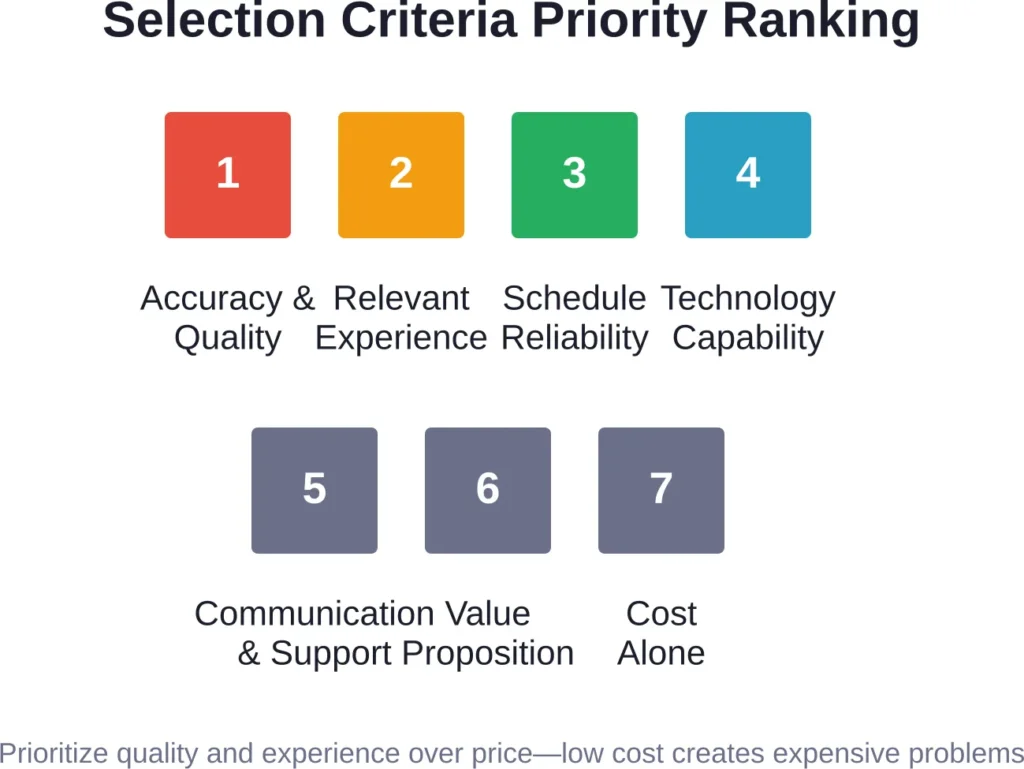
Value matters more than cost alone. The cheapest option often becomes the most expensive once you account for revisions, delays, and field confusion. Focus on the total project impact rather than the detailing fee in isolation.
Cultural fit shouldn’t be overlooked. Do you communicate well with the team? Do they seem genuinely interested in your project’s success? Trust your instincts about whether the partnership will work smoothly.
Start with a pilot phase if possible. Rather than committing to an entire project upfront, begin with a limited scope. Evaluate performance on that initial phase before expanding the engagement.
Quick Selection Checklist
- Confirmed experience with similar project types and complexity levels
- Current software capabilities that match project BIM requirements
- Demonstrated quality control processes with documented accuracy metrics
- Adequate staffing and capacity to meet project schedule requirements
- Responsive communication style with dedicated project management
- Positive references from recent projects of comparable scope
- Competitive value proposition balancing cost with quality assurance
- Compatible working style and cultural fit with project team
Industry Trends Shaping Rebar Detailing in 2026
The rebar detailing industry continues evolving as technology advances and construction methods change.
BIM adoption has reached critical mass. Projects that don’t use 3D coordination are becoming the exception rather than the rule. Detailing firms that haven’t invested in BIM capabilities are losing market relevance.
Automation is increasing but not eliminating the need for skilled detailers. Software can now auto-generate standard details and optimize bar layouts. But complex projects still require human judgment and experience.
Prefabrication is growing across construction sectors. More reinforcement arrives on site as pre-assembled cages and mats rather than loose bars. This shift changes detailing requirements, placing more emphasis on fabrication sequencing and transportation considerations.
Sustainability concerns are influencing reinforcement design. Detailers increasingly help optimize steel quantities to reduce material consumption while maintaining structural performance. Some projects now specify recycled steel content or alternative reinforcement materials.
Global delivery models have matured. The technology infrastructure now allows seamless collaboration between clients in one country and detailing teams in another. This has increased competition while also expanding access to specialized expertise.
Quality expectations continue rising. What counted as acceptable accuracy ten years ago no longer meets current standards. Project teams expect near-perfect first submissions with minimal revision cycles.
Common Mistakes When Selecting Detailing Services
Learning from others’ mistakes costs less than making your own. Here are pitfalls to avoid.
Choosing based solely on price is the most common error. That budget firm that saves you $15,000 on detailing fees will cost you $100,000 in field delays and rework. Always evaluate total project impact.
Failing to verify actual experience with your project type creates problems. A company with impressive infrastructure credentials might struggle with residential work, and vice versa. Relevant experience matters.
Overlooking software compatibility causes integration headaches. If your project uses Revit but the detailing firm works in AutoCAD, coordinate those requirements upfront. File conversions create opportunities for errors.
Assuming all detailers within a company have equal skills is unrealistic. Large firms have both stars and mediocre performers. Try to understand who specifically will work on your project.
Not establishing clear communication protocols leads to confusion. Define expectations upfront—response times, meeting frequency, revision processes, deliverable formats. Document these agreements.
Skipping reference checks is surprisingly common. Always contact past clients. A thirty-minute call can reveal issues that aren’t apparent from marketing materials.
Starting too late in the project timeline creates unnecessary pressure. Engage detailing services early enough to allow proper coordination and review time without rushing.
The Real Value of Professional Rebar Detailing
What’s the actual return on investment from hiring professional rebar detailing services rather than going with the cheapest option or trying to handle it internally?
The direct benefits show up in multiple areas. Accurate detailing reduces material waste—steel ordered matches steel needed. Fabrication efficiency improves when shop drawings are clear and complete. Installation proceeds faster when field crews aren’t puzzling over confusing details.
Schedule impacts often provide the largest financial benefit. Construction delays cost serious money—extended general conditions, accelerated labor to catch up, penalty clauses, and lost revenue from delayed occupancy. Professional detailing that keeps the project on schedule pays for itself many times over.
Risk reduction carries significant value that’s harder to quantify but equally real. Proper reinforcement detailing ensures structural safety. It helps avoid costly change orders. It reduces disputes and claims that consume management time and legal fees.
Coordination benefits accrue across the project team. When rebar models integrate properly with architectural, MEP, and structural models, everyone works more efficiently. Clash detection identifies problems during design rather than construction.
Many contractors report that professional rebar detailing services become profit centers rather than cost centers. The efficiency gains and problem avoidance more than offset the service fees.
Frequently Asked Questions
Rebar detailing services convert structural engineering plans into construction-ready documentation. This includes shop drawings showing reinforcement placement, bar bending schedules listing every steel piece with dimensions and bend details, 3D models for coordination, quantity takeoffs for material ordering, and often ongoing support responding to field questions. Professional firms handle everything from initial drawing creation through revisions and final as-built documentation.
Timeline varies with project complexity and size, but typical projects require two to four weeks for initial detailing work. Small residential projects might be completed in one week, while large commercial buildings could take several months as work proceeds in phases. Revision turnaround typically ranges from three to five days for professional firms. Companies should provide project-specific timelines during the proposal phase.
Project requirements determine the answer. Small, straightforward projects often work fine with traditional 2D shop drawings. But projects with complex geometry, congested reinforcement, or multiple-trade coordination benefit enormously from 3D modeling. If your project uses BIM coordination across disciplines, 3D rebar models become essential. Many fabricators now prefer 3D models since they can load them directly into automated bending equipment.
Quality assurance typically involves multiple review stages. The original detailer performs self-checking of calculations and dimensions. A senior detailer reviews technical accuracy and conformance to structural design. A final completeness check ensures all required information appears clearly. Some companies employ dedicated QA/QC staff who review work independently. Professional firms track error rates and continuously improve their processes based on that data.
No single software platform is universally best—what matters is alignment with your project requirements. Common professional platforms include Tekla Structures, RebarCAD, AutoCAD with rebar extensions, and Revit with structural add-ins. The important factor is whether the company’s software produces deliverables in formats your fabricator and project team can use. Ask about file compatibility and BIM integration capabilities during the selection process.
Yes, many leading firms serve global clients. Modern collaboration technology makes geographic distance largely irrelevant. However, verify that the company understands local building codes, reinforcement standards, and construction practices for your project location. Metric versus imperial units, bar sizing designations, and detailing conventions vary by region. The company should demonstrate experience with projects in your country or region.
Detailing services are commonly priced per ton of reinforcing steel, though some firms charge by square foot of building area or fixed fees for defined scopes. Payment structures usually involve an initial deposit with progress billing as work phases complete. Rather than focusing on the detailing fee in isolation, evaluate the total project value—professional detailing that prevents delays and rework delivers far more value than its direct cost. Request detailed proposals that clearly define scope, deliverables, and payment terms.
Moving Forward With Your Project
Selecting the right rebar detailing partner significantly impacts your construction project’s success. The ten companies profiled here represent proven options, but the best choice depends on your specific project requirements.
Start by clearly defining what you need. What type of project are you building? What’s the complexity level? What deliverable formats do you require? What schedule must be maintained? Answering these questions helps you evaluate which companies align best.
Reach out to multiple firms for preliminary conversations. Gauge their interest level, responsiveness, and understanding of your project. Request specific questions: Have you done similar work? What’s your current capacity? Can you meet our schedule?
Invest time in the selection process upfront rather than rushing into an engagement. A few extra days spent choosing carefully prevents months of problems later.
Remember that rebar detailing affects nearly every aspect of your concrete construction. Foundation work, structural frames, elevated slabs, retaining walls—all depend on accurate reinforcement details. The quality of those details flows directly from the capability of the company you choose.
Professional rebar detailing services aren’t an expense to minimize—they’re an investment in project success. The right partner delivers accurate documentation, maintains your schedule, prevents costly errors, and functions as a true team member throughout construction.
The construction industry continues evolving toward greater precision, tighter coordination, and higher performance standards. Companies that embrace professional rebar detailing position themselves to meet these rising expectations and deliver superior projects.
Take the time to choose wisely, establish clear communication from the start, and build a collaborative relationship with your detailing partner. Your project’s structural integrity, budget, and timeline all depend on this critical decision.