

Quick Summary: Dubai’s architectural engineering landscape is home to world-class firms specializing in residential, commercial, hospitality, and mixed-use projects. This comprehensive guide profiles 11 leading architectural engineering companies in Dubai for 2026, covering their specializations, notable projects, and service offerings to help you select the right partner for your next development.
Dubai has transformed into a global architectural marvel over the past two decades. From the iconic Burj Khalifa to the Palm Jumeirah, the city’s skyline showcases cutting-edge design and engineering excellence.
But here’s what most property developers and investors don’t realize: behind every successful project stands an architectural engineering firm that coordinates multiple disciplines under one roof.
The challenge? Finding a firm that delivers both aesthetic brilliance and structural integrity while navigating Dubai Municipality’s rigorous accreditation requirements.
This guide examines 11 architectural engineering companies operating in Dubai in 2026, based on project portfolio, technical capabilities, and industry recognition.
What Makes an Architectural Engineering Company Stand Out in Dubai?
Architectural engineering differs from pure architecture. These firms integrate structural, mechanical, electrical, and plumbing (MEP) engineering alongside architectural design.
The result? A single point of accountability from concept through construction.
In Dubai’s competitive market, leading firms share several characteristics. They maintain accreditation with Dubai Municipality and hold memberships in professional bodies like the UAE Society of Engineers and the AIA Middle East chapter.
They employ multidisciplinary teams that understand local building codes, climate considerations, and cultural sensitivities. Most importantly, they deliver projects that balance innovation with practicality.
According to Dubai Municipality’s self-build villa permit program (accreditation announced October 23, 2025), accredited engineering consultancy offices can provide instant permits for Emirati villas. This initiative highlights the importance of working with properly certified firms.
Understanding Dubai’s Architectural Engineering Landscape
According to industry standards, architectural services typically represent 8-15% of total construction cost for smaller projects and 2-8% for larger developments.
But cost isn’t everything. The right firm saves money through value engineering, prevents costly rework, and accelerates approvals.
Dubai’s architecture market continues expanding in 2026, driven by Expo legacy projects, sustainable development initiatives, and the ongoing demand for luxury residential properties.
Top 11 Architectural Engineering Companies in Dubai
1. Powerkh

Powerkh is a UK-based engineering-led BIM and VDC consultancy with offices in the United States and Ukraine, supporting architects, engineers, contractors, and consultants on projects in Dubai and other international markets. The company provides BIM modelling, structural and MEP coordination, Scan to BIM, and technical design support for commercial, residential, and industrial developments. Their work is focused on helping project teams improve coordination between disciplines during design and construction stages.
Powerkh works with Autodesk Revit, Navisworks, and point cloud-based workflows to support architectural and engineering coordination across different project phases. The company provides clash detection, constructability reviews, shop drawings, and fabrication-ready models, along with support for existing building modelling and as-built verification. Their services are used to help teams manage design changes, improve model accuracy, and maintain coordination between architectural, structural, and MEP systems throughout project delivery.
Contact Information:
- Website: www.powerkh.com
- Email: [email protected]
- Facebook: www.facebook.com/100064039650167
- LinkedIn: www.linkedin.com/company/powerkh
- Instagram: www.instagram.com/powerkh_com
- Address: 3, Lavinia Walk, Taw Hill, Swindon SN25 1AP
- Phone: +44 7490 426678
2. Atkins (Middle East)

Atkins stands as one of the most established architectural engineering firms in the Middle East. The company played a crucial role in designing the Burj Al Arab, Dubai’s iconic sail-shaped hotel.
Their Dubai office specializes in large-scale infrastructure, transportation hubs, and mixed-use developments. The firm employs professionals across the UAE, offering multidisciplinary capabilities spanning architecture, civil engineering, and environmental consulting.
Atkins excels in sustainable design, incorporating green building principles into projects ranging from master-planned communities to individual towers. Their experience with Dubai’s regulatory environment makes them particularly effective at navigating complex approval processes.
The firm’s portfolio includes work on Dubai Metro extensions, major residential towers in Downtown Dubai, and hospitality projects across the emirate.
3. Dar Al-Handasah (Dar Group)

Dar Al-Handasah represents Middle Eastern engineering excellence with a presence spanning over 60 years. The firm maintains one of the largest architectural engineering practices in Dubai.
Their services cover the full project lifecycle, from feasibility studies through detailed design and construction supervision. Dar specializes in healthcare facilities, educational institutions, commercial towers, and residential developments.
According to a LinkedIn job posting, the company requires lead architects with membership in the UAE Society of Engineers and 15+ years of UAE experience in design, review, and coordination across diverse project types including villas, malls, hotels, towers, medical centers, and educational buildings.
The firm’s technical depth allows them to handle complex engineering challenges while maintaining architectural vision. Their Dubai portfolio includes numerous landmarks and infrastructure projects that have shaped the city’s development.
4. Killa Design
Killa Design is recognized for designing the Museum of the Future, one of Dubai’s distinctive recent architectural additions.
The firm takes an innovation-first approach, combining parametric design tools with traditional architectural principles. Their portfolio focuses on cultural, commercial, and hospitality projects that push design boundaries.
Killa Design operates with a relatively compact team compared to larger firms, but this allows for greater creative control and design consistency. The studio emphasizes sustainability and cultural relevance in every project.
Beyond the Museum of the Future, their work includes office towers, retail developments, and public spaces throughout Dubai and the wider region. The firm’s design philosophy balances bold aesthetics with functional performance.
5. SSH International

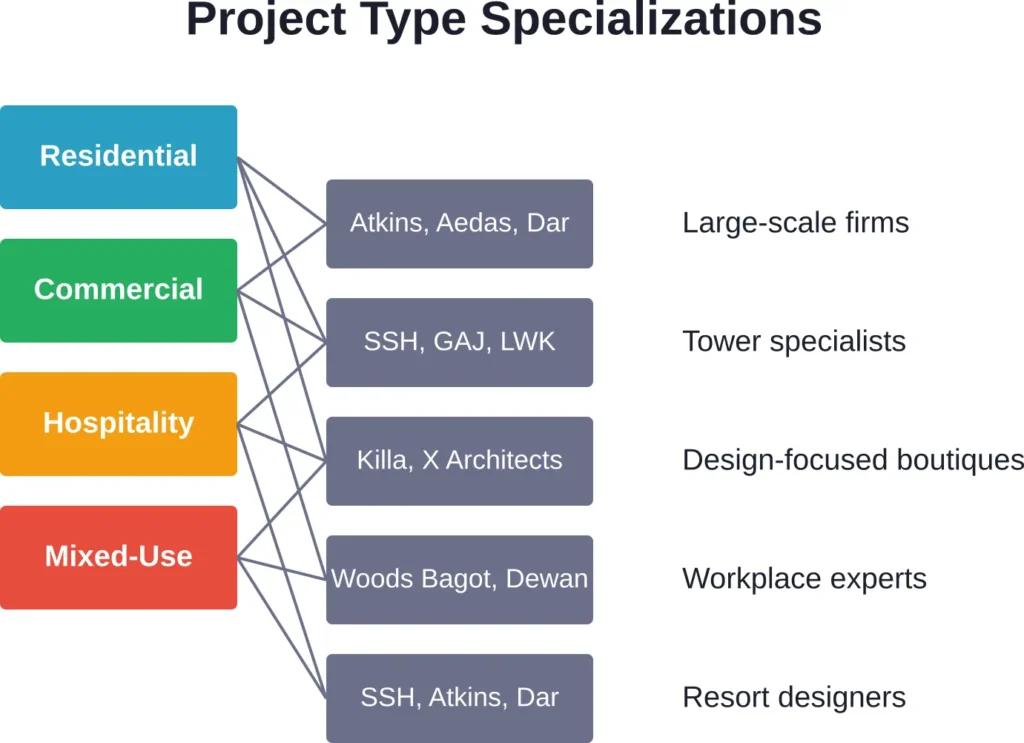
SSH International brings global expertise to Dubai’s architectural engineering market. The firm specializes in hospitality, residential, and mixed-use developments.
Their Dubai office handles projects across the luxury segment, with particular strength in resort design and high-end residential towers. SSH’s integrated approach combines architecture, interior design, and landscape architecture under unified project teams.
The firm’s technical capabilities extend to structural and MEP engineering coordination, though they often collaborate with specialist consultants on larger projects. Their portfolio demonstrates consistent attention to detail and construction quality.
SSH has contributed to numerous hotel properties and residential developments across Dubai Marina, Palm Jumeirah, and emerging districts. Their designs typically emphasize livability and long-term value alongside visual impact.
6. Godwin Austen Johnson (GAJ)

Godwin Austen Johnson operates as a pure-play architecture and engineering practice with deep roots in Dubai. The firm established its presence in the emirate during the construction boom of the 2000s.
GAJ specializes in residential towers, hospitality projects, and commercial developments. Their portfolio includes numerous high-rise residential buildings across Dubai’s key districts.
The firm’s approach emphasizes buildability—designs that look impressive but translate efficiently into construction. This practical focus has made them a preferred partner for developers seeking reliable delivery.
GAJ maintains strong relationships with Dubai’s major developers and contractors. Their understanding of local construction methodologies and material availability helps prevent design-to-construction disconnects.
7. Aedas
Aedas operates one of the world’s largest architectural practices, with significant capabilities in Dubai. The firm handles mega-projects, master planning, and complex mixed-use developments.
Their Dubai portfolio includes transportation infrastructure, commercial complexes, and residential communities. Aedas employs advanced digital tools including Building Information Modeling (BIM) for coordination across disciplines.
The firm’s scale allows them to staff large projects with dedicated teams while maintaining quality control. They specialize in fast-track projects requiring parallel design and construction processes.
Aedas excels at projects requiring coordination among multiple stakeholders, government agencies, and contractor teams. Their systematic approach to project delivery reduces risks for clients undertaking ambitious developments.
8. X Architects (formerly XBD Collective)

X Architects represents a boutique approach to architectural engineering in Dubai. The firm focuses on residential villas, luxury apartments, and small-to-medium commercial projects.
Their design philosophy emphasizes contextual response—creating buildings that relate to their surroundings rather than making isolated statements. This approach resonates particularly well with private clients seeking distinctive homes.
X Architects provides integrated services including interior design, landscape architecture, and engineering coordination. Their project scale allows for high levels of customization and client involvement.
The firm’s portfolio demonstrates particular strength in contemporary villa design for Dubai’s exclusive neighborhoods. They balance modern aesthetics with the practical requirements of the local climate.
9. LWK + Partners

LWK + Partners brings Asia-Pacific architectural expertise to Dubai’s market. The firm specializes in residential towers, mixed-use developments, and master planning.
Their Dubai office opened to serve the emirate’s growing demand for high-density residential design. LWK excels at creating efficient floor plans that maximize usable space while maintaining design quality.
The firm employs advanced visualization technologies to help clients and authorities understand proposed designs. Their presentation materials consistently rank among the industry’s most polished.
LWK’s portfolio includes numerous residential towers across Dubai’s key development zones. Their designs typically emphasize amenity spaces, connectivity, and lifestyle programming alongside individual unit quality.
10. Dewan Architects + Engineers
Dewan operates as one of the region’s largest homegrown architectural engineering firms. The company maintains comprehensive capabilities across architecture, engineering, and project management.
Their Dubai practice covers all major sectors including residential, commercial, hospitality, healthcare, and education. Dewan’s scale allows them to handle multiple concurrent projects while maintaining technical depth.
The firm places particular emphasis on value engineering—finding design solutions that reduce costs without compromising quality. This approach has made them popular among developers focused on project economics.
Dewan’s portfolio spans budget-conscious projects through luxury developments. Their versatility allows them to serve diverse client segments with appropriate design responses.
11. Woods Bagot

Woods Bagot brings Australian design sensibilities to Dubai’s architectural engineering landscape. The firm specializes in workplace design, hospitality, and mixed-use projects.
Their Dubai office focuses on commercial office towers and hotel developments. Woods Bagot pioneered workplace strategy consulting, helping clients optimize their real estate through evidence-based design.
The firm’s hospitality expertise spans business hotels through luxury resorts. They maintain a research-driven approach, studying user behavior to inform design decisions.
Woods Bagot collaborates with specialized engineering consultants to deliver comprehensive project documentation. Their designs typically emphasize operational efficiency alongside aesthetic quality.
How to Choose the Right Architectural Engineering Company
Selecting an architectural engineering firm requires evaluating several factors beyond portfolio aesthetics.
Start with accreditation. Verify the firm holds necessary approvals from Dubai Municipality and relevant professional memberships. This ensures they can legally submit permit applications and maintain professional insurance.
Look at the firm’s actual built projects, not just renderings. Visit completed buildings when possible. Speak with previous clients about their experience during design and construction phases.
Project Scale and Complexity
Match firm size to project requirements. Boutique firms excel at smaller projects requiring customization and personal attention. Large firms handle mega-developments requiring extensive coordination.
Consider the project’s technical complexity. Unique structural requirements, complicated MEP systems, or challenging sites demand firms with specific engineering depth.
Design Philosophy and Cultural Fit
Review the firm’s portfolio for design consistency. Some firms maintain a signature style; others adapt to client preferences. Neither approach is inherently better—it depends on what the project requires.
Evaluate communication style during initial meetings. The design process involves countless decisions. Working with a firm that communicates clearly prevents misunderstandings and frustration.
Service Integration
Determine which services the firm provides in-house versus through external consultants. Fully integrated firms offer single-point accountability but may cost more. Firms that coordinate external specialists provide flexibility but require more client oversight.
For complex projects, integrated firms typically deliver more efficiently. For straightforward projects, coordination-focused firms can offer better value.
| Selection Criteria | Large Firms | Boutique Firms |
|---|---|---|
| Project Scale | Best for major developments, master planning, multiple buildings | Best for individual buildings, villas, custom projects |
| Service Integration | Complete in-house capabilities across all disciplines | Architecture-led with coordinated engineering consultants |
| Design Customization | Systematic approach with established methodologies | Highly customized, client-specific solutions |
| Timeline Flexibility | Structured processes, predictable delivery | More adaptable to changing requirements |
| Regulatory Navigation | Deep experience with complex approval processes | Effective for standard project types |
| Cost Structure | Higher fees offset by efficiency and risk reduction | Lower overhead, competitive fees |
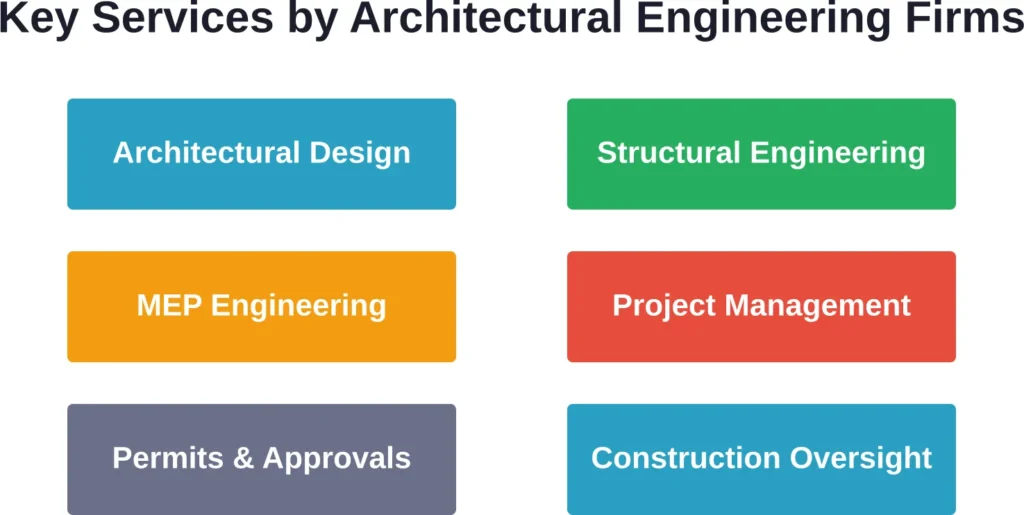
Key Services Offered by Dubai Architectural Engineering Firms
Architectural Design and Master Planning
Core architectural services include conceptual design, schematic design, design development, and construction documentation. Firms develop drawings, specifications, and coordination documents that guide construction.
Master planning services address site development strategy, phasing plans, infrastructure coordination, and long-term development frameworks. This proves particularly valuable for large landholdings requiring staged development.
Structural Engineering
Structural engineering ensures buildings safely support their own weight plus occupancy loads, wind forces, and seismic activity. Dubai’s tall buildings require sophisticated structural analysis and innovative systems.
Structural engineers coordinate with architects to achieve design intent while satisfying safety requirements. This balance between aesthetics and engineering often defines project success.
MEP Engineering
Mechanical, electrical, and plumbing engineering covers heating, ventilation, air conditioning, electrical distribution, lighting, fire protection, and plumbing systems. In Dubai’s climate, MEP systems significantly impact operating costs.
Effective MEP design balances initial construction costs against long-term operational efficiency. Leading firms employ energy modeling to optimize system performance.
Sustainability and Green Building
Sustainability services include energy analysis, green building certification (such as LEED or Estidama), renewable energy integration, and water conservation strategies.
Dubai’s building codes increasingly mandate sustainability measures. Working with firms experienced in green building ensures compliance while potentially reducing operating costs.
Permits and Regulatory Approvals
Navigating Dubai Municipality’s approval process requires understanding building codes, zoning regulations, and submission procedures. Experienced firms manage this process efficiently, preventing delays.
The self-build villa permit program introduced by Dubai Municipality with accreditation announced October 23, 2025 allows accredited consultancy offices to issue instant permits for qualifying projects. This expedited process rewards working with properly certified firms.
Construction Administration
Construction administration services include site observation, submittal review, responding to contractor questions, and verifying work complies with design intent. This oversight protects client interests during construction.
Some firms provide full-time site representation; others conduct periodic reviews. The appropriate level depends on project complexity and contractor experience.
Industry Trends Shaping Dubai Architecture in 2026
Sustainability and Net-Zero Targets
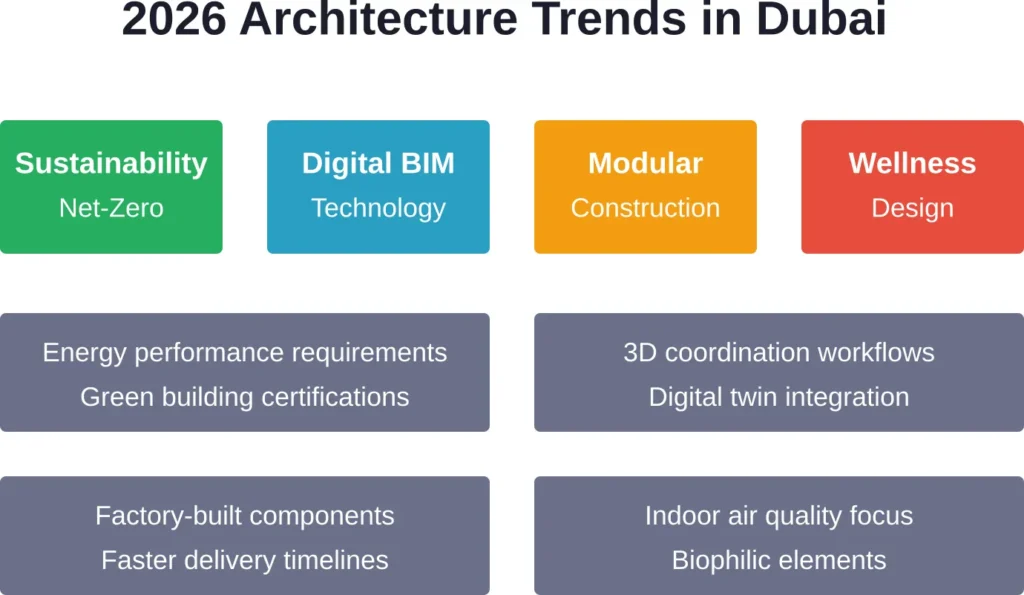
Dubai has committed to significant sustainability targets aligned with UAE national goals. Buildings now face increasingly stringent energy performance requirements.
Architectural engineering firms respond by integrating passive design strategies, high-performance building envelopes, and efficient systems from project inception rather than treating sustainability as an add-on.
Digital Tools and BIM Adoption
Building Information Modeling has become standard practice among leading firms. BIM enables better coordination among disciplines, reduces construction conflicts, and creates digital records for building management.
Advanced firms employ BIM for energy analysis, structural optimization, and construction sequencing. This digital approach improves outcomes while potentially reducing costs.
Modular and Prefabricated Construction
Interest in modular construction and prefabrication continues growing. These approaches promise faster delivery, improved quality control, and reduced site waste.
Architectural engineering firms adapt by designing for manufacturing processes rather than traditional site-built methods. This requires different detailing approaches and earlier construction planning involvement.
Wellness and Biophilic Design
Post-pandemic awareness of indoor environmental quality drives demand for buildings that support occupant health. This includes enhanced ventilation, natural lighting, connection to nature, and materials selection.
Biophilic design integrates natural elements, patterns, and processes into buildings. Leading firms incorporate these principles to create environments that support well-being.
Working with Architectural Engineering Firms: What to Expect
Initial Consultation and Feasibility
The process typically begins with a consultation where the firm assesses project requirements, site conditions, budget parameters, and schedule expectations. Established firms charge for this phase; some offer preliminary consultations at no cost.
Feasibility studies examine whether project goals can be achieved within constraints. This includes zoning analysis, preliminary design concepts, and budget estimates.
Design Phases
Architectural projects progress through distinct phases. Conceptual design explores overall approach and aesthetic direction. Schematic design develops spatial organization and major systems. Design development finalizes materials, details, and technical coordination.
Each phase produces progressively detailed drawings and specifications. Client reviews and approvals at phase milestones prevent costly changes later.
Permit Submission and Approvals
Once design is sufficiently developed, the firm submits applications to Dubai Municipality and other relevant authorities. The approval timeline varies by project type and complexity.
Working with accredited consultancies can significantly expedite this process, particularly for eligible project types under Dubai Municipality’s instant permit programs.
Construction Documentation
Construction documentation produces the complete set of drawings and specifications contractors use for bidding and construction. This phase requires meticulous coordination among all engineering disciplines.
Quality of construction documents directly impacts construction efficiency. Incomplete or poorly coordinated documents lead to contractor questions, change orders, and delays.
Construction Phase Services
During construction, the architectural engineering firm reviews contractor submissions, responds to questions, observes work in progress, and verifies compliance with design intent.
The level of construction phase involvement varies. Some contracts include only periodic reviews; others provide full-time resident project representatives.
Common Challenges and How Professional Firms Address Them
Design-Construction Disconnects
One frequent issue involves designs that prove difficult or expensive to build. Professional architectural engineering firms prevent this through constructability reviews, material availability checks, and contractor input during design.
Firms with extensive local experience understand Dubai’s construction industry capabilities and limitations. This knowledge informs realistic design decisions.
Budget Overruns
Construction costs often exceed initial estimates when design scope expands without corresponding budget adjustments. Professional firms provide regular cost checks throughout design development.
Value engineering identifies opportunities to reduce costs without compromising essential project goals. This becomes particularly valuable when initial design exceeds budget.
Schedule Delays
Delays commonly stem from permit issues, design changes, or construction coordination problems. Experienced firms minimize these through thorough planning, complete documentation, and proactive problem-solving.
Fast-track projects requiring overlapping design and construction phases demand even more sophisticated coordination. Only firms with proven systems should attempt such compressed schedules.
Quality Control Issues
Construction quality depends partly on contractor capabilities but also on clear documentation and diligent oversight. Professional firms establish quality benchmarks and verify compliance through construction observation.
Post-construction issues often trace back to inadequate construction phase services. Saving money by reducing oversight frequently costs more in remediation.
Frequently Asked Questions
Architects focus primarily on building design, aesthetics, and spatial planning. Architectural engineering firms integrate structural, mechanical, electrical, and plumbing engineering alongside architectural design. This comprehensive approach provides single-source responsibility for both design vision and technical performance. In Dubai’s market, most major projects benefit from the coordinated services architectural engineering firms provide, though smaller projects may work effectively with separate architect and engineer contracts.
Timeline varies significantly by project type and complexity. A residential villa might complete design and obtain approvals in 3-4 months with an efficient firm and straightforward requirements. Large mixed-use developments can require 12-18 months or more for design development and regulatory approvals. Dubai Municipality’s instant permit program for self-build villas dramatically reduces timeline for qualifying projects when working with accredited consultancies. Complex projects requiring multiple authority approvals naturally take longer than straightforward buildings.
This depends on the firm and project. Fully integrated architectural engineering firms provide all required services in-house, from architecture through structural and MEP engineering. Other firms specialize primarily in architecture and coordinate with independent engineering consultants. For clients, integrated firms offer simplified management and clear accountability. Separate consultants provide flexibility and sometimes lower costs for straightforward projects. Clarify service scope during initial discussions to understand what the firm provides directly versus through coordination.
Neither category inherently outperforms the other—success depends on specific firm capabilities and project requirements. International firms bring global best practices and experience from diverse markets. Local firms offer deep understanding of Dubai’s regulatory environment, construction industry, and cultural context. Many top-performing firms blend both advantages through international networks with strong local presence. Evaluate firms individually based on relevant project experience, technical capabilities, and demonstrated results rather than origin.
Verify Dubai Municipality accreditation and relevant professional memberships. For firms employing architects, check for UAE Society of Engineers membership for UAE-licensed professionals or AIA Middle East membership for internationally-trained architects. Review actual built projects, not just renderings or awards. Check the firm maintains appropriate professional liability insurance. For specialized projects like healthcare or hospitality, confirm sector-specific experience. References from previous clients provide valuable insights into working relationship and project delivery performance.
According to industry standards, architectural services typically represent 8-15% of total construction cost for smaller projects and 2-8% for larger developments. This range varies based on project complexity, service scope, schedule constraints, and customization level. Fast-track projects, highly complex buildings, or extensive customization increase fees. Straightforward designs using standard systems cost less. Obtain detailed fee proposals from multiple firms for accurate project-specific estimates. Remember that design fees represent a small fraction of total project cost—effective design creates value many times the professional service investment.
Most comprehensive firms provide services for existing buildings including renovation design, space planning, system upgrades, and historic preservation. Existing building projects often require different expertise than new construction—understanding existing conditions, working within constraints, and phasing work around ongoing operations. Some firms specialize in adaptive reuse and renovation. When selecting a firm for existing building work, review their portfolio for relevant experience. Renovation projects benefit from firms that thoroughly investigate existing conditions before design commitments.
Making Your Selection
Choosing an architectural engineering firm represents a critical project decision. The right partnership delivers buildings that exceed expectations. The wrong choice leads to frustration, delays, and compromised results.
Start by defining project requirements clearly. Understand scope, budget, schedule, and quality expectations before approaching firms. This clarity allows more productive initial discussions.
Interview multiple firms. Look beyond portfolio aesthetics to evaluate technical depth, communication style, and relevant experience. Ask about team composition, project approach, and how they handle challenges.
Check references carefully. Previous clients provide insights into working relationships and problem-solving capabilities that marketing materials cannot.
The firms profiled in this guide represent some of Dubai’s most capable architectural engineering practices in 2026. Each brings distinct strengths suited to different project types and client needs.
But the “best” firm depends entirely on specific project requirements. A firm perfect for a commercial tower may not suit a custom villa. A designer ideal for a boutique hotel might overwhelm a simple office fit-out.
Match firm capabilities to project needs. Consider both technical requirements and working relationship factors. The most successful projects emerge from partnerships where client and firm align on vision, approach, and expectations.
Conclusion
Dubai’s architectural engineering industry offers world-class capabilities across every building type and scale. The 10 firms highlighted here represent diverse approaches, from global practices to specialized boutiques.
Yet the industry continues evolving. Sustainability requirements increase. Digital tools advance. Construction methods change. The best firms adapt while maintaining design excellence and technical rigor.
When embarking on a building project in Dubai, invest time in firm selection. The architectural engineering partnership shapes every aspect of the final building—from first concepts through construction completion and beyond.
Visit completed projects. Meet design teams. Understand methodologies. Verify credentials and experience.
The firms profiled here have demonstrated consistent performance in Dubai’s demanding market. Each has delivered notable projects and satisfied clients. But the right choice for your specific project depends on careful evaluation of needs, priorities, and compatibility.
Ready to start your architectural project? Contact several firms from this list for initial consultations. Compare approaches, chemistry, and capabilities. The investment in thorough selection pays dividends throughout design and construction.
Dubai’s skyline testifies to the caliber of architectural engineering talent available in the emirate. The right firm partnership transforms vision into built reality.