

Quick Summary: Rebar detailing costs range from $45 to $85 per hour depending on experience, project complexity, and location. Per-ton pricing typically falls between $30 and $80 based on connection types and drawing requirements. Client billing rates in the United States average $80–$100 per hour as of 2025, though overseas providers may charge significantly less.
Rebar detailing transforms structural calculations into buildable shop drawings. But when budget planning starts, the question hits fast: what does this actually cost?
The answer isn’t simple. Pricing varies wildly based on project complexity, detailer experience, geographic location, and billing structure. Some firms charge by the hour. Others price per ton of steel. A few offer flat-rate packages.
Understanding what drives these costs—and what the real market rates are—helps construction teams budget accurately and avoid expensive surprises mid-project.
Hourly Rate Pricing for Rebar Detailing
Most rebar detailing services bill by the hour. According to industry data, typical rates range from $45 to $85 per hour depending on experience, complexity, and location.
Here’s the thing though—hourly billing works best when project scope remains uncertain or involves significant revisions. For straightforward projects with clear specifications, per-ton pricing often delivers better cost predictability.
Hourly rates reflect several factors:
- Detailer skill level and certifications
- Software licensing and technology costs
- Project complexity and revision frequency
- Geographic market conditions
- Turnaround time requirements
The detailer’s wage represents just one piece of the billing rate. For steel detailing services broadly, average detailer wages in the United States sit at $25–$28 per hour, with experienced professionals earning up to $35 per hour. But typical client billing rates for steel detailing in 2025 reach $80–$100 per hour.
That gap? Overhead.
What Makes Up Detailing Overhead
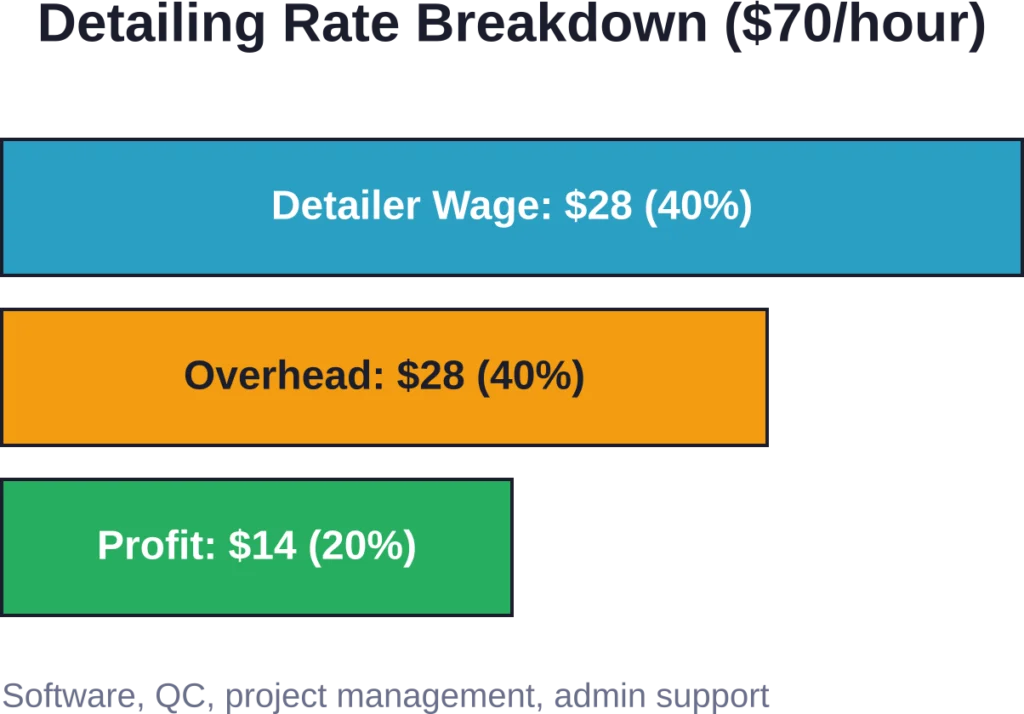
When billing rates run two to three times higher than wages, overhead accounts for the difference. This includes software subscriptions for modeling and drafting tools, hardware maintenance, quality control processes, project management, continuing education, and administrative support.
Industry analyses suggest overhead in steel and rebar detailing typically consumes 40–60% of the billable rate. For a $70/hour service, roughly $28–$42 covers overhead costs before any profit margin.
Per-Ton Pricing Models
Some detailing firms quote per ton of reinforcing steel. This pricing structure ranges from $30 to $80 per ton based on project complexity, connection types, and drawing requirements.
Per-ton pricing offers predictable costs when tonnage estimates are accurate. But scope creep hits hard if design changes increase steel quantities or add complex detailing zones.
Projects with straightforward layouts and repetitive elements typically land toward the lower end of the range. Complex structures with heavy congestion, numerous splice locations, or intricate connection details push pricing higher.
| Project Type | Complexity | Typical Rate per Ton |
|---|---|---|
| Simple slabs and footings | Low | $30–$45 |
| Standard columns and beams | Medium | $45–$60 |
| Transfer structures | High | $60–$75 |
| Complex connections and congestion | Very High | $75–$80 |
Remember that rebar estimates should include a 10% allowance for lapping, splicing, and waste in reinforcing steel. For welded wire fabric, waste allowances typically reach 10% as well. These factors affect total project cost even when detailing is priced per ton.
Regional Rate Variations
Geography significantly impacts detailing costs. Labor markets, cost of living, and local competition all shift pricing.
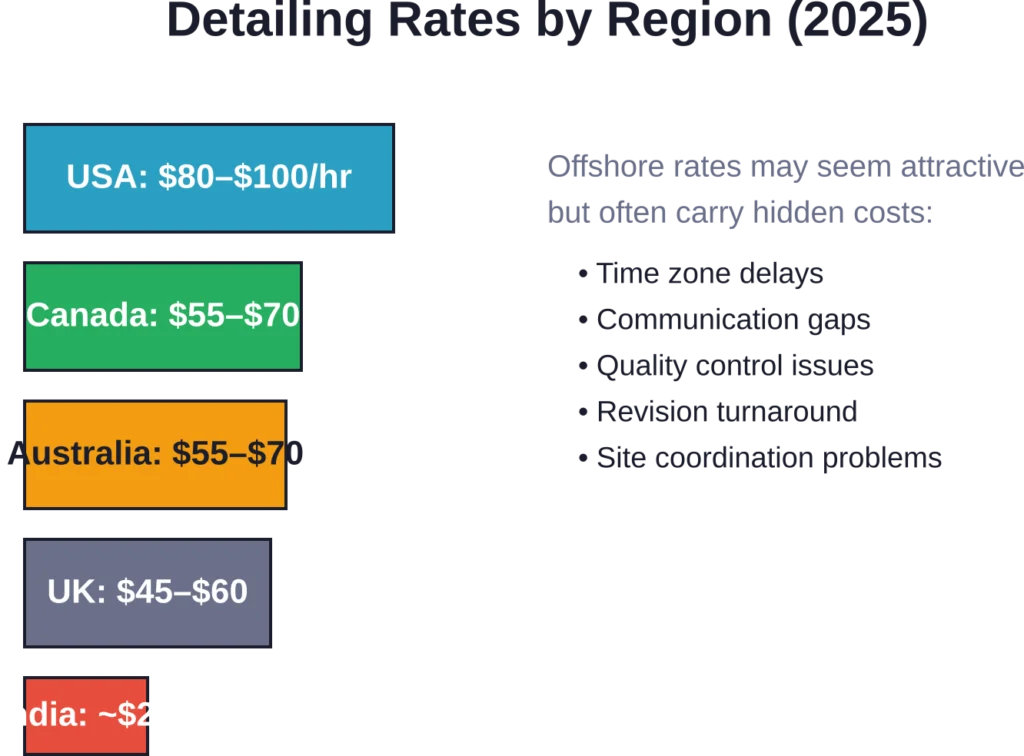
As of 2025, regional billing rates show clear patterns:
- United States: $80–$100/hour for steel detailing services
- Canada: $55–$70/hour (CAD $27.5/hour average detailer wage, approximately USD $21–$22)
- United Kingdom: $45–$60/hour
- Australia: $55–$70/hour
- India (export services): ~$20/hour
The offshore rate difference tempts many project teams. But community discussions in construction forums consistently highlight risks: communication gaps, time zone coordination challenges, quality control issues, and revision delays that often erase initial savings.
Real talk: when detailing costs $10/hour offshore but generates confusion on site, the crew standing idle waiting for clarification suddenly makes that cheap rate extremely expensive.
What Affects Project Detailing Costs
Beyond base rates, several project-specific factors drive final costs up or down.
Project Complexity and Congestion
Simple rectangular slabs with standard reinforcing patterns require minimal detailing time. Transfer beams with heavy bar congestion, complex splice requirements, and tight tolerance zones? That’s a different story.
Congestion drives detailing hours because every bar placement must be coordinated with adjacent elements, checked for clearance, and verified for constructability. Drawings must show clear bar marks, anchorage details, and splice locations that steel fixers can actually execute on site.
Revision Frequency
Design changes multiply detailing costs fast. Each structural modification requires updating 3D models, regenerating shop drawings, rechecking connections, and reissuing documentation.
Projects with unstable designs or frequent owner changes see detailing costs balloon. Fixed-price contracts often include revision limits to manage this risk.
Turnaround Requirements
Rush jobs cost more. When project schedules demand expedited detailing to meet construction deadlines, expect premium rates—typically 25–50% above standard pricing.
For complex projects, recommended contingency allowances run 10–15% to account for unexpected complications and documentation requirements.
Drawing Quality and Coordination
Good detailing means readable, structured drawings with buildable reinforcement layouts, coordinated splices and couplers, controlled congestion, and real site logic behind every bar.
Cheap detailing doesn’t reduce cost. It transfers risk. And in construction, risk is always expensive.
When a crew stands idle on site because bar marks are unclear or anchorage isn’t resolved, that $10/hour detailing rate suddenly becomes a $1,000/hour mistake.
Get Rebar Detailing Support for Construction Projects
Powerkh provides rebar detailing support for structural engineering and construction teams. Its services include reinforcement modelling, detailing, shop drawings, and coordination support for concrete structures.
Need Rebar Detailing Support?
Talk with Powerkh to:
- prepare rebar shop drawings and schedules
- support structural coordination workflows
- develop reinforcement BIM models
- improve detailing readiness before fabrication
Discuss reinforcement detailing requirements with Powerkh.
Estimating Your Project Budget
So how do project teams actually budget for rebar detailing?
Start with steel tonnage estimates. Typical detailing costs for commercial structures range from 2–4% of total rebar material cost. A project with $100,000 in rebar material might budget $2,000–$4,000 for detailing.
Alternatively, calculate expected detailing hours based on project complexity and multiply by regional hourly rates. A typical commercial project may require varied detailing hours per ton depending on connection complexity and structural configuration.
Always include contingency. Even well-defined projects encounter changes. A 10–15% detailing contingency protects against scope creep and revision costs.
| Estimating Method | Best For | Typical Range |
|---|---|---|
| Percentage of material cost | Preliminary budgets | 2–4% of rebar cost |
| Per-ton rate | Standard projects | $30–$80/ton |
| Hourly × estimated hours | Complex or uncertain scope | $45–$85/hour |
| Lump sum quote | Well-defined, stable designs | Negotiated fixed price |
Getting Accurate Quotes
Request quotes from multiple detailing firms. Provide structural drawings, design calculations, project schedule, and any special requirements.
Look, the lowest bid isn’t always the best value. Evaluate firms based on:
- Portfolio of similar projects
- Detailer qualifications and certifications
- Software capabilities and modeling standards
- Quality control processes
- Communication and revision turnaround
- References from recent projects
Ask about revision policies, change order procedures, and delivery timelines. Clarify what’s included in the base price versus additional services.
Frequently Asked Questions
Rebar detailing services typically charge $45 to $85 per hour depending on experience, project complexity, and location. United States market rates average $80–$100 per hour as of 2025, while Canadian services bill around $55–$70 per hour.
Per-ton pricing works well for projects with stable designs and accurate tonnage estimates, typically ranging from $30 to $80 per ton. Hourly billing suits projects with uncertain scope or frequent revisions. Neither is universally better—the right choice depends on project characteristics and risk tolerance.
Offshore providers in regions like India charge approximately $20 per hour due to lower labor costs and operating expenses. However, time zone differences, communication challenges, and quality control issues often create hidden costs that reduce or eliminate initial savings.
Typical detailing costs for commercial structures range from 2–4% of total rebar material cost. For example, a project with $100,000 in rebar material would budget $2,000–$4,000 for detailing. Add 10–15% contingency for design changes and revisions.
Project complexity and bar congestion drive costs significantly higher. Transfer structures, complex connections, heavy reinforcing zones, and tight tolerances require more detailing time. Rush turnarounds typically add 25–50% to base rates. Frequent design revisions multiply costs quickly.
Most quotes include a limited number of revisions—typically one or two rounds. Additional revisions due to design changes usually incur extra charges. Clarify revision policies and change order procedures before engaging a detailing service to avoid billing disputes.
Stabilize designs before detailing begins to minimize revisions. Provide complete, coordinated structural drawings and clear specifications. Allow reasonable turnaround times rather than rushing. Consider standardizing details and reinforcing patterns where possible. Good upfront coordination reduces total detailing hours significantly.
Making Smart Detailing Investments
Rebar detailing costs vary widely, but understanding the factors behind pricing helps project teams budget accurately and select appropriate services.
Whether choosing hourly billing at $45–$85 per hour or per-ton pricing from $30–$80, the key is matching the billing structure to project characteristics. Clear scope definition, stable designs, and realistic schedules keep costs predictable.
Quality detailing isn’t an expense to minimize—it’s an investment in buildability, safety, and site efficiency. Drawings that clearly communicate reinforcing intent, resolve congestion issues, and provide constructible details deliver value far beyond their direct cost.
The right detailing partner combines competitive pricing with proven expertise, robust quality control, and responsive communication. That combination ensures steel arrives on site ready to install, crews work efficiently, and the structure performs as designed.
Need accurate rebar detailing for your next project? Request quotes from qualified firms, provide complete project documentation, and evaluate providers based on capability—not just cost. The investment in quality detailing pays returns every day crews work efficiently in the field.