

Quick Summary: Quantity takeoff costs range from free for manual methods to professional training courses, while takeoff software subscriptions vary widely. The real cost includes labor hours—manual takeoffs can take 20-40 hours per project depending on complexity. Most contractors allocate varying percentages of project value to estimating and takeoff activities based on project type and bidding approach.
When contractors start pricing construction projects, one question comes up fast: what’s this going to cost just to figure out what it’ll cost?
Quantity takeoff—the process of measuring and itemizing every material, labor component, and equipment piece a project needs—carries its own price tag. That cost isn’t always obvious.
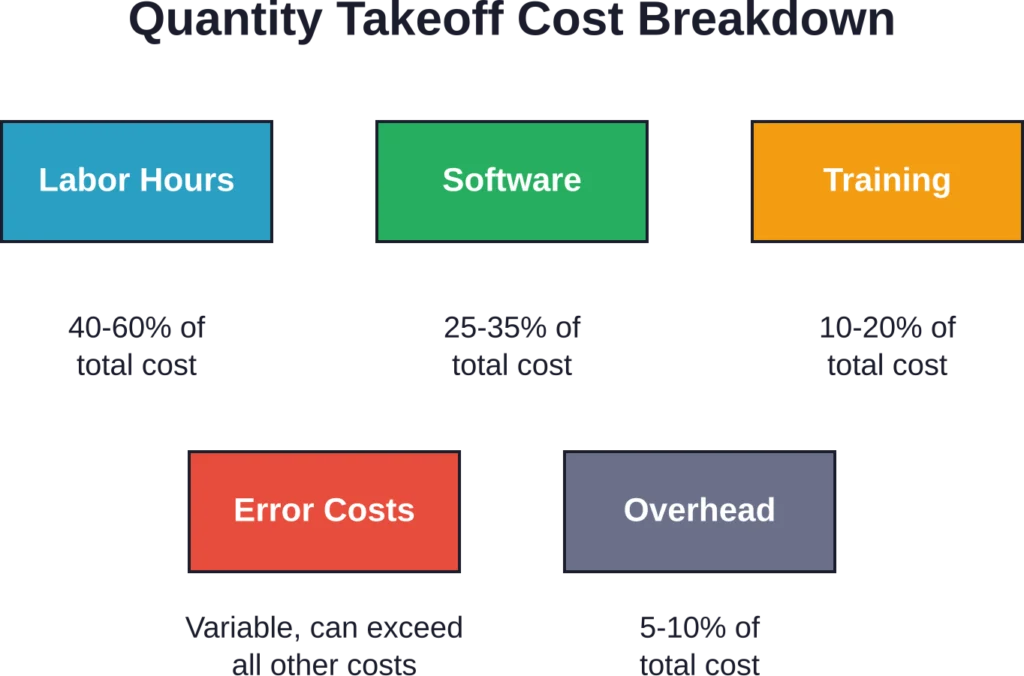
The real expense goes beyond software subscriptions. Labor hours pile up. Training investments add up. Mistakes get expensive.
Understanding What Quantity Takeoff Actually Means
Before diving into costs, it helps to understand what quantity takeoff actually delivers.
Quantity takeoff is the systematic process of measuring blueprints and specifications to determine exact quantities of materials needed. Think of it as translating architectural drawings into a shopping list—but with precision that keeps projects profitable.
This process sits at the foundation of construction cost estimating. Without accurate quantity data, cost estimates become guesswork. With it, contractors can bid competitively while protecting margins.
The takeoff process identifies every material quantity: linear feet of lumber, square yards of flooring, cubic yards of concrete, each door, window, fixture, and fastener. It specifies quantities in units, linear length, surface area, cubic volume, or weight depending on the material.
The True Cost Components of Quantity Takeoff
Quantity takeoff expenses break down into several distinct categories. Each carries weight in the total investment.
Labor and Time Investment
Labor represents the biggest ongoing cost for most firms.
Manual takeoffs consume substantial hours. A residential project might need 8-15 hours of takeoff work. Commercial projects often require 20-40 hours depending on complexity. Civil infrastructure projects can demand 60+ hours for a single estimate.
Estimator salaries vary by region and experience, but the hourly cost adds up quickly. When a senior estimator spends two full days on material counts, that’s direct cost hitting the bottom line.
Digital takeoff tools can reduce measurement and calculation hours compared to manual methods, but the initial time investment remains real.
Training and Education Expenses
Professional estimating skills don’t develop overnight.
According to Graduate School USA, their Construction Estimating Certification Online program includes training from experts and covers quantity takeoffs, pricing strategies, and accurate cost estimate proposals. Specific pricing should be verified on the Graduate School USA website as subscription and course costs change frequently.
For teams wanting specialized digital skills, professional construction estimating courses with software focus are available. Current pricing should be verified on vendor websites as costs change frequently. These courses include project-based training from professional estimators.
Universities and professional organizations offer construction estimating certificates that range from a few hundred to several thousand dollars. California State University San Marcos, for instance, provides a comprehensive online Certificate in Construction Estimating that equips students with proven methodologies for residential, commercial, and civil projects.
The education investment pays dividends through improved accuracy, but it represents upfront cost many firms overlook when budgeting.
Software and Technology Costs
This is where pricing gets complicated.
Manual takeoff costs almost nothing in direct expenses—just paper, pencils, scales, and calculators. But the labor hours multiply, and human error rates climb.
Digital takeoff software ranges from basic PDF markup tools to sophisticated AI-integrated platforms. Pricing models vary widely, and specific current prices should be verified on official vendor websites since subscription tiers change frequently.
Entry-level solutions might cost a few hundred dollars annually. Mid-tier construction-specific platforms typically run in the low thousands per year per user. Enterprise solutions with AI capabilities, integration with estimating databases, and advanced features can reach significantly higher price points.
The investment calculation isn’t just about subscription cost. It’s about time saved, accuracy gained, and competitive advantage earned.
Hidden Costs: Waste Allowances and Contingencies
Accurate takeoffs don’t just count material quantities—they account for waste, spoilage, and project-specific factors.
According to RSMeans guidance, waste allowances vary significantly by material type and project specifications. Accurate waste factors should be consulted in current RSMeans Data references for specific material categories.
Structural steel accessories and framing lumber require waste allowances that vary by material quality and project specifications. Current RSMeans Data should be consulted for precise percentages.
For specialized projects, contingencies may be higher. Project-specific contingency factors should be determined based on current RSMeans Data and project characteristics.
Estimators who skip these allowances produce takeoffs that look cheaper on paper but fail in reality. The cost of learning this lesson the hard way far exceeds the cost of doing it right initially.
Get Quantity Takeoff Support for Project Planning
Powerkh supports project teams with BIM-based quantity takeoffs and model-based documentation workflows during design and pre-construction stages.
Need Quantity Takeoff Support?
Talk with Powerkh to:
- extract quantities from BIM models
- support estimating and planning workflows
- improve consistency across project documentation
- prepare coordinated model information for delivery
Review your quantity takeoff workflow with Powerkh.
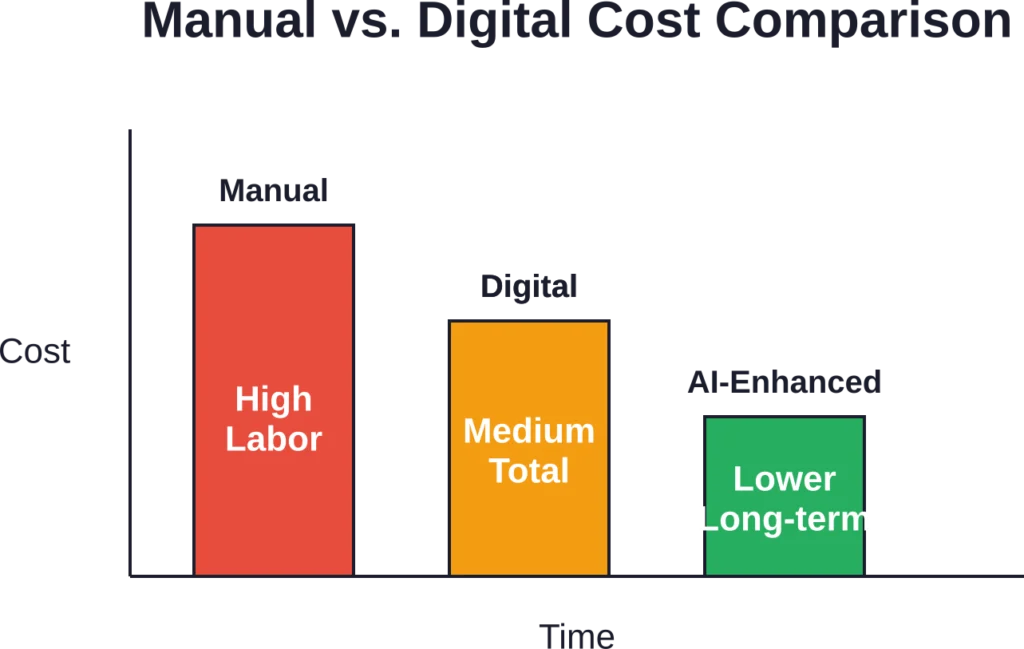
Manual vs. Digital Takeoff: The Real Cost Comparison
The manual versus digital debate centers on more than just tool costs.
Manual Takeoff Economics
Manual takeoffs use printed plans, physical scales, highlighters, and calculators. The tool cost barely registers.
But time costs compound. Measuring complex blueprints by hand is slow. Re-measuring for accuracy verification doubles the hours. Making changes when plans update means starting over.
Error rates run higher with manual methods. A misread scale, a missed detail, or a simple math mistake can throw off entire estimates. Community discussions among estimators frequently mention catching errors only after bids go out—an expensive discovery.
The labor multiplier makes manual takeoffs expensive despite zero software cost.
Digital Takeoff Investment Returns
Digital tools flip the economics.
Software carries subscription costs, but time savings offset the expense quickly. Digital takeoffs reduce measurement time by half or more. Point-and-click measuring beats scaling rulers. Automatic calculations eliminate math errors.
When plan changes arrive—and they always do—digital takeoffs update in minutes instead of hours. Layers and color coding prevent overlooking items. Built-in waste calculators apply correct percentages automatically.
According to academic sources including Texas A&M University, modern construction cost estimators rely on structured approaches that integrate digital tools for accuracy.
The breakeven calculation is straightforward: if software saves hours per estimate, and a firm produces multiple estimates annually, the cumulative time savings can be substantial.
Cost Variations by Project Type and Complexity
Not all takeoffs cost the same. Project type drives huge variations.
Residential Construction Takeoffs
Single-family homes represent the simplest takeoff scenarios. Plans are relatively straightforward. Material counts stay manageable. An experienced estimator might complete a full residential takeoff in 8-12 hours manually, or 4-6 hours with digital tools.
Multi-family projects scale up proportionally but benefit from repetition. Once one unit is counted, others follow the same pattern with minor variations.
Commercial Project Estimating
Commercial construction introduces complexity layers.
Office buildings, retail centers, and warehouses involve more systems: HVAC, electrical, plumbing, fire protection, specialized finishes. Plan sets grow thicker. Specifications run longer. Coordination between trades matters more.
A mid-sized commercial project might require 25-35 hours for complete takeoff work. Larger projects push 40-60 hours. The labor cost climbs accordingly.
Civil and Infrastructure Work
Roads, bridges, utilities, and site work present unique challenges.
Earthwork calculations involve complex volume computations. Linear infrastructure stretches across distances. Specifications reference engineering standards and testing requirements. Quantities might be measured in station-lengths, tons of asphalt, or cubic yards of excavation.
These projects demand specialized knowledge. Training costs increase. Software needs grow more sophisticated. A highway project takeoff can easily consume 80+ hours of estimator time.
| Project Type | Typical Takeoff Hours (Manual) | Typical Takeoff Hours (Digital) | Complexity Factors |
|---|---|---|---|
| Single-Family Residential | 8-12 hours | 4-6 hours | Standard materials, simple systems |
| Multi-Family Residential | 15-25 hours | 8-12 hours | Repetition helps, but scale increases |
| Small Commercial | 20-30 hours | 10-15 hours | Multiple systems, coordination required |
| Large Commercial | 40-60 hours | 20-30 hours | Complex specifications, numerous trades |
| Civil Infrastructure | 60-100+ hours | 30-50+ hours | Specialized calculations, extensive scope |
Technology Integration and AI-Enhanced Takeoffs
The construction industry is experiencing digital transformation. AI integration is changing takeoff economics.
According to RSMeans research on AI in construction, AI-integrated tools enhance and accelerate estimator work. Machine learning algorithms can recognize building components in digital plans, automatically measuring and counting items that previously required manual attention.
These capabilities don’t eliminate estimator expertise—they amplify it. AI handles repetitive measurement tasks. Estimators focus on judgment calls, material selection, and strategic decisions.
The cost calculation shifts again. AI-enhanced platforms typically carry premium pricing compared to basic digital takeoff tools. But time savings compound further. What took 20 hours might drop to 8-10 hours with AI assistance.
Early adopters gain competitive advantages. Faster turnaround on estimates means bidding more projects. Better accuracy means winning more bids profitably.
Estimating Best Practices That Control Costs
Smart contractors control takeoff costs through disciplined processes.
Standardized Methods and Templates
Consistency reduces errors and speeds work.
Successful estimating teams develop standardized takeoff sheets, checklists, and templates. Every estimator follows the same sequence, uses the same units, applies the same waste factors. This standardization prevents oversights and makes quality control easier.
Templates also preserve institutional knowledge. When experienced estimators retire, their methods live on in documented procedures.
Leveraging Cost Databases
Quantity takeoff identifies what’s needed. Pricing determines what it costs. These functions connect tightly.
Professional cost databases like RSMeans Data provide unit costs, labor rates, equipment expenses, and productivity factors. Integration between takeoff tools and cost databases eliminates double-entry work and reduces pricing errors.
Database subscriptions add cost, but they save enormous research time and improve estimate reliability.
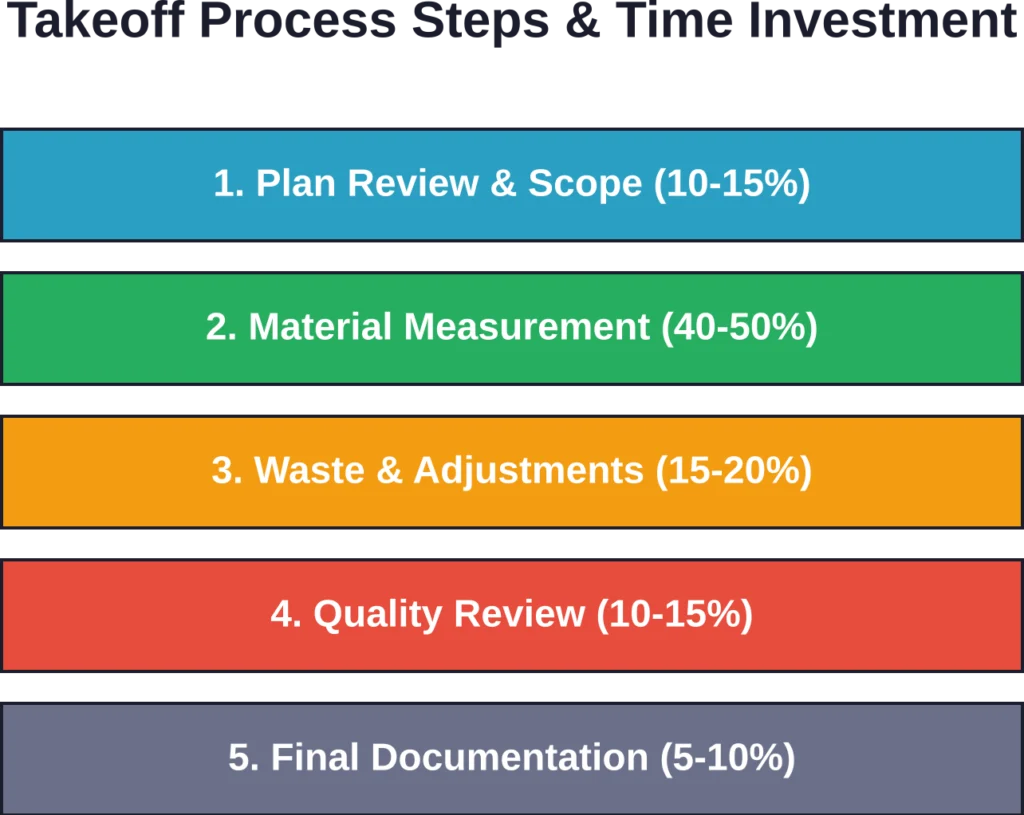
Quality Control and Review Processes
Peer review catches mistakes before they become expensive problems.
Leading firms implement multi-stage review processes. A junior estimator completes initial takeoff work. A senior estimator reviews for completeness and accuracy. A project manager validates assumptions against project requirements.
This review investment—perhaps 2-4 additional hours—costs far less than winning a job with quantities off by 15%.
Training Investment and Skill Development
Effective quantity takeoff requires specific skills that don’t develop by accident.
Formal Education Programs
Universities and professional schools offer structured learning paths.
As mentioned earlier, Graduate School USA offers a Construction Estimating Certification program covering essential tools, quantity takeoffs, pricing strategies, and cost estimate proposals. The program is taught by professional construction estimators. California State University San Marcos offers a Certificate in Construction Estimating that teaches proven methodologies for residential, commercial, and civil construction projects. The program covers everything from initial site work and general conditions through final finishes.
These formal programs cost more upfront but provide comprehensive foundations. Employers often consider the certificate investment worthwhile for staff development.
On-the-Job Training Costs
Many estimators learn through apprenticeship-style arrangements.
A junior estimator working under senior guidance produces work more slowly initially. The senior estimator invests time in teaching, reviewing, and correcting. This represents real cost—two people doing work one could do alone.
But the investment pays off. After 6-12 months, the junior estimator handles routine projects independently. After 2-3 years, they tackle complex work confidently.
Firms that skip this training investment often pay through errors, missed opportunities, and estimator turnover.
Software-Specific Training
Digital takeoff tools require their own learning curves.
Professional construction estimating courses with software focus are available through various providers. Platform-specific training accelerates proficiency and prevents bad habits.
Most software vendors offer training resources—webinars, video tutorials, documentation. Some include training credits with subscriptions. Others charge separately for formal courses or certification programs.
Budget 20-40 hours of learning time when implementing new software, plus ongoing skill development as features evolve.
The Hidden Cost of Inaccurate Takeoffs
Here’s the thing though—the biggest cost isn’t what firms spend on takeoffs. It’s what they lose through bad ones.
Underbidding and Margin Erosion
Takeoffs that undercount materials lead to underbids. Winning these jobs feels great initially. Then reality hits during construction.
Material shortages appear. Additional purchases cut into margins. What looked like a 12% profit project delivers 3%. Or loses money entirely.
This scenario plays out constantly across the industry. Community discussions among contractors frequently mention discovering takeoff errors only after mobilization—when it’s too late to fix pricing.
Overbidding and Lost Opportunities
Overcounting materials inflates bids unnecessarily. These estimates lose to sharper competitors.
Lost bids mean lost revenue. They also mean wasted estimating effort—all those takeoff hours produced nothing.
The opportunity cost compounds when firms consistently overbid due to poor takeoff accuracy. Market share erodes. Reputation suffers.
Change Order Disputes and Relationship Damage
Inaccurate takeoffs create change order conflicts.
When actual quantities differ significantly from estimated quantities, disputes arise. Did the contractor miss items in takeoff? Did the owner change requirements? The relationship strains regardless.
These disputes consume management time, delay payments, and damage future opportunities with that client.
Budgeting for Takeoff Operations
Smart firms budget estimating costs as a percentage of total business operations.
Construction companies allocate varying percentages of project value to estimating and takeoff activities based on project type and bidding approach. This percentage includes labor, software, training, overhead, and pursuit costs.
Percentages vary based on business model, project type, and bidding approach.
Within that overall estimating budget, quantity takeoff typically represents 30-50% of the total effort. The remainder goes to pricing, proposal preparation, project management planning, and bid assembly.
| Cost Category | Annual Investment Range | Notes |
|---|---|---|
| Estimator Salaries | $50,000-$90,000+ per estimator | Varies by experience and region |
| Takeoff Software | Check vendor websites for current pricing | Per-user annual subscriptions |
| Cost Database Access | Check vendor websites for current pricing | RSMeans and similar services |
| Training Programs | Check vendor websites for current pricing | Based on program provider |
| Plan Room Services | Variable | Access to bid documents |
| Hardware and IT | $2,000-$5,000+ per workstation | Computers, monitors, peripherals |
Software Selection and ROI Calculation
Choosing takeoff software requires analyzing return on investment, not just sticker price.
Feature Comparison Framework
Different platforms offer different capabilities. Basic tools provide PDF markup and linear measurement. Advanced platforms add automatic counting, assembly libraries, integration with accounting systems, and AI-assisted recognition.
Feature requirements depend on project types and business model. Residential contractors need different tools than civil estimators. Specialty trades have unique requirements.
Make a features checklist before shopping. Otherwise, impressive demos can sell capabilities the business won’t actually use.
Total Cost of Ownership
Software cost isn’t just subscription price.
Implementation time counts. Data migration from old systems takes hours. Template setup and customization require effort. Training investment matters, as discussed earlier.
Ongoing support needs affect costs too. Some vendors include unlimited support. Others charge per incident or tier support access.
Integration requirements matter. Does the software connect with existing estimating systems, accounting platforms, and project management tools? If not, manual data transfer adds labor cost.
Calculating Payback Period
Simple formula: divide total implementation cost by monthly savings.
ROI calculations should account for software costs, implementation time, training expenses, and projected hour savings. The specific calculation will vary based on individual firm circumstances and labor rates.
Best Practices from Industry Leaders
According to estimating best practices outlined by RSMeans and academic institutions, several principles separate excellent takeoff operations from mediocre ones.
Comprehensive Checklist Systems
Never rely on memory. Checklists ensure nothing gets missed.
Detailed takeoff checklists organized by CSI division or trade prevent overlooking items. The checklist prompts estimators to verify every category, even uncommon ones that don’t appear on every project.
Drawing Markup and Color Coding
Visual tracking prevents double-counting and omissions.
Highlighting measured items in distinct colors—different colors for different materials or trades—creates visual confirmation. At a glance, unmarked areas reveal what still needs counting.
Digital takeoff software enhances this practice with layers, allowing estimators to toggle visibility of different measurement sets.
Documentation and Assumptions Logs
Document every assumption and clarification.
When specifications are unclear or drawings conflict, estimators make judgment calls. Recording these decisions creates a trail. If questions arise later, the logic is documented. If assumptions prove wrong, they’re easy to adjust.
This documentation also helps with future similar projects, building institutional knowledge.
Systematic Approach to Plan Review
Read specs before measuring. Understand project requirements, quality standards, and special conditions. Then review drawings systematically—site plans, architectural plans, structural, MEP, each in sequence.
This prevents missing coordination items and reduces rework when details on later sheets affect earlier takeoffs.
Stakeholders and Cost Allocation
Quantity takeoff costs get distributed across different project participants.
General contractors bear most direct takeoff costs for projects they bid. They invest in software, employ estimators, and develop comprehensive quantity surveys. This investment gets recouped through competitive bids when won, or absorbed as pursuit cost when lost.
Subcontractors perform takeoffs for their specific trade scopes. A mechanical subcontractor counts HVAC equipment, ductwork, and accessories. An electrical sub measures conduit, wire, devices, and panels. These specialized takeoffs feed into the subcontractor’s quote to the general contractor.
Owners sometimes hire independent estimators for quantity verification, especially on public projects. This third-party takeoff provides bid validation and helps identify unrealistically low or high proposals.
Design-build firms integrate takeoff activities into their design process, using quantity feedback to refine design decisions toward budget targets.
Emerging Trends Affecting Takeoff Costs
The construction industry continues evolving. Several trends are reshaping takeoff economics.
Building Information Modeling Integration
BIM models contain embedded quantity data. When architects design in BIM, material counts can extract automatically from the model.
This promises reduced takeoff labor. But the reality is nuanced. BIM models aren’t always construction-ready. Levels of detail vary. Model accuracy depends on upstream diligence.
Estimators still verify BIM quantities against specifications and constructability requirements. The process becomes faster and more accurate, but doesn’t eliminate entirely.
Cloud-Based Collaboration
Modern takeoff platforms operate in the cloud, enabling real-time collaboration.
Multiple estimators can work on different project sections simultaneously. Changes sync instantly. Project managers review progress live rather than waiting for completed takeoff packages.
This collaborative capability reduces overall calendar time even if total labor hours stay similar. Faster turnaround enables bidding more opportunities.
Mobile Takeoff Capabilities
Tablet-based takeoff applications let estimators work from job sites.
Walking a renovation project while doing takeoff improves accuracy. Seeing actual conditions prevents assumptions. Measuring existing conditions directly eliminates field verification trips.
Mobile capabilities don’t reduce takeoff cost directly, but they improve quality and enable new workflows.
Measuring Takeoff Performance and Continuous Improvement
What gets measured gets managed.
Leading firms track takeoff performance metrics: hours per estimate by project type, accuracy rates compared to actual quantities, bid win rates, and post-project variance analysis.
These metrics reveal improvement opportunities. If residential takeoffs average 10 hours but commercial takeoffs require 45 hours, that suggests training needs or tool optimization for commercial work.
If actual material usage consistently runs 8% higher than takeoff quantities, the waste allowances need adjustment or measurement methods need refinement.
Continuous improvement reduces long-term costs while improving accuracy—the best of both worlds.
Frequently Asked Questions
Quantity takeoff software pricing varies widely depending on features and vendor. Entry-level tools may cost a few hundred dollars annually, while enterprise platforms with AI integration and advanced features can cost significantly more per user per year. Check vendor websites for current pricing since subscription tiers and features change frequently. The investment should be evaluated against time savings—software that saves 10-20 hours per estimate often pays for itself within months.
Manual takeoffs have minimal tool costs but high labor expenses. Digital takeoffs require software investment but reduce labor hours significantly. For firms producing multiple estimates monthly, digital tools become more cost-effective within the first year. The calculation depends on estimator labor rates, project volume, and project complexity.
Professional construction estimating courses vary in price and duration. Plan additional budget for software-specific training, which varies by platform. On-the-job training represents the largest investment—expect 6-12 months before new estimators reach full productivity, during which senior estimators invest significant supervision time.
Construction companies allocate varying percentages of project value to estimating and takeoff activities based on project type, bid competitiveness, and business model. Firms pursuing competitive bid work typically need higher estimating budgets than firms working primarily negotiated contracts.
Absolutely. According to RSMeans guidance, waste factors vary by material type and project specifications. Omitting proper waste calculations produces takeoffs that look cheaper but fail during construction, leading to margin erosion or losses. The cost of proper waste calculation is minimal compared to the cost of running short on materials.
Takeoff duration varies dramatically by project type and method. Residential projects might require 8-12 hours manually or 4-6 hours digitally. Commercial projects often need 20-40 hours depending on complexity. Civil infrastructure projects can consume 60-100+ hours for comprehensive takeoffs. AI-enhanced platforms can reduce these times further, sometimes by 30-50% compared to standard digital tools.
Return on investment depends on project volume and time savings. If software saves hours per estimate at an estimator labor cost, that produces measurable savings per estimate. A firm completing multiple estimates annually can realize substantial labor cost savings. Compared to software subscriptions typically in the low thousands annually, payback periods often run 3-6 months. Additional ROI comes from improved accuracy, faster turnaround enabling more bids, and reduced errors.
Making the Investment Decision
Quantity takeoff costs represent an investment, not an expense.
Firms that view takeoff as a cost center to minimize often end up with inaccurate estimates, lost bids, or unprofitable jobs. Those that view it as a strategic investment make smarter decisions about tools, training, and processes.
The calculation isn’t just about dollars spent. It’s about competitive positioning. Can the firm turn estimates faster than competitors? More accurately? With less risk?
Technology advances continue reducing takeoff costs while improving quality. AI integration, BIM connectivity, and cloud collaboration make 2026 estimating dramatically more efficient than even five years ago.
But technology is just a tool. Skilled estimators who understand construction methods, material properties, and project execution realities remain essential. The best results come from combining excellent people with excellent tools.
Conclusion: Understanding the True Cost to Make Better Decisions
Quantity takeoff costs encompass software subscriptions, training investments, labor hours, and opportunity costs from inaccuracy.
The smart approach balances these factors. Invest enough in tools and training to ensure accuracy and efficiency. Track performance metrics to identify improvement opportunities. Calculate true ROI including time savings, error reduction, and competitive advantages.
Remember that the most expensive takeoff is the inaccurate one. An underbid that wins costs more than all the software and training combined when margin evaporates during construction. An overbid that loses represents wasted estimating effort and missed opportunity.
The construction industry continues evolving toward more sophisticated estimating methods. Firms that invest appropriately in quantity takeoff capabilities position themselves to compete effectively, bid profitably, and grow sustainably.
Start by analyzing current costs—track hours per estimate, calculate error rates, and measure win/loss patterns. That data reveals whether current methods deliver adequate return or whether investment in upgraded tools and training would pay dividends.