

Quick Summary: MEP drafting is the process of creating detailed technical drawings for Mechanical, Electrical, and Plumbing systems in buildings. These drawings translate engineering designs into precise construction documents showing equipment locations, pipe routing, ductwork, electrical circuits, and system connections—ensuring that contractors can build, coordinate, and install building systems accurately and in compliance with codes.
Walk into any modern building and look around. The lights that illuminate your workspace, the air conditioning keeping you comfortable, the water flowing through the restrooms—none of it happens by accident.
Behind every functional building sits a complex web of mechanical, electrical, and plumbing systems. And before contractors can install a single pipe or wire, someone needs to create the technical drawings that guide construction.
That’s where MEP drafting comes in. It’s the bridge between engineering concepts and physical construction, translating design intent into the precise visual language that builders understand.
Understanding MEP Drafting Basics
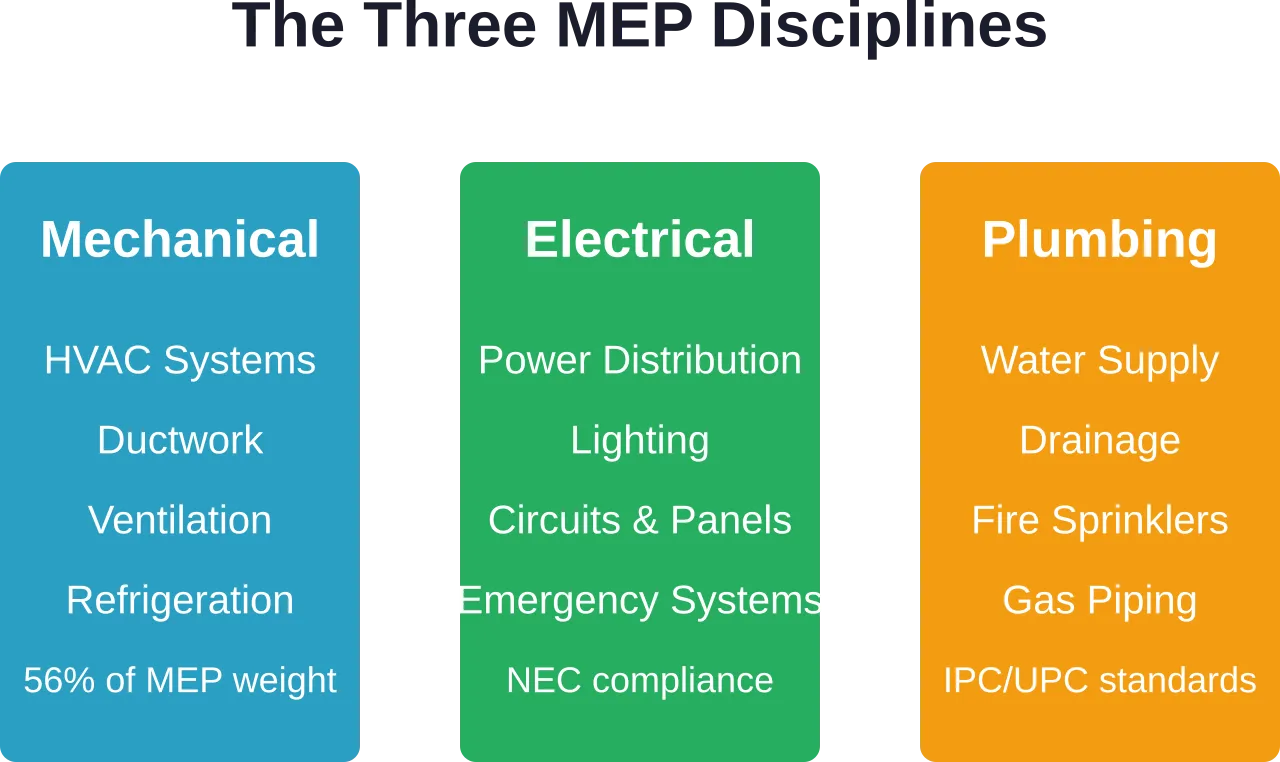
MEP drafting involves producing detailed technical drawings for three core building systems: Mechanical (HVAC, ventilation, refrigeration), Electrical (power distribution, lighting, emergency systems), and Plumbing (water supply, drainage, fire suppression).
These aren’t simple sketches. MEP drafters create construction-grade documents that specify exact dimensions, equipment specifications, routing paths, connection details, and installation requirements.
The drawings must comply with local building codes and industry standards. According to standards maintained by organizations like ASHRAE (American Society of Heating, Refrigerating and Air-Conditioning Engineers) and the National Electrical Code (NEC/NFPA 70), MEP systems must meet strict safety, efficiency, and coordination requirements.
Here’s the thing though—MEP drafting isn’t the same as MEP engineering. Engineers perform calculations, select equipment, and design system logic. Drafters take that engineering data and produce the visual documentation contractors need on-site.
The Three Core Disciplines
Mechanical drafting covers HVAC systems, including ductwork layouts, equipment placement, airflow diagrams, and refrigeration piping. Drafters show exactly where air handlers sit, how supply and return ducts route through the building, and where diffusers mount in ceilings.
According to ASHRAE research, HVAC systems account for 56% of weight and 74% of carbon emissions within MEP systems—making accurate mechanical drafting critical for both construction feasibility and sustainability.
Electrical drafting documents power distribution from service entry to end devices. This includes panel schedules, circuit routing, lighting layouts, receptacle locations, grounding systems, and emergency power connections. Drafters must follow NEC requirements for cable sizing, circuit protection, and segregation.
Plumbing drafting details water supply lines (hot and cold), drainage systems, vent piping, gas lines, and fire sprinkler networks. The drawings specify pipe sizes, slope requirements (typically 1–2% for proper drainage), fixture connections, and valve locations.
Types of MEP Drawings
MEP drafting produces several drawing types, each serving a specific construction phase. Understanding these categories matters because contractors rely on different drawings at different stages.
Construction Drawings
These are the primary documents used for permitting and bidding. Construction drawings show system layouts, equipment locations, major routing paths, and general specifications. They provide enough detail for cost estimating and code review but typically don’t include fabrication-level detail.
Coordination Drawings
Once a project moves forward, coordination drawings become critical. These documents overlay mechanical, electrical, and plumbing systems with structural elements to identify conflicts before construction begins.
Real talk: coordination drawings can save massive amounts of money. When a mechanical engineer challenged conservative design assumptions on one project, the team avoided spending $710,000 in first costs and achieved $110,000 in annual energy savings—simply by optimizing refrigeration loads before breaking ground.
Shop Drawings and Fabrication Documents
Shop drawings add fabrication-level detail. They show exact dimensions for prefabricated components, connection details, support locations, and installation sequences. Contractors and fabricators use these to manufacture and assemble system components off-site.
Spool drawings (a subset of shop drawings) detail individual pipe sections with precise measurements, allowing prefabrication of complex piping assemblies in a controlled shop environment.
As-Built Drawings
After construction, as-built drawings document what was actually installed. Field conditions often require modifications to original plans. As-built drawings capture these changes, creating accurate records for facility management, future renovations, and maintenance planning.
| Drawing Type | Primary Use | Detail Level |
|---|---|---|
| Construction Drawings | Permitting, bidding, general construction guidance | Moderate |
| Coordination Drawings | Clash detection, system integration verification | High |
| Shop Drawings | Fabrication, prefabrication, detailed assembly | Very High |
| As-Built Drawings | Facility management, future renovations, maintenance | Accurate to installation |
The MEP Drafting Process
So how does engineering intent become construction-ready drawings?
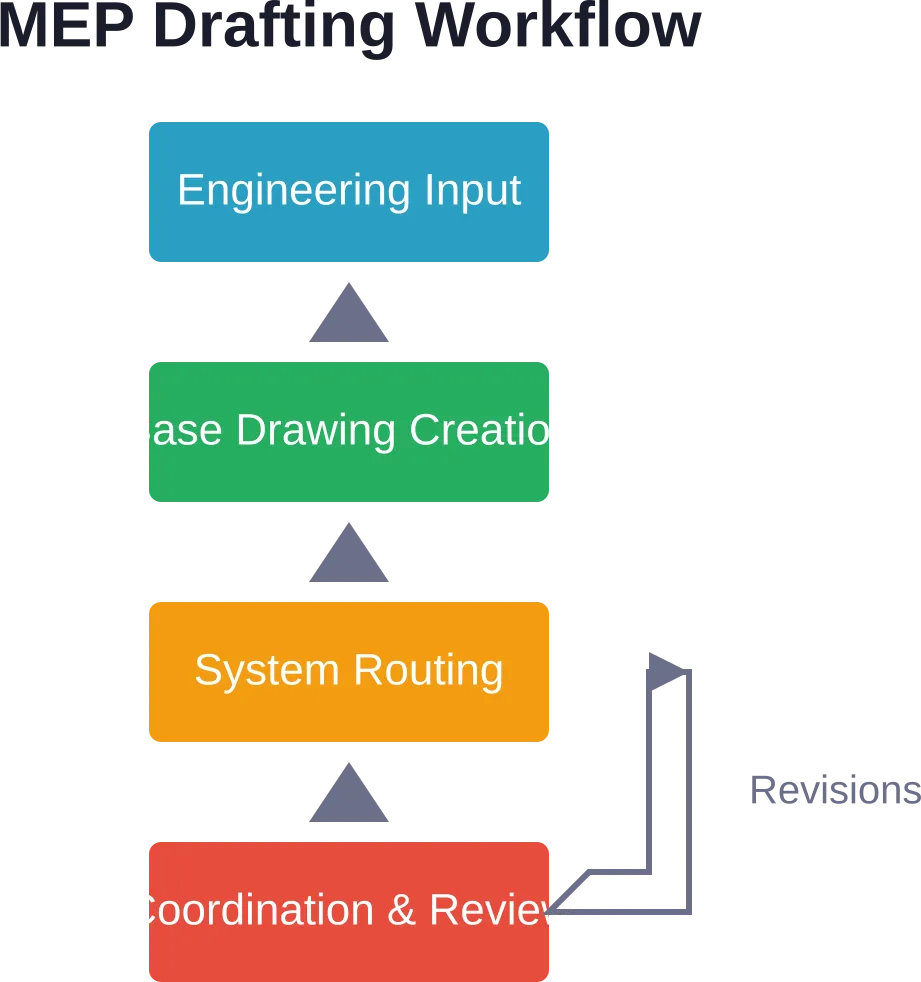
The process starts with engineering input. MEP engineers provide calculations, equipment selections, load analyses, and design criteria. They specify system capacities—like tonnage for HVAC units or amperage for electrical panels.
Drafters take this data and begin creating base drawings. They establish scale, coordinate with architectural and structural drawings, and lay out primary equipment locations. This stage involves constant reference to building plans to ensure MEP systems fit within available spaces.
Next comes system routing. Drafters map out duct paths, pipe runs, and cable trays, considering factors like accessibility, maintenance clearances, code requirements, and construction feasibility. They must balance shortest-path efficiency with practical installation constraints.
Coordination happens iteratively. As drafters develop drawings, they check for clashes—points where ducts intersect structural beams, pipes conflict with electrical conduits, or equipment won’t fit through access doors. Modern projects use CAD software to automate clash detection, but experienced drafters catch many issues through careful visual review.
Revisions follow feedback cycles. Engineers review drafts, contractors identify field concerns, and building officials note code issues. Drafters incorporate these changes, sometimes going through multiple revision rounds before drawings reach final approval.
Get MEP Drafting Support for Building Projects

MEP drafting helps coordinate mechanical, electrical, and plumbing systems during design and construction stages. Powerkh supports MEP workflows with BIM drafting, coordination, and technical documentation services.
Need MEP Drafting Support?
Talk with Powerkh to:
- prepare coordinated MEP drawings
- support BIM modelling and documentation
- improve coordination before construction
- update technical drawings during project delivery
Speak with Powerkh about MEP drafting and coordination requirements for your project.
Tools and Technology in MEP Drafting
MEP drafting has evolved significantly from hand-drawn blueprints. Most drafting now happens in specialized CAD software.
AutoCAD remains widely used for 2D drafting. It offers precision, flexibility, and broad compatibility with other construction software. Many firms still produce traditional 2D construction documents using AutoCAD, particularly for smaller projects or firms with established 2D workflows.
But wait. Building Information Modeling (BIM) has transformed how complex projects get drafted.
Revit MEP leads the BIM space for building systems. Unlike 2D CAD, Revit creates 3D models containing both geometric and data-rich information about every component. Changes propagate automatically across all views. Add a pipe fitting in a 3D view, and it appears correctly in floor plans, sections, and schedules.
BIM enables clash detection through tools like Navisworks. The software identifies spatial conflicts between disciplines—catching issues before they become expensive field problems.
According to Global Market Insights, the global MEP software market was valued at USD 3.5 billion in 2024 and is projected to expand at a CAGR of 9.6%, reflecting growing digitalization in construction.
Specialized tools handle specific tasks. HAP and Trace perform HVAC load calculations. AGi32 designs lighting systems. Fabrication CAD/CAM software converts design models into machine instructions for automated fabrication equipment.
Why MEP Drafting Matters in Construction
Accurate MEP drafting directly impacts construction success. Here’s why it’s not just paperwork.
Cost Control
Detailed drawings allow accurate quantity takeoffs. Contractors can estimate material costs, labor hours, and equipment needs with confidence. Labor requirements for MEP systems vary significantly based on building complexity and system design—precision that depends on complete drawings.
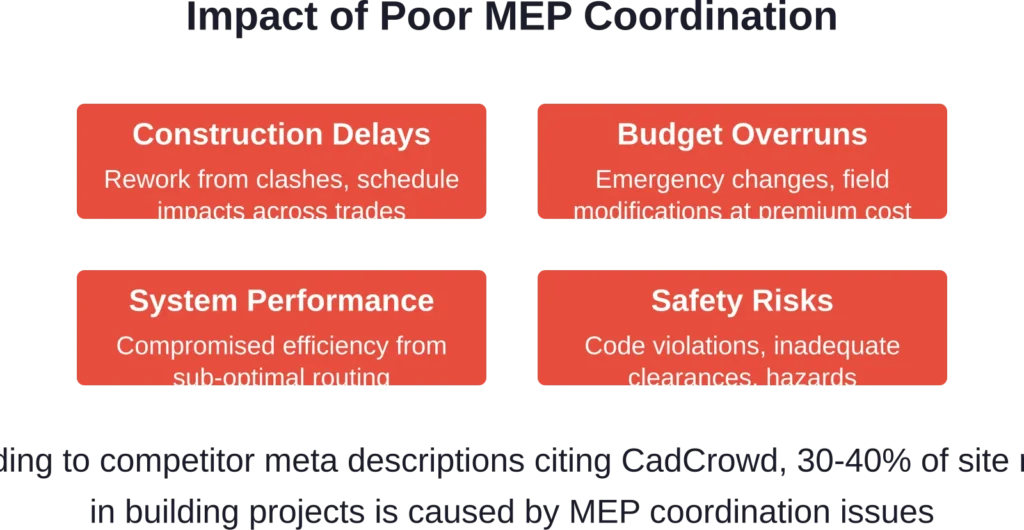
Early coordination catches expensive mistakes. Finding a duct-beam conflict on paper costs a few hours of drafting time. Discovering it during installation means cutting steel, rerouting systems, delaying schedules, and burning through contingency budgets.
Code Compliance and Safety
MEP systems must comply with numerous codes and standards. The National Electrical Code specifies grounding, circuit protection, and load calculations. The International Mechanical Code governs HVAC installations. Plumbing codes mandate proper drainage slopes, vent sizing, and backflow prevention.
Drafters translate these requirements into drawings contractors can follow. Proper documentation demonstrates compliance to building officials during plan review and inspection.
Safety standards from organizations like NFPA address fire hazards, electrical shock risks, and water damage prevention. MEP drawings show how systems meet these requirements through proper equipment selection, installation methods, and protective devices.
Construction Coordination
Modern buildings pack mechanical rooms, ceiling plenums, and utility chases with overlapping systems. Commercial ceilings typically contain overlapping systems including HVAC ducts, electrical conduits, plumbing pipes, fire sprinklers, data cables, and lighting fixtures competing for limited space.
Coordination drawings organize this chaos. They establish routing priorities, clearance zones, and installation sequences. Structural steel gets priority. Large ducts route first. Smaller pipes and conduits weave between. The drawing set documents these decisions so trades can work efficiently without conflicts.
Long-Term Facility Management
Buildings operate for decades. Facility managers need accurate documentation to maintain systems, troubleshoot problems, and plan upgrades.
As-built MEP drawings provide this reference. They show valve locations for isolating sections during repairs, panel schedules for circuit tracing, and equipment specifications for replacement planning. Without accurate drawings, simple maintenance tasks become time-consuming investigations.
Common MEP Drafting Challenges
Even experienced drafters face recurring obstacles. Recognizing these helps set realistic expectations.
Space Constraints
Architects design buildings to maximize usable floor area. That leaves tight quarters for MEP systems. Ceiling plenums might offer only 3–4 feet between structural deck and finished ceiling. Mechanical rooms get squeezed into minimal footprints.
Drafters must fit required systems into available space while maintaining code-required clearances. A large air handler needs service access on multiple sides. Electrical panels require working clearances. Plumbing cleanouts must remain accessible.
This puzzle-solving defines much of MEP drafting work.
Late Design Changes
Architectural modifications ripple through MEP drawings. Move a wall, and electrical outlets relocate. Change a ceiling height, and duct routing requires revision. Add building area, and system capacities need recalculation.
Late changes are construction reality. Good drafting practices include modular design approaches and flexible routing strategies that accommodate revisions without complete redesign.
Interdisciplinary Coordination
MEP disciplines must coordinate with each other and with architectural and structural design. A structural beam appears exactly where the main supply duct needs to run. A plumbing stack conflicts with an electrical panel location. Fire sprinkler heads can’t achieve proper coverage because of HVAC diffuser placement.
Resolving these conflicts requires communication across disciplines. Drafters can’t work in isolation—they need regular coordination meetings and shared model access.
Code Complexity
Building codes are detailed, technical, and vary by jurisdiction. The NEC alone spans hundreds of pages. Local amendments modify national codes. Energy codes add efficiency requirements. Accessibility standards affect equipment placement.
Drafters must understand applicable codes or work closely with engineers who do. Missing a code requirement during drafting leads to plan review rejections, expensive revisions, or failed inspections.
MEP Drafting vs. MEP Design vs. MEP Coordination
These terms often get confused, but they represent distinct activities.
MEP design involves engineering analysis. Engineers calculate loads, select equipment, size pipes and ducts, and determine system configurations. Design work requires engineering licenses and deep technical knowledge of thermodynamics, fluid mechanics, and electrical theory.
MEP drafting produces the visual documentation of engineered systems. Drafters create drawings based on engineering input. The role requires technical knowledge but focuses on documentation accuracy, CAD proficiency, and construction detailing rather than engineering calculations.
MEP coordination integrates multiple systems and disciplines. Coordination specialists (sometimes called BIM coordinators) manage clash detection, facilitate resolution meetings, and ensure all building systems fit together. This role bridges engineering, drafting, and construction planning.
On smaller projects, one person might handle multiple roles. Larger projects typically separate these functions, with engineers focusing on design, drafters producing documents, and coordinators managing integration.
| Function | Primary Activities | Required Skills |
|---|---|---|
| MEP Design | Load calculations, equipment selection, system sizing, performance specifications | Engineering degree, PE license, thermodynamics, electrical theory |
| MEP Drafting | Creating drawings, detailing connections, documenting layouts, producing schedules | CAD proficiency, code knowledge, construction detailing, technical drawing |
| MEP Coordination | Clash detection, integration meetings, conflict resolution, model management | BIM software, multi-discipline knowledge, communication, problem-solving |
The Value of Professional MEP Drafting Services
Quality MEP drafting requires specialized skills and significant time investment. Many architecture and engineering firms outsource drafting to specialized service providers.
Professional drafting services offer several advantages. They maintain dedicated teams with deep CAD expertise and up-to-date software. They can scale resources to match project demands without firms carrying overhead during slow periods. They often work across multiple time zones, accelerating project timelines.
Specialized MEP drafters bring focused experience. Someone who drafts healthcare mechanical systems daily develops pattern recognition for common challenges. They know standard solutions, typical equipment layouts, and efficient routing strategies.
That said, outsourcing requires clear communication. Detailed engineering input, complete architectural backgrounds, and specific project requirements prevent misunderstandings. Revision cycles happen, but good specifications minimize back-and-forth.
Frequently Asked Questions
MEP drafting traditionally refers to creating 2D technical drawings using CAD software like AutoCAD. MEP BIM modeling uses 3D software like Revit to create intelligent, data-rich models. BIM models contain geometric information plus system data, enable automatic clash detection, and generate drawings from the model. Both produce construction documents, but BIM offers enhanced coordination and data management. Many projects now use BIM exclusively, though 2D drafting remains common for simpler projects and renovation work.
Timeline varies dramatically with project size and complexity. A small residential project might need 40–80 hours of drafting across all disciplines. A mid-size commercial building could require 200–500 hours. Large institutional or industrial projects can demand thousands of drafting hours spread across multiple team members and months of calendar time. Coordination requirements, revision cycles, and project phasing significantly impact schedules. Early engineering input and frozen architectural plans accelerate drafting.
Most MEP drafters hold associate degrees or technical certificates in drafting, CAD technology, or engineering technology. Proficiency in relevant CAD software (AutoCAD, Revit MEP, or similar) is essential. Understanding of construction methods, building codes, and MEP systems comes through education and experience. Some drafters transition from construction trades, bringing practical installation knowledge. While engineering licenses aren’t required for drafting roles, many drafters pursue certifications from software vendors or professional organizations to demonstrate competency.
Absolutely. Detailed, coordinated MEP drawings catch conflicts before construction begins—when changes cost hours rather than days and affect paper rather than installed materials. Proper drafting identifies space constraints, routing conflicts, code violations, and constructability issues during design phases. According to competitor meta descriptions citing CadCrowd, 30-40% of site rework in building projects is caused by MEP coordination issues that proper MEP drafting would prevent. The investment in quality drafting returns multiples in avoided field problems, though it can’t eliminate all issues since unexpected conditions still arise during construction.
A complete set typically includes floor plans showing equipment locations and system routing for each discipline, enlarged plans for complex areas like mechanical rooms, riser diagrams showing vertical distribution between floors, sections and details for specific connections and installations, schedules listing equipment specifications and circuit loads, and specifications describing materials and installation requirements. Larger projects add shop drawings for fabrication, coordination drawings for clash resolution, and as-built drawings documenting final installations. The exact deliverables depend on project requirements and contract scope.
Costs vary with project complexity, location, timeline, and service provider. Hourly rates for professional MEP drafting typically range from $40 to $100+ per hour depending on experience level and market. Some firms quote fixed prices per sheet or per square foot of building area. Outsourced drafting services often offer lower rates than maintaining in-house staff, particularly for firms with variable workloads. Rush projects command premium rates. The drafting cost typically represents a small fraction of total MEP construction costs but generates significant value through error prevention and coordination.
AutoCAD remains the most widely used 2D drafting platform, particularly for electrical and plumbing disciplines. Revit MEP dominates BIM-based MEP drafting, offering 3D modeling with integrated data management and automatic drawing generation. Navisworks handles coordination and clash detection across disciplines. Specialized tools include HAP and Trace for HVAC analysis, AGi32 for lighting design, and fabrication software for shop drawings. The construction industry continues shifting toward BIM platforms, though 2D CAD persists for many project types and renovation work where 3D modeling overhead doesn’t justify benefits.
Moving Forward with MEP Drafting
MEP drafting transforms engineering concepts into buildable reality. Those detailed drawings guide every pipe installed, every wire pulled, and every duct hung throughout construction.
The technical documentation might not be glamorous, but it’s absolutely essential. Without accurate MEP drawings, contractors work blind, coordination fails, costs spiral, and building systems don’t function as intended.
As construction grows more complex and buildings become more sophisticated, MEP drafting expertise becomes increasingly valuable. Energy efficiency demands, code requirements, and coordination challenges make quality drafting a competitive advantage.
Whether you’re an architecture firm planning a project, a contractor estimating costs, or a facility manager maintaining a building, understanding MEP drafting helps you appreciate the technical foundation supporting functional buildings. The drawings represent countless decisions about equipment, routing, connections, and installation—decisions that determine whether building systems work reliably for decades or cause problems from day one.
Ready to move forward with your MEP project? Start with clear engineering input, invest in quality drafting, prioritize coordination, and recognize that excellent documentation pays dividends throughout construction and building life.