

Quick Summary: A/B testing development companies help businesses optimize conversion rates through systematic experimentation. This guide examines 15 leading firms specializing in A/B testing development—from full-service agencies to specialized platforms—highlighting their core strengths, technical capabilities, and ideal client profiles without discussing pricing structures.
Finding the right A/B testing development partner can make or break your optimization program. With the A/B testing market projected to reach $1,151 million by 2025 and growing at 11.5% annually, more companies than ever are entering this space.
But here’s the thing—not all A/B testing development companies are built the same. Some excel at technical implementation for product teams. Others focus on marketing optimization for agencies. And still others specialize in enterprise-scale experimentation programs.
This guide cuts through the noise. The following 15 companies represent the strongest options across different use cases, team sizes, and technical requirements.
What Makes a Great A/B Testing Development Company
Before diving into specific companies, understanding evaluation criteria matters. The best A/B testing development partners share several characteristics that separate them from average vendors.
Technical depth ranks first. Modern A/B testing requires more than simple split tests—sequential testing to stop experiments early, variance reduction techniques, and real-time monitoring capabilities have become standard requirements. According to research from authoritative sources, CUPED and stratified sampling can reduce variance by 30-50% for faster results.
Integration capabilities matter just as much. Testing platforms need to connect with existing analytics tools, customer data platforms, and marketing automation systems. The ability to run experiments across web, mobile, and server-side environments without switching tools saves enormous time.
Team expertise represents another critical factor. Companies that employ statisticians, behavioral psychologists, and experienced developers deliver better outcomes than those relying solely on marketers running visual editor tests.
Key Technical Capabilities to Look For
Server-side testing capability allows teams to experiment with backend logic, APIs, and algorithms—not just front-end design elements. This becomes essential for product teams and SaaS companies optimizing user experiences.
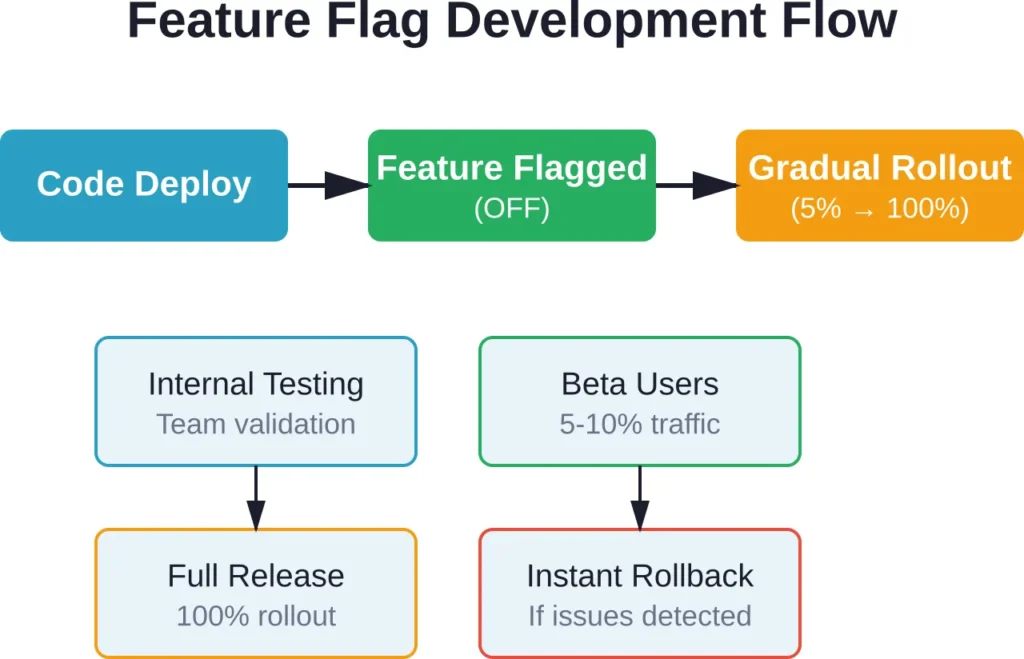
Feature flagging integration lets developers release features gradually, roll back problematic changes instantly, and tie code deployments directly to business metrics. The convergence of feature management and experimentation has reshaped how modern teams ship software.
Statistical rigor separates professional platforms from basic tools. Bayesian analysis, sequential testing, and proper multiple comparison corrections prevent false positives that lead to bad business decisions.
1. Oski

Oski builds smart, well-engineered software solutions for tech-forward enterprises and ambitious startups.
The company stands out for its ability to deliver scalable digital infrastructure that supports sophisticated experimentation programs across web, mobile, and cloud environments. Their AI-accelerated engineering helps teams move faster while maintaining quality in testing and optimization initiatives.
Oski provides cloud solutions, frontend development, artificial intelligence integrations, and CMS implementations. This technical breadth allows organizations to embed A/B testing, personalization engines, and behavioral analytics directly into their core products and platforms.
Technical Strengths
- Cloud and serverless architectures optimized for high-traffic experimentation
- Modern frontend solutions with React, Vue, Angular, and React Native
- AI and machine learning capabilities for intelligent testing and personalization
- Custom solutions for industries including fintech, e-commerce, logistics, and education
Best For
Enterprises and growth-stage companies that need robust technical infrastructure to power large-scale A/B testing and digital experimentation programs.
Contact Information
- Website: oski.site
- Phone: +48571282759
- Email: [email protected]
- Address: Kaupmehe tn 7, 10114 Tallinn, Estonia
- LinkedIn: www.linkedin.com/company/oski-solutions
2. A-listware

A-listware is a software development and consulting company focused on delivering high-quality digital solutions through dedicated teams and strategic outsourcing.
The company helps organizations build and scale the technical systems required for effective experimentation, including custom applications, analytics platforms, and integration layers that support A/B testing at enterprise scale.
A-listware offers software development, application services, UX/UI design, testing & QA, IT consulting, data analytics, and dedicated development teams. Their end-to-end approach ensures that experimentation logic, tracking, and reporting are built reliably into client systems.
Engineering Partnership Model
- Dedicated development teams that act as an extension of your organization
- Custom software development and legacy modernization
- Data analytics and infrastructure services for reliable experiment measurement
- Full spectrum of software engineering services including AI and cloud solutions
Best For
Companies that need reliable software development partners to implement and maintain custom A/B testing infrastructure and experimentation tools.
Contact Information
- Website: a-listware.com
- Phone: +1 (888) 337 93 73
- Email: [email protected]
- Address: North Bergen, NJ 07047, USA
- LinkedIn: www.linkedin.com/company/a-listware
- Facebook: www.facebook.com/alistware
3. Gilzor

Gilzor specializes in custom software development that helps startups and growing businesses validate ideas, build digital products, and scale efficiently.
The company focuses on turning product hypotheses into testable realities through structured development and validation processes. Their full-cycle approach supports teams that want to implement A/B testing directly into new applications and digital experiences from the ground up.
Gilzor delivers mobile and web development, UI/UX design focused on conversion, quality assurance, go-to-market strategy, and idea validation services. This foundation enables clients to launch MVPs with built-in experimentation capabilities and iterate based on real user data.
Development-Centric Approach
- User-centric UI/UX design that improves conversion rates for testing
- Full-cycle web and mobile development with clean, maintainable code
- Product-market fit validation and go-to-market support
- Research & Development for implementing advanced features and experiments
Best For
Startups and product teams building new digital products that require strong experimentation foundations. Companies needing custom development to support A/B testing, user validation, and rapid iteration.
Contact Information
- Website: www.gilzor.com
- Email: [email protected]
- Address: Poland, Warsaw, Office 58, street Adama Mickiewicza 37, 01-625
- LinkedIn: www.linkedin.com/company/gilzor-softwaredevelopment
4. Lengreo

Lengreo has positioned itself as a complete marketing and technology partner, helping B2B companies accelerate growth through targeted digital strategies and technical implementation.
The company excels at combining data-driven marketing with custom development to improve lead generation, conversion rates, and overall digital performance. Their integrated approach allows clients to test and optimize campaigns while building the underlying technical infrastructure needed for reliable experimentation.
Lengreo delivers full-cycle support, from strategy and SEO to website development, paid advertising, hyper-personalized outreach, and demand generation. This makes it possible to run sophisticated A/B tests across landing pages, email sequences, ad creatives, and user journeys with clear measurement of results.
Key Capabilities
- Custom website and landing page development optimized for conversion testing
- Lead generation and appointment-setting campaigns with built-in performance tracking
- Behavioral targeting and personalization to support segmented experimentation
- Marketing audits and strategy optimization that identify high-impact testing opportunities
Best For
B2B organizations looking to combine marketing experimentation with custom development and lead-generation infrastructure. Companies that want a single partner to handle strategy, testing, and technical execution.
Contact Information
- Website: Lengreo.com
- Phone: +31 686 147 566
- Email: [email protected]
- Address: Vrijstraat 9 C/D, 5611 AT Eindhoven, Netherlands
- LinkedIn: Lengreo
- Twitter: @Lengreo
- Instagram: @lengreo
5. Mobian Studio
Mobian Studio builds dedicated engineering teams that deliver production-ready mobile and AI solutions for companies in IT, healthcare, fintech, and logistics.
The company specializes in helping organizations ship faster and more reliably, making it easier to run continuous experiments on mobile applications, backend systems, and AI-powered features. Their dual outsourcing and outstaffing models provide flexibility for teams implementing experimentation programs.
Mobian delivers end-to-end product development, AI and automation systems, scalable architecture, and legacy integration. This enables clients to test new features, user flows, and intelligent algorithms with confidence.
Delivery-Focused Capabilities
- Dedicated teams for mobile, AI, backend, and full-stack development
- Custom AI agents and LLM-powered workflows suitable for advanced testing
- Scalable architecture designed for rapid iteration and experimentation
- Domain expertise in regulated industries where careful testing is critical
Best For
Companies in mobile-first or AI-driven sectors that need senior engineering execution to support fast, reliable A/B testing and product experimentation.
Contact Information
- Website: mobian.studio
- Phone: [email protected]
- Address: Harju maakond, Tallinn, Kesklinnalinnaosa, Masina tn 22, 10113
- LinkedIn: www.linkedin.com/company/mobian-studio
6. Kameleoon

Kameleoon specializes in AI-powered personalization alongside traditional A/B testing. The platform uses machine learning to automatically optimize experiences and predict which variations will perform best.
Real-time decisioning happens at the edge, minimizing latency impact. Tests and personalization rules execute close to users geographically, ensuring fast page loads even with sophisticated targeting.
The platform handles both client-side and server-side experimentation. Marketing teams can run visual editor tests while developers experiment with APIs, recommendation algorithms, and pricing logic.
AI-Driven Optimization
Predictive targeting uses machine learning to automatically serve the best experience to each visitor. The system learns from behavioral patterns and continuously improves performance without manual intervention.
Automatic anomaly detection flags experiments with unexpected results. If a test causes error rate spikes, performance degradation, or other issues, alerts fire immediately.
Smart allocation automatically adjusts traffic distribution based on performance. When one variant clearly outperforms others, the system shifts more traffic to the winner before the test officially concludes.
Best For
Enterprise companies with sophisticated personalization requirements. Organizations that want AI assistance in optimization decisions. Brands managing multiple sites or applications that need centralized experimentation.
7. Convert.com

Convert positions itself as the privacy-focused alternative in the experimentation space. The company emphasizes GDPR and CCPA compliance, with data processing that respects user privacy by default.
Convert offers pricing for professional implementations. The platform serves teams that need professional testing capabilities without enterprise-level budgets.
The visual editor balances power and usability. Marketers can create most tests independently, while developers have full JavaScript access for complex customizations.
Privacy-First Approach
Cookie-less tracking options let teams run experiments without third-party cookies. This becomes increasingly important as browsers restrict traditional tracking methods.
On-premise deployment options keep sensitive data within company infrastructure. Financial services, healthcare, and other regulated industries appreciate the ability to maintain complete data control.
GDPR-ready features include automatic consent management, data retention controls, and built-in privacy impact assessment tools. Compliance teams can audit exactly what data gets collected and how long it’s retained.
Best For
Organizations in regulated industries with strict data governance requirements. Privacy-conscious brands that want ethical optimization practices. Mid-market companies seeking enterprise features at accessible price points.
8. SiteSpect

SiteSpect takes a unique approach by running experiments at the server or CDN level rather than in the browser. This architecture enables testing on any digital property—websites, mobile apps, APIs, even IoT devices.
The server-side architecture means no JavaScript tag required on pages. This eliminates flickering effects, improves page load performance, and enables testing on platforms where injecting JavaScript isn’t possible.
Full-stack testing capabilities let teams experiment with any element of the digital experience. Backend logic, recommendation algorithms, pricing rules, and checkout flows can all be tested alongside front-end design changes.
Technical Advantages
Testing happens before content reaches users, so there’s zero client-side performance impact. Page speed remains unchanged regardless of test complexity or audience segmentation rules.
SEO-safe implementations ensure search engines see consistent content. Tests don’t interfere with crawling, indexing, or page rankings.
Security benefits from the server-side approach include no exposed test logic in client-side code and no third-party JavaScript execution that could create vulnerabilities.
Best For
Large enterprises with complex technical requirements. Organizations that prioritize page speed and SEO. Companies testing backend systems, APIs, or non-web digital properties.
9. Adobe Target
Adobe Target integrates tightly with the broader Adobe Experience Cloud, making it compelling for organizations already invested in that ecosystem. The platform combines A/B testing, multivariate testing, and AI-powered personalization.
Sensei AI automatically creates and optimizes experiences using machine learning. The system analyzes visitor behavior, predicts preferences, and serves personalized content without manual rule creation.
Automated Personalization features handle complex scenarios with many variables. Instead of manually testing combinations, teams define possible content variations and let AI determine optimal experiences for each visitor segment.
Adobe Ecosystem Integration
Native connections to Adobe Analytics provide deep behavioral insights. Test results connect directly to broader analytics data, eliminating the integration work required with standalone tools.
Integration with Adobe Audience Manager enables sophisticated targeting. Experiments can target based on any audience segment defined across the Adobe platform.
Creative Cloud integration streamlines asset management. Design variations created in Adobe tools flow directly into experiments without file transfers or re-uploads.
Best For
Enterprise organizations already using Adobe Experience Cloud. Marketing teams that need tight integration between testing and analytics. Companies with substantial creative asset management requirements.
10. Google Optimize (Legacy) and Modern Alternatives
Google Optimize served as the entry point for many teams starting with A/B testing. While Google discontinued the Google Optimize product, its approach influenced the market significantly.
Organizations previously using Google Optimize have migrated to modern alternatives that provide similar capabilities with improved performance. The market has responded with several strong options for teams seeking Google Analytics integration and ease of use.
Modern alternatives focus on what made Google Optimize popular—tight Google Analytics integration, visual editing without code, and straightforward implementation—while adding capabilities the legacy platform lacked.
Post-Google Optimize Landscape
Several platforms now offer native Google Analytics 4 integration that rivals the original Google Optimize connection. Real-time data sync and unified reporting maintain the seamless experience teams valued.
Visual editors have evolved significantly. Current tools provide more reliable page editing, better handling of dynamic content, and fewer technical limitations compared to older visual editor approaches.
Statistical engines in modern tools surpass what Google Optimize offered. Sequential testing, variance reduction, and proper handling of multiple comparisons deliver more reliable results.
Best For
Organizations need to understand the evolution of the A/B testing landscape. Teams evaluating migration options from legacy Google tools. Companies that prioritize Google Analytics integration in their optimization stack.
11. VWO (Visual Website Optimizer)

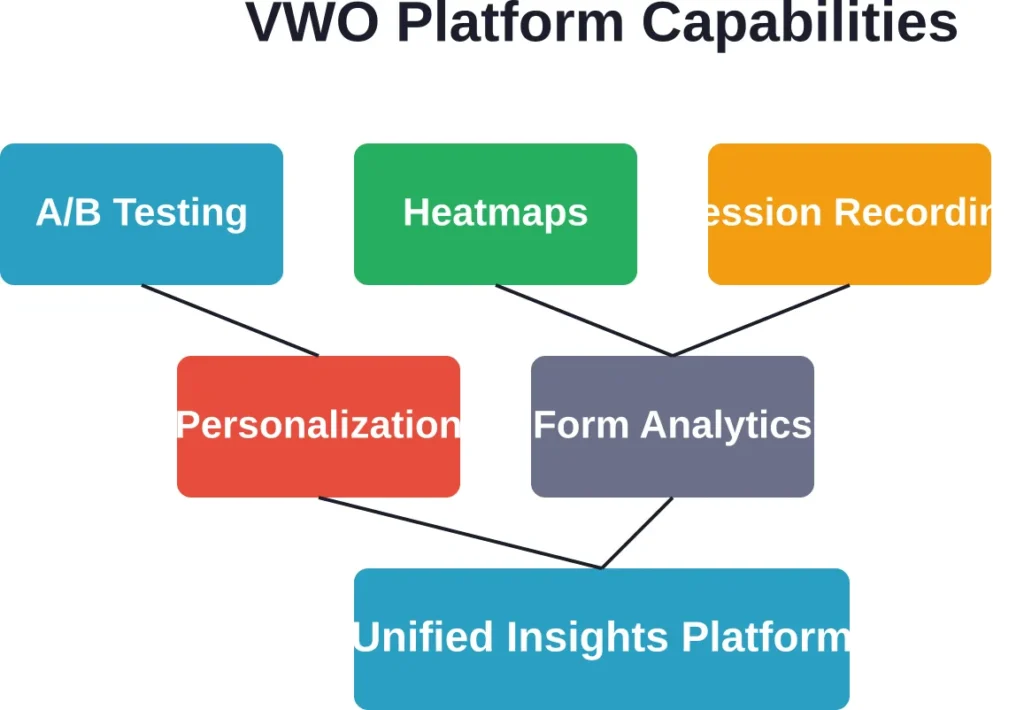
VWO has established itself as one of the most comprehensive experimentation platforms available. The company serves over 4,500 brands globally with a platform that combines A/B testing, personalization, and behavioral analytics.
What sets VWO apart is the depth of its feature set. The platform includes heatmaps, session recordings, form analytics, and customer surveys alongside its testing capabilities. This integrated approach means teams don’t need to stitch together data from multiple tools to understand user behavior.
The visual editor requires no coding knowledge, making it accessible for marketing teams. But VWO also provides full JavaScript customization for developers who need advanced control. This flexibility works well for organizations with mixed technical skill levels.
VWO works particularly well for e-commerce companies and content-heavy websites. The platform handles high-traffic sites efficiently, with 99% local storage-based tracking that minimizes page load impact.
Enterprise clients appreciate the white-label reporting and client workspace features. Agencies managing multiple brands can separate data cleanly while maintaining centralized control.
Best For
Mid-market to enterprise companies seeking an all-in-one optimization platform. Marketing teams that want behavioral insights alongside testing data. Organizations that value ease of use without sacrificing advanced capabilities.
12. Optimizely (Now Part of Episerver)

Optimizely pioneered the A/B testing industry and remains a dominant player, especially at the enterprise level. The platform has evolved from a simple testing tool into a comprehensive digital experience platform.
The company’s strength lies in handling complex experimentation programs at scale. Large organizations running dozens of concurrent tests across multiple properties benefit from Optimizely’s robust infrastructure and governance features.
Feature flagging capabilities have become a core part of Optimizely’s offering. Development teams can progressively roll out features, perform targeted releases, and instantly roll back problematic deployments—all tied to real business metrics.
The platform supports experimentation across web, mobile apps, connected devices, and server-side applications. This omnichannel capability matters for brands delivering consistent experiences across multiple touchpoints.
Enterprise-Grade Features
Statistical engines in Optimizely use both frequentist and Bayesian approaches, giving teams flexibility in how they interpret results. The Stats Accelerator feature uses historical data to reach significance faster on low-conversion events.
Advanced targeting and segmentation let teams create highly specific audience segments. Tests can target based on dozens of attributes including device type, referral source, behavioral history, and custom attributes from integrated systems.
Collaboration tools help large teams coordinate. Approval workflows, change logs, and role-based permissions prevent conflicts when multiple people manage the same account.
Best For
Enterprise organizations with complex testing requirements. Companies running experimentation programs across multiple channels. Development teams that need sophisticated feature flagging alongside marketing optimization.
13. Statsig
Statsig brings modern experimentation infrastructure to product teams. Founded by former Facebook engineers who built that company’s internal experimentation platform, Statsig focuses on helping product-led companies move fast with confidence.
The platform connects feature flags, A/B tests, and product metrics in a unified system. This integration means product managers can measure the real impact of every release without switching between tools or waiting for engineering support.
According to authoritative sources, Statsig offers a generous free tier with 2 million events per month and one-year data retention. This makes it accessible for startups and growing companies that aren’t ready for enterprise-scale investments.
What distinguishes Statsig is the focus on statistical rigor. The platform includes CUPED variance reduction, sequential testing, and automatic outlier detection. These advanced techniques help teams reach valid conclusions faster while avoiding common statistical pitfalls.
Developer-First Approach
SDKs for every major platform make implementation straightforward. The platform supports web, mobile, and server-side experimentation with consistent APIs across environments.
Warehouse-native architecture lets teams run experiments directly on their data warehouse. This eliminates data export delays and keeps sensitive customer data within existing security boundaries.
Real-time monitoring catches issues immediately. Automated health checks flag experiments with unexpected crashes, performance regressions, or other anomalies before they impact significant user populations.
Best For
Product teams at technology companies. Organizations with strong engineering cultures. Companies that want enterprise-grade experimentation capabilities without enterprise complexity.
14. AB Tasty

AB Tasty positions itself as the experimentation platform for marketing teams that lack dedicated development resources. The company emphasizes ease of use and speed to value over technical depth.
The visual editor allows marketers to create experiments without writing code. Drag-and-drop interfaces, pre-built widgets, and template libraries reduce the time from idea to live test.
AI-powered optimization features automatically allocate traffic to winning variants and suggest test ideas based on site analysis. These automation capabilities help smaller teams achieve results without hiring data scientists.
Personalization capabilities extend beyond testing. Teams can serve customized experiences based on behavioral segments, geographic location, referral source, and dozens of other attributes.
Marketing-Focused Features
Campaign management tools help teams coordinate testing with broader marketing initiatives. Tests can align with email campaigns, paid advertising, and content marketing efforts.
Built-in behavioral targeting uses on-site behavior to trigger personalized experiences. Different messaging for first-time visitors versus returning customers happens automatically once rules are configured.
Collaboration features keep stakeholders informed. Automated reporting, scheduled exports, and customizable dashboards ensure everyone sees relevant metrics without manual updates.
Best For
Marketing teams without dedicated developers. E-commerce brands focused on conversion optimization. Organizations that prioritize speed and ease of use over statistical sophistication.
15. LaunchDarkly

LaunchDarkly started as a feature flagging platform and evolved into a comprehensive experimentation solution. The company excels at helping engineering teams decouple code deployments from feature releases.
Feature flags let developers ship code to production with new features turned off, then gradually enable them for specific user segments. This approach dramatically reduces deployment risk and enables continuous delivery practices.
The platform supports both backend and frontend experimentation. API testing, algorithm optimization, and infrastructure changes can all be validated through controlled experiments—not just front-end design variations.
LaunchDarkly offers business plans with flexible pricing based on service units, with enterprise options available. The platform scales from startups to massive enterprises processing billions of flag evaluations daily.
Engineering-Focused Capabilities
SDKs for over 20 programming languages ensure compatibility with any tech stack. Server-side SDKs evaluate flags with microsecond latency, ensuring performance never suffers.
Integration with monitoring and incident management tools means feature flags participate in on-call workflows. Engineers can disable problematic features from PagerDuty or Datadog without deploying new code.
Audit logs track every flag change with full context. When troubleshooting issues, teams can see exactly when flags changed, who made the change, and what environments were affected.
Best For
Engineering-led organizations practicing continuous delivery. DevOps teams that need to decouple deployments from releases. Companies running experiments on backend systems and APIs.
Comparing Technical Capabilities Across Providers
Different companies excel in different technical areas. Understanding these distinctions helps match capabilities to specific requirements.
| Capability | Statsig | LaunchDarkly | VWO | Optimizely |
|---|---|---|---|---|
| Server-side testing | Excellent | Excellent | Good | Excellent |
| Feature flags | Excellent | Excellent | Limited | Excellent |
| Visual editor | Basic | None | Excellent | Excellent |
| Mobile SDK support | Excellent | Excellent | Good | Excellent |
| Statistical rigor | Excellent | Good | Good | Excellent |
| Real-time analytics | Excellent | Good | Good | Good |
Server-side capabilities matter most for product teams experimenting with backend logic. Feature flags become critical for engineering organizations practicing continuous delivery. Visual editors serve marketing teams that lack developer resources.
Integration Ecosystem Considerations
Analytics integration determines how easily teams can connect test results to broader business intelligence. Native connections to Google Analytics, Adobe Analytics, and data warehouses eliminate manual data exports.
Customer data platform integration enables sophisticated audience targeting. Tests can segment based on behavioral data, purchase history, lifetime value, and other attributes stored in CDPs.
Marketing automation connections let experimentation inform email campaigns, push notifications, and other communication channels. Winning test variations can automatically trigger corresponding changes in marketing tools.
Implementation and Setup Complexity
Getting started with A/B testing platforms varies dramatically in complexity. Some tools work within hours, while others require weeks or months of implementation effort.
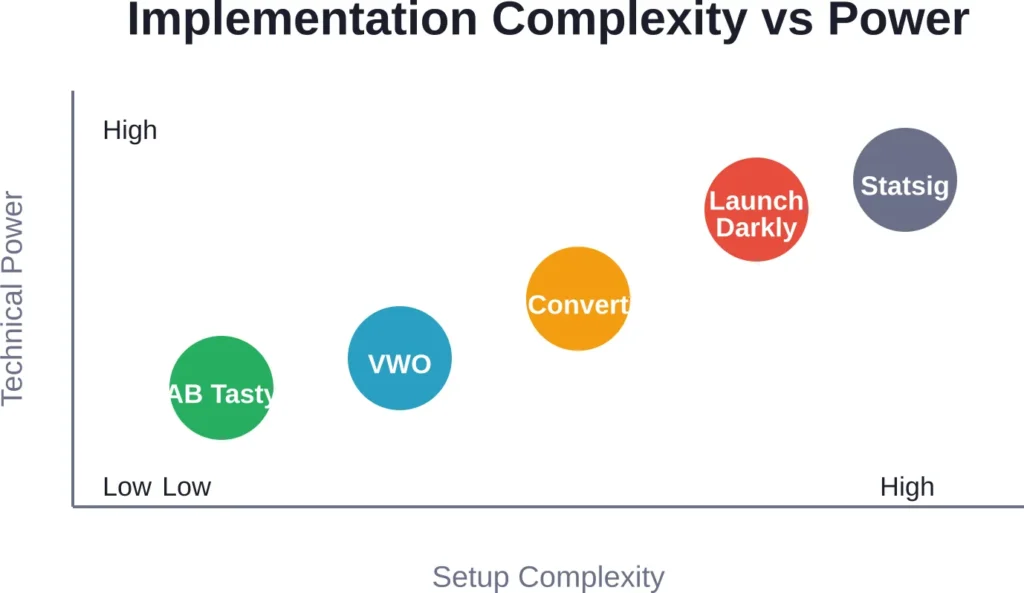
Tag-based implementations require only adding JavaScript to pages. Marketing teams can often handle this independently using tag management systems like Google Tag Manager.
SDK implementations demand developer involvement but enable more sophisticated testing. Server-side experiments, feature flags, and mobile testing all require SDK integration.
Hybrid approaches combine both methods. Visual editor tests run client-side while technical experiments use server-side SDKs. This flexibility lets teams start simple and add capabilities as needs grow.
Common Implementation Challenges
Flickering happens when test variations load after the page initially renders. Server-side testing eliminates this issue entirely. Client-side tools mitigate flickering through synchronous snippet loading and pre-hiding techniques.
Cross-domain tracking becomes complex when user journeys span multiple domains. Proper implementation requires coordination between domains to maintain consistent user identification.
Single-page application testing needs special handling. Traditional tools detect page changes through URL modifications. SPAs require custom event tracking to recognize navigation and apply test variations correctly.
Choosing the Right Development Partner
Matching capabilities to specific needs prevents both overpaying for unused features and outgrowing limited platforms. Several factors drive the selection process.
Team composition matters significantly. Marketing-heavy organizations benefit from visual editors and ease of use. Engineering-led companies prioritize SDKs, feature flags, and statistical rigor.
Testing volume influences platform selection. Companies running dozens of concurrent experiments need sophisticated targeting, allocation controls, and traffic management. Organizations running occasional tests can succeed with simpler tools.
Technical architecture constrains options. Single-page applications, mobile apps, and API-heavy systems require platforms with appropriate SDK support and flexible implementation models.
Evaluation Process
Trial periods let teams validate capabilities before committing. Most platforms offer 14-30 day trials or pilot programs. Running real tests with actual traffic reveals usability and performance issues better than demos.
Reference calls with similar customers provide honest feedback. Speaking with companies facing comparable challenges and similar technical environments surfaces potential issues vendors might not highlight.
Statistical validation ensures reliable results. Teams should understand what statistical methods each platform uses and whether those methods match organizational standards for decision-making.
Common Mistakes When Selecting Tools
Several selection pitfalls lead teams to platforms that don’t meet their needs. Avoiding these common mistakes improves outcomes.
Prioritizing features over usability creates adoption problems. A platform with every conceivable capability won’t deliver value if team members find it too complex to use regularly.
Ignoring statistical rigor leads to false positives. Tools that declare winners too early or don’t account for multiple comparisons encourage poor decisions based on noise rather than signal.
Overlooking integration requirements causes data silos. Tests running in isolation from analytics, customer data, and business intelligence limit the insights teams can extract.
Technical Debt Considerations
Proprietary implementations create switching costs. Platforms using custom JavaScript APIs or unique data models make migration difficult. Teams should favor tools using standard approaches when possible.
Vendor lock-in happens gradually. The more deeply integrated a platform becomes, the harder switching becomes. Evaluating exit strategies during selection prevents painful migrations later.
Data portability matters for long-term flexibility. Platforms should provide complete data exports in standard formats. Historical test results represent valuable organizational knowledge worth preserving across tool changes.
Frequently Asked Questions
Client-side testing runs in the user’s browser using JavaScript. It’s easier to implement and works well for visual changes but can cause flickering and doesn’t work for backend logic. Server-side testing happens on your servers or CDN before content reaches users, enabling testing of anything—APIs, algorithms, pricing logic—without JavaScript or performance impact. Product teams typically need server-side capabilities, while marketing teams often start client-side.
It depends on the platform and test complexity. Tools like VWO, AB Tasty, and Convert offer visual editors that let marketers create simple tests without code. But technical tests—changing checkout flows, modifying algorithms, testing backend features—always require developers. Even with visual editors, developer involvement improves test quality and prevents technical mistakes.
It varies based on current conversion rates and the effect size you’re trying to detect. Generally, sites with under 1,000 weekly conversions struggle to run traditional A/B tests because reaching statistical significance takes too long. Variance reduction techniques like CUPED can help teams with moderate traffic reach conclusions faster. Very low-traffic sites should focus on qualitative research and analytics-driven improvements rather than A/B testing.
Good hypotheses connect specific changes to expected outcomes with clear reasoning. Instead of “changing the button color will improve conversions,” try “changing the CTA from green to red will increase visibility against our blue background, reducing banner blindness and improving click-through by at least 10%.” The best hypotheses draw on user research, analytics data, or behavioral psychology rather than personal preferences.
Both approaches have merit. Frequentist methods provide clear significance thresholds and control false positive rates well, making them standard in academic research. Bayesian approaches let you incorporate prior knowledge and provide continuous probability estimates rather than binary significant/not-significant decisions. For most business contexts, the choice matters less than proper implementation—avoiding peeking at results, accounting for multiple comparisons, and ensuring adequate sample sizes.
Feature flags control which users see which features, while A/B tests measure the impact of those features on business metrics. The technologies overlap significantly—both require user targeting, gradual rollouts, and metric tracking. Modern platforms like LaunchDarkly and Statsig combine both capabilities, letting engineering teams progressively release features while automatically measuring their impact on conversion, retention, and other key metrics.
Poorly implemented tests can create SEO issues, but proper implementation is safe. Google explicitly permits A/B testing when done correctly—showing consistent content to search engine crawlers, using 302 redirects (not 301s) for redirect tests, and avoiding cloaking. Server-side testing platforms handle this automatically. Client-side tools require careful configuration to ensure crawlers see appropriate content.
Making Your Decision
Selecting an A/B testing development company requires balancing technical capabilities, team needs, and organizational context. No single platform serves all use cases equally well.
Start by defining requirements clearly. List must-have capabilities, nice-to-have features, and deal-breakers. Consider team composition, testing volume, technical architecture, and integration requirements.
Evaluate 2-3 platforms thoroughly rather than surveying dozens superficially. Run real tests during trial periods. Involve actual users—marketers, developers, analysts—in the evaluation process.
Remember that experimentation culture matters more than tools. The best platform won’t deliver results if organizational processes don’t support systematic testing. Build the practice alongside selecting the technology.
The A/B testing landscape continues evolving rapidly. AI-powered optimization, edge computing, privacy-first tracking, and warehouse-native architectures represent just some of the innovations reshaping how teams experiment. Choosing platforms with modern architectures and active development roadmaps helps future-proof investments.
But fundamentally, successful experimentation comes down to asking good questions, designing rigorous tests, and making data-driven decisions. The right development partner amplifies those capabilities—they don’t replace them.