

Quick Summary: The best landing page development companies in 2026 combine technical expertise with conversion optimization to deliver pages that turn visitors into customers. This guide profiles 15 leading agencies specializing in landing page design and development, covering their core strengths, ideal client profiles, and what makes each stand out in the competitive digital landscape.
Landing pages make or break digital marketing campaigns. Industry analyses indicate that only 22 percent of businesses are satisfied with their landing pages’ performance, and only 44 percent use A/B testing to improve results. The right development partner changes that equation entirely.
The design of a landing page forms the basis for 94% of first impressions. That’s not just about aesthetics—it’s about strategic architecture that guides visitors toward a single, clear action. Whether that’s signing up for a trial, downloading a resource, or making a purchase.
But here’s the thing: not all landing page agencies operate the same way. Some specialize in rapid deployment for startups. Others focus on enterprise-scale campaigns with sophisticated personalization. Some bring deep expertise in specific industries like SaaS or ecommerce.
This guide profiles 15 leading landing page development companies operating in 2026. Each agency has been selected based on demonstrated expertise, client outcomes, and specialization areas. No fluff, no invented metrics—just what these companies actually deliver.
Why Landing Page Specialists Matter in 2026
Marketing has never been a static discipline. But as operations move into 2026, growth is increasingly shaped by how well businesses understand their customers, structure their marketing systems, and connect every tactic back to measurable business outcomes.
Landing pages sit at the intersection of traffic and conversion. They’re where visitors decide whether to engage or bounce. According to analyses from academic marketing sources, the core question is not about chasing the newest platform or viral tactic—it’s about consistently attracting, converting, and retaining the right customers.
That’s where specialized agencies add value. They bring expertise in:
- Conversion-focused design principles that guide visitor behavior
- Technical implementation across platforms and devices
- Testing frameworks that identify what actually works
- Performance optimization for speed and accessibility
- Integration with marketing automation and analytics systems
Real talk: building a landing page isn’t hard. Building one that converts at scale? That requires expertise most in-house teams lack.
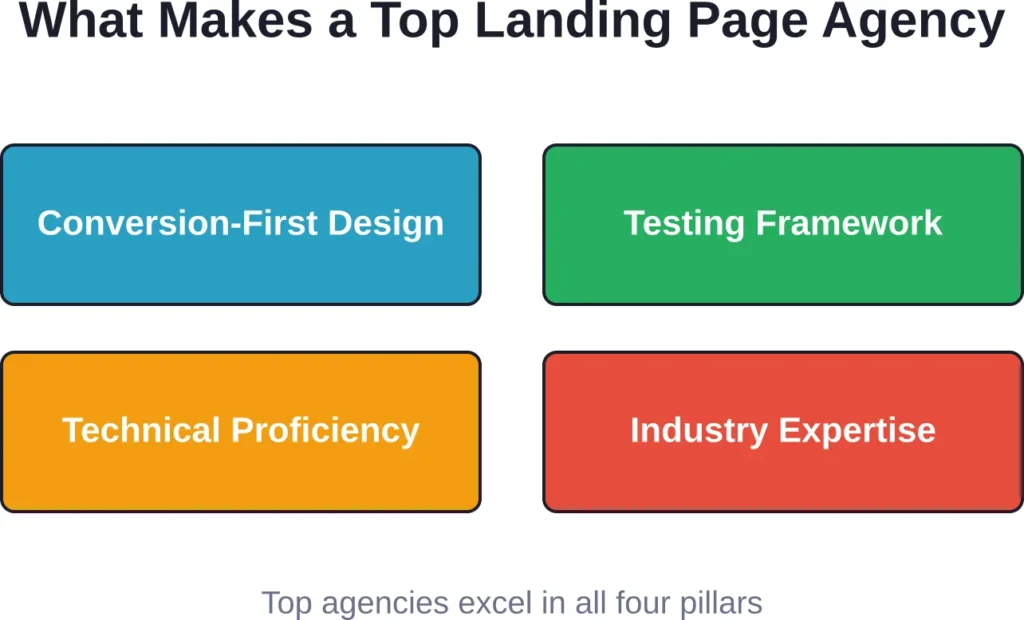
What Separates Top Landing Page Development Companies
Not every agency that builds landing pages qualifies as a specialist. The best landing page development companies share several distinguishing characteristics that separate them from generalist web design firms.
Conversion-First Methodology
Top agencies start with conversion goals, then work backward to design. They don’t just make pages look good—they architect experiences that move visitors through a deliberate psychological journey toward action.
This shows up in how they structure hierarchy, use whitespace, write microcopy, and position calls-to-action. Every element serves the conversion goal.
Testing and Optimization Framework
The best landing page companies don’t just deliver a page and walk away. They establish testing frameworks that continuously improve performance over time.
That means A/B testing headlines, layouts, imagery, and calls-to-action. It means using real-time data to check what works and iterating based on actual user behavior, not assumptions.
Technical Proficiency Across Platforms
Landing pages need to load fast, work seamlessly on mobile, integrate with marketing automation platforms, and handle form submissions reliably. Technical implementation matters as much as design.
Top agencies work fluently across landing page platforms, content management systems, and custom development environments. They know how to optimize for Core Web Vitals and ensure accessibility compliance.
Industry-Specific Experience
The landing page that works for a B2B SaaS company won’t work for an ecommerce brand. The best agencies often specialize in particular industries or business models, bringing deep understanding of what resonates with specific audiences.
They know the typical customer journey, common objections, competitive landscape, and messaging frameworks that drive results in that space.
The 15 Best Landing Page Development Companies in 2026
Based on demonstrated expertise, client outcomes, and specialization areas, these 15 agencies represent the top tier of landing page development companies operating in 2026.
1. Mobian
Mobian builds dedicated engineering teams that deliver production-ready digital products with a strong focus on high-converting landing pages and web experiences. They specialize in creating fast, user-centric interfaces for mobile-first and complex solutions, particularly in IT, Healthcare, Fintech, and Logistics.
What sets them apart is their end-to-end delivery model — from UI/UX design through full-stack development to post-launch support. Their landing pages are built as part of scalable architectures that prioritize performance, clarity, and seamless user journeys.
Best for: IT, healthcare, fintech, and logistics companies, businesses needing mobile-optimized landing pages, teams requiring senior-level product development
Core strengths: Full-stack development, conversion-focused UI/UX, scalable architecture, dedicated engineering teams
Contact Information:
- Website: mobian.studio
- Phone: [email protected]
- Address: Harju maakond, Tallinn, Kesklinnalinnaosa, Masina tn 22, 10113
- LinkedIn: www.linkedin.com/company/mobian-studio
2. Oski
Oski designs and develops smart, high-performance web solutions with deep expertise in frontend technologies and user experience. They create modern landing pages that combine aesthetic excellence with technical robustness to drive conversions for tech-forward enterprises and startups.
What sets them apart is their AI-accelerated engineering approach and focus on intuitive, responsive interfaces across industries such as e-commerce, fintech, education, and travel. Their pages emphasize speed, seamless functionality, and alignment with broader business goals.
Best for: Tech-forward enterprises, ambitious startups, companies needing modern conversion-ready landing pages
Core strengths: Frontend excellence, UI/UX optimization, scalable web solutions, industry-specific design
Contact Information:
- Website: oski.site
- Phone: +48571282759
- Email: [email protected]
- Address: Kaupmehe tn 7, 10114 Tallinn, Estonia
- LinkedIn: www.linkedin.com/company/oski-solutions
3. A-listware
A-listware delivers comprehensive software development and UX/UI design services, specializing in creating impactful, responsive landing pages as part of complete digital solutions. They focus on user-friendly interfaces that support business objectives and enhance engagement across devices.
What sets them apart is their dedicated team model that ensures seamless integration with client workflows while delivering custom, high-quality designs paired with robust technical implementation.
Best for: Enterprises and SMBs requiring custom digital experiences, companies seeking integrated design and development, businesses needing reliable landing page performance
Core strengths: UX/UI design, custom web development, responsive landing pages, dedicated team delivery
Contact Information:
- Website: a-listware.com
- Phone: +1 (888) 337 93 73
- Email: [email protected]
- Address: North Bergen, NJ 07047, USA
- LinkedIn: www.linkedin.com/company/a-listware
- Facebook: www.facebook.com/alistware
4. Gilzor

Gilzor excels at building custom digital products with a core emphasis on UI/UX design and web development that significantly improves conversion rates. They create optimized landing pages and websites for startups and growing businesses, focusing on user-centric design, clear value propositions, and fast performance.
What sets them apart is their integrated full-cycle approach — from idea validation and prototyping to development and go-to-market strategy. Their landing pages are crafted to support successful product launches and user acquisition.
Best for: Startups launching new products, SMBs scaling online presence, product studios needing conversion-optimized web assets
Core strengths: User-centric UI/UX design, conversion rate improvement, full-cycle web development, product launch support
Contact Information:
- Website: www.gilzor.com
- Email: [email protected]
- Address: Poland, Warsaw, Office 58, street Adama Mickiewicza 37, 01-625
- LinkedIn: www.linkedin.com/company/gilzor-softwaredevelopment
5. Lengreo
Lengreo specializes in full-funnel digital marketing and website development, with a strong emphasis on high-converting landing pages for B2B and SaaS companies. Their team combines strategic consulting, UX research, and conversion-focused design to build pages that generate qualified leads and measurable growth.
What sets them apart is their end-to-end approach: from discovery and business analysis to prototyping, development, and continuous optimization. They seamlessly integrate landing pages with lead generation, SEO, and paid ad campaigns.
Best for: B2B companies, SaaS and tech firms, businesses focused on lead generation and conversion rate optimization
Core strengths: Conversion-focused landing pages, full-funnel integration, B2B strategy, performance marketing alignment
Contact Information:
- Website: Lengreo.com
- Phone: +31 686 147 566
- Email: [email protected]
- Address: Vrijstraat 9 C/D, 5611 AT Eindhoven, Netherlands
- LinkedIn: Lengreo
- Twitter: @Lengreo
- Instagram: @lengreo
6. Conversion Fanatics
Conversion Fanatics specializes exclusively in conversion rate optimization, making landing pages their core competency. They bring scientific rigor to the optimization process, using behavioral psychology principles and extensive testing to drive performance improvements.
Their team includes dedicated CRO strategists, designers, and developers who work together to identify opportunities and implement changes. They focus heavily on understanding visitor behavior through heatmaps, session recordings, and user testing before making design recommendations.
What makes them distinctive is their emphasis on understanding the “why” behind visitor behavior, not just the “what.” They dig into motivation, objections, and decision-making processes to inform design strategy.
Best for: Companies with established traffic looking to improve conversion, brands ready to invest in optimization, marketing teams that value testing rigor
Core strengths: Behavioral analysis, scientific testing methodology, CRO specialization, user research
7. Webstacks

Webstacks focuses on headless CMS and modern web architecture for landing pages and marketing sites. They work primarily with tech companies and SaaS businesses that need high-performance, technically sophisticated landing page solutions.
Their technical expertise allows them to build landing pages that load extremely fast, scale efficiently, and integrate seamlessly with marketing automation platforms and data systems. They’re particularly strong when landing pages need to be part of a larger, technically complex marketing ecosystem.
Webstacks also emphasizes developer experience and maintainability. Their landing pages are built to be easily updated and iterated by internal teams without requiring extensive custom development.
Best for: Tech companies, SaaS businesses with complex technical requirements, companies using headless CMS architectures
Core strengths: Technical architecture, performance optimization, modern web technologies, developer-friendly implementations
8. Single Grain

Single Grain combines landing page development with full-funnel digital marketing strategy. They’re particularly effective for companies that need landing pages integrated with broader content marketing, SEO, and paid advertising programs.
Their landing pages are built with distribution in mind. They understand how organic search, paid campaigns, email marketing, and social traffic each require different approaches to landing page design and messaging.
Single Grain also brings strong analytical capabilities. They track landing page performance within the broader context of marketing funnel metrics, helping clients understand not just conversion rates but the quality and lifetime value of leads generated.
Best for: Companies running integrated marketing programs, brands focused on full-funnel optimization, marketing teams needing strategic guidance alongside execution
Core strengths: Full-funnel strategy, multi-channel integration, analytics and attribution, strategic marketing guidance
9. The Good
The Good specializes in landing pages for ecommerce and direct-to-consumer brands. They understand the unique requirements of product pages, promotional landing pages, and campaign-specific experiences for retail brands.
Their design work emphasizes product presentation, social proof, and urgency—elements particularly important for ecommerce conversions. They know how to balance detailed product information with streamlined checkout flows.
The Good also brings expertise in platform-specific implementations, working fluently with Shopify, WooCommerce, and other ecommerce platforms to ensure landing pages integrate smoothly with existing tech stacks.
Best for: Ecommerce brands, direct-to-consumer companies, retail businesses running promotional campaigns
Core strengths: Ecommerce expertise, product presentation, promotional campaign design, platform integration
10. Volume Nine
Volume Nine takes an SEO-first approach to landing page development, specializing in pages designed to rank organically while still converting traffic effectively. They understand the balance between optimization for search engines and optimization for human visitors.
Their landing pages are built with technical SEO best practices baked in—proper heading structure, semantic HTML, optimized loading performance, and mobile responsiveness. They also bring content strategy expertise to ensure pages target the right keywords and address searcher intent effectively.
Volume Nine works particularly well for companies where organic search drives significant traffic to landing pages, rather than relying primarily on paid advertising.
Best for: Companies focused on organic search traffic, content-driven marketing strategies, brands building long-term SEO programs
Core strengths: SEO expertise, technical optimization, content strategy, organic search visibility
11. Intuita Tech
Intuita Tech specializes in landing page design for SaaS companies and digital product businesses. Their approach combines user experience research with conversion optimization, creating pages that balance aesthetic appeal with measurable performance.
What sets them apart is their focus on the entire customer journey. They don’t just build isolated landing pages—they create connected experiences across product onboarding, pricing pages, trial sign-ups, and conversion funnels.
According to their case studies, their team has helped some SaaS clients achieve up to 68 percent more conversions by using real-time tools to check what works and fix what doesn’t. They use continuous testing cycles to refine messaging, layout, and calls-to-action based on actual user behavior.
Best for: SaaS companies, digital product launches, B2B technology companies
Core strengths: Conversion optimization, A/B testing, user experience research, SaaS-specific expertise
12. Superside

Superside operates as a creative-as-a-service platform with deep expertise in landing page design. They combine a global team of designers with a streamlined project management system that delivers consistent quality at speed.
Their landing page work emphasizes brand consistency across campaigns. For companies running multiple simultaneous campaigns or managing landing pages at scale, Superside provides the production capacity and design expertise to maintain quality without bottlenecks.
They work particularly well with marketing teams that need reliable, fast turnaround on landing page variations for different campaigns, audiences, or product launches.
Best for: Marketing teams managing multiple campaigns, companies needing scalable design capacity, brands focused on visual consistency
Core strengths: Production speed, design consistency, scalability, creative quality
13. KlientBoost
KlientBoost brings a performance marketing perspective to landing page development. Their team specializes in pages designed specifically for paid advertising campaigns—particularly PPC and paid social.
They understand the connection between ad creative, messaging alignment, and landing page experience. Their pages are built to maintain message continuity from ad click through conversion, reducing friction and improving campaign ROI.
KlientBoost also emphasizes speed. They know that even small delays in page load time impact conversion rates, especially for mobile traffic from paid campaigns.
Best for: Companies running significant paid advertising campaigns, PPC-focused marketing teams, brands optimizing for paid social conversions
Core strengths: Paid campaign optimization, message continuity, performance marketing expertise, mobile optimization
14. Directive
Directive specializes in B2B and enterprise landing pages, particularly for complex products and longer sales cycles. They understand the unique challenges of converting business buyers who need more information and face multiple stakeholders in the decision process.
Their landing pages balance persuasion with education. They know when to provide detailed information versus when to gate content behind a form. They understand how to position offers that work for different stages of the B2B buying journey.
Directive also brings SEO expertise to landing page development, ensuring pages are optimized for organic search visibility alongside conversion performance.
Best for: B2B companies, enterprise software, complex products with longer sales cycles
Core strengths: B2B expertise, enterprise marketing, SEO optimization, educational content integration
15. Disruptive Advertising

Disruptive Advertising takes a data-first approach to landing page development. Their team starts every project with thorough analysis of existing data, customer insights, and competitive landscape before any design work begins.
They’re particularly strong at identifying and addressing specific friction points in the conversion funnel. Their pages are built to remove objections systematically and guide visitors toward action through clear value propositions and strategic messaging.
Testing is central to their methodology. They establish baseline performance, then run structured testing programs to continuously improve conversion rates over time.
Best for: Data-driven marketing teams, companies with existing traffic needing better conversion, brands focused on continuous optimization
Core strengths: Data analysis, friction reduction, systematic testing, conversion rate optimization
How to Choose the Right Landing Page Development Partner
Selecting the right agency depends on specific business needs, technical requirements, and marketing objectives. Several factors determine which landing page development company makes the best fit.
Define Clear Goals First
Before evaluating agencies, establish what success looks like. Is the goal lead generation? Direct sales? Trial sign-ups? Downloads? Different conversion goals require different design approaches.
Also consider volume expectations. An agency that excels at producing high-performing pages one at a time might not be the right fit for a company needing to scale production of dozens of landing page variations.
Match Industry Experience
Agencies with experience in specific industries bring understanding of what works for those audiences. A SaaS-focused agency understands trial sign-up optimization in ways a generalist doesn’t. An ecommerce specialist knows product page psychology that doesn’t apply to B2B services.
Review agency case studies and client portfolios. Look for projects similar to what’s needed, not just impressive work in unrelated areas.
Evaluate Technical Capabilities
Technical requirements vary widely. Some projects need custom development. Others work fine with landing page builders or CMS templates. Some require sophisticated integrations with marketing automation platforms, CRMs, or analytics systems.
Ensure the agency’s technical capabilities match project requirements. An agency that excels with no-code tools might not be the right choice for a project requiring custom React development.
Understand the Process and Timeline
Different agencies work at different speeds with different processes. Some can turn around landing pages in days. Others follow longer research and development cycles that take weeks.
Neither approach is inherently better—it depends on project needs. A rapid product launch might require speed. A major campaign for an established brand might benefit from extensive research and testing.
Consider Ongoing Optimization
Landing page performance improves over time through testing and optimization. Some agencies include ongoing optimization in their services. Others deliver the page and hand it off.
Consider whether the team has capacity to manage ongoing optimization internally, or whether that needs to be part of the agency relationship.
| Selection Factor | Why It Matters | Questions to Ask |
|---|---|---|
| Industry Experience | Specialized knowledge of target audience behavior and expectations | What similar projects have you completed? Can we see case studies in our industry? |
| Technical Capabilities | Ensures agency can execute on required platform and integration needs | What platforms do you work with? How do you handle integrations with our existing tools? |
| Testing Methodology | Continuous improvement requires structured testing approach | What’s your process for A/B testing and optimization? What tools do you use? |
| Timeline and Process | Alignment between agency workflow and project deadlines | What’s your typical timeline? How many revision rounds are included? |
| Ongoing Support | Landing pages need maintenance and optimization over time | Do you offer ongoing optimization? What happens after launch? |
Common Landing Page Development Mistakes to Avoid
Even when working with experienced agencies, certain mistakes undermine landing page performance. Awareness of these pitfalls helps ensure better outcomes.
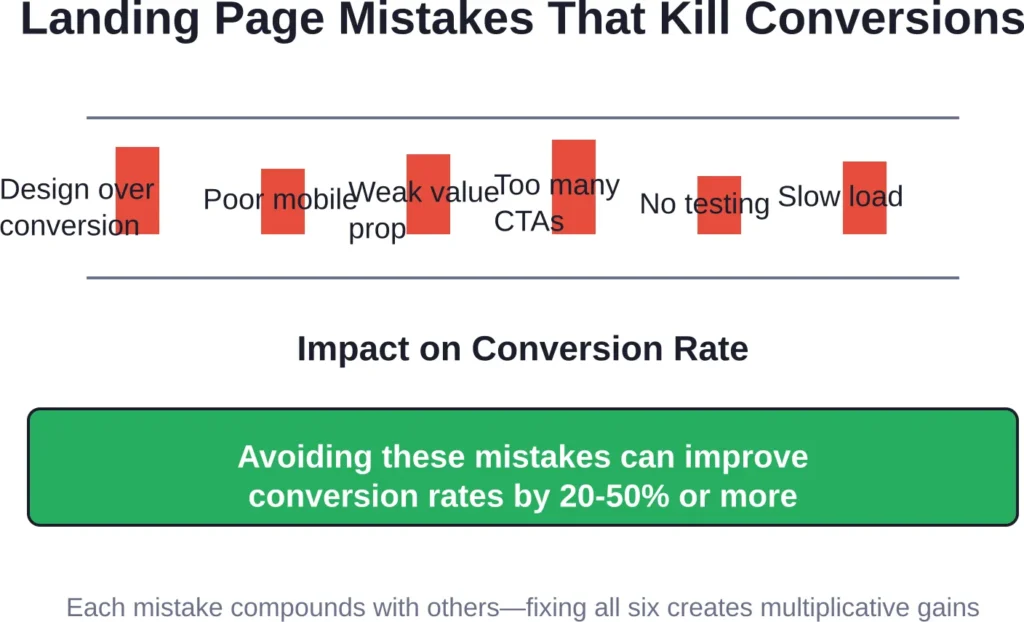
Prioritizing Design Over Conversion
Beautiful design matters. But design should serve conversion goals, not exist for its own sake. The most visually impressive landing page that doesn’t convert is a failure.
Top agencies balance aesthetic appeal with conversion optimization. They make pages look professional and trustworthy while ensuring every design element guides visitors toward action.
Ignoring Mobile Experience
Mobile traffic often represents the majority of landing page visitors. Pages that work well on desktop but provide poor mobile experiences lose conversions at scale.
Mobile optimization goes beyond responsive design. It means rethinking hierarchy for smaller screens, ensuring touch targets are appropriately sized, and prioritizing speed for mobile networks.
Weak or Unclear Value Propositions
Visitors need to understand immediately what’s being offered and why it matters to them. Vague or clever headlines that sacrifice clarity for creativity undermine conversion.
The value proposition should answer three questions clearly: What is this? Who is it for? Why should I care? If a visitor can’t answer those within seconds of landing, the page needs work.
Too Many Conversion Goals
Effective landing pages focus on a single conversion action. Pages that ask visitors to “Sign up” OR “Learn more” OR “Contact sales” OR “Download the app” dilute focus and reduce conversion rates across all actions.
Pick one primary conversion goal per landing page. Secondary actions can exist but should be clearly de-emphasized.
Skipping the Testing Phase
No one—not even the most experienced agency—knows with certainty what will perform best. Assumptions about design, messaging, or layout need validation through testing.
Build testing into the timeline and budget. Plan for multiple iterations. Use data to guide decisions rather than opinions or preferences.
Slow Load Times
Page speed directly impacts conversion rates. Even delays of a few seconds significantly increase bounce rates, especially for mobile traffic.
Work with agencies that prioritize technical performance. Request performance benchmarks and ensure pages meet Core Web Vitals standards.
Landing Page Development Trends Shaping 2026
The landing page development landscape continues evolving. Several trends are shaping how top agencies approach projects in 2026.
AI-Assisted Design and Personalization
Artificial intelligence plays an expanding role in landing page development. Some agencies use AI tools to accelerate design iteration and testing. Others leverage AI for dynamic personalization that adapts page content based on visitor characteristics.
That said, AI hasn’t replaced human expertise. The best results come from combining AI efficiency with strategic human judgment about what to test and how to interpret results.
Performance as a Priority
Page speed and technical performance receive increasing emphasis. AI-driven caching can increase cache hit rates by up to 15% by improving data availability and reducing latency, according to authoritative technical sources.
This matters because even small performance improvements compound across large traffic volumes. Faster pages convert better, rank better in search results, and provide better user experiences.
Privacy-First Tracking and Attribution
Changes in privacy regulations and browser tracking capabilities force new approaches to landing page analytics. Agencies are adapting to cookie-less tracking environments and helping clients maintain conversion visibility despite these constraints.
This means greater emphasis on first-party data collection, server-side tracking implementations, and measurement approaches that don’t rely on third-party cookies.
Accessibility as Standard Practice
Accessibility is shifting from optional consideration to standard requirement. Top agencies build landing pages that work for users with disabilities, not just to meet legal requirements but because accessible pages often perform better for everyone.
Proper heading structure, sufficient color contrast, keyboard navigation support, and screen reader compatibility are becoming baseline expectations rather than premium features.
Integration Complexity
Marketing technology stacks grow more complex. Landing pages need to integrate smoothly with CRMs, marketing automation platforms, analytics systems, A/B testing tools, and more.
Agencies that handle integration complexity well—ensuring data flows reliably between systems—deliver more value than those focused solely on front-end design.
Beyond Design: What Agencies Should Provide
The best landing page development companies deliver more than just designed pages. Comprehensive service includes several supporting elements that determine long-term success.
Strategic Guidance
Top agencies don’t just execute what clients request—they provide strategic counsel about what will work. They challenge assumptions, recommend alternatives, and explain tradeoffs between different approaches.
This consulting element distinguishes strategic partners from execution vendors. Clients should expect agencies to push back when requested approaches won’t deliver results.
Competitive Analysis
Understanding what competitors do—both what works and what doesn’t—informs smarter design decisions. Agencies should analyze competitive landscape and identify opportunities for differentiation.
This doesn’t mean copying competitors. It means understanding the baseline expectations in a given market and making informed decisions about where to align with conventions versus where to break them.
Content Development Support
Landing page design is only as good as the content it presents. Many agencies provide copywriting services or collaborate closely with client content teams to ensure messaging aligns with design.
Even when clients provide content, agencies should offer feedback about what will work effectively in the designed layout and what needs adjustment.
Post-Launch Support
Landing pages need maintenance, updates, and optimization after launch. Clarify what post-launch support is included and what requires additional engagement.
At minimum, agencies should monitor initial performance, address any technical issues that emerge, and provide guidance about next steps for optimization.
Measuring Landing Page Success
Working with a landing page development company requires clear metrics for evaluating success. Different goals require different measurement approaches.
Primary Conversion Rate
The most important metric: what percentage of visitors complete the desired action? This is the foundation of landing page performance.
But conversion rate alone doesn’t tell the complete story. A page with a 10% conversion rate generating low-quality leads might perform worse than a 5% conversion rate page generating high-quality leads.
Cost Per Conversion
For paid traffic, cost per conversion determines ROI. This metric combines landing page conversion rate with traffic costs to show the full picture of campaign efficiency.
Improving landing page conversion rates while holding traffic costs constant reduces cost per conversion linearly. A page that doubles conversion rate cuts cost per conversion in half.
Lead Quality Metrics
Not all conversions are equal. Track downstream metrics like lead-to-opportunity rate, sales-qualified lead percentage, or purchase completion rate for ecommerce.
Sometimes design changes that increase raw conversion rates attract lower-quality leads. Balancing volume with quality requires tracking beyond the landing page itself.
Engagement Indicators
Time on page, scroll depth, and interaction with specific elements provide insights about visitor engagement. These metrics help diagnose issues when conversion rates underperform.
Low scroll depth might indicate weak opening content. High scroll depth with low conversion might point to unclear calls-to-action or friction in the conversion process.
Technical Performance
Core Web Vitals—Largest Contentful Paint, First Input Delay, and Cumulative Layout Shift—measure technical performance. These metrics correlate with both conversion rates and SEO rankings.
Agencies should provide performance benchmarks and ensure pages meet acceptable standards across all metrics.
| Metric Category | Key Measurements | What It Reveals |
|---|---|---|
| Conversion Performance | Conversion rate, submissions, sign-ups | Core effectiveness at driving desired actions |
| Traffic Economics | Cost per click, cost per conversion, ROI | Economic efficiency of traffic and conversion |
| Lead Quality | MQL rate, SQL rate, purchase completion | Downstream value of generated conversions |
| User Engagement | Time on page, scroll depth, element interactions | Visitor engagement and friction points |
| Technical Performance | Page load time, Core Web Vitals, mobile performance | Technical factors affecting conversion and SEO |
Questions to Ask Before Hiring
When evaluating landing page development companies, several questions help assess fit and capability.
What’s your process for understanding our audience and conversion goals? Agencies should demonstrate interest in understanding the business, not just executing a design brief.
Can we see examples of landing pages you’ve built for similar companies? Review actual work, preferably with performance data, rather than just hearing about capabilities.
How do you approach A/B testing and optimization? Understanding the testing methodology reveals how seriously the agency takes performance improvement.
What platforms and technologies do you work with? Ensure technical capabilities match project requirements.
What happens after launch? Clarify post-launch support, optimization services, and what’s included versus what requires additional engagement.
How do you handle revisions and feedback? Understanding the revision process prevents frustration during the project.
What metrics do you track to measure success? Agencies should have clear ideas about how to measure and demonstrate results.
Can you provide client references? Speaking with past clients reveals how the agency actually works, not just how they present themselves.
The Real Cost of Poor Landing Pages
Working with top landing page development companies requires investment. But the cost of poor landing pages often exceeds agency fees significantly.
Consider a company spending money on paid advertising that drives 10,000 visitors per month to a landing page. If that page converts at 2%, it generates 200 conversions.
Now imagine an optimized page that converts at 4%—not an unrealistic improvement with professional development. That’s 400 conversions from the same traffic. The difference is 200 additional conversions every month.
If those conversions have any meaningful value—whether direct sales or qualified leads—the incremental revenue from improved conversion quickly justifies the investment in professional landing page development.
This logic applies even more strongly when traffic comes from paid sources. Every percentage point of conversion rate improvement directly reduces customer acquisition costs.
Frequently Asked Questions
Landing page specialists focus specifically on conversion optimization rather than general web design. They understand the psychology of visitor behavior, use data-driven testing methodologies, and specialize in single-page experiences designed to drive specific actions. Regular web design agencies often lack this specialized conversion expertise and testing discipline.
Timeline varies based on complexity, customization requirements, and agency process. Simple landing pages using templates might be completed in a few days. Custom-designed, strategically researched pages with original content typically take 2-4 weeks. Complex projects requiring extensive integration or custom development can extend to 6-8 weeks. Discuss timeline expectations early in the evaluation process.
Not necessarily. Many companies use dedicated landing page platforms separate from their main website CMS. This allows for faster deployment, easier A/B testing, and specialized functionality. However, pages hosted on the main domain can benefit from established domain authority for SEO. The best approach depends on specific technical requirements, SEO strategy, and operational workflow preferences.
Extremely important. Mobile traffic often represents the majority of landing page visitors, particularly for paid advertising campaigns. Mobile optimization goes beyond responsive design—it requires rethinking layout hierarchy, ensuring fast load times on mobile networks, properly sizing touch targets, and streamlining forms for small screens. Landing pages that provide poor mobile experiences lose significant conversion opportunities.
Conversion rates vary dramatically based on traffic source, offer type, industry, and target audience. Paid search traffic typically converts better than display advertising. Free trials convert more readily than paid purchases. B2B lead generation pages face different expectations than ecommerce product pages. Rather than fixating on absolute numbers, focus on improving conversion rates over time through testing and optimization. Even industry benchmarks provide limited value—what matters is performance relative to business goals and continuous improvement.
Continuous optimization through testing should happen regularly—monthly or even weekly for high-traffic pages. Full redesigns are typically needed less frequently, perhaps annually or when major strategic shifts occur. However, landing pages should never be “set and forget.” Regular testing of headlines, imagery, calls-to-action, and layout elements keeps performance improving. Major redesigns are warranted when business positioning changes, when competitive landscape shifts significantly, or when continuous optimization reaches a performance plateau.
Services vary by agency. Some provide full-service solutions including hosting, domain configuration, and ongoing technical maintenance. Others deliver designed pages but expect clients to handle hosting and deployment through their own infrastructure or preferred platforms. Clarify these expectations during the evaluation process. For companies without technical resources, agencies that handle hosting and maintenance provide valuable convenience. For companies with established technical teams, focusing purely on design and optimization might make more sense.
Conclusion
Choosing the right landing page development company shapes marketing performance for years to come. The agencies profiled here represent the top tier of specialists operating in 2026—each bringing distinctive strengths to different types of projects and business models.
The best choice depends on specific needs. SaaS companies benefit from agencies like Intuita Tech or Webstacks with deep product-focused experience. B2B enterprises should consider Directive’s expertise in complex sales cycles. Ecommerce brands fit well with The Good’s retail specialization. Companies running significant paid campaigns need KlientBoost’s performance marketing focus.
But here’s what they all share: a data-driven approach to conversion optimization, technical expertise in implementation, and commitment to measurable results rather than just attractive design.
Landing pages remain one of the highest-leverage investments in digital marketing. Small improvements in conversion rates compound across all traffic sources, reducing customer acquisition costs and improving campaign ROI systematically.
The right development partner doesn’t just deliver a page—they deliver a strategic asset that performs better over time through continuous optimization. That’s what separates the top agencies from the rest.
Ready to improve landing page performance? Start by defining clear goals, evaluating agencies with relevant experience, and committing to optimization as an ongoing practice rather than a one-time project. The best landing page development companies will partner in that journey, bringing expertise that transforms conversion performance sustainably.