

Quick Summary: The best ADA web development companies specialize in creating accessible, WCAG-compliant digital experiences that meet legal standards and serve all users. This comprehensive list profiles 15 leading agencies offering audits, remediation, training, and accessible design services — with expertise spanning enterprise platforms, e-commerce, education, and government sectors.
Digital accessibility isn’t optional anymore. With 1.2 billion people globally depending on accessible digital solutions, organizations face mounting pressure from legal requirements, ethical obligations, and business imperatives to build inclusive experiences.
But here’s the challenge: achieving genuine accessibility requires specialized expertise that most development teams simply don’t have in-house. The Web Content Accessibility Guidelines (WCAG) contain hundreds of success criteria, and automated tools can catch 30-40% of issues.
That’s where dedicated ADA web development companies come in. These specialized agencies combine technical expertise, assistive technology knowledge, and compliance experience to help organizations build truly accessible digital properties.
This guide profiles the 15 best accessibility agencies, explains what services they offer, and helps you understand how to choose the right partner for your accessibility journey.
Services Offered By ADA Web Development Companies
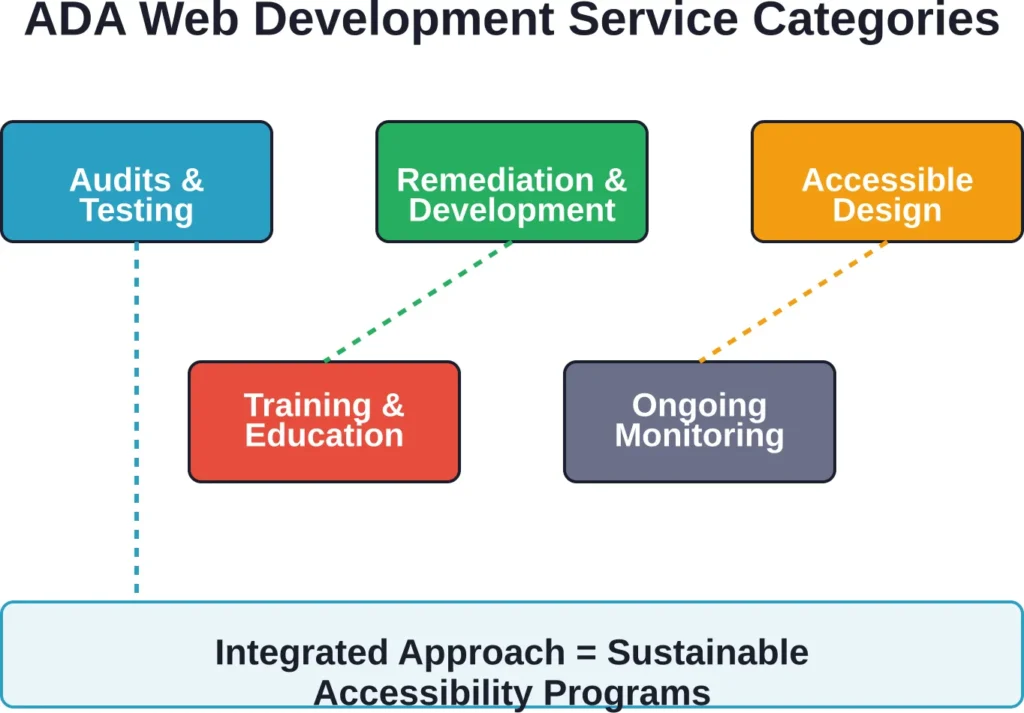
Accessibility agencies typically offer a range of services designed to address different stages of the accessibility journey. Understanding these service categories helps organizations identify what they actually need.
Accessibility Audits and Testing
Comprehensive audits form the foundation of most accessibility engagements. Agencies use a combination of automated scanning tools and manual testing to identify WCAG violations and usability barriers.
The best audits go beyond automated reports. Experienced accessibility testers use real assistive technologies — screen readers, voice control software, screen magnifiers — to evaluate actual user experiences.
Audit deliverables typically include detailed reports documenting each issue, its severity, affected user groups, and specific remediation recommendations.
Remediation and Development Services
Many accessibility companies offer hands-on remediation services. Their developers directly fix accessibility issues in your codebase, applications, or content management systems.
This approach works well for organizations lacking internal accessibility expertise. The agency handles the technical implementation while internal teams focus on their core work.
Remediation often pairs with knowledge transfer. Agency developers document their fixes and explain the accessibility principles behind each change.
Accessible Design and Development
Forward-thinking organizations engage accessibility agencies during the design phase, not after launch. Building accessibility in from the start costs far less than retrofitting later.
Agencies offering accessible design services work alongside your product teams, reviewing mockups, advising on interaction patterns, and ensuring designs meet WCAG requirements before a single line of code is written.
Some agencies offer full-service accessible development, building entire sites or applications with accessibility as a core requirement rather than an add-on.
Training and Education
The most sustainable accessibility programs build internal capability. Many agencies offer training programs that teach your teams how to design, develop, and test accessible experiences.
Training formats vary widely — from short workshops covering accessibility basics to comprehensive programs certifying team members in specific WCAG conformance levels.
The best training programs include hands-on exercises using actual assistive technologies. Nothing replaces the experience of navigating your own site with a screen reader.
Ongoing Monitoring and Support
Accessibility isn’t a one-time project. Websites and applications change constantly, and each change can introduce new accessibility barriers.
Many agencies offer ongoing monitoring services that continuously scan your digital properties for accessibility issues. When problems emerge, you receive alerts and remediation guidance.
Retainer-based support arrangements give organizations access to accessibility expertise whenever questions arise or new features need accessibility review.
The 15 Best ADA Web Development Companies
These agencies represent the top tier of accessibility expertise. Each brings distinct strengths, specialized focus areas, and proven track records helping organizations achieve digital accessibility.
1. A-listware
A-listware specializes in ADA-compliant web development and accessible digital solutions for enterprises, SMBs, and startups. The company delivers secure, inclusive websites and applications that meet WCAG and ADA standards while maintaining high performance and user experience.
They provide full-cycle web development, UX/UI design with accessibility in mind, testing & QA, and ongoing maintenance to ensure continuous ADA compliance. A-listware works as a seamless extension of client teams, helping organizations avoid accessibility barriers and legal risks.
Their expertise covers custom website development, enterprise web applications, and modernization of legacy systems with built-in accessibility from the ground up.
Key Strengths: ADA-compliant web development, accessible UX/UI design, full-spectrum accessible software engineering, WCAG & ADA testing and remediation, secure and scalable inclusive solutions.
Contact Information:
- Website: a-listware.com
- Phone: +1 (888) 337 93 73
- Email: [email protected]
- Address: North Bergen, NJ 07047, USA
- LinkedIn: www.linkedin.com/company/a-listware
- Facebook: www.facebook.com/alistware
2. Mobian Studio
Mobian Studio builds dedicated engineering teams that deliver production-ready, ADA-compliant web and mobile solutions on time and on budget. The company focuses on accessible digital products for Healthcare, Fintech, Logistics, and IT sectors where inclusivity is critical.
They offer full outsourcing and outstaffing models with senior engineers experienced in accessible development. Mobian emphasizes clean, semantic code, proper ARIA implementation, keyboard navigation, and screen reader compatibility across all projects.
Their services cover end-to-end accessible product development, legacy system integration, and post-launch accessibility maintenance and monitoring.
Key Strengths: ADA-compliant web & mobile development, dedicated accessible engineering teams, WCAG-focused architecture, screen reader and keyboard accessibility, ongoing compliance support.
Contact Information:
- Website: mobian.studio
- Phone: [email protected]
- Address: Harju maakond, Tallinn, Kesklinnalinnaosa, Masina tn 22, 10113
- LinkedIn: www.linkedin.com/company/mobian-studio
3. Lengreo
Lengreo serves as a complete partner for ADA-compliant website development and digital marketing for B2B companies. The company builds accessible websites, landing pages, and eCommerce platforms that drive growth while meeting legal accessibility requirements.
Their services combine ADA-focused web development, SEO for accessible sites, conversion optimization, and ongoing maintenance to keep websites compliant. Lengreo helps organizations create inclusive digital experiences that reach wider audiences.
Key Strengths: ADA-compliant website development, accessible eCommerce and landing pages, inclusive digital marketing, conversion optimization with accessibility, full-funnel accessible web solutions.
Contact Information:
- Website: Lengreo.com
- Phone: +31 686 147 566
- Email: [email protected]
- Address: Vrijstraat 9 C/D, 5611 AT Eindhoven, Netherlands
- LinkedIn: Lengreo
- Twitter: @Lengreo
- Instagram: @lengreo
4. Gilzor

Gilzor delivers custom ADA-compliant web development for startups and small-to-medium businesses that need inclusive digital products. The company combines technical excellence with accessibility best practices from idea validation through launch and growth.
Their expertise includes accessible web development, user-centric UI/UX design that meets ADA requirements, quality assurance with accessibility testing, and go-to-market strategies for inclusive products. Gilzor helps clients build websites and applications that are usable by everyone.
Key Strengths: Full-cycle ADA-compliant web development, accessible UI/UX design, inclusive product validation, WCAG-aligned quality assurance, user-focused accessible solutions.
Contact Information:
- Website: www.gilzor.com
- Email: [email protected]
- Address: Poland, Warsaw, Office 58, street Adama Mickiewicza 37, 01-625
- LinkedIn: www.linkedin.com/company/gilzor-softwaredevelopment
5. Oski
Oski creates well-engineered, ADA-compliant web solutions for tech-forward enterprises and ambitious startups. The company integrates accessibility into cloud architecture, modern frontend development, and AI-powered web applications.
They specialize in building scalable, inclusive websites and web platforms for industries including e-commerce, education, fintech, travel, and logistics. Oski ensures every solution meets ADA standards while delivering excellent performance and user experience.
Key Strengths: ADA-compliant enterprise web development, accessible cloud and frontend solutions, inclusive AI integrations, scalable accessible architecture, full development and maintenance with accessibility focus.
Contact Information:
- Website: oski.site
- Phone: +48571282759
- Email: [email protected]
- Address: Kaupmehe tn 7, 10114 Tallinn, Estonia
- LinkedIn: www.linkedin.com/company/oski-solutions
6. Accessible360
Accessible360 brings comprehensive accessibility services with particular strength in education and nonprofit sectors. Their approach emphasizes education alongside remediation, building internal capability within client organizations.
Testing methodology combines automated scanning with manual evaluation by accessibility specialists. Detailed reports document each issue along with specific code examples showing how to fix problems.
The company offers flexible engagement models — from one-time audits to ongoing accessibility programs providing continuous support. Smaller organizations appreciate their ability to scale services to available budgets.
Accessible360 maintains focus on practical accessibility that balances legal compliance with genuine usability improvements. Their recommendations prioritize changes delivering the greatest user impact.
Key Strengths: Education sector expertise, focus on building internal capability, flexible engagement models, practical approach.
7. Bureau of Internet Accessibility
Bureau of Internet Accessibility (BoIA) offers technology-enabled accessibility services combining automated scanning with expert review. Their platform provides clients with continuous monitoring and detailed issue tracking.
BoIA specializes in helping organizations achieve and maintain WCAG conformance. Their methodology emphasizes documentation — critical for organizations needing to demonstrate compliance for legal or regulatory purposes.
The company serves clients across industries with particular strength in higher education, government, and healthcare sectors. Their experience with Section 508 and WCAG conformance claims proves valuable for public sector organizations.
Training services help internal teams understand accessibility requirements and learn how to test their own work. BoIA’s goal involves creating sustainable accessibility programs that continue after active engagements end.
Key Strengths: Compliance documentation expertise, public sector experience, continuous monitoring platform, sustainability focus.
8. Tenon.io
Tenon.io brings developer-focused accessibility expertise. Their platform integrates directly into development workflows, enabling teams to test accessibility as part of their standard build processes.
The company targets organizations with strong technical teams who want to build accessibility capability internally rather than outsourcing indefinitely. Their tools and training empower developers to catch and fix accessibility issues themselves.
Tenon’s API-based approach allows accessibility testing to run automatically during continuous integration. Development teams receive immediate feedback when code changes introduce accessibility barriers.
Their consulting services help organizations implement accessibility best practices in design systems, component libraries, and development standards. This systemic approach prevents accessibility issues rather than just fixing them after the fact.
Key Strengths: Developer-focused tools, CI/CD integration, design system consulting, building internal capability.
9. Converge Accessibility
Converge Accessibility combines technical expertise with legal knowledge — particularly valuable for organizations facing accessibility lawsuits or compliance mandates. Their team includes both accessibility specialists and attorneys.
The company specializes in higher education and public sector clients navigating Section 508 requirements and accessibility policies. Their experience with procurement, vendor management, and institutional accessibility programs serves these complex organizations.
Converge emphasizes governance and policy development alongside technical remediation. They help organizations create accessibility standards, define roles and responsibilities, and implement processes ensuring ongoing compliance.
Training programs address both technical skills and organizational change management. Converge recognizes that sustainable accessibility requires cultural change, not just technical fixes.
Key Strengths: Legal and technical expertise, higher education specialization, governance and policy development, organizational change focus.
10. WebAIM
WebAIM (Web Accessibility in Mind) operates from Utah State University and brings academic rigor to accessibility services. The organization conducts influential research including annual screen reader user surveys providing critical data about assistive technology usage patterns.
Their services emphasize education and training. WebAIM offers public workshops, custom training for organizations, and extensive free resources including articles, tutorials, and the widely-used WAVE accessibility evaluation tool.
The organization serves education, government, and nonprofit sectors particularly well. Their nonprofit status and academic foundation align with the missions of these organizations.
WebAIM’s research contributions inform the broader accessibility community. Their screen reader surveys provide data that shapes how developers approach accessibility decisions.
Key Strengths: Academic rigor, free resources and tools, influential research, education and training focus, nonprofit mission alignment.
11. Deque Systems
Deque Systems stands as arguably the most recognized name in digital accessibility. The company developed the axe testing engine that powers accessibility testing for thousands of organizations worldwide.
Deque’s service offerings span the full accessibility spectrum. Their teams conduct comprehensive WCAG audits using both automated tools and manual testing with assistive technologies. Remediation services help organizations fix identified issues.
The company specializes in enterprise and government clients tackling complex accessibility challenges across large digital ecosystems. Their tools integrate directly into development workflows, enabling teams to catch accessibility issues before they reach production.
Training programs from Deque range from introductory accessibility workshops to advanced courses preparing participants for IAAP certification. The company maintains a strong focus on building sustainable accessibility programs rather than one-time fixes.
Key Strengths: Industry-leading testing tools, enterprise expertise, comprehensive training programs, strong government sector experience.
12. Level Access
Level Access brings decades of accessibility expertise to organizations seeking comprehensive accessibility programs. The company emphasizes ongoing monitoring and continuous improvement over point-in-time audits.
Their platform combines automated testing with expert manual review, providing clients with continuous visibility into accessibility status across their digital properties. When issues emerge, Level Access provides detailed guidance for remediation.
The company’s training programs emphasize practical skills. Participants learn not just WCAG success criteria, but how to apply accessibility principles in real-world design and development contexts.
Level Access serves clients across industries, with particular strength in financial services, healthcare, and education sectors where accessibility compliance carries significant regulatory implications.
Key Strengths: Continuous monitoring platform, practical training approach, strong compliance expertise, proven remediation methodology.
13. TPGi (The Paciello Group)
TPGi earned its reputation through deep technical expertise and genuine understanding of disability experiences. Many team members are themselves people with disabilities who use assistive technologies daily.
This lived experience translates into accessibility recommendations grounded in actual user needs rather than checkbox compliance. TPGi’s audits identify not just WCAG violations but genuine usability barriers that might technically pass automated tests.
The company provides expert consulting services for organizations building complex interactive applications. Their developers understand the nuances of ARIA implementation, focus management, and creating custom accessible components.
TPGi contributed significantly to WCAG development and maintains active involvement in W3C accessibility standards work. Clients benefit from this standards expertise when interpreting guidelines or addressing edge cases.
Key Strengths: Team includes assistive technology users, deep technical expertise, standards involvement, custom component development.
14. AudioEye

AudioEye offers a distinctive approach combining automated technology with human expertise. Their platform continuously monitors websites for accessibility issues and applies automated fixes for certain categories of problems.
This hybrid model appeals to organizations seeking accessible solutions without extensive manual remediation work. The platform handles many common accessibility barriers automatically while flagging complex issues requiring human intervention.
AudioEye provides a managed service model where their team handles ongoing accessibility maintenance. Clients receive regular reports documenting accessibility status and improvements over time.
The company targets organizations seeking faster paths to baseline accessibility, particularly in retail, hospitality, and small business sectors where internal accessibility expertise may be limited.
Key Strengths: Automated remediation technology, managed service model, continuous monitoring, suited for organizations lacking internal expertise.
15. UsableNet

UsableNet specializes in accessibility for complex digital ecosystems — enterprise websites, mobile applications, digital documents, and third-party content. Their enterprise focus shows in sophisticated testing capabilities and workflow integrations.
The company’s service model emphasizes partnership. UsableNet teams work embedded with client organizations, providing not just audits and remediation but strategic guidance on building accessibility into existing processes.
Mobile accessibility represents a particular strength. As organizations expand beyond websites into native applications, UsableNet’s experience with iOS and Android accessibility proves valuable.
Their legal expertise helps organizations understand how accessibility regulations apply to specific industries and digital contexts. This guidance proves especially valuable for organizations in highly regulated sectors.
Key Strengths: Enterprise ecosystem expertise, mobile application accessibility, embedded partnership model, regulatory guidance.
Why Organizations Partner With Accessibility Specialists
Building accessible digital experiences demands skills that extend far beyond standard web development. Accessibility design requires understanding assistive technologies, disability contexts, legal frameworks, and inclusive design principles.
Most internal development teams lack this specialized knowledge. And that creates real risks.
The Legal Landscape Has Changed
Accessibility lawsuits have exploded in recent years. Organizations across industries — from retail to education to healthcare — face legal action for inaccessible websites and applications.
The Americans with Disabilities Act (ADA) applies to digital properties, and courts increasingly side with plaintiffs in accessibility cases. Section 508 governs federal agencies and contractors. The European Accessibility Act creates enforceable standards across EU member states.
Small businesses can offset some costs with the $5,000 ADA tax credit (IRS Section 44). But prevention remains far cheaper than remediation after a lawsuit.
Accessibility Equals Market Opportunity
Beyond compliance, accessibility represents genuine business opportunity. The disability market controls over $490 billion in disposable income in the United States alone.
Accessible design benefits everyone, not just people with disabilities. Captions help people in noisy environments. Keyboard navigation speeds up power users. Clear content structure improves comprehension for all readers.
Organizations that prioritize accessibility see measurable improvements in user satisfaction, conversion rates, and brand perception.
The Technical Complexity Challenge
Real talk: accessibility is technically complex. WCAG 2.2 Level AA compliance — the standard most organizations target — requires expertise across multiple domains.
Developers need to understand semantic HTML, ARIA attributes, focus management, color contrast requirements, keyboard interaction patterns, screen reader behavior, and much more.
That’s before considering the testing required. Manual testing with actual assistive technologies remains essential, since automated tools miss the majority of accessibility barriers.
How to Choose the Right Accessibility Partner
Selecting an accessibility agency requires evaluating several factors beyond general reputation. The right partner depends on your specific context, needs, and organizational capabilities.
Define Your Accessibility Goals
Start by clarifying what you’re trying to achieve. Are you responding to a lawsuit? Pursuing proactive compliance? Building a long-term accessibility program? Different goals call for different approaches.
Organizations facing immediate legal pressure need agencies with compliance documentation expertise and rapid remediation capabilities. Those building sustainable programs benefit from agencies emphasizing training and capability development.
Consider your timeline and budget constraints realistically. Comprehensive accessibility programs take time to implement, and rushing often leads to incomplete results.
Evaluate Service Scope
Different agencies specialize in different services. Some excel at audits but offer limited remediation support. Others provide full-service development but minimal training.
List the specific services you need — audits, remediation, design review, training, ongoing monitoring — and confirm potential partners actually deliver all of them.
Ask about their testing methodology specifically. Agencies relying primarily on automated tools will miss most accessibility barriers. Look for partners emphasizing manual testing with real assistive technologies.
Assess Technical Expertise
Accessibility requires genuine technical depth. Ask potential partners about their experience with your specific technology stack, frameworks, and platforms.
Building accessible React applications differs significantly from remediating WordPress sites. Mobile accessibility brings unique challenges. Complex web applications require different expertise than marketing websites.
Request examples of similar projects they’ve completed. Case studies and client references provide insight into whether they’ve solved problems like yours before.
Consider Industry Experience
Certain industries face specific accessibility requirements. Healthcare organizations deal with HIPAA alongside accessibility. Education institutions navigate Section 508 and Clery Act obligations. Financial services face strict regulatory oversight.
Agencies with experience in your industry understand these additional contexts. They recognize how accessibility intersects with other compliance requirements and business constraints.
But don’t overweight industry experience. Core accessibility principles apply universally, and agencies from adjacent industries often bring fresh perspectives.
Understand Their Approach to Standards
WCAG provides the foundation for most accessibility work, but interpretation varies. Some agencies take conservative approaches, recommending changes that go beyond strict WCAG requirements.
Others focus narrowly on documented success criteria. Neither approach is inherently wrong, but you need to understand their philosophy.
Ask how they handle edge cases and ambiguity. WCAG doesn’t address every scenario, and accessibility often requires judgment calls balancing competing considerations.
Evaluate Cultural Fit
Successful accessibility partnerships require genuine collaboration. You’ll work closely with agency teams, so cultural alignment matters.
Some agencies operate as external consultants delivering reports and recommendations. Others embed with internal teams, working side-by-side on implementation.
Consider which model suits your organization. Do you want external experts providing guidance, or partners integrating directly into your workflows?
Review Their Own Accessibility
This might seem obvious, but check whether the agency’s own website and tools are accessible. Agencies that don’t prioritize accessibility in their own work likely won’t prioritize it for clients.
Test their site with a screen reader. Check keyboard navigation. Evaluate color contrast and content structure. Their digital presence demonstrates their accessibility values and capabilities.
| Evaluation Factor | Key Questions to Ask | Red Flags |
|---|---|---|
| Testing Methodology | What percentage of testing is manual vs automated? Do testers use actual assistive technologies? | Reliance solely on automated scanning, no mention of manual testing |
| Technical Expertise | Experience with our specific tech stack? Examples of similar projects? | Generic answers, no specific technical knowledge, unable to discuss edge cases |
| Service Scope | What services are included? What happens after initial remediation? | One-size-fits-all packages, no ongoing support options, unclear deliverables |
| Team Qualifications | Team certifications? Do team members use assistive technologies? | No IAAP certifications, no assistive technology users on staff |
| Approach to Standards | How do you interpret WCAG? How handle ambiguous cases? | Overly rigid or overly loose interpretation, unwilling to discuss judgment calls |
Understanding the ROI of Accessibility Services
Organizations often struggle to quantify the return on accessibility investments. While some benefits are obvious — avoiding lawsuits, reaching more customers — others emerge over longer timeframes.
Risk Mitigation Value
Accessibility lawsuits cost organizations far more than proactive accessibility work. Legal fees alone often exceed six figures, before considering settlement costs, remediation expenses, and reputational damage.
Calculating risk mitigation ROI requires estimating the probability and cost of potential lawsuits in your industry. Organizations in high-litigation sectors like retail, hospitality, and education face elevated risk.
Remember that small businesses can access the $5,000 ADA tax credit to offset initial accessibility investments.
Market Expansion Benefits
Accessible digital properties reach larger audiences. Beyond people with permanent disabilities, accessible design benefits people with temporary limitations, situational constraints, and aging-related changes.
Quantifying this benefit requires tracking conversion rates, user engagement metrics, and customer satisfaction scores before and after accessibility improvements.
Some organizations see measurable increases in these metrics. Others find benefits harder to isolate from other factors affecting performance.
Operational Efficiency Gains
Accessible code tends to be cleaner, more semantic, and better structured. These qualities improve maintainability and reduce technical debt over time.
Organizations that build accessibility into development processes report fewer late-stage issues and rework. Catching accessibility problems during design costs far less than fixing them post-launch.
Training internal teams creates lasting capability. After initial investments in accessibility knowledge, teams naturally build more accessible products without external help.
Brand and Reputation Impact
Accessibility signals organizational values. Companies demonstrating genuine commitment to inclusion often see positive brand impact, particularly with values-driven consumers.
This benefit proves challenging to quantify but shouldn’t be dismissed. Brand perception influences customer loyalty, employee retention, and partnership opportunities in ways that compound over years.
Building Internal Accessibility Capability
The most successful organizations don’t outsource accessibility indefinitely. They use agency partnerships to build internal expertise that ultimately reduces dependence on external help.
The Knowledge Transfer Model
Look for agencies that emphasize knowledge transfer. During remediation work, their developers should document not just what they fixed but why and how they fixed it.
Paired programming sessions where agency developers work alongside internal teams create learning opportunities. Internal developers see accessibility principles applied to actual code rather than abstract guidelines.
Request that agencies create organization-specific accessibility documentation tailored to your tech stack, design system, and common patterns.
Training Investment Strategy
Comprehensive training programs cost money upfront but deliver returns over time. Teams that understand accessibility principles catch issues early rather than creating them.
Prioritize hands-on training over theoretical knowledge. Developers need to practice using screen readers, testing keyboard navigation, and evaluating color contrast in realistic scenarios.
Don’t limit training to developers. Designers need accessibility knowledge during mockup creation. Content creators need to understand heading structure and alternative text. Product managers need to prioritize accessibility requirements.
Process Integration
Sustainable accessibility requires integrating accessibility into existing workflows rather than treating it as a separate concern.
Build accessibility checks into design reviews. Include accessibility testing in definition of done. Make accessibility a standard agenda item in sprint planning.
Many organizations find that formal accessibility champions or working groups help maintain focus. These internal advocates keep accessibility visible and provide peers with guidance.
Common Mistakes When Selecting Accessibility Partners
Organizations new to accessibility often make predictable mistakes when choosing partners. Avoiding these pitfalls improves outcomes.
Prioritizing Cost Over Capability
Accessibility services vary dramatically in quality. The cheapest option almost never delivers the best results.
Automated-only audits cost less than comprehensive manual testing. But they also miss 60-70% of accessibility barriers, leaving organizations with false confidence in incomplete remediation.
Focus on value rather than cost. An expensive but thorough audit that identifies all critical issues provides better value than a cheap scan missing major problems.
Treating Accessibility as One-Time Work
Some organizations engage accessibility agencies for single audits or remediation projects, then consider accessibility “done.”
Digital properties change constantly. Every feature addition, design update, or content change can introduce new accessibility barriers. One-time fixes don’t remain fixed without ongoing attention.
Plan for ongoing accessibility work from the start. Whether that means retainer arrangements with agencies or building internal capability, accessibility requires continuous commitment.
Ignoring Assistive Technology Testing
Agencies that don’t test with real assistive technologies can’t identify many accessibility barriers. Screen reader testing in particular remains essential for evaluating actual user experiences.
Ask specifically whether proposed testing includes manual screen reader evaluation. If the agency only mentions automated tools, their testing will be incomplete.
Accepting Vague Deliverables
Unclear scopes lead to mismatched expectations. Insist on specific deliverables before engaging agencies.
What format will audit reports take? How detailed are remediation recommendations? What documentation comes with training? How do ongoing monitoring services actually work?
Vague answers to these questions often indicate agencies that under-deliver or surprise clients with limitations discovered mid-engagement.
Future Trends in Accessibility Services
The accessibility services market continues evolving as technology changes and awareness grows. Several trends are reshaping how agencies deliver accessibility expertise.
AI and Automated Testing Advances
Machine learning improves automated accessibility testing capabilities. While automated tools still can’t evaluate many accessibility criteria, they’re getting better at detecting certain pattern violations.
Some agencies are developing AI-powered tools that provide smarter remediation suggestions based on context. These technologies won’t replace human expertise but may reduce manual effort for routine issues.
That said, claims about AI “solving” accessibility often prove overblown. Complex interaction patterns, content comprehension, and user experience evaluation still require human judgment.
Mobile and Emerging Platform Focus
As digital experiences expand beyond traditional websites into mobile apps, voice interfaces, and augmented reality, accessibility expertise must expand too.
Agencies are developing specialized capabilities in iOS and Android accessibility, voice user interface design, and accessibility for emerging technologies.
Organizations building in these spaces should specifically seek agencies with relevant platform expertise rather than assuming web accessibility knowledge transfers directly.
Privacy-First Accessibility Solutions
Some accessibility overlay products raised privacy concerns by tracking user behavior in problematic ways. The industry is moving toward privacy-respecting approaches that provide accessibility without invasive data collection.
Agencies emphasizing privacy-first accessibility align better with regulations like GDPR and CCPA while still delivering accessible experiences.
Accessibility as Business Intelligence
Forward-thinking organizations are recognizing accessibility metrics as valuable business intelligence. Usage patterns from assistive technology users provide insights into content effectiveness and navigation flows.
Some agencies now offer analytics services that help organizations understand how people with disabilities actually use their digital properties, informing both accessibility improvements and broader UX optimization.
Frequently Asked Questions
The Americans with Disabilities Act (ADA) is civil rights legislation that prohibits discrimination against people with disabilities. It doesn’t specify technical requirements for websites. WCAG (Web Content Accessibility Guidelines) provides detailed technical standards for accessible web content. Courts generally interpret ADA compliance for websites as requiring WCAG 2.1 Level AA conformance, though the ADA itself doesn’t explicitly state this. Organizations pursuing ADA compliance typically implement WCAG standards as their technical roadmap.
No. Automated accessibility testing tools catch only 30-40% of accessibility issues according to industry analyses. They excel at detecting certain mechanical problems like missing alt attributes, insufficient color contrast, or invalid HTML. But automated tools cannot evaluate content quality, logical reading order, keyboard interaction patterns, screen reader user experience, or many complex WCAG success criteria requiring human judgment. Comprehensive accessibility requires combining automated scanning with expert manual testing using actual assistive technologies.
Timeline varies dramatically based on site complexity, issue severity, and available resources. A simple marketing website might achieve baseline WCAG compliance in 4-8 weeks. Complex web applications with custom interactive components often require 3-6 months for thorough remediation. Enterprise ecosystems spanning multiple properties may need a year or more for comprehensive accessibility. Organizations facing lawsuits often pursue phased approaches — fixing critical barriers immediately while developing longer-term plans for complete remediation.
Most organizations benefit from both. Agencies provide immediate expertise and handle initial audits and remediation efficiently. But sustainable accessibility requires internal knowledge. The ideal approach involves engaging agencies to jumpstart accessibility efforts while simultaneously training internal teams. Over time, organizations reduce agency dependence as internal capability grows. Small organizations with limited resources might rely more heavily on agencies, while large enterprises often build substantial internal accessibility teams supplemented by agency expertise for specialized needs.
WCAG Level AA represents the standard target for most organizations. It balances meaningful accessibility with reasonable implementation effort. Courts generally expect Level AA conformance for ADA compliance. Level A provides insufficient accessibility — it’s essentially the bare minimum. Level AAA includes requirements that may not be achievable for all content types, and WCAG itself states that full Level AAA conformance isn’t recommended as a general policy. Focus on thorough Level AA conformance rather than partial AAA achievement.
Generally speaking, accessibility overlays — JavaScript widgets that claim to make websites accessible without code changes — are controversial within the accessibility community. While some provide limited helpful features, they cannot fix most accessibility barriers, which exist in underlying code and content. Many disability advocates specifically oppose overlays, and some overlay vendors face lawsuits over accessibility claims. The consensus among accessibility experts strongly favors proper remediation of underlying issues over overlay solutions. Organizations serious about accessibility should work with agencies that emphasize actual code and content fixes rather than overlay installations.
The International Association of Accessibility Professionals (IAAP) offers the most recognized accessibility certifications. The Certified Professional in Accessibility Core Competencies (CPACC) demonstrates foundational accessibility knowledge. The Web Accessibility Specialist (WAS) certification indicates technical implementation expertise. Some agencies employ Certified Professional in Web Accessibility (CPWA) credential holders. While certifications indicate baseline knowledge, practical experience matters more. Look for teams that include assistive technology users, have completed similar projects, and can discuss nuanced accessibility scenarios beyond textbook answers.
Taking the Next Step
Choosing an ADA web development company represents an important decision with lasting implications for digital accessibility, legal compliance, and user experience.
The agencies profiled here represent proven expertise across different specializations and organization types. Whether facing immediate compliance needs or building long-term accessibility programs, these firms offer the capabilities necessary for success.
Start by clarifying your specific needs and constraints. Define what you’re trying to achieve, your timeline, and available resources. Then evaluate potential partners against those specific requirements rather than general reputation alone.
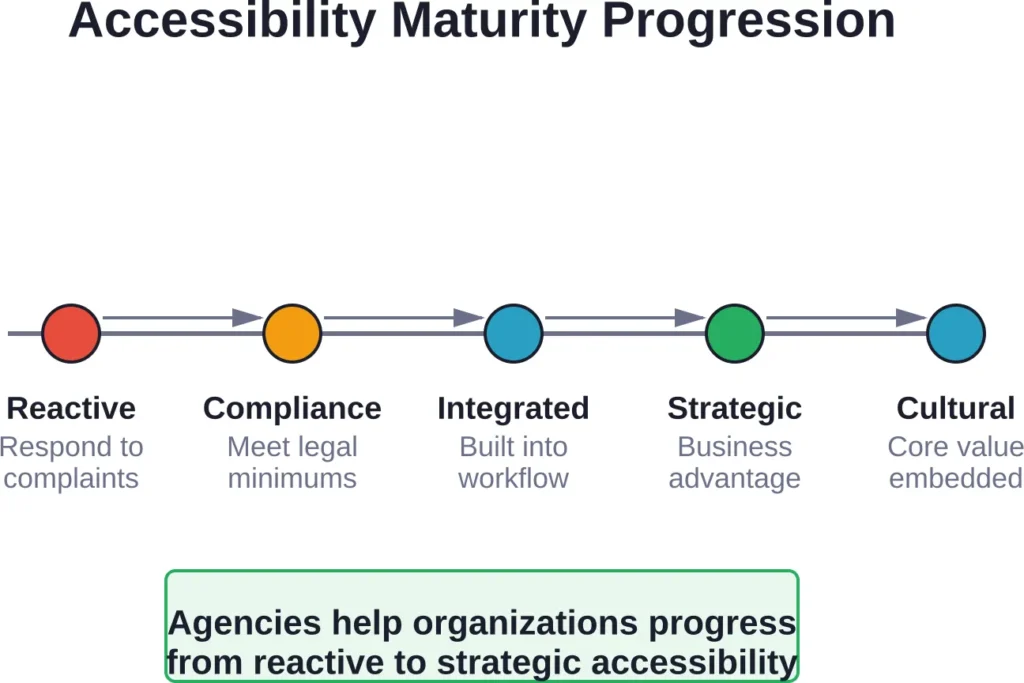
Remember that successful accessibility initiatives require genuine organizational commitment. Agencies provide essential expertise, but sustainable accessibility depends on internal culture, process integration, and ongoing attention.
The organizations making the greatest accessibility progress view it not as a checkbox exercise but as continuous improvement toward inclusive digital experiences serving all users equally.
Digital accessibility has moved from optional enhancement to business necessity. Legal, ethical, and market forces all point toward the same conclusion: accessible digital experiences aren’t just the right thing to build — they’re increasingly the only acceptable thing to build.
The agencies on this list can help you get there.