

Quick Summary: The top API development companies in 2026 combine deep technical expertise in RESTful and GraphQL architectures with proven track records across industries like fintech, healthcare, and SaaS. This guide profiles 15 leading agencies specializing in custom API development, third-party integrations, microservices architecture, and enterprise-grade security—without discussing hourly rates or project costs.
APIs have evolved from background connectors into the strategic backbone of modern digital ecosystems. From fintech platforms processing millions of transactions to healthcare apps syncing patient records across providers, APIs enable the integrations that businesses now depend on to survive.
According to Postman’s 2025 State of the API Report, 82% of organizations have adopted some level of an API-first approach, with 25% operating as fully API-first organizations. That shift isn’t just technical—it’s existential. Companies that can’t integrate, share data securely, or scale their systems through robust APIs get left behind.
But here’s the challenge: building production-grade APIs demands specialized expertise. Architecture decisions, security protocols, documentation standards, versioning strategies—all of these require teams who’ve solved these problems before.
This guide profiles the 15 best API development companies leading the industry in 2026. Each agency brings proven experience across different technology stacks, industry verticals, and integration patterns.
Why API Development Expertise Matters in 2026
The API economy has matured. Simple CRUD endpoints no longer cut it. Modern businesses need APIs that handle authentication flows, rate limiting, webhook delivery, real-time subscriptions, and comprehensive error handling—all while maintaining sub-200ms response times under load.
Security breaches through poorly secured APIs cost companies millions. Compliance frameworks like GDPR, HIPAA, and PCI-DSS impose strict requirements on how APIs handle sensitive data. An experienced API development company understands these requirements from day one, building security into the architecture rather than bolting it on later.
Then there’s the integration challenge. According to data from the API-mega-list repository on GitHub, developers work with specialized APIs across multiple categories including automation-apis (4,825), lead-generation-apis (3,452), and social-media-apis (3,268). Businesses need partners who can navigate this ecosystem and build integrations that actually work reliably.
Documentation quality separates great APIs from mediocre ones. The best API development companies treat documentation as a first-class deliverable, not an afterthought. They create interactive API explorers, maintain comprehensive reference guides, and provide SDKs in multiple languages.
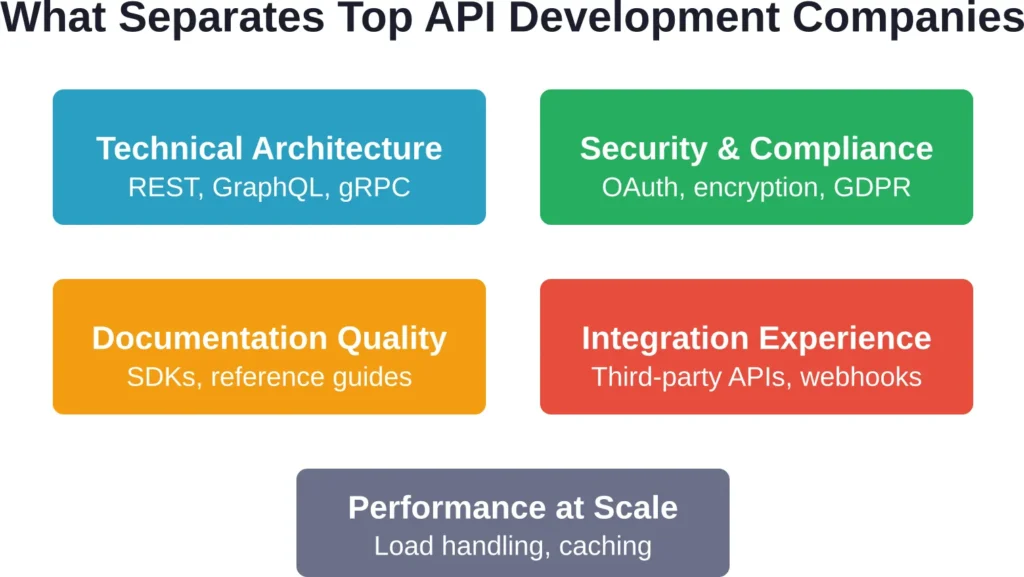
Top 15 API Development Companies in 2026
These agencies represent the leading API development firms across different specializations, industries, and technology stacks. Each brings distinct strengths to different types of projects.
1. Mobian Studio

Operating from Europe, Mobian Studio specializes in building dedicated engineering teams for mobile-first and AI-enhanced API solutions tailored to IT, healthcare, fintech, and logistics companies. The firm delivers production-ready software through outsourcing and outstaffing models with senior-level execution.
Mobian excels at full-stack delivery that includes robust backend APIs, cloud infrastructure, and seamless integrations. The team focuses on clean architecture, scalable systems, real-time features, and legacy system connections while maintaining comprehensive documentation and post-launch support. Projects emphasize HL7/FHIR integrations, payment flows, and high-performance architectures designed for growth from small user bases to enterprise scale.
Contact Information:
- Website: mobian.studio
- Phone: [email protected]
- Address: Harju maakond, Tallinn, Kesklinnalinnaosa, Masina tn 22, 10113
- LinkedIn: www.linkedin.com/company/mobian-studio
2. A-listware

A-listware provides skilled software development and dedicated teams with strong capabilities in custom API development, cloud application development, and enterprise integrations. The company delivers secure, responsive digital solutions across various industries through outsourcing and team augmentation.
The team handles full-cycle API work including legacy modernization, application integration, and cloud-native implementations. Strengths include microservices patterns, data analytics layers, cybersecurity measures, and seamless team integration that acts as an extension of client organizations. A-listware supports high-quality API projects with comprehensive QA, infrastructure management, and compliance-ready solutions for enterprise environments.
Contact Information:
- Website: a-listware.com
- Phone: +1 (888) 337 93 73
- Email: [email protected]
- Address: North Bergen, NJ 07047, USA
- LinkedIn: www.linkedin.com/company/a-listware
- Facebook: www.facebook.com/alistware
3. Gilzor

Gilzor builds custom digital products with deep expertise in scalable web and mobile solutions that rely on well-designed APIs. The company supports startups and established businesses through full-cycle development from idea validation to production deployment.
The team creates secure, high-performance APIs for web platforms, mobile applications, and complex integrations. Projects often include architecture consulting, R&D for innovative features, database optimization, and go-to-market support. Gilzor emphasizes user-centric design, quality assurance with minimal rework, ongoing maintenance, and solutions that connect effectively with target audiences in industries like e-commerce, airlines, and health tech.
Contact Information:
- Website: www.gilzor.com
- Email: [email protected]
- Address: Poland, Warsaw, Office 58, street Adama Mickiewicza 37, 01-625
- LinkedIn: www.linkedin.com/company/gilzor-softwaredevelopment
4. Oski

Based with a strong focus on enterprise and startup solutions, Oski delivers well-engineered software including cloud-native APIs, frontend-backend integrations, and AI-powered systems. The company specializes in scalable digital platforms for travel, logistics, e-commerce, fintech, and insurance verticals.
Oski excels at cloud and serverless architectures, real-time data handling, and secure API implementations using modern frameworks. The team handles everything from custom API development and DevOps practices to AI integrations and CMS-enhanced solutions. Projects feature robust performance, seamless third-party connections, and solutions that enhance booking systems, supply chains, payments, and customer experiences.
Contact Information:
- Website: oski.site
- Phone: +48571282759
- Email: [email protected]
- Address: Kaupmehe tn 7, 10114 Tallinn, Estonia
- LinkedIn: www.linkedin.com/company/oski-solutions
5. Lengreo

Lengreo serves as a complete marketing and tech partner for API and software development companies, driving lead generation and digital growth through specialized B2B strategies. The firm helps tech businesses increase client acquisition and optimize online presence with measurable results.
The team provides website development, SEO optimization, and lead generation campaigns tailored for API providers and technology firms. Strengths include hyper-personalized outreach, content strategies that highlight technical capabilities, paid advertising for developer tools, and conversion-focused landing pages. Lengreo supports API companies with demand generation, appointment setting, and integrated digital solutions that connect solutions with enterprise decision-makers.
Contact Information:
- Website: Lengreo.com
- Phone: +31 686 147 566
- Email: [email protected]
- Address: Vrijstraat 9 C/D, 5611 AT Eindhoven, Netherlands
- LinkedIn: Lengreo
- Twitter: @Lengreo
- Instagram: @lengreo
6. Orases

Orases brings a consultative approach to API development, starting projects with architecture planning and technical discovery before development begins. Based in Maryland, the company serves mid-market and enterprise clients across multiple industries.
The firm specializes in API gateway implementation, managing authentication, rate limiting, and routing across multiple backend services. Projects often involve modernizing legacy systems by building API layers that enable gradual migration without disrupting existing operations.
Orases handles complex data transformation scenarios where APIs need to bridge systems with incompatible data formats or business logic. The team also provides ongoing API management services including version upgrades and documentation maintenance.
7. Modgility

Modgility focuses on rapid API development for startups and product companies needing to move quickly. The company’s approach emphasizes iterative development with working endpoints delivered in sprint cycles.
The team specializes in Node.js and Python API frameworks, building RESTful services with modern tooling. Projects include MVP development, proof-of-concept work, and scaling existing APIs to handle growth.
Modgility’s engagement model suits teams that need to augment internal development capacity or bootstrap API development before hiring in-house teams. The company provides knowledge transfer and documentation to enable smooth handoffs.
8. Outright Development

Based in Boston, Outright Development combines API development with product strategy, helping clients define the right API architecture for their business model. The company holds a 4.7/5 Clutch rating.
Outright specializes in platform APIs designed for third-party developer ecosystems. Projects include developer portal creation, SDK generation, and sandbox environments for API testing. The team understands what makes APIs developer-friendly beyond just technical functionality.
The company works extensively with B2B SaaS platforms building API-first products where the API itself is a core product offering rather than just internal infrastructure.
9. AppIt Ventures

AppIt Ventures, based in Denver, brings a 4.9/5 Clutch rating and experience across IoT, connected devices, and data-intensive applications. The company handles APIs that process sensor data, device telemetry, and real-time analytics.
The team specializes in time-series databases, stream processing, and APIs designed for high-frequency data ingestion. Projects include building APIs for smart home systems, industrial IoT, and fleet management platforms.
AppIt’s approach includes infrastructure planning for APIs that need to scale to millions of requests per day, with expertise in serverless architectures, container orchestration, and auto-scaling configurations.
10. ScienceSoft

ScienceSoft operates as a full-service IT consultancy with a dedicated API development practice. Founded in 1989, the company brings enterprise-grade processes to API projects, with formal QA practices and project management frameworks.
The firm handles large-scale API projects for Fortune 500 clients, including integration work across complex enterprise systems. ScienceSoft specializes in SAP integrations, Oracle ecosystem APIs, and Microsoft Dynamics connectors.
Security certifications and compliance experience make ScienceSoft suitable for highly regulated environments. The company maintains ISO certifications and follows enterprise development standards expected by large organizations.
11. Space-O Technologies
Based in Mesa, Arizona, Space-O Technologies has built a reputation for delivering enterprise-grade API solutions across fintech, healthcare, and logistics verticals. The team specializes in RESTful API development with a focus on scalability and security.
Space-O’s approach emphasizes comprehensive API documentation and developer experience. Projects include custom API development, third-party integration work, and API modernization for legacy systems. The company maintains a Clutch rating of 4.8/5.
Notable strengths include experience with microservices architecture, cloud-native deployments on AWS and Azure, and compliance-ready implementations for regulated industries. The team handles both greenfield API development and migration projects from monolithic architectures.
12. Velvetech

Operating from Sunny Isles Beach, Florida, Velvetech brings a 5/5 Clutch rating and deep expertise in complex API ecosystems. The firm specializes in financial services, insurance, and enterprise SaaS platforms requiring sophisticated integration patterns.
Velvetech excels at GraphQL implementations, particularly for applications with complex data requirements and multiple client types. The team also handles real-time APIs using WebSocket protocols and event-driven architectures with message queues.
Security practices include penetration testing, OAuth 2.0 implementation, and compliance frameworks for PCI-DSS and SOC 2. Velvetech projects often involve integrating multiple third-party APIs into unified data layers with consistent authentication and error handling.
13. Softjourn

With headquarters in Wrocław, Poland and a strong US presence, Softjourn has earned a 4.8/5 Clutch rating through work with enterprise clients including IBM. The company founded in 2004 brings over two decades of experience to API development projects.
Softjourn specializes in payment APIs, ticketing systems, and media streaming platforms—domains where API performance and reliability directly impact user experience. The team handles high-throughput scenarios with caching strategies, CDN integration, and database optimization.
The company’s approach includes thorough API testing with automated test suites, load testing to validate performance under production conditions, and comprehensive monitoring with alerting for API health metrics.
14. Zazz

Zazz focuses on mobile-first API development, building backend systems optimized for iOS and Android applications. Based in the United States, the company handles projects where API design directly shapes mobile app functionality.
The team excels at designing APIs with mobile constraints in mind—payload optimization, efficient pagination, offline sync capabilities, and push notification infrastructure. Projects often include real-time features using Firebase or custom WebSocket implementations.
Zazz works extensively with startups and growth-stage companies launching consumer-facing applications. The company’s portfolio spans social networking, on-demand services, and content platforms where API performance impacts user retention.
15. SDSol Technologies
SDSol Technologies specializes in healthcare and telemedicine API development, bringing deep expertise in HIPAA compliance and PHI handling. The company builds FHIR-compliant APIs for EHR integrations and patient data exchange.
Healthcare APIs face unique challenges—patient matching, consent management, audit trails, and interoperability with legacy systems. SDSol’s team navigates these requirements while maintaining the security standards healthcare organizations demand.
Beyond healthcare, the company handles e-commerce APIs, payment gateway integrations, and inventory management systems. Projects include both custom development and integration with platforms like Shopify, Salesforce, and ServiceNow.
Key Selection Criteria: Choosing Your API Development Partner
Matching the right company to a specific project requires looking beyond general reputation to evaluate fit across multiple dimensions.
Define Technical Requirements First
Start by documenting what the API needs to accomplish. Will it serve a mobile app, power a web application, or enable third-party integrations? Does it need real-time capabilities, or will request-response patterns suffice?
Identify performance requirements—expected request volume, response time targets, and data payload sizes. These specifications help filter companies by relevant experience.
Determine the technology stack. Some companies specialize in specific languages or frameworks. If an existing system requires integration, matching technology expertise reduces friction.
Evaluate Industry-Specific Experience
Generic API experience doesn’t always translate to regulated industries. Healthcare projects need teams familiar with HIPAA. Financial services require PCI-DSS knowledge. SaaS platforms benefit from multi-tenancy expertise.
Ask candidates for case studies in the target industry. Have they solved similar integration challenges? Do they understand the compliance requirements without needing education?
Assess Communication and Collaboration Practices
Time zone differences impact projects differently depending on engagement model. Fixed-scope projects handle time differences better than staff augmentation where daily coordination matters.
Evaluate communication tools and project management practices. How do they handle requirements gathering? What documentation do they deliver? How transparent is progress tracking?
Request references from past clients with similar project structures. Ask about responsiveness, deadline adherence, and how the company handles changes or issues.
Review Security and Compliance Capabilities
API security failures create existential risks. Evaluate candidates’ security practices through specific questions: How do they handle secrets management? What authentication patterns do they implement? How do they prevent common vulnerabilities like injection attacks or broken authentication?
For regulated industries, verify compliance experience through documentation, not just claims. Can they produce past compliance artifacts? Do they follow secure development lifecycle practices?
Consider Long-Term Support and Maintenance
APIs require ongoing maintenance—security patches, version upgrades, documentation updates, and performance optimization. Clarify whether the engagement includes post-launch support or ends at deployment.
Some companies offer API management services as ongoing engagements. Others deliver code and documentation for internal teams to maintain. Match this to internal capabilities and preferences.
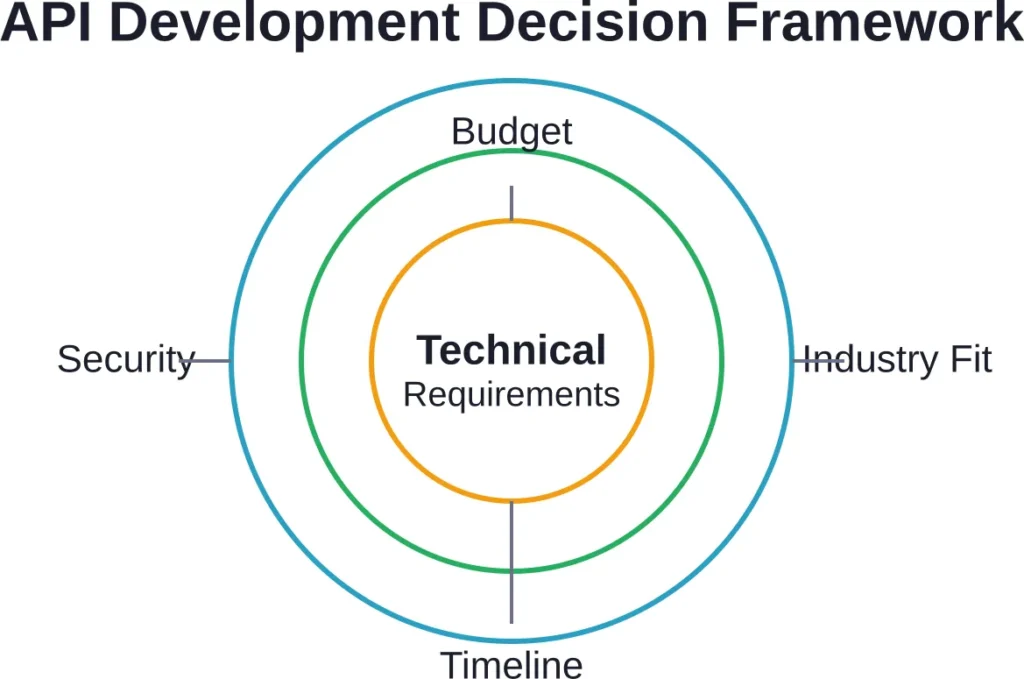
Common API Development Services and Capabilities
Understanding what services top API development companies typically offer helps clarify what to expect from an engagement.
Custom API Development
Building APIs from scratch based on specific business requirements. This includes architecture design, database schema planning, endpoint definition, authentication implementation, and documentation creation.
Custom development projects typically involve discovery phases to map data flows, define API contracts, and establish performance targets before coding begins.
Third-Party API Integration
Connecting applications to external services like payment processors, CRM platforms, marketing tools, or data providers. Integration work involves handling authentication flows, error handling, rate limit management, and data transformation.
According to data from GitHub’s API-mega-list repository, developers integrate across multiple API categories including automation-apis (4,825), lead-generation-apis (3,452), and social-media-apis (3,268). Experienced companies navigate this ecosystem efficiently.
API Modernization and Migration
Upgrading legacy systems by building new API layers, migrating from SOAP to REST, or refactoring monolithic applications into microservices architectures. These projects require careful planning to maintain backward compatibility during transitions.
API Gateway and Management
Implementing API gateway solutions that handle cross-cutting concerns: authentication, rate limiting, request routing, protocol translation, and analytics. Gateways enable consistent policies across multiple backend services.
API Documentation and Developer Experience
Creating comprehensive documentation, interactive API explorers, SDKs, code samples, and sandbox environments. Developer-facing APIs succeed or fail based on documentation quality and onboarding experience.
API Security and Compliance
Implementing security best practices: OAuth 2.0 authentication, API key management, encryption, input validation, SQL injection prevention, and audit logging. Compliance projects add HIPAA, PCI-DSS, GDPR, or SOC 2 requirements.
Understanding API Development Project Scopes
Project complexity varies dramatically based on requirements. Breaking down common project types helps set realistic expectations.
Simple Internal APIs
Basic CRUD operations for internal applications. These projects typically involve straightforward data models, limited authentication requirements, and basic documentation for internal teams.
Simple internal APIs might handle tasks like employee directories, document management, or reporting dashboards where security requirements focus on internal access control rather than external threats.
Customer-Facing Application APIs
APIs powering mobile apps or web applications. These require careful attention to performance, caching strategies, error handling, and user experience. Authentication often involves OAuth flows or JWT tokens.
Projects include real-time features, push notifications, file uploads, and complex business logic. Documentation targets internal developers rather than third parties.
Partner Integration APIs
APIs enabling business partners to integrate with systems—often seen in B2B SaaS, marketplace platforms, or supply chain systems. These require robust documentation, sandbox environments, and partner onboarding support.
Security focuses on tenant isolation, usage tracking, and billing integration. Versioning strategies become critical as breaking changes impact external integrations.
Public Developer Platform APIs
APIs designed as product offerings where third-party developers build on the platform. These represent the most complex projects—requiring developer portals, comprehensive documentation, SDKs in multiple languages, and community support.
Examples include payment APIs, mapping services, communication platforms, or data providers where the API itself generates revenue. Projects include rate limiting, usage-based billing, and analytics dashboards.
Technology Stack Considerations in API Development
Different technology choices impact performance, maintenance, and integration capabilities. Understanding the trade-offs helps evaluate vendor recommendations.
REST vs. GraphQL vs. gRPC
REST remains the dominant API architecture for its simplicity and broad tooling support. RESTful APIs work well for CRUD operations, public-facing integrations, and scenarios where caching matters.
GraphQL excels when clients need flexible data querying or when multiple client types require different data shapes from the same backend. The technology suits applications with complex data relationships but adds complexity to caching and security.
gRPC provides high-performance RPC for microservices communication, particularly in polyglot environments. The technology fits internal service-to-service communication better than public APIs due to tooling requirements and HTTP/2 dependencies.
Language and Framework Selection
Node.js with Express or Fastify dominates for JavaScript-centric teams. Python frameworks like FastAPI or Django REST Framework suit data science integrations. Go provides excellent performance for high-throughput scenarios.
Java and Spring Boot remain enterprise standards for organizations with existing Java investments. .NET Core serves Microsoft-centric environments well.
Framework choice impacts development speed, available libraries, and talent availability for future maintenance. Matching the broader technology ecosystem reduces integration friction.
Database and Caching Strategies
PostgreSQL and MySQL serve most relational data needs. MongoDB or DynamoDB fit document-oriented data. Time-series databases like InfluxDB or TimescaleDB suit IoT and monitoring data.
Redis caching dramatically improves API performance for frequently accessed data. CDNs cache static or semi-static responses at the edge. Database read replicas distribute query load.
Authentication and Security Approaches
OAuth 2.0 suits scenarios where APIs access resources on behalf of users. API keys work for service-to-service authentication with simpler requirements. JWT tokens provide stateless authentication for microservices.
Security implementations include HTTPS enforcement, rate limiting to prevent abuse, input validation to prevent injection attacks, and secrets management through tools like HashiCorp Vault or AWS Secrets Manager.
| Technology Choice | Best Use Cases | Key Advantages | Considerations |
|---|---|---|---|
| REST APIs | Public APIs, CRUD operations, broad compatibility | Simple, cacheable, universal tooling | Over-fetching, multiple roundtrips |
| GraphQL | Complex data, multiple clients, flexible queries | Single endpoint, precise data fetching | Caching complexity, security considerations |
| gRPC | Microservices, high-performance internal APIs | Fast, type-safe, bi-directional streaming | HTTP/2 required, limited browser support |
| Node.js | Real-time, JavaScript ecosystem, rapid development | Non-blocking I/O, npm ecosystem | Single-threaded, callback complexity |
| Python | Data science, ML integrations, rapid prototyping | Clear syntax, rich libraries | Performance vs. compiled languages |
| Go | High-throughput, concurrent processing, microservices | Compiled performance, concurrency primitives | Smaller ecosystem vs. Node/Python |
Red Flags When Evaluating API Development Companies
Certain warning signs indicate potential problems before signing contracts.
Vague Technical Responses
If a company can’t articulate specific technical approaches or handwaves important questions about security, scalability, or architecture, that’s concerning. Strong candidates provide detailed technical proposals.
Lack of Documentation Standards
Ask to see sample API documentation from past projects. Poor documentation quality or reluctance to share examples suggests this won’t be a priority during the engagement.
No Verifiable References
Companies should readily provide references from similar projects. Reluctance to connect potential clients with past customers raises questions about satisfaction levels.
Unrealistic Timeline Estimates
Complex API projects take time. Vendors promising aggressive timelines without understanding requirements often miss deadlines or deliver incomplete work.
Security as an Afterthought
If security doesn’t come up until clients raise it, that’s a problem. Leading companies discuss security practices proactively during initial conversations.
The Future of API Development in 2026 and Beyond
Several trends are reshaping how companies approach API development.
AI-Powered APIs and ML Integrations
GitHub data shows ai-apis repositories across categories, reflecting the explosion in machine learning integrations. APIs increasingly expose AI capabilities—from natural language processing to computer vision to predictive analytics.
API developers now need familiarity with ML model serving, GPU infrastructure, and handling large data payloads for training or inference workloads.
API-First Product Development
The Postman 2025 State of the API Report found that 25% of organizations operate as fully API-first. This architectural approach treats APIs as primary products rather than afterthoughts, with UI layers built on top of API foundations.
API-first development enables multiple client types from a single backend and facilitates third-party integrations from day one.
Event-Driven and Asynchronous Architectures
Beyond request-response patterns, modern systems increasingly use webhooks, message queues, and event streams. APIs trigger background processing, notify subscribers of state changes, and coordinate across distributed systems.
Technologies like Apache Kafka, RabbitMQ, and cloud-native messaging services enable loosely coupled architectures that scale better than synchronous request chains.
Serverless and Edge Computing
Serverless API deployments eliminate infrastructure management, automatically scale with demand, and charge only for actual usage. Edge computing pushes API endpoints closer to users globally, reducing latency.
Companies increasingly deploy APIs across multiple regions using services like AWS Lambda, Cloudflare Workers, or Fastly Compute@Edge.
Frequently Asked Questions About API Development Companies
API development companies design, build, and maintain application programming interfaces that enable systems to communicate. Services include custom API development from scratch, integrating third-party APIs into existing applications, modernizing legacy systems with new API layers, implementing API gateways and security, and creating comprehensive documentation for developers. The best companies combine technical expertise with industry-specific knowledge to deliver APIs that meet both functional requirements and compliance standards.
Timeline varies dramatically based on complexity. A simple internal API with basic CRUD operations might take 4-6 weeks. A customer-facing API powering a mobile app typically requires 8-12 weeks including architecture, development, testing, and documentation. Complex enterprise APIs with multiple integrations, advanced security, and regulatory compliance can take 4-6 months or longer. Discovery phases to define requirements properly add 2-4 weeks before development starts. Realistic timeline estimates consider not just coding time but also testing, documentation, security reviews, and deployment planning.
Build in-house when API development represents a core competency that delivers ongoing competitive advantage and internal teams possess the necessary expertise in architecture, security, and documentation. Hire specialists when API development is a one-time project, the required expertise doesn’t exist internally, timeline constraints demand rapid delivery, or compliance requirements in regulated industries require demonstrated experience. Many organizations use hybrid approaches—hiring consultants for initial architecture and development, then transitioning maintenance to internal teams with proper documentation and knowledge transfer.
Production APIs require multiple security layers. Authentication and authorization through OAuth 2.0, API keys, or JWT tokens verify who can access resources. HTTPS encryption protects data in transit. Input validation prevents injection attacks and malformed requests. Rate limiting prevents abuse and DoS attacks. API keys and secrets must be stored securely through proper secrets management. Logging and monitoring track access patterns and detect anomalies. For regulated industries, additional measures include audit trails, data encryption at rest, and compliance with frameworks like HIPAA, PCI-DSS, or GDPR depending on data types handled.
API development companies build new APIs from the ground up—designing architecture, writing code, implementing security, and creating documentation. API integration companies specialize in connecting existing systems through third-party APIs—implementing authentication flows, handling data transformation, managing error handling, and maintaining integrations as external APIs change. Some companies offer both services, while others specialize in one domain. Projects often involve both: building a custom API for an application while simultaneously integrating multiple third-party services like payment processors, CRM platforms, or data providers.
Ask about technical approach: Which API architecture do they recommend and why? How do they handle authentication and security? What documentation do they deliver? Request examples of past API documentation to evaluate quality. Ask about industry experience: Have they built similar APIs? Do they understand relevant compliance requirements? Can they provide references from comparable projects? Clarify the engagement model: What’s included in the project scope? Do they provide post-launch support? How do they handle changes or issues? What’s the communication cadence? Discuss timeline and process: What’s their development methodology? How do they track progress? What testing processes do they follow?
Project costs vary based on complexity, features, security requirements, and vendor location. According to aggregated industry data, a simple internal API might cost $5,000-$10,000. A customer-facing API with authentication, documentation, and moderate complexity typically ranges from $10,000-$50,000. Complex enterprise APIs with advanced security, multiple integrations, comprehensive documentation, and compliance features can cost $50,000-$200,000 or more. Ongoing maintenance, updates, and support add annual costs typically ranging from 15-25% of initial development cost. Request detailed proposals from multiple vendors to understand market rates for specific project requirements.
Making the Final Decision: Selecting Your API Development Partner
The companies profiled in this guide represent different strengths across industries, technologies, and engagement models. No single firm is universally “best”—the right choice depends on matching capabilities to specific project needs.
Start by clarifying technical requirements, performance targets, and security needs. Narrow the field to companies with demonstrated experience in the target industry and relevant technology stack. Evaluate communication practices and project management approaches for compatibility with internal processes.
Request proposals from 3-5 candidates. Compare not just timelines and scopes but technical approaches, documentation standards, and support models. Check references thoroughly, asking past clients about responsiveness, quality, and how the company handles challenges.
Remember that APIs become long-term infrastructure. The partnership matters as much as initial deliverables. Choose companies that demonstrate not just technical skills but also clear communication, proactive problem-solving, and commitment to delivering maintainable, well-documented solutions.
The API landscape continues evolving rapidly. Working with experienced specialists who stay current with emerging patterns, security threats, and architectural approaches provides value that extends far beyond individual projects. These companies bring accumulated knowledge from hundreds of API implementations—patterns that worked, pitfalls to avoid, and approaches that scale.
Ready to start your API development project? Review the companies profiled here based on alignment with your specific technical needs, industry requirements, and engagement preferences. Reach out to top candidates with detailed requirement documentation to receive proposals that enable meaningful comparison and informed decision-making.