

Quick Summary: The best website migration companies combine deep SEO expertise, proven CMS transition skills, and minimal-downtime deployment processes. This guide reviews 15 specialized agencies that preserve rankings, maintain traffic, and deliver measurable results across platform, content, and cloud migrations—backed by real case studies and transparent migration frameworks.
Website migrations fail more often than they succeed. Rankings drop overnight. Traffic evaporates. Recovery takes six months or longer.
The difference between growth and disaster sits in the planning phase—months before a single redirect goes live. Teams that treat migration as an engineering discipline rather than a one-time technical lift avoid the pitfalls that sink most projects.
This breakdown examines 15 migration companies that consistently deliver results across CMS transitions, platform rebranding, and infrastructure overhauls. Each agency brings documented methodologies, verifiable case studies, and specialized expertise that separates competent execution from catastrophic ranking loss.
What Separates the Best Migration Companies From the Rest
Not every web development shop can handle a migration. The stakes demand specialized knowledge that goes beyond theme installation or content copying.
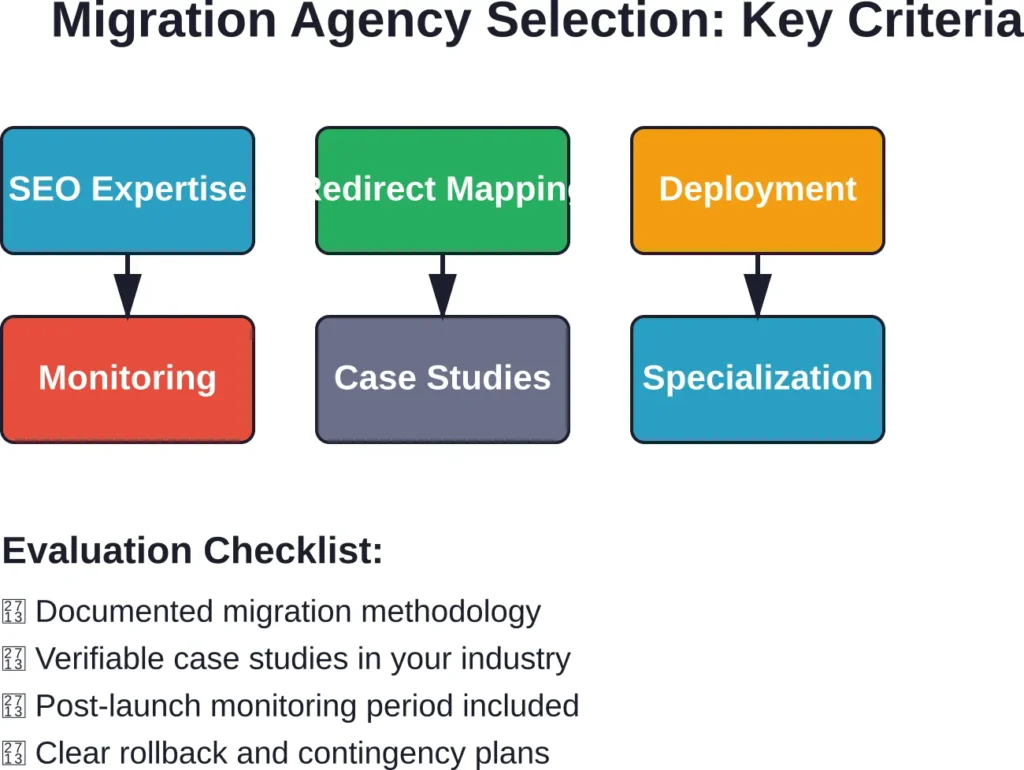
The best migration partners share four characteristics that directly correlate with success rates.
SEO-First Migration Planning
Strong migration agencies integrate SEO analysis before wireframes get created. They audit existing URL equity, map taxonomy changes, and model ranking risk across every redirect decision.
This approach contrasts sharply with teams that bolt SEO onto the end of development. By then, architectural decisions have locked in patterns that require expensive rework or permanent ranking sacrifice.
Redirect Mapping at Scale
Every backlink pointing at a specific URL represents earned authority. When URLs change, that equity doesn’t transfer automatically—it follows explicit redirect instructions.
Competent migration teams build redirect matrices that preserve link equity across thousands or tens of thousands of pages. They test redirect chains, eliminate orphaned pages, and validate crawl paths before launch.
Minimal-Downtime Deployment
Prolonged downtime compounds migration risk. Search engines interpret extended unavailability as a signal that content has disappeared permanently.
The best agencies deploy migrations during low-traffic windows with rollback procedures ready. They stage environments meticulously and run parallel systems until validation completes.
Post-Migration Monitoring
Launch day represents the beginning of migration validation, not the end. Redirect failures, orphaned content, and indexation issues surface over days and weeks.
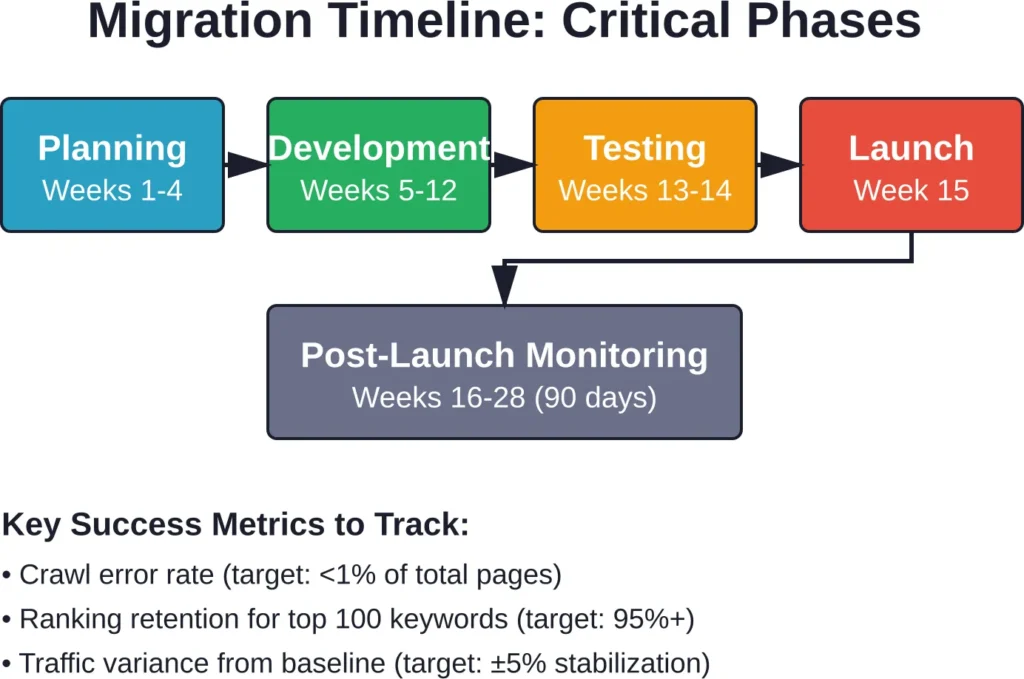
Strong partners monitor crawl errors, ranking fluctuations, and traffic patterns for 30 to 90 days post-launch. They triage issues immediately rather than waiting for clients to discover problems through analytics.
Top 15 Website Migration Companies (Detailed Reviews)
These agencies demonstrate consistent results across multiple migration types. Each brings specialized strengths worth examining.
1. Oski – Enterprise-Grade Software & Cloud Migration Solutions

Oski builds and migrates smart, well-engineered software solutions for tech-forward enterprises and ambitious startups. They focus on moving existing systems to modern cloud architectures with enhanced performance and scalability.
Their methodology covers cloud migrations (serverless, hybrid, multi-cloud), frontend transitions, AI integrations, and CMS modernizations while maintaining business continuity. Projects move from planning to operational teams in 2-4 weeks with AI-accelerated engineering for faster delivery.
They emphasize clean architecture, seamless integrations, and solutions that scale without limitations across industries including fintech, e-commerce, logistics, and healthcare.
Best for: Enterprises and growth-stage companies executing complex migrations to cloud-native platforms, modern frontends, or AI-enhanced systems.
Contact Information:
- Website: oski.site
- Phone: +48571282759
- Email: [email protected]
- Address: Kaupmehe tn 7, 10114 Tallinn, Estonia
- LinkedIn: www.linkedin.com/company/oski-solutions
2. Mobian – Dedicated Engineering Teams for Mobile & AI Platform Migrations

Mobian builds dedicated engineering teams that help companies migrate and scale mobile, AI, and full-stack digital platforms without disruption. They operate through outsourcing or outstaffing models for maximum flexibility.
Their delivery includes end-to-end product migration, legacy integration, scalable architecture redesign, and post-launch support. Special focus on mobile applications, AI systems, and complex integrations for regulated industries.
Projects feature clean architecture, full documentation, and systems designed to grow from hundreds to hundreds of thousands of users without rebuilds. They maintain production-ready standards with ongoing partnership after migration.
Best for: IT, healthcare, fintech, and logistics companies migrating or scaling mobile-first and AI-powered platforms where speed, quality, and domain expertise are critical.
Contact Information:
- Website: mobian.studio
- Phone: [email protected]
- Address: Harju maakond, Tallinn, Kesklinnalinnaosa, Masina tn 22, 10113
- LinkedIn: www.linkedin.com/company/mobian-studio
3. Lengreo – Performance-Driven Website & Marketing Platform Migration

Lengreo acts as a complete marketing and tech partner for B2B companies transitioning to new websites and digital platforms. They combine technical migration with conversion optimization and lead-generation systems from day one.
Their process begins with deep business analysis and discovery, followed by prototyping, full development, and seamless integration of marketing tools. They focus on reducing friction, improving lead quality, and connecting new platforms directly to sales funnels.
Documented client results include a 400% increase in annually acquired clients for a US software development company, a 53.6% boost in conversion rate for a Ukrainian IT company, over 6X reduction in cost per lead for a Dutch event technology company, and generation of 400+ qualified opportunities from 13,000 targeted prospects for a Swiss sports tech provider.
Lengreo builds fast, conversion-focused websites and landing pages with integrated SEO, paid ads, and lead nurturing systems that work immediately after launch.
Best for: B2B companies migrating websites where the new platform must immediately drive higher lead volume, better quality, and measurable ROI.
Contact Information:
- Website: Lengreo.com
- Phone: +31 686 147 566
- Email: [email protected]
- Address: Vrijstraat 9 C/D, 5611 AT Eindhoven, Netherlands
- LinkedIn: Lengreo
- Twitter: @Lengreo
- Instagram: @lengreo
4. A-listware – Dedicated Team Software & Legacy Modernization

A-listware provides skilled development teams and consulting for companies migrating legacy software to modern, scalable solutions. They act as an extension of client teams to ensure smooth transitions.
Their services include legacy software modernization, cloud application development, enterprise software migration, infrastructure management, and seamless team integration. They handle end-to-end migration projects with focus on security, performance, and business process continuity.
Clients benefit from cost-effective, high-quality development that integrates directly with internal processes, supported by 24/7 expert access and full-spectrum engineering capabilities.
Best for: Enterprises, SMBs, and startups needing reliable dedicated teams for large-scale platform migrations and legacy system modernization.
Contact Information:
- Website: a-listware.com
- Phone: +1 (888) 337 93 73
- Email: [email protected]
- Address: North Bergen, NJ 07047, USA
- LinkedIn: www.linkedin.com/company/a-listware
- Facebook: www.facebook.com/alistware
5. Gilzor – Custom Digital Product Migration & Modernization

Gilzor specializes in migrating and rebuilding digital products for startups and scaling businesses moving from legacy systems to modern, high-performance platforms.
They handle full-cycle transitions including idea validation, UI/UX redesign for better conversion, secure development, quality assurance, and go-to-market integration. Their approach ensures new platforms are scalable, user-centric, and connected to business growth objectives.
Client outcomes feature successful migrations that delivered X3 MRR growth in five months for partner businesses, rapid user adoption (1000+ downloads in the first month for one product app), and significant efficiency gains through automated and optimized solutions.
Gilzor delivers clean, maintainable codebases for web and mobile applications with ongoing support, making post-migration scaling and feature additions straightforward.
Best for: Startups and product companies migrating or modernizing custom web and mobile platforms to support faster growth and better user experiences.
Contact Information:
- Website: www.gilzor.com
- Email: [email protected]
- Address: Poland, Warsaw, Office 58, street Adama Mickiewicza 37, 01-625
- LinkedIn: www.linkedin.com/company/gilzor-softwaredevelopment
6. ScienceSoft – Technical Migration Complexity

ScienceSoft tackles migrations with significant technical complexity—legacy database structures, custom integrations, and multi-platform consolidations.
They excel at projects where data integrity and system interoperability create substantial risk. Their testing protocols validate that migrated data maintains accuracy and that integrated systems continue functioning correctly.
The agency works across industries but shows particular strength in healthcare, finance, and manufacturing where regulatory compliance and data accuracy carry legal weight.
Best for: Regulated industries with complex data structures and strict compliance requirements.
7. Lemongrass – SAP Cloud Migrations

Lemongrass specializes exclusively in SAP cloud migrations. They bring deep SAP expertise that generalist migration agencies can’t match.
Their services include advisory consulting, transformation workshops, and managed support that continues after migration completes. They help organizations optimize SAP deployments rather than simply moving existing configurations to cloud environments.
For companies running SAP systems, Lemongrass offers focused expertise that reduces risk in business-critical migrations.
Best for: Enterprises migrating SAP environments to cloud infrastructure.
8. Cloud4C – Multi-Cloud Migration Platform

Cloud4C manages migrations across AWS, Azure, Google Cloud, and other infrastructure platforms. They help organizations select the right cloud environment for specific workloads.
Their methodology includes cost modeling that compares infrastructure expenses across platforms and deployment patterns. They optimize for total cost of ownership rather than migration speed alone.
Cloud4C also provides managed services post-migration, handling ongoing infrastructure optimization and cost management.
Best for: Organizations evaluating multiple cloud platforms or managing hybrid multi-cloud environments.
9. OpenText – Content Migration at Scale

OpenText handles content migrations involving millions of documents, complex metadata structures, and intricate permission systems.
They work extensively with enterprises consolidating content repositories, upgrading document management systems, or transitioning to modern content platforms from legacy systems.
Their tools and methodologies preserve content relationships, maintain version histories, and migrate permissions accurately—capabilities that matter deeply in regulated industries and large organizations.
Best for: Enterprise content management migrations with complex metadata and governance requirements.
10. BitTitan – Automated Migration Platform

BitTitan offers a migration platform that automates significant portions of the migration process, particularly for email, collaboration tools, and document repositories.
Their tools reduce manual effort and human error in migrations involving Microsoft 365, Google Workspace, and similar cloud productivity platforms.
The platform approach works well for organizations with standardized systems and straightforward migration requirements. It becomes less suitable for highly customized environments requiring extensive manual intervention.
Best for: Mid-market companies migrating standard email and collaboration platforms.
11. Blend – B2B Platform Migration Specialists

Blend operates across the UK and USA, focusing exclusively on B2B companies migrating platforms to improve conversion rates and marketing performance.
Their methodology starts with conversion research before technology selection. They analyze user behavior, identify friction points, and architect new platforms around revenue impact rather than feature checklists.
Documented results include an 800% marketing ROI improvement for Datel, along with a 38% increase in high-intent marketing qualified leads and an 84% improvement in key conversion metrics. Another client, Viedoc, saw measurable gains in lead quality following their platform transition.
Blend builds sites on lean codebases optimized for performance. Pages load quickly and integrate with CRM systems from day one rather than through post-launch patches.
Best for: B2B companies where marketing performance and lead quality justify significant platform investment.
12. Insightland – SEO-Safe Migration Framework

Insightland specializes in migrations that protect or improve organic traffic. Their process manages the entire workflow from strategy and UX validation through URL mapping and indexation control.
Real case studies demonstrate the impact of their approach. Hotel 500 achieved a 306% increase in direct bookings post-migration. Paryskie Perfumy saw traffic increase by 200% after transitioning platforms under Insightland’s guidance.
Their architecture planning focuses on scalable structures. New categories, products, or geographic markets can be added without costly rebuilds or structural compromises.
The agency emphasizes data-driven decision-making throughout the migration process. They validate assumptions through testing rather than industry best practices that may not apply to specific business contexts.
Best for: Content-heavy sites and e-commerce platforms where organic traffic represents the primary acquisition channel.
13. Huemor – Custom CMS Transitions

Huemor handles complex custom CMS migrations for companies outgrowing proprietary platforms. They operate throughout the USA and serve clients with unique technical requirements.
Their strength lies in translating legacy system logic into modern platform capabilities without losing functionality that business operations depend on. They document existing workflows meticulously before proposing technical solutions.
The agency works particularly well with organizations running highly customized internal systems. They bridge the gap between what stakeholders need and what off-the-shelf platforms can deliver.
Best for: Mid-market and enterprise companies migrating from custom-built or heavily modified CMS platforms.
14. Veza Digital – B2B SaaS Migration Expertise

Veza Digital focuses on B2B SaaS companies navigating platform migrations while maintaining aggressive growth targets. Their client roster includes Chili Piper, Grata, and Awardco.
They understand the unique constraints SaaS marketing teams face—product launches that can’t wait, sales cycles that depend on specific content, and attribution models that break during platform transitions.
Veza coordinates migrations around product roadmaps and revenue milestones. They stage rollouts to minimize disruption to active campaigns and preserve tracking across marketing technology stacks.
Best for: Fast-growing SaaS companies where migration timing must align with product and revenue goals.
15. Rackspace Technology – Enterprise Cloud Migration

Rackspace handles large-scale infrastructure migrations for enterprise organizations moving to cloud environments. They bring decades of hosting expertise to complex multi-system transitions.
Their managed services extend beyond initial migration. They provide ongoing support, optimization, and architectural guidance as infrastructure needs evolve.
Rackspace works across multiple cloud platforms and handles hybrid environments where some systems remain on-premises while others move to cloud infrastructure.
Best for: Enterprise organizations executing cloud transformation initiatives with multi-year roadmaps.
How to Choose the Right Migration Partner
Selecting a migration agency requires matching their strengths to project-specific needs. Generic criteria matter less than fit.
Define Migration Scope First
Platform migrations differ fundamentally from content migrations. Moving from WordPress to Webflow demands different expertise than consolidating three content repositories into one.
Cloud infrastructure migrations require specialized knowledge that CMS migration experts may lack entirely. Technical specialization matters more than agency size or general reputation.
Clarify exactly what’s moving before evaluating partners.
Verify Relevant Case Studies
Agencies showcase their best work. Request case studies matching project scope and industry context closely.
A proven track record migrating e-commerce platforms provides limited confidence for SaaS marketing site transitions. The technical challenges differ enough that expertise doesn’t transfer cleanly.
Look for documented results—traffic preservation metrics, ranking retention data, conversion rate impacts. Vague success claims carry little weight.
Understand the Migration Methodology
Strong agencies articulate clear migration frameworks covering planning, execution, and validation phases.
Ask specific questions about redirect strategy, testing protocols, rollback procedures, and post-launch monitoring. Vague answers or reluctance to detail processes signals risk.
The methodology should address SEO explicitly, not as an afterthought but as a core component driving architectural decisions.
Assess Technical Depth
Surface-level platform knowledge creates risk in complex migrations. Probe technical understanding during discovery conversations.
Can they explain how they’ll handle edge cases specific to your system? Do they understand the technical constraints your infrastructure or compliance requirements impose?
Generalists struggle with migrations involving custom integrations, complex data structures, or unusual technical requirements.
Clarify Post-Launch Support
Migrations create issues that surface days or weeks after launch. Redirect chains break. Content gets orphaned. Indexation behaves unexpectedly.
Understand exactly what support the agency provides post-launch and for how long. Some agencies disappear after deployment. Others monitor actively for 30 to 90 days.
This distinction often determines whether small issues get resolved quickly or compound into ranking losses.
| Migration Type | Specialized Skills Required | Primary Risk Factors | Typical Duration |
|---|---|---|---|
| Platform Migration | SEO architecture, redirect mapping, CMS expertise | Ranking loss, broken functionality, traffic drop | 2-6 months |
| Content Migration | Data mapping, metadata preservation, taxonomy design | Content loss, broken relationships, search degradation | 1-4 months |
| Cloud Migration | Infrastructure architecture, security, performance optimization | Downtime, cost overruns, performance degradation | 3-12 months |
| CMS Migration | Content modeling, workflow replication, template development | Editor workflow disruption, content formatting issues | 2-5 months |
Common Migration Mistakes That Destroy Rankings
Most migration failures follow predictable patterns. Understanding common mistakes helps avoid them.
Ignoring Crawl Budget During Migration
Large sites have finite crawl budgets. Search engines won’t crawl every URL immediately after migration.
Agencies that ignore crawl prioritization create situations where important pages take weeks to get re-indexed while low-value pages consume crawl budget.
Strong migration plans include crawl optimization—submitting updated sitemaps, using internal linking to signal priority, and monitoring crawl rates closely.
Redirect Chains and Loops
Redirect chains slow page loads and dilute link equity. Each hop in a redirect chain loses a small percentage of authority.
Careless redirect planning creates chains three or four hops deep. Sometimes redirects loop entirely, making pages inaccessible.
Competent agencies test redirect logic systematically and eliminate chains before launch.
Failing to Preserve Internal Link Structure
Internal links distribute authority across sites. Migration often breaks this structure when URL patterns change.
Pages that previously received strong internal linking support get orphaned. New URL structures change how authority flows through site architecture.
Effective migrations audit internal linking patterns and intentionally replicate or improve authority distribution in new structures.
Incomplete Mobile Experience Testing
Mobile-first indexing means Google primarily evaluates mobile versions of pages. Desktop testing alone misses critical issues.
Migrations sometimes introduce mobile-specific problems—broken navigation, hidden content, performance degradation—that tank rankings despite desktop versions working perfectly.
Thorough testing across devices and viewport sizes catches these issues before they impact search visibility.
Launching Without Monitoring Plans
Some teams treat launch as project completion. Issues discovered weeks later require emergency fixes that cost more and deliver worse outcomes.
Monitoring crawl errors, ranking positions, traffic patterns, and conversion rates during the first 30 days catches problems while they’re still easy to fix.
Migration Planning: What Happens Before Launch
Successful migrations invest heavily in pre-launch planning. The work that happens before development determines outcomes more than execution quality.
Comprehensive SEO Audit
Strong migrations begin with complete audits of existing site performance. This includes ranking keyword inventory, backlink profiles, traffic patterns by page, and conversion paths.
The audit establishes baseline metrics for validation. Without clear before-state documentation, assessing migration success becomes guesswork.
URL Mapping and Redirect Planning
Every existing URL needs an explicit destination. One-to-one mappings work for simple redesigns. Platform changes often require many-to-one consolidation or one-to-many splitting.
The mapping document becomes the source of truth for redirect implementation. It accounts for every page receiving external backlinks or generating organic traffic.
Content Inventory and Gap Analysis
Migrations often involve content consolidation or reorganization. A complete inventory catalogs what exists, where it lives, and how it performs.
Gap analysis identifies content that needs creation, revision, or retirement. This prevents launching with incomplete content or broken user journeys.
Technical Architecture Planning
New platform capabilities enable different technical approaches. Architecture planning maps out URL structures, taxonomy design, internal linking patterns, and technical SEO implementation.
Decisions made here compound over time. Poor URL structures become increasingly expensive to fix as content grows.
Staging Environment and Testing Protocol
Migrations require production-like staging environments for validation. Testing in local development environments misses issues that only surface under real hosting conditions.
Testing protocols should cover redirect logic, crawlability, mobile experience, page speed, conversion tracking, and integration functionality.
Post-Migration Monitoring and Recovery
Launch day starts the validation period, not ends it. Competent agencies monitor specific metrics closely for weeks after deployment.
Crawl Error Monitoring
Google Search Console reports crawl errors within 24 to 48 hours of launch. Redirect failures, server errors, and orphaned pages surface quickly if monitoring happens actively.
Agencies should triage errors immediately. Some represent minor issues affecting low-value pages. Others indicate systematic problems requiring urgent fixes.
Ranking Position Tracking
Track ranking positions daily for the first 30 days post-migration. Small fluctuations are normal. Sustained drops across multiple keywords signal problems.
Compare ranking changes against pre-migration baselines. Agencies should investigate any keyword losing more than five positions within two weeks of launch.
Traffic Pattern Analysis
Organic traffic typically fluctuates 5-10% during migrations. Larger swings warrant investigation.
Segment traffic by landing page to identify specific pages or sections experiencing disproportionate changes. This pinpoints problem areas more effectively than site-wide metrics.
Conversion Tracking Validation
Conversion tracking breaks surprisingly often during migrations. Tag managers get misconfigured. Event tracking fails to fire. Attribution models lose historical data.
Validate that all conversion events track correctly immediately after launch. Test forms, purchases, downloads, and other conversion actions manually.
Backlink and Authority Preservation
Monitor referring domains and backlink counts through third-party SEO tools. Significant drops suggest redirects failed for important pages.
Cross-reference backlink data against redirect maps. Pages receiving valuable backlinks must redirect correctly or those links lose value permanently.
Real Results: What Successful Migrations Achieve
The best evidence for agency capability comes from documented results. Several case studies demonstrate what’s possible with competent execution.
Hotel 500 worked with Insightland on a platform migration focused on increasing direct bookings. The project achieved a 306% increase in direct bookings post-migration—a result that directly impacted revenue and reduced dependence on booking platforms.
Paryskie Perfumy saw a 200% traffic increase after their website migration, also guided by Insightland. The migration didn’t just preserve existing search visibility—it improved it substantially through better architecture and technical implementation.
These aren’t subtle improvements. They represent transformative business impact driven by migration projects that treated SEO and conversion optimization as core objectives rather than secondary concerns.
The TBM Council case study documents organizations achieving significant cost savings through Technology Business Management initiatives during the first year through targeted IT cost optimizations. TBM Council case studies document organizations identifying multiple optimization opportunities and targeting significant multi-year savings.
While not a traditional website migration, this case demonstrates how systematic technical transformation projects deliver measurable financial impact when executed with clear methodologies and rigorous validation.
Investment Ranges for Migration Projects
Understanding typical investment ranges helps with budgeting and vendor evaluation. Actual costs vary based on scope, complexity, and agency expertise.
Simple CMS migrations for small marketing sites typically range from several thousand to tens of thousands of dollars. These projects involve straightforward content transfer with minimal custom development.
Mid-complexity migrations involving custom development and integration work generally represent significant investment for well-scoped projects. This tier includes custom template development, integration work, and comprehensive redirect mapping.
Enterprise migrations involving extensive customization, complex data structures, or large content volumes often start around $15,000 for basic platform assessments and can exceed six figures for full implementation.
Some agencies offer phased approaches with platform assessment starting around $1,500 and MVP migrations beginning around $10,000, allowing organizations to validate fit before committing to complete projects.
These ranges reflect typical market conditions but shouldn’t replace detailed scoping conversations with potential partners.
Questions to Ask During Agency Evaluation
The discovery process reveals how agencies think about migration challenges. These questions elicit responses that separate competent partners from risky ones.
About Their Migration Methodology
How do they approach redirect strategy for sites with complex URL structures? Strong answers detail redirect matrix creation, equity preservation logic, and testing protocols.
What’s their process for handling content that doesn’t map one-to-one between platforms? Look for systematic approaches to consolidation, splitting, or retirement decisions.
How do they prioritize which pages migrate first in phased rollouts? Answers should reference traffic data, conversion value, and strategic importance rather than arbitrary technical convenience.
About SEO Integration
At what point does SEO analysis enter their migration planning? The correct answer is “during initial discovery” rather than “after design approval” or “during development.”
How do they handle situations where design preferences conflict with SEO requirements? Strong agencies navigate these tensions explicitly rather than defaulting to design or technical preferences.
What SEO deliverables do they include in migration projects? Comprehensive redirect maps, crawl audits, ranking tracking, and post-launch monitoring should be standard, not add-ons.
About Post-Launch Support
How long do they actively monitor migrations after launch? Thirty days represents minimum acceptable support. Sixty to ninety days indicates more thorough validation.
What specific metrics do they track during the monitoring period? Crawl errors, ranking positions, traffic by landing page, and conversion rates should all be included.
How do they handle issues discovered after launch? Understand response time commitments and whether fixes are included or billed separately.
About Past Project Challenges
Ask about migrations that encountered problems and how they were resolved. Agencies claiming every project went perfectly are either lying or lack sufficient experience to have encountered edge cases.
Strong answers acknowledge specific challenges—unexpected redirect complexity, platform limitations, timeline pressure—and explain systematic solutions rather than heroic individual effort.
When to Avoid Migration (And What to Do Instead)
Not every situation calls for complete migration. Sometimes alternative approaches deliver better outcomes with less risk.
Incremental Improvements
If current platform performance is acceptable and specific features need enhancement, targeted improvements often work better than wholesale migration.
Adding specific integrations, improving page speed, or enhancing mobile experience can happen without platform risk.
Parallel Builds
For organizations with complex requirements and uncertainty about platform fit, building new properties in parallel allows validation without commitment.
Launch new sections on different platforms. Test thoroughly. Migrate existing content only after the new approach proves itself.
Phased Migration
Large sites don’t always need to migrate atomically. Phasing by section, geography, or content type spreads risk and allows learning between phases.
Migrate the blog first. Validate results. Apply lessons to the product catalog migration.
Frequently Asked Questions
Timeline depends heavily on scope and complexity. Simple CMS migrations for small sites often complete in four to eight weeks. Mid-complexity platform changes typically require two to four months. Enterprise migrations with extensive customization, integrations, or compliance requirements can extend six months to a year. The planning phase alone should consume 20-30% of total timeline—rushing discovery and architecture planning creates expensive problems during execution.
Some ranking fluctuation during migration is normal, but significant sustained drops indicate problems. Well-executed migrations typically see rankings stabilize within two to four weeks at 95%+ of pre-migration positions. The first 48 hours after launch matter most—this is when redirect failures and crawl errors surface. Agencies monitoring actively during this window catch and fix issues before they compound into traffic loss. Migrations that ignore SEO planning or rush redirect implementation often see 20-40% traffic drops that take months to recover.
Not necessarily. Phased migrations work well for large sites or situations with high risk tolerance concerns. Common approaches include migrating by section (blog first, then product pages), by template type (landing pages before detail pages), or by traffic value (high-traffic pages first to validate approach). Phasing spreads risk and allows learning between phases. The tradeoff is longer total timeline and complexity managing two platforms simultaneously. Sites under 500 pages typically migrate atomically—phasing overhead exceeds risk reduction benefits.
Treating migration as purely a technical project rather than a strategic initiative with SEO and business implications. Teams that view migration as “just moving content to a new platform” consistently underinvest in redirect planning, SEO architecture, and post-launch monitoring. The technical lift of migration is straightforward—copying content and configuring systems. The strategic work of preserving link equity, maintaining rankings, and improving conversion paths requires specialized expertise that generalist development teams lack. The second most common mistake is launching without comprehensive redirect mapping, leading to orphaned pages and lost link equity.
Success metrics vary by migration goals but typically include ranking retention (95%+ of keywords maintaining position), traffic preservation (within 5-10% of pre-migration baseline within 30 days), crawl error rate below 1%, and conversion rate maintenance or improvement. Track these metrics weekly for the first month and monthly for three months post-launch. Also monitor referring domains and backlink counts—significant drops suggest redirect problems. For migrations with specific business goals like increasing direct bookings or improving lead quality, track those KPIs as primary success measures.
Yes, with proper planning and execution. The case studies from Insightland demonstrate that migrations can actually increase traffic substantially—Paryskie Perfumy saw 200% traffic growth post-migration. The key factors are comprehensive redirect mapping that preserves link equity, URL structures that maintain or improve SEO performance, technical implementation that doesn’t introduce crawl barriers, and active monitoring during the first 30 days to catch and fix issues quickly. Migrations fail when teams skip redirect planning, ignore mobile experience, or launch without validation protocols.
Strong migration contracts specify deliverables explicitly: redirect mapping document with coverage percentage, staging environment access, testing protocol documentation, launch runbook with rollback procedures, and post-launch monitoring period with specific duration and metrics tracked. The contract should clarify what constitutes project completion—it’s not code deployment, but rather successful validation after a monitoring period. Include response time commitments for post-launch issues and specify whether fixes are included or billed separately. Define success criteria explicitly so both parties align on what constitutes acceptable outcomes versus what requires remediation.
The Future of Website Migrations
Migration methodologies continue evolving as platforms, tools, and search algorithms change. Several trends shape how agencies approach transitions in 2026.
AI-Assisted Migration Planning
Artificial intelligence tools now assist with redirect mapping, content gap analysis, and URL structure optimization. Platform Engineering research explores whether AI agents are ready for large-scale migration tasks.
Real-world case studies from companies like Slack, Airbnb, and Google demonstrate AI applications in specific migration contexts. The technology works best for well-defined migration subtasks rather than end-to-end automation.
Human expertise still drives strategic decisions, but AI tools accelerate execution on repetitive technical tasks.
Headless CMS Adoption
Headless content management systems decouple content from presentation, enabling omnichannel delivery and more flexible front-end frameworks.
Migrations to headless architectures introduce different complexity than traditional CMS transitions. Content modeling becomes more critical. API design affects performance. Front-end framework selection impacts development velocity.
Agencies specializing in headless migrations understand these unique challenges.
Composable Architecture Migrations
Enterprise organizations increasingly adopt composable architectures that combine best-of-breed services rather than monolithic platforms.
These migrations involve coordinating multiple vendors, managing complex integrations, and orchestrating phased rollouts across service boundaries.
The technical complexity demands agencies with integration expertise beyond traditional web development.
Making Your Migration Decision
Choosing whether to migrate, when to execute, and which partner to trust represents a high-stakes decision with long-term consequences.
The agencies reviewed here demonstrate proven capabilities across different migration types. Match their specializations to project requirements. Verify relevant case studies. Understand methodologies in detail.
Invest adequate time in planning. Rush migrations consistently produce worse outcomes regardless of agency quality. The 20-30% of timeline allocated to discovery and architecture planning determines execution success more than development speed.
Build success metrics into contracts. Define what constitutes acceptable ranking retention, traffic preservation, and crawl error rates. Agree on monitoring duration and remediation processes.
Treat migration as a strategic initiative with business impact, not a technical project to execute cheaply. The difference between agencies shows most clearly in results six months post-launch—when poorly executed migrations still struggle with traffic recovery while well-planned transitions compound into growth.
Get Started With Your Migration
Website migrations demand specialized expertise that justifies careful partner selection. The 15 agencies detailed here bring documented methodologies, verifiable results, and focused specializations across platform, content, and infrastructure transitions.
Start by defining migration scope precisely. Clarify whether the project involves platform change, content consolidation, infrastructure upgrade, or some combination. This clarity shapes agency evaluation.
Request detailed case studies matching project context. Generic migration experience provides limited confidence—look for proven results in similar technical and business situations.
Evaluate methodology depth during discovery conversations. Strong agencies articulate clear frameworks covering planning, execution, and validation. They discuss SEO integration from initial conversations rather than treating it as an afterthought.
Budget adequate timeline for proper execution. Cutting corners during planning or rushing deployment consistently produces ranking losses that cost more to recover than the time saved.
The right migration partner preserves existing search equity while enabling platform capabilities that drive business growth. The wrong partner creates months of recovery work and permanent ranking losses.
Choose carefully. The decision compounds over time.